|
(11) | EP 0 598 479 A1 |

| (12) | EUROPEAN PATENT APPLICATION |
|
|
|
|
|||||||||||||||||||||||||||
| (54) | Metallurgical pouring vessels |
| (57) A method and product is provided to improve the positioning of loose anti-skulling
material in the outlet nozzle zone of a metallurgical pouring vessel. Thus the formation of skull in the outlet nozzle zone of a metallurgical pouring vessel (10) is inhibited by positioning in the outlet nozzle zone (14) an elongated container (24) containing loose anti-skulling material (26), the container (24) being formed of an intumescent material whereby when heated it expands to fill the gap between itself and the walls of the nozzle (18) and releases the anti-skulling material (26). |
[0001] This invention relates to metallurgical pouring vessels having closable outlet nozzles and particularly to the inhibition of skull in the nozzle zone, i.e. the space between the inner side of the outlet and an external closure means.
[0002] Molten steel in a ladle having a closed outlet nozzle tends to cool and solidify in the nozzle zone to form what is known as 'skull' and this may partly or completely block the outlet when the outlet is opened. It is known to try to avoid this problem by putting into the nozzle zone from its inner side and with the ladle upright, particulate high melting point matter (known as 'anti-skulling material') before the steel is introduced into the ladle. This, however, for reasons explained below is not entirely satisfactory.
[0003] It has also been proposed to place loose anti-skulling material in an elongated container and to place the container in the nozzle zone of an outlet of a vessel for molten metal whereby the loose material fills the desired space in the nozzle zone, either by pouring from the container when the vessel is rotated to an upright position or on destruction of the container on heating.
[0004] These container proposals have the advantage of placing the anti-skulling material more accurately where it is desired in contrast to the previous methods of introducing it from the inner side of the vessel. Accurate positioning from the inner side is very difficult and there is a risk of the nozzle zone being provided with insufficient material to do the job properly or with excess material and, hence, waste. Nevertheless, the prior container proposals have not been entirely successful and the present invention aims to provide an improvement of that type.
[0005] Accordingly, in one aspect the invention provides a method of inhibiting the formation of skull in the outlet nozzle zone of a metallurgical pouring vessel having an outlet nozzle in which an elongated container is formed from an intumescent material, is filled with loose anti-skulling material, the container is placed in the nozzle zone to extend along the bore of the nozzle and under the influence of heat it expands to fill the gap between the container and the nozzle walls defining the bore, thereby releasing the anti-skulling material.
[0006] In another aspect the invention provides a container for use in the outlet nozzle zone of a metallurgical pouring vessel, the container being of size to contain sufficient loose anti-skulling material to fill adequately the nozzle zone and being formed of intumescent material which will expand on heating to contact the nozzle walls and release the anti-skulling material.
[0007] The container may be longer than the length of the nozzle zone so that after insertion it extends into the interior of the vessel, the required container length being determined by the volume of anti-skulling material required to fill adequately the nozzle zone after expansion of the container.
[0008] The ends of the container may be closed by any suitable means, e.g. by caps of readily heat-destructible material.
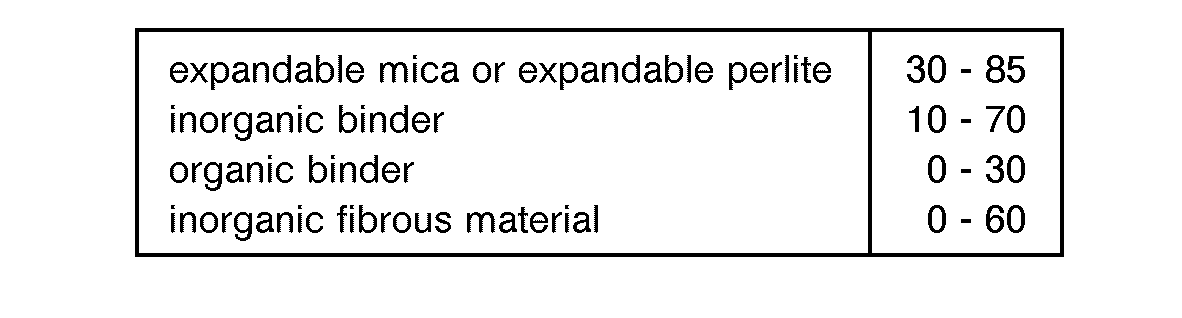
[0009] The intumescent material from which the container is made may be, for example, based on exfoliated graphite, expandable mica or expandable perlite. Exfoliated graphite is a preferred material and suitable compositions may be, for example, as follows.
Where expandable mica is used suitable compositions may be, for example, as follows.
[0011] The containers of the invention preferably have a wall thickness of from 1 to 4 mm, i.e. a thickness of that amount of intumescent material. They may be formed by any convenient means but in a preferred embodiment the composition containing the intumescent material is cast into seamless tubular form.
[0012] Alternatively, a sheet of the intumescent material of the desired thickness may have an opposed pair of edges joined, e.g. by tape, to give a tubular form.
[0013] The loose anti-skulling material may be any conventionally used for this purpose. It is preferably based on a mixture of chromite sand and silica sand and may contain further desired additives, e.g. a minor proportion of carbon black. Up to 0.5% by weight of carbon black is sufficient to coat all the particulates in the anti-skulling material and has the benefit of reducing the sintering rate in contact with molten metal. Preferably the anti-skulling material contains from 60 to 80% by weight of chromite sand.
[0014] The invention is further illustrated, by way of example only, by the accompanying drawings, in which:-
Figure 1 is a diagrammatic cross-section through part of the base of a ladle showing the outlet nozzle zone;
Figure 2 shows the nozzle zone of Figure 1 containing a container of the invention prior to heating; and
Figure 3 is a similar view to Figure 2 after heating of the nozzle zone.
[0015] In Figure 1, the shell 10 of a ladle has a conventional refractory lining 12. A centrally-bored nozzle well block 16 is fitted into a suitable recess 14 in the lining 12 and a inner nozzle 18 is fitted into the central bore of well block 16 and into a corresponding hole in shell 10 of the ladle. The bore 20 of inner-nozzle 18 communicates with bore 20A of a sliding gate valve assembly 22, shown in the open configuration in Figure 1. Sliding gate valve 22 comprises an upper fixed plate 22B mounted by conventional means to the underside of shell 10 and a slidable lower plate 22A.
[0016] In Figure 2 is shown the device of Figure 1 with the sliding gate valve 22 in the closed position. An elongated container 24 made of exfoliated graphite and filled with loose anti-skulling material 26 has been placed in bore 20. Its lower end rests on plate 22A of the sliding gate valve and its upper end protrudes above the level of lining 12 into the interior of the ladle. The container is of such a diameter as to not completely fill bore 20 but is a loose fit in the bore.
[0017] Figure 3 shows the subsequent stage after the nozzle zone has been heated. The intumescent material of container 24 has expanded to closely fill and contact bore 20 and the container has effectively disintegrated to allow loose anti-skulling material 26 to fill the nozzle zone. Thus, the container has effectively disappeared leaving a thin carbon coating 27 on the walls of bore 20. Its expansion into close contact with the walls of the bore ensured that the loose anti-skulling material filled the entire nozzle zone without risk of gaps or channels into which molten steel could subsequently run and form skull.
1. A method of inhibiting the formation of skull in the outlet nozzle zone (14) of
a metallurgical pouring vessel (10) having an outlet nozzle (16, 18) by positioning
loose anti-skulling material (26) in the outlet nozzle zone, characterised in that
an elongated container (24) is formed from an intumescent material, the container
(24) is filled with loose anti-skulling material (26) and is placed in the nozzle
zone (14) to extend along the bore (20) of the nozzle (18) and is heated whereby it
expands to fill the gap between the container (24) and the walls of the nozzle (18)
defining the bore (20) and releases the anti-skulling material.
2. A method according to Claim 1, characterised in that the container (24) is longer
than the length of the nozzle zone (14) so that it extends into the interior of the
vessel (10).
3. A method according to Claim 1 or 2, characterised in that the ends of the container
(24) are closed by caps of readily heat-destructible material.
4. A method according to Claim 1, 2 or 3, characterised in that the container (24)
is made by casting into seamless tubular form.
5. A method according to Claim 1, 2 or 3, characterised in that the container (24)
is made from a sheet of intumescent material formed to tubular form with its edges
joined by tape.
6. A method according to any preceding claim, characterised in that the anti-skulling
material (26) is formed from a mixture of chromite sand and silica sand.
7. A method according to Claim 6, characterised in that the mixture additionally includes
up to 0.5 per cent by weight of carbon black.
8. A method according to any preceding claim, characterised in that the filled container
(24) is placed in the bore (20) of the nozzle (18) so that its lower end rests on
a plate (22A) of a closed sliding gate valve (22) attached to the underside of the
vessel (10).
9. A method according to any preceding claim, characterised in that when the container
(24) expands under heating it leaves a thin carbon coating on the walls defining bore
(20) of the outlet (18).
10. A container (24) for use in the outlet nozzle zone (14)of a metallurgical pouring
vessel (10), characterised in that the container (24) is of a size to contain sufficient
loose anti-skulling material (26) to fill adequately the nozzle zone (14) and is formed
of intumescent material which will expand on heating to contact the walls of the nozzle
(18) and release the anti-skulling material.
11. A container according to Claim 10, characterised in that it is longer than the
length of the nozzle zone (14) so that it will extend into the interior of the vessel
(10).
12. A container according to Claim 10 or 11, characterised in that its ends are closed
by caps of readily heat-destructible material.
13. A container according to Claim 10, 11 or 12, characterised in that it is made
of expandable graphite, expandable mica or expandable perlite.
14. A container according to Claim 13, characterised in that it is made of expandable
graphite and is of the following composition in percentages by weight:
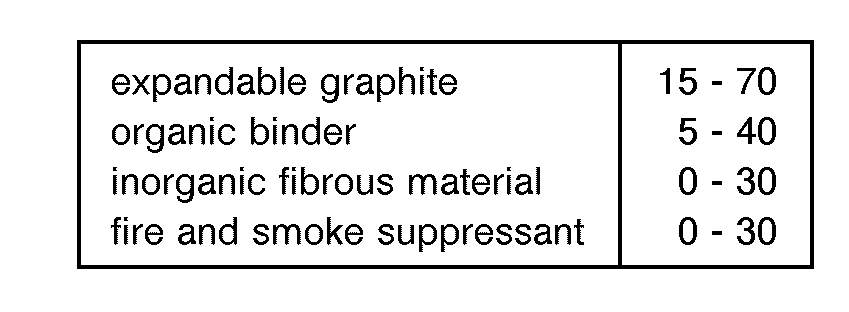
15. A container according to Claim 13, characterised in that it is made of expandable
mica or expandable perlite and is of the following composition in percentages by weight:
16. A container according to any one of Claims 10 to 15, characterised in that it
has a wall thickness of from 1 to 4mm.
17. A container according to any one of Claims 10 to 16, characterised in that it
contains as anti-skulling material (26) a mixture of chromite sand and silica sand.
18. A container according to Claim 17, characterised in that the anti-skulling material
(26) contains from 60 to 80 per cent by weight of chromite sand.
19. A container according to any one of Claims 10 to 18, characterised in that it
contains an anti-skulling material containing up to 0.5 per cent by weight of carbon
black.