|
(11) | EP 0 600 691 A1 |

| (12) | EUROPEAN PATENT APPLICATION |
|
|
|
|
|||||||||||||||||||||||||||
| (54) | Method of reducing the impact- and friction sensitivity of tetrazoles |
| (57) The present invention has the objective of reducing physical properties of tetrazoles
and provides a method of reducing physical properties of tetrazoles by converting
them into their amine salts represented by the following chemical formula (1):
wherein R represents hydrogen, alkyl, phenyl, benzyl or phenetyl group, which may be substituted by an alkyl with carbon number 1 - 3, chlorine, hydroxyl, carboxyl, methoxy, aceto, nitro or other group, and wherein R may also be tetrazolyl group, which may be substituted via diazo or triazo group, and wherein Z is an amine. The present invention has the following effect. Tetrazoles are reduced in their physical properties by being converted into their amine salts, and thus have become usable as gas-generating agents for air-bags or as foaming agents for high polymers. |
Background of the Invention
(1) Field of the Invention
[0002] Compounds to be employed in the present invention, which are represented by the chemical formula (1) shown later and which have been discovered by the present inventors, can be reduced in such physical properties as impact sensitivity and friction sensitivity further than conventional tetrazoles. Therefore, they are useful as less-toxic gas-generating agents for air-bags or as foaming agents for high polymers. As such, they are expected to be widely used as safe, easy-to-handle gas-generating agents or foaming agents for high polymers.
(2) Description of the Prior Art
[0003] Compounds of free radicals [5,5'-bi-1H-tetrazole (abbreviated as BHT hereinafter)] represented by the chemical formula (1) shown later have been utilized as gas-generating agents for air-bags or as foaming agents for high polymers. When a BHT compound is employed as a gas-generating agent for air-bags, it involves the work of converting the compound into fine powder and loading it into a container for acceleration of their thermal decomposition. In such processes, due to their high impact and friction sensitivities, they may decompose during powdering or explode at the time of loading. When the BHT compound is used as a foaming agent for high polymers, on the other hand, it would be necessary to form master chips by adding the BHT compound to a thermoplastic resin with a melting point somewhat lower than that of the high polymer to be molded so that the BHT compound can be easily added to the polymer and that a preferable dispersion state of the compound into the high polymer to be molded can be obtained.
Summary of the Invention
[0004] In forming the master chips, there has been a problem that because of their high physical properties tetrazole compounds may often decompose at temperatures lower than the proper decomposition temperature (at the molding temperature of the master chips obtained by adding the compounds to a thermoplastic resin with a melting point somewhat lower than that of the high polymer to be molded), such that desired master chips cannot be obtained.
[0005] The object of the present invention is therefore to provide a method of reducing physical properties of tetrazoles which can be used as gas-generating agents for air-bags or as foaming agents for high polymers, by converting BHT compounds into amine salts.
Detailed Description of the Invention
[0006] According to a first aspect of the present invention, there is provided a method of reducing physical properties of tetrazoles, characterized by comprising a step of converting the tetrazoles into tetrazole amine salts represented by the following chemical formula (1):
wherein R represents hydrogen, alkyl, phenyl, benzyl or phenetyl group, which may be substituted by an alkyl with carbon number 1 to 3, chlorine, hydroxyl, carboxyl, methoxy, aceto, amino, nitro or other group, and wherein R may also be tetrazolyl group, which may be substituted via diazo or triazo group.
[0007] Z is selected from such primary amines as methylamine, ethylamine, n-propylamine, isopropylamine, n-butylamine, ter-butylamine, n-pentylamine, n-hexylamine, aniline, benzylamine, phenetylamine, 1-amino-4-phenylbutane, benzhydrylamine and cyclohexylamine; from such secondary amines as dimethylamine, diethylamine, di-n-propylamine, di-n-pentylamine, di-n-hexylamine, propyleneimine, pyrrolidine, piperidine and N-methylmorpholine; from such tertiary amines as trimethylamine, triethylamine, tri-n-pentylamine, tri-n-hexylamine, triphenylamine, pyridine and 1,8-diazabicyclo[5,4,0]-7-undecene; from such diamines as hydrazine, trimethylenediamine, pentamethylenediamine, hexamethylenediamine, piperazine, m-phenylenediamine, 1,3-diazacyclohexane, triethylenediamine, N,N,N',N'-tetramethylethylenediamine; and from such compounds as ammonia, urea, carbohydrazide, thiocarbohydrazide, azodicarbonamide, guanidine, dicyandiamide, aminoguanidine, N,N'-bis(3-aminopropyl)piperazine, melamine, acetoguanamine, 3-amino-1,2,4-triazole and hexamethylenetetramine.
[0008] According to a second aspect of the present invention, there is provided a method of reducing physical properties of tetrazoles as described for the first aspect, wherein the tetrazole amine salts represented by the above chemical formula (1) are used for air-bags or as foaming agents for high polymers.
Examples
Example 1:
[0010] 5,5'-Bi-1H-tetrazole (13.8 g) and piperazine hexahydrate (9.7 g) were added to 200 g of water and the mixture was heated to 80°C for allowing them to react at this temperature for 1 hour. Then the mixture was cooled to room temperature and filtered to obtain 9.5 g of Compound (1). While 5,5'-bi-1H-tetrazole showed a decomposition temperature of 254°C, a drop hammer sensitivity of JIS class 4 and a friction sensitivity of JIS class 2, Compound (1), namely the piperazine salt of 5,5'-1H-tetrazole, showed a decomposition temperature of 330°C, a drop hammer sensitivity of JIS class 8 and a friction sensitivity of JIS class 7, demonstrating that the objective of the present invention was achieved.
Example 2:
[0012] 5,5'-Bistetrazole (2.7 g) and m-phenylenediamine (2.3 g) were added into 200 g of water and allowed to react at room temperature for 1 hour. Then the solvent was distilled away nearly completely and the residue was filtered to obtain 4.3 g of Compound (2). 5,5'-Bistetrazole showed a decomposition temperature of 254°C, a drop hammer sensitivity of JIS class 4 and a friction sensitivity of JIS class 2, while Compound (2) showed a decomposition temperature of 250°C, a drop hammer sensitivity of JIS class 8 and a friction sensitivity of JIS class 7, thus showing that the objective of the present invention was achieved.
Example 3:
[0013] Results of thermal analysis and physical properties of various amine salts of 5,5'-bi-1H-tetrazole (abbreviated as BHT) are shown in Table 1.
Example 4:
[0014] Results of thermal analysis and physical properties of various amine salts of 1H-tetrazole (abbreviated as 1HT) are shown in Table 2.
Example 5:
[0015] Results of thermal analysis and physical properties of various amine salts of 5-methyl-1H-tetrazole (abbreviated as M5T) are shown in Table 3. The results in Table 3 show that MST has rather low sensitivities and that its conversion to amine salts hardly affects on the physical properties.
[0016] Other tetrazole amine salts with other different groups for Z in the chemical formula (1) were also tested to find that they also have been reduced in the physical properties of mother tetrazoles.
Effect of the Invention
[0018] While tetrazoles have been known to be useful as gas-generating agents for air-bags by virtue of their low toxicity of decomposed gases and as foaming agents for high polymers by virtue of their high thermal decomposition temperature, they have been troublesome in use because of their high physical properties. The present invention has made it possible to overcome the above problems, opening new applications of these compounds in the above discussed fields. The effect of the invention is thus believed to be enormous.
1. A method of reducing physical properties of tetrazoles, comprising a step of converting
them into tetrazole amine salts represented by the following chemical formula (1):
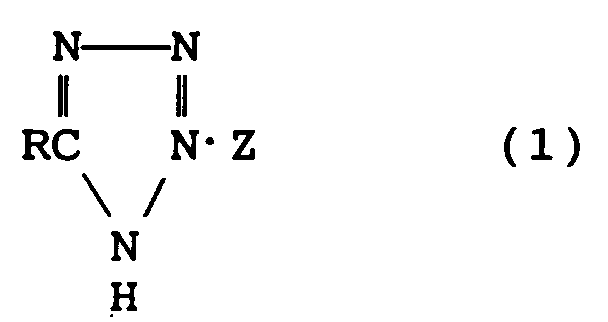
wherein R represents hydrogen, alkyl, phenyl, benzyl or phenetyl group, which may be substituted by an alkyl with carbon number 1 to 3, chlorine, hydroxyl, carboxyl, methoxy, aceto, amino, nitro or other group, and wherein R may also be tetrazolyl group, which may be substituted via diazo or triazo group;
and wherein Z is selected from such primary amines as methylamine, ethylamine, n-propylamine, isopropylamine, n-butylamine, ter-butylamine, n-pentylamine, n-hexylamine, aniline, benzylamine, phenetylamine, 1-amino-4-phenylbutane, benzhydrylamine and cyclohexylamine; from such secondary amines as dimethylamine, diethylamine, di-n-propylamine, di-n-pentylamine, di-n-hexylamine, propyleneimine, pyrrolidine, piperidine and N-methylmorpholine; from such tertiary amines as trimethyamine, triethylamine, tri-n-pentylamine, tri-n-hexylamine, triphenylamine, pyridine and 1,8-diazabicyclo[5,4,0]-7-undecene; from such diamines as hydrazine, trimethylenediamine, pentamethylenediamine, hexamethylenediamine, piperazine, m-phenylenediamine, 1,3-diazacyclohexane, triethylenediamine, N,N,N',N'-tetramethylethylenediamine; and from such compounds as ammonia, urea, carbohydrazide, thiocarbohydrazide, azodicarbonamide, guanidine, dicyandiamide, aminoguanidine, N,N'-bis(3-aminopropyl)piperazine, melamine, acetoguanamine, 3-amino-1,2,4-triazole and hexamethylenetetramine.
wherein R represents hydrogen, alkyl, phenyl, benzyl or phenetyl group, which may be substituted by an alkyl with carbon number 1 to 3, chlorine, hydroxyl, carboxyl, methoxy, aceto, amino, nitro or other group, and wherein R may also be tetrazolyl group, which may be substituted via diazo or triazo group;
and wherein Z is selected from such primary amines as methylamine, ethylamine, n-propylamine, isopropylamine, n-butylamine, ter-butylamine, n-pentylamine, n-hexylamine, aniline, benzylamine, phenetylamine, 1-amino-4-phenylbutane, benzhydrylamine and cyclohexylamine; from such secondary amines as dimethylamine, diethylamine, di-n-propylamine, di-n-pentylamine, di-n-hexylamine, propyleneimine, pyrrolidine, piperidine and N-methylmorpholine; from such tertiary amines as trimethyamine, triethylamine, tri-n-pentylamine, tri-n-hexylamine, triphenylamine, pyridine and 1,8-diazabicyclo[5,4,0]-7-undecene; from such diamines as hydrazine, trimethylenediamine, pentamethylenediamine, hexamethylenediamine, piperazine, m-phenylenediamine, 1,3-diazacyclohexane, triethylenediamine, N,N,N',N'-tetramethylethylenediamine; and from such compounds as ammonia, urea, carbohydrazide, thiocarbohydrazide, azodicarbonamide, guanidine, dicyandiamide, aminoguanidine, N,N'-bis(3-aminopropyl)piperazine, melamine, acetoguanamine, 3-amino-1,2,4-triazole and hexamethylenetetramine.
2. A method of reducing physical properties of tetrazoles as claimed in Claim 1, wherein
the tetrazole amine salts represented by the chemical formula (1) are used as gas-generating
agents for air-bags or as foaming agents for high polymers.