|
(11) | EP 0 600 899 B1 |

| (12) | EUROPEAN PATENT SPECIFICATION |
|
|
| (54) |
FUEL OIL TREATMENT Kraftölbehandlung TRAITEMENT POUR CARBURANT |
|
|
|||||||||||||||||||||||||||||||
| Note: Within nine months from the publication of the mention of the grant of the European patent, any person may give notice to the European Patent Office of opposition to the European patent granted. Notice of opposition shall be filed in a written reasoned statement. It shall not be deemed to have been filed until the opposition fee has been paid. (Art. 99(1) European Patent Convention). |
[0001] This invention relates to the use of additives in fuel oils to reduce emissions on combustion of the fuel oil and to increase engine power when used in an internal combustion engine.
[0002] Although most modern internal combustion engines are highly efficient and give almost complete combustion of the hydrocarbon fuel used, the slight reduction from total efficiency leads to the formation of black smoke, a proportion of which is particulate carbon and other products of incomplete combustion. Apart from the smoke being unpleasant to breathe and unsightly, the carbon particles may have absorbed in them polynuclear hydrocarbons, which also result from incomplete combustion, some of which are known carcinogens.
[0003] Furthermore, internal combustion engines give rise to gaseous emissions on combustion of fuel therein, examples of such emissions being one or more hydrocarbons, carbon monoxide, and oxides of nitrogen and which examples are noxious and undesirable.
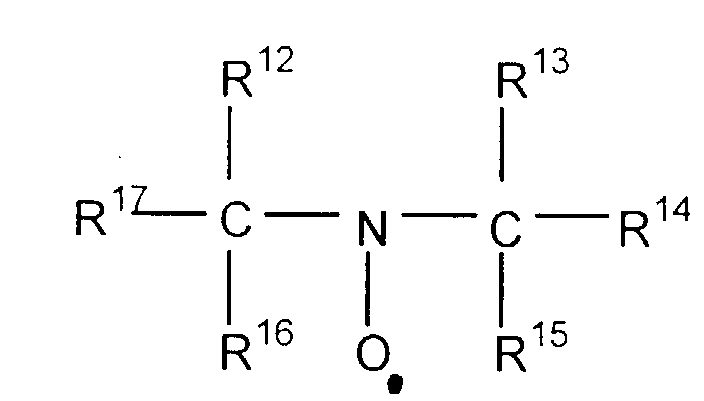
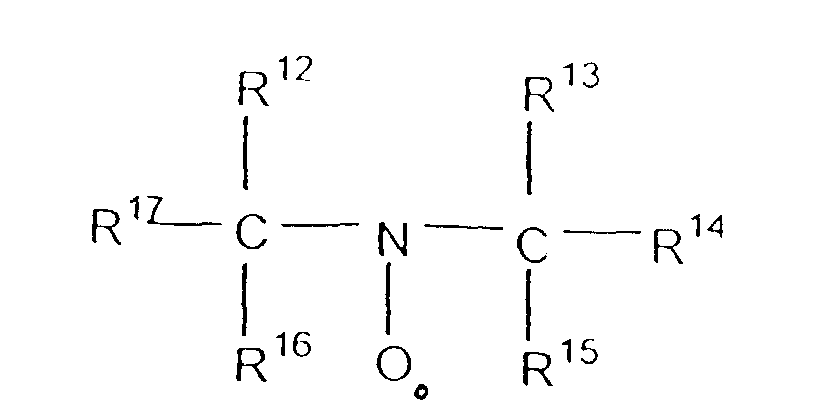
[0004] US-A-4,398,505 describes diesel fuel compositions including N,N-disubstituted organic nitroxides, which are organic free radicals, in amounts effective to increase the cetane number of the fuel. Such amounts are stated to ordinarily be in the range from about 0.01 to 5 weight percent based on the total weight of the resulting fuel, preferably from about 0.1 to 3 weight per cent. However, US-A-4,398,505 neither discloses nor suggests that organic free radicals such as those disclosed therein are capable of reducing emissions on combustion of the fuel. This effectiveness has now been found, according to this invention. Thus the invention provides in one aspect the use as an additive in a middle distillate fuel oil boiling in the range of 120°C to 500°C (ASTM D-86) to reduce, on combustion of the fuel oil, one or more of particulate emissions, hydrocarbon emissions, carbon monoxide emissions, and oxides of nitrogen emissions, the additive being present in a proportion of less than 80 ppm of active ingredient by weight, based on the weight of fuel oil, and comprising an oil-soluble stable free radical or a precursor therefor that is convertible to an oil-soluble stable free radical under said combustion wherein the stable free radical is a nitroxide of the formula:
wherein each of R17, R12 and R13 and R14 is a hydrocarbyl group or hetero-atom substituted hydrocarbyl group having 1 to 200 carbon atoms, R15 and R16 (a) each being a hydrocarbyl group having 1 to 200 carbon atoms, or a substituted hydrocarbyl group having 1 to 200 carbon atoms wherein the substituent is halogen, cyano, -CONH2, SC6H5, -S-COCH3, -OCOCH3, -OCOC2H5, carbonyl, alkenyl wherein the double bond is not conjugated with the nitroxide moiety, or -COOR wherein R of the -COOR group is alkyl or aryl, or (b) together forming part of a ring that contains carbon atoms and up to two hetero-atoms of O, N or S, optionally linked to a side chain for enhancing the solubility of the free radical in a fuel oil.
[0005] Furthermore, US-A-4,398,505 neither discloses nor suggests the use of organic free radicals in amounts less than those effective to increase the cetane number of the fuel. It has now been found, according to this invention, that such amounts are effective in reducing emissions on combustion of fuels. Thus in a second aspect, the invention provides a composition comprising a major proportion of a middle distillate fuel oil boiling in the range of 120°C to 500°C (ASTM D-86) and less than 80 ppm of active ingredient by weight, based on the weight of fuel oil of an additive comprising an oil-soluble stable free radical or a precursor therefor that is convertible to an oil-soluble stable free redical under combustion of said composition, wherein the stable free radical is a nitroxide of the formula:
wherein each of R17, R12 and R13 and R14 is a hydrocarbyl group or hetero-atom substituted hydrocarbyl group having 1 to 200 carbon atoms, R15 and R16 (a) each being a hydrocarbyl group having 1 to 200 carbon atoms, or a substituted hydrocarbyl group having 1 to 200 carbon atoms wherein the substituent is halogen, cyano, -CONH2, SC6H5, -S-COCH3, -OCOCH3, -OCOC2H5, carbonyl, alkenyl wherein the double bond is not conjugated with the nitroxide moiety, or -COOR wherein R of the -COOR group is alkyl or aryl, or (b) together forming part of a ring that contains carbon atoms and up to two hetero-atoms of O, N or S, optionally linked to a side chain for enhancing the solubility of the free radical in a fuel oil. In a third aspect, the invention provides a method for operating a diesel engine to reduce one or more of particulate emissions, hydrocarbon emissions, carbon monoxide emissions, and oxides of nitrogen emissions in operation of the engine, which method comprises combusting in the engine a composition comprising a major proportion of a middle distillate fuel oil boiling in the range of 120°C to 500°C (ASTM D-86) and less than 80 ppm of active ingredient by weight, based on the weight of fuel oil, of an additive comprising an oil-soluble stable free radical or a precursor therefor that is convertible to an oil-soluble stable free radical under said combusting wherein the stable free radical is a nitroxide is of the formula:,
wherein each of R17, R12 and R13 and R14 is a hydrocarbyl group or hetero-atom substituted hydrocarbyl group having 1 to 200 carbon atoms, R15 and R16 (a) each being a hydrocarbyl group having 1 to 200 carbon atoms, or a substituted hydrocarbyl group having 1 to 200 carbon atoms wherein the substituent is halogen, cyano, -CONH2, SC6H5, -S-COCH3, -OCOCH3, -OCOC2H5, carbonyl, alkenyl wherein the double bond is not conjugated with the nitroxide moiety, or -COOR wherein R of the -COOR group is alkyl or aryl, or (b) together forming part of a ring that contains carbon atoms and up to two hetero-atoms of O, N or S, optionally linked to a side chain for enhancing the solubility of the free radical in a fuel oil.
[0006] Moreover, US-A-4,398,505 neither discloses nor suggests using organic free radicals in additive combinations with co-additives. Such combinations have been found to be surprisingly beneficial according to the invention.
[0007] It is noteworthy in the present invention that the organic free radicals or precursors therefor, when incorporated in a diesel, heatingor jet fuel, may reduce the emissions of particulates even in the absence of injector deposits. Thus the reduction in particulate emission achieved by the present invention may result directly on combustion of a fuel containing the free radical or precursor, compared with the emissions resulting from combustion, in the same combustion chamber with the same conditions upstream of the combustion chamber, of fuel not containing the free radical or precursor but otherwise identical. Such reduction is herein referred to as the "direct" reduction.
[0008] While the applicants do not wish to be bound by any theory, it is believed that under given conditions (which include any deposits present in injectors or elsewhere upstream of the combustion chamber) the presence of the free radical or precursor in the fuel, or in the fuel/air mixture, in the combustion chamber results in an improvement in the quality of combustion, as measured by completeness of oxidation. The improvement may in turn be the result of a change in the physical properties of the fuel, or the fuel/air mixture, e.g. the surface tension of the fuel, resulting in improved mixing and reduced soot and smoke formation. The reference above to the presence of the free radical or precursor includes the presence of a reaction product of the free radical or precursor with a component of the fuel, the reaction having taken place either before entry into the combustion chamber or within the combustion chamber prior to combustion.
ADDITIVE
[0010] Stable free radicals or precursors therefor such as can be used in this invention are described in US-A-4,670,131, which describes their use in controlling fouling in equipment for processing and storing hydrocarbon compositions containing unsaturated hydrocarbons.
[0011] By "stable free radical" in this specification is meant a free radical that can be prepared by conventional chemical methods and that can exist long enough under the conditions of combustion of a fuel oil for it to be able to influence combustion to reduce one or more of the above-mentioned emissions. Generally, the free radical should be capable of existing under such conditions for longer than the time of the combustions reactions occurring during combustion.
[0012] By "precursor" in this specification is meant a chemical species that is convertible to the stable free radical during the combustion.
[0013] In this invention, nitroxides are of the formula:
wherein each of R17, R12 and R13 and R14 is a hydrocarbyl group or hetero-atom substituted hydrocarbyl group having 1 to 200 carbon atoms, R15 and R16 (a) each being a hydrocarbyl group having 1 to 200 carbon atoms, or a substituted hydrocarbyl group having 1 to 200 carbon atoms wherein the substituent is halogen, cyano, -CONH2, -SC6H5, -S-COCH3, -OCOCH3, -OCOC2H5, carbonyl, alkenyl wherein the double bond is not conjugated with the nitroxide moiety, or -COOR wherein R of the -COOR group is alkyl or aryl, or (b) together forming part of a ring that contains carbon atoms and up to two hetero-atoms of O, N or S, optionally linked to a side chain for enhancing the solubility of the free radical in a fuel oil.
[0014] "Hydrocarbyl" means an organic moiety composed of carbon and hydrogen which may be aliphatic, including alicyclic; aromatic; or any combination thereof, e.g. aralkyl. For example, the moiety may be a polymonoolefin group such as polyisobutylene. Preferably, one or more of the hydrocarbyl groups is an alkyl group having 1 to 15 carbon atoms. When hetero atom substituted, the hetero atom may be nitrogen, oxygen or sulphur; there may be one or more such hetero atoms.
[0015] In the above formula, it is preferred that the ring, where present, contains 4 to 8 such as 4 or 5 carbon atoms. Examples of the optional side chain are groups of the same definition of R15 and R16 herein which may optionally be linked to the ring via a functional group, examples of which being -NH-; -S-; -O-; -CO-; -CS-; -CO-NH-; -CS-NH-; -O-CO-NH-; -O-CS-NH-; -S-CO-NH-; -S-CS-NH-: -O-O-; 〉C=N- ; and 〉C=N-O-.
[0016] The selection of such a functional group may be determined primarily by manufacturing ease; otherwise its selection may not be critical.
[0017] Preferably, each of R17, R12, R13 and R14 is a methyl, ethyl or propyl group. Also, each of R15 and R16 may be a methyl, ethyl or propyl group. A specific example of a nitroxide for use in this invention is: 4-hydroxy-2,2,6,6-tetramethylpiperindinyloxy.
[0018] The additive is, when the invention is the use or the composition, notably present in the fuel oil in a proportion in the range of from 1 to 50 ppm of active ingredient by weight based on the weight of the fuel oil.
CO-ADDITIVES
[0019] The additives of the invention may be used in combination with one or more co-additives. Particular noteworthy co-additives are the ashless dispersants which are described in numerous patent specifications and which are additives that leave little or no metal-containing residue on combustion. Many classes are known such as described in EP-A-0 482 253 and to which attention is directed for further details thereof. Examples of co-additives, which include examples of ashless dispersants, are as follows:
(i) Macrocyclic Compound
[0020] Such a compound is an oil soluble compound of the formula
or
R6R4N(R5)b[NR4(R5)c]dNR4R4
or mixtures of two or more such compounds, wherein R1, R2 and R3 may be the same or different and are independently hydrogen or a hydrocarbyl substituent having from 2 to 600 carbon atoms, or a keto, hydroxy, nitro, cyano, or alkoxy derivative thereof, provided that at least one of R1, R2 and R3 is a hydrocarbyl substituent having from 2 to 600 carbon atoms or said derivative thereof, or wherein R1 and R2 together form a hydrocarbylene substituent having 4 to 600 carbon atoms or a keto, hydroxy, nitro, cyano or alkoxy derivative thereof, provided that R1 and R2 together with the carbon atom which forms the C-R1 bond with R1 and the nitrogen atom which forms the N-R2 bond with R2 form a ring having at least 5 members, wherein Z represents
- R10[NR11(R10)]e-
or
-[R10R11N]fR10[NR11R10]g-
wherein each R10, which may be the same or different, represents an alkylene group having from 1 to 5 carbon atoms in its chain, R11 represents a hydrogen atom or a hydrocarbyl group, and e is from 0 to 6, f is from 1 to 4, g is from 1 to 4, provided that f + g is at most 5, each R4 is independently H or an alkyl group having up to 5 carbon atoms, R5 is an alkylene group having up to 6 carbon atoms in the chain, optionally substituted by one or more hydrocarbyl groups having up to 10 carbon atoms, an acyl group having from 2 to 10 carbon atoms, or a keto, hydroxy, nitro, cyano or alkoxy derivative of a hydrocarbyl group having from 1 to 10 carbon atoms or of an acyl group having from 2 to 10 carbon atoms, R6 is a hydrocarbyl substituent having from 2 to 600 carbon atoms or said derivative thereof, b is from 1 to 6, c is from 1 to 6 and d is from 0 to 12.
[0021] For example, the compounds of formula (I) may be
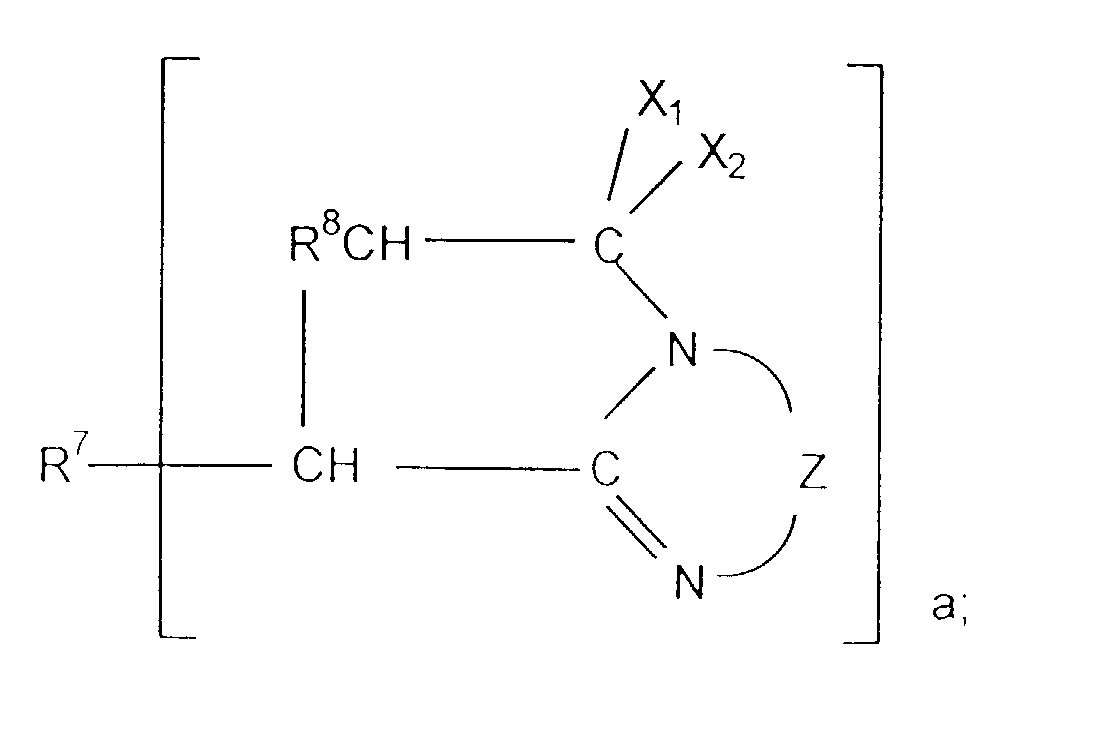
wherein R7 is a hydrogen or a hydrocarbyl substituent having from 1 to 600 carbon atoms, R8 is hydrogen or a C1 to C12 hydrocarbyl substituent, and if there is more than one R8 in a compound, they may be the same or different, R9 is a hydrocarbylene substituent having from 2 to 600 carbon atoms, two of which carbon atoms are bonded to the a-carbon atoms of the succinic anhydride based ring, X1 represents hydrogen or an alkyl group having from 1 to 12 carbon atoms, X2 represents hydrogen, an alkyl group having from 1 to 12 carbon atoms, a hydroxy group, or an alkoxy group, the alkoxy group having from 1 to 12 carbon atoms, or X1 and X2 may together represent an oxygen (or sulphur) atom, and a is 1 to 20.
[0022] Macrocyclic compounds such as the above are described in US-A-4,637,886 and US-A-4,880,923. When the invention is the use or the composition, the macrocyclic compound, if present, is advantageously in a proportion in the range of from 5 to 20,000 ppm of active ingredient by weight based on the weight of the fuel oil, preferably from 10 to 5,000, more preferably from 50 to 3,000.
(ii) Cetane Improvers
[0023] It has been found that using a cetane improver in combination with the additive of the invention and optionally with a macrocyclic compound as described above may give rise to operational benefit.
[0024] Preferred cetane improvers are organic nitrates; there may also be used, for example, substituted triazoles and tetrazoles, for example those described in European Patent Application No 230783. Preferred organic nitrates are nitrate esters containing aliphatic or cycloaliphatic groups with up to 30 carbon atoms, preferably saturated groups, and preferably with up to 12 carbon atoms. As examples of such nitrates, there may be mentioned methyl, ethyl, propyl, isopropyl, butyl, amyl, hexyl, heptyl, octyl, iso-octyl, 2-ethylhexyl, nonyl, decyl, allyl, cyclopentyl, cyclohexyl, methylcyclohexyl, cyclododecyl, 2-ethoxyethyl, and 2-(2-ethoxyethoxy) ethyl nitrates.
[0025] When the invention is the use or the composition, the cetane improver is advantageously present in the fuel in a proportion in the range of from 5 to 10,000 ppm of active ingredient by weight based on the weight of the fuel, preferably from 50 to 5,000, more preferably from 100 to 2,000.
(iii) Polymer of Monoolefin
[0026] The presence of a polymer of a C2 to C6 monoolefin, the polymer having a number average molecular weight of less than about 500, may also be advantageous. Such a polymer may, for example, be a homo- or copolymer of ethylene, propylene, butylene (1- or 2-), pentylene or isobutylene, polyisobutylene being preferred. When it is a copolymer, it may be a copolymer of two or more of the specified monomers, or a copolymer of one or more of the specified monomers with a copolymerisable unsaturated monomer. Further, it may be a block or a random copolymer.
[0027] The number average molecular weight is as measured by Gel Permeation Chromatography (GPC). Preferably, it is in the range of 300 to 500, more preferably 350 to 450. The polymer may, for example, have a kinematic viscosity at 100°C in the range of 1 to 20 cSt, preferably 4 to 16 cSt, more preferably 8 to 12 cSt.
[0028] The polymer may be made, for example, by catalysed polymerisation using cationic catalyst systems described in the art such as AlCl3/H2O; AlCl3/HCl; Et AlCl2/HCl; BF3; or Ziegler-Natta type catalysts.
[0029] When the invention is the use or the composition, the polymer is advantageously present in the fuel in a proportion in the range of from 5 to 10,000 ppm of active ingredient by weight based on the weight of the fuel, preferably from 50 to 5,000, more preferably from 100 to 2,000.
(iv) Other Additive Components
[0030] In the practice of this invention, the additive or co-additives, if present, may be used in combination with one or more other additives, for example additives providing particular properties such as dispersants, for example hydrocarbyl-substituted succinimides or succinamides and hydrocarbylpolyamines; metallic-based combustion improvers such as ferrocene; corrosion inhibitors; anti-oxidants such as amine-formaldehyde products; anti-foams; reodorants; anti-wear agents; flow improvers; wax antisettling additives or other operability improvers; and cloud point depressants.
[0031] Examples of the above other additive components are known in the art. Such other additives may, for example, be present in the fuel oil in a proportion in the range of 5 to 500 ppm (weight:weight).
PROPORTIONS
[0032] Where the additive of the invention is used in combination with one or more co-additives, the relative proportion of the additives to one another may, for example, be in the weight:weight ratio of 500:1 to 1:500 such as 10:1 to 1:10.
FUEL OIL
[0033] The fuel oils that can be used are petroleum compositions comprising hydrocarbons such as straight chain paraffins, branched chain paraffins, olefins, aromatic hydrocarbons, and naphenic hydrocarbons, and hetero-atom containing derivatives of the above. The components of the fuel oil can be derived by any of the conventional refining and blending processes. Synthetic fuels are also included.
[0034] The fuel oils are middle distillate fuel oils such as diesel fuel, aviation fuel, kerosene, fuel oil, jet fuel and heating oil. Suitable distillate fuels are those boiling in the range of 120°C to 500°C (ASTM D-86). A heating oil may have a specification with a 10% distillation point no higher than 226°C, a 50% distillation point no higher than 282°C, and a 90% distillation point of at least 282°C and no higher than about 338°C to 343°C or possibly 357°C. Heating oils are preferably a blend of virgin distillate, e.g. gas oil or naphtha, and cracked distillate, e.g. catalytic cycle stock. A diesel fuel may have a specification that includes a minimum flash point of 38°C and a 90% distillation point between 282°C and 338°C (see ASTM Designations D-396 and D-975).
[0035] The additive and co-additives, if to be provided, may be added to the fuel oil as a mixture or separately in any order using conventional fuel additive injection methods, e.g. in the form of a concentrate. In a concentrate, the additive(s) may be dissolved in the solvent at a concentration within wide limits according to needs and restrictions, for example from 20 to 90, such as 30 to 80, per cent (weight:weight). Examples of such solvents are hydrocarbons or oxygen-containing hydrocarbons such as kerosene, aromatic naphthas, and mineral lubricating oils.
EXAMPLES
Example 1
[0037] An additive of the invention was tested in a truck engine to determine its effect on hydrocarbon, carbon monoxide, oxides of nitrogen, and particulate emissions. The engine used was a 6 litre 6 cylinder 4 stroke naturally aspirated Dl truck engine.
[0038] The fuel used had the following characteristics:
- Cloud point:
- -6°C
- Pour point:
- -27°C
- Cetane Number (CFR):
- 51.3
| Distillation Characteristics: | |
| Volume % Off | Temp (°C) |
| Initial Boiling Point | 148 |
| 5 | 194 |
| 10 | 209 |
| 20 | 229 |
| 30 | 248 |
| 40 | 263 |
| 50 | 275 |
| 60 | 286 |
| 70 | 298 |
| 80 | 312 |
| 90 | 331 |
| 95 | 345 |
| Final Boiling Point | 367 |
[0039] The tests were run in the following manner according to a standard ECE R49 cycle:
1. The engine was warmed up over a period of 90 minutes to full speed and full load.
2. A stabilising test was run using untreated fuel.
3. A test was run on the untreated fuel and emission data were collected.
4. A test was run on fuel treated with 500 ppm (weight:weight) of an additive comprising 4-hydroxy-2,2,6,6-tetramethylpiperindinyloxy.
[0040] The results are summarised in Table 1 below:
Table 1
| HC | CO | NOX | Particulates | |
| Untreated Fuel | 1.195 | 5.306 | 8.520 | 1.097 |
| Treated Fuel | 0.958 | 3.816 | 9.371 | 0.784 |
[0041] All figures represent g/kWh of the indicated emission, HC being hydrocarbons, CO being carbon monoxide, NO being oxides of nitrogen, and PARTICULATES being particulate matter collected via a conventional dilution tunnel.
[0042] The above results show that the additive reduced each of the hydrocarbon, carbon monoxide and particulates emissions.
Example 2
[0043] The following formulations were used:
| Additive Formulation A (Comparison) | |
| Macrocycle** | 150 |
| Cetane Improver (Octyl Nitrate) | 750 |
| Polymer (polyisobutene; MN = 450) | 500 |
| * Anti-Foam (alkoxy-substituted poly-dimethy poly-siloxane) | 12.5 |
| * Solvent (aromatic hydrocarbon) | 52.5 |
| * Anti-Rust (alkoxy-substituted alkylphenol) | 20 |
| * Demulsifier | 15 |
| Total: |
| ** A cyclic acyl amidine compound of the type described in US Patents Nos 4,637,886 and 4,880,923. |
| Additive Formulation B | |
| Macrocycle (as used in Additive Formulation A) | 150 |
| Cetane Improver (Octyl Nitrate) | 750 |
| Polymer (polyisobutene; MN = 450) | 500 |
| Nitroxide (as in Example 1) | 50 |
| * Solvent (aromatic hydrocarbon) | 1050 |
| Total: |
[0044] In the above formulations, the numbers indicate quantities in ppm (weight:weight) present in the fuel when tested The components marked with a single asterisk are believed to have no significant effect on emissions..
[0045] The above additive formulations (A and B) were each tested in a car engine to determine their effects on hydrocarbon, carbon monoxide, oxides of nitrogen, and particulate emissions. The engine used was a 1.7 litre naturally aspirated IDI passenger car engine.
[0047] The tests were carried out in accordance with a standard ECE 15.04 + EUDC registered cycle and were carried out using untreated fuel and fuels containing each of additives A and B.
1. The use as an additive in a middle distillate fuel oil boiling in the range of 120°C
to 500°C (ASTM D-86) to reduce, on combustion of the fuel oil, one or more of particulate
emissions, hydrocarbon emissions, carbon monoxide emissions, and oxides of nitrogen
emissions, the additive being present in a proportion of less than 80 ppm of active
ingredient by weight, based on the weight of fuel oil, and comprising an oil-soluble
stable free radical or a precursor therefor that is convertible to an oil-soluble
stable free radical under said combustion, wherein the stable free radical is a nitroxide
is of the formula:

wherein each of R17, R12 and R13 and R14 is a hydrocarbyl group or hetero-atom substituted hydrocarbyl group having 1 to 200 carbon atoms, R15 and R16 (a) each being a hydrocarbyl group having 1 to 200 carbon atoms, or a substituted hydrocarbyl group having 1 to 200 carbon atoms wherein the substituent is halogen, cyano, -CONH2, SC6H5, -S-COCH3, -OCOCH3, -OCOC2H5, carbonyl, alkenyl wherein the double bond is not conjugated with the nitroxide moiety, or -COOR wherein R of the -COOR group is alkyl or aryl, or (b) together forming part of a ring that contains carbon atoms and up to two hetero-atoms of O, N or S, optionally linked to a side chain for enhancing the solubility of the free radical in a fuel oil.
wherein each of R17, R12 and R13 and R14 is a hydrocarbyl group or hetero-atom substituted hydrocarbyl group having 1 to 200 carbon atoms, R15 and R16 (a) each being a hydrocarbyl group having 1 to 200 carbon atoms, or a substituted hydrocarbyl group having 1 to 200 carbon atoms wherein the substituent is halogen, cyano, -CONH2, SC6H5, -S-COCH3, -OCOCH3, -OCOC2H5, carbonyl, alkenyl wherein the double bond is not conjugated with the nitroxide moiety, or -COOR wherein R of the -COOR group is alkyl or aryl, or (b) together forming part of a ring that contains carbon atoms and up to two hetero-atoms of O, N or S, optionally linked to a side chain for enhancing the solubility of the free radical in a fuel oil.
2. A composition comprising a major proportion of a middle distillate fuel oil boiling
in the range of 120°C to 500°C (ASTM D-86) and less than 80 ppm of active ingredient
by weight, based on the weight of fuel oil of an additive comprising an oil-soluble
stable free radical or a precursor therefor that is convertible to an oil-soluble
stable free radical under combustion of said composition, wherein the stable free
radical is a nitroxide is of the formula:
wherein each of R17, R12 and R13 and R14 is a hydrocarbyl group or hetero-atom substituted hydrocarbyl group having 1 to 200 carbon atoms, R15 and R16 (a) each being a hydrocarbyl group having 1 to 200 carbon atoms, or a substituted hydrocarbyl group having 1 to 200 carbon atoms wherein the substituted hydrocarbyl group having 1 to 200 carbon atoms wherein the substituent is halogen, cyano, -CONH2, SC6H5, -S-COCH3, -OCOCH3, -OCOC2H5, carbonyl, alkenyl wherein the double bond is not conjugated with the nitroxide moiety, or -COOR wherein R of the -COOR group is alkyl or aryl, or (b) together forming part of a ring that contains carbon atoms and up to two hetero-atoms of O, N or S, optionally linked to a side chain for enhancing the solubility of the free radical in a fuel oil.
wherein each of R17, R12 and R13 and R14 is a hydrocarbyl group or hetero-atom substituted hydrocarbyl group having 1 to 200 carbon atoms, R15 and R16 (a) each being a hydrocarbyl group having 1 to 200 carbon atoms, or a substituted hydrocarbyl group having 1 to 200 carbon atoms wherein the substituted hydrocarbyl group having 1 to 200 carbon atoms wherein the substituent is halogen, cyano, -CONH2, SC6H5, -S-COCH3, -OCOCH3, -OCOC2H5, carbonyl, alkenyl wherein the double bond is not conjugated with the nitroxide moiety, or -COOR wherein R of the -COOR group is alkyl or aryl, or (b) together forming part of a ring that contains carbon atoms and up to two hetero-atoms of O, N or S, optionally linked to a side chain for enhancing the solubility of the free radical in a fuel oil.
3. The use of claim 1 or composition of claim 2 wherein one or more of the hydrocarbyl
groups is an alkyl group having 1 to 15 carbon atoms.
4. The use or composition of any of claims 1 to 3 wherein the ring contains 4 or 5 carbon
atoms.
5. The use or composition of any of claims 1 to 4 wherein each of R17, R12, R13 and R14 is a methyl, ethyl or propyl group.
6. The use or composition of any of claims 1 to 5 wherein each of R15 and R16 is a methyl, ethyl or propyl group.
7. The use or composition of any of claims 1 to 5 wherein the nitroxide is 4-hydroxy-2,2,6,6-tetramethylpiperindinyloxy.
8. The use or composition of any of the preceding claims wherein the middle distillate
petroleum fuel oil is a diesel fuel.
9. The use or composition of any of the preceding claims wherein the proportion is in
the range of 1 to 50 ppm.
10. The use or composition of any of the preceding claims wherein the additive is present
in combination with one or more co-additives.
11. The use or composition of claim 10 wherein the or one of the co-additives is an oil
soluble compound of the formula

or
R6R4N(R5)b[NR4(R5)c]dNR4R4
or mixtures of two or more such compounds, wherein R1, R2 and R3 may be the same or different and are independently hydrogen or a hydrocarbyl substituent having from 2 to 600 carbon atoms, or a keto, hydroxy, nitro, cyano, or alkoxy derivative thereof, provided that at least one of R1, R2 and R3 is a hydrocarbyl substituent having from 2 to 600 carbon atoms or said derivative thereof, or wherein R1 and R2 together form a hydrocarbylene substituent having 4 to 600 carbon atoms or a keto, hydroxy, nitro, cyano or alkoxy derivative thereof, provided that R1 and R2 together with the carbon atom which forms the C-R1 bond with R1 and the nitrogen atom which forms the N-R2 bond with R2 form a ring having at least 5 members, wherein Z represents
-R10[NR11(R10)]e-
or
-[R10R11N]fR10[NR11R10]g-
wherein each R10, which may be the same or different, represents an alkylene group having from 1 to 5 carbon atoms in its chain, R11 represents a hydrogen atom or a hydrocarbyl group, and e is from 0 to 6, f is from 1 to 4, g is from 1 to 4, provided that f + g is at most 5, each R4 is independently H or an alkyl group having up to 5 carbon atoms, R5 is an alkylene group having up to 6 carbon atoms in the chain, optionally substituted by one or more hydrocarbyl groups having up to 10 carbon atoms, an acyl group having from 2 to 10 carbon atoms, or a keto, hydroxy, nitro, cyano or alkoxy derivative of a hydrocarbyl group having from 1 to 10 carbon atoms or of an acyl group having from 2 to 10 carbon atoms, R6 is a hydrocarbyl substituent having from 2 to 600 carbon atoms or said derivative thereof, b is from 1 to 6, c is from 1 to 6 and d is from 0 to 12.
or
R6R4N(R5)b[NR4(R5)c]dNR4R4
or mixtures of two or more such compounds, wherein R1, R2 and R3 may be the same or different and are independently hydrogen or a hydrocarbyl substituent having from 2 to 600 carbon atoms, or a keto, hydroxy, nitro, cyano, or alkoxy derivative thereof, provided that at least one of R1, R2 and R3 is a hydrocarbyl substituent having from 2 to 600 carbon atoms or said derivative thereof, or wherein R1 and R2 together form a hydrocarbylene substituent having 4 to 600 carbon atoms or a keto, hydroxy, nitro, cyano or alkoxy derivative thereof, provided that R1 and R2 together with the carbon atom which forms the C-R1 bond with R1 and the nitrogen atom which forms the N-R2 bond with R2 form a ring having at least 5 members, wherein Z represents
-R10[NR11(R10)]e-
or
-[R10R11N]fR10[NR11R10]g-
wherein each R10, which may be the same or different, represents an alkylene group having from 1 to 5 carbon atoms in its chain, R11 represents a hydrogen atom or a hydrocarbyl group, and e is from 0 to 6, f is from 1 to 4, g is from 1 to 4, provided that f + g is at most 5, each R4 is independently H or an alkyl group having up to 5 carbon atoms, R5 is an alkylene group having up to 6 carbon atoms in the chain, optionally substituted by one or more hydrocarbyl groups having up to 10 carbon atoms, an acyl group having from 2 to 10 carbon atoms, or a keto, hydroxy, nitro, cyano or alkoxy derivative of a hydrocarbyl group having from 1 to 10 carbon atoms or of an acyl group having from 2 to 10 carbon atoms, R6 is a hydrocarbyl substituent having from 2 to 600 carbon atoms or said derivative thereof, b is from 1 to 6, c is from 1 to 6 and d is from 0 to 12.
12. The use or composition of claim 11 wherein the compound of formula (I) is


wherein R7 is a hydrogen or a hydrocarbyl substituent having from 1 to 600 carbon atoms, R8 is hydrogen or a C1 to C12 hydrocarbyl substituent, and if there is more than one R8 in a compound, they may be the same or different, R9 is a hydrocarbylene substituent having from 2 to 600 carbon atoms, two or which carbon atoms are bonded to the a-carbon atoms of the succinic anhydride based ring, X1 represents hydrogen or an alkyl group having from 1 to 12 carbon atoms, X2 represents hydrogen, an alkyl group having from 1 to 12 carbon atoms, a hydroxy group, or an alkoxy group, the alkoxy group having from 1 to 12 carbon atoms, or X1 and X2 may together represent an oxygen (or sulphur) atom, and a is 1 to 20.
wherein R7 is a hydrogen or a hydrocarbyl substituent having from 1 to 600 carbon atoms, R8 is hydrogen or a C1 to C12 hydrocarbyl substituent, and if there is more than one R8 in a compound, they may be the same or different, R9 is a hydrocarbylene substituent having from 2 to 600 carbon atoms, two or which carbon atoms are bonded to the a-carbon atoms of the succinic anhydride based ring, X1 represents hydrogen or an alkyl group having from 1 to 12 carbon atoms, X2 represents hydrogen, an alkyl group having from 1 to 12 carbon atoms, a hydroxy group, or an alkoxy group, the alkoxy group having from 1 to 12 carbon atoms, or X1 and X2 may together represent an oxygen (or sulphur) atom, and a is 1 to 20.
13. The use or composition of claim 12 wherein one or both of R7 and R9 is or is derived from a C2 to C5 olefin polymer.
14. The use or composition of claim 13 wherein the polymer is polyisobutylene.
15. The use or composition of any of claims 11 to 14 wherein the co-additive is present
in the fuel oil in a proportion in the range of from 50 to 20,000 ppm of active ingredient
by weight based on the weight of fuel oil.
16. The use or composition of claim 15 wherein the proportion is in the range of 10 to
500 ppm.
17. The use or composition of claim 10 wherein the or one of the co-additives is a cetane
improver.
18. The use or composition of claim 17 wherein the cetane improver is an aliphatic or
cycloaliphatic nitrate.
19. The use or composition of claim 18 wherein the nitrate is an alkyl or cycloalkyl nitrate
containing up to 30 carbon atoms.
20. The use or composition of any of claims 17 to 19 wherein the cetane improver is present
in the fuel oil in a proportion in the range of from 5 to 10,000 ppm of active ingredient
by weight based on the weight of the fuel oil.
21. The use or composition of claim 20 wherein the proportion is from 50 to 2000 ppm.
22. The use or composition of claim 10 wherein the or one of the co-additives is a polymer
of a C2 to C6 mono-olefin, the polymer having a number average molecular weight of less than about
500.
23. The use or composition of claim 22 wherein the polymer is polyisobutylene.
24. A method for operating a diesel engine to reduce one or more of particulate emissions,
hydrocarbon emissions, carbon monoxide emissions, and oxides of nitrogen emissions
in operation of the engine, which method comprises combusting in the engine a composition
comprising a major proportion of a middle distillate fuel oil boiling in the range
of 120°C to 500°C (ASTM D86) and less than 80 ppm of active ingredient by weight,
based on the weight of fuel oil, of an additive comprising an oil-soluble stable free
radical or a precursor therefor that is convertible to an oil-soluble free radical
under said combusting wherein the stable free radical is a nitroxide is of the formula:
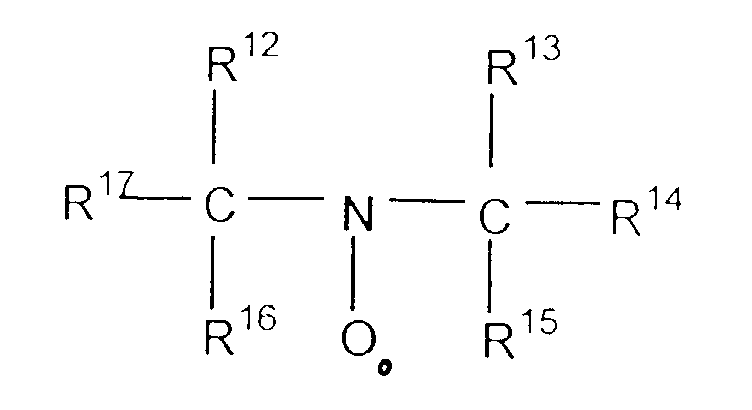
wherein each of R17, R12 and R13 and R14 is a hydrocarbyl group or hetero-atom substituted hydrocarbyl group having 1 to 200 carbon atoms, R15 and R16 (a) each being a hydrocarbyl group having 1 to 200 carbon atoms, or a substituted hydrocarbyl group having 1 to 200 carbon atoms wherein the substituent is halogen, cyano, -CONH2, SC6H5, -S-COCH3, -OCOCH3, -OCOC2H5, carbonyl, alkenyl wherein the double bond is not conjugated with the nitroxide moiety, or -COOR wherein R of the -COOR group is alkyl or aryl, or (b) together forming part of a ring that contains carbon atoms and up to two hetero-atoms of O, N or S, optionally linked to a side chain for enhancing the solubility of the free radical in a fuel oil.
wherein each of R17, R12 and R13 and R14 is a hydrocarbyl group or hetero-atom substituted hydrocarbyl group having 1 to 200 carbon atoms, R15 and R16 (a) each being a hydrocarbyl group having 1 to 200 carbon atoms, or a substituted hydrocarbyl group having 1 to 200 carbon atoms wherein the substituent is halogen, cyano, -CONH2, SC6H5, -S-COCH3, -OCOCH3, -OCOC2H5, carbonyl, alkenyl wherein the double bond is not conjugated with the nitroxide moiety, or -COOR wherein R of the -COOR group is alkyl or aryl, or (b) together forming part of a ring that contains carbon atoms and up to two hetero-atoms of O, N or S, optionally linked to a side chain for enhancing the solubility of the free radical in a fuel oil.
1. Verwendung als Additiv in einem Mitteldestillatbrennstofföl im Siedebereich von 120°C
bis 500°C (ASTM D-86) zur Verminderung von einer oder mehreren aus Teilchenemissionen,
Kohlenwasserstoffemissionen, Kohlenmonoxidemissionen und Stickoxidemissionen bei Verbrennung
des Brennstofföls, wobei das Additiv in einem Anteil von weniger als 80 Gew.ppm aktiver
Bestandteil, bezogen auf das Gewicht des Brennstofföls, vorhanden ist und ein öllösliches
stabiles freies Radikal oder einen Vorläufer desselben umfaßt, der bei der Verbrennung
in ein öllösliches stabiles freies Radikal umwandelbar ist, wobei das stabile freie
Radikal ein Aminyloxid mit der Formel

ist, wobei jeder von R17, R12 und R13 und R14 eine Kohlenwasserstoffgruppe oder heteroatomsubstituierte Kohlenwasserstoffgruppe mit 1 bis 200 Kohlenstoffatomen ist, R15 und R16 (a) jeweils eine Kohlenwasserstoffgruppe mit 1 bis 200 Kohlenstoffatomen oder eine substituierte Kohlenwasserstoffgruppe mit 1 bis 200 Kohlenstoffatomen sind, wobei der Substituent Halogen, Cyano, -CONH2, SC6H5, -S-COCH3, -OCOCH3, -OCOC2H5, Carbonyl, Alkenyl, wobei die Doppelbindung nicht mit dem Aminyloxidanteil konjugiert ist, oder -COOR ist, wobei R der -COOR-Gruppe Alkyl oder Aryl ist, oder (b) zusammen einen Teil eines Rings bilden, der Kohlenstoffatome und bis zu zwei Heteroatome aus O, N oder S umfaßt, die gegebenenfalls zur Erhöhung der Löslichkeit des freien Radikals in einem Brennstofföl an eine Seitenkette gebunden sind.
ist, wobei jeder von R17, R12 und R13 und R14 eine Kohlenwasserstoffgruppe oder heteroatomsubstituierte Kohlenwasserstoffgruppe mit 1 bis 200 Kohlenstoffatomen ist, R15 und R16 (a) jeweils eine Kohlenwasserstoffgruppe mit 1 bis 200 Kohlenstoffatomen oder eine substituierte Kohlenwasserstoffgruppe mit 1 bis 200 Kohlenstoffatomen sind, wobei der Substituent Halogen, Cyano, -CONH2, SC6H5, -S-COCH3, -OCOCH3, -OCOC2H5, Carbonyl, Alkenyl, wobei die Doppelbindung nicht mit dem Aminyloxidanteil konjugiert ist, oder -COOR ist, wobei R der -COOR-Gruppe Alkyl oder Aryl ist, oder (b) zusammen einen Teil eines Rings bilden, der Kohlenstoffatome und bis zu zwei Heteroatome aus O, N oder S umfaßt, die gegebenenfalls zur Erhöhung der Löslichkeit des freien Radikals in einem Brennstofföl an eine Seitenkette gebunden sind.
2. Zusammensetzung, die einen größeren Anteil eines Mitteldestillatbrennstofföls im Siedebereich
von 120°C bis 500°C (ASTM D-86) und weniger als 80 Gew.ppm aktiven Bestandteil, bezogen
auf das Gewicht des Brennstofföls, von einem Additiv umfaßt, das ein öllösliches stabiles
freies Radikal oder einen Vorläufer desselben umfaßt, der bei Verbrennung der Zusammensetzung
in ein öllösliches stabiles freies Radikal umwandelbar ist, wobei das stabile freie
Radikal ein Aminyloxid mit der Formel
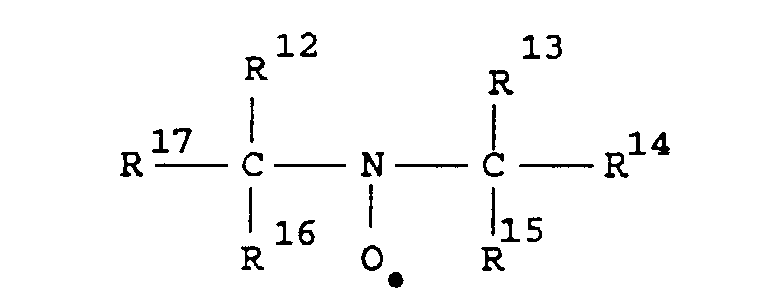
ist, wobei jeder von R17, R12 und R13 und R14 eine Kohlenwasserstoffgruppe oder heteroatomsubstituierte Kohlenwasserstoffgruppe mit 1 bis 200 Kohlenstoffatomen ist, R15 und R16 (a) jeweils eine Kohlenwasserstoffgruppe mit 1 bis 200 Kohlenstoffatomen oder eine substituierte Kohlenwasserstoffgruppe mit 1 bis 200 Kohlenstoffatomen sind, wobei der Substituent Halogen, Cyano, -CONH2, SC6H5, -S-COCH3, -OCOCH3, -OCOC2H5, Carbonyl, Alkenyl, wobei die Doppelbindung nicht mit dem Aminyloxidanteil konjugiert ist, oder -COOR ist, wobei R der -COOR-Gruppe Alkyl oder Aryl ist, oder (b) zusammen einen Teil eines Rings bilden, der Kohlenstoffatome und bis zu zwei Heteroatome aus O, N oder S umfaßt, die gegebenenfalls zur Erhöhung der Löslichkeit des freien Radikals in einem Brennstofföl an eine Seitenkette gebunden sind.
ist, wobei jeder von R17, R12 und R13 und R14 eine Kohlenwasserstoffgruppe oder heteroatomsubstituierte Kohlenwasserstoffgruppe mit 1 bis 200 Kohlenstoffatomen ist, R15 und R16 (a) jeweils eine Kohlenwasserstoffgruppe mit 1 bis 200 Kohlenstoffatomen oder eine substituierte Kohlenwasserstoffgruppe mit 1 bis 200 Kohlenstoffatomen sind, wobei der Substituent Halogen, Cyano, -CONH2, SC6H5, -S-COCH3, -OCOCH3, -OCOC2H5, Carbonyl, Alkenyl, wobei die Doppelbindung nicht mit dem Aminyloxidanteil konjugiert ist, oder -COOR ist, wobei R der -COOR-Gruppe Alkyl oder Aryl ist, oder (b) zusammen einen Teil eines Rings bilden, der Kohlenstoffatome und bis zu zwei Heteroatome aus O, N oder S umfaßt, die gegebenenfalls zur Erhöhung der Löslichkeit des freien Radikals in einem Brennstofföl an eine Seitenkette gebunden sind.
3. Verwendung nach Anspruch 1 oder Zusammensetzung nach Anspruch 2, bei der eine oder
mehrere der Kohlenwasserstoffgruppen eine Alkylgruppe mit 1 bis 15 Kohlenstoffatomen
ist.
4. Verwendung oder Zusammensetzung nach einem der Ansprüche 1 bis 3, bei der der Ring
4 oder 5 Kohlenstoffatome enthält.
5. Verwendung oder Zusammensetzung nach einem der Ansprüche 1 bis 4, bei der jede von
R17, R12, R13 und R14 eine Methyl-, Ethyl- oder Propylgruppe ist.
6. Verwendung oder Zusammensetzung nach einem der Ansprüche 1 bis 5, bei der jede von
R15 und R16 eine Methyl-, Ethyl- oder Propylgruppe ist.
7. Verwendung oder Zusammensetzung nach einem der Ansprüche 1 bis 5, bei der das Aminyloxid
4-Hydroxy-2,2,6,6-tetramethylpiperindinyloxid ist.
8. Verwendung oder Zusammensetzung nach einem der vorhergehenden Ansprüche, bei der das
Mitteldestillaterdölbrennstofföl ein Dieselöl ist.
9. Verwendung oder Zusammensetzung nach einem der vorhergehenden Ansprüche, bei der der
Anteil im Bereich von 1 bis 50 ppm liegt.
10. Verwendung oder Zusammensetzung nach einem der vorhergehenden Ansprüche, bei der das
Additiv in Kombination mit einem oder mehreren Coadditiven vorliegt.
11. Verwendung oder Zusammensetzung nach Anspruch 10, bei der das oder eines der Coadditiv(e)
eine öllösliche Verbindung mit der Formel

oder
R6R4N(R5)b[NR4(R5)c]dNR4R4
oder Mischungen aus zwei oder mehreren solchen Verbindungen ist, wobei R1, R2 und R3 gleich oder unterschiedlich sein können und unabhängig Wasserstoff oder ein Kohlenwasserstoffsubstituent mit 2 bis 600 Kohlenstoffatomen oder ein Keto-, Hydroxy-, Nitro-, Cyano- oder Alkoxyderivat desselben sind, mit der Maßgabe, daß mindestens einer aus R1, R2 und R3 ein Kohlenwasserstoffsubstituent mit 2 bis 600 Kohlenstoffatomen oder das Derivat desselben ist, oder wobei R1 und R2 zusammen einen zweiwertigen Kohlenwasserstoffsubstituenten mit 4 bis 600 Kohlenstoffatomen oder ein Keto-, Hydroxy-, Nitro-, Cyano- oder Alkoxyderivat desselben bilden, mit der Maßgabe, daß R1 und R2 zusammen mit dem Kohlenstoffatom, das die C-R1-Bindung mit R1 bildet, und dem Stickstoffatom, das die N-R2-Bindung mit R2 bildet, einen Ring mit mindestens 5 Gliedern bilden, wobei Z
-R10[NR11(R10)]e-
oder
-[R10R11N]fR10[NR11R10]g-
wiedergibt, wobei jedes R10, das gleich oder unterschiedlich sein kann, eine Alkylengruppe mit 1 bis 5 Kohlenstoffatomen in seiner Kette wiedergibt, R11 ein Wasserstoffatom oder eine Kohlenwasserstoffgruppe wiedergibt, und e 0 bis 6 ist, f 1 bis 4 ist, g 1 bis 4 ist, mit der Maßgabe, daß f + g höchstens 5 ist, jedes R4 unabhängig Wasserstoff oder eine Alkylgruppe mit bis zu 5 Kohlenstoffatomen ist, R5 eine Alkylengruppe mit bis zu 6 Kohlenstoffatomen in der Kette ist, die gegebenenfalls mit einer oder mehreren Kohlenwasserstoffgruppen mit bis zu 10 Kohlenstoffatomen, einer Acylgruppe mit 2 bis 10 Kohlenstoffatomen, oder einem Keto-, Hydroxy-, Nitro-, Cyano-oder Alkoxyderivat einer Kohlenwasserstoffgruppe mit 1 bis 10 Kohlenstoffatomen oder einer Acylgruppe mit 2 bis 10 Kohlenstoffatomen substituiert ist, R6 ein Kohlenwasserstoffsubstituent mit 2 bis 600 Kohlenstoffatomen oder das Derivat desselben ist, b 1 bis 6 ist, c 1 bis 6 ist, und d 0 bis 12 ist.
oder
R6R4N(R5)b[NR4(R5)c]dNR4R4
oder Mischungen aus zwei oder mehreren solchen Verbindungen ist, wobei R1, R2 und R3 gleich oder unterschiedlich sein können und unabhängig Wasserstoff oder ein Kohlenwasserstoffsubstituent mit 2 bis 600 Kohlenstoffatomen oder ein Keto-, Hydroxy-, Nitro-, Cyano- oder Alkoxyderivat desselben sind, mit der Maßgabe, daß mindestens einer aus R1, R2 und R3 ein Kohlenwasserstoffsubstituent mit 2 bis 600 Kohlenstoffatomen oder das Derivat desselben ist, oder wobei R1 und R2 zusammen einen zweiwertigen Kohlenwasserstoffsubstituenten mit 4 bis 600 Kohlenstoffatomen oder ein Keto-, Hydroxy-, Nitro-, Cyano- oder Alkoxyderivat desselben bilden, mit der Maßgabe, daß R1 und R2 zusammen mit dem Kohlenstoffatom, das die C-R1-Bindung mit R1 bildet, und dem Stickstoffatom, das die N-R2-Bindung mit R2 bildet, einen Ring mit mindestens 5 Gliedern bilden, wobei Z
-R10[NR11(R10)]e-
oder
-[R10R11N]fR10[NR11R10]g-
wiedergibt, wobei jedes R10, das gleich oder unterschiedlich sein kann, eine Alkylengruppe mit 1 bis 5 Kohlenstoffatomen in seiner Kette wiedergibt, R11 ein Wasserstoffatom oder eine Kohlenwasserstoffgruppe wiedergibt, und e 0 bis 6 ist, f 1 bis 4 ist, g 1 bis 4 ist, mit der Maßgabe, daß f + g höchstens 5 ist, jedes R4 unabhängig Wasserstoff oder eine Alkylgruppe mit bis zu 5 Kohlenstoffatomen ist, R5 eine Alkylengruppe mit bis zu 6 Kohlenstoffatomen in der Kette ist, die gegebenenfalls mit einer oder mehreren Kohlenwasserstoffgruppen mit bis zu 10 Kohlenstoffatomen, einer Acylgruppe mit 2 bis 10 Kohlenstoffatomen, oder einem Keto-, Hydroxy-, Nitro-, Cyano-oder Alkoxyderivat einer Kohlenwasserstoffgruppe mit 1 bis 10 Kohlenstoffatomen oder einer Acylgruppe mit 2 bis 10 Kohlenstoffatomen substituiert ist, R6 ein Kohlenwasserstoffsubstituent mit 2 bis 600 Kohlenstoffatomen oder das Derivat desselben ist, b 1 bis 6 ist, c 1 bis 6 ist, und d 0 bis 12 ist.
12. Verwendung oder Zusammensetzung nach Anspruch 11, bei der die Verbindung der Formel
(I)
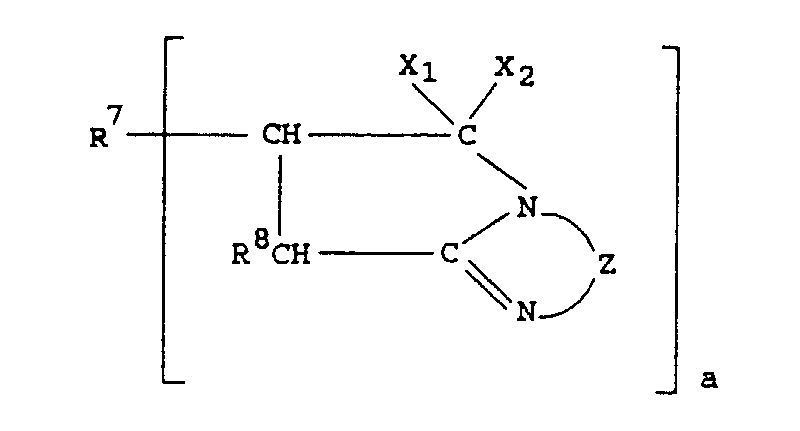
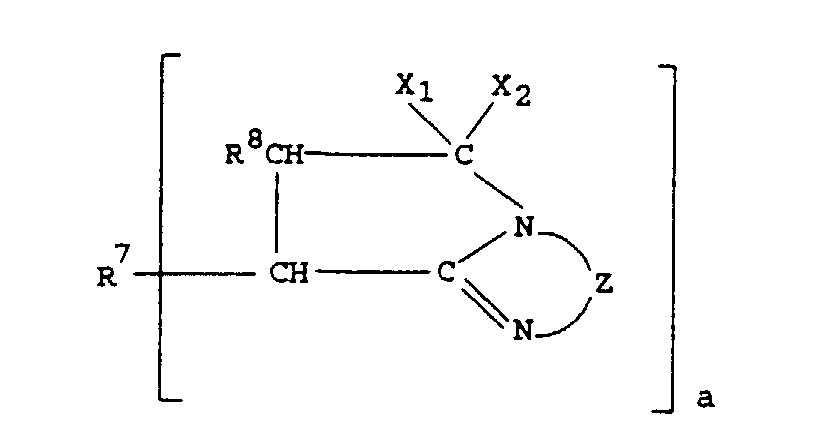

ist, wobei R7 Wasserstoff oder ein Kohlenwasserstoffsubstituent mit 1 bis 600 Kohlenstoffatomen ist, R8 Wasserstoff oder ein C1- bis C12-Kohlenwasserstoffsubstituent ist, und wenn mehr als ein R8 in einer Verbindung vorhanden ist, dies gleich oder unterschiedlich sein kann, R9 ein zweiwertiger Kohlenwasserstoffsubstituent mit 2 bis 600 Kohlenstoffatomen ist, wobei zwei der Kohlenstoffatome an die a-Kohlenstoffatome des Rings auf Bernsteinsäureanhydridbasis gebunden sind, X1 Wasserstoff oder eine Alkylgruppe mit 1 bis 12 Kohlenstoffatomen wiedergibt, X2 Wasserstoff, eine Alkylgruppe mit 1 bis 12 Kohlenstoffatomen, eine Hydroxygruppe oder eine Alkoxygruppe wiedergibt, wobei die Alkoxygruppe 1 bis 12 Kohlenstoffatome hat, oder X1 und X2 zusammen ein Sauerstoffatom (oder Schwefelatom) wiedergeben können, und a 1 bis 20 ist.
ist, wobei R7 Wasserstoff oder ein Kohlenwasserstoffsubstituent mit 1 bis 600 Kohlenstoffatomen ist, R8 Wasserstoff oder ein C1- bis C12-Kohlenwasserstoffsubstituent ist, und wenn mehr als ein R8 in einer Verbindung vorhanden ist, dies gleich oder unterschiedlich sein kann, R9 ein zweiwertiger Kohlenwasserstoffsubstituent mit 2 bis 600 Kohlenstoffatomen ist, wobei zwei der Kohlenstoffatome an die a-Kohlenstoffatome des Rings auf Bernsteinsäureanhydridbasis gebunden sind, X1 Wasserstoff oder eine Alkylgruppe mit 1 bis 12 Kohlenstoffatomen wiedergibt, X2 Wasserstoff, eine Alkylgruppe mit 1 bis 12 Kohlenstoffatomen, eine Hydroxygruppe oder eine Alkoxygruppe wiedergibt, wobei die Alkoxygruppe 1 bis 12 Kohlenstoffatome hat, oder X1 und X2 zusammen ein Sauerstoffatom (oder Schwefelatom) wiedergeben können, und a 1 bis 20 ist.
13. Verwendung oder Zusammensetzung nach Anspruch 12, bei der eines oder beide von R7 und R9 ein C2- bis C5-Olefinpolymer ist bzw. sind oder von diesem abgeleitet ist bzw. sind.
14. Verwendung oder Zusammensetzung nach Anspruch 13, bei der das Polymer Polyisobutylen
ist.
15. Verwendung oder Zusammensetzung nach einem der Ansprüche 11 bis 14, bei der das Coadditiv
in dem Brennstofföl in einem Anteil im Bereich von 50 bis 20 000 Gew.ppm aktiver Bestandteil,
bezogen auf das Gewicht des Brennstofföls, vorhanden ist.
16. Verwendung oder Zusammensetzung nach Anspruch 15, bei der der Anteil im Bereich von
10 bis 500 ppm liegt.
17. Verwendung oder Zusammensetzung nach Anspruch 10, bei der das oder eines der Coadditive
ein Zündbeschleuniger (Cetanverbesserer) ist.
18. Verwendung oder Zusammensetzung nach Anspruch 17, bei der der Zündbeschleuniger ein
aliphatisches oder cycloaliphatisches Nitrat ist.
19. Verwendung oder Zusammensetzung nach Anspruch 18, bei der das Nitrat ein Alkyl- oder
Cycloalkylnitrat ist, das bis zu 30 Kohlenstoffatome enthält.
20. Verwendung oder Zusammensetzung nach einem der Ansprüche 17 bis 19, bei der der Zündbeschleuniger
in dem Brennstofföl in einem Anteil im Bereich von 5 bis 10 000 Gew.ppm aktiver Bestandteil,
bezogen auf das Gewicht des Brennstofföls, vorhanden ist.
21. Verwendung oder Zusammensetzung nach Anspruch 20, bei der der Anteil 50 bis 2000 ppm
beträgt.
22. Verwendung oder Zusammensetzung nach Anspruch 10, bei der das oder eines der Coadditive
ein Polymer eines C2- bis C6-Monoolefins ist, wobei das Polymer ein durchschnittliches Molekulargewicht (Zahlenmittel)
von weniger als etwa 500 aufweist.
23. Verwendung oder Zusammensetzung nach Anspruch 22, bei der das Polymer Polyisobutylen
ist.
24. Verfahren zum Betreiben eines Dieselmotors zur Verminderung von einer oder mehreren
aus Teilchenemissionen, Kohlenwasserstoffemissionen, Kohlenmonoxidemissionen und Stickoxidemissionen
beim Betreiben des Motors, wobei bei dem Verfahren in dem Motor eine Zusammensetzung
verbrannt wird, die einen größeren Anteil eines Mitteldestillatbrennstofföls im Siedebereich
von 120°C bis 500°C (ASTM D86) und weniger als 80 Gew.ppm aktiven Bestandteil, bezogen
auf das Gewicht des Brennstofföls, von einem Additiv umfaßt, das ein öllösliches stabiles
freies Radikal oder einen Vorläufer desselben umfaßt, der bei der Verbrennung in ein
öllösliches freies Radikal umwandelbar ist, wobei das stabile freie Radikal ein Aminyloxid
mit der Formel

ist, wobei jedes von R17, R12 und R13 und R14 eine Kohlenwasserstoffgruppe oder heteroatomsubstituierte Kohlenwasserstoffgruppe mit 1 bis 200 Kohlenstoffatomen ist, R15 und R16 (a) jeweils eine Kohlenwasserstoffgruppe mit 1 bis 200 Kohlenstoffatomen oder eine substituierte Kohlenwasserstoffgruppe mit 1 bis 200 Kohlenstoffatomen sind, wobei der Substituent Halogen, Cyano, -CONH2, SC6H5, -S-COCH3, -OCOCH3, -OCOC2H5, Carbonyl, Alkenyl, wobei die Doppelbindung nicht mit dem Aminyloxidanteil konjugiert ist, oder -COOR ist, wobei R der -COOR-Gruppe Alkyl oder Aryl ist, oder (b) zusammen einen Teil eines Rings bilden, der Kohlenstoffatome und bis zu zwei Heteroatome aus O, N oder S umfaßt, die gegebenenfalls zur Erhöhung der Löslichkeit des freien Radikals in einem Brennstofföl an eine Seitenkette gebunden sind.
ist, wobei jedes von R17, R12 und R13 und R14 eine Kohlenwasserstoffgruppe oder heteroatomsubstituierte Kohlenwasserstoffgruppe mit 1 bis 200 Kohlenstoffatomen ist, R15 und R16 (a) jeweils eine Kohlenwasserstoffgruppe mit 1 bis 200 Kohlenstoffatomen oder eine substituierte Kohlenwasserstoffgruppe mit 1 bis 200 Kohlenstoffatomen sind, wobei der Substituent Halogen, Cyano, -CONH2, SC6H5, -S-COCH3, -OCOCH3, -OCOC2H5, Carbonyl, Alkenyl, wobei die Doppelbindung nicht mit dem Aminyloxidanteil konjugiert ist, oder -COOR ist, wobei R der -COOR-Gruppe Alkyl oder Aryl ist, oder (b) zusammen einen Teil eines Rings bilden, der Kohlenstoffatome und bis zu zwei Heteroatome aus O, N oder S umfaßt, die gegebenenfalls zur Erhöhung der Löslichkeit des freien Radikals in einem Brennstofföl an eine Seitenkette gebunden sind.
1. Utilisation d'un additif dans un fuel-oil distillé moyen bouillant dans la plage de
120°C à 500°C (ASTM D-86), pour réduire, lors de la combustion du fuel-oil, une ou
plusieurs émissions consistant en émission de particules, émissions d'hydrocarbure,
émissions de monoxyde de carbone et émissions d'oxydes d'azote, l'additif étant présent
en une proportion inférieure à 80 ppm d'ingrédient actif en poids, sur la base du
poids du fuel-oil, et comprenant un radical libre stable, soluble dans l'huile, ou
un de ses précurseurs qui peut être transformé en un radical libre stable, soluble
dans l'huile, dans les conditions de ladite combustion, dans laquelle le radical libre
stable est un nitroxyde de formule :
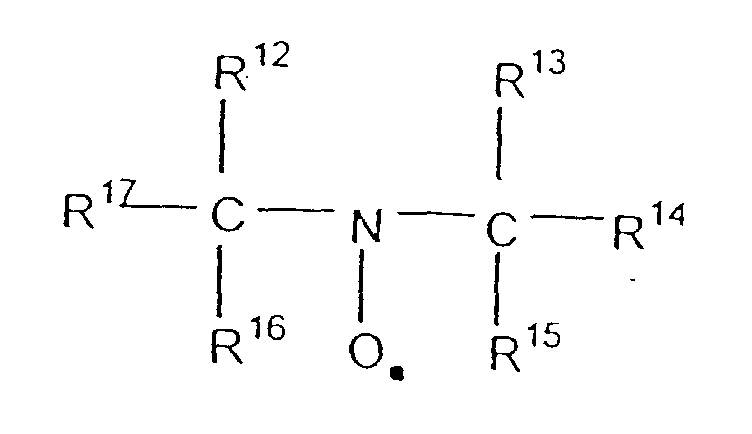
dans laquelle chacun des groupes R17, R12, R13 et R14 représente un groupe hydrocarbyle ou groupe hydrocarbyle substitué avec un hétéroatome ayant 1 à 200 atomes de carbone, R15 et R16 (a) représentant chacun un groupe hydrocarbyle ayant 1 à 200 atomes de carbone, ou un groupe hydrocarbyle substitué ayant 1 à 200 atomes de carbone dans lequel le substituant est un substituant halogéno, cyano, -CONH2, -SC6H5, -S-COCH3, -OCOCH3, -OCOC2H5, carbonyle, alcényle dans lequel la double liaison n'est pas conjuguée avec le groupement nitroxyde, ou -COOR dans lequel le groupe R du groupe -COOR est un groupe alkyle ou aryle, ou (b) faisant partie conjointement d'un noyau qui contient des atomes de carbone et jusqu'à deux hétéroatomes O, N ou S, facultativement lié à une chaîne latérale pour accroître la solubilité du radical libre dans un fuel-oil.
dans laquelle chacun des groupes R17, R12, R13 et R14 représente un groupe hydrocarbyle ou groupe hydrocarbyle substitué avec un hétéroatome ayant 1 à 200 atomes de carbone, R15 et R16 (a) représentant chacun un groupe hydrocarbyle ayant 1 à 200 atomes de carbone, ou un groupe hydrocarbyle substitué ayant 1 à 200 atomes de carbone dans lequel le substituant est un substituant halogéno, cyano, -CONH2, -SC6H5, -S-COCH3, -OCOCH3, -OCOC2H5, carbonyle, alcényle dans lequel la double liaison n'est pas conjuguée avec le groupement nitroxyde, ou -COOR dans lequel le groupe R du groupe -COOR est un groupe alkyle ou aryle, ou (b) faisant partie conjointement d'un noyau qui contient des atomes de carbone et jusqu'à deux hétéroatomes O, N ou S, facultativement lié à une chaîne latérale pour accroître la solubilité du radical libre dans un fuel-oil.
2. Composition comprenant une proportion dominante d'un fuel-oil distillé moyen bouillant
dans la plage de 120°C à 500°C (ASTM D-86) et moins de 80 ppm d'ingrédient actif en
poids, sur la base du poids du fuel-oil, d'un additif comprenant un radical libre
stable, soluble dans l'huile, ou un de ses précurseurs qui peut être transformé en
un radical libre stable, soluble dans l'huile, dans les conditions de combustion de
ladite composition, dans laquelle le radical libre stable est un nitroxyde de formule
:
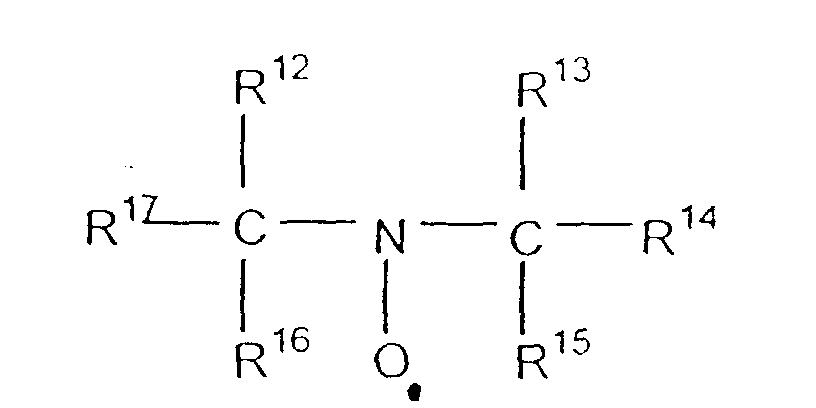
dans laquelle chacun des groupes R17, R12, R13 et R14 représente un groupe hydrocarbyle ou groupe hydrocarbyle substitué avec un hétéroatome ayant 1 à 200 atomes de carbone, R15 et R16 (a) représentant chacun un groupe hydrocarbyle ayant 1 à 200 atomes de carbone, ou un groupe hydrocarbyle substitué ayant 1 à 200 atomes de carbone dans lequel le substituant est un substituant halogéno, cyano, -CONH2, -SC6H5, -S-COCH3, -OCOCH3, -OCOC2H5, carbonyle, alcényle dans lequel la double liaison n'est pas conjuguée avec le groupement nitroxyde, ou -COOR dans lequel le groupe R du groupe -COOR est un groupe alkyle ou aryle, ou (b) faisant partie conjointement d'un noyau qui contient des atomes de carbone et jusqu'à deux hétéroatomes O, N ou S, facultativement lié à une chaîne latérale pour accroître la solubilité du radical libre dans un fuel-oil.
dans laquelle chacun des groupes R17, R12, R13 et R14 représente un groupe hydrocarbyle ou groupe hydrocarbyle substitué avec un hétéroatome ayant 1 à 200 atomes de carbone, R15 et R16 (a) représentant chacun un groupe hydrocarbyle ayant 1 à 200 atomes de carbone, ou un groupe hydrocarbyle substitué ayant 1 à 200 atomes de carbone dans lequel le substituant est un substituant halogéno, cyano, -CONH2, -SC6H5, -S-COCH3, -OCOCH3, -OCOC2H5, carbonyle, alcényle dans lequel la double liaison n'est pas conjuguée avec le groupement nitroxyde, ou -COOR dans lequel le groupe R du groupe -COOR est un groupe alkyle ou aryle, ou (b) faisant partie conjointement d'un noyau qui contient des atomes de carbone et jusqu'à deux hétéroatomes O, N ou S, facultativement lié à une chaîne latérale pour accroître la solubilité du radical libre dans un fuel-oil.
3. Utilisation suivant la revendication 1, ou composition suivant la revendication 2,
dans laquelle un ou plusieurs des groupes hydrocarbyle consistent en groupes alkyle
ayant 1 à 15 atomes de carbone.
4. Utilisation ou composition suivant l'une quelconque des revendications 1 à 3, dans
laquelle le noyau contient 4 ou 5 atomes de carbone.
5. Utilisation ou composition suivant l'une quelconque des revendications 1 à 4, dans
laquelle chacun des groupes R17, R12, R13 et R14 représente un groupe méthyle, éthyle ou propyle.
6. Utilisation ou composition suivant l'une quelconque des revendications 1 à 5, dans
laquelle chacun des groupes R15 et R16 représente un groupe méthyle, éthyle ou propyle.
7. Utilisation ou composition suivant l'une quelconque des revendications 1 à 5, dans
laquelle le nitroxyde consiste en 4-hydroxy-2,2,6,6-tétraméthyl-pipéridinyloxy.
8. Utilisation ou composition suivant l'une quelconque des revendications précédentes,
dans laquelle le fuel-oil distillé moyen dérivé du pétrole est un combustible diesel.
9. Utilisation ou composition suivant l'une quelconque des revendications précédentes,
dans laquelle la proportion est comprise dans l'intervalle de 1 à 50 ppm.
10. Utilisation ou composition suivant l'une quelconque des revendications précédentes,
dans laquelle l'additif est présent en association avec un ou plusieurs co-additifs.
11. Utilisation ou composition suivant la revendication 10, dans laquelle le co-additif
ou l'un des co-additifs est un composé, soluble dans l'huile, de formule :

ou
R6R4N(R5)b[NR4(R5)c]dNR4R4
ou un mélange de deux ou plus de deux tels composés, formule dans laquelle R1, R2 et R3 peuvent être identiques ou différents et représentent, indépendamment, l'hydrogène ou un substituant hydrocarbyle ayant 2 à 600 atomes de carbone, ou un de ses dérivés à fonction céto, hydroxy, nitro, cyano ou alkoxy, sous réserve qu'au moins un des groupes R1, R2 et R3 soit un substituant hydrocarbyle ayant 2 à 600 atomes de carbone ou un tel dérivé, ou dans laquelle R1 et R2 forment conjointement un substituant hydrocarbylène ayant 4 à 600 atomes de carbone ou un de ses dérivés à fonction céto, hydroxy, nitro, cyano ou alkoxy, sous réserve que R1 et R2, conjointement avec l'atome de carbone qui forme la liaison C-R1 avec R1 et l'atome d'azote qui forme la liaison N-R2 avec R2, forment un noyau constitué d'au moins 5 atomes, Z représente un groupe
-R10[NR11(R10)]e-
ou
-[R10R11N]fR10[NR11R10]g-
dans lequel chacun des groupes R10, qui peuvent être identiques ou différents, représente un groupe alkylène ayant 1 à 5 atomes de carbone dans sa chaîne, R11 représente un atome d'hydrogène ou un groupe hydrocarbyle, et e a une valeur de 0 à 6, f a une valeur de 1 à 4, g a une valeur de 1 à 4, sous réserve que la somme f + g soit égale à 5 au plus, chaque groupe R4 représente, indépendamment, H ou un groupe alkyle ayant jusqu'à 5 atomes de carbone, R5 représente un groupe alkylène ayant jusqu'à 6 atomes de carbone dans la chaîne, facultativement substitué avec un ou plusieurs groupes hydrocarbyle ayant jusqu'à 10 atomes de carbone, un groupe acyle ayant 2 à 10 atomes de carbone, ou un dérivé à fonction céto, hydroxy, nitro, cyano ou alkoxy d'un groupe hydrocarbyle ayant 1 à 10 atomes de carbone ou d'un groupe acyle ayant 2 à 10 atomes de carbone, R6 représente un substituant hydrocarbyle ayant 2 à 600 atomes de carbone ou un de ses dérivés, b a une valeur de 1 à 6, c a une valeur de 1 à 6 et d a une valeur de 0 à 12.
ou
R6R4N(R5)b[NR4(R5)c]dNR4R4
ou un mélange de deux ou plus de deux tels composés, formule dans laquelle R1, R2 et R3 peuvent être identiques ou différents et représentent, indépendamment, l'hydrogène ou un substituant hydrocarbyle ayant 2 à 600 atomes de carbone, ou un de ses dérivés à fonction céto, hydroxy, nitro, cyano ou alkoxy, sous réserve qu'au moins un des groupes R1, R2 et R3 soit un substituant hydrocarbyle ayant 2 à 600 atomes de carbone ou un tel dérivé, ou dans laquelle R1 et R2 forment conjointement un substituant hydrocarbylène ayant 4 à 600 atomes de carbone ou un de ses dérivés à fonction céto, hydroxy, nitro, cyano ou alkoxy, sous réserve que R1 et R2, conjointement avec l'atome de carbone qui forme la liaison C-R1 avec R1 et l'atome d'azote qui forme la liaison N-R2 avec R2, forment un noyau constitué d'au moins 5 atomes, Z représente un groupe
-R10[NR11(R10)]e-
ou
-[R10R11N]fR10[NR11R10]g-
dans lequel chacun des groupes R10, qui peuvent être identiques ou différents, représente un groupe alkylène ayant 1 à 5 atomes de carbone dans sa chaîne, R11 représente un atome d'hydrogène ou un groupe hydrocarbyle, et e a une valeur de 0 à 6, f a une valeur de 1 à 4, g a une valeur de 1 à 4, sous réserve que la somme f + g soit égale à 5 au plus, chaque groupe R4 représente, indépendamment, H ou un groupe alkyle ayant jusqu'à 5 atomes de carbone, R5 représente un groupe alkylène ayant jusqu'à 6 atomes de carbone dans la chaîne, facultativement substitué avec un ou plusieurs groupes hydrocarbyle ayant jusqu'à 10 atomes de carbone, un groupe acyle ayant 2 à 10 atomes de carbone, ou un dérivé à fonction céto, hydroxy, nitro, cyano ou alkoxy d'un groupe hydrocarbyle ayant 1 à 10 atomes de carbone ou d'un groupe acyle ayant 2 à 10 atomes de carbone, R6 représente un substituant hydrocarbyle ayant 2 à 600 atomes de carbone ou un de ses dérivés, b a une valeur de 1 à 6, c a une valeur de 1 à 6 et d a une valeur de 0 à 12.
12. Utilisation ou composition suivant la revendication 11, dans laquelle le composé de
formule (I) répond à la formule


dans laquelle R7 représente l'hydrogène ou un substituant hydrocarbyle ayant 1 à 600 atomes de carbone, R8 représente l'hydrogène ou un substituant hydrocarbyle en C1 à C12 et, s'il existe plus d'un groupe R8 dans un composé, ces groupes peuvent être identiques ou différents, R9 représente un substituant hydrocarbylène ayant 2 à 600 atomes de carbone, dont deux atomes de carbone sont liés aux atomes de carbone α du noyau à base anhydride succinique, X1 représente l'hydrogène ou un groupe alkyle ayant 1 à 12 atomes de carbone, X2 représente l'hydrogène, un groupe alkyle ayant 1 à 12 atomes de carbone, un groupe hydroxy ou un groupe alkoxy, le groupe alkoxy ayant 1 à 12 atomes de carbone, ou bien X1 et X2 peuvent représenter conjointement un atome d'oxygène (ou de soufre) et a a une valeur de 1 à 20.
dans laquelle R7 représente l'hydrogène ou un substituant hydrocarbyle ayant 1 à 600 atomes de carbone, R8 représente l'hydrogène ou un substituant hydrocarbyle en C1 à C12 et, s'il existe plus d'un groupe R8 dans un composé, ces groupes peuvent être identiques ou différents, R9 représente un substituant hydrocarbylène ayant 2 à 600 atomes de carbone, dont deux atomes de carbone sont liés aux atomes de carbone α du noyau à base anhydride succinique, X1 représente l'hydrogène ou un groupe alkyle ayant 1 à 12 atomes de carbone, X2 représente l'hydrogène, un groupe alkyle ayant 1 à 12 atomes de carbone, un groupe hydroxy ou un groupe alkoxy, le groupe alkoxy ayant 1 à 12 atomes de carbone, ou bien X1 et X2 peuvent représenter conjointement un atome d'oxygène (ou de soufre) et a a une valeur de 1 à 20.
13. Utilisation ou composition suivant la revendication 12, dans laquelle l'un des ou
les deux groupes R7 et R9 est ou sont dérivés d'un polymère d'oléfine en C2 à C5.
14. Utilisation ou composition suivant la revendication 13, dans laquelle le polymère
consiste en polyisobutylène.
15. Utilisation ou composition suivant l'une quelconque des revendications 11 à 14, dans
laquelle le co-additif est présent dans le fuel-oil en une proportion comprise dans
l'intervalle de 50 à 20 000 ppm d'ingrédient actif en poids, sur la base du poids
du fuel-oil.
16. Utilisation ou composition suivant la revendication 15, dans laquelle la proportion
est comprise dans l'intervalle de 10 à 500 ppm.
17. Utilisation ou composition suivant la revendication 10, dans laquelle le co-additif
ou l'un des co-additifs est un agent améliorant l'indice de cétane.
18. Utilisation ou composition suivant la revendication 17, dans laquelle l'agent améliorant
l'indice de cétane est un nitrate aliphatique ou cycloaliphatique.
19. Utilisation ou composition suivant la revendication 18, dans laquelle le nitrate est
un nitrate d'alkyle ou de cycloalkyle contenant jusqu'à 30 atomes de carbone.
20. Utilisation ou composition suivant l'une quelconque des revendications 17 à 19, dans
laquelle l'agent améliorant l'indice de cétane est présent dans le fuel-oil en une
proportion comprise dans l'intervalle de 5 à 10 000 ppm d'ingrédient actif en poids,
sur la base du poids du fuel-oil.
21. Utilisation ou composition suivant la revendication 20, dans laquelle la proportion
est comprise dans l'intervalle de 50 à 2000 ppm.
22. Utilisation ou composition suivant la revendication 10, dans laquelle le co-additif
ou l'un des co-additifs est un polymère d'une mono-oléfine en C2 à C6, polymère ayant une moyenne numérique du poids moléculaire inférieure à environ 500.
23. Utilisation ou composition suivant la revendication 22, dans laquelle le polymère
consiste en polyisobutylène.
24. Procédé pour faire fonctionner un moteur diesel afin de réduire une ou plusieurs des
émissions consistant en émissions de particules, émissions d'hydrocarbures, émissions
de monoxyde de carbone et émissions d'oxydes d'azote lors du fonctionnement du moteur,
procédé qui comprend la combustion dans le moteur d'une composition comprenant une
proportion dominante d'un fuel-oil distillé moyen bouillant dans la plage de 120°C
à 500°C (ASTM D-86) et moins de 80 ppm d'ingrédient actif en poids, sur la base du
poids du fuel-oil, d'un additif comprenant un radical libre stable, soluble dans l'huile,
ou un de ses précurseurs qui peut être transformé en un radical libre, soluble dans
l'huile, dans les conditions de ladite combustion, dans lequel le radical libre stable
est un nitroxyde de formule :
dans laquelle chacun des groupes R17, R12, R13 et R14 représente un groupe hydrocarbyle ou groupe hydrocarbyle substitué avec un hétéroatome comprenant 1 à 200 atomes de carbone, R15 et R16 (a) représentant chacun un groupe hydrocarbyle ayant 1 à 200 atomes de carbone, ou un groupe hydrocarbyle substitué ayant 1 à 200 atomes de carbone dans lequel le substituant est un substituant halogéno, cyano, -CONH2, -SC6H5, -S-COCH3, -OCOCH3, -OCOC2H5, carbonyle, alcényle dans lequel la double liaison n'est pas conjuguée avec le groupement nitroxyde, ou -COOR dans lequel le groupe R du groupe -COOR est un groupe alkyle ou aryle, ou (b) faisant partie conjointement d'un noyau qui contient des atomes de carbone et jusqu'à deux hétéroatomes O, N ou S, facultativement lié à une chaîne latérale pour accroître la solubilité du radical libre dans un fuel-oil.
dans laquelle chacun des groupes R17, R12, R13 et R14 représente un groupe hydrocarbyle ou groupe hydrocarbyle substitué avec un hétéroatome comprenant 1 à 200 atomes de carbone, R15 et R16 (a) représentant chacun un groupe hydrocarbyle ayant 1 à 200 atomes de carbone, ou un groupe hydrocarbyle substitué ayant 1 à 200 atomes de carbone dans lequel le substituant est un substituant halogéno, cyano, -CONH2, -SC6H5, -S-COCH3, -OCOCH3, -OCOC2H5, carbonyle, alcényle dans lequel la double liaison n'est pas conjuguée avec le groupement nitroxyde, ou -COOR dans lequel le groupe R du groupe -COOR est un groupe alkyle ou aryle, ou (b) faisant partie conjointement d'un noyau qui contient des atomes de carbone et jusqu'à deux hétéroatomes O, N ou S, facultativement lié à une chaîne latérale pour accroître la solubilité du radical libre dans un fuel-oil.