(57) Diversity for direct sequence spread spectrum wireless communication systems is provided
by a transmitting technique for communicating a first signal comprising one or more
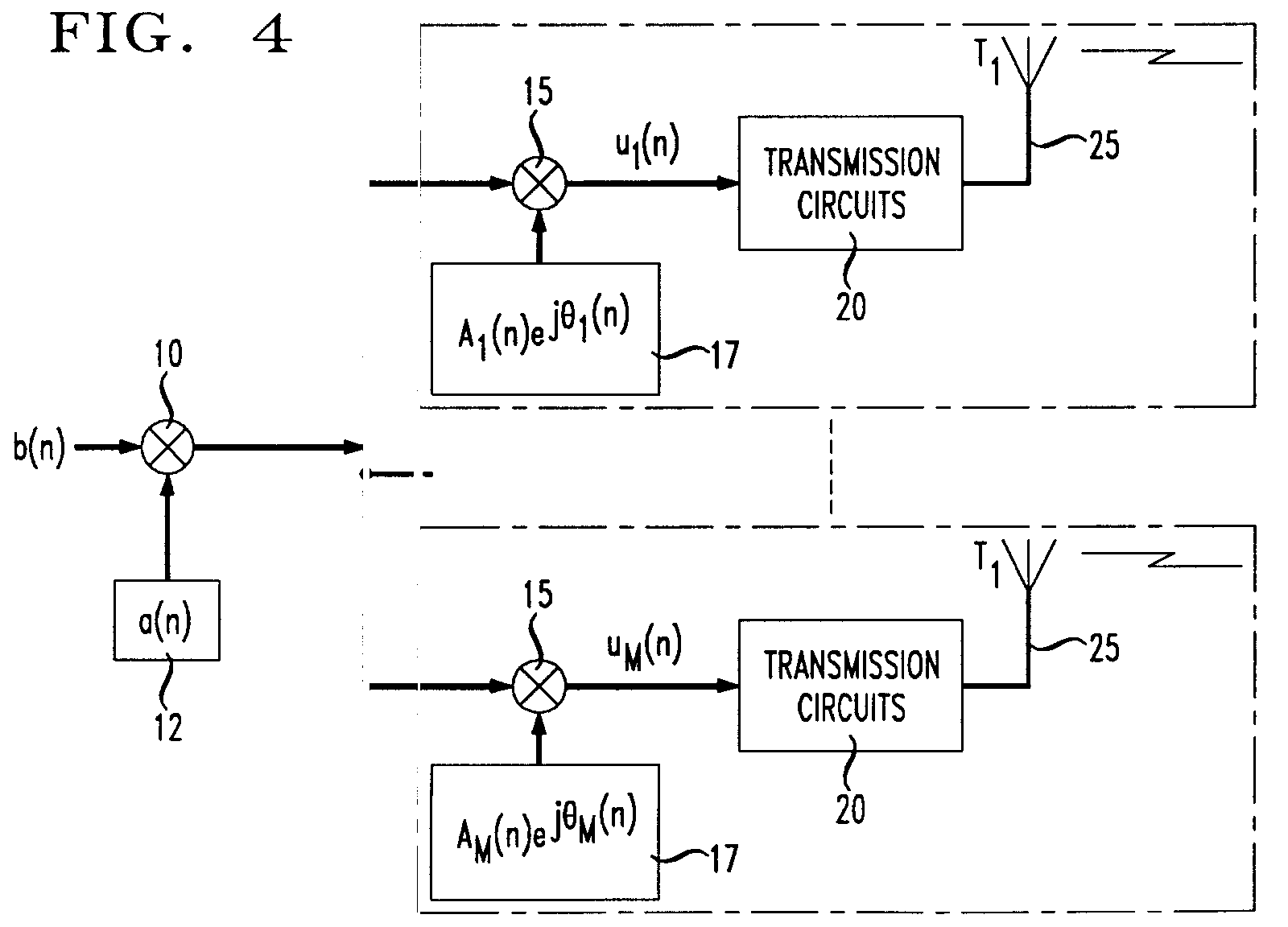
segments to a receiver via a plurality of M antennas (T₁, T₁). The first signal includes
one or more signal segments. The technique cmprises forming M copies of the first
signal; for a segment of a signal copy, weighting (by 15) each of two or more sub-segments
of the segment with a distinct signal (from 17), wherein a sequence of the distinct
weighting signals for the segment is distinct from sequences of signals weighting
the same segment of one or more other signal copies; and for each of M weighted signal
copies U₁(n)..Um(n), transmitting a signal to the receiver using a distinct antenna (T₁, T₁), the
transmitted signal being based on the weighted signal copy. Illustratively, the first
signal is a spread spectrum signal (by 10,12). Moreover, the process of weighting
comprises applying a phase shift to a sub-segment. The invention further provides
a receiving technique which comprises, for a copy of a received signal, despreading
a segment of the received signal, demodulating a plurality of sub-segments of the
despread signal segment, wherein each sub-segment is demodulated with use of one or
more estimated communication channel characteristics corresponding to the sub-segment,
and forming a summation signal reflecting a summation of a plurality of demodulated
sub-segments. The receiving technique further comprises forming a signal reflecting
a signal segment value, the formed signal based on one or more summation signals.
The step of demodulating may precede the step of despreading in some embodiments.
|
|
