|
(11) | EP 0 606 656 B1 |

| (12) | EUROPEAN PATENT SPECIFICATION |
|
|
| (54) |
Controlling method to follow-up target value Steuerungsmethode zur Erreichung eines Sollwertes Méthode de commande pour atteindre une valeur de consigne |
|
|
|||||||||||||||||||||||||||||||||||
| Note: Within nine months from the publication of the mention of the grant of the European patent, any person may give notice to the European Patent Office of opposition to the European patent granted. Notice of opposition shall be filed in a written reasoned statement. It shall not be deemed to have been filed until the opposition fee has been paid. (Art. 99(1) European Patent Convention). |
[0001] The present invention generally relates to a controlling method for having a desired target value followed up in an automatic control system.
[0002] In a controlling system of digits to be measured, calculated, outputted for each control cycle, a control demand value obtained by the calculation in accordance with a present value of a certain controlled physical quantity and a target value given by some means are given to a controlled apparatus so as to operate the controlled apparatus in accordance with a control demand value for causing the controlled physical quantity to change to follow up the target value. This controlling operation is widely effected in an automatic control system.
[0003] In this type of controlling method, it is a primary object to smoothly follow the controlled physical quantity to a target value. But a long time is often required to reach the target value. It is often impossible to follow the target value by a hunting operation caused.
[0004] Accordingly, the present invention has been developed with a view to substantially eliminating the above discussed drawbacks inherent in the prior art and for its essential object to provide an improved target value follow-up controlling method.
[0005] Another important object of the present invention is to provide an improved target value follow-up controlling method capable of causing the controlled physical quantity as smoothly as possible to follow up the target value.
[0006] According to the invention, there is provided a target value follow-up controlling method as defined by claim 1.
[0007] Assume that the controlled physical quantity measured value of the present cycle is X, the next cycle target value of the controlled physical quantity is Y, a control demand value with respect to the controlled apparatus (4) is Z.
[0009] In the present invention, a control demand value Z to be outputted at the present cycle
where the desired value of a variation dX per cycle of the controlled physical quantity is made dXw. The f-1 is an inverse function of a function
describing the relation between a control demand value Z during one cycle and a variation dX to appear in the controlled physical quantity through a controlled apparatus (4) having Z as a result outputted. The f can be considered an expectation value with respect to distribution. The P shows a parameter collectively when the reaction of the controlled apparatus (4) changes with respect to the same Z. For example, the P can be X or dX, the other physical quantity capable of measuring operation for reference, or a combination of them. Assume that the P is included in the function f if necessary, and it can be made as simple as
,
.
[0010] The function f is to previously suppose a proper shape as described in the claim 2 so that a constant in it can be learned from the actual value.
[0011] These and other objects and features of the present invention will become apparent from the following description of the preferred embodiments thereof, given by way of example with reference to the accompanying drawings, in which;
Fig. 1 is a diagram showing a control system to which a controlling method of the present invention is applied;
Fig. 2 is a time chart showing the following to a target value of the present value; and
Fig. 3 is a time chart showing the control operation of an apparatus of Fig. 2.
[0012] Before the description of the present invention proceeds, it is to be noted that like parts are designated by like reference numerals throughout the accompanying drawings.
[0013] Fig. 1 shows a control system to which the controlling method of the present invention is applied. Reference numeral 1 is a target value setting portion for calculating a target value Y in accordance with some measured value B for reflecting an external input A and / or a control system condition, reference numeral 2 is a desired variation operation portion for obtaining a desired variation dXw of the controlled physical quantity in accordance with the target value Y and a measured value X of the controlled physical quantity, reference numeral 3 is a control demand output portion for outputting a control demand value Z in accordance with a desired variation dXw and a parameter P for reflecting the condition of the control system, reference numeral 4 is a controlled apparatus to be operated in accordance with a control demand value Z.
[0014] The control demand output portion 3 is defined as an inverse function
of a function (namely, a characteristic function of a controlled apparatus (4)
between a control demand value Z and a variation dX of the controlled physical quantity to be realized through a controlled apparatus (4) due to outputting of a control demand value Z during one control cycle. When the desired variation dXw is inputted to the control demand output portion (3),
is outputted. The function f can be considered an expectation value with respect to distribution having certain dispersion.
[0015] A parameter P summarily shows a parameter in a case where the reaction of a controlled apparatus (4) changes with respect to the same control demand value Z. For example, the P may be X or dX, the other physical quantity to be measured for reference or a combination of them.
[0016] The function f is to previously suppose a proper shape so that a constant in it can be learned from actual values. When the function f is supposed as
as the simplest example, a constant b only can be learned with a constant a being fixed. It is considered for the b to be slowly followed towards (
) calculated from each actual result values Z and dX. The Z with respect to dXw is obtained as
with the use of leaned b in accordance with the inverse function f -1 of this case.
[0017] When the desired variation dXw exceeds a limit of the control performance of the controlled apparatus (4), the dXw enters a region of the function f-1 not defined. In this case, a maximum value is given immediately as the Z and the X is left from the Y. A deal with respect to the problem is given by the following control.
[0019]
shows the desired variation to be expected by the next cycle, wherein the present value is X, Y is a target value of the next cycle, W is a desired value showing how far X is approached in the next cycle.
Y-1 is a target value with respect to the present cycle calculated by the previous cycle and
is a variation of a target value. Assume that
, because the (Y - X) is a deviation between a target value and the present value. This means that the deviation is intended to disappear by 1 / n cycle.
[0020] Assume that
and it is intended to disappear with 1 / m cycle in 1 / m cycle in the former, and 1 / n cycle in the latter with the total deviation value (Y - X) being divided between the new deviation dY and the existing deviation (Y-1 -X).
[0021] The following advantage is provided by the separation between the disappearing speed of the new deviation and the disappearing speed of the existing deviation.
[0022] When the sign of the dY is different from that of (Y-1 -X), it is found from the combination of m, n that the sign of dXw can be inverted. This suggests from the situation that the control characteristics can be changed considerably depends upon a situation by only change in m, n.
[0023] When m, n are made larger (close to 1), weaker noises, instead of faster following, are provided. When the m, n are made smaller (close to 0), it becomes opposite. In addition to the above described common characteristics, there is a considerable effect in restraining the hunting that the phase delay of the X with respect to Y is reduced when the m / n is made larger.
[0024] From the fact, it is recommended that the phase be considered seriously, namely, m / n be relatively made larger, at a time when (dY > 0) and (Y or Y -1 be < X or
X, namely, Y is smaller than X) or (dY < 0) and (Y or Y-1 be > X or
X, namely, Y is larger than X). At a time except for it, the following property is considered seriously, namely, m / n is relatively made small.
[0025] In further detailed control, the sign of the variation ddY of the dY can be also considered. As the phase should be considered most seriously at a time when
the m / n can be set into two stages, three stages or four stages from three sign relation. At a time dY = 0, following property is considered seriously, namely, m / n is required to be kept relatively smaller (in this case, it means that n is substantially made sufficiently large, because
)
[0026] Even except for it, the division is effected in accordance with the characteristics of the control system, and m and n can be switched in value in accordance with the case.
[0028] When the noise of Y is sufficiently small practically, m = 1 is desirable. If m = 1,
in
, namely, when the change speed of the Y is constant, the following operation can be effected without constant deviation (needless to say, the controlling operation is restricted to time where dY is within the performance range of the controlled apparatus).
[0029] Noises of X may become large especially when the Z changes suddenly. The n often cannot be made too large except when the following property is not considered seriously. When such fear exists, dXw including noises is calculated, thereafter a filter may applied upon dXw so as to calculate Z. The calculation is effected till Z with the noises being included as they are, and thereafter, the filter processing operation is effected. The outputting operation can be effected. The relation among the above described noise and m, n show the relative tendency strictly.
[0030] As is clear from the foregoing description, the present method described above is especially effective in a case where a target value is adapted to change in connection with the controlled physical quantity. Some factors, for example, a case where the capability of the controlled apparatus is lower than the dXw temporarily, if Y comes smaller after X is left later than Y because of dispersion or the like in the response of the controlled apparatus and thereafter, namely, if dY becomes negative, the X still tries to follow the Y, thus the X outruns the Y, so that a hunting phenomenon is caused. It is known that a phenomenon where X and Y outruns each other because of the shift in phase is likely to be caused in a case where there is some cause and effect relationship between X and Y. According to the present method, the Z can be made negative relatively earlier when the dY becomes negative. Therefore, X is restrained from outrunning Y so that a stable controlling operation can be restored.
1. A target value follow-up controlling method comprising the steps of setting, in a
target value setting portion (1) of a control system which comprises, in succession,
said target value setting portion (1), a desired variation operation portion (2),
a control demand output portion (3), and a controlled apparatus (4), a target value
Y of a controlled physical quantity to be output by said controlled apparatus (4);
obtaining, in said desired variation operation portion (2) a desired variation dXw
per cycle of the controlled physical quantity on the basis of said target value Y
and a present value X of the controlled physical quantity; and obtaining in said control
demand output portion (3) a control demand value Z to be output during the present
cycle in accordance with the inverse function;

whereby the said inverse function relates to the inverse of a function f which defines the relationship between the control demand value Z and a variation dX of the controlled physical quantity; and whereby the controlled apparatus (4) responds to said obtained control demand value Z by changing said controlled physical quantity.
whereby the said inverse function relates to the inverse of a function f which defines the relationship between the control demand value Z and a variation dX of the controlled physical quantity; and whereby the controlled apparatus (4) responds to said obtained control demand value Z by changing said controlled physical quantity.
2. A target value follow-up controlling method as claimed in claim 1, further comprising
a step of learning, correcting constants to be included in the function f by the actual
values of Z and dX under controlling by the control demand output portion (3) in accordance
with a function of predetermined shape.
3. A target value follow-up controlling method as claimed in claim 1 or 2, further comprising
a step of having a variation dXw restrained, from dXw-1 outputted with the previous cycle by some means, with respect to dXw once calculated
by the desired variation operation portion (2) and thereafter to output it.
4. A target value follow-up control method as claimed in claim 1, 2 or 3, further comprising
a step of having a variation dZ restrained, from Z-1 outputted with the previous cycle by some means, with respect to Z once calculated
by the control demand output portion (3) and thereafter to output it.
5. A target value follow-up controlling method as claimed in claim 1, 2, 3 or 4, further
comprising a step of having the target value setting portion (1) adapted to set depending
at least particularly upon the measured value which is relative to controlled physical
quantity or controlled physical quantity.
1. Sollwertfolge-Steuerverfahren, das die Schritte zum Einstellen, in einem Sollwert-Einstellteil
(1) eines Steuersystems, das in Aufeinanderfolge den Sollwert-Einstellteil (1) einen
Operationsteil (2) für eine gewünschte Veränderung, einen Steueranforderungs-Ausgabeteil
(3) und ein gesteuertes Gerät (4) aufweist, eines Sollwerts Y einer gesteuerten physikalischen
Quantität, die durch das gesteuerte Gerät (4) auszugeben ist; zum Erhalten, im Operationsteil
(2) für eine gewünschte Veränderung, einer gewünschten Veränderung dXw pro Zyklus
der gesteuerten physikalischen Quantität auf der Basis des Sollwerts Y und eines gegenwärtigen
Werts X der gesteuerten physikalischen Quantität; und zum Erhalten, im Steueranforderungs-Ausgabeteil
(3), eines Steueranforderungswerts Z, der während dem vorliegenden Zyklus gemäß der
inversen Funktion
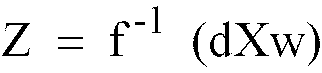
auszugeben ist, aufweist, wobei sich die inverse Funktion auf das Inverse einer Funktion f bezieht, die die Beziehung zwischen dem Steueranforderungswert Z und einer Veränderung dX der gesteuerten physikalischen Quantität definiert; und wobei das gesteuerte Gerät (4) auf den erhaltenen Steueranforderungswert Z durch Ändern der gesteuerten physikalischen Quantität antwortet.
auszugeben ist, aufweist, wobei sich die inverse Funktion auf das Inverse einer Funktion f bezieht, die die Beziehung zwischen dem Steueranforderungswert Z und einer Veränderung dX der gesteuerten physikalischen Quantität definiert; und wobei das gesteuerte Gerät (4) auf den erhaltenen Steueranforderungswert Z durch Ändern der gesteuerten physikalischen Quantität antwortet.
2. Sollwertfolge-Steuerverfahren nach Anspruch 1, das weiterhin einen Schritt zum Lernen,
zum Korrigieren von Konstanten, die in der Funktion f enthalten sein sollen, durch
die aktuellen Werte von Z und dX unter Steuerung durch den Steueranforderungs-Ausgabeteil
(3) gemäß einer Funktion einer vorbestimmten Form aufweist.
3. Sollwertfolge-Steuerverfahren nach Anspruch 1 oder 2, das weiterhin einen Schritt
aufweist zum Haben einer beschränkten Veränderung dXw von dXw-1, das beim vorherigen Zyklus durch eine Einrichtung ausgegeben wird, in bezug auf
dXw, was durch den Operationsteil (2) für eine gewünschte Veränderung einmal berechnet
ist, und danach zum Ausgeben davon.
4. Sollwertfolge-Steuerverfahren nach Anspruch 1, 2 oder 3, das weiterhin einen Schritt
aufweist zum Haben einer beschränkten Veränderung dZ von Z-1, das beim vorherigen Zyklus durch eine Einrichtung ausgegeben wird, in bezug auf
Z, das durch den Steueranforderungs-Ausgabeteil (3) einmal berechnet ist, und danach
zum Ausgeben davon.
5. Sollwertfolge-Steuerverfahren nach Anspruch 1, 2, 3 oder 4, das weiterhin einen Schritt
aufweist zum Haben des Sollwert-Einstellungsteils (1) geeignet zum Einstellen in Abhängigkeit
von wenigstens insbesondere dem Meßwert, der relativ zur gesteuerten physikalischen
Quantität oder die gesteuerte physikalische Quantität ist.
1. Procédé de contrôle du suivi d'une valeur cible comportant les étapes consistant à
fixer, dans une partie de fixation de valeur cible (1) d'un système de commande qui
comprend, en succession, ladite partie de fixation de valeur cible (1), une partie
d'opération de variation désirée (2), une partie de délivrance de demande de contrôle
(3), et un appareil contrôlé (4), une valeur cible (Y) d'une grandeur physique contrôlée
à délivrer par ledit appareil contrôlé (4) ; à obtenir, dans ladite partie d'opération
de variation désirée (2) une variation désirée dXw par cycle de la grandeur physique
contrôlée en fonction de ladite valeur cible Y et d'une valeur présente X de la grandeur
physique contrôlée ; et à obtenir dans ladite partie de délivrance de demande de contrôle
(3) une valeur de demande de contrôle Z à délivrer durant le présent cycle conformément
à la fonction inverse ;
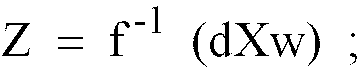
de telle sorte que ladite fonction inverse représente l'inverse d'une fonction f qui définit la relation entre la valeur de demande de contrôle Z et une variation dX de la grandeur physique contrôlée, et de telle sorte que l'appareil contrôlé (4) réponde à ladite valeur de demande de contrôle obtenue Z en modifiant ladite grandeur physique contrôlée.
de telle sorte que ladite fonction inverse représente l'inverse d'une fonction f qui définit la relation entre la valeur de demande de contrôle Z et une variation dX de la grandeur physique contrôlée, et de telle sorte que l'appareil contrôlé (4) réponde à ladite valeur de demande de contrôle obtenue Z en modifiant ladite grandeur physique contrôlée.
2. Procédé de contrôle du suivi d'une valeur cible selon la revendication 1, comportant
en outre une étape d'apprentissage, de correction de constantes à inclure dans la
fonction f par les valeurs réelles de Z et de dX sous la commande de la partie de
délivrance de demande de contrôle (3) conformément à une fonction de forme prédéterminée.
3. Procédé de contrôle du suivi d'une valeur cible selon la revendication 1 ou 2, comportant
en outre une étape de limitation d'une variation dXw, à partir de dXw-1 délivré au cours du cycle précédent par certains moyens, par rapport à dXw calculé
une fois par la partie d'opération de variation désirée (2) et ensuite de la délivrer.
4. Procédé de contrôle du suivi d'une valeur cible selon la revendication 1, 2 ou 3,
comportant en outre une étape de limitation de variation dZ, à partir de Z-1 délivré au cours du cycle précédent par certains moyens, par rapport à Z calculé
une fois par la partie de sortie de demande de contrôle (3) et ensuite de la délivrer.
5. Procédé de contrôle du suivi d'une valeur cible selon la revendication 1, 2, 3 ou
4, comportant en outre une étape consistant à adapter la partie de fixation de valeur
cible (1) pour une fixation en fonction au moins particulièrement de la valeur mesurée
qui est relative à la grandeur physique contrôlée ou de la grandeur physique contrôlée.