|
(11) | EP 0 606 883 B1 |

| (12) | EUROPEAN PATENT SPECIFICATION |
|
|
| (54) |
Fluorine-containing elastomer composition Fluorhaltige Elastomermischung Composition d'élastomer contenant du fluore |
|
|
|||||||||||||||||||||||||||||||
| Note: Within nine months from the publication of the mention of the grant of the European patent, any person may give notice to the European Patent Office of opposition to the European patent granted. Notice of opposition shall be filed in a written reasoned statement. It shall not be deemed to have been filed until the opposition fee has been paid. (Art. 99(1) European Patent Convention). |
[0001] The present invention relates to a fluorine-containing elastomer composition, and more particularly to a cross-linkable elastomer composition of fluorine-containing elastomer having cyano groups as cross-linkable groups.
RELATED PRIOR ART
[0002] Japanese Patent Publication (Kokai) 59-109546 discloses a fluorine-containing elastomer composition, which comprises a terpolymer of tetrafluoroethylene, perfluoro(methyl vinyl ether) and cyano(perfluorovinyl ether) represented by the following general formula:
CF2=CF[OCF2CF(CF3)]nO(CF2)mCN
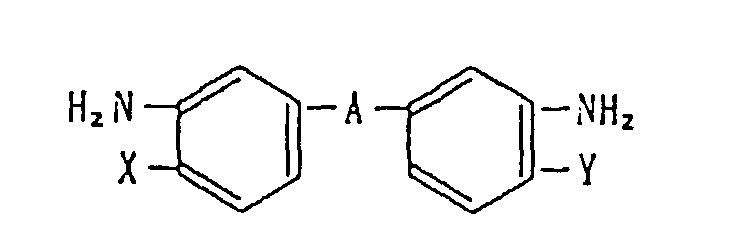
wherein n is 1 to 2 and m is 1 to 4, and a bisaminophenyl compound represented by the following general formula as a curing agent:
wherein A is an alkylidene group having 1 to 6 carbon atoms, a perfluoroalkylidene group having 1 to 10 carbon atoms, a SO2 group, an O group, a CO group, or a carbon-carbon bond capable of directly coupling two benzene rings; and X and Y each are a hydroxyl group or an amino group.
[0003] However, the cyano(perfluorovinyl ether) to be copolymerized as a cross-linking site monomer in the terpolymer has been synthesized through many steps, as shown in US-A-4,138,426 and thus is not an industrially preferable raw material and also fails to give a satisfactory compression set at an elevated temperature.
[0004] US-A-3,546,186 discloses a terpolymer obtained by copolymerization of tetrafluoroethylene and perfluoro-(methyl vinyl ether) with perfluoro(ω-cyanoalkyl vinyl ether) represented by the following general formula as a cross-linking site monomer:
CF2=CFO(CF2)nCN
wherein n is 2 to 12, and also discloses that the cross-linking is carried out by tetraphenyl tin.
[0005] The perfluoro(ω-cyanoalkyl vinyl ether) used as a comonomer component in the terpolymer can be readily synthesized from a corresponding carboxylic acid ester with a high selectivity, and thus is an industrially utilizable compound, but the cross-linking of the resulting terpolymer is carried out through cyclization and terpolymerization of the cyano groups by tetraphenyl tin and thus not only press vulcanization requires such a longer time as 18 hours at 160°C, but also its industrial utilization still has problems in the cross-linking such as use of highly toxic tetraphenyl tin as a cross-linking agent and use of expensive silver oxide as a promoter. Furthermore, it fails to give a satisfactory compression set at an elevated temperature.
SUMMARY OF THE INVENTION
[0006] An object of the present invention is to provide a fluorine-containing elastomer composition comprising a copolymer containing a cross-linking site monomer capable of being readily synthesized with a good selectivity as copolymerized, the composition being capable of giving a rubbery vulcanization product with a good processability and good physical properties by a commercially available cross-linking agent free from any safety problem.
DETAILED DESCRIPTION OF THE INVENTION
[0007] According to the present invention, there is provided a fluorine-containing elastomer composition, which comprises a terpolymer of tetrafluoroethylene, perfluoro(C1-C5 alkyl vinyl ether) and perfluoro(ω-cyanoalkyl vinyl ether) represented by the following general formula:
CF2=CFO(CF2)nCN
wherein n is an integer of 2 to 12, and a bisaminophenyl compound represented by the following general formula as a curing agent:
wherein A is an alkylidene group having 1 to 6 carbon atoms, a perfluoroalkylidene group having 1 to 10 carbon atoms, a SO2 group, an O group, a CO group, or a carbon-carbon bond directly coupling two benzene rings; and X and Y each are a hydroxyl group and an amino group.
[0008] The terpolymer of tetrafluoroethylene, perfluoro(C1-C5 alkyl vinyl ether) and perfluoro(ω-cyanoalkyl vinyl ether) for use in the present invention is a terpolymer obtained by copolymerizing a copolymer containing about 30 to about 75% by mole of tetrafluoroethylene and about 70 to about 30% by mole of perfluoro(C1-C5 alkyl vinyl ether) with about 0.1 to about 5% by mole, preferably about 1 to about 2% by mole of perfluoro(ω-cyanoalkyl vinyl ether) as a cross-linking site monomer. The terpolymer can contain various vinyl compounds or olefin fluorides, as copolymerized to such an extent as not to inhibit the copolymerization reaction and not to deteriorate physical properties of vulcanization product.
[0009] Copolymerization reaction can be carried out by emulsion polymerization or suspension polymerization in an aqueous medium or by solution polymerization in a perfluoro compound as a solvent, using a free radical generator. Emulsion polymerization is preferable for obtaining a terpolymer of larger molecular weight.
[0010] In the emulsion polymerization in an aqueous medium, ammonium persulfate, potassium persulfate, etc. are used as a free radical generator. These free radical generators can be also used as a redox system together with a reducing agent such as ammonium salts, sodium salts, potassium salts, etc. of sulfurous acid, thiosulfuric acid, etc. Ammonium salts of perfluorated carboxylic acids can be usually used as an emulsifying agent, and ammonium perfulorooctanoate is particularly preferable. A pH-adjusting agent such as Na2HPO4, NaH2PO4, K2HPO4, KH2PO4, etc. can be usually used.
[0011] The copolymerization reaction can be carried out according to one charge polymerization procedure where predetermined amounts of the respective monomers are all charged into a reactor at one time and subjected to the polymerization reaction or according to a polymerization procedure of continuous addition at constant rates, where the respective monomers are continuously added to a reactor at constant rates under a constant pressure. The latter polymerization reaction procedure is preferable for obtaining polymers with good physical properties, where the polymerization pressure is kept under about 2 to about 50 kg/cm2 gage and the polymerization temperature at about 40 to about 80°C during the continuous addition at constant rates.
[0012] After the polymerization reaction, the resulting aqueous latex is salted out by an aqueous solution of water-soluble electrolyte such as sodium chloride, magnesium chloride, etc., recovered by filtration and dried, whereby a terpolymer can be obtained. In place of salting-out, the aqueous latex can be freezed, recovered by filtration and dried.
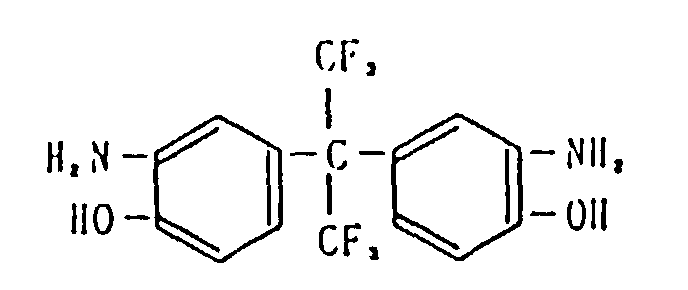
[0013] About 0.5 to about 5 parts by weight, preferably about 1 to about 2 parts by weight, of the bisaminophenyl cross-linking agent represented by the above-mentioned general formula, for example, as given below, can be added to 100 parts by weight of the terpolymer:
[0014] The fluorine-containing elastomer composition containing the above-mentioned components as essential ones can be further admixed properly, when required, with an inorganic filler such as carbon black, silica, etc., an acid receptor such as oxides, hydroxides or stearates of divalent metal, litharge, etc.: and necessary additives. The composition can be prepared by mixing in an open roll, etc. The cross-linking can be carried out by heating to about 160 to about 250°C for about 10 to about 60 minutes. Secondary vulcanization, if required, can be carried out preferably in an inert gas atmosphere, for example, in a nitrogen gas atomosphere.
[0015] According to the present invention, there is provided a fluorine-containing elastomer composition comprising a copolymer containing a cross-linking site monomer capable of being readily synthesized with a good selectivity, as copolymerized, the composition being capable of giving a rubber vulcanization product with a good processability and good physical properties by a commercially available cross-linking agent free from any safety problem.
PREFERRED EMBODIMENTS OF THE INVENTION
REFERENCE EXAMPLE 1
[0017] 200ml of distilled water, 2.5g of ammonium perfluorooctanoate and 4.4g of Na2HPO4·12H2O were charged into a stainless steel autoclave having a net capacity of 500ml, and then the autoclave was flushed with a nitrogen gas and then subjected to pressure reduction.
[0018] After the autoclave was cooled to about -50°C, the following compounds were successively charged into the autoclave.
| Perfluoro(5-cyanopentyl vinyl ether) [FCVE] | 6.4g |
| Perfluoro(methyl vinyl ether) [FMVE] | 72g |
| Tetrafluoroethylene [TFE] | 32g |
[0019] Then, the autoclave was heated to 50°C, and 0.75g of sodium sulfite and 3.75g of ammonium persulfate were charged into the autoclave each as 25ml of an aqueous solution to start polymerization reaction. The polymerization reaction was continued for 20 hours, and then unreacted gases were purged from the autoclave. The resulting aqueous latex was taken out of the autoclave, salted out and dried, whereby 18.0g of white, rubbery terpolymer A was obtained.
[0020] Infrared absorption analysis of the terpolymer A revealed that the terpolymer consisted of 69.5% by mole of TFE, 30.3% by mole of FMVE and 0.2% by mole of FCVE (characteristic absorption of nitrile group: 2268cm-1).
REFERENCE EXAMPLE 2
[0021] In Reference Example 1, the amount of FCVE was changed to 8.2g, that of FMVE to 83g, and that of TFE to 28g, and equal amounts of sodium sulfate in an aqueous solution state and ammonium persulfate in an aqueous solution state were added thereto at the point of 8 hours after the start of polymerization reaction, whereby 36.4g of white, rubbery terpolymer B was obtained. The terpolymer consisted of 61.8% by mole of TFE, 37.7% by mole of FMVE and 0.5% by mole of FCVE.
REFERENCE EXAMPLE 3
[0022] In Reference Example 2, the polymerization temperature was changed to 65°C, whereby 41.5g of white, rubbery terpolymer C was obtained. The terpolymer consisted of 58.6% by mole of TFE, 40.7% by mole of FMVE and 0.7% by mole of FCVE.
REFERENCE EXAMPLE 4
[0023] In Reference Example 2, the amount of FCVE was changed to 12.1g, and the polymerization temperature to 65°C, whereby 31.2g of white, rubbery terpolymer D was obtained. The terpolymer consisted of 62.1% by mole of TFE, 36.8% by mole of FMVE and 1.1% by mole of FCVE.
REFERENCE EXAMPLE 5
[0024] In Reference Example 2, the amount of FCVE was changed to 16.4g, and the polymerization temperature to 65°C, whereby 22.4g of white, rubbery terpolymer E was obtained. The terpolymer consisted of 67.7% by mole of TFE, 30.8% by mole of FMVE and 1.5% by mole of FCVE.
REFERENCE EXAMPLE 6
[0025] 1.57 liters of distilled water, 27.3 of ammonium perfluorooctanoate and 23.7g of Na2HPO4·12H2O were charged into a stainless steel autoclave having a net capacity of 3 liters, and then the autoclave was flushed with a nitrogen gas and then subjected to pressure reduction. After the autoclave was cooled to about -50°C, the following compounds were successively charged into the autoclave.
| Tetrafluoroethylene [TFE] | 30g |
| Perfluoro(methyl vinyl ether) [FMVE] | 50g |
| Perfluoro(5-cyanopentyl vinyl ether) [FCVE] | 4.6g |
[0026] Then, the autoclave was heated to 60°C, and 1.66g of sodium sulfite and 9.08g of ammonium persulfate were added thereto each as 50ml of an aqueous solution to start polymerization reaction.
[0027] During the polymerization reaction, 27 g/hr of TFE, 43 g/hr of FMVE and 4.0 g/hr of FCVE were continuously added to the autoclave to keep the internal pressure of the autoclave under 9 kg/cm2 gage. At the point of 10 hours after the start of polymerization reaction, the continuously addition was discontinued and the autoclave was kept in that state for one hour, and then the autoclave was cooled and remaining gases were purged. The resulting aqueous latex was taken out of the autoclave.
[0028] Then, the aqueous latex (solid content: 28% by weight) was freezed, washed with 10% ethanol and dried at 70°C under the atmospheric pressure for 12 hours and further at 120°C under reduced pressure for 8 hours, whereby 700g of white, rubbery terpolymer F was obtained. The terpolymer consisted of 55.9% by mole of TFE, 42.7% by mole of FMVE and 1.4% by mole of FCVE and its reduced viscosity [measured in 1 wt.% solution of perfluoro(2-butyltetrahydrofuran)] was 1.04 ml/g.
EXAMPLE 1
[0029]
| Terpolymer A | 100 parts by weight |
| Bis(aminophenol) AF | 2 " |
| Dicyclohexyl-18-Crown-6 | 0.5 " |
| MT carbon black | 10 " |
| Litharge | 2 " |
[0030] The foregoing components were mixed through a double roll rubber mill and press vulcanized at 180°C for 5 minutes. Then, the resulting vulcanization product was subjected to measurement of vulcanization torque by a curelasto meter V (made by Orientec K.K.). An increase by 0.5 kg·cm was found, and the vulcanization was confirmed.
EXAMPLES 2 TO 4
[0031] In Example 1, the same amount of terpolymer C, D or E was used in place of the terpolymer A, and primary (press) vulcanization was carried out at 180°C for one hour and then secondary (oven) vulcanization at 250°C for 24 hours. Physical properties of the resulting vulcanization products are shown in the following Table 1 together with a torque increase span.
TABLE 1
| Example 2 | Example 3 | Example 4 | |
| Terpolymer | C | D | E |
| Torque increase span (kg·cm) | 3.1 | 3.9 | 4.8 |
| Breaking strength (kgf/cm2) | 175 | 182 | 180 |
| Breaking Elongation (%) | 220 | 173 | 160 |
EXAMPLES 5 AND 6
[0032]
| Terpolymer F | 100 parts by weight |
| Bis(aminophenol) AF | 1 " (Ex. 5) |
| " | 2 " (Ex. 6) |
| MT carbon black | 20 " |
[0033] The foregoing components were mixed through a double roll rubber mill, and subjected to primary (press) vulcanization at 180°C for 30 minutes and secondary (oven) vulcanization at two stages, i.e. at 210°C for 18 hours and at 288°C for 18 hours.
[0034] Physical properties in the normal state and compression set (ASTM method B with P24 O-ring at 275°C for 70 hours) of the resulting vulcanization products are shown in the following Table 2 together with a torque increase span.
TABLE 2
| Example 5 | Example 6 | |
| Torque increase span (kg·cm) | 9. 3 | 11. 9 |
| Hardness (JIS A) | 76 | 78 |
| 100% Modulus (kgf/cm2) | 92 | 132 |
| Breaking strength (kgf/cm2) | 192 | 194 |
| Breaking Elongation (%) | 180 | 130 |
| Compression set (%) | 22 | 13 |
| COMPARATIVE EXAMPLE | ||
| Component | Mixing ratio I | Mixing ratio II |
| Terpolymer B | 100 parts by weight | 100 parts by weight |
| Tetraphenyl tin | 6 " | - " |
| MT carbon black | 10 " | 10 " |
| Silver oxide | - " | 4.8 " |
1. A fluorine-containing elastomer composition, which comprises a terpolymer of tetrafluoroethylene,
perfluoro(C1-C5 alkyl vinyl ether) and perfluoro(ω-cyanoalkyl vinyl ether) represented by the following
general formula:
CF2=CFO(CF2)nCN
wherein n is an integer of 2 to 12, and a bisaminophenyl compound represented by the following general formula as a curing agent:
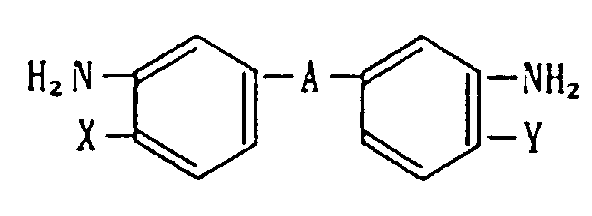
wherein A is an alkylidene group having 1 to 6 carbon atoms, a perfluoroalkylidene group having 1 to 10 carbon atoms, a SO2 group, an O group, a CO group, or a carbon-carbon bond directly coupling two benzene rings; and X and Y each are a hydroxyl group or an amino group.
CF2=CFO(CF2)nCN
wherein n is an integer of 2 to 12, and a bisaminophenyl compound represented by the following general formula as a curing agent:
wherein A is an alkylidene group having 1 to 6 carbon atoms, a perfluoroalkylidene group having 1 to 10 carbon atoms, a SO2 group, an O group, a CO group, or a carbon-carbon bond directly coupling two benzene rings; and X and Y each are a hydroxyl group or an amino group.
2. A fluorine-containing elastomer composition according to Claim 1, wherein the terpolymer
is a terpolymer obtained by copolymerizing a copolymer containing about 30 to about
75% by mole of tetrafluoroethylene and about 70 to about 30% by mole of perfluoro
(C1-C5 alkyl vinyl ether) with about 0.1 to about 5% by mole of perfluoro(ω-cyanoalkyl vinyl
ether) as a cross-linking site monomer.
3. A fluorine-containing elastomer composition according to Claim 1, wherein the bisaminophenyl
compound has the following formula:
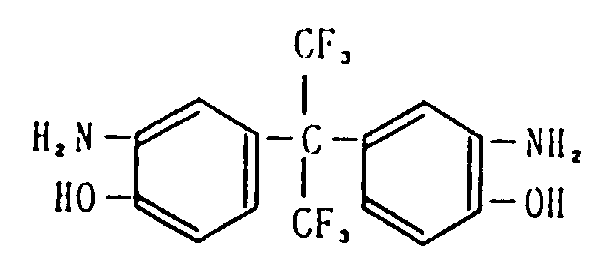
4. A fluorine-containing elastomer composition according to Claim 1 or 3, wherein about
0.5 to about 5 parts by weight of the bisaminophenyl compound is added to 100 parts
by weight of the terpolymer.
1. Fluorhaltige Elastomerzusammensetzung, umfassend ein Terpolymer aus Tetrafluorethylen,
Perfluor-(C1-C5-alkylvinylether) und Perfluor(ω-cyanoalkylvinylether), dargestellt durch die folgende
allgemeine Formel:
CF2=CFO(CF2)nCN
worin n eine ganze Zahl von 2 bis 12 ist, und eine Bisaminophenylverbindung als Vulkanisierungsmittel, dargestellt durch die folgende allgemeine Formel:
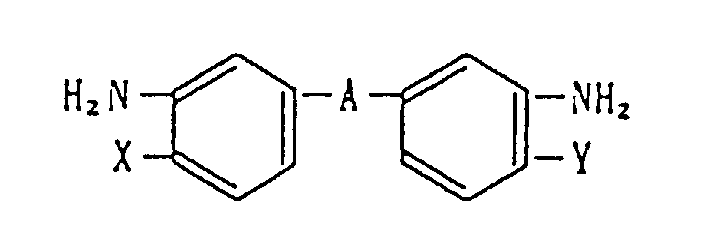
worin A eine Alkylidengruppe mit 1 bis 6 Kohlenstoffatomen, eine Perfluoralkylidengruppe mit 1 bis 10 Kohlenstoffatomen, eine SO2-Gruppe, eine O-Gruppe, eine CO-Gruppe oder eine die zwei Benzolringe direkt verknüpfende Kohlenstoff-Kohlenstoffbindung ist; und X und Y jeweils eine Hydroxylgruppe oder eine Aminogruppe sind.
CF2=CFO(CF2)nCN
worin n eine ganze Zahl von 2 bis 12 ist, und eine Bisaminophenylverbindung als Vulkanisierungsmittel, dargestellt durch die folgende allgemeine Formel:
worin A eine Alkylidengruppe mit 1 bis 6 Kohlenstoffatomen, eine Perfluoralkylidengruppe mit 1 bis 10 Kohlenstoffatomen, eine SO2-Gruppe, eine O-Gruppe, eine CO-Gruppe oder eine die zwei Benzolringe direkt verknüpfende Kohlenstoff-Kohlenstoffbindung ist; und X und Y jeweils eine Hydroxylgruppe oder eine Aminogruppe sind.
2. Fluorhaltige Elastomerzusammensetzung gemäß Anspruch 1, worin das Terpolymer ein Terpolymer
ist, erhalten durch Copolymerisation eines Copolymers, enthaltend ca. 30 bis ca. 75
mol-% Tetrafluorethylen und ca. 70 bis ca. 30 mol-% Perfluor(C1-C5-alkylvinylether), mit ca. 0,1 bis ca. 5 mol-% Perfluor(ω-cyanoalkylvinylether) als
Vernetzungsstellenmonomer.
3. Fluorhaltige Elastomerzusammensetzung gemäß Anspruch 1, worin die Bisaminophenylverbindung
folgende Formel hat:
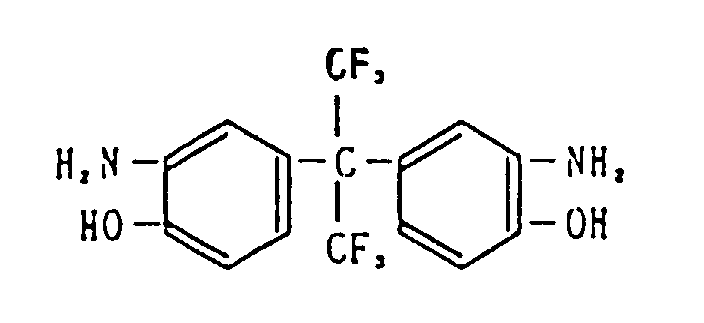
4. Fluorhaltige Elastomerzusammensetzung gemäß Ansprüchen 1 oder 3, worin ca. 0,5 bis
ca. 5 Gewichtsteile der Bisaminophenylverbindung zu 100 Gewichtsteilen des Terpolymers
zugegeben sind.
1. Composition élastomère contenant du fluor, qui comporte un terpolymère de tétrafluoroéthylène,
de perfluoro(vinyléther d'alkyle en C1-C5) et de perfluoro(vinyléther d'ω-cyanoalkyle) représenté par la formule générale ci-dessous:
CF2=CFO(CF2)nCN
dans laquelle n est un entier de 2 à 12, et un composé de bisaminophényle représenté par la formule générale ci-dessous, comme agent de durcissement:
dans laquelle A est un groupe alkylidène comptant de 1 à 6 atomes de carbone, un groupe perfluoroalkylidène comptant de 1 à 10 atomes de carbone, un groupe SO2, un groupe O, un groupe CO ou une liaison carbone-carbone reliant directement deux cycles de benzène; et X et Y représentent chacun un groupe hydroxyle ou un groupe amino.
CF2=CFO(CF2)nCN
dans laquelle n est un entier de 2 à 12, et un composé de bisaminophényle représenté par la formule générale ci-dessous, comme agent de durcissement:
dans laquelle A est un groupe alkylidène comptant de 1 à 6 atomes de carbone, un groupe perfluoroalkylidène comptant de 1 à 10 atomes de carbone, un groupe SO2, un groupe O, un groupe CO ou une liaison carbone-carbone reliant directement deux cycles de benzène; et X et Y représentent chacun un groupe hydroxyle ou un groupe amino.
2. Composition élastomère contenant du fluor selon la revendication 1, dans laquelle
le terpolymère est un terpolymère obtenu par copolymérisation d'un copolymère contenant
environ 30 à environ 75% en moles de tétrafluoroéthylène et environ 70 à environ 30%
en moles de perfluoro(vinyléther d'alkyle en C1-C5), avec environ 0,1 à environ 5% en mole de perfluoro(vinyléther d'ω-cyanoalkyle)
comme monomère de sites de réticulation.
3. Composition élastomère contenant du fluor selon la revendication 1, dans laquelle
le composé de bisaminophényle a la formule ci-dessous:
4. Composition élastomère contenant du fluor selon les revendication 1 ou 3, dans laquelle
environ 0,5 à environ 5 parties en poids du composé de bisaminophényle sont ajoutées
à 100 parties en poids du terpolymère.