|
(11) | EP 0 611 782 A1 |

| (12) | EUROPEAN PATENT APPLICATION |
|
|
|
|
|||||||||||||||||||||||
| (54) | Antimicrobial quaternary ammonium group-containing polymers, compositions thereof, and monomers used to produce said polymers |
| (57) Antimicrobial quaternary ammonium group-containing organosilicon polymers, aqueous
disinfectant solutions containing such polymers, and lenses produced from such polymers
are provided herein. The polymers are produced by homopolymerizing or copolymerizing,
with a suitable comonomer, a quaternary ammonium group-containing organosilicon monomer
of formula I as defined herein. A preferred monomer of formula I is the monomer of
formula II:
3-methacryloxypropyltetramethyldisiloxanylpropyldimethyloctadecylammonium chloride (MADAC). |
[0001] This invention relates to quaternary ammonium group-containing organosilicon polymers and novel monomers used to produce these polymers. The invention also relates to methods of producing such polymers and monomers. The polymers may be used in wide applications as antimicrobial agents as, for example, in solutions to disinfect contact lenses and certain of these polymers may be used to produce solid structures, such as contact lenses.
[0002] Contact lenses are typically made of hydrophilic and partially hydrophilic plastic materials. These materials have a high capacity to absorb water and swell to a soft mass or hydrogel. This hydrogel is characterized by excellent mechanical properties, complete transparency, good shape retention and high resistance to degradation in boiling water. Such hydrophilic or partially hydrophilic plastic materials are described in such patents as US-A-2,976,576, US-A-3,499,862 and US-A-3,503,942. These patents disclose, inter alia, the production of the so-called soft contact lenses.
[0003] One of the problems associated with cleaning soft contact lenses made from the aforementioned hydrophilic materials, is in the disinfecting and cleaning of such lenses. These lenses have a high capacity to absorb water, i.e. upwards of about 38 weight % water, based on the total weight of the hydrogel. Therefore, the compounds employed to disinfect the contact lenses are often absorbed and possibly even concentrated in the lenses and later released when the soft contact lenses are worn on the eye. This, of course, may damage or stain the contact lenses and harm the sensitive tissues of the eye. Such preservative or disinfectant materials typically used to disinfect the contact lenses may be such materials as chlorohexidine or thimerosal, for example.
[0004] To overcome these problems, materials such as quaternary ammonium group-containing polymers having antimicrobial activity may be used to disinfect the lenses. The advantage of using antimicrobial polymers is that they have a larger molecular size and are less likely to penetrate or be absorbed into the soft contact lenses, and tend to be less toxic.
[0005] Examples of such polmyers are the polymeric quaternary ammonium compounds having recurring vinyl benzene ammonium units. Such polymers are disclosed in US-A-4,482,680. These polymers have a disadvantage in that they have relatively poor solubility in water.
[0006] Another example of polymers employed for disinfecting contact lenses are the organosilicon quaternary ammonium compounds disclosed in US-A-4,615,882. These polymers are produced by reacting an organosilicon quaternary ammonium salt having a hydrolyzable group with a water soluble high molecular weight organic polymer, such as polyvinyl alcohol, reactive with said hydrolyzable group. The hydrophilic polymers described in US-A-4,615,882 have silicone and quaternary ammonium components as required in the present invention, however the synthesis of the polymers disclosed in the patent result in the formation of hydrolytically unstable linkages, e.g. silicon-oxygen-carbon linkages. Such Si-O-C bonds are unstable, break down over time, and the existence of such bonds could lead to toxicity problems.
[0007] The present invention relates to quaternary ammonium group-containing organosilicon polymers having antimicrobial activity which do not have the unstable linkages, i.e. the silicon-oxygen-carbon linkages of US-A-4,615,882 and therefore are free of the toxicity problems due to the breakdown of these compounds with time.
[0008] The antimicrobial polymers of the present invention are suitable for treating soft contact lenses and are especially suitable for cleaning and disinfecting such lenses to remove proteinaceous deposits which tend to form and build on the lenses during wear and handling.
[0009] The polymers of the present invention are of such a molecular size that they do not penetrate the contact lenses polymer matrix as readily as non-polymeric organic molecules, and when they do penetrate, are less toxic than said non-polymeric compounds. Therefore, they are less apt to damage the lenses or injure the eye as is typical of non-polmyeric materials which penetrate the lenses and may leach out and damage the soft tissues of the eye during the use thereof.
[0010] The organosilicon quaternary ammonium compounds of the present invention may typically be dissolved or dispersed in a solution, especially an aqueous solution, used to disinfect the contact lenses and are used in amounts sufficient to disinfect the lenses. The polymers of the present invention have advantages over the poly(vinylbenzyl quaternary ammonium) halide structure disclosed in the Sheldon patent, US-A-4,482,680, in that they are more water soluble and therefore can be more easily dissolved in aqueous solutions. The solutions, according to the present invention, are preferably aqueous based solutions, occasionally containing organic solvents, which are nontoxic to the eye, i.e. are ophthalmically safe for use.
[0011] Although the quaternary ammonium-containing organosilicon compounds of the present invention are especially suitable for disinfecting soft lenses, they can also be used for other utilities where the antimicrobial properties are effective, i.e. for hair care and in other topical pharmaceutical products. Specific uses may be in the therapeutic skin care preparations and use as deodorants or antimicrobials for the body, etc. In addition, the products can be formulated with various cleanser components to form disinfectants for home or hospital use.
[0012] The quaternary ammonium group-containing organosilicon polymers of the present invention can be produced by homo- or copolymerizing a monomer of the following generic structure of formula I
wherein R₁, R₂ and R₃ are independently hydrogen, C₁-C₇ alkyl, or -COOR₁₃ with R₁₃ being hydrogen or C₁-C₄ alkyl;
z₁ and z₂ are independently 0 or 1;
La is -C(O)O-, -C(O)N(Ra)-, or a bond;
La₁ is a bond, -C(O)O-, -C(O)N(Ra)-, -O-, -OC(O)O-, -N(Ra)C(O)N(Ra)- or -N(Ra)C(O)O-;
wherein Ra is hydrogen or C₁-C₈ alkyl;
R₁₀ is a bivalent C₁-C₂₀ aliphatic, C₃-C₂₅ cycloaliphatic or C₆-C₂₀ aryl group, each of which may be substituted with up to five halogen atoms, or (CH₂CH(Ra)O)j, wherein j is an integer from 1 to 50 and Ra is as defined hereinbefore;
R₄ and R₇ are independently a bivalent group selected from C₂-C₁₀ aliphatic, such as C₂-C₈ alkylene, C₁-C₄ alkylene-(oxy-C₁-C₄ alkylene)g, C₁-C₄ alkylene-OCH₂-(hydroxy C₁-C₄ alkylene)-CH₂, cycloaliphatic up to 25 carbon atoms and aryl up to 25 carbon atoms, wherein g is an integer from 1 to 10;
y is an integer from 1 to 10;
R₅ and R₆ are independently C₁-C₈ alkyl, C₆-C₂₅ aryl, or C₆-C₂₅ cycloaliphatic which may be substituted by one or more halogen, hydroxy, C₁-C₄ alkyl, carboxy or C₁-C₁₂ perhaloalkyl groups, or R₅ and R₆ may be -Si(OSiCH₃)₃;
R₈ and R₉ are independently C₁-C₂₄ alkyl, C₃-C₂₄ cycloaliphatic or C₆-C₂₅ aryl, which groups may be each substituted with from 1 to 11 groups selected from hydroxy, C₁-C₄ alkyl, carboxy, C₁-C₁₂ perhaloalkyl, and halogen, or R₈ and R₉ may also be (CH₂CH₂O)xH units, where x is an integer from 1 to 10, and
X is an ophthalmically acceptable counterion.
[0013] The ophthalmically acceptable counterion X is preferably a halogen, hydroxy, acetate, SO₄²⁻, CO₃²⁻, or PO₄³⁻ for example. If not otherwise defined, a bivalent C₁-C₂₀ aliphatic group is preferably C₁-C₁₀ alkylene, more preferred C₁-C₆ alkylene. Likewise, the cycloaliphatic groups are all preferably groups having 3 to 25 carbon atoms, more preferred cycloalkyl groups containing 6 to 10 carbon atoms, and more preferably 5 to 7 membered cycloaliphatic groups, including e.g. combinations of cycloalkyl and lower alkyl. A preferred cycloalkyl is cyclohexyl. Likewise, aryl groups preferably have 6 to 25 carbon atoms, more preferred 6 to 10 carbon atoms. A preferred aryl group is phenyl. Halogen is e.g. fluoro, chloro or bromo, of which fluoro and chloro are preferred.
[0014] Preferred are those monomers of formula I wherein R₁, R₂ and R₃ are independently hydrogen or C₁-C₄ alkyl;
z₁ and z₂ are independently 0 or 1;
La is -C(O)O- or a bond;
La₁ is a bond, -N(Ra)C(O)N(Ra)- or -N(Ra)C(O)O-;
wherein Ra is hydrogen or C₁-C₄ alkyl;
R₁₀ is a bivalent C₁-C₆ alkylene, or phenyl group,
R₄ and R₇ are independently a bivalent C₂-C₆ alkylene;
y is an integer from 1 to 10, preferably 1 to 5;
R₅ and R₆ are independently C₁-C₄ alkyl;
R₈ and R₉ are independently C₁-C₂₄ alkyl, and
X is an ophthalmically acceptable counterion.
[0015] Typical and preferred structures of the above monomers have the following formulae:
3-methacryloxypropyltetramethyldisiloxanylpropyldimethyloctadecylammonium chloride (MADAC),
[0016] The novel monomers of the present invention used to produce the organosilicon polymers are a further embodiment of this invention. A description of a typical procedure for producing these novel monomers is reproduced hereinafter. Below is a synthetic scheme for the production of the MADAC monomer of the formula II (a typical and preferred monomer) used in producing the water soluble polymers and contact lense materials of the present invention.
Step 1
[0017] A compound of the formula IIA
is reacted with a compound of the formula IIB
in the presence of water to produce a compound of the formula IIC
and HCl as a by-product.
Step 2
[0018] The compound of the formula (IIC) is reacted with an excess of NH₃, to produce a compound of the formula IID
Step 3
[0019] Said compound of the formula IID is reacted with an excess of CH₃Br to produce a compound of the formula IIE
Step 4
[0020] The compound of the formula IIE is quaternized with C₁₈H₃₇Cl to produce a compound of formula II (MADAC)
[0021] The reaction conditions in Step 1 may be varied, but it is usually carried out preferably from about ambient temperatures to about 40°C in an aqueous solution, which may be slightly acidic.
[0022] The reaction with the amine in Step 2 is preferably carried out in an aqueous solution at a temperature from about 0°C to about ambient temperature and preferably from about 0°C to about 20°C. This reaction is ordinarily carried out at atmospheric pressure, however, it can be carried out under high pressure at even higher temperatures, if necessary.
[0023] Step 3 is preferably carried out at a reaction temperature of from about room temperature to up to about 40°C in a suitable organic solvent, especially an inert organic solvent, such as toluene, benzene, etc.
[0024] Step 4 may be carried out in a solvent, preferably at room or ambient temperature. The solvents include such organic solvents as toluene, benzene and other inert, typically used solvents. The reaction conditions vary depending upon the nature of the reactants, solvents employed, pressure conditions, etc. The above conditions represent the typical conditions employed.
[0025] The other monomers of the generic formula (I) can be produced by following the same reaction scheme used to produce the MADAC monomer as set forth in Steps (1) to (4) above.
[0026] The quaternized monomers of the generic formula (I) set forth above, may be homo- or co-polymerized to produce the final polymer structure. The monomers are typically polymerized in an inert atmosphere, such as nitrogen or argon, free of oxygen. The polymerization may be initiated by way of initiators, such as peroxides or azobisisobutyronitrile (AIBN) in amounts sufficient to initiate the reaction, i.e. typically from about 0.01 to 0.5 weight % based on the weight of the monomer. The reaction may be carried out in the presence of a solvent, such as an alcohol, toluene, benzene, tetrahydrofuran or a ketone, such as methylethyl ketone. The reaction may be carried out by heating the reaction solution at elevated temperatures and preferably at temperatures from about 40°C to about 150°C or the reflux temperature of the solvent. The temperature varies depending upon the monomers and other materials present in the reaction solution.
[0027] The reaction may also be carried out by subjecting the reaction solution to a UV source to produce the final product. The reaction is carried out for a time sufficient to complete the polymerization, which reaction may proceed for time periods up to about 100 hours or more. The initiator used in the polymerization reaction is dependent upon the type of energy source used and may be different if a UV source is used as opposed to a thermal energy source.
[0028] The above monomers of formula (I) may be homopolymerized or they may be copolymerized with suitable comonomers. This copolymerization reaction thus includes the reaction of the quaternary ammonium group-containing organosilicon monomers with one or more comonomers.
[0029] The copolymers may contain copolymeric units having a generic structure depicted as -M-. The copolymeric units can be added to achieve the desired physical properties, enhance the solubility in aqueous or nonaqueous media, achieve better miscibility in various solvents or to improve the dispersibility of the polymer.
[0030] The first type of M units is represented by vinylaromatics, e.g. styrene, lower alkenes or lower alkadienes, such as ethylene, butadiene and the like. The second type of M units is illustrated by vinyl acetamide, vinyl amines, vinyl amine quaternized with hydroxyethylenes or similar water solubilizers or with hydrophobes such as alkyls, e.g. dodecyls, or vinylbenzyl amine quaternized with three long chain alkyl hydrophobes or with three lower alkyl or hydroxyalkyl hydrophiles. Other units include, for example, vinyl acetate, vinyl alcohol, acrylic acid, acrylate and methacrylate esters; acrylamide and acrylamide derivatives, including quaternized acrylamide; N-vinylimidazole and derivatives thereof, including quaternized N-vinylimidazoles; 4-vinylpyridine and derivatives thereof, including quaternized 4-vinylpyridines; N-vinylpyrrolidone and derivatives thereof; vinylbenzyl ethers of polyethylene glycols and their monoalkyl ethers. These units are all known in the art as are the methods for their incorporation into copolymers. Mixtures of two or more M units may, of course, be used. The term "lower" used in the context of this invention defines radicals or groups having preferably up to 7 carbon atoms, more preferred up to 4 carbon atoms.
[0031] Generically, the M units can be grouped as 2 to 6 carbon alkylenes or alkenylenes, having pendent therefrom, from 0 to 2 substituent groups selected from aryls, alkaryls, and aralkyls of 6-8 carbons, alkyls of 1-4 carbons, amides, hydroxyls, carboxylic acids, and their esters, preferably lower alkyl esters, nitrogen-containing 5 or 6 atom heterocyclics and amine and ether-substituted aryls, alkaryls and aralkyls.
[0032] The M copolymer units may be vinylbenzyl amines quaternized by hydrophilic groups such as hydroxyalkyls of from 1 to 4 carbon atoms, particularly vinylbenzyl amines quaternized with three 2-hydroxyethylenes (i.e. with a triethanolamine structure). Such units are represented structurally as
wherein a is 2 through 4 inclusive and most preferably 2.
[0033] Another group of copolymer units M contemplated herein are vinylbenzyl ethers of poly(ethylene glycol)s or their mono-lower alkyl ethers, particularly methyl ethers. Such units are represented structurally as
wherein b is 1 through 10 inclusive, preferably 1 through 4 inclusive, and R" is hydroxy or lower alkoxy, such as alkoxy having from 1 to 4 carbons, e.g. methoxy, ethoxy, propoxy or butoxy, most generally methoxy.
[0034] As can be seen from the above, any compatible copolymer unit can be polymerized with the monomers (I) to incorporate the antimicrobial quaternary group-containing organosilicon monomers (I) of the present invention into the polymer structure as long as the monomers do not deleteriously affect the objective purposes of the present invention, which is primarily to achieve antimicrobial effects, for disinfecting contact lenses, etc.
[0035] The polymers of the present invention may be crosslinked with various crosslinking agents. Examples of such crosslinking agents are allyl compounds e.g. allyl methacrylate, diallyl itaconate, monoallyl itaconate, diallyl maleate, diallyl fumarate, diallyl succinate, diallyl phthalate, triallyl cyanurate, triallyl isocyanurate, diethylene glycol bis-allyl carbonate, triallyl phosphate, triallyl trimellitate, allyl vinyl ether, N,N-diallylmelamine; vinyl compounds, e.g. divinyl benzene, N,N'-methylene bis acrylamide, ethylene glycol dimethacrylate, neopentylglycol dimethacrylate, tetraethylene glycol dimethacrylate, hexamethylene bis maleimide, divinyl urea, bisphenol A bis methacrylate, divinyl adipate, glycerin trimethacrylate, trimethylolpropane triacrylate, trivinyl trimellitate, 1,5-pentadiene, 1,3-bis(4-methacryloxybutyl) tetramethyl disiloxane, divinyl ether and divinyl sulfone; hydroxyl reactive compounds such as polyvalent isocyanates, e.g. hexamethylene diisocyanate, isophorone diisocyanate, toluene diisocyanate; polyaldehydes, e.g. glutaraldehyde and glyoxal; polyacids, e.g. glutaric acid and oxalic acid; polyepoxides, e.g. butane diepoxide, vinylcyclohexane dioxide and butanediol diglycidyl ether; polyols (acid catalysis), e.g. dimethylol urea and diethylene glycol.
[0036] The amounts of such crosslinking agents are dependent upon the purpose desired and usually about 0.01 to 10 weight % of the crosslinking agent, based upon the weight of the monomers may be used.
[0037] The polymers of the present invention preferably have average molecular weights ranging from about 2,000 to about 1,000,000 for the homo- or co-polymer. The average molecular weight as used herein means the weight average molecular weight (Mw) as determined by light scattering measurement.
[0038] The number of recurring units, i.e. the mers units, ranges from about 10 mers to about 3,000 mers for the quaternary ammonium group-containing organosilicon monomers in the homopolymers or in the case of copolymers, the total number of units of all the comonomers ranges from 10 mers to about 3,000 mers.
[0039] The homopolymer of the monomers of the present invention as represented by the polymerized MADAC monomer of Formula (II) above, is expressed by the following formula:
wherein n is an integer of 10 to about 3000 and X is an ophthalmically acceptable counterion. As can be seen from the above, the polymerization takes place at the reactive alkene terminal portion of the MADAC monomer. The n group varies between about 10 mers up to about 3,000 mers as previously mentioned. The comonomers M, similarly react at the alkene portion of the quaternary ammonium group-containing monomer structure.
[0040] The polymerization and copolymerization methods discussed above relate to the homopolymerization or copolymerization of the quaternary ammonium group-containing organosilicon monomers, but the monomers may be homopolymerized or copolymerized before being quaternized and then subsequently quaternized. For example, the product as set forth in Step 3 (prior to the quaternizing step), may be polymerized and the resulting polymer subsequently quaternized as in Step 4 for producing the monomer as discussed above.
[0041] The polymers of the present invention are primarily used in ophthalmic solutions for cleaning lenses, particularly soft lenses, where penetration of the antimicrobial component into the soft gel structure is to be avoided. However, the liquid composition can be used on hard contact lenses and any surface where antimicrobials and preservatives are typically employed. Further, the polymers of the present invention can be used to produce contact lenses which are strong, flexible, highly oxygen permeable, wettable and optically clear.
[0042] To produce solid structures, such as contact lenses, preferably higher molecular weight polymers are employed, and especially crosslinked polymers are preferably used, which are crosslinked to a degree sufficient to attain the desirable properties as discussed above. The final lenses thus produced have sufficient antimicrobial properties to help kill bacteria and other microorganisms which grow on the lenses, but are not toxic or harmful to the eyes.
[0043] The aqueous solutions for disinfecting e.g. soft contact lenses provided herein are compatible, from pharmacological and chemical standpoints, with typical ingredients normally included in the antimicrobial or disinfectant solutions for contact lens care, and do not significantly alter the toxicity of the system. They have very low mammalian toxicity and are chemically stable, odorless and non-volatile, and exhibit a broad spectrum of anti-bacterial activity against a wide range of microorganisms which pose a danger to the eye, as exemplified by Pseudomonas aeruginosa. They are nontoxic and non-irritating to the tissues of the eye in the concentrations and frequency of use contemplated herein.
[0044] The compositions of this invention also are compatible with other ingredients usually found in ophthalmological eye care solutions. They are easily handled and applied, do not foam, and can be and are chemically stable in a wide range of pH's. However, it is preferable to apply the solutions at a pH of 7, plus or minus one unit, and in an isotonic solution, so that there will be no adverse effects to the eye from osmotic pressure due to an imbalance in the ionic strength of the solution.
[0045] In the practice of the present invention, in respect to the sterilization of contact lenses, the active quaternary ammonium group-containing organosilicon polymer is present in the solution in amounts sufficient to impart antimicrobial or disinfecting properties to the solution against pathogens, i.e. in an amount sufficient to destroy or inhibit multiplication of bacterial microorganisms such as Staphylococcus aureus, Escherichia coli, Pseudomonas aeruginosa, and Aerobacter aerogenes, while at the same time not causing irritation to the eye or damage to the lens.
[0046] The antimicrobial polymers of the present invention may be present in small amounts such as 0.001 weight %, based on the weight of the aqueous disinfectant solution, when used as a disinfectant to clean hard surfaces, such as contact lenses. The upper limit is dictated by factors which may cause eye irritation over long periods of time and/or damage to the soft contact lenses, when used for that purpose. An upper limit is e.g. about 0.5 weight %, but a practical range is from about 0.002 weight percent to about 0.1 weight %, based upon the weight of the aqueous disinfectant solution.
[0047] A typical disinfectant solution useful in the practice of this invention, may contain in addition to the active ingredient, buffers, stabilizers, and isotonizing agents. These additional materials should be non-toxic and should not distort or otherwise damage the contact lens and they should not lower or raise the pH below 5.5 or above 8.5 since this can have an adverse effect on ocular tissue.
[0048] Other disinfectants can be used in the disinfectant composition to enhance the sterilizing or disinfecting effects, if desired.
[0049] The disinfectant liquid compositions of the present invention can be used in a variety of compositions where the antimicrobial effects of the polymer are desired. The description of the utilities in the specification and claims should therefore not be construed as precluding the utility of such compositions or polymers in areas or fields of uses other than specifically described herein.
[0050] The following examples are given by illustration only and are not designed to limit the essential inventive concept as broadly disclosed herein. Temperature are given in degrees Celsius. The first three examples will illustrate concrete procedures for producing the antimicrobial polymers of the present invention.
Example 1:
[0051] To a dry, 250 milliliter, three-neck flask equipped with a condenser, nitrogen inlet and magnetic stirrer, are added 10.02 g of 50% 3-methacryloxypropyltetramethyldisiloxanylpropyl-dimethyloctadecylammonium chloride (MADAC) in methanol, 5.01 g N,N-dimethylacrylamide, 0.10 g 2-hydroxy-2-methyl-1-phenyl-propan-1-one and 100 ml methanol. The mixture is stirred and purged five minutes with nitrogen. The outlets are then sealed and the reaction system is subjected to ultraviolet light at ambient temperature for 96 hours. At the end of 96 hours the methanol is removed via rotary evaporation. The residue is purified by stirring in 200 ml hexanes for 18 hours. The resulting solids are filtered and the purification process is repeated two more times.
Example 2:
[0052] To a dry, 250 milliliter, three-neck, water-jacketed flask equipped with a condenser, nitrogen inlet, magnetic stirrer and constant-temperature water circulator, are added 10.02 g of 50% 3-methacryloxypropyltetramethyldisiloxanylpropyldimethyloctadecylammonium chloride (MADAC) in methanol, 5.06 g N,N-dimethylacrylamide, 0.12 g Vazo 52 (pentanenitrile-2,4-dimethyl-2,2-azobis) and 100 ml methanol. The mixture is stirred and purged five minutes with nitrogen. The outlets are then sealed and the reaction system is heated to 60°C for 96 hours. At the end of the reaction, the methanol is removed via rotary evaporation. The residue is stirred in 200 ml hexanes for 18 hours. The resulting solids are filtered and the purification process is repeated for two more times.
Example 3:
[0053] To a dry 250 milliliter, three-neck water-jacketed flask equipped with a condenser, nitrogen inlet, magnetic stirrer and constant-temperature water circulator are added 10.03 g of 50% 3-methacryloxypropyltetramethyldisiloxanylpropyldimethyloctadecylammonium chloride (MADAC) in methanol, 5.03 g N-vinyl pyrrolidone, 0.10 g Vazo 52 and 100 ml methanol. The mixture is stirred and purged five minutes with nitrogen. The outlets are then sealed and the reaction system is heated to 60°C for 96 hours. At the end of the reaction, the methanol is removed via rotary evaporation. The residue is stirred in 200 ml hexanes for 18 hours. The resulting solids are filtered and the purification process is repeated two more times.
[0054] The following Examples 4-6 represent examples in which the solutions of the polymers of Examples 1-3 are tested for their preservative efficacy and cytotoxicity. The formulations and results are shown in Tables 1 and 2, respectively.
Examples 4-6:
[0055] Solutions are prepared from the polymers described in Examples 1 through 3. Table 1 indicates the concentration of each solution and solvent. Each solution is tested for preservative efficacy and cytotoxicity. The results of the microbial and toxicity tests are shown in Table 2.
Table 1
| (Formulations of Examples 4-6) | |||
| Example | Polymer Used | Concentration | Solvent |
| 4 | Example 1 | 0.025% | Saline, Isotonic |
| 5 | Example 2 | 0.025% | Saline, Isotonic |
| 6 | Example 3 | 0.025% | Saline, Isotonic |
[0056] Example 7 illustrates a typical procedure for preparing contact lenses from the quaternary ammonium group-containing organosilicon monomers of the present invention.
Example 7:
[0057] Contact lenses are prepared from the following formulation: 9.85 g 2-hydroxyethyl methacrylate, 0.05 g ethyleneglycol dimethacrylate, 0.10 g 3-methacryloxypropyltetramethyl-disiloxanylpropyldimethyloctadecylammonium chloride (MADAC) and 0.05 g 2-hydroxy-2-methyl-1-phenyl-propan-1-one. The formulation is stirred to effect solution and cured via actinic irradiation. After a two-hour cure, the resulting lenses are clear and colorless.
1. An antimicrobial quaternary ammonium group-containing polymer comprising in its structure
repeating monomer units of the formula I

wherein R₁, R₂ and R₃ are independently hydrogen, C₁-C₇ alkyl, or -COOR₁₃ with R₁₃ being hydrogen or C₁-C₄ alkyl;
z₁ and z₂ are independently 0 or 1;
La is -C(O)O-, -C(O)N(Ra)-, or a bond;
La₁ is a bond, -C(O)O-, -C(O)N(Ra)-, -O-, -OC(O)O-, -N(Ra)C(O)N(Ra)- or -N(Ra)C(O)O-; wherein Ra is hydrogen or C₁-C₈ alkyl;
R₁₀ is a bivalent C₁-C₂₀ aliphatic, C₃-C₂₅ cycloaliphatic or C₆-C₂₀ aryl group, each of which may be substituted with up to five halogen atoms, or (CH₂CH(Ra)O)j, wherein j is an integer from 1 to 50;
R₄ and R₇ are independently a bivalent group selected from C₂-C₁₀ aliphatic, such as C₂-C₈ alkylene, C₁-C₄ alkylene-(oxy-C₁-C₄ alkylene)g, C₁-C₄ alkylene-OCH₂-(hydroxy C₁-C₄ alkylene)-CH₂, cycloaliphatic up to 25 carbon atoms and aryl up to 25 carbon atoms, wherein g is an integer from 1 to 10;
y is an integer from 1 to 10;
R₅ and R₆ are independently C₁-C₈ alkyl, C₆-C₂₅ aryl, or C₆-C₂₅ cycloaliphatic which may be substituted by one or more halogen, hydroxy, C₁-C₄ alkyl, carboxy or C₁-C₁₂ perhaloalkyl groups, or R₅ and R₆ may be -Si(OSiCH₃)₃;
R₈ and R₉ are independently C₁-C₂₄ alkyl, C₃-C₂₄ cycloaliphatic or C₆-C₂₅ aryl, which groups may be each substituted with from 1 to 11 groups selected from hydroxy, C₁-C₄ alkyl, carboxy, C₁-C₁₂ perhaloalkyl, and halogen, or R₈ and R₉ may also be (CH₂CH₂O)xH units, where x is an integer from 1 to 10, and
X is an ophthalmically acceptable counterion.
wherein R₁, R₂ and R₃ are independently hydrogen, C₁-C₇ alkyl, or -COOR₁₃ with R₁₃ being hydrogen or C₁-C₄ alkyl;
z₁ and z₂ are independently 0 or 1;
La is -C(O)O-, -C(O)N(Ra)-, or a bond;
La₁ is a bond, -C(O)O-, -C(O)N(Ra)-, -O-, -OC(O)O-, -N(Ra)C(O)N(Ra)- or -N(Ra)C(O)O-; wherein Ra is hydrogen or C₁-C₈ alkyl;
R₁₀ is a bivalent C₁-C₂₀ aliphatic, C₃-C₂₅ cycloaliphatic or C₆-C₂₀ aryl group, each of which may be substituted with up to five halogen atoms, or (CH₂CH(Ra)O)j, wherein j is an integer from 1 to 50;
R₄ and R₇ are independently a bivalent group selected from C₂-C₁₀ aliphatic, such as C₂-C₈ alkylene, C₁-C₄ alkylene-(oxy-C₁-C₄ alkylene)g, C₁-C₄ alkylene-OCH₂-(hydroxy C₁-C₄ alkylene)-CH₂, cycloaliphatic up to 25 carbon atoms and aryl up to 25 carbon atoms, wherein g is an integer from 1 to 10;
y is an integer from 1 to 10;
R₅ and R₆ are independently C₁-C₈ alkyl, C₆-C₂₅ aryl, or C₆-C₂₅ cycloaliphatic which may be substituted by one or more halogen, hydroxy, C₁-C₄ alkyl, carboxy or C₁-C₁₂ perhaloalkyl groups, or R₅ and R₆ may be -Si(OSiCH₃)₃;
R₈ and R₉ are independently C₁-C₂₄ alkyl, C₃-C₂₄ cycloaliphatic or C₆-C₂₅ aryl, which groups may be each substituted with from 1 to 11 groups selected from hydroxy, C₁-C₄ alkyl, carboxy, C₁-C₁₂ perhaloalkyl, and halogen, or R₈ and R₉ may also be (CH₂CH₂O)xH units, where x is an integer from 1 to 10, and
X is an ophthalmically acceptable counterion.
2. An antimicrobial quaternary ammonium group-containing polymer according to claim 1
in which the counterion X is selected from the group consisting of halogen, hydroxyl,
acetate, SO₄²-, CO₃²- and PO₄³-.
3. An antimicrobial quaternary ammonium group-containing polymer according to claim 1
in which the polymer is a homopolymer containing repeating monomer units of the formula
I.
4. An antimicrobial quaternary ammonium group-containing homopolymer according to claim
3 of the formula

wherein n is an integer of 10 to about 3000 and X is an ophthalmically acceptable counterion.
wherein n is an integer of 10 to about 3000 and X is an ophthalmically acceptable counterion.
5. An antimicrobial quaternary ammonium group-containing homopolymer according to claim
4 in which X is Cl.
6. An antimicrobial quaternary ammonium group-containing polymer according to claim 1
in which the polymer is a copolymer of a monomer of formula I and at least one suitable
comonomer.
7. An antimicrobial quaternary ammonium group-containing polymer according to claim 6
in which the comonomer is selected from the group consisting of vinyl aromatics, lower
alkenes, lower alkadienes, vinyl acetamide, vinyl amines, vinyl acetate, vinyl alcohols,
acrylic acid, acrylate and methacrylate esters, acrylamides, N-vinylpyridine and derivatives
thereof, N-vinylpyrrolidone and derivatives thereof, and vinyl benzyl ethers of polyethylene
glycols and their monoalkyl ethers.
8. An antimicrobial quaternary ammonium group-containing polymer according to claim 1
in which the polymer is crosslinked with a suitable crosslinking agent.
9. An antimicrobial quaternary ammonium group-containing polymer according to claim 1
in which the polymer has an average weight molecular weight of 2000 to about 1000000.
10. A liquid composition comprising a solvent and an antimicrobially effective amount
of the antimicrobial quaternary ammonium group-containing polymer of claim 1.
11. A liquid composition according to claim 10 in which the solvent is water.
12. An aqueouls ophthalmic solution comprising an antimicrobially effective amount of
the antimicrobial quaternary ammonium group-containing polymer of claim 1.
13. A method for cleaning and disinfecting contact lenses which comprises treating the
contact lenses with an aqueous solution containing an antimicrobially effective amount
of the antimicrobial quaternary ammonium group-containing polymer according to claim
1.
14. A contact lens made from the antimicrobial polymer of any one of claims 1, 3, 6 or
8.
15. An antimicrobial quaternary ammonium group-containing monomer of the formula I:

wherein R₁, R₂ and R₃ are independently hydrogen, C₁-C₇ alkyl, or -COOR₁₃ with R₁₃ being hydrogen or C₁-C₄ alkyl;
z₁ and z₂ are independently 0 or 1;
La is -C(O)O-, -C(O)N(Ra)-, or a bond;
La₁ is a bond, -C(O)O-, -C(O)N(Ra)-, -O-, -OC(O)O-, -N(Ra)C(O)N(Ra)- or -N(Ra)C(O)O-; wherein Ra is hydrogen or C₁-C₈ alkyl;
R₁₀ is a bivalent C₁-C₂₀ aliphatic, C₃-C₂₅ cycloaliphatic or C₆-C₂₀ aryl group, each of which may be substituted with up to five halogen atoms, or (CH₂CH(Ra)O)j, wherein j is an integer from 1 to 50;
R₄ and R₇ are independently a bivalent group selected from C₂-C₁₀ aliphatic, such as C₂-C₈ alkylene, C₁-C₄ alkylene-(oxy-C₁-C₄ alkylene)g, C₁-C₄ alkylene-OCH₂-(hydroxy C₁-C₄ alkylene)-CH₂, cycloaliphatic up to 25 carbon atoms and aryl up to 25 carbon atoms, wherein g is an integer from 1 to 10;
y is an integer from 1 to 10;
R₅ and R₆ are independently C₁-C₈ alkyl, C₆-C₂₅ aryl, or C₆-C₂₅ cycloaliphatic which may be substituted by one or more halogen, hydroxy, C₁-C₄ alkyl, carboxy or C₁-C₁₂ perhaloalkyl groups, or R₅ and R₆ may be -Si(OSiCH₃)₃;
R₈ and R₉ are independently C₁-C₂₄ alkyl, C₃-C₂₄ cycloaliphatic or C₆-C₂₅ aryl, which groups may be each substituted with from 1 to 11 groups selected from hydroxy, C₁-C₄ alkyl, carboxy, C₁-C₁₂ perhaloalkyl, and halogen, or R₈ and R₉ may also be (CH₂CH₂O)xH units, where x is an integer from 1 to 10, and
X is an ophthalmically acceptable counterion.
wherein R₁, R₂ and R₃ are independently hydrogen, C₁-C₇ alkyl, or -COOR₁₃ with R₁₃ being hydrogen or C₁-C₄ alkyl;
z₁ and z₂ are independently 0 or 1;
La is -C(O)O-, -C(O)N(Ra)-, or a bond;
La₁ is a bond, -C(O)O-, -C(O)N(Ra)-, -O-, -OC(O)O-, -N(Ra)C(O)N(Ra)- or -N(Ra)C(O)O-; wherein Ra is hydrogen or C₁-C₈ alkyl;
R₁₀ is a bivalent C₁-C₂₀ aliphatic, C₃-C₂₅ cycloaliphatic or C₆-C₂₀ aryl group, each of which may be substituted with up to five halogen atoms, or (CH₂CH(Ra)O)j, wherein j is an integer from 1 to 50;
R₄ and R₇ are independently a bivalent group selected from C₂-C₁₀ aliphatic, such as C₂-C₈ alkylene, C₁-C₄ alkylene-(oxy-C₁-C₄ alkylene)g, C₁-C₄ alkylene-OCH₂-(hydroxy C₁-C₄ alkylene)-CH₂, cycloaliphatic up to 25 carbon atoms and aryl up to 25 carbon atoms, wherein g is an integer from 1 to 10;
y is an integer from 1 to 10;
R₅ and R₆ are independently C₁-C₈ alkyl, C₆-C₂₅ aryl, or C₆-C₂₅ cycloaliphatic which may be substituted by one or more halogen, hydroxy, C₁-C₄ alkyl, carboxy or C₁-C₁₂ perhaloalkyl groups, or R₅ and R₆ may be -Si(OSiCH₃)₃;
R₈ and R₉ are independently C₁-C₂₄ alkyl, C₃-C₂₄ cycloaliphatic or C₆-C₂₅ aryl, which groups may be each substituted with from 1 to 11 groups selected from hydroxy, C₁-C₄ alkyl, carboxy, C₁-C₁₂ perhaloalkyl, and halogen, or R₈ and R₉ may also be (CH₂CH₂O)xH units, where x is an integer from 1 to 10, and
X is an ophthalmically acceptable counterion.
16. An antimicrobial monomer according to claim 15 of the formula II

17. An antimicrobial monomer according to claim 15 of the formula III

18. An antimicrobial monomer according to claim 15 of the formula IV

19. An antimicrobial monomer according to claim 15 of the formula V

20. A method of producing an antimicrobial monomer of the formula II

by (1) reacting a compound of the formula IIA

with a compound of the formula IIB

in the presence of water to produce a compound of the formula IIC
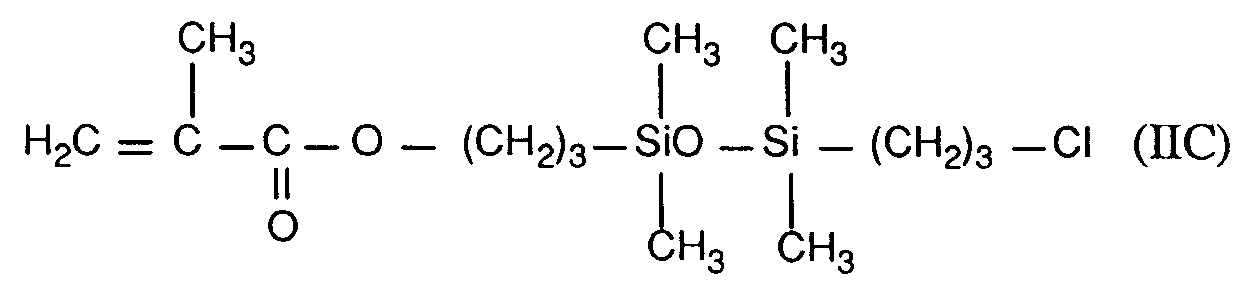
(2) reacting the compound of the formula (IIC) with an excess of NH₃, to produce a compound of the formula IID
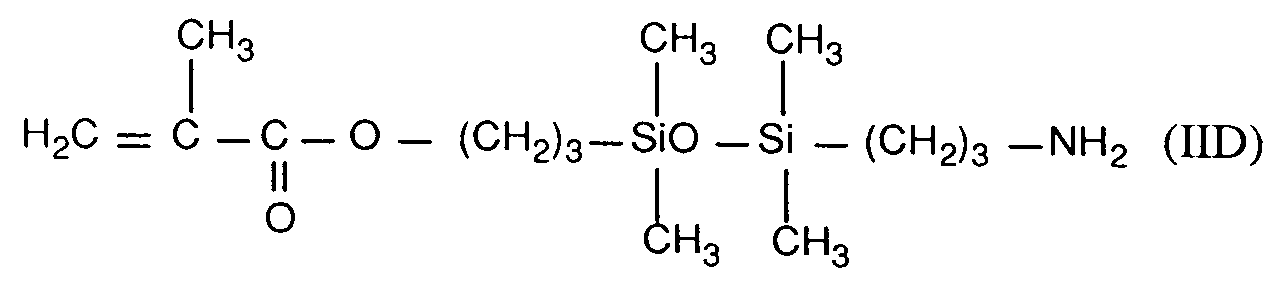
(3) reacting said compound of the formula IID with an excess of CH₃Br to produce a compound of the formula IIE
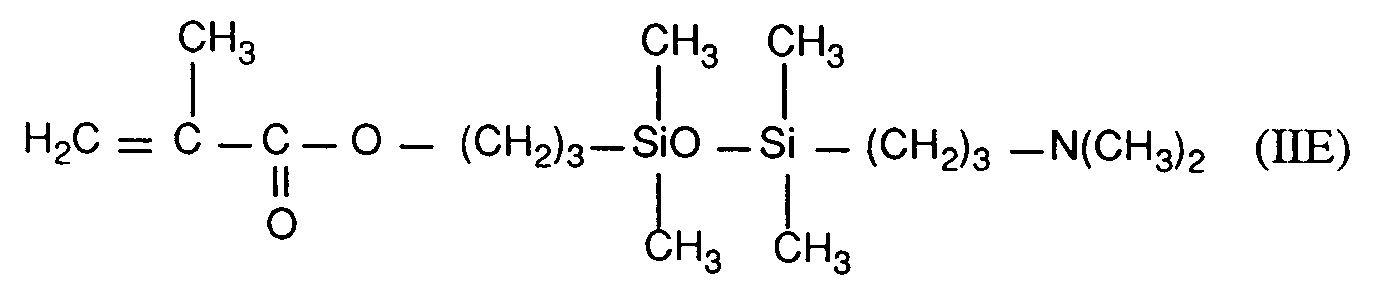
and (4) quaternizing the compound of the formula IIE with C₁₈H₃₇Cl to produce a compound of formula II.
by (1) reacting a compound of the formula IIA
with a compound of the formula IIB
in the presence of water to produce a compound of the formula IIC
(2) reacting the compound of the formula (IIC) with an excess of NH₃, to produce a compound of the formula IID
(3) reacting said compound of the formula IID with an excess of CH₃Br to produce a compound of the formula IIE
and (4) quaternizing the compound of the formula IIE with C₁₈H₃₇Cl to produce a compound of formula II.
21. A method of producing an antimicrobial quaternary ammonium group-containing polymer
which comprises homopolymerizing or copolymerizing, with a suitable comonomer, an
antimicrobial monomer of the formula I

wherein R₁, R₂ and R₃ are independently hydrogen, C₁-C₇ alkyl, or -COOR₁₃ with R₁₃ being hydrogen or C₁-C₄ alkyl;
z₁ and z₂ are independently 0 or 1;
La is -C(O)O-, -C(O)N(Ra)-, or a bond;
La₁ is a bond, -C(O)O-, -C(O)N(Ra)-, -O-, -OC(O)O-, -N(Ra)C(O)N(Ra)- or -N(Ra)C(O)O-; wherein Ra is hydrogen or C₁-C₈ alkyl;
R₁₀ is a bivalent C₁-C₂₀ aliphatic, C₃-C₂₅ cycloaliphatic or C₆-C₂₀ aryl group, each of which may be substituted with up to five halogen atoms, or (CH₂CH(Ra)O)j, wherein j is an integer from 1 to 50;
R₄ and R₇ are independently a bivalent group selected from C₂-C₁₀ aliphatic, such as C₂-C₈ alkylene, C₁-C₄ alkylene-(oxy-C₁-C₄ alkylene)g, C₁-C₄ alkylene-OCH₂-(hydroxy C₁-C₄ alkylene)-CH₂, cycloaliphatic up to 25 carbon atoms and aryl up to 25 carbon atoms, wherein g is an integer from 1 to 10;
y is an integer from 1 to 10;
R₅ and R₆ are independently C₁-C₈ alkyl, C₆-C₂₅ aryl, or C₆-C₂₅ cycloaliphatic which may be substituted by one or more halogen, hydroxy, C₁-C₄ alkyl, carboxy or C₁-C₁₂ perhaloalkyl groups, or R₅ and R₆ may be -Si(OSiCH₃)₃;
R₈ and R₉ are independently C₁-C₂₄ alkyl, C₃-C₂₄ cycloaliphatic or C₆-C₂₅ aryl, which groups may be each substituted with from 1 to 11 groups selected from hydroxy, C₁-C₄ alkyl, carboxy, C₁-C₁₂ perhaloalkyl, and halogen, or R₈ and R₉ may also be (CH₂CH₂O)xH units, where x is an integer from 1 to 10, and
X is an ophthalmically acceptable counterion.
wherein R₁, R₂ and R₃ are independently hydrogen, C₁-C₇ alkyl, or -COOR₁₃ with R₁₃ being hydrogen or C₁-C₄ alkyl;
z₁ and z₂ are independently 0 or 1;
La is -C(O)O-, -C(O)N(Ra)-, or a bond;
La₁ is a bond, -C(O)O-, -C(O)N(Ra)-, -O-, -OC(O)O-, -N(Ra)C(O)N(Ra)- or -N(Ra)C(O)O-; wherein Ra is hydrogen or C₁-C₈ alkyl;
R₁₀ is a bivalent C₁-C₂₀ aliphatic, C₃-C₂₅ cycloaliphatic or C₆-C₂₀ aryl group, each of which may be substituted with up to five halogen atoms, or (CH₂CH(Ra)O)j, wherein j is an integer from 1 to 50;
R₄ and R₇ are independently a bivalent group selected from C₂-C₁₀ aliphatic, such as C₂-C₈ alkylene, C₁-C₄ alkylene-(oxy-C₁-C₄ alkylene)g, C₁-C₄ alkylene-OCH₂-(hydroxy C₁-C₄ alkylene)-CH₂, cycloaliphatic up to 25 carbon atoms and aryl up to 25 carbon atoms, wherein g is an integer from 1 to 10;
y is an integer from 1 to 10;
R₅ and R₆ are independently C₁-C₈ alkyl, C₆-C₂₅ aryl, or C₆-C₂₅ cycloaliphatic which may be substituted by one or more halogen, hydroxy, C₁-C₄ alkyl, carboxy or C₁-C₁₂ perhaloalkyl groups, or R₅ and R₆ may be -Si(OSiCH₃)₃;
R₈ and R₉ are independently C₁-C₂₄ alkyl, C₃-C₂₄ cycloaliphatic or C₆-C₂₅ aryl, which groups may be each substituted with from 1 to 11 groups selected from hydroxy, C₁-C₄ alkyl, carboxy, C₁-C₁₂ perhaloalkyl, and halogen, or R₈ and R₉ may also be (CH₂CH₂O)xH units, where x is an integer from 1 to 10, and
X is an ophthalmically acceptable counterion.