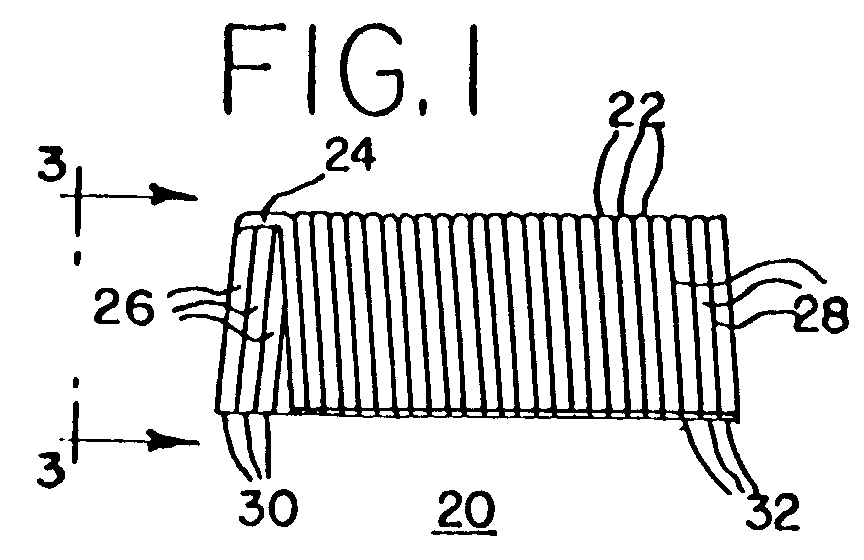
(57) A clinch type staple (22) has a U-shaped configuration with a pair of legs (26, 28)
extending generally perpendicularly from a base portion (24) of the staple with the
outside surface of the distal ends (30, 32) of the legs being bevelled. The legs of
the staple lie in spaced apart planes that are parallel to one another, but are angularly
offset from one another in order to insure that the legs (26, 28) will not contact
or interfere with each other as they are clinched into a workpiece (34, 36). A plurality
of such clinch staples (22) can be manufactured into an assembly (20) of clinch staples.
The method of making such an assembly of clinch staples includes advancing a plurality
of wires (42) in parallel side-by-side relation in a flat, planar array and adhering
them to one another. A blank (54), severed from an end of the formed array, includes
a plurality of side-by-side wire segments of equal length extending parallel to one
another in a first direction. The severing of the wires is accomplished along a cutting
line that is inclined by a bias angle (56) from a perpendicular to the first direction.
The blank (54) is bent along two bending lines to form a channel-shaped stick of clinch
staples with the legs (26, 28) extending perpendicularly from a base or bight portion
(24) of the staples (22). The two bending lines are parallel to the cutting line so
that the legs of the formed staples will be offset angularly from each other.
|
|
