|
(11) | EP 0 617 324 A1 |

| (12) | EUROPEAN PATENT APPLICATION |
|
|
|
|
|||||||||||||||||||||||||||
| (54) | Method of processing photographic silver halide materials |
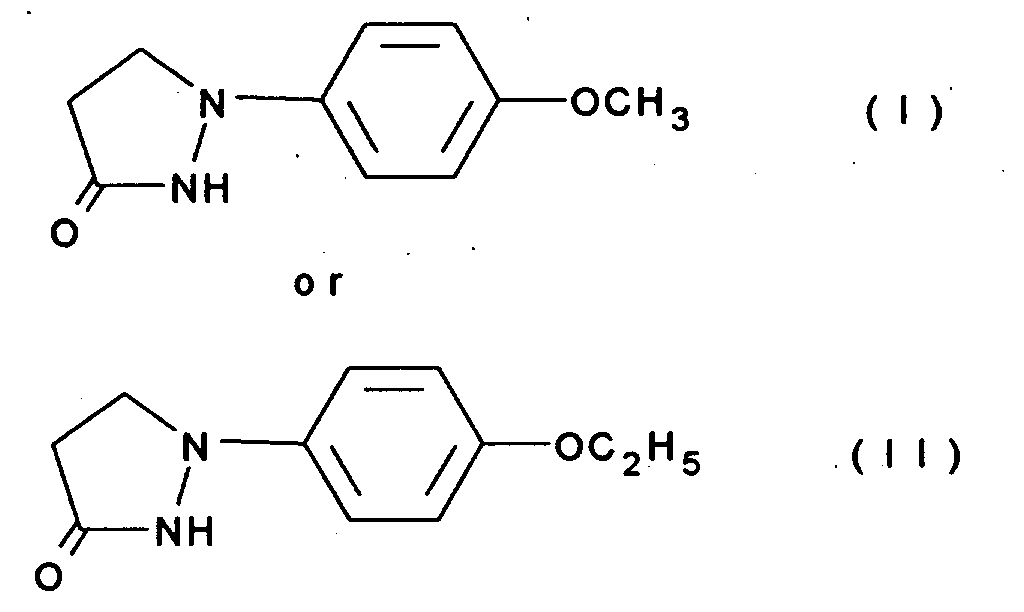
| (57) A method of reducing the granularity of an imagewise exposed photographic silver
halide colour negative material comprising a support bearing at least one photosensitive
silver halide emulsion layer having associated therewith a dye image-forming coupler
which method includes processing the imagewise exposed colour negative material to
form at least one silver image and corresponding dye image by treatment in a colour
developer solution containing a primary amino colour developing agent wherein the
colour negative material contains a pyrazolidinone compound of the formula:
or a precursor thereof in such amount that the granularity is reduced without any substantial change in dye density at the same level of exposure. |
[0001] This invention relates to a method of processing photographic silver halide materials and in particular colour negative materials.
[0002] There is a constant desire to improve the quality of photographic colour negative materials, particularly colour negative films, so as to obtain improved properties in the images formed after exposure and processing. These improvements are desirable but not at the expense of losing some other desirable property.
[0004] US patent 4 859 578 describes a photographic colour negative recording material which contains (1) an image dye-forming coupler, (2) a DIR compound, (3) a compound which releases a water-soluble mercaptan on silver halide development said to be invovled in selective development acceleration and (4) a compound which releases an electron transfer agent (ETA) on silver halide development. (Incidentally such materials very often contain developer inhibitor-releasing compounds (usually couplers) to improve properties such as sharpness in the image areas in the vicinity of its release). The material is said to have improved granularity without sacrificing other desirable properties. The present invention does not use incorporated compounds (3) or (4) which, of course, only act in the vicinity of their release.
[0005] US patent 4 526 863 describes a photographic colour negative recording material having a relatively light-insensitive silver halide, zinc oxide or titanium oxide layer positioned between two photosensitive silver halide layers which contains a compound which releases a fogging agent in the vicinity of silver halide development.
[0006] In contrast to the above two pieces of prior art, it is not essential to use incorporated fogging agent-or ETA-releasing compounds which only act in the vicinity of silver halide development in the present invention.
[0007] According to the present invention there is provided a method of reducing the granularity of an imagewise exposed photographic silver halide colour negative material comprising a support bearing at least one photosensitive silver halide emulsion layer having associated therewith a dye image-forming coupler which method includes processing the imagewise exposed colour negative material to form at least one silver image and corresponding dye image by treatment in a colour developer solution containing a primary amino colour developing agent wherein the colour negative material contains a pyrazolidinone compound of the formula:
or a precursor thereof in such amount that the gamma-normalised granularity is reduced without any substantial change in dye density at the same level of exposure.
[0008] The invention provides a processed colour negative material having improved granularity without loss or gain of density for a given exposure. It is believed that mechanism by which the invention achieves its results is through an increase in silver development and the number of silver centres but with a lowering of dye yield per unit silver. This is especially true of the Dmin and fog regions.
[0009] The pyrazolidinones employed herein (which are electron transfer agents) are those which, at the correct level, can increase silver development, reduce dye yield such that the dye density is about the same as in the control case and reduce the gamma-normalised granularity.
[0010] The pyrazolidinones may be present in the colour negative material in an amount of from 0.01 to 5.0 g/m², preferably 0.05 to 1.0 g/m² and especially 0.2 to 0.8 g/m². They may be located in an emulsion layer or another layer of the material. Preferably they are located in or adjacent the silver halide emulsion layer nearest the support.
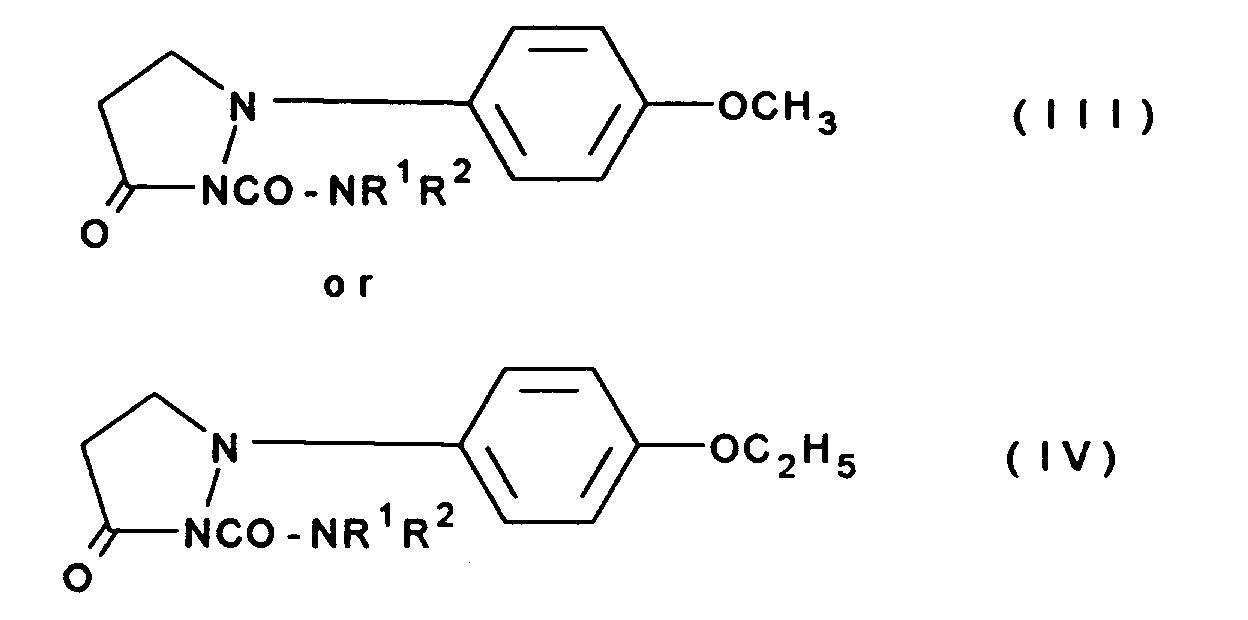
[0011] Preferably the incorporated material is a pyrazolidinone precursor which remains inactive until the material is treated with an alkaline processing solution. Such a precursor may beta compound of one of the formulae:
wherein R¹ and R² are alkyl or aryl groups that may be substituted. It is preferred that R¹ and R² are ballast groups of such a size and configuration to render the compound non wandering in photographic layers.
[0012] The pyrazolidinone may also be present in the colour developer in addition to the colour negative material. The amount of the pyrazolidone of formula (I) or (II) employed in the colour developer may range from 0.05 to 5.0 g/l, preferably from 0.1 to 1.0 g/l and particularly from 0.2 to 0.5 g/l As will be illustrated below in the Examples, the optimum amount can be determined by experiment.
[0013] Thee other electron transfer agents used as comparison examples in the Examples below illustrate different balances between silver development and dye yield. Those in Examples 2 and 3 cause a small increase in silver development but most of this is translated into dye resulting in an overall increase in density in the Dmin and toe region. This result is similar to over-development and gives an increase in granularity.
[0014] The electron transfer agent in Example 5 is one which causes a small increase in silver development but with a much reduced dye yield resulting in an overall reduction in dye density throughout the entire sensitometric curve. This causes a reduction in raw granularity but is accompanied by a loss of sensitometric response typical of other compounds which act as "toe-cutters".
[0015] The colour development step is preferably followed by the conventional bleach, fix (or bleach-fix) and wash and/or stabilise steps. A typical process is the C41 process described in British Journal of Photography (1988) pages 196-98. The exact composition, the temperature and the time of processing can be established by experiment.
[0016] The photographic material to be processed may be any of those described in Research Disclosure Item 308119, December 1989 published by Kenneth Mason Publications, Emsworth, Hants, United Kingdom.
[0017] The following Examples are included for a better understanding of the invention. They are model experiments in which the pyrazolidinone is located entirely in the colour developer but it is believed that the results obtained with the single layer coatings employed would be very similar if the pyrazolidinone were contained in the coated element.
EXAMPLE 1 (Invention)
[0018] A single layer colour negative film (strip a) containing 1.0g/m² of silver in the form of a bromoiodide
T-Grain emulsion and 0.6g/sq.metre of a cyan coupler of the formula:
was exposed to a test step wedge and processed by the following process what 38 °C:
| 1. Colour developer | 3.25 mins |
| 2. Bleach | 4.50 mins |
| 3. Wash | 1.00 mins |
| 4. Fix | 4.35 mins |
| 5. Stabilise | 1.00 mins |
| Colour developer | |
| DTPA | 6.5 ml |
| Sodium sulphite (anhy) | 4.25 g |
| Potassium iodide | 1.2 mg |
| Sodium bromide | 1.3 g |
| Hydroxylamine sulphate | 2.0 g |
| 4-(N-ethyl-N-2-hydroxyethyl)-2-methylphenylenediamine | 4.75 g |
| Water to | 1.0 litre |
| pH = 10.0 | |
[0019] DTPA is a 41% solution of the penta sodium salt of diethylenetriamine pentaacetic acid.
| Bleach | |
| Sodium iron(III) ethylenediamine-tetra-acetic acid | 100.0 g |
| Potassium bromide | 50.0 g |
| Acetic acid | 6.0 ml |
| Water to | 1.0 litre |
| Fixer | |
| Ammonium thiosulphate | 120.0 g |
| Sodium sulphite (anhy) | 20.0 g |
| Potassium metabisulphite | 20.0 g |
| Water to | 1.0 litre |
| Stabiliser | |
| Formaldehyde (36% soln) | 6.0 ml |
| Water to | 1.0 litre. |
[0020] Further strips of the same material were processed similarly except that the developer additionally contained 4'-methoxy-1-phenylpyrazolidin-3-one. In Figure 1 a comparison of 0, 0.15 (b) and 0.3g/l (c) of 4'-methoxy-1-phenylpyrazolidin-3-one (4MP) for a 2.5 minute development time shows a reduction in gamma normalised granularity with 4MP. This extends over most of the exposure scale. There is also a reduction of raw granularity particularly in the Dmin. It can be seen that the Dmin density increases with 4MP then comes down again. A photmicrographic examination shows that 4MP increases the number of developed silver centres in the Dmin and toe region of the sensitometric curve. In the Dmin region these extra silver centres are simply more fog grains but because the dye density is about the same (at 0.3g/l of 4MP) the granularity in the Dmin area is reduced. It appears that the granularity reduction carries on up the sensitometric curve but it is not certain that the mechanism is the same as in the Dmin and toe region. The results of a similar experiment but with a longer development time (5 minutes) is shown in Figure 2. Here the effects are essentially the same but more pronounced with a larger reduction in gamma-normalised and raw granularity. If the raw granularity in the Dmin is plotted against the level of ETA in the developer solution at differing development times then the plot in Figure 3 is obtained. In this plot it is clear that 4MP causes a reduction in granularity at all levels and prevents the increase in granularity at extended development times.
Example 2 (Comparative)
[0021] This is a comparison example of a commercially used pyrazolidone, 4,4-dimethyl-1-phenyl-pyrazolidin-3-one. In Figure 4 the effect of adding the pyrazolidone to the developer of Example 1 at 0 (curve a), 0.15 (b) and 0.3g/l (c) is shown. There is an increase in dye density in the Dmin and toe of the curve and an increase in raw granularity. Gamma-normalised granularity is either unchanged or slightly higher depending on the exposure. This compound compares unfavourably with that used in Example 1.
Example 3 (Comparative)
[0022] This is a comparison example with another pyrazolidone, 4,4-bis-hydroxymethyl-1-phenylpyrazolidin-3-one (BOP). In Figure 5 the effect of adding BOP to the developer of Example 1 at 0, 0.15 and 0.3g/l is shown. There is an increase in dye density in the Dmin and toe of the curve similar to that of Example 2. There is also an increase in raw granularity and in gamma-normalised granularity for most of the sensitometric curve. This compound compares unfavourably with that shown in Example 1.
[0023] Other pyrazolidones such as 1-phenylpyrazolidin-3-one and 4,4-hydroxymethyl-methyl pyrazolidin-3-one (MOP) behave similarly to those in Examples 2 and 3.
Example 4 (Invention)
[0024] The procedure of Example 1 was repeated except that the pyrazolidone was replaced with 4'-ethoxy 1-phenylpyrazolidin-3-one. As can be seen from Figure 6, this lowers raw granularity and gamma-normalised granularity but to a lesser extent than 4'-methoxy-1-phenylpyrazolidin-3-one.
Example 5 (Comparative)
[0025] This is a comparison example using the same method as above of a pyrazolidone that acts as a "toe cutter". 4-n-pentyl-1-phenylpyrazolidin-3-one lowers sensitometric response in terms of speed and Dmin even at low levels where Examples 1-4 show increases. This is shown in Figure 7. This compound lowers raw granularity by reducing the dye yield and, as shown by photomicrographic examination, leaving the number of developed silver grains approximately the same as in its absence.
1. A method of reducing the granularity of an imagewise exposed photographic silver halide
colour negative material comprising a support bearing at least one photosensitive
silver halide emulsion layer having associated therewith a dye image-forming coupler
which method includes processing the imagewise exposed colour negative material to
form at least one silver image and corresponding dye image by treatment in a colour
developer solution containing a primary amino colour developing agent wherein the
colour negative material contains a pyrazolidinone compound of the formula:
or a precursor thereof in such amount that the granularity is reduced without any substantial change in dye density at the same level of exposure.
or a precursor thereof in such amount that the granularity is reduced without any substantial change in dye density at the same level of exposure.
2. A method as claimed in claim 1 in which the precursor is a ballasted compound which
releases the pyrazolidone when contacted with an alkaline colour developer solution.
3. A method as claimed in claim 2 in which the pyrazolidone precursor has one of the
formulae:
wherein R¹ and R² are alkyl or aryl groups that may be substituted and wherein R¹ and R² are of such size and configuration to render the precursor non-wandering in photographic layers.
wherein R¹ and R² are alkyl or aryl groups that may be substituted and wherein R¹ and R² are of such size and configuration to render the precursor non-wandering in photographic layers.
4. A method as claimed in any of claims 1-3 in which the colour negative film contains
from 0.01 to 5.0 g/m² of the pyrazolidinone.
5. A method as claimed in any of claims 1-3 in which the colour negative film contains
from 0.05 to 1.0 g/m² of the pyrazolidinone.
6. A method as claimed in any of claims 1-5 in which the colour developer solution also
contains a pyrazolidinone of formula (I) or (II) as defined in claim 1.
7. A method as claimed in claim 6 in which the colour developer solution contains from
0.05 to 5.0 g/l of the pyrazolidinone.
8. A method as claimed in claim 6 in which the colour developer solution contains from
0.1 to 1.0 g/l of the pyrazolidinone.
9. A method as claimed in any of claims 1-8 in which the colour negative material is
a multicolour photographic material comprising a support bearing a yellow dye image-forming
unit comprised of at least one blue-sensitive silver halide emulsion layer having
associated therewith at least one yellow dye-forming coupler, at least one magenta
dye image-forming unit comprising at least one green-sensitive silver halide emulsion
layer having associated therewith at least one magenta dye-forming coupler at least
one cyan dye image-forming unit comprising at least one red-sensitive silver halide
emulsion layer having associated therewith at least one cyan dye-forming coupler.
10. A method as claimed in any of claims 1-9 in which the pyrazolidinone is located in
or adjacent the silver halide emulsion layer nearest the support.