|
(11) | EP 0 617 717 B1 |

| (12) | EUROPEAN PATENT SPECIFICATION |
|
|
| (54) |
PHOSPHORUS-CONTAINING TRIAZINE COMPOUNDS AND THEIR USE PHOSPOR ENTHALTENDE TRIAZIN-VERBINDUNGEN UND IHRE VERWENDUNG COMPOSES DE TRIAZINE CONTENANT DU PHOSPORE ET LEUR UTILISATION |
|
|
|||||||||||||||||||||||||||||||
| Note: Within nine months from the publication of the mention of the grant of the European patent, any person may give notice to the European Patent Office of opposition to the European patent granted. Notice of opposition shall be filed in a written reasoned statement. It shall not be deemed to have been filed until the opposition fee has been paid. (Art. 99(1) European Patent Convention). |
Field of the Invention
[0001] This invention relates to substituted triazine compounds and to their use. In particular, it relates to sym-triazine (1,3,5-triazine) compounds containing a phosphonate groups which are generally useful as flame retardants, especially in polyurethane foams.
Background to the Invention
[0002] US-A-3210350 describes sym-triazine compounds having one or two of the three ring carbon atoms attached to a phosphonic radical of the formula:-
where R represents hydrogen or a saturated hydrocarbon group of up to 12 carbon atoms and X represents -OR or -NR2; the other ring carbon atom(s) are attached to a hydroxy, mercapto, nitro, acyl, acyloxy, amino, alkoxy, aryloxy, cycloalkyloxy, alkylsulpho, arylsulpho, cycloalkylsulpho, ureido, hydrazino, alkyl, aryl or cycloalkyl group. The compounds are stated to be useful as fire retardants, rust inhibitors, chemical intermediates, rust removers, electroplating additives, herbicides, insecticides, ion exchange resins, tanning agents, water-soluble interfacial agents, water-insoluble dispersion agents, detergents, wetting agents, gasoline inhibitors and monomers for vinyl polymerisation and copolymers. US-A-3158450 describes the use of such a compound or a metal derivative thereof as an additive to leaded gasoline to inhibit engine misfiring. US-A-3011998 describes condensation products of such triazine compounds with an aldehyde.
[0003] An article by J.P. Moreau and L.H. Chance in "American Dyestuff Reporter", May 1970 at pages 37-38 and 64-65 describes the evaluation of 2-amino-4,6-bis(diethoxyphosphinyl)-1,3,5-triazine and 2,4-diamino-6-diethoxyphosphinyl-1,3,5-triazine as possible flame retardant finishes for cotton. An article by the same authors in the same journal in February 1971 at pages 34-38 describes the evaluation of the formaldehyde derivative of 2,4-diamino-6-diethoxyphosphinyl-1,3,5-triazine as a flame retardant for cotton. US-A-3654274 describes new processes for preparing this compound.
[0004] An article by J A Mikroyannidis in J Polymer Science: Part A; Polymer Chemistry, Vol. 26, pages 583-593 (1988) describes linear poly(dialkoxyphosphinyl-sym-triazine)s prepared by interfacial or solution polycondensation reactions of various diamines such as ethylene diamine, hexamethylene diamine or bis(4-aminocyclohexyl) methane with 2-dialkoxyphosphinyl-4,6-dichloro-sym-triazines.
Summary of the Invention
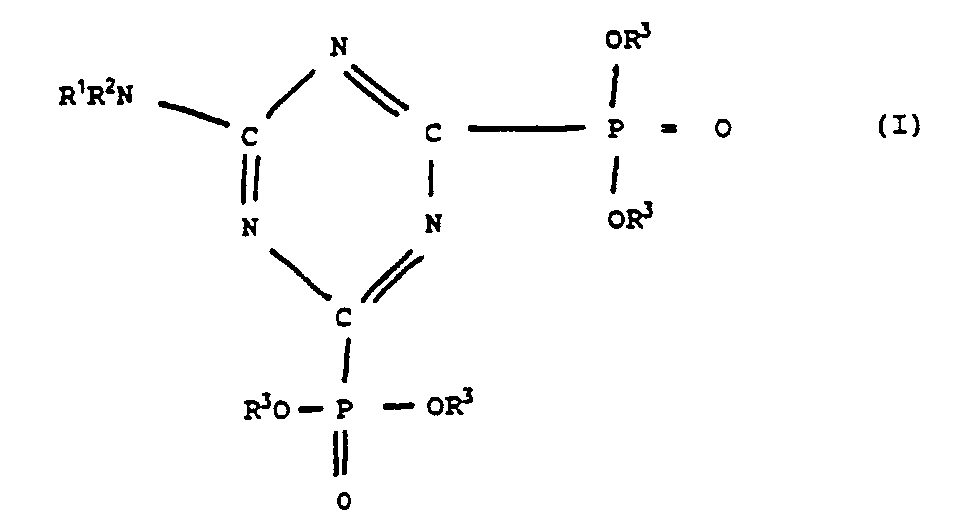
[0005] According to one aspect of the invention a polyurethane foam contains a phosphorus-containing heterocyclic flame retardant and is characterised in that the flame retardant is a sym-triazine compound of the formula:
where R1 and R2 each represent an alkyl group having 1 to 12 carbon atoms and R3 represents an alkyl or cycloalkyl group having 1 to 12 carbon atoms.
[0006] The compounds of formula (I), which are essentially halogen-free, are at least as effective as present commercial flame retardants containing halogen; halogenated compounds are becoming regarded as environmentally undesirable for some uses.
[0007] The flame retardants used in the invention are particularly suitable for incorporation in polyurethane foam used in furniture and in seats for cars, trains or aircraft; the flame retardant can be mixed with the polyol which is reacted with polyisocyanate to form the polyurethane foam.
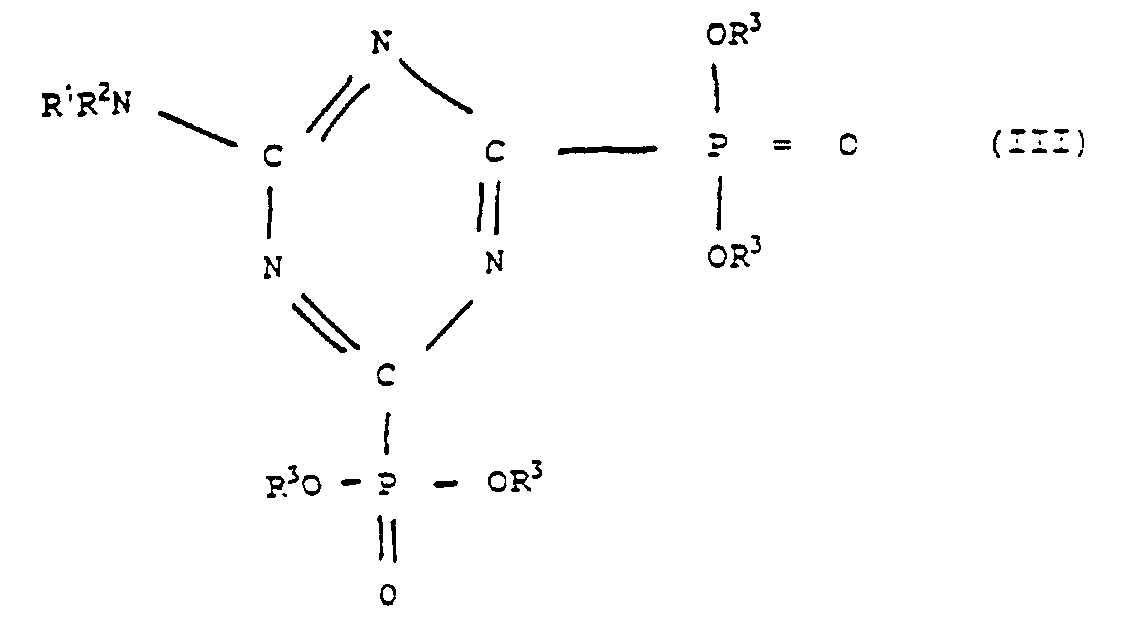
[0008] The invention thus includes a polyol composition comprising a polyol selected from polyether and polyester polyols suitable for preparing polyurethane foam, said polyol composition containing as flame retardant a phosphorus-containing sym-triazine compound of the formula:
in which the groups R1, R2 and R3 are defined as above, but R3 preferably represents an alkyl group having 1 to 6 carbon atoms, the groups R3 being the same or different. The invention also includes a process for the production of polyurethane foam of reduced flammability in which such a polyol composition is reacted with a polyisocyanate in the presence of a foaming agent.
[0009] Certain of the compounds of formula (I) are new compounds. Thus, according to another aspect of the invention a phosphorus-containing flame retardant is a sym-triazine compound which is liquid at ambient temperature, is soluble in a polyether polyol (for example a polyoxypropylene triol of molecular weight 3500) and has the formula (I) above, in which the group R1 contains at least two carbon atoms.
Detailed Description
[0010] The compounds of formula (I) can be prepared with a wide range of physical properties by changes in the number and type of alkyl substituents in -NR1R2 and -PO(OR3)2 groups. The compounds of formula (I) tend to be high-boiling liquids and can have varying solubility in organic solvents.
[0011] The compounds of formula (I) in which R1 represents an alkyl group having 1 to 12, preferably 1 to 6, carbon atoms are more easily processed than the compounds in which R1 and R2 are both hydrogen. Those compounds having an N-organo substituent generally have lower melting points and increased solubility in organic solvents. For example, the compounds in which R1 and R2 each represent an alkyl group are soluble in the polyols (polyether or polyester polyols) used in polyurethane foam manufacture. They are generally soluble in common organic solvents, for example alcohols, cyclic ethers, aromatic ethers, diethers, ether-alcohols, ketones, nitriles and aromatic hydrocarbons. Unlike the corresponding compounds of formula (I) in which R2 is hydrogen they are also soluble in alkanes. The diphosphonate compounds of formula (I) in which both R1 and R2 are alkyl groups are liquids, as are compounds in which at least one of the groups R1 and R2 is a long chain alkyl group having at least 6, particularly 8 to 12, carbon atoms. Liquid flame retardants are often preferred in polyurethane foam manufacture. Examples of preferred alkyl groups for R1 are ethyl, isopropyl, methyl and hexyl. R2 can for example be a methyl or ethyl group, so that preferred groups -NR1R2 are diethylamino or dimethylamino.
[0012] Within the class of compounds of formula (I), those compounds in which R1 and R2 are both alkyl groups have relatively low water solubility (generally less than 5% by weight when both groups R3 are ethyl).
[0013] The compounds of formula (I) in which R3 is an alkyl group having more than two carbon atoms, for example where R3 is an isopropyl group or an n-butyl group, have markedly reduced water solubility and are generally liquid. Such compounds are preferred flame retardants.
[0014] Polyurethane foams are generally produced by reacting a polyol composition with a polyisocyanate in the presence of a foaming agent. The polyol is generally a polyether polyol or polyester polyol. The polyol is usually a polyether polyol of functionality 2.5-3.5 for production of a flexible foam, for example a polyether triol of molecular weight 3000-6000 prepared by the addition of propylene oxide and optionally ethylene oxide to a polyalcohol such as glycerol or to an aminoalcohol or polyamine. The polyether triol can optionally contain a dispersion of another polymer, for example a polyurea or a styrene/acrylonitrile copolymer, to produce a high-resilience flexible foam. For production of a rigid foam, a more highly functional polyol, for example of average functionality 4 to 5, of lower equivalent weight, for example 100-150, is used. The polyisocyanate is usually toluene diisocyante (TDI) for production of flexible foam, and it may be a TDI prepolymer or diphenylmethane-4,4'-diisocyanate or an oligomer thereof for rigid foam production. The foaming agent can be a volatile compound such as a halocarbon, but for flexible foams it is usually water, which reacts with isocyanate groups to release CO2. The foam-forming composition also generally contains a surfactant and catalysts and may contain other additives; all these are generally premixed with the polyol.
[0015] The flame retardant is preferably dissolved in the polyol. Particularly preferred flame retardants for use in polyurethane foam, for example for mixing with a polyether or polyester polyol in the above process, are those of the formula:
in which R1 and R2 are each alkyl groups having 6 to 12 carbon atoms.
[0016] Examples of preferred flame retardants are:- Tetraisopropyl 2-diethylamino-1,3,5-triazine-4,6-diphosphonate and tetraisopropyl 2-dimethylamino-1,3,5-triazine-4,6-diphosphonate. The flame retardants can be used at 0.1-50% by weight based on the polyurethane foam. In general, at least 0.5% by weight and preferably at least 1% is used to obtain a significant effect. The amount of flame retardant is preferably less than 20% by weight, and most preferably less than 10%, based on the plastics material. When the flame retardant is incorporated in a polyol composition for producing polyurethane foam, it preferably forms 1.5 to 15% by weight of the polyol composition.
[0017] The flame-retardant compound of formula (I) can in general be prepared from cyanuric chloride (2,4,6-trichlorotriazine) by reaction with an appropriate derivative of phosphorous acid, followed by reaction with an amine. For example, cyanuric chloride can be reacted with a trialkyl phosphite of the formula (R3O)3P in a molar ratio of 1:2 to produce a triazine having
phosphonate ester substituents with 1 remaining chlorine substituent, i.e. a tetraalkyl 2-chloro-1,3,5-triazine-4,6-diphosphonate. The reaction is carried out in an organic solvent, for example an aromatic hydrocarbon such as benzene, toluene or xylene, in the absence of moisture, preferably at an elevated temperature in the range 50-150°C. The reaction can be catalysed by a catalyst such as sodium iodide. A catalyst is preferably used if the trialkyl phosphite is a secondary alkyl phosphite such as triisopropyl phosphite, allowing complete reaction at 120°C without decomposition of the product. Alkyl chloride R3Cl is evolved as by-product; it is most convenient if the alkyl chloride R3Cl can be removed from the reaction mixture, for example if the alkyl chloride R3Cl has a lower boiling point than the solvent. The reaction with trimethyl or triethyl phosphite proceeds readily at 120°C in toluene. Reaction with tri-n-butyl phosphite is preferably at 140°C in xylene. However, it is preferred in most cases that R3 contains at least 2 carbon atoms, since the methyl phosphonate groups react differently with amines compared to other alkyl phosphonate groups.
[0018] If the trialkyl phosphite P(OR3)3 is unavailable or too expensive, it is possible to prepare the phosphonate by transesterification of a triazine phosphonate which can be made readily.
[0019] The tetraalkyl 2-chlorotriazine-4,6-diphosphonate can react with a secondary amine R1R2NH to introduce tertiary amino groups -NR1R2. The reaction may be carried out in an organic solvent, for example an aromatic hydrocarbon as described above, at a temperature in the range from -20° to 150°C, preferably at at least -10°C and below 100°C. In many cases the reaction is preferably carried out by addition of the amine to the triazine phosphonate, or vice versa, at a temperature in the range -10°C to 0°C. The reaction can then be completed by allowing the reaction mixture to warm to 0°C and above, with heating to 50°C or above if necessary. The amino groups replace the chloro group on the triazine ring more readily than they replace the phosphonate ester groups, so that reaction of a tetraalkyl chlorotriazine diphosphonate with at least an equimolar amount of amine per mole of phosphonate will produce a product substantially free from chlorine.
[0020] Removal of successive phosphonate ester groups by an amine generally requires increasingly forcing conditions. A hexaalkyl triazinetriphosphonate will react with a secondary dialkyl amine at room temperature to replace only one phosphonate ester group by a tertiary amino group. The 2-dialkylamino-triazine-4,6-diphosphonate is produced in high yield. At temperatures of 50°C and above, for example 50-100°C, the secondary amine will replace two phosphonate ester groups to form primarily a 2,4-bis(dialkylamino)-triazine-6-phosphonate. This reaction may require the use of excess amine and an extended reaction period, for example at least 24 hours at 60°C.
[0021] The amount of amine required for the above reaction is generally more than the stoichiometric amount required to substitute -NR1R2 groups on the triazine ring, since base is required to neutralise chloride or phosphite groups displaced from the triazine ring. The same amine can act as both nucleophile and base. For example, the reaction with a chlorotriazine Tz-Cl can be represented by the equation:
The reaction to displace a phosphonate ester group from a triazine-phosphonate Tz-PO(OR3)2 is generally according to the equation:
but some amine is consumed by reaction with the dialkyl phosphite co-product according to the equation:
Excess amine is preferably used, although less is required than for reaction with a chlorotriazine. The amine phosphite by-product HPO(OR3)O- R1R2N+H2 can readily be removed from the desired aminotriazine phosphonate, since the by-product is readily soluble in both water and organic solvents.
[0022] As an alternative to the use of excess of the amine R1R2NH, this amine can be used in conjunction with a tertiary amine such as triethylamine. Use of a tertiary amine is preferred when it is desirable to avoid excess of the substituting amine, for example when the amine R1R2NH is expensive, or is involatile or of low volatility, or when different amines R1R2NH and R6R7NH are successively employed to introduce dissimilar substituents. Use of a tertiary amine is also preferred when the amine R1R2NH is only a weak nucleophile and/or a weak base, for example an aromatic amine such as aniline. The tertiary amine is generally used in an equimolar amount to the amine R1R2NH when reacting with a chlorotriazine, but it can be used in catalytic amounts, for example 10-50 mole % based on R1R2NH, when reacting with a triazinetriphosphonate. The reaction of R1R2NH with a chlorotriazine phosphonate can alternatively be carried out in a 2-phase aqueous/organic solvent system using an inorganic base in the aqueous phase and a phase transfer catalyst.
Use of the symbol R means a hydrocarbon group, particularly an alkyl group, (the groups R may be the same or different). This scheme may be summarised more succinctly as follows:
[0023] In the above reaction schemes, the group R3 preferably has at least two carbon atoms and the reaction scheme applies most accurately to the case where R3 is ethyl (use of triethyl phosphite). When the group R3 is methyl, the tetramethyl aminotriazine diphosphonate of the formula
can be formed by the above reaction scheme using a secondary amine R1R2NH with strict avoidance of excess amine. In the presence of excess amine or ammonia the phosphonate ester group reacts at least partly with the amine or ammonia (R1R2NH) to form phosphonate salt groups of the formula:
[0024] A hexa(secondary alkyl) triazine triphosphonate is preferred for reaction with amino compounds R1R2NH which are readily available only as a gas or aqueous solution. An example of such an amino compound is dimethylamine.
[0025] Compounds containing more than one phosphonate group are generally useful in inhibiting corrosion of metals or for any other use requiring complexing of metals as a chelate.
Example 1
Tetraethyl 2-diethylamino-1,3,5-triazine-4,6-diphosphonate
[0027] To a stirred solution of hexaethyl 1,3,5-triazine-2,4,6-triphosphonate (29.34 g, 0.06 mol) in toluene (90 ml), cooled at -5°C and protected from atmospheric moisture, was added dropwise over 25 minutes a solution of diethylamine (26.28 g, 0.36 mol) in toluene (45 ml). The resulting solution was stirred for 1 hour at 0°C, and then allowed to react for a further 3 days at 20°C with stirring. Removal of solvent, and drying at 95°C/1 mm, gave a mobile oil (26.57 g). A solution of the oil in dichloromethane was extracted with water and dried (Na2SO4). Removal of solvent, and drying at 95°C/1.5 mm, gave the analytical sample of tetraethyl 2-diethylamino-1,3,5-triazine-4,6-diphosphonate (24.50 g, 96%) as a yellow oil, identified by 1H-NMR, 13C-NMR and FT-IR.
1H-NMR : δ (CDCl3) 1.22 (6H, t, J=7Hz, MeCH2N), 1.41 (12H, t, JHH=7Hz, MeCH2O-P), 3.68 (4H, quartet, J=7Hz, Me-CH2-N), 4.38 (8H, doublet of quartets, JHH=7Hz, JPH=7Hz, Me-CH2 -O-P);
13C-NMR : δ (CDCl3) 12.2 (s, MeCH2N), 16.1 (s, MeCH2O-P), 41.9 (s, Me-CH2-N), 64.0 (s, Me-CH2-O-P), 161.4 (t, JPCNC=19Hz, triazine ring carbon with nitrogen substituent), 170.6 (dd, JPC=265Hz, JPCNC=15Hz, triazine ring carbons with phosphorus substituents);
FT-IR : υmax (neat) 3495, 2985, 2935, 2910, 1575, 1535, 1480, 1255, 1045, 1025 cm-1.
(Analysis : Found C, 42.21; H, 7.30; N, 13.27; P, 14.89. C15H30N4O6P2requires C, 42.45; H, 7.13; N, 13.20; P, 14.60%).
Example 2
Tetraethyl 2-bis-(2'ethylhexyl)amino-1,3,5-triazine-4,6-diphosphonate
[0028] Reaction of hexaethyl 1,3,5-triazine-2,4,6-triphosphonate (29.34 g, 0.06 mol), di-2-ethylhexylamine (14.46 g, 0.06 mol) and triethylamine (6.06 g, 0.06 mol) in toluene (total 135 ml), according to the procedure described in Example 1, on removal of solvent gave a solid/liquid mixture (39.60 g). Aqueous washing of a toluene solution, removal of solvent and drying afforded the analytical sample of tetraethyl 2-bis- (2'-ethylhexyl) amino-1,3,5-triazine-4,6-diphosphonate (29.37 g, 83%) as a red viscous oil, identified by 1H-NMR, 13C-NMR and FT-IR.
(Analysis : Found C, 54.80; H, 9.43; N, 8.59; P, 10.24. C27H54N4O6P2 requires C, 54.72; H, 9.18; N, 9.45; P, 10.45%).
Example 3
Tetraisopropyl 2-dimethylamino-1,3,5-triazine-4,6-diphosphonate
[0029] To a stirred solution of hexaisopropyl 1,3,5-triazine-2,4,6-triphosphonate (42.98 g, 0.075 mol) in isopropanol (105 ml), cooled at -6°C and protected from atmospheric moisture, was added dropwise over 10 minutes a mixture of aqueous dimethylamine (40% w/w, 50.63 g, 20.25 g (CH3)2NH, 0.450 mol) and isopropanol (33 ml). The resulting solution was stirred for 1 hour at -2°C, and then allowed to react for a further 3 days at 18°C with stirring. Removal of solvent, and drying at 95°C/1 mm, gave a stiff gum. A solution of the gum in dichloromethane was extracted with water and dried (Na2SO4). Removal of solvent, and drying at 95°C/0.4 mm, gave tetraisopropyl 2-dimethylamino-1,3,5-triazine-4,6-diphosphonate.
Example 4
Combustion Tests of Polyurethane Foams containing Amino Triazine Phosphonates
[0030] Rigid polyurethane foam, of density 40 kg m-3 and containing 6.2% w/w of amino triazine phosphonate, was made from ICI "PBA 6919" polyol, containing amino triazine phosphonate (15 parts per hundred), plus ICI "Suprasec 5005" p,p'-methylenediphenyl diisocyanate (MDI). Assessment of the horizontal burning characteristics of foam strips of dimensions 150 mm x 50 mm x 13 mm was carried out in accordance with the BS 4735 combustion test. Where flame became extinguished without total burn-out of specimens, the extent of combustion quoted refers to the average of percentage distance burnt and percentage weight lost. For 10 foam strips of density 41 kg m-3 containing 6.2% w/w of tetraethyl diethylaminotriazinediphosphonate [TDTDP], the extent of combustion was 29% and the mean burn rate (determined from the time to burn 125 mm) was 0.9 mm sec-1. For foam of density 39 kg m-3, containing no flame retardant but otherwise identical, the extent of combustion was 100% (total burn-out) and the burn rate was 2.3 mm sec-1.
[0031] The flame retardant performance of an amino triazine phosphonate was compared with those of the commercial chloroalkyl phosphate flame retardants tris-(2-chloroethyl) phosphate [TCEP] and tris-(1-chloro-2-propyl) phosphate [TCPP] in rigid polyurethane foam. The foam, of mean density 38 kg m-3 and containing 4.1% w/w of amino triazine phosphonate or chloroalkyl phosphate, was made from PBA 6919 polyol, containing the appropriate phosphorus ester (10 parts per hundred), plus Suprasec 5005 MDI, and combustion tests were carried out in an identical manner to those previously described. The amino triazine phosphonate tested was tetraethyl diethylaminotriazinediphosphonate [TDTDP] (Example 1). The extent of combustion and rate of burn for the amino triazine phosphonate and for TCPP are expressed relative to the corresponding figures for TCEP in the following Table.
BS4735 Combustion Tests of Polyurethane Foam containing Phosphorus Esters
1. A polyurethane foam containing a phosphorus-containing heterocyclic flame retardant,
characterised in that the flame retardant is a sym-triazine compound of the formula
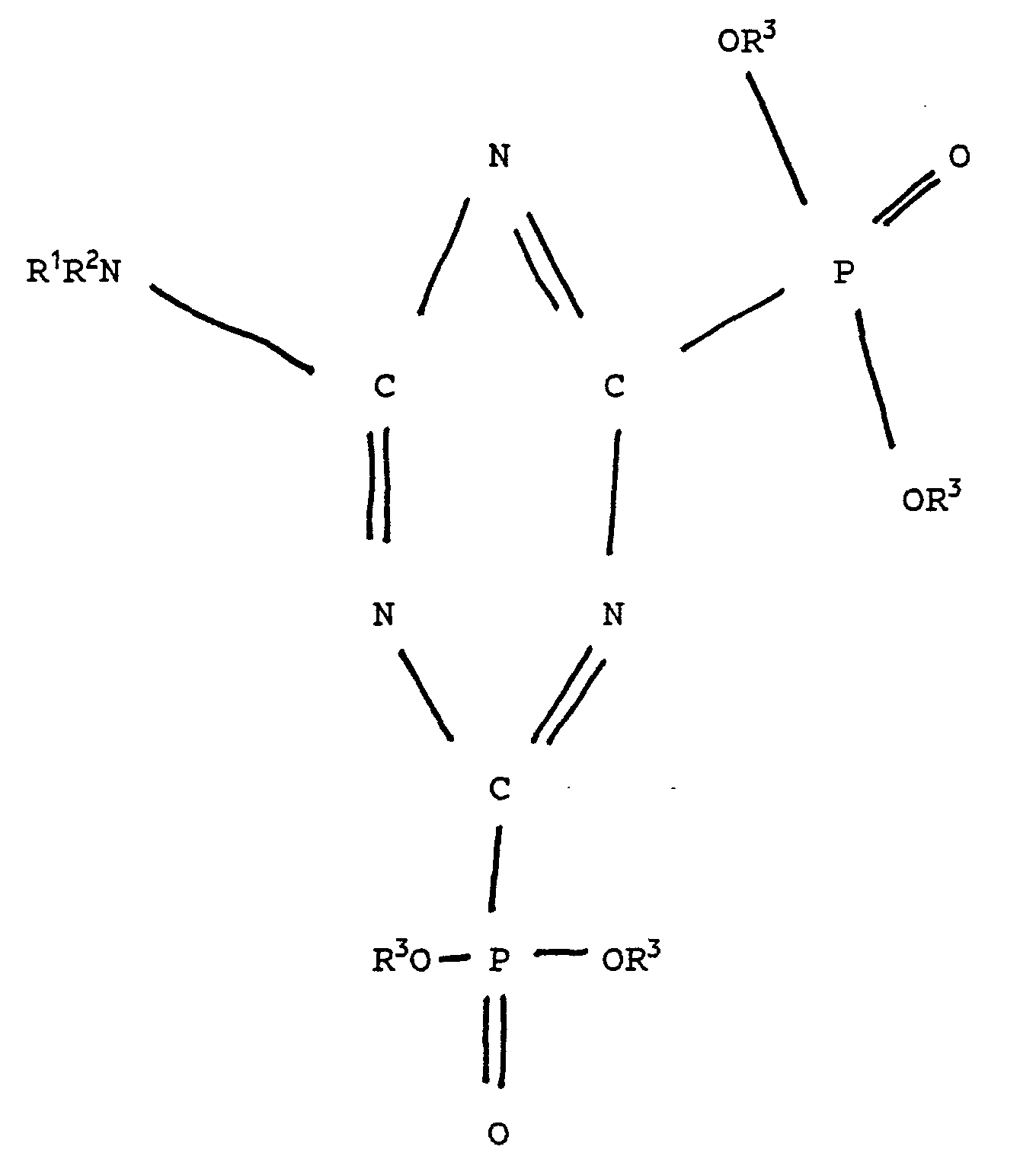
where R1 and R2 each represent an alkyl group having 1 to 12 carbon atoms and each group R3 independently represents an alkyl or cycloalkyl group having 1 to 12 carbon atoms.
where R1 and R2 each represent an alkyl group having 1 to 12 carbon atoms and each group R3 independently represents an alkyl or cycloalkyl group having 1 to 12 carbon atoms.
2. A polyurethane foam according to claim 1, characterised in that the flame retardant is a sym-triazine compound of formula (I) in which R3 is an alkyl group having 2 to 6 carbon atoms.
3. A polyol composition comprising a polyol selected from polyether and polyester polyols
suitable for preparing polyurethane foam, said polyol composition containing a phosphorus-containing
flame retardant, characterised in that the flame retardant is a sym-triazine compound of the formula:
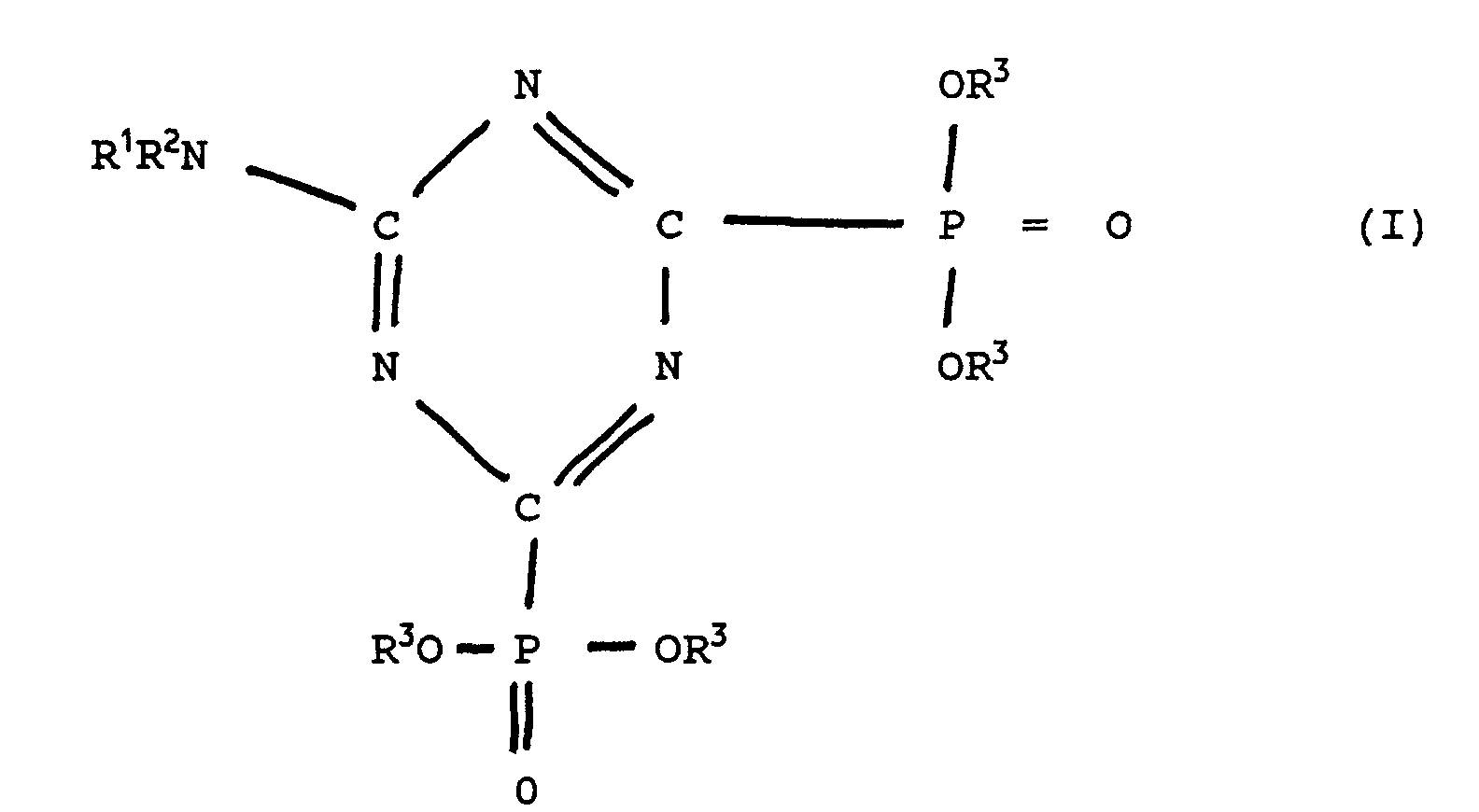
where R1 and R2 each represent an alkyl group having 1 to 12 carbon atoms, and
each group R3, which may be the same or different, represents an alkyl group having 1 to 6 carbon atoms.
where R1 and R2 each represent an alkyl group having 1 to 12 carbon atoms, and
each group R3, which may be the same or different, represents an alkyl group having 1 to 6 carbon atoms.
4. A polyol composition according to claim 3, characterised in that the flame retardant is dissolved in the polyol.
5. A process for the production of polyurethane foam of reduced flammability, characterised in that a polyol composition according to claim 3 or 4 is reacted with a polyisocyanate in
the presence of a foaming agent.
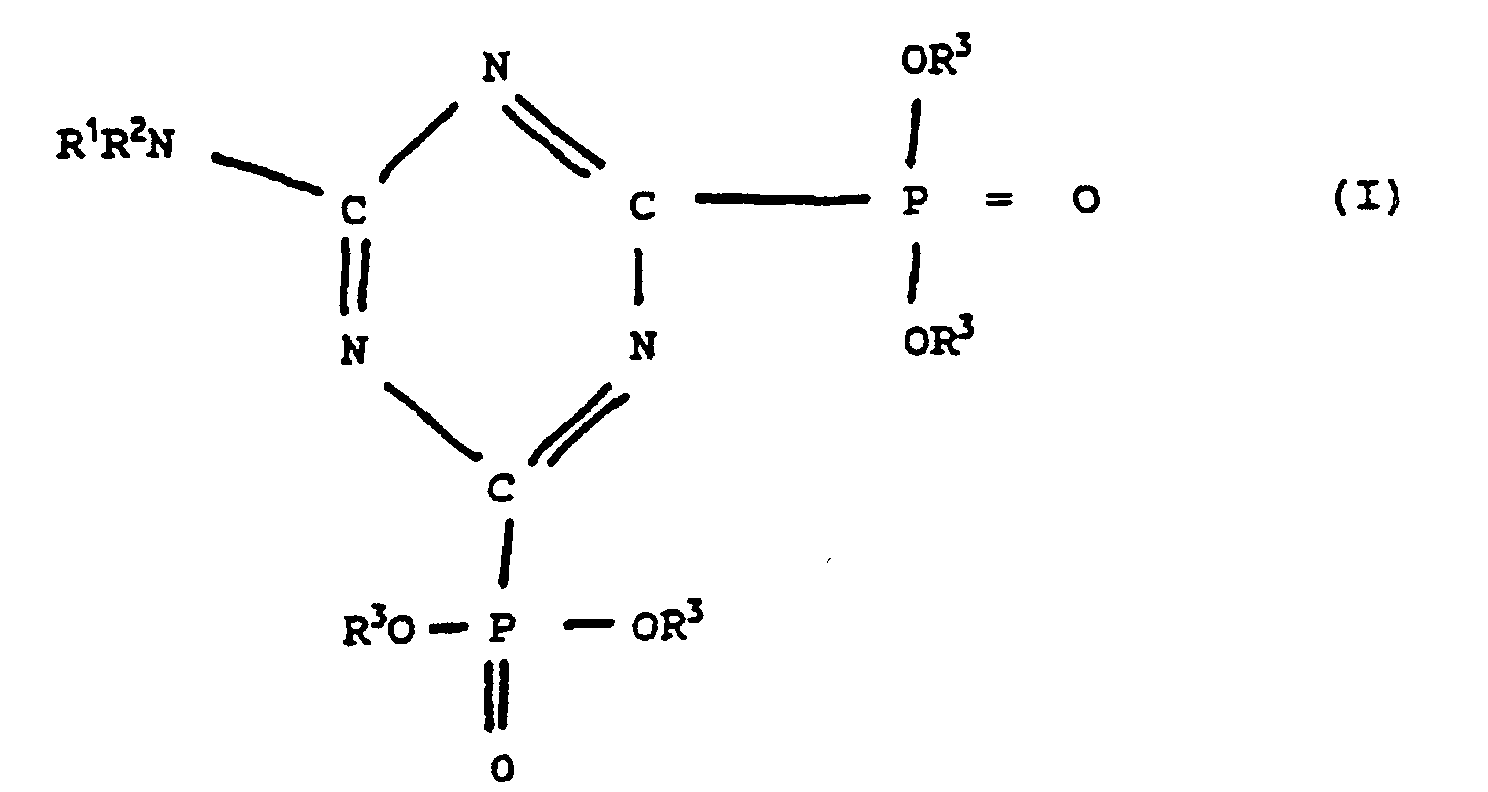
6. A phosphorus-containing flame retardant, characterised in that the flame retardant is a sym-triazine compound which is liquid at ambient temperature,
is soluble in a polyoxypropylene triol of molecular weight 3500 and has the formula:
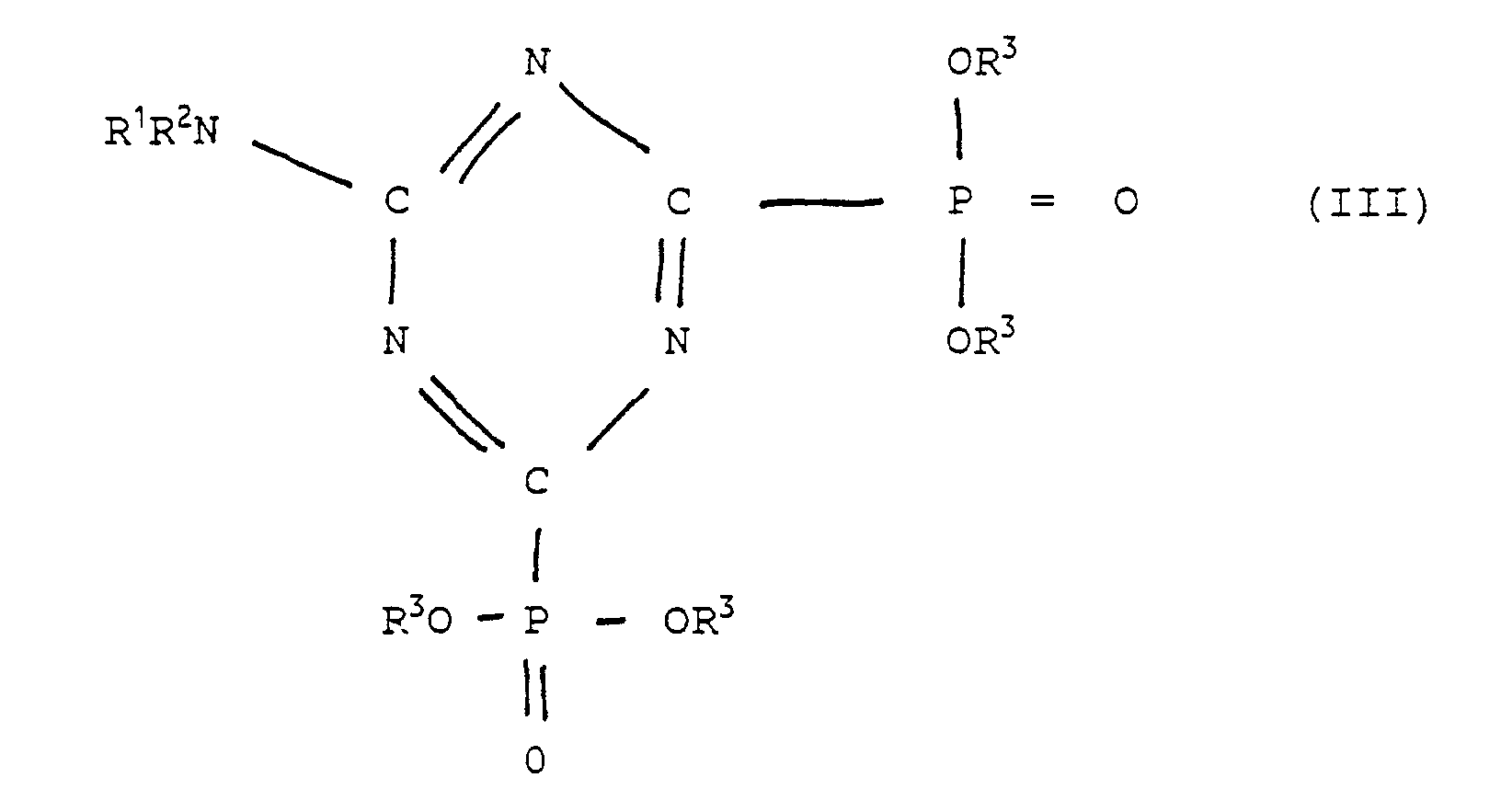
where R1 represents an alkyl group having 2 to 12 carbon atoms, R2 represents an alkyl group having 1 to 12 carbon atoms and each R3, which may be the same or different, represents an alkyl group having 1 to 6 carbon atoms.
where R1 represents an alkyl group having 2 to 12 carbon atoms, R2 represents an alkyl group having 1 to 12 carbon atoms and each R3, which may be the same or different, represents an alkyl group having 1 to 6 carbon atoms.
7. A phosphorus-containing flame retardant according to claim 6 which is tetraethyl 2-diethylamino-1,3,5-triazine-4,6-diphosphonate.
1. Ein phosphorhaltiges heterocyclisches Flammschutzmittel enthaltender Polyurethanschaumstoff,
dadurch gekennzeichnet, daß es sich bei dem Flammschutzmittel um eine sym-Triazinverbindung der Formel
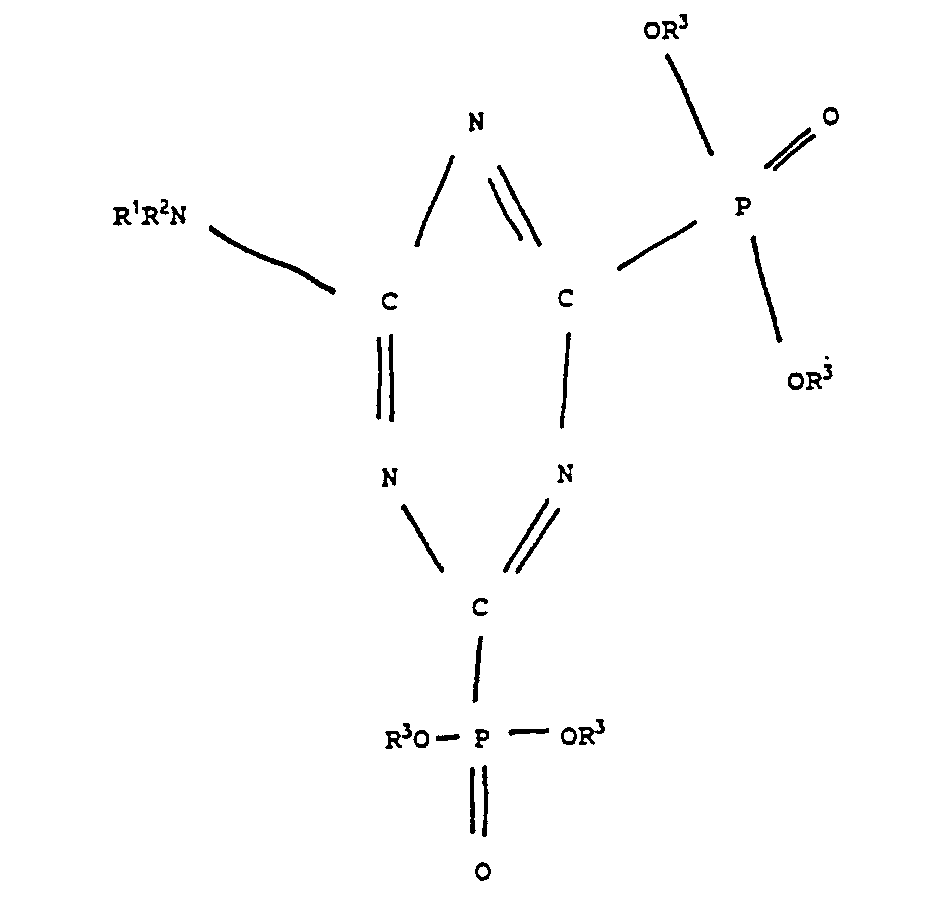
handelt, wobei R1 und R2 jeweils für eine Alkylgruppe mit 1 bis 12 Kohlenstoffatomen stehen und R3 jeweils unabhängig voneinander eine Alkyl- oder Cycloalkylgruppe mit 1 bis 12 Kohlenstoffatomen bedeutet.
handelt, wobei R1 und R2 jeweils für eine Alkylgruppe mit 1 bis 12 Kohlenstoffatomen stehen und R3 jeweils unabhängig voneinander eine Alkyl- oder Cycloalkylgruppe mit 1 bis 12 Kohlenstoffatomen bedeutet.
2. Polyurethanschaumstoff nach Anspruch 1, dadurch gekennzeichnet, daß es sich bei dem Flammschutzmittel um eine sym-Triazinverbindung der Formel (I) handelt,
in der R3 eine Alkylgruppe mit 2 bis 6 Kohlenstoffatomen bedeutet.
3. Polyolzusammensetzung aus einem unter zur Herstellung von Polyurethanschaumstoff geeigneten
Polyether- und Polyesterpolyolen ausgewählten Polyol, enthaltend ein phosphorhaltiges
Flammschutzmittel, dadurch gekennzeichnet, daß es sich bei dem Flammschutzmittel um eine sym-Triazinverbindung der Formel
handelt, wobei R1 und R2 jeweils für eine Alkylgruppe mit 1 bis 12 Kohlenstoffatomen stehen und
R3 je gleich oder verschieden eine Alkylgruppe mit 1 bis 6 Kohlenstoffatomen bedeutet.
handelt, wobei R1 und R2 jeweils für eine Alkylgruppe mit 1 bis 12 Kohlenstoffatomen stehen und
R3 je gleich oder verschieden eine Alkylgruppe mit 1 bis 6 Kohlenstoffatomen bedeutet.
4. Polyolzusammensetzung nach Anspruch 3, dadurch gekennzeichnet, daß das Flammschutzmittel in dem Polyol gelöst ist.
5. Verfahren zur Herstellung von reduziert entzündbarem Polyurethanschaumstoff, dadurch gekennzeichnet, daß man eine Polyolzusammensetzung gemäß Anspruch 3 oder 4 mit einem Polyisocyanat unter
Zusatz eines Schäummittels umsetzt.
6. Phosphorhaltiges Flammschutzmittel, dadurch gekennzeichnet, daß es sich dabei um eine bei Umgebungstemperatur flüssige und in Polyoxypropylentriol
des Molekulargewichts 3 500 lösliche sym-Triazinverbindung der Formel
wobei R1 eine Alkylgruppe mit 2 bis 12 Kohlenstoffatomen, R2 eine Alkylgruppe mit 1 bis 12 Kohlenstoffatomen und R3 je gleich oder verschieden eine Alkylgruppe mit 1 bis 6 Kohlenstoffatomen bedentet,
handelt.
wobei R1 eine Alkylgruppe mit 2 bis 12 Kohlenstoffatomen, R2 eine Alkylgruppe mit 1 bis 12 Kohlenstoffatomen und R3 je gleich oder verschieden eine Alkylgruppe mit 1 bis 6 Kohlenstoffatomen bedentet,
handelt.
7. Phosphorhaltiges Flammschutzmittel nach Anspruch 6, wobei es sich um Tetraethyl-2-diethylamino-1,3,5-triazin-4,6-diphosphonat
handelt.
1. Mousse de polyuréthanne contenant un ignifugeant hétérocyclique contenant du phosphore,
caractérisé en ce que l'ignifugeant est un composé sym-triazine de formule
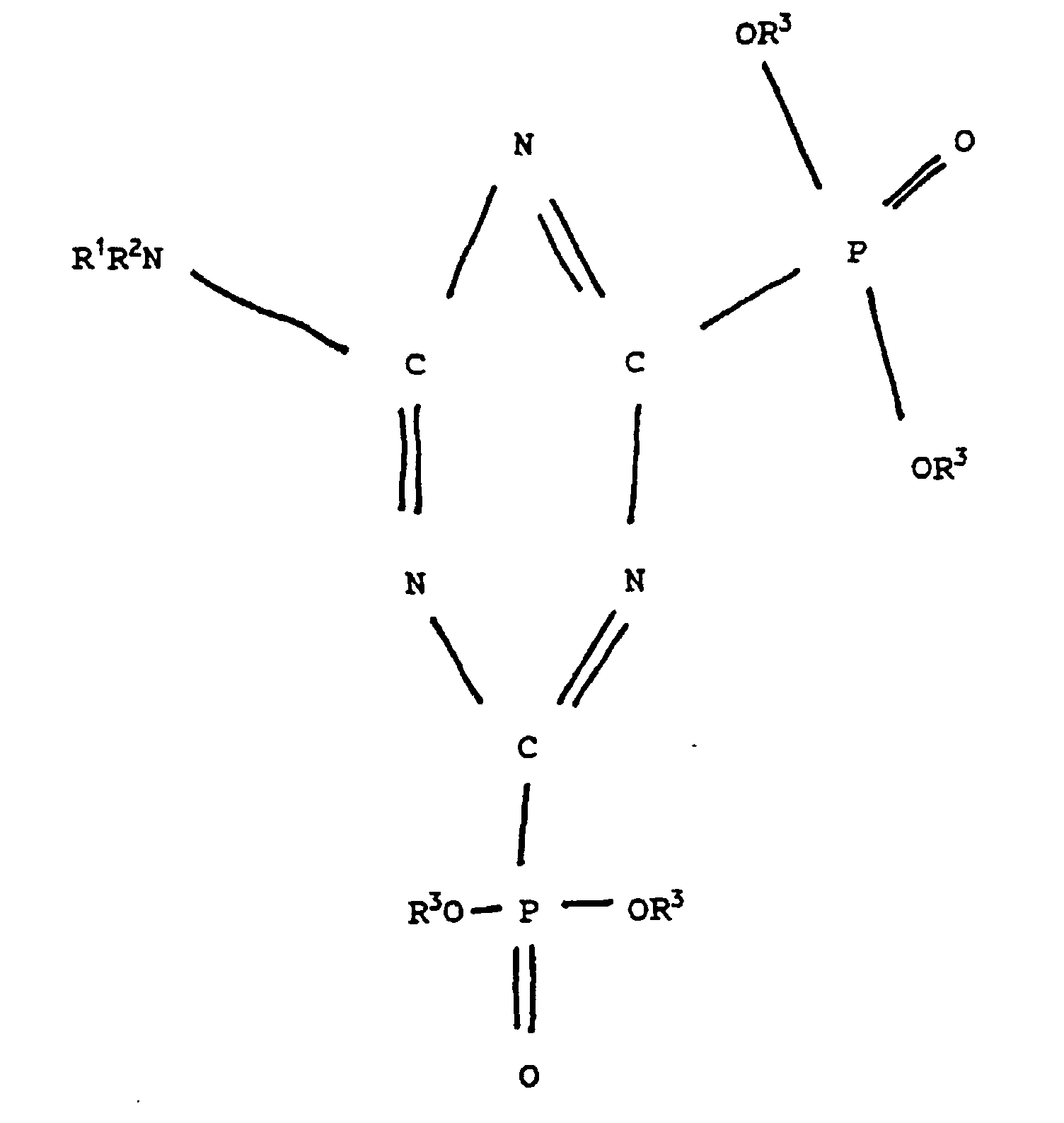
dans laquelle chacun des groupes R1 et R2 représente un groupe alkyle comportant 1 à 12 atomes de carbone et chacun des groupes R3 représente indépendamment des autres un groupe alkyle ou cycloalkyle comportant 1 à 12 atomes de carbone.
dans laquelle chacun des groupes R1 et R2 représente un groupe alkyle comportant 1 à 12 atomes de carbone et chacun des groupes R3 représente indépendamment des autres un groupe alkyle ou cycloalkyle comportant 1 à 12 atomes de carbone.
2. Mousse de polyuréthanne selon la revendication 1, caractérisée en ce que l'ignifugeant est un composé sym-triazine de formule (I) dans laquelle R3 est un groupe alkyle comportant 2 à 6 atomes de carbone.
3. Composition de polyol comprenant un polyol choisi parmi les polyols de polyéther et
les polyols de polyester appropriés pour préparer une mousse de polyuréthanne, ladite
composition de polyol contenant un ignifugeant contenant du phosphore, caractérisé en ce que l'ignifugeant est un composé sym-triazine de formule:
dans laquelle chacun des groupes R1 et R2 représente un groupe alkyle comportant 1 à 12 atomes de carbone et chacun des groupes R3, lesquels peuvent être identiques ou différents, représente un groupe alkyle comportant 1 à 6 atomes de carbone.
dans laquelle chacun des groupes R1 et R2 représente un groupe alkyle comportant 1 à 12 atomes de carbone et chacun des groupes R3, lesquels peuvent être identiques ou différents, représente un groupe alkyle comportant 1 à 6 atomes de carbone.
4. Composition de polyol selon la revendication 3 caractérisé en ce que l'ignifugeant est dissous dans le polyol.
5. Procédé de production d'une mousse de polyuréthanne d'inflammabilité réduite, caractérisé en ce que l'on fait réagir une composition de polyol selon la revendication 3 ou 4 avec un
polyisocyanate en présence d'un agent moussant.
6. Ignifugeant contenant du phosphore, caractérisé en ce que l'ignifugeant est un composé sym-triazine qui est liquide à température ambiante,
qui est soluble dans un polyoxypropylène-triol de poids moléculaire 3 500 et qui répond
à la formule:
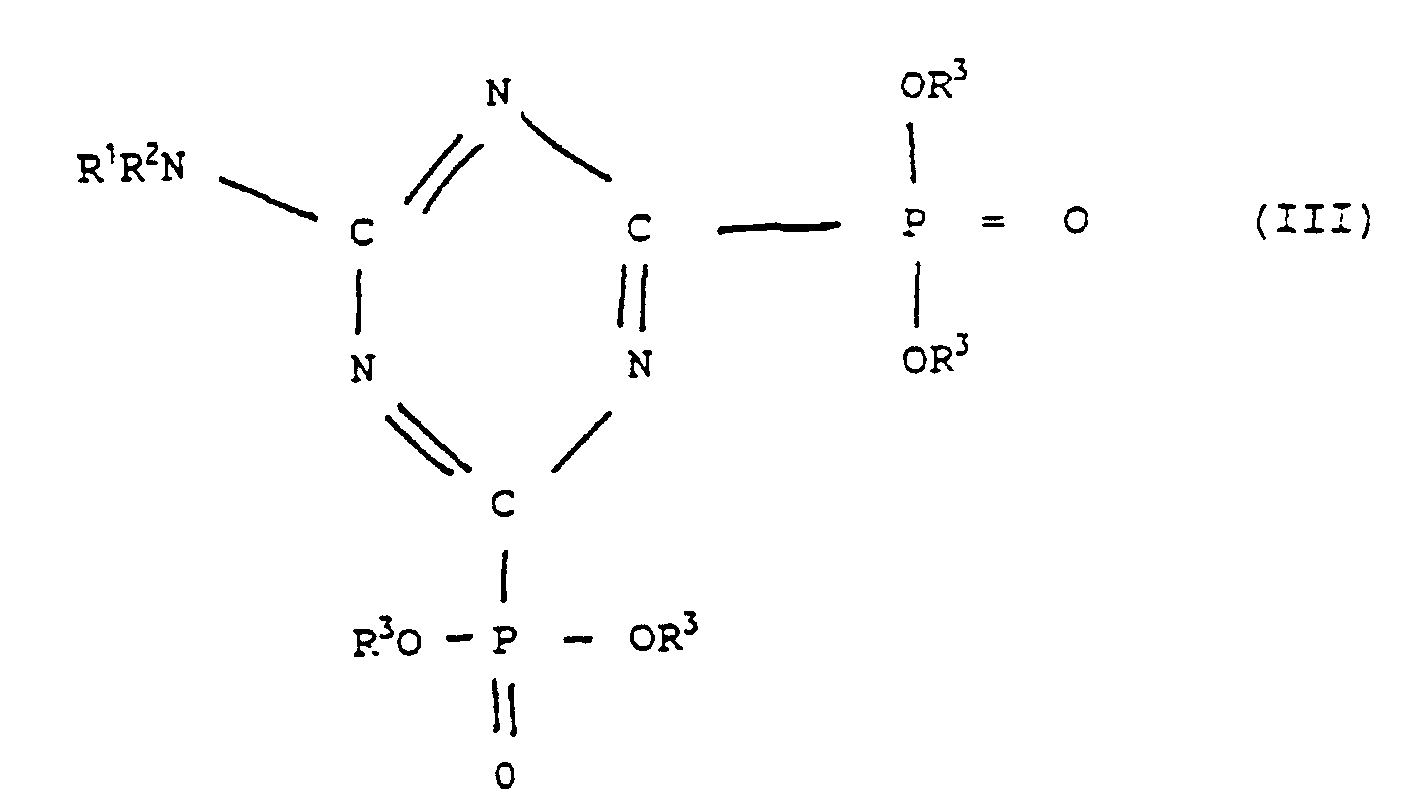
dans laquelle R1 représente un groupe alkyle comportant 2 à 12 atomes de carbone, R2 représente un groupe alkyle comportant 1 à 12 atomes de carbone et chacun des groupes R3, lesquels peuvent être identiques ou différents, représente un groupe alkyle comportant 1 à 6 atomes de carbone.
dans laquelle R1 représente un groupe alkyle comportant 2 à 12 atomes de carbone, R2 représente un groupe alkyle comportant 1 à 12 atomes de carbone et chacun des groupes R3, lesquels peuvent être identiques ou différents, représente un groupe alkyle comportant 1 à 6 atomes de carbone.
7. Ignifugeant contenant du phosphore selon la revendication 6 qui est le 2-diéthylamino-1,3,5-triazine-4,6-diphosphonate
de tétraéthyle.