| (19) |
 |
|
(11) |
EP 0 620 432 B1 |
| (12) |
EUROPEAN PATENT SPECIFICATION |
| (45) |
Mention of the grant of the patent: |
|
25.08.2004 Bulletin 2004/35 |
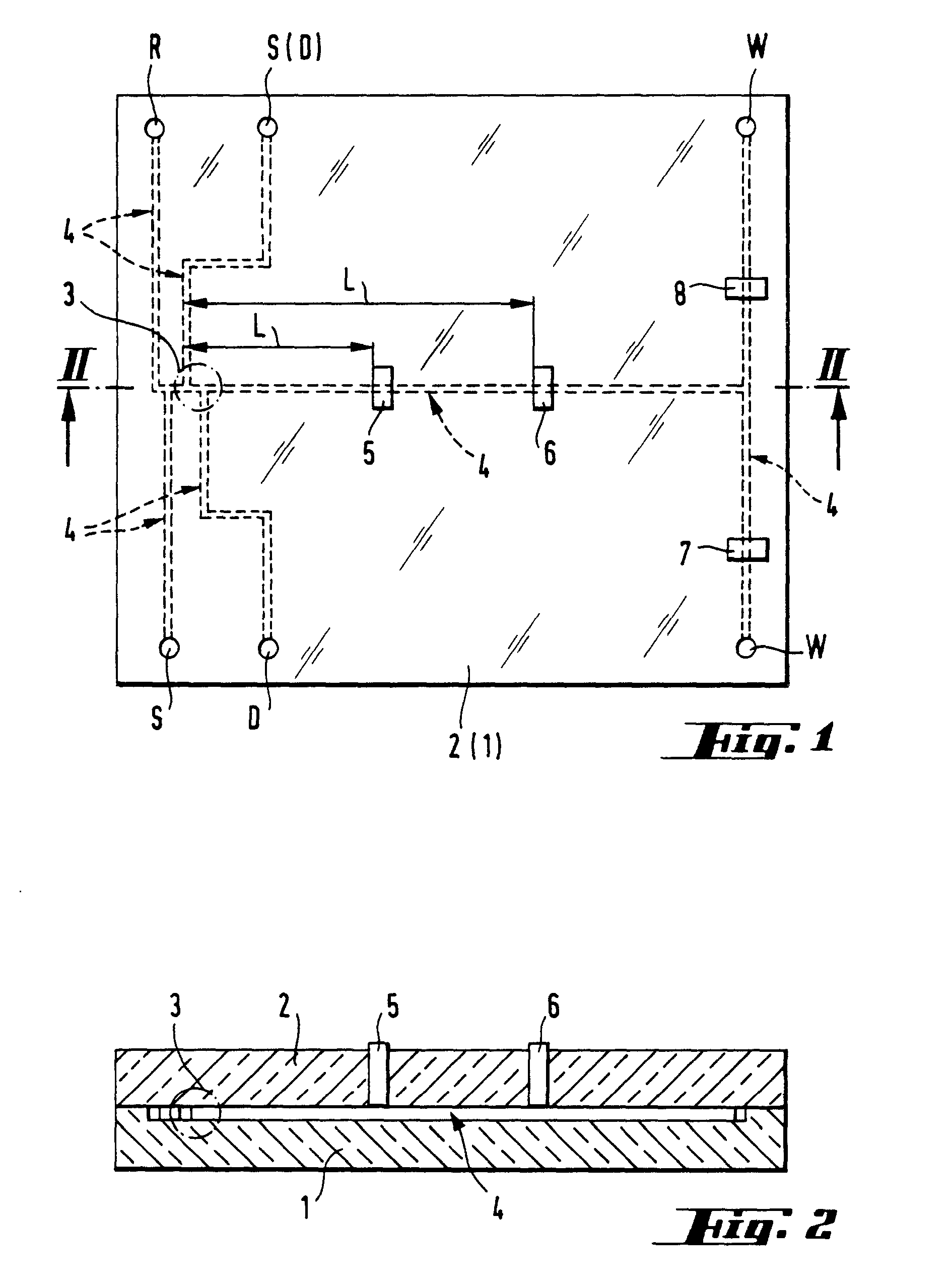
| (22) |
Date of filing: 15.04.1993 |
|
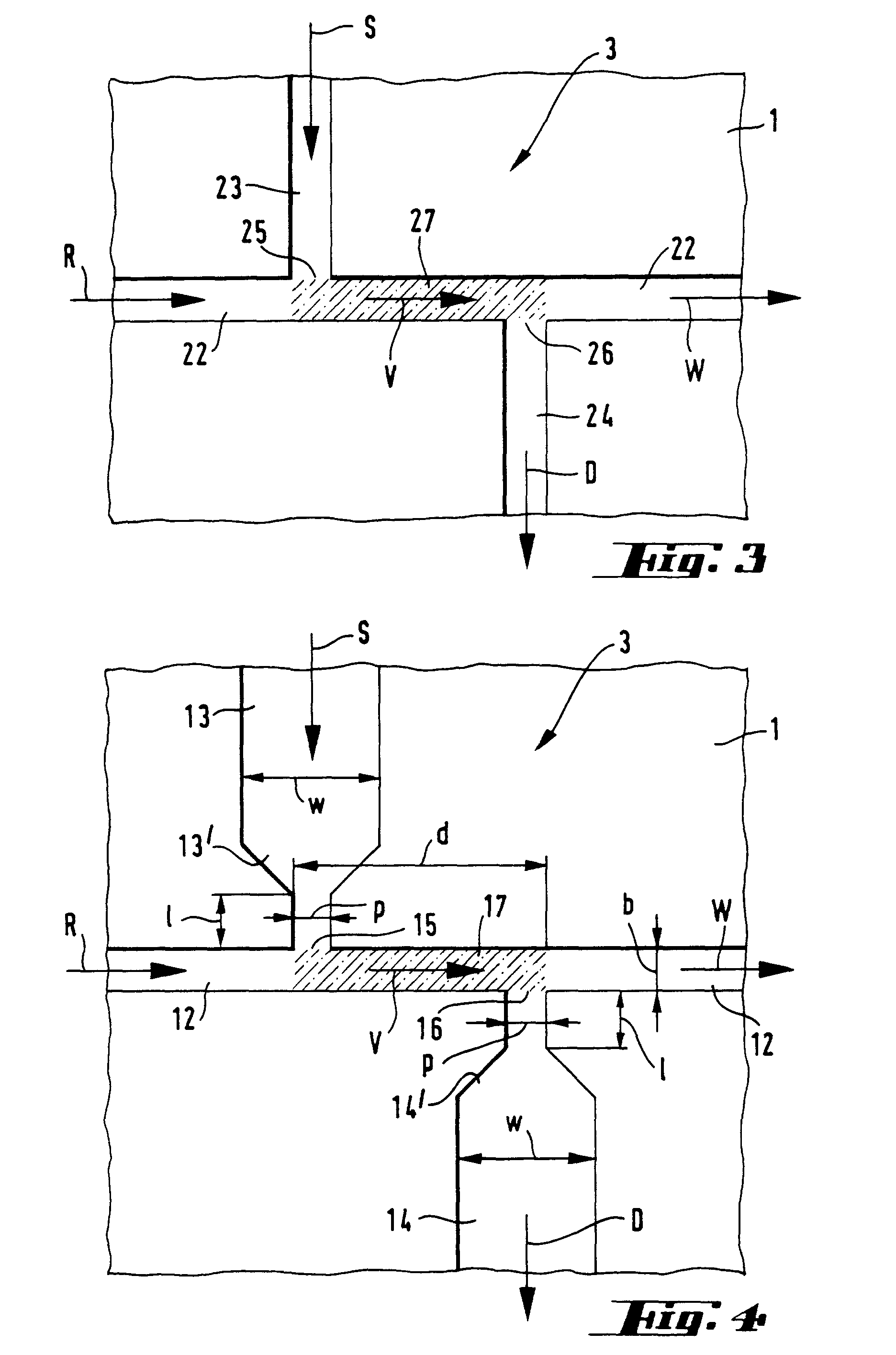
| (51) |
International Patent Classification (IPC)7: G01N 27/447 |
|
| (54) |
Method for controlling sample introduction in microcolumn separation techniques and
sampling device
Verfahren zur Steuerung der Probeneinführung bei Mikrosäulentrennungstechniken und
Probenentnahmevorrichtungen
Méthode pour contrôler l'introduction d'un échantillon en séparation par micro colonnes
et appareil d'échantillonage
|
| (84) |
Designated Contracting States: |
|
CH DE FR GB IT LI SE |
| (43) |
Date of publication of application: |
|
19.10.1994 Bulletin 1994/42 |
| (60) |
Divisional application: |
|
02028452.7 / 1296134 |
| (73) |
Proprietor: Zeptosens AG |
|
4108 Witterswil (CH) |
|
| (72) |
Inventors: |
|
- Manz, Andreas, Dr.
East Molesey, Surrey KT80JX (GB)
- Harrison, D. Jed, Prof. Dr.
Edmonton, Alberta T6R 1C5 (CA)
- Effenhauser, Carlo S., Dr.
69469 Weinheim (DE)
|
| (74) |
Representative: Dannappel, Hans-Jochen, Dr. et al |
|
Solvias AG,
Patente,
WKL-402.4.26,
Klybeckstrasse 191
4002 Basel
4002 Basel (CH) |
| (56) |
References cited: :
US-A- 4 908 112
|
US-A- 4 941 958
|
|
| |
|
|
- JOURNAL OF CHROMATOGRAPHY vol. 320, no. 1, 28 February 1985, AMSTERDAM, NL pages 159
- 165 M. DEML 'ELECTRIC SAMPLE SPLITTER FOR CAPILLARY ZONE ELECTROPHORESIS' *
- ANALYTICAL CHEMISTRY vol. 64, no. 17, 1 September 1992, WASHINGTON, DC, US pages 1926
- 1932 D. J. HARRISON 'CAPILLARY ELECTROPHORESIS AND SAMPLE INJECTION SYSTEMS INTEGRATED
ON A PLANAR GLASS CHIP' *
- SENSORS AND ACTUATORS B CHEMICAL vol. B10, no. 2, 31 January 1993, LAUSANNE, CH pages
107 - 116 D.J. HARRISON 'TOWARD MINIATURIZED ELECTROPHORESIS AND CHEMICAL ANALYSIS
SYSTEMS ON SILICON: AN ALTERNATIVE TO CHEMICAL SENSORS' *
|
|
| |
|
| Note: Within nine months from the publication of the mention of the grant of the European
patent, any person may give notice to the European Patent Office of opposition to
the European patent
granted. Notice of opposition shall be filed in a written reasoned statement. It shall
not be deemed to
have been filed until the opposition fee has been paid. (Art. 99(1) European Patent
Convention).
|
[0001] The present invention concerns a method for controlling sample introduction in microcolumn
separation techniques according to patent claim 1. The invention also concerns a respective
sampling device according to the precharacterizing clause of patent claim 18.
[0002] Microcolumn separation techniques, in particular capillary electrophoresis has become
a very interesting separation technique which is used as part of a sensor or a chemical
analysis system. One major reason for this is the great efficiency of the method as
a separation technique. The sampling methods usually applied in capillary electrophoresis
are:
injection of a sample with a syringe, via a septum, in an injection block,
the use of injection valves with/without a sample loop, and
dipping one end of the capillary tube into the sample reservoir, whereby the sample
is introduced by gravity flow, by over- or underpressure, or by electroendosmosis
and/or electromigration.
[0003] While it is mentioned in Journal of Chromatography, 452, (1988) 615-622, that sample
valves are the most suitable sampling method for capillary electrophoresis, there
also is described a valveless device for the injection of a sample. The described
arrangement comprises a cast capillary block which is connected between an electrode
compartment and a sampling device. In the electrode compartment electrolyte solutions
contact electrodes. The capillary tube contains measuring electrodes which are connected
with an evaluation electronics. The sampling device consists of a broadened part of
the capillary tube connected with two feeders which extend perpendicular to the capillary
tube. The arrangement of the two feeders off-set from each other along the longitudinal
extension of the capillary. tube is such, that the sampling device has the shape of
a capillary double T structure.
[0004] The sample is introduced into the sampling device via a syringe. The injection volume
is defined geometrically by the distance which the two feeders are spaced apart along
the capillary tube. The transport of the electrolyte solution and the sample in the
capillary tube is accomplished by electric fields that are applied between the respective
electrodes along the capillary tube. An advantage of the double T shape sampling device,
as is also obtained with the use of injection valves, is the concentration effect
of dilute sample ionic species. However, it is possible that, although no electric
field gradient over the feeders exists, sample components from the feeders may diffuse
into the capillary tube when the sample has already left the sampling position. The
amounts of sample components that uncontrollably enter the capillary tube depend on
the diffusion coefficients and the mobilities of the respective sample components.
Thus, at the detector there not only arrives a more or less broadened plug of injected
sample fluid, depending on the diffusion coefficients and the mobilities of the respective
components in the electrolyte and the electric field, but also the electrolyte in
front and after or between individual plugs of sample fluid is "polluted" with unpredictable
amounts of sample components. These unpredictable amounts of sample components reaching
the detector are highly undesirable and result in a high noise of the detected signal,
thus reducing the limits of detection considerably.
[0005] In Analytical Chemistry, 1992, 64, pages 1926 - 1932 a capillary electrophoretic
device is described in which the sample is injected electrokinetically dipping one
end of a capillary into the sample reservoir and applying a voltage across the ends
of the capillary. In the electric field the sample is transported electrokinetically
and is injected at a T-junction into the channel system of the capillary electrophoretic
device. This method, however, leads to a well-known bias of the actual sample composition
due to the differences in the electrophoretic mobilities of the sample components.
Thus, the sample introduced often does not have the same composition as the original
sample. In addition, the volume of the introduced sample is very often unknown such,
that internal standards have to be used for quantitative analyses.
[0006] It is therefore an object of the present invention to provide a method for controlling
sample introduction in microcolumn separation techniques, and more particularly in
capillary electrophoresis (CE), and a sampling device which overcomes the aforementioned
disadvantages of the prior art. The sample volume shall be geometrically defined.
The composition of the sample which is injected shall not differ from the original
composition of the sample in the reservoir. The uncontrolled introduction of sample
fluid into the capillary tube shall be reduced considerably. If the unwanted leakage
of sample fluid into the capillary tube cannot be totally avoided, provisions shall
be made that at least it only occurs in a predictable and controllable manner.
[0007] The method and the sampling device according to the invention shall also allow an
easy realization of miniaturized analysis concepts, such as the ones described, for
example, in Sensors and Actuators B, 10 (1993) 107-116. There the concept of a multi-manifold
flow system integrated on a silicon substrate, with valveless switching of solvent
flow between channels and electro-kinetic pumping of an aqueous solvent, is described.
A similar concept is described, for example, in Analytical Chemistry , Vol.64, No.
17, September 1, 1992, 1926-1932. The described miniaturized chemical analysis system
on the basis of capillary electrophoresis comprises a complex manifold of capillary
channels, which are micromachined in a planar glass substrate. The transport of the
solvent and the sample occurs due to electro-kinetic effects (electro-osmosis and/or
electrophoresis).
[0008] The objects of the invention are met by a method for controlling sample introduction
in microcolumn separation techniques, especially capillary electrophoresis (CE), which
involves the process steps according to patent claim 1. By this measure the composition
of the injected sample plug will reflect the actual sample composition.
[0009] In a further preferred process step, immediately after the injection of the sample
plug, the electrolyte buffer is allowed to advance into the supply channel and into
the drain channel at the respective supply and drain ports for a time period, which
amounts to at least the migration time of a slowest component within the sample plug
from the supply port to the detector. Thus, the sample is pushed back into the respective
supply and drain channels and substantially prevented from uncontrollably diffusing
into the electrolyte buffer which is transported past the supply and drain ports.
In addition the method allows to control the sample composition within the electrolyte
buffer.
[0010] Preferred variants of the method according to the invention and preferred embodiments
of the sampling device according to the invention are subject of the respective dependent
claims. The invention will become apparent from the following description with reference
to the schematic drawings in which:
- Fig. 1
- is a schematic view of a microcolumn separation device which illustrates, a sampling
device for the process according to the present invention,
- Fig. 2
- is a sectional view of the microcolumn separation device according to Fig. 1,
- Fig. 3
- is an enlarged view of the encircled part of the microcolumn separation device according
to Fig. 1, showing a sampling device for the process, according to the invention,
and
- Fig. 4
- is a sampling device, according to claim 18.
[0011] In Figs. 1 and 2 an exemplary embodiment of a microcolumn separation device, more
particularly of an electrophoretic separation device, is depicted. It comprises a
base part 1 and a lid part 2. The base part 1 can be made of glass, monocrystalin
silicon or other materials known from semiconductor manufacture, or of a suitable
polymer material. The lid part 2 is preferably made of glass. The base part 1 comprises
a channel system 4 which is etched, micromachined or otherwise established in its
surface. Preferably techniques known from semiconductor manufacture are applied for
creating the channel system in the surface of the base part 1. The lid part is provided
with through holes R, S, D, W, which communicate with the channel system 4 and are
adapted to accomodate and hold the ends of capillary tubes. The lid part 2 is also
provided with various ports for light waveguides, which are part of an optical detection
system, such as, for example, a fluorescence detection system, or an absorption detection
system, or a system for the detection of changes of the refractive index of a sample
flowing through the channel system. The ports are distributed along the channel system
4 after a sampling device 3, where a sample is introduced into an electrolyte buffer,
thus allowing measurements at different locations along the channel system.
[0012] The transport of the electrolyte buffer and of the more or less concentrated sample
is preferably accomplished by means of electric fields, which are created by switching
electric potentials between electrodes of a respective reservoir R and waste receptacles
W for the electrolyte buffer and between electrodes associated with respective source
S and drain receptacles D for the sample.
[0013] In Figs. 3 and 4 the encircled sampling device 3 of Fig. 1 is shown in an enlarged
scale. It is part of the flow injection analysis system of Fig. 1, which is based
on electro-kinetic principles and allows an electrophoretic analysis of a sample.
The sampling device 3 is an integrated part of the capillary channel system 4 and
is thus connected with the reservoir R and the waste receptacle W behind the detectors
5-8, for the electrolyte buffer, and with the source receptacle S and the drain receptacle
D for the sample which is to be analyzed. In Figs. 3 and 4, for the sake of clarity
the reservoir R and the receptacles W, S,D are not drawn, but they are only symbolized
by arrows, which at the same time indicate the direction of fluid flow in the channel
system 4.
[0014] In Fig. 3 a sampling device for carrying out the process is shown. It comprises a
capillary channel piece 22, which on one end is connected to a capillary channel communicating
with the reservoir R for the electrolyte buffer and in longitudinal direction on the
other end with a capillary channel where the electrophoretic separation of the sample
takes place, and which leads to the detector(s) and in further consequence to the
waste receptacle(s) W. The sampling device further comprises a supply channel 23,
which communicates with a source receptacle S for the sample, and a drain channel
24 which leads to a drain receptacle D. The source channel 23 and the drain channel
24 are inclined to the longitudinal extension of the channel piece 2, preferably they
are arranged about perpendicular such, that together with the channel piece 22 they
form a double T structure, as shown in the drawing. The source channel S and the drain
channel D each discharge into the channel piece 22 at respective supply and drain
ports 25, 26. According to the drawing in Fig. 3 the supply port 25 and the drain
port 26 are spaced apart from each other longitudinally at the channel piece 22 such,
that a sample volume 27 is geometrically defined as will be explained in more detail
hereinafter. It is to be understood, that the drain channel 24 can be arranged in
direct longitudinal extension of the source channel 23 such, that the supply and drain
ports 25, 26 are situated opposite each other. In that case the channels of the sampling
device have no double T structure, but they are arranged in form of an ordinary crossing.
[0015] As already mentioned before the transport of the fluids, i.e. the electrolyte buffer
and the sample, is accomplished with electric fields, which are a result of different
electric potentials at the reservoir R and the waste receptacle W for the electrolyte
buffer, and the respective source receptacle S and the drain receptacle D for the
sample. By applying, for example, a positive electric potential to the reservoir R
and a negative electric potential to the waste receptacle, the electrolyte buffer
is electro-kinetically transported from the reservoir R through the capillary channel
system to the waste receptacle W. In order to introduce the sample into the channel
piece 22, for example, the source receptacle S for the sample is maintained at a positive
potential and the drain receptacle D is kept on a negative potential. In the resulting
electric field the sample is transported electro-kinetically from the source receptacle
S to the drain receptacle D. The direction of flow is indicated in Fig. 3 by the arrows
S, V, and D. By this measure, a part 27 of the channel piece 22, which is delimited
by the supply port 25 on the one end and by the drain port 26 on the other end is
filled with sample. Thus, the sample-filled part 27 of the channel piece of the sampling
device 3 defines the volume of the electro-kinetically injected sample plug, which
is indicated by the hatchings in Fig. 3. In other words, the volume 27 of the sample
plug is geometrically delimited by the spaced apart supply and drain ports 25 and
26. In the aforementioned case that the supply and drain ports are arranged opposite
each other, such that the channel piece 22 and the supply and drain channels 23, 24
form an ordinary crossing, the size and volume of the intersection determines the
sample volume. Thus, in that case, the sample volume is only defined by the cross-sections
of the respective channels 22, 23, 24.
[0016] In order to assure that the composition of the sample in the sample volume 27 reflects
the actual sample composition in the reservoir R the electric field across the supply
and drain channels 23, 24 must be maintained for at least for a time period long enough
that the geometrically defined sample volume is filled and contains the component
of the sample which has the lowest electrophoretic mobility. This minimum time period
t
min is given by the equation t
min = d/µ
i ·E . In this equation d stands for the distance, which the source and drain port
are spaced apart; µ
i is the total mobility of the slowest component i of the sample, which will be referred
to in more detail hereinafter; E is the field strength across the source and drain
channels, which results from the difference in potentials.
[0017] When a electrophoretic analysis of a sample is to be carried out, first an electric
field between the reservoir R and the waste receptacle W is established such, that
the electrolyte buffer is transported from the reservoir R to the waste receptacle
W. After the channel system of the chemical analysis system has been filled with the
electrolyte buffer, the injection of the sample into the channel piece 22 is initiated.
For that purpose an electric field is established between the source receptacle S
and the drain receptacle D such, that the sample is electro-kinetically transported
from the source receptacle S through the supply channel 23
via the channel piece 22 into the drain channel 24 and on to the drain receptacle D.
It is understood that during the time period, in which the sample is injected, the
electric field between the reservoir R and the waste receptacle W is switched off,
or that the potentials are chosen such, that the sample only is transported along
the path described above. After the injection time period which is chosen such, that
it is ensured that the sample volume 27 between the supply port 25 and the drain port
26 is filled with the sample, the electric field between the source receptacle S and
the drain receptacle D is switched off. At the same time the electric field between
the reservoir R and the waste receptacle W is activated again such, that the sample
contained within the sample volume 27 is transported on into the direction of the
detector(s) and the waste reservoir. While it is transported through the channel system
the sample is separated electrophoretically in the electric field.
[0018] The problem of leakage or diffusion of sample components into the electrolyte buffer
while it is transported past the supply and drain ports 23 and 24, even though no
electric field is applied between the source receptacle S and the drain receptacle
D, is solved by allowing the electrolyte buffer to advance into the supply channel
23 and into the drain channel 24 at the respective supply and drain ports 25 and 26
for a time period, which amounts to at least the migration time t
i of the slowest component i within the sample plug from the supply port 25 to the
respective detector. Thus, the sample is pushed back into the supply and drain channels
23, 24 and substantially prevented from uncontrollably diffusing into the electrolyte
buffer which is transported past the supply and drain ports 25,26.
[0019] The migration time t
i of the slowest component i of the sample is defined as the quotient between the separation
length L and the product of the total mobility µ
i of the slowest component i of the sample and the electric field strength E' acting
on it along its path L, and is given by the equation T
i = L/(µ
i ·E') . In this equation the separation length L (Fig. 1) is the distance the sample
component i travels between the supply port 25 and the respective activated detector
5-8, and the total mobility µ
i of the component is the sum of the electrophoretic mobility µ
i,ep of the component and the overall electro-osmotic mobility µ
eo of the sample. The time period during which the detection is accomplished is very
short in comparison to the migration time of the slowest component of the sample and
thus is neglectable.
[0020] In order to allow the electrolyte buffer to advance into the supply and drain channels
23 and 24, in the exemplary embodiment of the sampling device depicted in Fig. 3 the
source receptacle S and the drain receptacle D are switched on an electric potential
which is different from the electric potential at the reservoir R for the electrolyte
buffer, thus establishing a potential difference of suitable magnitude. In an embodiment,
where the electrolyte buffer is transported from a positive potential to a negative
potential, the potentials at the source and drain receptacles S, D are chosen negative
with respect to the positive potential at the reservoir R. In case of a transport
of the electrolyte buffer from a negative potential to a positive potential the potentials
of the source and drain receptacles S, D are chosen positive with respect to the reservoir
R.
[0021] Preferably the potential difference between the reservoir R and the source and drain
receptacles S, D is chosen such, that the resultant electric field has a field strength
which amounts to at least about 0.1 V/cm.
[0022] Another approach to allow an advancement of the electrolyte buffer into the supply
and drain channels 3, 4 is depicted in Fig. 4. The construction of the depicted sampling
device 3 basically corresponds to the one depicted in Fig. 3. It comprises a channel
piece 12 with two side channels 13, 14. The side channels are inclined to the longitudinal
extension of the channel piece 12 an angle that amounts to from about 5 degrees to
about 175 degrees; however, preferably they are arranged about perpendicular with
respect to the channel piece 12. The side channels are a supply channel 13 and a drain
channel 14, which discharge into the channel piece 12 at respective supply and drain
ports 15, 16. Preferably the supply port 15 and the drain port 16 are spaced apart
from each other at the channel piece 12 and delimit a sample volume 17. The distance
d which they are spaced apart from each other typically amounts to from about 0 µm
to about 3 cm, most preferably to about 3 mm, wherein the value 0 indicates that the
supply and drain ports are located opposite each other. The channel piece 12 communicates
with a reservoir R and a waste receptacle W for the electrolyte buffer. The supply
channel 13 is connected with a source receptacle S for the sample, while the drain
channel 14 communicates with a drain receptacle D.
[0023] The sampling device 3 is part of an electrophoretic chemical analysis system and
basically functions in the same way as the sampling device depicted in Fig. 3. However,
in order to allow the electrolyte buffer to advance into the supply and drain channels
13, 14 the resistance of flow within the two channels is reduced. In particular the
source channel and the drain channel each have a resistance to flow with respect to
said electrolyte buffer, which is about 5% lower than the respective resistance to
flow of said electrolyte channel. Surprisingly the reduction of the resistance to
flow of the supply and drain channels 13, 14 does not result in an increase of the
leakage or diffusion of sample components into the electrolyte buffer as it is transported
past the respective supply and drain port 15, 16. Instead, the reduction of the resistance
to flow of the side channels 13, 14 leads to a convective flow of the electrolyte
buffer into the channels 13, 14, even when the applied electric fields should not
result in such a flow. Thus, the leakage or diffusion of sample components is considerably
decreased and the noise of the detected signal is reduced. In consequence the sensitivity
of the analytic system, that is the limit of detection, is increased. The resistance
to flow of the supply and drain channel can be diminished by either reducing the length
of the respective channels or by increasing their respective widths w. The reduction
of the resistance to flow of the supply and drain channels 13, 14 is achieved by providing
them each with a width w that is at least about two times greater than the width p
of the supply and drain ports 15, 16. Such, the supply and drain channels 13, 14 each
have about the shape of a bottle, the bottle neck being the respective supply or drain
port 15, 16.
[0024] While it is possible that the supply and drain channels 13, 14 empty directly into
the channel piece 12 such, that their ends, which are located right next to the channels
piece 12 are the respective source and drain ports 15, 16, from where the width of
the channels gradually increases over a respective intermediate piece 13', 14' from
the width p of the ports to the final width w of the channels, the supply and drain
ports also have longitudinal extensions 1. These longitudinal extensions l correspond
at least to the width p of the respective supply and drain ports 15, 16. It is advantageous,
if the widths p of the supply and drain port 15, 16 are kept constant along their
longitudinal extension 1. The widths p of the supply and drain port 15, 16 are chosen
such, that they about correspond to the width b of the channel piece 12.
[0025] The depth of the channel piece 12 (which should correspond to the depth of the channel
system that it is part of) and of the supply and drain channels 13, 14 typically amounts
to from about 0.1 µm to about 100 µm. The depths of the bottle-neck-like supply and
drain port 15, 16 about corresponds to the depth of the channels.
[0026] The sampling device 3 according to the invention has been explained with reference
to exemplary embodiments which are part of micro-analysis chips. It can as well be
an arrangement of capillary tubes, which is part of a electrophoretic chemical analysis
system made of capillary tubes. In the most preferred embodiment, however, the sampling
device is integrated into a system of capillary channels which are established in
a small planar sheet of glass, semiconductor material, or a suitable polymer. Advantageously
the channel system including the supply and drain channels and the respective supply
and drain ports are etched or micromachined or casted (in case of a polymer base part),
or otherwise established in the planar substrate. Most suitable for its manufacture
are techniques which are well established in semiconductor production or in the manufacture
of micromechanical elements.
[0027] The combination of a structure that geometrically defines the injected sample volume
with an electro-kinetic injection of the sample over a defined minimum time period
allows to relyably control the sample volume and to assure that the composition of
the sample contained within the sample volume reflects the original composition of
the sample in the reservoir. A further improvement of the method and the sampling
device according to the invention allows a considerable reduction of uncontrolled
leakage or diffusion of sample components into the electrolyte buffer. Thus, it is
possible to reduce the leakage or diffusion such, that the still occuring leakage
results in a concentration of the sample in the electrolyte buffer, that is less than
3% of the original concentration of the sample. By this measure the noise of the detected
electrophoretic signal is reduced and the detection limits are increased.
1. A method for controlling sample introduction in microcolumn separation techniques
with a system of capillary channels, comprising a sampling device containing a supply
channel, which contains a sample, a drain channel, and an electrolyte channel, which
contains an electrolyte buffer, said supply and drain channels each being inclined
with respect to the electrolyte channel, and which supply and drain channels intersect
said electrolyte channel at a supply and drain port, respectively, such that a geometrically
defined sample volume is defined by a section of said electrolyte channel located
between said supply port and drain port, wherein said sample is a composition which
consists of components which have different electrophoretic mobilities, and wherein
said electrolyte buffer and said sample are transported through said system of capaillary
channels, which method comprises the step of electrokinetically injecting the sample
as a sample plug into said electrolyte channel by applying an electric field across
the supply and drain channels, wherein said electric field is applyed for a time period
which is at least long enough that a component of said sample having the lowest electrophoretic
mobility migrates into the geometrically defined sample volume, and the time period
corresponds to at least to the time defined by the equation tmin = d/(µi·E), wherein d stands for said section of the electrolyte channel between said supply
and drain ports, µi is the electrokinetic mobility of said component having the lowest electrophoretic
mobility, and E stands for the electric field strength across said supply and drain
channels.
2. A method according to claim 1, wherein said electrolyte buffer and said sample are
transported elektrokinetically, and further wherein immediately after said injection
of said sample plug said electrolyte buffer is allowed to advance into said supply
channel and into said drain channel at said respective supply and drain ports for
a time period, which amounts to at least a migration time of a slowest component within
said sample plug from the supply port to a detector, thus pushing back said sample
into said respective supply and drain channels and substantially preventing said sample
from uncontrollably diffusing into said electrolyte buffer which is transported past
said supply and drain ports.
3. A method according to claim 2, wherein within said time period said sample in said
supply and drain channels is subjected to an electric potential, which is different
from an electric potential at a reservoir for said electrolyte buffer, thus establishing
a potential difference such, that said electrolyte buffer is allowed to advance into
said supply channel and into said drain channel.
4. A method according to claim 3, wherein said potential difference is chosen such, that
a resultant electric field strength amounts to at least 0.1 V/cm.
5. A method according to claim 2, wherein said electrolyte buffer is allowed to advance
into said supply and drain channels by reducing a resistance to flow within said supply
and drain channels in either reducing the lengths of said supply and drain channels
or by increasing their respective widths.
6. A method according to claim 5, wherein said resistance to flow of said supply and
drain channels is reduced by providing said supply and drain channels each with a
width that is at least two times greater than a width of said supply and drain ports.
7. A method according to claim 6, wherein said supply and drain ports of said respective
supply and drain channels have a longitudinal extension which corresponds at least
to about said widths of said supply and drain ports, and that said widths are kept
constant along the extension of said supply and drain ports.
8. A method according to claim 7, wherein said widths of said supply and drain ports
are chosen such that they correspond to a width of said channel piece.
9. A method according to any one of the preceding claim, wherein said system of capillary
channels including said supply and drain channels with their respective ports are
etched or micromachined or otherwise established in a planar substrate made of glass,
or semiconductor materials, or a suitable polymer.
10. The method according to claim 1, wherein said drain channel is a longitudinal extension
of said supply channel, and the supply and drain ports are situated opposite one another.
11. The method according to claim 1, wherein said supply and drain ports are spaced apart
from each other longitudinally along the electrolyte channel, and said sample volume
region is defined as a region along the electrolyte channels between the supply and
drain port.
12. A method according to claim 1, wherein the system of capillary channels comprises
a capillary channel, which is connected at one end to a reservoir for the electrolyte
buffer and extends after said geometrically defined sample volume in longitudinal
direction in a capillary channel, where an electrophoretic separation of the sample
takes place.
13. A method according to claim 1, wherein said supply channel, said drain channel and
said channel containing the electrolyte buffer are associated with reservoirs.
14. A method according to claims 13, wherein electrodes are applied to the reservoirs.
15. A method according to claims 12 to 14, comprising the steps (1) applying an electrical
field across the electrolyte channel, (2) switching off the electrical field across
the electrolyte channel, (3) applying an electric field across the supply and drain
channels, to electrokinetically inject the sample as a sample plug into said sample
volume in the electrolyte channel, and (4) applying an electric field across the electrolyte
channel, to move sample contained in the sample volume through the electrolyte channel.
16. A method according to claims 12 to 14, comprising the steps (1) applying an electrical
field across the electrolyte channel, (2) applying an electric field across the supply
and drain channels, to electrokinetically inject the sample as a sample plug into
said sample volume in the electrolyte channel, and (3) maintaining after step (1)
an electrical field across the electrolyte channel with a potential such, that the
sample contained in the sample volume is moved through the electrolyte channel.
17. A method according to claims 12 to 14, comprising the steps (1) of applying an electric
field across the electrolyte channel to move the electrolyte buffer through the electrolyte
channel, and (2) simultaneously applying an electric field across the supply and drain
channels to electrokinetically move the sample from the supply to the drain channels,
wherein the potentials of the electric fields in step (1) and step (2) are different.
18. A sampling device comprising an electrolyte channel (12; 22) for an electrolyte buffer,
a supply (13; 23) and a drain channel (14; 24) for a sample, wherein said supply and
drain channels each are inclined to said electrolyte channel, and which supply and
drain channels intersect said electrolyte channel at supply (15; 25) and drain ports
(16; 26), respectively, such that a geometrically defined sample volume (17; 27) is
defined by a section of said electrolyte channel located between said supply port
and drain port, which sampling device further comprises means for electrokinetically
injecting a sample in said geometrically defined sample volume, and wherein said supply
channel (13; 23) and said drain channel (14; 24) each have a resistance to flow with
respect to said electrolyte buffer, which is about 5% lower than the respective resistance
to flow of said electrolyte channel (12; 22), characterized in that
said supply (13; 23) and said drain channel (14; 24) each has a width (w) that is
at least two times greater than a width (p) of said supply (15; 25) and drain ports
(16; 26), and
wherein said widths (p) of said supply (15; 25) and drain ports (16; 26) corresponds
to a widths (b) of said channel piece (12; 22).
19. A sampling device according to claim 18, wherein said supply (15; 25) and drain ports
(16; 26) of said respective said supply (13; 23) and drain channel (14; 24) have a
longitudinal extension (I) which corresponds at least to said width (p) of supply
and drain ports, and that said width (p) are constant along the extension (I) of said
supply and drain ports.
20. A sampling device according to claim 19, wherein said channels have a depth of from
0.1 µm to 100 µm.
21. A sampling device according to claim 18, wherein said drain channel (14; 24) is a
longitudinal extension of said supply channel (13; 23), and the supply (15; 25) and
drain ports (16; 26) are situated opposite one another.
22. A sampling device according to claim 18, wherein said supply (15; 25) and drain ports
(16; 26) are spaced apart from each other longitudinally along the electrolyte channel,
and said sample-volume region is defined as a region along the electrolyte channels
between said supply (15; 25) and drain ports(16; 26).
23. A sampling device according to claim 22, wherein said supply (15; 25) and drain ports
(16; 26) are spaced apart from each other a distance (d) which amounts to from 0 µm
to 3 cm, preferably 3 mm.
24. A sampling device according to anyone of claims 18 to 23, wherein said supply (13;
23) and said drain channel (14; 24), respectively, each are inclined with respect
to said longitudinal extension of said channel piece an angle that amounts to from
5 to 175, preferably 90 degrees, and wherein further said supply (13; 23) and said
drain channel (14; 24) extend parallel to each other.
25. A sampling device according to claim 18, comprising a system of capillary channels
with an electrolyte channel (12; 22) for an electrolyte buffer, a supply (13; 23)
and a drain channel (14; 24) and wherein the electrolyte channel is connected at one
end to a reservoir for the electrolyte buffer and extends after said geometrically
defined sample volume in longitudinal direction in a capillary channel.
26. A sampling device according to claim 25, wherein said supply channel (13; 23) and
said drain channel (14; 24) are associated with reservoirs.
27. A sampling device according to claims 26, wherein electrodes are applied to the reservoirs.
28. Use of a sampling device according to claim 18 for electrokinetic sample introduction
and capillary electrophoretic separation.
1. Verfahren zum Steuern der Probeneinführung in Mikrosäulentrenntechniken mit einem
System aus Kapillarkanälen, aufweisend eine Probenentnahmevorrichtung, die einen Zufuhrkanal
enthält, der eine Probe enthält, einen Ablaufkanal und einen Elektrolytkanal, der
einen Elektrolytpuffer enthält, wobei die Zufuhr- und Ablaufkanäle relativ zu dem
Elektrolytkanal jeweils geneigt verlaufen, und wobei die Zufuhr- und Ablaufkanäle
den Elektrolytkanal am Zufuhr- und Ablaufanschluss jeweils schneiden, so dass ein
geometrisch definiertes Probenvolumen durch einen Abschnitt des Elektrolytkanals,
der zwischen dem Zufuhranschluss und dem Ablaufanschluss zu liegen kommt, definiert
ist, wobei die Probe eine Zusammensetzung ist, die aus Komponenten mit unterschiedlichen
elektrophoretischen Mobilitäten besteht, und wobei der Elektrolytpuffer und die Probe
durch das System aus Kapillarkanälen transportiert werden, wobei das Verfahren den
Schritt aufweist, die Probe als Probestopfen in den Elektrolytkanal durch Anlegen
eines elektrischen Felds über den Zufuhr- und Ablaufkanälen elektrokinetisch einzuspritzen,
wobei das elektrische Feld für eine Zeitdauer angelegt wird, die zumindest lang genug
ist, dass eine Komponente der Probe mit der niedrigsten elektrophoretischen Mobilität
in das geometrisch definierte Probenvolumen migriert, und wobei die Zeitdauer zumindest
der Zeit entspricht, die durch die Gleichung tmin = d/ (µi · E) definiert ist, wobei d für den Querschnitt des Elektrolytkanals zwischen den
Zufuhr- und Ablaufanschlüssen steht, wobei µi die elektrokinetische Mobilität der Komponente mit der niedrigsten elektrophoretischen
Mobilität ist und wobei E für die elektrische Feldstärke über den Zufuhr- und Ablaufkanälen
steht.
2. Verfahren nach Anspruch 1, wobei der Elektrolytpuffer und die Probe elektrokinetisch
transportiert werden, und wobei ausserdem unmittelbar nach dem Einspritzen des Probestopfens
der Elektrolytpuffer in den Zufuhrkanal hinein und in den Ablaufkanal hinein an den
jeweiligen Zufuhr- und Ablaufanschlüssen für eine Zeitdauer vorrücken gelassen wird,
die zumindest der Migrationszeit der langsamsten Komponente in dem Probestopfen von
dem Zufuhranschluss zu einem Detektor entspricht, wodurch die Probe in die jeweiligen
Zufuhr- und Ablaufkanäle hinein zurückgeschoben wird und im wesentlichen verhindert,
dass die Probe unkontrolliert in den Elektrolytpuffer diffundiert, der über die Zufuhr-
und Ablaufanschlüsse hinaus transportiert wird.
3. Verfahren nach Anspruch 2, wobei innerhalb der besagten Zeitdauer die Probe in den
Zufuhr- und Ablaufkanälen einem elektrischen Potential unterworfen wird, das sich
von einem elektrischen Potential an einem Vorratsbehälter für den Elektrolytpuffer
unterscheidet, wodurch eine Potentialdifferenz derart erzeugt wird, dass der Elektrolytpuffer
in den Zufuhrkanal und in den Ablaufkanal hinein vorrücken gelassen wird.
4. Verfahren nach Anspruch 3, wobei die Potentialdifferenz derart gewählt ist, dass eine
resultierende elektrische Feldstärke zumindest 0,1 V/cm beträgt.
5. Verfahren nach Anspruch 2, wobei der Elektrolytpuffer in die Zufuhr- und Ablaufkanäle
vorrücken gelassen wird durch Verringern eines Strömungswiderstands in den Zufuhrund
Ablaufkanälen entweder durch Verringern der Längen der Zufuhr- und Ablaufkanäle oder
durch Vergrössern ihrer jeweiligen Breiten.
6. Verfahren nach Anspruch 5, wobei der Strömungswiderstand der Zufuhr- und Ablaufkanäle
durch Bereitstellen der Zufuhr- und Ablaufkanäle jeweils mit einer Breite verringert
wird, die zumindest zweimal so gross ist wie die Breite der Zufuhr- und Ablaufanschlüsse.
7. Verfahren nach Anspruch 6, wobei die Zufuhr- und Ablaufanschlüsse der jeweiligen Zufuhr-
und Ablaufkanäle eine Längserstreckung aufweisen, die zumindest in etwa den Breiten
der Zufuhr- und Ablaufanschlüsse entspricht, und wobei die Breiten entlang der Erstreckung
der Zufuhr- und Ablaufanschlüsse konstant gehalten sind.
8. Verfahren nach Anspruch 7, wobei die Breiten der Zufuhr- und Ablaufanschlüsse derart
gewählt sind, dass sie einer Breite des Kanalelements entsprechen.
9. Verfahren nach einem der vorangehenden Ansprüche, wobei das System aus Kapillarkanälen,
die die Zufuhr- und Ablaufkanäle mit ihren jeweiligen Anschlüssen umfassen, geätzt
oder mikromaschinell eingebracht oder anderweitig in einem planaren Substrat ausgebildet
sind, das aus Glas, Halbleitermaterialien oder einem geeigneten Polymer hergestellt
ist.
10. Verfahren nach Anspruch 1, wobei der Ablaufkanal eine Längsverlängerung des Zufuhrkanals
bildet und wobei die Zufuhr- und Ablaufanschlüsse einander gegenüberliegend angeordnet
sind.
11. Verfahren nach Anspruch 1 wobei die Zufuhr- und Ablaufanschlüsse entlang dem Elektrolytkanal
in Längsrichtung verlaufend voneinander beabstandet sind, und wobei der Probevolumenbereich
als Bereich entlang den Elektrolytkanälen zwischen dem Zufuhrund Ablaufanschluss definiert
ist.
12. Verfahren nach Anspruch 1, wobei das System aus den Kapillarkanälen einen Kapillarkanal
umfasst, der an einem Ende mit einem Vorratsbehälter für den Elektrolytpuffer verbunden
ist und der sich nach dem geometrisch definierten Probenvolumen in Längsrichtung in
einem Kapillarkanal erstreckt, in dem eine elektrophoretische Trennung der Probe stattfindet.
13. Verfahren nach Anspruch 1, wobei der Zufuhrkanal, der Ablaufkanal und der den Elektrolytpuffer
enthaltende Kanal mit Vorratsbehältern verbunden sind.
14. Verfahren nach Anspruch 13, wobei die Elektroden an die Vorratsbehälter angelegt sind.
15. Verfahren nach einem der Ansprüche 12 bis 14, aufweisend die Schritte
(1) Anlegen eines elektrischen Felds über dem Elektrolytkanal,
(2) Ausschalten des elektrischen Felds über dem Elektrolytkanal,
(3) Anlegen eines elektrischen Felds über den Zufuhr- und Ablaufkanälen, um die Probe
als Probestopfen in das Probevolumen in dem Elektrolytkanal elektrokinetisch einzuspritzen,
und
(4) Anlegen eines elektrischen Felds über dem Elektrolytkanal, um die in dem Probevolumen
enthaltende Probe durch den Elektrolytkanal zu bewegen.
16. Verfahren nach einem der Ansprüche 12 bis 14, aufweisend die Schritte
(1) Anlegen eines elektrischen Felds über dem Elektrolytkanal,
(2) Anlegen eines elektrischen Felds über den Zufuhr- und Ablaufkanälen, um die Probe
als Probestopfen in das Probevolumen in dem Elektrolytkanal elektrokinetisch einzuspritzen,
und
(3) Aufrechterhalten eines elektrischen Felds nach dem Schritt (1) über dem Elektrolytkanal
mit einem Potential derart, dass die in dem Probevolumen enthaltende Probe durch den
Elektrolytkanal bewegt wird.
17. Verfahren nach einem der Ansprüche 12 bis 14, aufweisend die Schritte
(1) Anlegen eines elektrischen Felds über dem Elektrolytkanal, um den Elektrolytpuffer
durch den Elektrolytkanal zu bewegen, und
(2) gleichzeitiges Anlegen eines elektrischen Felds über den Zufuhr- und Ablaufkanälen,
um die Probe von dem Zufuhr- zu dem Ablaufkanal elektrokinetisch zu bewegen, wobei
die Potentiale der elektrischen Felder im Schritt (1) und im Schritt (2) unterschiedlich
sind.
18. Probenentnahmevorrichtung, aufweisend einen Elektrolytkanal (12; 22) für einen Elektrolytpuffer,
einen Zufuhrkanal (13; 23) und einen Ablaufkanal (14; 24) für eine Probe, wobei die
Zufuhr- und Ablaufkanäle gegenüber dem Elektrolytkanal jeweils geneigt verlaufen,
und wobei die Zufuhr- und Ablaufkanäle den Elektrolytkanal an einem Zufuhranschluss
(15; 25) und einem Ablaufanschluss (16; 26) jeweils schneiden, so dass ein geometrisch
definiertes Probevolumen (17; 27) durch einen Abschnitt des Elektrolytkanals definiert
ist, der zwischen dem Zufuhr- und dem Ablaufanschluss zu liegen kommt, wobei die Probenentnahmevorrichtung
außerdem eine Einrichtung zum elektrokinetischen Einspritzen einer Probe in das geometrisch
definierte Probevolumen aufweist, und worin der Zufuhrkanal (13; 23) und der Ablaufkanal
(14; 24) jeweils einen Strömungswiderstand relativ zu dem Elektrolytpuffer aufweisen,
der in etwa 5% geringer ist als der entsprechende Strömungswiderstand des Elektrolytkanals
(12; 22), dadurch gekennzeichnet, dass der Zufuhrkanal (13; 23) und der Ablaufkanal (14; 24) jeweils eine Breite (w) aufweisen,
die zumindest doppelt so gross ist wie eine Breite (p) des Zufuhranschlusses (15;
25) und des Ablaufanschlusses (16; 26), und die Breite (p) des Zufuhranschlusses (15;
25) und des Ablaufanschlusses (16;26) einer Breite (b) des Kanalelements (12; 22)
entspricht.
19. Probenentnahmevorrichtung nach Anspruch 18, wobei der Zufuhranschluss (15; 25) und
der Ablaufanschluss (16; 26) des jeweiligen Zufuhrkanals (13, 23) und des jeweiligen
Ablaufkanals (14; 24) eine Längserstreckung (1) aufweisen, die zumindest der Breite
(p) der Zufuhr- und Ablaufanschlüsse entspricht, und wobei die Breite (p) entlang
der Erstreckung (1) der Zufuhr- und Ablaufanschlüsse konstant ist.
20. Probenentnahmevorrichtung nach Anspruch 19, wobei die Kanäle eine Tiefe von 0,1 µm
bis 100 µm aufweisen.
21. Probenentnahmevorrichtung nach Anspruch 18, wobei der Ablaufkanal (14; 24) eine Längsverlängerung
des Zufuhrkanals (13; 23) ist und wobei der Zufuhranschluss (15; 25) und der Ablaufanschluss
(16; 26) einander gegenüberliegen.
22. Probenentnahmevorrichtung nach Anspruch 18, wobei der Zufuhranschluss (15; 25) und
der Ablaufanschluss (16; 26) voneinander entlang dem Elektrolytkanal in Längsrichtung
beabstandet sind, und wobei der Probevolumenbereich als Bereich entlang den Elektrolytkanälen
zwischen dem Zufuhranschluss (15; 25) und dem Ablaufanschluss (16; 26) definiert ist.
23. Probenentnahmevorrichtung nach Anspruch 22, wobei der Zufuhranschluss (15; 25) und
der Ablaufanschluss (16; 26) voneinander um eine Distanz (d) beabstandet sind, die
von 0 µm bis 3 cm, bevorzugt 3 mm beträgt.
24. Probenentnahmevorrichtung nach einem der Ansprüche 18 bis 23, wobei der Zufuhrkanal
(13; 23) und der Ablaufkanal (14; 24) jeweils relativ zur Längserstreckung des Kanalstücks
um einen Winkel geneigt verlaufen, der von 5 bis 175, bevorzugt 90 Grad beträgt, und
wobei der Zufuhrkanal (13; 23) und der Ablaufkanal (14; 24) parallel zueinander verlaufen.
25. Probenentnahmevorrichtung nach Anspruch 18, aufweisend ein System aus Kapillarkanälen
mit einem Elektrolytkanal (12; 22) für einen Elektrolytpuffer, einem Zufuhrkanal (13;
23) und einem Ablaufkanal (14; 24), und wobei der Elektrolytkanal an einem Ende mit
einem Vorratsbehälter für den Elektrolytpuffer verbunden ist und sich hinter dem geometrisch
definierten Probenvolumen in Längsrichtung des Kapillarkanals erstreckt.
26. Probenentnahmevorrichtung nach Anspruch 25, wobei der Zufuhrkanal (13; 23) und der
Ablaufkanal (14; 24) mit Vorratsbehältern verbunden sind.
27. Probenentnahmevorrichtung nach Anspruch 26, wobei Elektroden an den Vorratsbehältern
angelegt sind.
28. Verwendung der Probenentnahmevorrichtung nach Anspruch 18 zur elektrokinetischen Probeneinführung
und kapillarelektrophoretischen Trennung.
1. Procédé destiné à commander une introduction d'échantillon dans des techniques de
séparation par microcolonne comportant un système de canaux capillaires, comprenant
un dispositif d'échantillonnage contenant un canal d'alimentation, qui contient un
échantillon, un canal d'évacuation et un canal d'électrolyte, qui contient un tampon
d'électrolyte, lesdits canaux d'alimentation et d'évacuation étant chacun inclinés
par rapport au canal d'électrolyte et lesdits canaux d'alimentation et d'évacuation
coupent ledit canal d'électrolyte au niveau d'un orifice d'alimentation et d'évacuation,
respectivement, de sorte qu'un volume d'échantillon défini géométriquement est défini
par une section dudit canal d'électrolyte situé entre ledit orifice d'alimentation
et ledit orifice d'évacuation, dans lequel ledit échantillon est une composition qui
est constituée de composants qui présentent des mobilités électrophorétiques différentes,
et dans lequel ledit tampon d'électrolyte et ledit échantillon sont transportés à
travers ledit système de canaux capillaires, lequel procédé comprend l'étape consistant
à injecter l'échantillon par électrocinétique sous la forme d'un bouchon d'échantillon
dans ledit canal d'électrolyte en appliquant un champ électrique à travers les canaux
d'alimentation et d'évacuation, dans lequel ledit champ électrique est appliqué pendant
un intervalle de temps qui est au moins suffisamment long pour qu'un composant dudit
échantillon présentant la mobilité électrophorétique la plus faible migre dans le
volume d'échantillon défini géométriquement, et l'intervalle de temps correspond à
au moins la durée définie par l'équation tmin = d/(µi.E), dans laquelle d représente ladite section du canal d'électrolyte entre les orifices
d'alimentation et d'évacuation, µi est la mobilité électrocinétique dudit composant présentant la mobilité électrophorétique
la plus faible, et E représente l'intensité du champ électrique à travers lesdits
canaux d'alimentation et d'évacuation.
2. Procédé selon la revendication 1, dans lequel ledit tampon d'électrolyte et ledit
échantillon sont transportés par électrocinétique et en outre dans lequel, immédiatement
après ladite injection dudit bouchon d'échantillon, il est permis audit tampon d'électrolyte
d'avancer dans ledit canal d'alimentation et dans ledit canal d'évacuation au niveau
desdits orifices d'alimentation et d'évacuation respectifs pendant un intervalle de
temps, lequel équivaut au moins à la durée de migration du composant le plus lent
à l'intérieur dudit bouchon d'échantillon depuis l'orifice d'alimentation vers un
détecteur, en repoussant ainsi ledit échantillon dans lesdits canaux d'alimentation
et d'évacuation respectifs et en empêchant pratiquement ledit échantillon de se diffuser
de façon incontrôlable dans ledit tampon d'électrolyte qui est transporté au-delà
desdits orifices d'alimentation et d'évacuation.
3. Procédé selon la revendication 2, dans lequel dans ledit intervalle de temps, ledit
échantillon dans lesdits canaux d'alimentation et d'évacuation est soumis à un potentiel
électrique, qui est différent d'un potentiel électrique au niveau d'un réservoir pour
ledit tampon d'électrolyte, en établissant ainsi une différence de potentiel de sorte
qu'il est permis au tampon d'électrolyte d'avancer dans ledit canal d'alimentation
et dans ledit canal d'évacuation.
4. Procédé selon la revendication 3, dans lequel ladite différence de potentiel est choisie
de sorte qu'une intensité de champ électrique résultante équivaut à au moins 0,1 V/cm.
5. Procédé selon la revendication 2, dans lequel il est permis audit tampon d'électrolyte
d'avancer dans lesdits canaux d'alimentation et d'évacuation en réduisant une résistance
à l'écoulement à l'intérieur desdits canaux d'alimentation et d'évacuation, soit en
réduisant les longueurs desdits canaux d'alimentation et d'évacuation, soit en augmentant
leurs largeurs respectives.
6. Procédé selon la revendication 5, dans lequel ladite résistance à l'écoulement desdits
canaux d'alimentation et d'évacuation est réduite en donnant chacun des canaux d'alimentation
et d'évacuation une largeur qui est au moins deux fois supérieure à une largeur desdits
orifices d'alimentation et d'évacuation.
7. Procédé selon la revendication 6, dans lequel lesdits orifices d'alimentation et d'évacuation
desdits canaux d'alimentation et d'évacuation respectifs présentent une extension
longitudinale qui correspond au moins à environ lesdites largeurs desdits orifices
d'alimentation et d'évacuation, et lesdites largeurs sont maintenues constantes le
long de l'extension desdits orifices d'alimentation et d'évacuation.
8. Procédé selon la revendication 7, dans lequel lesdites largeurs desdits orifices d'alimentation
et d'évacuation sont choisies de sorte qu'elles correspondent à une largeur dudit
morceau de canal.
9. Procédé selon l'une quelconque des revendications précédentes, dans lequel ledit système
de canaux capillaires, comprenant lesdits canaux d'alimentation et d'évacuation avec
leurs orifices respectifs, est gravé ou micro-usiné ou sinon établi dans un substrat
plan constitué de verre, de matériaux semiconducteurs ou d'un polymère approprié.
10. Procédé selon la revendication 1, dans lequel ledit canal d'évacuation est une extension
longitudinale dudit canal d'alimentation, et lesdits orifices d'alimentation et d'évacuation
sont situés de façon opposée l'un à l'autre.
11. Procédé selon la revendication 1, dans lequel lesdits orifices d'alimentation et d'évacuation
sont espacés l'un de l'autre longitudinalement le long du canal d'électrolyte, et
ladite région de volume d'échantillon est définie en tant que région le long des canaux
d'électrolyte entre les orifices d'alimentation et d'évacuation.
12. Procédé selon la revendication 1, dans lequel le système de canaux capillaires comprend
un canal capillaire, qui est relié à une première extrémité à un réservoir pour le
tampon d'électrolyte et s'étend, après ledit volume d'échantillon défini géométriquement,
dans une direction longitudinale dans un canal capillaire, où une séparation électrophorétique
de l'échantillon a lieu.
13. Procédé selon la revendication 1, dans lequel ledit canal d'alimentation, ledit canal
d'évacuation et ledit canal contenant le tampon d'électrolyte sont associés à des
réservoirs.
14. Procédé selon la revendication 13, dans lequel les électrodes sont appliquées aux
réservoirs.
15. Procédé selon les revendications 12 à 14, comprenant les étapes consistant à (1) appliquer
un champ électrique à travers le canal d'électrolyte, (2) interrompre le champ électrique
à travers le canal d'électrolyte, (3) appliquer un champ électrique à travers les
canaux d'alimentation et d'évacuation, afin d'injecter par électrocinétique l'échantillon
sous la forme d'un bouchon d'échantillon dans ledit volume d'échantillon dans le canal
d'électrolyte, et (4) appliquer un champ électrique à travers le canal d'électrolyte,
afin de déplacer l'échantillon contenu dans le volume d'échantillon à travers le canal
d'électrolyte.
16. Procédé selon les revendications 12 à 14, comprenant les étapes consistant à (1) appliquer
un champ électrique à travers le canal d'électrolyte, (2) appliquer un champ électrique
à travers les canaux d'alimentation et d'évacuation afin d'injecter par électrocinétique
l'échantillon sous la forme d'un bouchon d'échantillon dans ledit volume d'échantillon
dans le canal d'électrolyte et (3) maintenir après l'étape (1) un champ électrique
à travers le canal d'électrolyte avec un potentiel tel que l'échantillon contenu dans
le volume d'échantillon est déplacé à travers le canal d'électrolyte.
17. Procédé selon la revendication 12 à 14, comprenant les étapes consistant à (1) appliquer
un champ électrique à travers le canal d'électrolyte afin de déplacer le tampon d'électrolyte
à travers le canal d'électrolyte et (2) appliquer simultanément un champ électrique
à travers les canaux d'alimentation et d'évacuation afin de déplacer par électrocinétique
l'échantillon depuis le canal d'alimentation vers le canal d'évacuation, où les potentiels
des champs électriques de l'étape (1) et de l'étape (2) sont différents.
18. Dispositif d'échantillonnage comprenant un canal d'électrolyte (12 ; 22) pour un tampon
d'électrolyte, un canal d'alimentation (13 ; 23) et un canal d'évacuation (14 ; 24)
pour un échantillon, dans lequel lesdits canaux d'alimentation et d'évacuation sont
chacun inclinés par rapport audit canal d'électrolyte, lesquels canaux d'alimentation
et d'évacuation recoupent ledit canal d'électrolyte au niveau des orifices d'alimentation
(15 ; 25) et d'évacuation (16 ; 26), respectivement, de sorte qu'un volume d'échantillon
défini géométriquement (17 ; 27) est défini par une section dudit canal d'électrolyte
situé entre ledit orifice d'alimentation et ledit orifice d'évacuation, lequel dispositif
d'échantillonnage comprend en outre un moyen destiné à injecter par électrocinétique
un échantillon dans ledit volume d'échantillon défini géométriquement, et où ledit
canal d'alimentation (13 ; 23) et ledit canal d'évacuation (14 ; 24) présentent chacun
une résistance à l'écoulement par rapport audit tampon d'électrolyte qui est environ
5 % plus faible que la résistance respective à l'écoulement dudit canal d'électrolyte
(12 ; 22), caractérisé en ce que
ledit canal d'alimentation (13 ; 23) et ledit canal d'évacuation (14 ; 24) présentent
chacun une largeur (w) qui est au moins deux fois supérieure à la largeur (p) desdits
orifices d'alimentation (15 ; 25) et d'évacuation (16 ; 26), et
où lesdites largeurs (p) desdits orifices d'alimentation (15 ; 25) et d'évacuation
(16 ; 26) correspondent à une largeur (b) dudit morceau de canal (12 ; 22).
19. Dispositif d'échantillonnage selon la revendication 18, dans lequel lesdits orifices
d'alimentation (15 ; 25) et d'évacuation (16 ; 26) desdits canaux d'alimentation (13
; 23) et d'évacuation (14 ; 24) respectifs présentent une extension longitudinale
(1) qui correspond à au moins ladite largeur (p) desdits orifices d'alimentation et
d'évacuation, et ladite largeur (p) est constante le long de l'extension (1) desdits
orifices d'alimentation et d'évacuation.
20. Dispositif d'échantillonnage selon la revendication 19, dans lequel lesdits canaux
présentent une profondeur de 0,1 µm à 100 µm.
21. Dispositif d'échantillonnage selon la revendication 18, dans lequel ledit canal d'évacuation
(14 ; 24) est une extension longitudinale dudit canal d'alimentation (13 ; 23), et
lesdits orifices d'alimentation (15 ; 25) et d'évacuation (16 ; 26) sont situés de
façon opposée l'un par rapport à l'autre.
22. Dispositif d'échantillonnage selon la revendication 18, dans lequel lesdits orifices
d'alimentation (15 ; 25) et d'évacuation (16 ; 26) sont espacés l'un de l'autre longitudinalement
le long du canal d'électrolyte et ladite région de volume d'échantillon est définie
en tant que région le long des canaux d'électrolyte entre lesdits orifices d'alimentation
(15 ; 25) et d'évacuation (16 ; 26).
23. Dispositif d'échantillonnage selon la revendication 22, dans lequel lesdits orifices
d'alimentation (15 ; 25) et d'évacuation (16 ; 26) sont espacés l'un de l'autre d'une
distance d dont la valeur est de 0 µm à 3 cm, de préférence 3 mm.
24. Dispositif d'échantillonnage selon l'une quelconque des revendications 18 à 23, dans
lequel lesdits canaux d'alimentation (13 ; 23) et d'évacuation (14 ; 24) respectivement
sont chacun inclinés par rapport à ladite extension longitudinale dudit morceau de
canal d'un angle qui est de 5 à 175 degrés, de préférence 90 degrés, et dans lequel
en outre lesdits canaux d'alimentation (13 ; 23) et d'évacuation (14 ; 24) s'étendent
parallèlement l'un à l'autre.
25. Dispositif d'échantillonnage selon la revendication 18, comprenant un système de canaux
capillaires comportant un canal d'électrolyte (12 ; 22) pour un tampon d'électrolyte,
un canal d'alimentation (13 ; 23) et un canal d'évacuation (14 ; 24) et dans lequel
le canal d'électrolyte est relié au niveau d'une première extrémité à un réservoir
pour le tampon d'électrolyte et s'étend après ledit volume d'échantillon défini géométriquement
dans une direction longitudinale dans un canal capillaire.
26. Dispositif d'échantillonnàge selon la revendication 25, dans lequel ledit canal d'alimentation
(13 ; 23) et ledit canal d'évacuation (14 ; 24) sont associés à des réservoirs.
27. Dispositif d'échantillonnage selon la revendication 26, dans lequel les électrodes
sont appliquées aux réservoirs.
28. Utilisation d'un dispositif d'échantillonnage selon la revendication 18 en vue d'une
introduction d'échantillon par électrocinétique et d'une séparation électrophorétique
capillaire.