| (19) |
 |
|
(11) |
EP 0 620 463 B1 |
| (12) |
EUROPEAN PATENT SPECIFICATION |
| (45) |
Mention of the grant of the patent: |
|
04.02.1998 Bulletin 1998/06 |
| (22) |
Date of filing: 11.04.1994 |
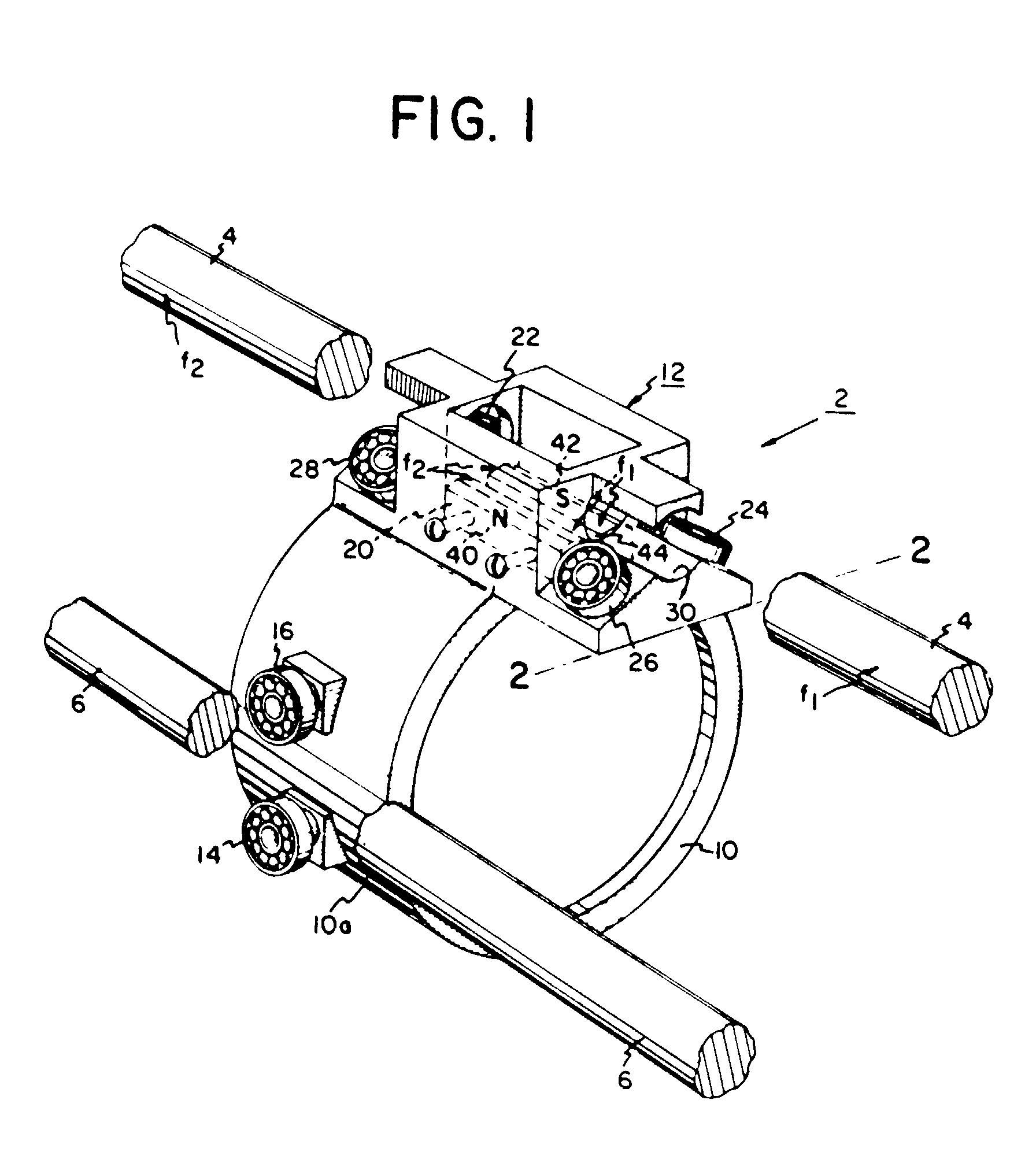
|
| (51) |
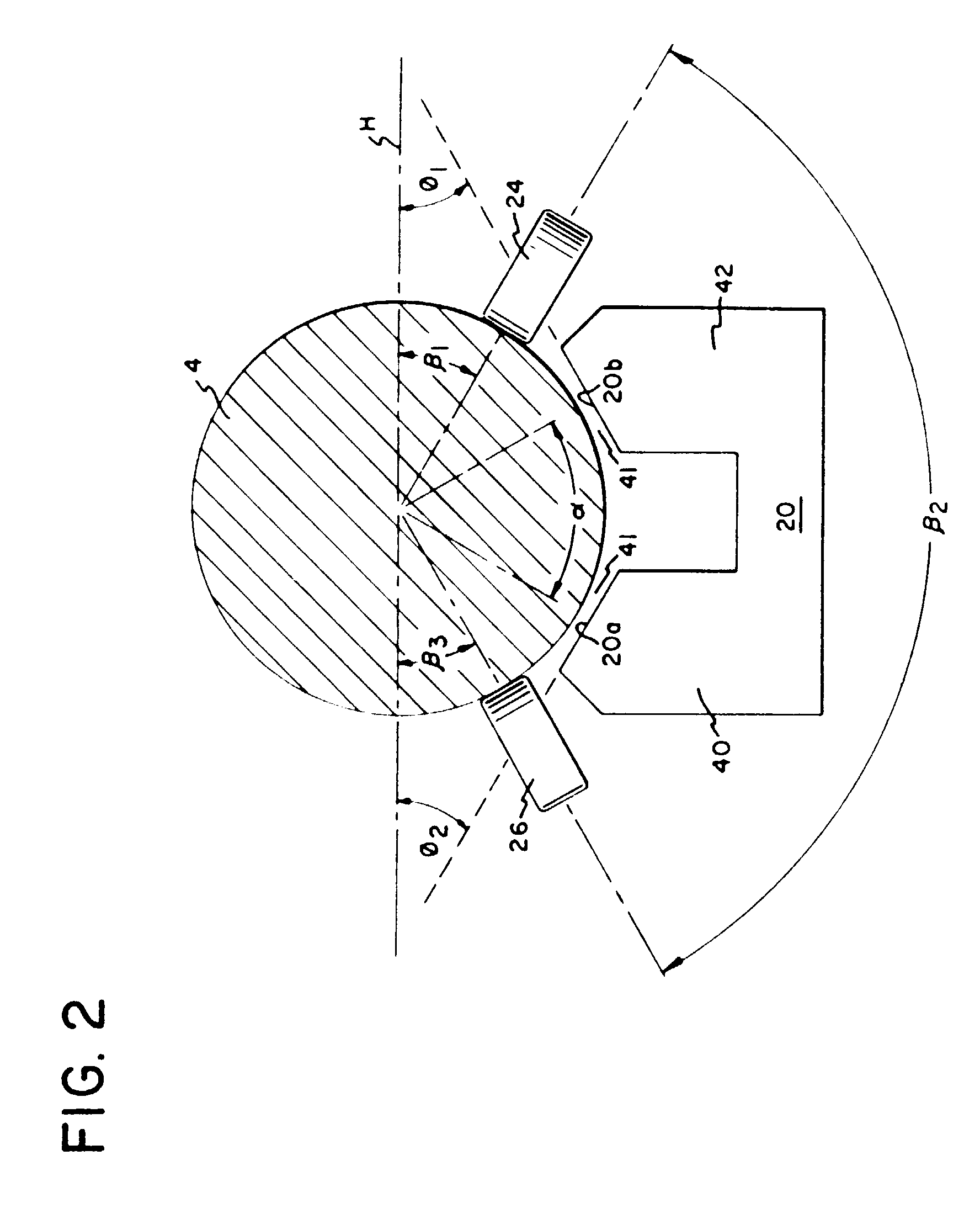
International Patent Classification (IPC)6: G02B 7/02 |
|
| (54) |
Permanent magnetic suspension with roller guides
Dauermagnetaufhängung mit Rollenführung
Suspension à aimant permanent ayant des galets de guidage
|
| (84) |
Designated Contracting States: |
|
DE FR GB |
| (30) |
Priority: |
12.04.1993 US 45958
|
| (43) |
Date of publication of application: |
|
19.10.1994 Bulletin 1994/42 |
| (73) |
Proprietor: Hughes Aircraft Company |
|
Los Angeles, California 90045-0066 (US) |
|
| (72) |
Inventor: |
|
- Devenyi, Gabor
Ontario, G.D. (CA)
|
| (74) |
Representative: KUHNEN, WACKER & PARTNER |
|
Alois-Steinecker-Strasse 22
85354 Freising
85354 Freising (DE) |
| (56) |
References cited: :
EP-A- 0 316 684
|
WO-A-93/06515
|
|
| |
|
|
- DATABASE WPI Section PQ, Week 9325, Derwent Publications Ltd., London, GB; Class P81,
AN 93-204351 & SU-A-1 744 681 (G.I.ANDROSOV) 30 June 1992
- PATENT ABSTRACTS OF JAPAN vol. 7, no. 282 (P-243) 16 December 1983 & JP-A-58 156 967
(FUJI) 19 September 1983
|
|
| |
|
| Note: Within nine months from the publication of the mention of the grant of the European
patent, any person may give notice to the European Patent Office of opposition to
the European patent
granted. Notice of opposition shall be filed in a written reasoned statement. It shall
not be deemed to
have been filed until the opposition fee has been paid. (Art. 99(1) European Patent
Convention).
|
BACKGROUND OF THE INVENTION
Field of the Invention
[0001] The present invention generally relates to a lens which is movably positioned along
a guide rod, and in particular relates to a movably positioned lens having magnetic
means for holding it in place on the guide rod.
Description of the Prior Art
[0002] Conventional guidance assemblies for optical or mechanical devices include guide
rods and re-circulating linear ball bearings which must be heavily pre-loaded to provide
precision play-free guidance. This results in high cost, requires high accuracy between
mating parts, and includes relatively bulky components.
[0003] Further, relatively high drive forces are typically needed to move the pre-loaded
components. Such pre-loads are susceptible to change with temperature.
[0004] In one typical use, a guidance assembly supports a lens for filming motion pictures
which requires exceptionally accurate positioning to ensure very sharp images to film
a master tape (from which all future tapes will be copied). The filming of a motion
picture may subject the guidance assembly to extreme temperature variations, such
as those in a desert or mountainous climate. The extreme temperature variations may
cause difficulty in positioning the lens assembly and may cause movement due to expansion
and contraction in a pre-positioned lens assembly.
SUMMARY OF THE INVENTION
[0005] The invention provides a lens assembly according to claim 1.
[0006] In an embodiment, the permanent magnetic assembly has an aperture therein through
which the guide rod passes to protect the lens assembly from falling off the guide
rod when shock loading may exceed the closed-coupled magnetic attraction force.
[0007] The invention provides accurate guidance to moving mechanical assemblies (e.g. moving
elements in a zoom lens) while maintaining low resistance to the drive forces in the
direction of motion.
[0008] The invention provides a reliable and accurate guidance under extreme temperature
variations by employing permanent magnetic attraction unchanged by lubricants or other
physical conditions.
[0009] The invention applies to electronic zoom lens. It also applies to any opto-mechanical,
electro-mechanical or like devices where reliable athermal guidance is needed.
[0010] Other objects and advantages of the present invention will become apparent to those
skilled in the art from the following detailed description of the invention when read
in conjunction with the appended claims and drawing attached hereto.
BRIEF DESCRIPTION OF THE DRAWING
[0011] Figure 1, not drawn to scale, shows a movable lens arranged on guide rods according
to the present invention.
[0012] Figure 2, not drawn to scale, shows a cross-sectional view of the guide rod and the
permanent magnetic assembly along lines 2-2 in Figure 1.
DETAILED DESCRIPTION OF THE INVENTION
[0013] Figure 1 shows a movable lens assembly 2 arranged on guide rods 4 and 6. In one embodiment,
the guide rods 4 and 6 are two hardened steel rods.
[0014] The movable lens assembly 2 includes a lens cell 10 having a perimeter 10a with a
permanent magnet assembly
12 arranged thereon at the top of the lens cell 10 as shown. A pre-loaded bearing 14
and guide bearing 16 are also arranged on the perimeter 10a of the lens cell 10 at
a 90° angle with respect to the permanent magnetic assembly 12. The pre-load bearing
14 and guide bearing 16 cooperate with the guide rod 6 to further support and position
the lens cell 10 along the guide rod 4.
[0015] The permanent magnet assembly
12 has a permanent magnet 20 which provides a closed-coupled attractive magnetic force
to support the lens assembly 2 to the guide rod 4. Magnetic force lines f1 and f2
illustrate the magnetic force applied to the guide rod 4 as a close-coupled attractive
magnetic force. The permanent magnet 20, in the embodiment, is U-shaped, having a
north pole 40 and a south pole 42, and having a V-shaped recessed longitudinal channel
44 placed in close proximity to the guide rod 4 on the permanent magnetic assembly
12 to attract the guide rod and hold it against the ball bearings. As shown in Figure
2, the north pole 40 and south pole 42 are disposed about the guide rod 4 with a small
air gap or clearance 41, at an arc segment of α. In a preferred embodiment, α equals
60°.
[0016] The permanent magnet assembly
12 in the preferred embodiment has four ball bearings 22, 24, 26 and 28 arranged in
a V-shaped configuration on each side of the permanent magnet assembly
12, as shown. The four ball bearings 22, 24, 26 and 28 provide guidance for the lens
cell 10 by rolling against the underside of the guide rod 4. The four ball bearings
22, 24, 26 and 28 provide all supportive and guiding functions. As shown in Figure
2, the rotational guide bearings 24 and 26 are disposed about the guide rod, and contact
it at an arc segment of β
1 and β
3 respectively with respect to the horizontal plane H of the guide rod 4, as shown.
In a preferred embodiment, β
1 and β
3 = 30° and β
2 equals 120°.
[0017] Preferably, the lens cell 10 is secured against shock loads that may exceed the close-coupled
magnetic attraction forces f1 and f2 by means of a clearance aperture 30 passing through
the assembly (nonmagnetic i.e. lens cell)
12. The guide rod 4 is thus surrounded by the rest of the assembly
12 to retain the guide rod 4 and to prevent the lens from falling off the guide rod
4.
[0018] In the embodiment, additional guidance must be provided by the pair of bearings 14
and 16 which cooperate with a second guide rod 6 in order to control rotation of the
assembly out of the optical axes. The guide bearing 16 is mounted on a rigid shaft
(not shown), and the pre-load bearing 14 is mounted on two spring rods (not shown)
to provide pre-loading. The above- described system is "space efficient" and easily
adaptable to different design applications.
[0019] The aforementioned embodiments described admirably achieve the objects of the invention;
however, it will be appreciated that departures can be made by those skilled in the
art without departing from the scope of the invention which is limited only to the
following claims.
1. A lens assembly (2) for slidably positioning a lens along a guide rod (4), comprising:
a lens cell assembly (10); and
a permanent magnetic assembly (12) connected to the lens cell assembly (10), having
a permanent magnet (20) arranged to be juxtaposed in close spatial relationship to
the guide rod (4) with minimum clearance (41) between guide rod (4) and magnet assembly
(12) for applying a close-coupled magnetic force on the guide rod (4) to hold the
lens cell assembly (10) at a desired position along the guide rod (4), and having
a plurality of rotational guide bearings (22, 24, 26, 28), each guiding the lens assembly
(2) as it is moved along the guide rod (4).
2. A lens assembly (2) according to claim 1, wherein the permanent magnet has a north
pole (40) and a south pole (42) arranged to be disposed adjacent the guide rod (4)
and spaced apart from one another.
3. A lens assembly (2) according to claim 2, wherein the permanent magnet (20) is U-shaped.
4. A lens assembly (2) according to claim 2, the north (40) and south (42) poles form
a longitudinal channel (44) arranged to correspond to the shape of the guide rod (4)
for providing maximum attraction forces with minimum clearance (41) between guide
rod (4) and magnet assembly (12) supporting the lens cell assembly (10) on the guide
rod (4) through four rolling elements (22, 24, 26, 28).
5. A lens assembly (2) according to claim 2, wherein the north (40) and south (42) poles
form a longitudinal channel (44) which is V-shaped.
6. A lens assembly (2) according to claim 2, wherein the north pole (40) and south pole
(42) are arranged to attract the guide rod (4) at an arc segment of about 60°.
7. A lens assembly (2) according to claim 1, wherein the permanent magnetic assembly
(12) has a plurality of rotational guide bearings (22, 24, 26, 28), each being arranged
to be disposed adjacent the guide rod (4) and to support it to guide the lens assembly
(2) along the guide rod (4).
8. A lens assembly (2) according to claim 7, wherein the rotational guide bearings (22,
24, 26, 28) are arranged to contact the guide rod (4) at an arc segment of about 120°
with respect to the horizontal plane H of the guide rod (4).
9. A lens assembly (2) according to claim 1, wherein the permanent magnet assembly (12)
has a longitudinal clearance aperture (30) for the guide rod (4) to pass through for
preventing the lens assembly (2) from breaking if the permanent magnet (20) releases
from the guide rod (4) in the event of shock loading that may exceed the closed-coupled
magnetic force.
10. A lens assembly (2) according to claim 1, wherein the lens cell assembly (10) comprises
a pair of rotational guide bearings (14, 16) arranged to cooperate with another guide
rod (6).
11. A lens assembly (2) according to claim 10, wherein one (16) of the rotational guide
bearings of said pair is rigidly mounted, and the other (14) is resiliently mounted
for providing pre-loading.
1. Ein Linsensystem (2) zum gleitfähigen Positionieren einer Linse entlang eines Führungsstabs
(4) mit:
einem Linsenzellensystem (10); und
einem Dauermagnetsystem (12), das mit dem Linsenzellensystem (10) verbunden ist, mit
einem Dauermagneten (20), der so angeordnet ist, daß er in naher räumlicher Beziehung
neben dem Führungsstab (4) mit einem minimalen Zwischenraum (41) zwischen dem Führungsstab
(4) und dem Magnetsystem (12) angeordnet ist, zum Beaufschlagen des Führungsstabes
(4) mit einer fest gekoppelten magnetischen Kraft, um das Linsenzellensystem (10)
bei einer erwünschten Position entlang des Führungsstabs (4) zu halten, und mit einer
Vielzahl von Rotationsführungslagern (22, 24, 26, 28), von denen jedes das Linsensystem
(2) führt wenn es entlang des Führungsstabs (4) bewegt wird.
2. Ein Linsensystem (2) nach Anspruch 1, dadurch gekennzeichnet, daß der Dauermagnet
einen Nordpol (40) und einen Südpol (42) aufweist, die so angeordnet sind, daß sie
angrenzend an den Führungsstab (4) und räumlich getrennt voneinander angeordnet sind.
3. Ein Linsensystem (2) nach Anspruch 2, dadurch gekennzeichnet, daß der Dauermagnet
(20) U-förmig ist.
4. Ein Linsensystem (2) nach Anspruch 2, dadurch gekennzeichnet, daß der Nordpol (40)
und der Südpol (42) einen Längskanal (44) bilden, der so angeordnet ist, daß er der
Gestalt des Führungsstabs (4) entspricht, zum Bereitstellen von maximalen Anziehungskräften
mit einem minimalen Zwischenraum (41) zwischen dem Führungsstab (4) und dem Magnetsystem
(12), das das Linsenzellensystem (10) auf dem Führungsstab (4) durch vier Rollelemente
(22, 24, 26, 28) lagert.
5. Ein Linsensystem (2) nach Anspruch 2, dadurch gekennzeichnet, daß der Nordpol (40)
und der Südpol (42) einen Längskanal (44) bilden, der V-förmig ist.
6. Ein Linsensystem (2) nach Anspruch 2, dadurch gekennzeichnet, daß der Nordpol (40)
und der Südpol (42) so angeordnet sind, daß sie den Führungsstab (4) in einem Bogensegment
von ungefähr 60° anziehen.
7. Ein Linsensystem (2) nach Anspruch 1, dadurch gekennzeichnet, daß das Dauermagnetsystem
(12) eine Vielzahl von Rotationsführungslagern (22, 24, 26, 28) aufweist, von denen
jedes so angeordnet ist, daß es angrenzend an den Führungsstab (4) angeordnet ist
und um ihn zu lagern, um das Linsensystem (2) entlang des Führungsstabs (4) zu führen.
8. Ein Linsensystem (2) nach Anspruch 7, dadurch gekennzeichnet, daß die Rotationsführungslager
(22, 24, 26, 28) so angeordnet sind, daß sie den Führungsstab (4) in einem Bogensegment
von ungefähr 120° in Bezug auf die horizontale Ebene H des Führungsstabs (4) kontaktieren.
9. Ein Linsensystem (2) nach Anspruch 1, dadurch gekennzeichnet, daß das Dauermagnetsystem
(12) eine längliche Freiraumöffnung (30) aufweist, durch die der Führungsstab (4)
hindurchgeht, um das Linsensystem (2) davor zu bewahren, zu zerbrechen, falls sich
der Dauermagnet (20) im Falle einer Stoßbelastung, die die fest gekoppelte magnetische
Kraft übersteigt, vom Führungsstab (4) löst.
10. Ein Linsensystem (2) nach Anspruch 1, dadurch gekennzeichnet, daß das Linsenzellensystem
(10) ein Paar von Rotationsführungslagern (14, 16) aufweist, die angeordnet sind,
um mit einem anderen Führungsstab (6) zusammenzuwirken.
11. Ein Linsensystem (2) nach Anspruch 10, dadurch gekennzeichnet, daß eines (16) der
Rotationsführungslager des Paares starr angebracht ist und das andere (14) zur Bereitstellung
von Vorspannung federnd angebracht ist.
1. Ensemble d'objectif (2) servant à positionner par glissement un objectif le long d'une
tige de guidage (4), comprenant :
un ensemble (10) de cellule d'objectif ; et
un ensemble à aimant permanent (12) raccordé à l'ensemble de cellule d'objectif (10),
comportant un aimant permanent (20) disposé de manière à être juxtaposé, selon une
étroite relation spatiale, à la tige de guidage agencée de manière à appliquer une
force magnétique de couplage étroit à la tige de guidage (4) pour maintenir l'ensemble
de cellule d'objectif (10) dans une position désirée le long de la tige de guidage
(4), et possédant une pluralité de paliers de guidage en rotation (22, 24, 26, 28),
dont chacun guide l'ensemble d'objectif (2) lorsqu'il se déplace le long de la tige
de guidage (4).
2. Ensemble d'objectif (2) selon la revendication 1, dans lequel l'aimant permanent possède
un pôle nord (40) et un pôle sud (42) disposés de manière à être adjacents à la tige
de guidage (4) et qui sont espacés l'un de l'autre.
3. Ensemble d'objectif (2) selon la revendication 2, dans lequel l'aimant permanent (20)
a une forme en U.
4. Ensemble d'objectif (2) selon la revendication 2, dans lequel le pôle nord (40) et
le pôle sud (42) forment un canal longitudinal (44) agencé de manière à correspondre
à la forme de la tige de guidage (4) pour produire des forces d'attraction maximales
avec un jeu minimum (41) entre la tige de guidage (4) et l'ensemble à aimant (12)
supportant l'ensemble de cellule d'objectif (10) sur la tige de guidage (4) au moyen
de quatre éléments roulants (22, 24, 26, 28).
5. Ensemble d'objectif (2) selon la revendication 2, dans lequel le pôle nord (40) et
le pôle sud (42) forment un canal longitudinal (44) qui est en forme de V.
6. Ensemble d'objectif (2) selon la revendication 2, dans lequel le pôle nord (40) et
le pôle sud (42) sont agencés de manière à attirer la tige de guidage (4) sur un segment
d'arc d'environ 60°.
7. Ensemble d'objectif (2) selon la revendication 1, dans lequel l'ensemble à aimant
permanent (12) possède une pluralité de paliers de guidage en rotation (22, 24, 26,
28), dont chacun est disposé de manière à être adjacent à la tige de guidage (4) et
à supporter cette dernière pour guider l'ensemble d'objectif (2) le long de la tige
de guidage (4) .
8. Ensemble d'objectif (2) selon la revendication 7, dans lequel les paliers de guidage
en rotation (22, 24, 26, 28) sont agencés de manière à être en contact avec la tige
de guidage (4) sur un segment d'arc d'environ 120° par rapport au plan horizontal
H de la tige de guidage (4).
9. Ensemble d'objectif (2) selon la revendication 1, dans lequel l'ensemble à aimant
permanent (12) possède une ouverture longitudinale de passage (30) pour le passage
de la tige de guidage (4) pour empêcher que l'ensemble d'objectif (2) se casse si
l'aimant permanent (20) se détache de la tige de guidage (4) dans le cas d'une charge
de choc pouvant dépasser la force magnétique de couplage étroit.
10. Ensemble d'objectif (2) selon la revendications 1, dans lequel l'ensemble de cellule
d'objectif (10) comprend une paire de paliers de guidage en rotation (14, 16) agencés
de manière à coopérer avec une autre tige de guidage (6).
11. Ensemble d'objectif (2) selon la revendication 10, dans lequel l'un (16) des paliers
de guidage en rotation de ladite paire est monté rigidement et l'autre (14) est monté
élastiquement de manière à produire une précontrainte.