|
(11) | EP 0 622 350 B1 |

| (12) | EUROPEAN PATENT SPECIFICATION |
|
|
| (54) |
PROCESS FOR PRODUCING AROMATIC HYDROXYLIC COMPOUND VERFAHREN ZUR HERSTELLUNG VON AROMATISCHEN HYDROXYDERIVATEN PROCEDE DE PRODUCTION D'UN COMPOSE HYDROXYLIQUE AROMATIQUE |
|
|
|||||||||||||||||||||||||||||||
| Note: Within nine months from the publication of the mention of the grant of the European patent, any person may give notice to the European Patent Office of opposition to the European patent granted. Notice of opposition shall be filed in a written reasoned statement. It shall not be deemed to have been filed until the opposition fee has been paid. (Art. 99(1) European Patent Convention). |
[0001] This invention relates to a process for producing an aromatic hydroxylic compound useful for the production of synthetic resins, agricultural chemicals, dyestuffs or medicines.
Background Art
[0002] Among a number of processes for industrial production of aromatic hydroxylic compounds, there is known a process in which a hydroperoxide is decomposed in the presence of an acid catalyst. In this process, sulfuric acid has been mainly used as the acid catalyst, however, a variety of acid catalysts have been proposed other than sulfuric acid.
[0003] For instance, a process wherein trifluoromethanesulfonic acid is used as the acid catalyst is proposed in Japanese Patent Application Laid-open No. 50-50311. In addition, for instance, the use of an ion exchange resin containing sulfonic acid groups is proposed in U.S. Patent No. 4,893,995, and the use of a variety of zeolites in European Patent No. 125,065. The use of Lewis acid such as stannic chloride, antimony chloride, sulfur tetrafluoride, silicon tetrafluoride or tungsten hexafluoride is proposed in U.S. Patent No. 4,267,380, and a further Lewis acid such as boron trifluoride or boron trifluoride etherate in U.S. Patent No. 4,267,379.
[0004] The decomposition of a hydroperoxide in the presence of an acid catalyst provides a ketone as well as an aromatic hydroxylic compound. In general, the decomposition of hydroperoxide having the general formula (I)
wherein Ar represents an aromatic hydrocarbon group having a valence of n; and n represents an integer of 1 or 2, produces acetone as the ketone. According to the conventional processes, the thus produced acetone readily reacts with the hydroperoxide as the starting material to by-produce hydroxyacetone. Thus, there arises a problem in the conventional industrial production of aromatic hydroxylic compound and acetone by the decomposition of hydroperoxide in the presence of an acid catalyst.
[0005] The first problem is that the yields of the aromatic hydroxylic compound and acetone are small. The second problem is that waste water contaminated with hydroxyacetone is generated as hydroxyacetone is water-soluble. The third problem is that the by-produced hydroxyacetone gets mixed with the resultant aromatic hydroxylic compound to lower its purity.
[0006] EP-A-0001043 discloses a process for making and recovering hydroquinone comprising the acid catalyzed decomposition of diisopropylbenzene dihydroperoxide in a reaction solvent with an acid catalyst selected from the group consisting of H3PO4, HClO4, p-toluene-sulfonic acid, SO2, HBF4, H2SiF6, BF3 and other Lewis acids in a concentration of from 0.05 to 3.0 weight percent of the reaction mixture within a temperature range of from 50 to 100 °C.
[0007] Object of the present invention is to provide a process for the production of an aromatic hydroxylic compound and acetone by the decomposition of hydroperoxide in the presence of an acid catalyst, which enables the production of an aromatic hydroxylic compound in a high yield with suppression of by-production of hydroxyacetone.
[0008] Subject matter of the present invention is a process for producing an aromatic hydroxylic compound by acid decomposition of a hydroperoxide according to Claim 1.
Disclosure of the Invention
[0010] The invention provides a process for producing an aromatic hydroxylic compound by acid decomposition of a hydroperoxide having the general formula (I)
wherein Ar represents an aromatic hydrocarbon group having a valence of n; and n represents an integer of 1 or 2, in the presence of an acid catalyst, thereby to provide an aromatic hydroxylic compound having the general formula (II)
Ar―(OH)n (II)
wherein Ar and n are the same as above defined, characterized in that tetrafluoroboric acid, hexafluorosilicic acid or hexafluorophosphoric acid is used as the acid catalyst and that the acid decomposition is carried out in two stages wherein the first stage of the reaction is carried out in the first reactor at a temperature of 50-95°C, the resultant reaction mixture is sent to the second reactor, and then the second stage of the reaction is carried out in the second reactor at a temperature of 80-120°C.
[0011] In the above general formula, Ar represents an aromatic hydrocarbon group having a valence of n; and n represents an integer of 1 or 2.
[0012] Accordingly, when n is 1, Ar is, for example, phenyl; an alkyl substituted phenyl such as tolyl, isopropylphenyl, t-butylphenyl or diisopropylphenyl, a phenyl substituted phenyl such as phenylphenyl; an alkoxy or aryloxy substituted phenyl such as methoxyphenyl or phenoxyphenyl; naphthyl; an alkyl substituted naphthyl such as methylnaphthyl or isopropylnaphthyl; or a phenyl substituted naphthyl such as phenylnaphthyl. When n is 2, Ar is, for example, phenylene; an alkyl substituted phenylene such as methylphenylene or isopropylphenylene; naphthylene; an alkyl substituted naphthylene such as methylnaphthylene or isopropylnaphthylene; or a phenyl substituted naphthylene such as phenylnaphthylene.
[0013] The preferred hydroperoxide among the above represented by the general formula (I) in the process of the invention includes, for example, cumene hydroperoxide, cymene hydroperoxide, diisopropylbenzene monohydroperoxide, triisopropylbenzene monohydroperoxide, isopropylnaphthalene hydroperoxide, methylisopropylnaphthalene monohydroperoxide, diisopropylnaphthalene monohydroperoxide, diisopropylbenzene dihydroperoxide, triisopropylbenzene dihydroperoxide or diisopropylnaphthalene dihydroperoxide. These hydroperoxides may be produced by oxydation of the corresponding isopropyl substituted aromatic compounds with air or molecular oxygen.
[0014] The aromatic hydroxylic compound having the general formula (II) which is produced according to the process of the invention includes, for example, phenol, cresol, isopropylphenol, diisopropylphenol, naphthol, methylnaphthol, isopropylnaphthol, resorcinol, hydroquinone, isopropylresorcinol or dihydroxynaphthalene, corresponding to the hydroperoxide used.
[0015] The decomposition of the hydroperoxide is carried out in the presence of tetrafluoroboric acid (HBF4), hexafluorosilicic acid (H2SiF6) or hexafluorophosphoric acid (HPF6) as the acid catalyst.
[0016] In the process of the invention, such a protonic acid containing fluorine atoms therein as above mentioned is used as the acid catalyst. Since the hydroperoxide decomposes promptly in the presence of such a protonic acid, the protonic acid is used usually as a purified acid. However, as the case may be, a crude acid may be used. Taking tetrafluoroboric acid as an example, a crude form thereof may be a reaction product obtained by admixing hydrofluoric acid (HF) and boric acid (H3BO3) both in theoretical amounts in water at room temperatures.
[0017] Usually the acid catalyst is prepared as an aqueous solution or it is diluted with a solvent inactive to the reaction, and is then added to the reaction system.
[0018] The amount of the acid catalyst used is preferably in the range of 20 ppm to 5% by weight, most preferably of 100 ppm to 2% by weight, based on the reaction mixture. As well known, a hydroperoxide may be obtained in the form of solution which may contain a trace or small amount of by-products and the unreacted hydrocarbon by oxidizing the corresponding hydrocarbon as a starting material with molecular oxygen, for instance, with the air, in the presence of an aqueous alkaline solution under heating, and thereafter effecting oil-water separation, and then concentrating the separated oily product. Therefore, the reaction mixture means herein a mixture composed of solution of the hydroperoxide used and a catalyst (and a solvent, if used). The optimum amount of catalyst used depends upon the catalyst and reaction solvent used, reaction temperature, the amount of water in the reaction system and reaction time among others.
[0019] In the process of the invention, a reaction solvent may not be used. However, if necessary, a reaction solvent may be used which is stable under the reaction conditions under which the process of the invention is carried out. The solvent usable includes, for example, a ketone such as acetone; an aromatic hydrocarbon such as benzene, toluene or cumene; an aliphatic hydrocarbon such as hexane, heptane or octane; a cycloaliphatic hydrocarbon such as cyclohexane, methylcyclohexane or cyclooctane; a halogenated hydrocarbon such as dichloroethane or chlorobenzene; a phenolic compound such as phenol or cresol. The solvent may be used singly or as a mixture.
[0020] If a solvent is used, it is used in an amount preferably of 0.1-5 parts by weight per part by weight of the hydroperoxide used.
[0021] The reaction may be carried out batchwise or continuously. When the reaction is carried out continuously, the reactor used may be composed of a single vessel or a plurality of vessels, or a tubular reactor. If necessary, the reactor may be a combination of a vessel reactor and a tubular reactor.
[0022] According to the invention, the first stage of the reaction is carried out in the first reactor, for example, in a continuous type vessel reactor, at a temperature of 50-95°C, and then the second stage of the reaction is carried out in a second reactor, for example, in a tubular reactor, at a temperature of 80-120°C, so that the by-production of hydroxyacetone is more effectively suppressed and a higher yield of the target aromatic hydroxylic compound is achieved.
[0023] The reaction is carried out in two stages as set forth above, the first stage of the reaction is ceased when the concentration of the hydroperoxide remaining in the reaction mixture becomes not more than 1% by weight, preferably not more than 0.5% by weight, and then the second stage of the reaction is carried out until the concentration of the hydroperoxide remaining in the reaction mixture becomes not more than 0.1% by weight. In this manner, especially desirable results are obtained.
[0024] The reaction may be carried out under a reduced, normal or increased pressure, irrespectively of the manners as above mentioned in which the reaction is carried out.
[0025] After the completion of the reaction, the resultant reaction mixture is neutralized or washed with water to remove the acid catalyst therefrom, and is then concentrated, followed by distillation, crystallization or other suitable operations, to separate the aromatic hydroxylic compound.
Industrial Availability
[0026] According to the process of the invention for producing an aromatic hydroxylic compound and acetone by decomposing a hydroperoxide in the presence of an acid catalyst, the acid catalyst is selected from among tetrafluoroboric acid, hexafluorosilicic acid and hexafluorophosphoric acid, and hence the aromatic hydroxylic compound is obtained in a high yield while the by-production of hydroxyacetone is effectively suppressed.
[0027] By carrying out the acid decomposition reaction in two stages a more effective suppression of by-production of hydroxyacetone and a higher yield of the target compopund can be achieved. Namely, the first stage of the reaction is carried out in the first reactor at a temperature of 50-95°C, the resultant reaction mixture is sent to the second reactor, and then the second stage of the reaction is carried out in the second reactor at a temperature of 80-120°C.
[0028] The invention will now be described with reference to examples, however, the invention is not limited thereto. Hereinafter the concentration of catalyst is indicated by a concentration in a reaction mixture, and the concentration of hydroxyacetone is indicated by a weight ratio to the aromatic hydroxylic compound obtained as the reaction product (target compound).
Reference Example 1
[0029] Cumene was air-oxidized at 100-110°C in the presence of an aqueous solution of sodium carbonate. After the reaction, oil-water separation was conducted, and the oily product was concentrated to provide a solution of cumene hydroperoxide (CHP) of which composition is indicated in Table 1.
TABLE 1
| Composition | Concentration (% by weight) |
| Cumene hydroperoxide (CHP) | 80.39 |
| Dicumyl peroxide (DCP) | 0.75 |
| Dimethylphenylcarbinol (DMPC) | 7.41 |
| Acetophenone | 0.94 |
| Cumene | 10.29 |
| Others | 0.22 |
Example 1
[0030] Into a single vessel reactor (the first reactor) of stainless having a 100 ml hold-up capacity for use in a continuous reaction and provided with a stirrer, a water cooling condenser, a warm water jacket, a temperature detector, an inlet tube for a feed material, an inlet tube for a catalyst and an outlet tube for extracting a reaction mixture, the solution of CHP prepared in the reference example 1 was added at a rate of 260 g per hour and an acetone solution containing 0.15% by weight of tetrafluoroboric acid and 1.6% by weight of water at a rate of 40.9 g per hour. The concentration of tetrafluoroboric acid in the reaction mixture was 200 ppm. The reaction was carried out in this manner with a hold-up time of 20 minutes while the reaction mixture was maintained at a temperature of 84°C.
[0031] The reaction mixture was extracted continuously from the first reactor and neutralized with sodium carbonate powder, and then the composition of the supernatant was analyzed by gas chromatography. The results are indicated in Table 2.
TABLE 2
| Composition | Concentration (% by weight) |
| Phenol | 41.47 |
| Acetone | 38.00 |
| Cumene | 8.92 |
| DCP | 4.47 |
| α-Methylstyrene | 2.40 |
| Acetophenone | 0.94 |
| DMPC | 0.74 |
| CHP | 0.31 |
| Others | 2.75 |
[0032] The reaction mixture extracted continuously from the first reactor was sent with a pressure pump into a coiled stainless tube having an inside diameter of 4 mm (the second reactor) provided with a temperature detector and a pressure gage and immersed in a heated oil bath, with an inside volume of 20 ml in the oil bath. The reaction was carried out in this manner with a hold-up time of 4 minutes while the reaction mixture was maintained at a temperature of 116°C.
[0033] The reaction mixture was extracted continuously from the second reactor through a water-cooling jacket and a pressure release valve, and was neutralized with sodium carbonate powder. The composition of the supernatant was then analyzed by gas chromatography. The results are indicated in Table 3.
TABLE 3
| Composition | Concentration (% by weight) |
| Phenol | 42.96 |
| Acetone | 39.33 |
| Cumene | 8.94 |
| DCP | 0.73 |
| α-Methylstyrene | 3.45 |
| Acetophenone | 1.08 |
| DMPC | 0.33 |
| CHP | 0.01 |
| Others | 3.17 |
[0034] In a manner as above set forth the acid decomposition was conducted in two stages by use of the first and second reactor. As results, the yield of phenol was found to be 99%. From the analysis of the other components in Table 3, the by-production of hydroxyacetone was found to be 240 ppm.
Comparative Example 1
1. A process for producing an aromatic hydroxylic compound by acid decomposition of a
hydroperoxide having the general formula (I)
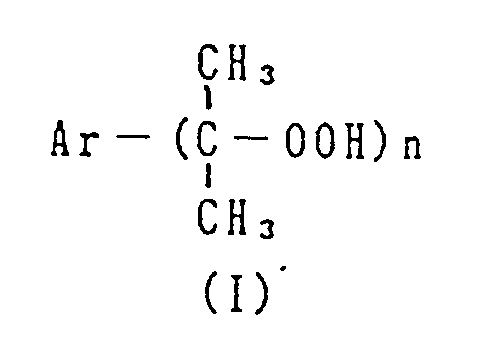
wherein Ar represents an aromatic hydrocarbon group having a valence of n; and n represents an integer of 1 or 2, in the presence of an acid catalyst, thereby to provide an aromatic hydroxylic compound having the general formula (II)
Ar―(OH)n (II)
wherein Ar and n are the same as above defined, characterized in that tetrafluoroboric acid, hexafluorosilicic acid or hexafluorophosphoric acid is used as the acid catalyst, and that the acid decomposition is carried out in two stages wherein the first stage of the reaction is carried out in the first reactor at a temperature of 50-95°C, the resultant reaction mixture is sent to the second reactor, and then the second stage of the reaction is carried out in the second reactor at a temperature of 80-120°C.
wherein Ar represents an aromatic hydrocarbon group having a valence of n; and n represents an integer of 1 or 2, in the presence of an acid catalyst, thereby to provide an aromatic hydroxylic compound having the general formula (II)
Ar―(OH)n (II)
wherein Ar and n are the same as above defined, characterized in that tetrafluoroboric acid, hexafluorosilicic acid or hexafluorophosphoric acid is used as the acid catalyst, and that the acid decomposition is carried out in two stages wherein the first stage of the reaction is carried out in the first reactor at a temperature of 50-95°C, the resultant reaction mixture is sent to the second reactor, and then the second stage of the reaction is carried out in the second reactor at a temperature of 80-120°C.
2. The process as claimed in claim 1 wherein the first stage of the reaction is ceased
when the concentration of the hydroperoxide in the reaction mixture becomes not more
than 1% by weight, and then the second stage of the reaction is carried out until
the concentration of the hydroperoxide in the reaction mixture becomes not more than
0.1% by weight.
3. The process as claimed in any claim 1 or 2 wherein the acid catalyst is used in an
amount of 20 ppm to 5% by weight based on the reaction mixture.
4. The process as claimed in any one of claims 1 to 3, wherein, when n is 1, Ar is phenyl
or a substituted phenyl, and when n is 2, Ar is phenylene, a substituted phenylene,
naphthylene or a substituted naphthylene.
5. The process as claimed in any one of claims 1 to 3, wherein the hydroperoxide is cumene
hydroperoxide, cymene hydroperoxide, diisopropylbenzene monohydroperoxide, triisopropylbenzene
monohydroperoxide, isopropylnaphthalene hydroperoxide, methylisopropylnaphthalene
monohydroperoxide, diisopropylnaphthalene monohydroperoxide, diisopropylbenzene dihydroperoxide,
triisopropylbenzene dihydroperoxide or diisopropylnaphthalene dihydroperoxide.
6. The process as claimed in any one of claims 1 to 3, wherein the hydroperoxide is cumene
hydroperoxide.
7. The process as claimed in any one of claims 1 to 3, wherein the hydroperoxide is cymene
hydroperoxide.
8. The process as claimed in any one of claims 1 to 3, wherein the hydroperoxide is diisopropylbenzene
dihydroperoxide.
1. Verfahren zur Herstellung einer aromatischen Hydroxyverbindung durch saures Zersetzen
eines Hydroperoxids mit der allgemeinen Formel (I)
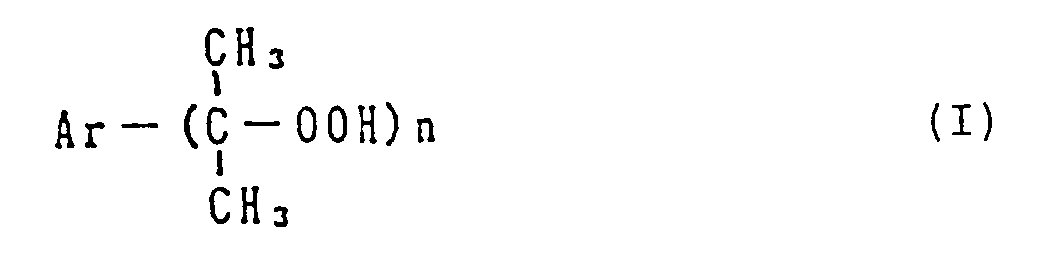
worin Ar eine aromatische Kohlenwasserstoffgruppe mit der Valenz n bedeutet; und n die ganze Zahl 1 oder 2 bedeutet, in Gegenwart eines sauren Katalysators, um dadurch eine aromatische Hydroxyverbindung mit der allgemeinen Formel (II) bereitzustellen,
Ar-(OH)n (II)
worin Ar und n die gleiche Bedeutung haben, wie oben definiert, dadurch gekennzeichnet, daß Tetrafluorborsäure, Hexafluorkieselsäure, oder Hexafluorphosphorsäure als saurer Katalysator verwendet wird, und daß die saure Zersetzung in zwei Stufen ausgeführt wird, von denen die erste Reaktionsstufe in einem ersten Reaktor bei einer Temperatur von 50-95°C durchgeführt wird; die resultierende Reaktionsmischung zu dem zweiten Reaktor geführt wird, und dann die zweite Reaktionsstufe im zweiten Reaktor bei einer Temperatur von 80-120°C durchgeführt wird.
worin Ar eine aromatische Kohlenwasserstoffgruppe mit der Valenz n bedeutet; und n die ganze Zahl 1 oder 2 bedeutet, in Gegenwart eines sauren Katalysators, um dadurch eine aromatische Hydroxyverbindung mit der allgemeinen Formel (II) bereitzustellen,
Ar-(OH)n (II)
worin Ar und n die gleiche Bedeutung haben, wie oben definiert, dadurch gekennzeichnet, daß Tetrafluorborsäure, Hexafluorkieselsäure, oder Hexafluorphosphorsäure als saurer Katalysator verwendet wird, und daß die saure Zersetzung in zwei Stufen ausgeführt wird, von denen die erste Reaktionsstufe in einem ersten Reaktor bei einer Temperatur von 50-95°C durchgeführt wird; die resultierende Reaktionsmischung zu dem zweiten Reaktor geführt wird, und dann die zweite Reaktionsstufe im zweiten Reaktor bei einer Temperatur von 80-120°C durchgeführt wird.
2. Verfahren gemäß Anspruch 1, worin die erste Reaktionsstufe beendet wird, wenn die
Konzentration des Hydroperoxids in der Reaktionsmischung nicht mehr als 1 Gew.% beträgt
und dann die zweite Reaktionsstufe ausgeführt wird, bis die Konzentration des Hydroperoxids
in der Reaktionsmischung nicht mehr als 0.1 Gew.% beträgt.
3. Verfahren gemäß einem der Ansprüche 1 oder 2, worin der saure Katalysator in einer
Menge von 20 ppm bis 5 % per Gewicht bezogen auf die Reaktionsmischung verwendet wird.
4. Verfahren gemäß einem der Ansprüche 1 bis 3, worin, wenn n 1 ist, Ar Phenyl oder ein
substituiertes Phenyl ist, und wenn n 2 ist, Ar ein Phenylen, substituiertes Phenylen,
ein Naphtylen oder ein substituiertes Naphthylen ist.
5. Verfahren gemäß einem der Ansprüche 1 bis 3, worin das Hydroperoxid Cumen-hydroperoxid,
Cymen-hydroperoxid, Diisopropylbenzol-monohydroperoxid, Triisopropylbenzol-monohydroperoxid,
Isopropylnaphthalin-hydroperoxid, Methylisopropylnaphthalin-monohydroperoxid, Diisopropylnaphthalin-monohydroperoxid,
Diisopropylbenzol-dihydroperoxid, Triisopropylbenzol-dihydroperoxid oder Diisopropylnaphthalin-dihydroperoxid
ist.
6. Verfahren gemäß einem der Ansprüche 1 bis 3, worin das Hydroperoxid Cumen-hydroperoxid
ist.
7. Verfahren gemäß einem der Ansprüche 1 bis 3, worin das Hydroperoxid Cymen-hydroperoxid
ist.
8. Verfahren gemäß einem der Ansprüche 1 bis 3, worin das Hydroperoxid Diisopropylbenzol-dihydroperoxid
ist.
1. Procédé pour la préparation d'un composé hydroxylé aromatique par une décomposition
par un acide d'un hydroperoxyde ayant la formule générale (I)
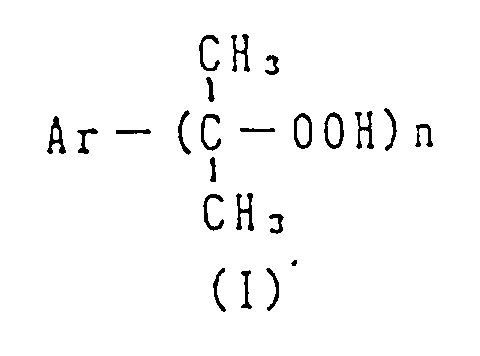
dans laquelle Ar représente un groupe hydrocarbure aromatique ayant une valence de n; et n représente un nombre entier de 1 ou 2, en présence d'un catalyseur acide, pour fournir ainsi un composé hydroxylé aromatique ayant la formule générale (II)
Ar-(OH)n (II)
dans laquelle Ar et n sont identiques à ceux définis précédemment, caractérisé en ce que de l'acide tétrafluoroborique, de l'acide hexafluorosilicique ou de l'acide hexafluorophosphorique est utilisé en tant que catalyseur acide, et en ce que la décomposition par un acide est effectuée en deux étapes successives où la première étape de la réaction est effectuée dans le premier réacteur à une température de 50-95°C; le mélange réactionnel résultant est envoyé dans le second réacteur, et ensuite la seconde étape de la réaction est effectuée dans le second réacteur à une température de 80-120°C.
dans laquelle Ar représente un groupe hydrocarbure aromatique ayant une valence de n; et n représente un nombre entier de 1 ou 2, en présence d'un catalyseur acide, pour fournir ainsi un composé hydroxylé aromatique ayant la formule générale (II)
Ar-(OH)n (II)
dans laquelle Ar et n sont identiques à ceux définis précédemment, caractérisé en ce que de l'acide tétrafluoroborique, de l'acide hexafluorosilicique ou de l'acide hexafluorophosphorique est utilisé en tant que catalyseur acide, et en ce que la décomposition par un acide est effectuée en deux étapes successives où la première étape de la réaction est effectuée dans le premier réacteur à une température de 50-95°C; le mélange réactionnel résultant est envoyé dans le second réacteur, et ensuite la seconde étape de la réaction est effectuée dans le second réacteur à une température de 80-120°C.
2. Procédé selon la revendication 1, dans lequel la première étape de la réaction est
stoppée lorsque la concentration d'hydroperoxyde dans le mélange réactionnel devient
pas supérieure à 1 % en poids, et ensuite la seconde étape de la réaction est effectuée
jusqu'à ce que la concentration d'hydroperoxyde dans le mélange réactionnel devienne
pas supérieure à 0,1 % en poids.
3. Procédé selon l'une quelconque des revendications 1 ou 2, dans lequel le catalyseur
acide est utilisé dans une quantité de 20 ppm à 5 % en poids sur la base du mélange
réactionnel.
4. Procédé selon l'une quelconque des revendications 1 à 3, dans lequel, lorsque n est
égal à 1, Ar est un phényle ou un phényle substitué, et lorsque n est égal à 2, Ar
est un phénylène, un phénylène substitué, un naphtylène ou un naphtylène substitué.
5. Procédé selon l'une quelconque des revendications 1 à 3, dans lequel l'hydroperoxyde
est un hydroperoxyde de cumène, un hydroperoxyde de cymène, un monohydroperoxyde de
diisopropylbenzène, un monohydroperoxyde de triisopropylbenzène, un hydroperoxyde
de isopropylnaphtalène, un monohydroperoxyde de méthylisopropylnaphtalène, un monohydroperoxyde
de diisopropylnaphtalène, un dihydroperoxyde de diisopropylbenzène, un dihydroperoxyde
de triisopropylbenzène ou un dihydroperoxyde de diisopropylnaphtalène.
6. Procédé selon l'une quelconque des revendications 1 à 3, dans lequel l'hydroperoxyde
est un hydroperoxyde de cumène.
7. Procédé selon l'une quelconque des revendications 1 à 3, dans lequel l'hydroperoxyde
est un hydroperoxyde de cymène.
8. Procédé selon l'une quelconque des revendications 1 à 3, dans lequel l'hydroperoxyde
est un dihydroperoxyde de diisopropylbenzène.