|
(11) | EP 0 624 151 B1 |

| (12) | EUROPEAN PATENT SPECIFICATION |
|
|
| (54) |
RACEMIZATION PROCESS RACEMISIERUNGSVERFAHREN PROCEDE DE RACEMISATION |
|
|
|||||||||||||||||||||||||||||||
| Note: Within nine months from the publication of the mention of the grant of the European patent, any person may give notice to the European Patent Office of opposition to the European patent granted. Notice of opposition shall be filed in a written reasoned statement. It shall not be deemed to have been filed until the opposition fee has been paid. (Art. 99(1) European Patent Convention). |
Field of the Invention
[0001] This invention relates to a process for convening an enantiomeric form of certain aliphatic carboxylic acids into a racemic mixture of enantiomers. This invention specifically relates to the racemization of one of the enantiomers of profen-type carboxylic acids or ester.
Background of the Invention
[0002] Profen-types of compounds are typically defined as propionic acids (or esters) bearing at least one aromatic substituent, usually α- to the carboxylic function.
[0003] These carboxylic acids have an asymmetric carbon atom (the carbon atom adjacent to the carbonyl group) that typically produces a racemic mixture of these acids [a mixture of both the (+) and (-) or dextro and levo rotorary forms]. For example, ibuprofen [(2-(4-isobutylphenyl)propionic acid)], a commercially and pharmaceutically important chemical compound, is typically produced and sold as the racemic mixture. Many other of the pharmaceutically-active profen drugs are also produced as racemates and administered in this form. However, it is well known that the physiological utility of the racemic mixtures is almost exclusively focused on one enantiomer, the other having either no effect or even diminishing the effect of the active enantiomer. Thus the S(+) form of ibuprofen is physiologically active in reducing inflammation and in providing an analgesic effect. See, for example, U. S. Patent Nos. 4,851.444 and 4.877.620. The R(-) enantiomer is devoid of activity for these indications, although it is, in part, converted in vivo into the S(+) compound. Other profens, i.e., naproxen, are only prescribed as the single enantiomer.
[0004] Patent abstract of Japan, vol. 13, no. 262 (C-608) (3610) discloses a method for racemizing an optically active α-substituted aryl acetic acid, wherein a mixture of 1-(p-tolyl)ethylamine and the optically active a-substituted aryl acetic acid is heated in a solvent.
Summary
[0005] It has been found that the inactive or undesirable enantiomer of these carboxylic acids or esters may be converted into the other usable, desirable enantiomer by heating an aequous solution of the enantiomer at 70-200°C in the presence of from 0,01% to 10%, based on the mole-% of the carboxylic acid enantiomer, of an aliphatic, aromatic or mixed aliphatic and aromatic tertiary amine and an aliphatic hydrocarbon as a cocatalyst for a time sufficient to racemize the enantiomer.
Description of the Preferred Embodiments
[0006] The carboxylic acids and esters useful in the process of the present invention have the formula:
where R1 is hydrogen or C1 to C6 linear or branched alkyl, R2, R3 and R4 are different and are hydrogen or C1 to C6 linear or branched alkyl, e.g., methyl or ethyl; C1 to C6 linear or branched haloalkyl, e.g., chloromethyl, fluoromethyl, chloroethyl, fluoroethyl; aralkyl, e.g., benzyl; cycloalkyl, e.g., cyclopropyl, cyclobutyl, cyclopentyl, or cyclohexyl; alkyl substituted cycloalkyl, e.g., methylcyclohexyl; C6 to C10 aryl, e.g., phenyl unsubstituted or substituted with, for example, methyl, dimethyl, or butyl, especially isobutyl or phenyl substituted with C1 to C4 alkylthio, C1 to C4 alkoxy, cyano or halo, e.g., fluoro or chloro; C1 to C6 linear or branched alkoxy, e.g., methoxy, ethoxy, propoxy, or butoxy; C6 to C10 aryloxy, e.g., phenoxy or phenoxy substituted with, for example, methyl, dimethyl, butyl or isobutyl or phenoxy substituted with C1 to C4 alkylthio, C1 to C4 alkoxy, cyano or halo; C1 to C6 alkylthio, e.g., methylthio; C2 to C8 cycloalkylthio; C6 to C10 arylthio; C6 to C10 arylcarbonyl, e.g., benzoyl; C4 to C8 cycloalkenyl, e.g., cyclohexenyl; trifluoromethyl; halo, e.g., fluoro or chloro; C4 to C5 heteroaryl, e.g., furyl, pyrrolyl, or thienyl; or C10 to C14 aryl, e.g., naphthyl or naphthyl substituted with C1 to C4 alkyl, e.g., methyl, C1 to C4 alkoxy, e.g., ethoxy or halo; or biphenyl unsubstituted or substituted with methyl or halo, especially fluoro.
[0007] Preferred compounds of formula I are those of the formula:
where R1, R2 and R3 are as previously defined and R5 and R6 are C1 to C4 linear or branched alkyl, C1 to C4 linear or branched alkoxy or halo.
[0008] The process of the present invention is particularly applicable to 2-(4-isobutylphenyl)propionic acid and especially in racemization of the R(-) isomer.
[0009] The process involves using one of the enantiomeric forms (or an enantiomerically enriched mixture) of such carboxylic acids as a starting material and subjecting this starting material to the process of the present invention whereby conversion of one enantiomer to the other is effected. It should be noted, however, that the present conversion process only functions to achieve a racemic mixture of the enantiomers, i.e., it is a racemization process.
[0010] The process involves racemizing the enantiomer in the presence of water at a temperature of from 100°C to 150°C. Preferably, the process is carried out at 110°C to 140°C, most preferably 115°C to 130°C. The time of conversion to the racemic mixture is dramatically affected by adding to the aqueous solution the above indicated amount of a tertiary amine that is aliphatic, aromatic or mixed aliphatic and aromatic. Aliphatic tertiary amines are those having three identical or different C1 to C6 linear or branched alkyl groups attached to the nitrogen atom and include, for example, trimethylamine, triethylamine, tri-n-propylamine, methyldiethylamine, dimethylethylamine, and tri-n-butylamine.
[0011] Aromatic amines are those where phenyl, substituted phenyl, naphthyl or substituted naphthyl groups, either the same or different, are bound to the nitrogen atom. These include triphenylamine, trinaphthylamine, ortho, meta or para-substituted tolyldiphenylamine, phenyl, di(ortho, meta, or para-substituted) and tolylphenylamine.
[0012] Mixed aliphatic/aromatic amines are also useful in this process such as, for example, dimethylphenylamine.
[0013] The amounts of such catalytic amine added to the solution can vary from 0.01% to 10.0% of such amine based on the mole % of carboxylic acid enantiomer to be converted. Preferably, the amount of amine is from 0.05 mole % to 0.5 mole % based on moles of carboxylic acid, most preferably 0.075 mole % to about 0.25 mole %.
[0014] By using the above disclosed catalytic amines, the time period to achieve a racemic mixture is reduced to from 4 to 24 hours, depending on the amount of excess enantiomer in the starting material. For example, with a starting material of 100% enantiomer, periods of conversion to the racemic mixture are 20 to 24 hours. Enantiomerically enriched starting materials reach the racemization maximum more quickly, e.g., a composition comprising 70% R(-) enantiomer and 30% S(+) enantiomer will achieve the 50:50 racemization in 10 to about 12 hours.
[0015] In addition to the tertiary amine catalyst useful to enhance the rate of racemization, it has been discovered that the presence of an aliphatic hydrocarbon in amounts noted earlier for the amine catalyst further catalyze the process. Thus, by using hexane, heptane, as a co-catalyst, the rates of racemization can be decreased by 10 to 20% from those rates shown about using solely the amine catalyst.
[0016] In addition to the tertiary amine catalyst and the said hydrocarbon, it has been discovered that the presence of water eliminates the by-product formation, thus increased yield.
[0017] As indicated above, the process of the present invention is useful for conversion of one of the enantiomeric forms of the disclosed aliphatic carboxylic acid into the other only up to the point of achieving a racemic mixture of enantiomers. The racemic mixture is, of course, useful as is or it may be subject to other processes to separate the enantiomeric mixture.
EXAMPLES
[0019] Examples 1, 2, 4 as far referring to Examples 1 and 2, and Example 5 represent comparative Examples.
[0020] To a 12-liter flask equipped with an agitator, thermometer, reflux condenser, and an addition funnel, were charged 824 grams of racemic ibuprofen and 8 liters of hexane. The slurry was agitated and heated to dissolve the ibuprofen to which was added 242 grams of S-methylbenzyl amine over 4 hours. After agitating for two more hours, the resultant slurry was filtered and washed with hexane to isolate the solids. The filtrates were combined and heated to remove most of the hexane. The syrupy liquid was evaporated to dryness and the R-enantiomer enriched ibuprofen was recovered (411 grams). The analvsis shows these solids contain 98.9% ibuprofen (78% R-enantiomer and 1.1% S-methylbenzyl amine).
EXAMPLE 1
[0021] 50 grams of R-enantiomer enriched solids (78% R-enantiomer) containing 49.5 grams ibuprofen and 0.5 gram S-methylbenzyl amine, and 12 grams triethylamine were charged to a reactor and heated to 120° C under pressure for 4 hours. Upon cooling, the solids from the reactor were removed and analyzed. The analysis is as follows:
| Total solids recovered = | 49.5 grams |
| Ibuprofen = | 78.3% |
| Ibuprofen - S-methylbenzyl amide = | 2.3% |
| S-methylbenzyl amine = | 0.0% |
| Triethylamine = | 19.4% |
| % S-enantiomer = | 49.4% |
EXAMPLE 2
[0022] The procedure of Example 1 was repeated except that the 12 grams of triethylamine were replaced by 100 grams of hexane. The mixture was treated at 120°C under pressure for 4 hours. Upon cooling, the entire contents of the reactor were dissolved in 1,000 mL of hexane and analyzed. The analysis of this solution on a solvent-free basis is as follows:
| Ibuprofen = | 97.5% |
| S-methylbenzyl amine = | 0.0% |
| Ibuprofen-S-methylbenzyl amide = | 2.5% |
| % S-enantiomer = | 34.0% |
EXAMPLE 3
[0023] The procedure of Example 1 was repeated. However, in addition to the solids and triethylamine, 1,000 mL of hexane were charged to the reactor. The mixture was heated to 120°C and held under pressure for 4 hours. Upon cooling the reactor, the contents of the reactor were analyzed and are as follows on a solvent-free basis:
| Ibuprofen = | 78.2% |
| S-methylbenzyl amine = | 0.0% |
| Ibuprofen - S-methylbenzyl amide = | 2.3% |
| Triethylamine = | 19.5% |
| % S-enantiomer = | 49.2% |
EXAMPLE 4
[0024] 50 grams of solids from the same batch used in Examples 1 through 3 were charged to the reactor and treated at 120°C for 4 hours. Upon cooling, the solids were analyzed. The analysis was very similar to the analysis from Example 2. No racemization had occurred.
EXAMPLE 5
[0025] 50 grams of solids from the same batch used in Examples 1 through 4, 12 grams triethylamine and 10 grams of water were charged to a reactor. The reactor contents were treated at 120°C for 4 hours. The analysis showed that partial racemization had taken place and no amide had formed. The S-enantiomer content of the ibuprofen was 44%.
EXAMPLE 6
[0026] In addition to the charges from Example 5, 50 mL of hexane were charged to the reactor and treated at 120° C for 4 hours under pressure. The analysis showed that the ibuprofen had racemized and no amide was formed. Ex. solvent analysis follows:
| Total solids recovered = | 49.4 grams |
| Ibuprofen = | 78.5% |
| S-methylbenzyl amine = | 1.4% |
| Triethylamine = | 19.9% |
| S-enantiomer = | 49.4% |
1. A method for racemizing an optically active carboxylic acid, or ester thereof, of
the formula:
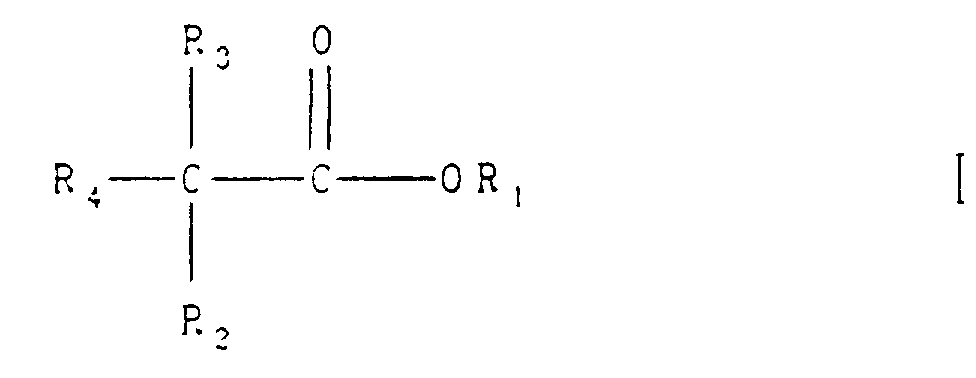
where R1 is hydrogen or C1 to C6 linear or branched alkyl; R2, R3 and R4 are different and are hydrogen or C1 to C6 linear or branched alkyl, C1 to C6 linear or branched haloalkyl, aralkyl, cycloalkyl, alkyl substituted cycloalkyl, C6 to C10 aryl C1 to C6 linear or branched alkoxy, C6 to C10 aryloxy, C1 to C6 alkylthio, C2 to C8 cycloalkylthio, C6 to C10 arylthio, C6 to C10 arylcarbonyl, C4 to C8 cycloalkenyl, trifluoromethyl, halo, C4 to C5 heteroaryl, C10 to C14 aryl, or biphenyl unsubstituted or substituted with methyl or halo, comprising heating an aqueous solution of said optically active carboxylic acid or ester thereof at a temperature of from 75°C to 200°C in the presence of from 0,01% to 10%, based on the mole-% of the carboxylic acid enantiomer, of an aliphatic, aromatic or mixed aliphatic and aromatic tertiary amine and an aliphatic hydrocarbon as a cocatalyst for a time sufficient to racemize said carboxylic acid or ester thereof.
where R1 is hydrogen or C1 to C6 linear or branched alkyl; R2, R3 and R4 are different and are hydrogen or C1 to C6 linear or branched alkyl, C1 to C6 linear or branched haloalkyl, aralkyl, cycloalkyl, alkyl substituted cycloalkyl, C6 to C10 aryl C1 to C6 linear or branched alkoxy, C6 to C10 aryloxy, C1 to C6 alkylthio, C2 to C8 cycloalkylthio, C6 to C10 arylthio, C6 to C10 arylcarbonyl, C4 to C8 cycloalkenyl, trifluoromethyl, halo, C4 to C5 heteroaryl, C10 to C14 aryl, or biphenyl unsubstituted or substituted with methyl or halo, comprising heating an aqueous solution of said optically active carboxylic acid or ester thereof at a temperature of from 75°C to 200°C in the presence of from 0,01% to 10%, based on the mole-% of the carboxylic acid enantiomer, of an aliphatic, aromatic or mixed aliphatic and aromatic tertiary amine and an aliphatic hydrocarbon as a cocatalyst for a time sufficient to racemize said carboxylic acid or ester thereof.
2. The method according to Claim 1 wherein said temperature is from 100°C to 150°C.
3. The method according to Claim 1 wherein said temperature is from 110°C to 140°C.
4. The method according to Claim 1 wherein said tertiary amine is aliphatic.
5. The method according to Claim 4 wherein said tertiary amine is selected from the group
consisting of trimethylamine, triethylamine, tri-n-propylamine, methyldiethylamine,
dimethylethylamine and tri-n-butylamine.
6. The method according to Claim 1 wherein said tertiary amine is N,N-dimethylaniline.
7. The method according to Claim 1 wherein said aliphatic hydrocarbon is a C5 to C8 aliphatic hydrocarbon.
8. The method according to Claim 7 wherein said aliphatic hydrocarbon is hexane.
9. The method according to Claim 1, wherein said optically active carboxylic acid is
R(-)-ibuprofen.
10. The method according to Claim 9 wherein said temperature is from 100°C to 150°C.
11. The method according to Claim 9 wherein said temperature is from 110°C to 140°C.
12. The method according to Claim 9 wherein said tertiary amine is aliphatic.
13. The method according to Claim 12 wherein said tertiary amine is selected from the
group consisting of trimethylamine, triethylamine, tri-n-propylamine, methyldiethylamine,
dimethylethylamine and tri-n-butylamine.
14. The method according to Claim 9 wherein said tertiary amine is N,N-dimethylaniline.
15. The method according to Claim 9 wherein said co-catalyst is a C5 to C8 aliphatic hydrocarbon.
16. The method according to Claim 15 wherein said co-catalyst is hexane.
1. Verfahren zur Racemisierung einer optisch aktiven Carbonsäure oder eines Carbonsäureesters
der Formel
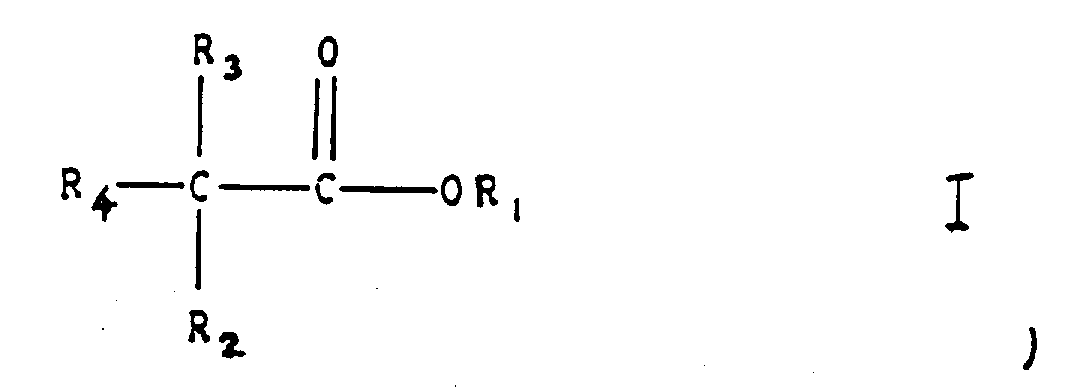
in der R1 Wasserstoff oder ein lineares oder verzweigtes C1-C6-Alkyl ist; R2, R3 und R4 verschieden sind und Wasserstoff, lineares oder verzweigtes C1-C6-Alkyl, lineares oder verzweigtes C1-C6-Halogenalkyl, Aralkyl, Cycloalkyl, Alkylsubstituiertes Cycloalkyl, C6-C10-Aryl, lineares oder verzweigtes C1-C6-Alkoxy, C6-C10-Aryloxy, C1-C6-Alkylthio, C2-C8-Cycloalkylthio, C6-C10-Arylthio, C6-C10-Arylcarbonyl, C4-C8-Cycloalkenyl, Trifluormethyl, Halogen, C4-C5-Heteroaryl, C10-C14-Aryl oder Biphenyl, das mit Methyl oder Halogen substituiert oder nicht substituiert ist, bedeutet, bei dem man eine wäßrige Lösung der optisch aktiven Carbonsäure bzw. des Carbonsäureesters bei einer Temperatur von 75 bis 200°C in Gegenwart von 0,01 bis 10 %, bezogen auf die Mol-% des Carbonsäureenantiomeren, eines aliphatischen, aromatischen oder gemischt aliphatischen und aromatischen tertiären Amins und eines aliphatischen Kohlenwasserstoffs als Cokatalysator ausreichend lange erhitzt, um die Carbonsäure oder den Carbonsäureester zu racemisieren.
in der R1 Wasserstoff oder ein lineares oder verzweigtes C1-C6-Alkyl ist; R2, R3 und R4 verschieden sind und Wasserstoff, lineares oder verzweigtes C1-C6-Alkyl, lineares oder verzweigtes C1-C6-Halogenalkyl, Aralkyl, Cycloalkyl, Alkylsubstituiertes Cycloalkyl, C6-C10-Aryl, lineares oder verzweigtes C1-C6-Alkoxy, C6-C10-Aryloxy, C1-C6-Alkylthio, C2-C8-Cycloalkylthio, C6-C10-Arylthio, C6-C10-Arylcarbonyl, C4-C8-Cycloalkenyl, Trifluormethyl, Halogen, C4-C5-Heteroaryl, C10-C14-Aryl oder Biphenyl, das mit Methyl oder Halogen substituiert oder nicht substituiert ist, bedeutet, bei dem man eine wäßrige Lösung der optisch aktiven Carbonsäure bzw. des Carbonsäureesters bei einer Temperatur von 75 bis 200°C in Gegenwart von 0,01 bis 10 %, bezogen auf die Mol-% des Carbonsäureenantiomeren, eines aliphatischen, aromatischen oder gemischt aliphatischen und aromatischen tertiären Amins und eines aliphatischen Kohlenwasserstoffs als Cokatalysator ausreichend lange erhitzt, um die Carbonsäure oder den Carbonsäureester zu racemisieren.
2. Verfahren nach Anspruch 1, bei dem die Temperatur 100 bis 150°C beträgt.
3. Verfahren nach Anspruch 1, bei dem die Temperatur 110 bis 140°C beträgt.
4. Verfahren nach Anspruch 1, bei dem das tertiäre Amin aliphatisch ist.
5. Verfahren nach Anspruch 4, bei dem das tertiäre Amin aus der aus Trimethylamin, Triethylamin,
Tri-n-propylamin, Methyldiethylamin, Dimethylethylamin und Tri-n-butylamin bestehenden
Gruppe ausgewählt ist.
6. Verfahren nach Anspruch 1, bei dem das tertiäre Amin N,N-Dimethylanilin ist.
7. Verfahren nach Anspruch 1, bei dem der aliphatische Kohlenwasserstoff ein aliphatischer
C5-C8-Kohlenwasserstoff ist.
8. Verfahren nach Anspruch 7, bei dem der aliphatische Kohlenwasserstoff Hexan ist.
9. Verfahren nach Anspruch 1, bei dem die optisch aktive Carbonsäure R(-)-Ibuprofen ist.
10. Verfahren nach Anspruch 9, bei dem die Temperatur 100 bis 150°C beträgt.
11. Verfahren nach Anspruch 9, bei dem die Temperatur 110 bis 140°C beträgt.
12. Verfahren nach Anspruch 9, bei dem das tertiäre Amin aliphatisch ist.
13. Verfahren nach Anspruch 12, bei dem das tertiäre Amin aus der Trimethylamin, Triethylamin,
Tri-n-propylamin, Methyldiethylamin, Dimethylethylamin und Tri-n-butylamin bestehenden
Gruppe ausgewählt ist.
14. Verfahren nach Anspruch 9, bei dem das tertiäre Amin N,N-Dimethylanilin ist.
15. Verfahren nach Anspruch 9, bei dem der Cokatalysator ein aliphatischer C5-C8-Kohlenwasserstoff
ist.
16. Verfahren nach Anspruch 15, bei dem der Cokatalysator Hexan ist.
1. Procédé pour la racémisation d'un acide carboxylique optiquement actif, ou d'un de
ses esters, de formule :
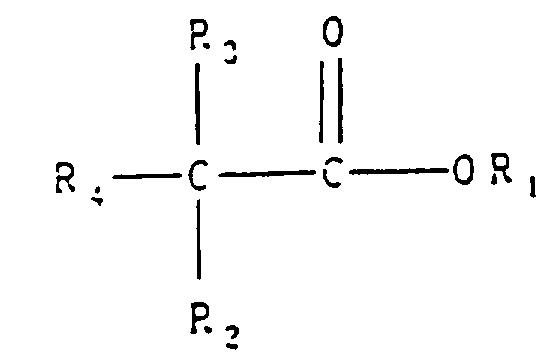
dans laquelle R1 représente l'hydrogène ou un groupe alkyle linéaire ou ramifié en C1 à C6 ; R2, R3 et R4 sont différents et représentent l'hydrogène ou un groupe alkyle linéaire ou ramifié en C1 à C6, halogénalkyle linéaire ou ramifié en C1 à C6, aralkyle, cycloalkyle, cycloalkyle à substituant alkyle, aryle en C6 à C10, alkoxy linéaire ou ramifié en C1 à C6, aryloxy en C6 à C10, alkylthio en C1 à C6, cycloalkylthio en C2 à C8, arylthio en C6 à C10, (aryle en C6 à C10)carbonyle, cycloalcényle en C4 à C8, trifluorométhyle, halogéno, hétéroaryle en C4 ou C5, aryle en C10 à C14, ou biphényle non substitué ou substitué avec des groupes méthyle ou halogéno, comprenant le chauffage d'une solution aqueuse de cet acide carboxylique optiquement actif ou de son ester à une température de 75°C à 200°C en présence d'une quantité de 0,01 % à 10 %, sur la base du pourcentage molaire de l'énantiomère d'acide carboxylique, d'une amine tertiaire aliphatique, aromatique ou aliphatique-aromatique mixte et d'un hydrocarbure aliphatique servant de cocatalyseur pendant un temps suffisant pour la racémisation de cet acide carboxylique ou de son ester.
dans laquelle R1 représente l'hydrogène ou un groupe alkyle linéaire ou ramifié en C1 à C6 ; R2, R3 et R4 sont différents et représentent l'hydrogène ou un groupe alkyle linéaire ou ramifié en C1 à C6, halogénalkyle linéaire ou ramifié en C1 à C6, aralkyle, cycloalkyle, cycloalkyle à substituant alkyle, aryle en C6 à C10, alkoxy linéaire ou ramifié en C1 à C6, aryloxy en C6 à C10, alkylthio en C1 à C6, cycloalkylthio en C2 à C8, arylthio en C6 à C10, (aryle en C6 à C10)carbonyle, cycloalcényle en C4 à C8, trifluorométhyle, halogéno, hétéroaryle en C4 ou C5, aryle en C10 à C14, ou biphényle non substitué ou substitué avec des groupes méthyle ou halogéno, comprenant le chauffage d'une solution aqueuse de cet acide carboxylique optiquement actif ou de son ester à une température de 75°C à 200°C en présence d'une quantité de 0,01 % à 10 %, sur la base du pourcentage molaire de l'énantiomère d'acide carboxylique, d'une amine tertiaire aliphatique, aromatique ou aliphatique-aromatique mixte et d'un hydrocarbure aliphatique servant de cocatalyseur pendant un temps suffisant pour la racémisation de cet acide carboxylique ou de son ester.
2. Procédé suivant la revendication 1, dans lequel la température est comprise dans l'intervalle
de 100°C à 150°C.
3. Procédé suivant la revendication 1, dans lequel la température est comprise dans l'intervalle
de 110°C à 140°C.
4. Procédé suivant la revendication 1, dans lequel l'amine tertiaire est aliphatique.
5. Procédé suivant la revendication 4, dans lequel l'amine tertiaire est choisie dans
le groupe consistant en la triméthylamine, la triéthylamine, la tri-n-propylamine,
la méthyldiéthylamine, la diméthyléthylamine et la tri-n-butylamine.
6. Procédé suivant la revendication 1, dans lequel l'amine tertiaire est la N,N-diméthylaniline.
7. Procédé suivant la revendication 1, dans lequel l'hydrocarbure aliphatique est un
hydrocarbure aliphatique en C5 à C8.
8. Procédé suivant la revendication 7, dans lequel l'hydrocarbure aliphatique est l'hexane.
9. Procédé suivant la revendication 1, dans lequel l'acide carboxylique optiquement actif
consiste en R(-)-ibuprofène.
10. Procédé suivant la revendication 9, dans lequel la température est comprise dans l'intervalle
de 100°C à 150°C.
11. Procédé suivant la revendication 9, dans lequel la température est comprise dans l'intervalle
de 110°C à 140°C.
12. Procédé suivant la revendication 9, dans lequel l'amine tertiaire est aliphatique.
13. Procédé suivant la revendication 12, dans lequel l'amine tertiaire est choisie dans
le groupe consistant en la triméthylamine, la triéthylamine, la tri-n-propylamine,
la méthyldiéthylamine, la diméthyléthylamine et la tri-n-butylamine.
14. Procédé suivant la revendication 9, dans lequel l'amine tertiaire est la N,N-diméthylaniline.
15. Procédé suivant la revendication 9, dans lequel le cocatalyseur est un hydrocarbure
aliphatique en C5 à C8.
16. Procédé suivant la revendication 15, dans lequel le cocatalyseur est l'hexane.