| (19) |
 |
|
(11) |
EP 0 626 131 B1 |
| (12) |
EUROPEAN PATENT SPECIFICATION |
| (45) |
Mention of the grant of the patent: |
|
18.11.1998 Bulletin 1998/47 |
| (22) |
Date of filing: 24.05.1994 |
|
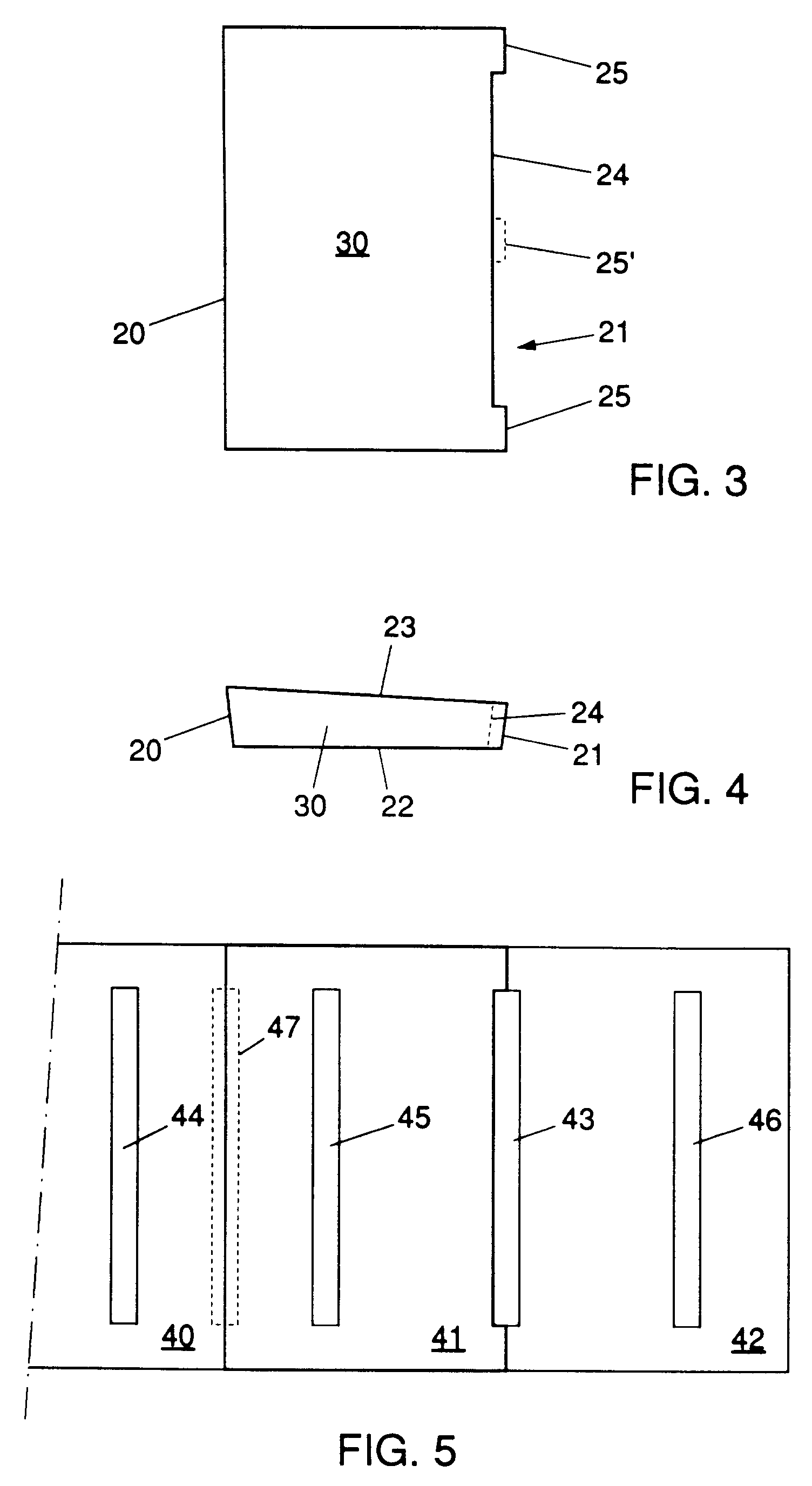
| (51) |
International Patent Classification (IPC)6: A01K 1/015 |
|
| (54) |
Stable floor for use above a dung pit and/or dung channel; floor plate for forming
a stable floor; and stable comprising such floor
Stallböden zum Gebrauch über einer Dunggrube und/oder eine Dungrinne; Bodenplatte
für Stallböden; und Stall mit einem solchen Boden
Plancher d'étable pour utilisateur au-dessus d'une fosse à purin et/ou d'une rigole
à purin; plaque de plancher par constituer un plancher d'étable; et étable comprenant
un tel plancher
|
| (84) |
Designated Contracting States: |
|
BE DE DK FR GB NL |
| (30) |
Priority: |
24.05.1993 NL 9300883
|
| (43) |
Date of publication of application: |
|
30.11.1994 Bulletin 1994/48 |
| (73) |
Proprietor: BETONINDUSTRIE B.V. CONCRELIT |
|
NL-8331 KG Steenwijk (NL) |
|
| (72) |
Inventors: |
|
- van der Zee, Tjeerd-Dirk
NL-8605 AA Sneek (NL)
- Broersma, Jansen
NL-8331 DD Steenwijk (NL)
- Nichting, Pieter Antonius Maria
NL-3817 TA Amersfoort (NL)
|
| (74) |
Representative: Smulders, Theodorus A.H.J., Ir. et al |
|
Vereenigde Octrooibureaux
Nieuwe Parklaan 97
2587 BN 's-Gravenhage
2587 BN 's-Gravenhage (NL) |
| (56) |
References cited: :
DE-B- 1 130 645
NL-A- 9 000 628
|
FR-A- 1 540 233
US-A- 3 859 962
|
|
| |
|
|
|
|
| |
|
| Note: Within nine months from the publication of the mention of the grant of the European
patent, any person may give notice to the European Patent Office of opposition to
the European patent
granted. Notice of opposition shall be filed in a written reasoned statement. It shall
not be deemed to
have been filed until the opposition fee has been paid. (Art. 99(1) European Patent
Convention).
|
[0001] This invention relates to a stable-floor for livestock, said stable floor comprising
a floor portion covering a dung pit and/or a dung channel, said pit and/or channel
having spaced substantially parallel supports extending in a longitudinal direction
supporting a number of floor plates each bridging the pit and/or channel and together
forming said floor portion, said floor portion comprising a plurality of openings
for the discharge of slurry and manure into the dung pit and/or dung channel, the
openings comprising a plurality of parallel mutually spaced slots extending transversely
to said longitudinal direction. The invention also relates to a floor plate for forming
such stable-floor.
[0002] Such a stable-floor is known from published Dutch patent application 9000628. The
known floor, at least the section thereof located above a dung pit and/or dung channel,
has concrete floor plates comprising a plurality of parallel slots. The top side of
the such grid plates is located in a horizontal plane and the passage of the manure
and slurry through the slots is promoted by periodically moving a dung scraper over
de stable-floor section formed from such plates.
[0003] A drawback of the known floor is that the discharge of slurry and manure is not optimal
between the points in time when the dung scraper is active. The manure and the slurry
are left on top of the plates, so that ammonia is produced, which may eventually end
up in the outside air. Since ammonia is considered one of the causes of acid rain,
it is important that the ammonia emission be reduced as much as possible.
[0004] The object of the invention is to provide a floor by the use of which the ammonia
emission of livestock stables can be reduced. To that end, in accordance with the
invention, a stable-floor of the above described type is characterized in that substantially
the whole of the top surface of said floor plates comprises at least one sloping surface
inclined downwards towards at least one of the slots.
[0005] It is observed that US 3 859 962 discloses a feedlot floor having a number of sloping
sections discharging into manure removal channels. The floor does not cover a dung
pit. Also the slopes are not in the longitudinal direction of the channels but perpendicular
thereto.
[0006] Hereinafter the invention will be described in detail with reference to the accompanying
drawings of an exemplary embodiment.
Fig. 1 diagrammatically shows a top plan view of a part of a stable-floor according
to the prior art;
Fig. 2 diagrammatically shows a perspective view of an example of a part of a stable-floor
section according to the invention;
Fig. 3 diagrammatically shows a top plan view of an example of a floor plate according
to the invention;
Fig. 4 diagrammatically shows a side elevational view of the floor plate of Fig. 3;
and
Fig. 5 diagrammatically shows a similar view to Fig. 3 of an example of a stable-floor
section built up from plates according to another embodiment of the invention.
[0007] Fig. 1 diagrammatically shows a top plan view of a part of a floor of a known livestock
stable, in this example a cowshed. However, the invention is also applicable to stables
for other animals, such as pigs. The stable-floor has a central portion 1 comprising
grid plates 2-5 of the traditional type. The grid plates cover a dung pit located
under the stable-floor. Typically located on opposite sides of the grid floor are
floor sections 6, 7 disposed at a slightly higher level and comprising boxes for the
individual animals, formed by suitable partitions. The grid plates each comprise a
plurality of slots 10 and in the example shown a further slot 11 is formed between
pairs of successive grid plates.
[0008] The manure and slurry produced by the cattle can be discharged through the slots
10, 11 into the dung pit, which may or may not occur by way of a channel formed under
the grid floor by means of a floating floor or the like. Ammonia is released from
the excreta produced by the livestock, in particular at the time when manure and urine
come into contact with each other.
[0009] In order to limit the ammonia emission in the stable as much as possible, oftentimes
use is made of dung scrapers periodically sweeping across the grid floor in a direction
transverse to the slots. In Fig. 1 such a dung scraper is diagrammatically indicated
at 12. If the dung scraper moves over the grid floor in the direction of the arrows
13, the manure and slurry located on the grid floor are pushed towards the slots,
so that the manure and the slurry fall into the dung pit or dung channel located under
the grid floor. Since the slots are not spaced apart very widely, the scraper need
only travel a short path to reach a next slot and cause the manure pushed up by the
scraper after it has passed the preceding slot, to fall through the slot.
[0010] Since the ammonia emission limits envisaged by the authorities are becoming increasingly
more stringent, there is a need for a still more efficient removal, if possible, of
manure and slurry from the stable-floor. In this connection, it is of importance that
the manure and the slurry be separated as early as possible and to keep them separated
as well as possible, at any rate in the stable. An example of the solution to this
problem as provided by the invention is shown diagrammatically in Fig. 2.
[0011] Fig. 2 diagrammatically shows in perspective four juxtaposed concrete plates 15-18.
The plates are intended for use at the position of plates 2-5 shown in Fig. 1. Plates
15-18 each have a thickness increasing from one longitudinal edge to the other longitudinal
edge, as can be clearly seen in Fig. 2. Adjacent plates alternately abut each other
by their thinner and thicker sides, respectively, with a slot 19 being located on
the thinner side. Further, the plates are supported by conventional continuous beams
or dung pit walls (not shown), so that the slots are located at the lowest portions
of the plates.
[0012] Urine excreted onto the plates will therefore flow automatically and directly to
the slots, thereby carrying along at least a part of the manure, consisting of more
solid elements, lying on the plates. The slope from the thicker edge 20 towards the
thinner edge 21 is preferably selected to be such that the conventional dung scrapers,
without any adaptations or with only minor adaptations, can also be used with a floor
of the type shown in Fig. 2, in spite of the fact that the surface of such a floor
is not level but shaped as a washboard.
[0013] In a practical situation the plates may, for instance, have a decreasing thickness
from about 12 cm to about 10 cm over a distance of about 1 meter. The width of the
slots 19 may for instance be 35 mm. The slope is generally of the order of one or
a few per cent.
[0014] Figs. 3 and 4 diagrammatically show a top plan view and a side elevational view,
respectively, of an example of a floor plate 30 according to the invention. In top
plan view the plate 30 is substantially rectangular and, as can be seen in Fig. 4,
has a thicker and a thinner longitudinal side 21. In the service position the underside
22 of the plates is substantially horizontal, so that the top side 23 exhibits a slope
from side 20 to side 21.
[0015] In this example, on the side 21 a recess 24 has been formed, extending along the
greater part of the length of the longitudinal edge 21. The recess 24 is located between
two projections 25 constituting stops which, in the service position, abut against
corresponding projections of an adjacent plate, as can be seen in Fig. 2. Thus, in
the example shown, each slot 19 is formed by the cooperating recesses 24 on facing
thinner sides of two adjacent plates.
[0016] If desired, it is, of course, also possible to form the slots by simply arranging
the adjacent plates with the facing thinner longitudinal sides spaced apart. In that
case, recesses are not needed. If desired, loose spacer pieces can be used to define
the slot width.
[0017] Conversely, if desired, it is also possible to use one or more additional stops.
Thus it would for instance be possible to form a further stop 25' in the centre of
the recess 24, as indicated in Fig. 3 by broken lines.
[0018] The slots are preferably narrower at their upper ends than at their lower ends, as
shown in Fig. 4, so as to prevent stoppage as much as possible. Further, the surfaces
on the longitudinal sides 20 and 21 are preferably of receding design, so that they
include an obtuse angle with the undersurface 22, yielding a form adapted for easy
removal.
[0019] The plates are preferably designed with surfaces finished so as to be as smooth as
possible to thereby prevent caking as much as possible. Further, if desired, the plates
can be impregnated with a moisture-proofing agent, which also promotes the downflow
of the manure and slurry. It is also possible for the plates to be provided with a
coat of a suitable material. Such a coat could for instance be formed from an epoxy
mortar. In that case, if so desired, the coat could also serve to provide the desired
slope.
[0020] After the foregoing, various modifications will readily occur to those skilled in
the art. For instance, the plates could comprise one or more additional slots in the
area between the thin side and the thick side. An example of such an embodiment is
shown diagrammatically in top plan view in Fig. 5. Fig. 5 shows three plates 40, 41,
42 with a slot 43 formed between the facing thinner sides of the plates 41, 42. In
this example each of the plates further comprises an additional slot 44, 45, 46, extending
parallel to the slot 43.
[0021] Further, if desired, it would also be possible to form a slot on the facing thicker
sides of the plates, towards which manure and slurry do not flow automatically, but
which can cooperate with a dung scraper. Such a slot is shown in Fig. 5 with broken
lines at 47.
[0022] If desired, the slots could also be herringbone-shaped. The plates can be rectangular
in top plan view but may also have a different shape, for instance a V-shape.
[0023] The plates can be designed with parallel top and bottom surfaces and the slope can
then be obtained by the use of supporting legs, which may or may not be formed integrally
with the plates, or a series of such supporting legs increasing in height or tapering
supporting edges. The same effect can be obtained by arranging the plates in sloping
orientation using adjustment mortar or by appropriately profiling the upper edges
of the dung pit supporting the plates, for instance by designing these upper edges
with a serrated profile.
[0024] Further, if desired, the plates can be made of a material other than concrete or
be provided with a top layer of a material other than concrete or a different kind
of concrete. Epoxy mortar has already been mentioned. Other possibly applicable materials
are metal, for instance steel, synthetic material, possibly wood, and the like. The
plates can also be poured in the work and then finished
in situ, with or without a separate coat.
[0025] Further, it is possible to combine two plates, such as plates 15 and 16 or plates
16 and 17, into a single plate. It would also be possible to combine more than two
plates into a single element.
[0026] Fig. 3 shows a plate having a receding longitudinal edge bounded at the ends by stops
25 and interrupted in the middle by stop 25'. Accordingly, by the application of such
plates, two slotted openings are formed, separated by the stop 25'.
[0027] As already indicated above, it is also possible to use several additional stops.
In that case, instead of a slot, rows of openings are formed. In this way a stable-floor
can be obtained having a very small percentage of open surface. The discharge of manure
can then be substantially effected by means of a periodically acting scraper which
pushes the manure over the entire length of the dunging floor to the end thereof and
discharges it. The slurry is then substantially handled by the openings. In such an
embodiment it would be possible, if desired, to provide a further (slight) slope in
transverse direction towards the openings to promote a fast discharge of the slurry.
[0028] The openings can be small in number, located, for instance, only in the centre of
the dunging floor and/or on one or both longitudinal sides of the dunging floor, with
an adjusted transverse slope, if used.
[0029] In accordance with a further elaboration of the concept of the invention, the openings
or the slots may be closable by closing means to be periodically opened, yielding
a substantially closed stable-floor.
[0030] For this purpose, swiveling metal or plastic flaps can be used, adapted for control
by suitable (automatically operating) control means activated by a switching clock.
[0031] It would also be possible to place in slotted openings two apertured strips adapted
for relative displacement between a position wherein the apertures are in line and
a position wherein the apertures are not in line and are closed.
1. A stable-floor for livestock, said stable floor comprising a floor portion (1) covering
a dung pit and/or a dung channel, said pit and/or channel having spaced substantially
parallel supports extending in a longitudinal direction supporting a number of floor
plates (15-18;30;40-42) each bridging the pit and/or channel and together forming
said floor portion (1), said floor portion (1) comprising a plurality of openings
for the discharge of slurry and manure into the dung pit and/or dung channel, the
openings comprising a plurality of parallel mutually spaced slots (19;43-47) extending
transversely to said longitudinal direction, characterized in that substantially the whole of the top surface (23) of each of said floor plates (15-18;30;40-42)
comprises at least one sloping surface inclined downwards towards at least one of
said slots (19;43-47).
2. A stable-floor according to claim 1, characterized in that at least a number of slots (19;43-47) are formed by an interspace between the adjacent
edges of two adjacent plates (15-18;30;40-42).
3. A stable-floor according to claim 2, characterized in that the interspace between two adjacent plates (15-18;30;40-42) which constitutes a slot
(19;43-47) is formed by at least one elongate recess (24) at the longitudinal edge
(21) of a plate (15-18;30;40-42) facing the other plate.
4. A stable-floor according to any one of the preceding claims, characterized in that the sloping portions are formed by plates (15-18;30;40-42) substantially wedge-shaped
in cross section.
5. A stable-floor according to any one of claims 1-3, characterized in that the sloping portions are formed by plates (15-18;30;40-42) which, viewed in cross
section parallel to the supports have a central portion of a greatest thickness and
a thickness decreasing on opposite sides of the central portion towards the edges
(21).
6. A stable-floor according to any one of claims 1-3, characterized in that the sloping portions are formed by plates (15-18;30;40-42) having parallel top and
bottom surfaces, each plate being arranged in a slightly inclined position.
7. A stable-floor according to any one of claims 2-6, characterized in that a number of plates (15-18;30;40-42) comprise, in the area between the lower and higher
edges of a sloping surface, one or more additional slots (45,46) substantially parallel
to said edges.
8. A stable-floor according to any one of the preceding claims, characterized in that the slots (19;43-47) are herringboneshaped in top plan view.
9. A stable-floor according to any one of the preceding claims, characterized in that a number of discharge slots (47) are formed at the location of the higest portions
of the top surface (23) of the syable-floor portion (1).
10. A stable-floor according to any one of claims 6-8, characterized in that, for the purpose of obtaining the inclined position, the plates (15-18;30;4042) are
arranged on suitable supporting legs or supporting edges.
11. A stable-floor according to any one of claims 6-8, characterized in that, for the purpose of obtaining an inclined position, the plates (15-18;30;4042) are
placed on suitably profiled upper edges of the walls of a dung pit.
12. A stable-floor according to any one of claims 6-8, characterized in that the plates (15-18;30;40-42), for the purpose of obtaining an inclined top surface
(23), are provided with a finish layer increasing in thickness.
13. A stable-floor according to any one of the preceding claims, characterized in that at least the sloping portions are provided with a very smooth surface finish.
14. A stable-floor according to any one of the preceding claims, characterized in that at least the sloping portions have been treated with a moisture-proofing agent.
15. A stable-floor according to any one of the preceding claims, characterized in that the slots (19;43-47) are partly closed so as to form a series of openings.
16. A stable-floor according to any one of claims 1-14, characterized in that the slots (19;43-47) are at least partly closed while leaving open one or more openings
halfway the length of the slot and/or adjacent at least one of the ends thereof.
17. A stable-floor according to claim 16, characterized by an additional slope transverse to the sloping portion, in the direction of said openings.
18. A stable-floor according to claim 16 or 17, characterized by closing means capable of closing or clearing the openings and coupled with control
means.
19. A stable-floor according to claim 15, characterized in that the slots are closed by apertured strip-shaped elements.
20. A stable-floor according to claim 19, characterized in that the strip-shaped elements comprise two superposed apertured strips adapted for relative
displacement between a position wherein the apertures are substantially open and a
position wherein the apertures are substantially closed.
21. A floor plate for forming a stable-floor portion (1) as claimed in any one of claims
1-5;7-9;12-20, comprising a top surface, a bottom surface, a first pair of spaced
first edges and a second pair of spaced second edges, characterized in that the plate (15-18;30;402-42) at least near the first edges, is thicker at one edge
of the pair of second edges (20), than at the other edge (21).
22. A floor plate according to claim 21, characterized in that the plate comprises at least one open recess (24) at least at said other second edge
(21).
23. A floor plate according to claim 21 or 22, characterized in that in the area between the two second edges (20,21) at least one slot (45,46) is provided
which extends substantially parallel to the second edges (20,21).
24. A floor plate according to any one of claims 21-23, characterized in that the plate (15-18;30;40-42) is V-shaped in top plan view.
25. A floor plate according to any one of claims 22-24, characterized in that the recess (24) is an elongate recess extending over a considerable part of the corresponding
edge (21).
26. A floor plate according to any one of claims 21-25, characterized in that the floor plate (15-18;30;40-42) has a smooth finish at least on the top side (23).
27. A floor plate according to any one of claims 21-26, characterized in that the floor plate (15-18;30;40-42) comprises a top layer of a different material.
28. A floor plate according to any one of claims 21-27, characterized in that at least the top surface (23) has been treated with a moisture-proofing agent.
29. A floor plate according to any one of claims 21-28, characterized in that at least the top side (23) of the plate (15-18;30;40-42) is made from other material
than concrete.
30. A stable comprising a stable-floor according to any one of claims 1-20.
1. Stallboden für Vieh, wobei dieser Stallboden einen Bodenbereich (1) hat, durch den
eine Dunggrube und/oder eine Dungrinne abgedeckt ist, wobei die Grube und/oder Rinne
voneinander beabstandete, im wesentlichen parallel verlaufende Abstützungen aufweist,
die sich in einer Längsrichtung erstrecken und eine Anzahl von Bodenplatten (15-18;
30; 40-42) abstützen, die jede die Grube und/oder Rinne überbrücken und die zusammen
den Bodenbereich (1) bilden, wobei der Bodenbereich (1) eine Anzahl von Öffnungen
für das Abführen von Brei und Dung in die Dunggrube und/oder Dungrinne aufweist, wobei
die Öffnungen eine Anzahl von parallel verlaufenden, voneinander beabstandeten Schlitzen
(19; 43-47) umfassen, die sich schräg zu der Längsrichtung erstrecken, dadurch gekennzeichnet, daß im wesentlichen die Gesamtheit der oberen Fläche (23) von jeder der Bodenplatten
(15-18; 30; 40-42) zumindest eine abgeschrägte Fläche hat, die nach unten in Richtung
auf zumindest einen der Schlitze (19; 43-47) geneigt ist.
2. Stallboden nach Anspruch 1, dadurch gekennzeichnet, daß zumindest eine Anzahl von Schlitzen (19; 43-47) durch einen Zwischenraum zwischen
den benachbarten Kanten von zwei benachbarten Platten (15-18; 30; 40-42) gebildet
ist.
3. Stallboden nach Anspruch 2, dadurch gekennzeichnet, daß der Zwischenraum zwischen zwei benachbarten Platten (15-18; 30; 40-42), durch
den ein Schlitz (19; 43-47) gebildet ist, durch zumindest eine längliche Vertiefung
(24) an der Längskante (21) von einer Platte (15-18; 30; 40-42) gebildet ist, die
der anderen Platte zugewandt ist.
4. Stallboden nach einem der vorhergehenden Ansprüche, dadurch gekennzeichnet, daß die abgeschrägten Bereiche durch Platten (15-18; 30; 40-42) gebildet sind, die
im Querschnitt im wesentlichen keilförmig sind.
5. Stallboden nach einem der Ansprüche 1 bis 3, dadurch gekennzeichnet, daß die abgeschrägten Bereiche durch Platten (15-18; 30; 40-42) gebildet sind, die,
im Querschnitt gesehen, parallel zu den Abstützungen einen mittleren Bereich mit einer
größten Dicke und eine Dicke haben, die an gegenüberliegenden Seiten bezüglich des
mittleren Bereiches in Richtung auf die Kanten (21) abnimmt.
6. Stallboden nach einem der Ansprüche 1 bis 3, dadurch gekennzeichnet, daß die abgeschrägten Bereiche durch Platten (15-18; 30; 40-42) gebildet sind, die
parallel verlaufende obere und untere Flächen haben, wobei jede Platte in einer leicht
geneigten Position angeordnet ist.
7. Stallboden nach einem der Ansprüche 2 bis 6, dadurch gekennzeichnet, daß eine Anzahl von Platten (15-18; 30; 40-42) in einem Bereich zwischen den niedrigeren
und höheren Kanten einer abgeschrägten Fläche einen oder mehrere zusätzliche Schlitze
(45, 46) hat, die im wesentlichen parallel zu den Kanten verlaufen.
8. Stallboden nach einem der vorhergehenden Ansprüche, dadurch gekennzeichnet, daß die Schlitze (19; 43-47) in der Draufsicht fischgrätenförmig sind.
9. Stallboden nach einem der vorhergehenden Ansprüche, dadurch gekennzeichnet, daß eine Anzahl von Abführschlitzen (47) an der Stelle der höchsten Bereiche der
oberen Fläche (23) des Stallbodenbereiches (1) gebildet ist.
10. Stallboden nach einem der Ansprüche 6 bis 8, dadurch gekennzeichnet, daß die Platten (15-18; 30; 40-42) zum Zwecke des Erhaltens der geneigten Position
auf geeigneten Stützbeinen oder Stützkanten angeordnet sind.
11. Stallboden nach einem der Ansprüche 6 bis 8, dadurch gekennzeichnet, daß die Platten (15-18; 30; 40-42) zum Zwecke des Erhaltens einer geneigten Position
auf geeignet profilierten oberen Kanten der Wände einer Dungrinne angeordnet sind.
12. Stallboden nach einem der Ansprüche 6 bis 8, dadurch gekennzeichnet, daß die Platten (15-18; 30; 40-42) zum Zwecke des Erhaltens einer geneigten oberen
Fläche (23) mit einer Abdeckschicht versehen sind, durch die die Dicke erhöht wird.
13. Stallboden nach einem der vorhergehenden Ansprüche, dadurch gekennzeichnet, daß zumindest die abgeschrägten Bereiche mit einer sehr glatten Oberflächenbeschaffenheit
versehen sind.
14. Stallboden nach einem der vorhergehenden Ansprüche, dadurch gekennzeichnet, daß zumindest die angeschrägten Bereiche mit einem Flüssigkeiten abweisenden Mittel
behandelt sind.
15. Stallboden nach einem der vorhergehenden Ansprüche, dadurch gekennzeichnet, daß die Schlitze (19; 43-47) teilweise geschlossen sind, um so eine Reihe von Öffnungen
zu bilden.
16. Stallboden nach einem der Ansprüche 1 bis 14, dadurch gekennzeichnet, daß die Schlitze (19; 43-47) teilweise geschlossen sind, wobei mittig der Länge
des Schlitzes und/oder benachbart zu zumindest einem der Enden davon eine oder mehrere
Öffnungen offen gelassen sind.
17. Stallboden nach Anspruch 16, gekennzeichnet durch eine zusätzliche Abschrägung schräg zu dem abgeschrägten Bereich und in der
Richtung auf die Öffnungen.
18. Stallboden nach Anspruch 16 oder 17, gekennzeichnet durch Verschlußeinrichtungen, die in der Lage sind, die Öffnungen zu schließen oder
freizugeben, und die mit Steuerungseinrichtungen gekoppelt sind.
19. Stallboden nach Anspruch 15, dadurch gekennzeichnet, daß die Schlitze durch mit Aussparungen versehene, streifenförmige Elemente geschlossen
sind.
20. Stallboden nach Anspruch 19, dadurch gekennzeichnet, daß die streifenförmigen Elemente zwei übereinander angeordnete, mit Aussparungen
versehene Streifen enthalten, die für eine relative Verschiebung zwischen einer Position,
in der die Aussparungen im wesentlichen offen sind, und einer Position ausgestaltet
sind, in der die Aussparungen im wesentlichen geschlossen sind.
21. Bodenplatte zum Bilden eines Stallbodenbereiches (1) nach einem der Ansprüche 1 bis
5; 7 bis 9; 12 bis 20, mit einer oberen Fläche, einer unteren Fläche, einem ersten
Paar von beabstandeten ersten Kanten und einem zweiten Paar von beabstandeten zweiten
Kanten, dadurch gekennzeichnet, daß die Platte (15-18; 30; 40-42) zumindest nahe der ersten Kanten an einer Kante
von dem Paar von zweiten Kanten (20) dicker ist als an der anderen Kante (21).
22. Bodenplatte nach Anspruch 21, dadurch gekennzeichnet, daß die Platte zumindest eine offene Vertiefung (24) an zumindest der anderen zweiten
Kante (21) hat.
23. Bodenplatte nach Anspruch 21 oder 22, dadurch gekennzeichnet, daß in dem Gebiet zwischen den beiden zweiten Kanten (20, 21) zumindest ein Schlitz
(45, 46) vorgesehen ist, der sich im wesentlichen parallel zu den zweiten Kanten (20,
21) erstreckt.
24. Bodenplatte nach einem der Ansprüche 21 bis 23, dadurch gekennzeichnet, daß die Platte (15-18; 30; 40-42) in Draufsicht V-förmig ist.
25. Bodenplatte nach einem der Ansprüche 22 bis 24, dadurch gekennzeichnet, daß die Vertiefung (24) eine längliche Vertiefung ist, die sich über einen beträchtlichen
Teil der zugehörigen Kante (21) erstreckt.
26. Bodenplatte nach einem der Ansprüche 21 bis 25, dadurch gekennzeichnet, daß die Bodenplatte (15-18; 30; 40-42) eine glatte Beschaffenheit zumindest an der
oberen Fläche (23) hat.
27. Bodenplatte nach einem der Ansprüche 21 bis 26, dadurch gekennzeichnet, daß die Bodenplatte (15-18; 30; 40-42) eine obere Schicht aus einem anderen Material
aufweist.
28. Bodenplatte nach einem der Ansprüche 21 bis 27, dadurch gekennzeichnet, daß zumindest die obere Fläche (23) mit einem Flüssigkeiten abweisenden Mittel behandelt
ist.
29. Bodenplatte nach einem der Ansprüche 21 bis 28, dadurch gekennzeichnet, daß zumindest die obere Fläche (23) der Platte (15-18; 30; 40-42) aus einem anderen
Material als Beton hergestellt ist.
30. Stall, der einen Stallboden nach einem der Ansprüche 1 bis 20 hat.
1. Plancher d'élevage pour animaux vivants, ledit plancher d'élevage comprenant une partie
formant plancher (1) qui couvre une fosse à excréments et/ou un canal à excréments,
ladite fosse et/ou ledit canal ayant des supports écartés sensiblement parallèles
qui s'étendent dans une direction longitudinale et qui supportent un certain nombre
de plaques de plancher (15-18 ; 30 ; 40-42) qui recouvrent chacune la fosse et/ou
le canal et qui forment ensemble ladite partie de plancher (1), ladite partie de plancher
(1) comprenant une pluralité d'ouvertures pour la décharge de boues et de fumier jusque
dans la fosse et/ou le canal à excréments, les ouvertures comprenant une pluralité
de fentes écartées et mutuellement parallèles (19 ; 43-47) qui s'étendent transversalement
par rapport à ladite direction longitudinale, caractérisé en ce que sensiblement la
totalité de la surface supérieure (23) de chacune desdites plaques de plancher (15-18
; 30 ; 40-42) comprend au moins une surface en pente inclinée vers le bas en direction
de l'une au moins desdites fentes (19 ; 43-47).
2. Plancher d'élevage selon la revendication 1, caractérisé en ce qu'au moins un certain
nombre de fentes (19 ; 43-47) sont formées par un intervalle entre les bords adjacents
de plaques adjacentes (15-18 ; 30 ; 40-42).
3. Plancher d'élevage selon la revendication 2, caractérisé en ce que l'intervalle entre
deux plaques adjacentes (15-18 ; 30 ; 40-42) qui constitue une fente (19 ; 43-47)
est formé par au moins un évidement allongé (24) à la bordure longitudinale (21) d'une
plaque (15-18 ; 30 ; 41-42) qui fait face à l'autre plaque.
4. Plancher d'élevage selon l'une quelconque des revendications précédentes, caractérisé
en ce que les parties en pente sont formées par des plaques (15-18 ; 30 ; 40-42) sensiblement
en forme de coin en section transversale.
5. Plancher d'élevage selon l'une des revendications 1 à 3, caractérisé en ce que les
parties en pente sont formées par des plaques (15-18 ; 30 ; 40-42) qui, vues en section
transversale parallèlement aux supports, ont une partie centrale avec une épaisseur
importante et une épaisseur qui diminue sur les côtés opposés de la partie centrale
en direction des bords (21).
6. Plancher d'élevage selon l'une quelconque des revendications 1 à 3, caractérisé en
ce que les parties en pente sont formées par des plaques (15-18 ; 32 ; 40-42) ayant
des surfaces supérieure et inférieure parallèles, chaque plaque étant agencée dans
une position légèrement inclinée.
7. Plancher d'élevage selon l'une quelconque des revendications 2 à 6, caractérisé en
ce qu'un certain nombre de plaques (15-18 ; 30 ; 40-42) comprend, dans la zone entre
les bordures supérieure et inférieure d'une surface en pente, une ou plusieurs fentes
additionnelles (45, 46) sensiblement parallèles auxdites bordures.
8. Plancher d'élevage selon l'une quelconque des revendications précédentes, caractérisé
en ce que les fentes (19 ; 43-47) présentent, vues en plan de dessus, une forme en
arêtes de poisson.
9. Plancher d'élevage selon l'une quelconque des revendications précédentes, caractérisé
en ce qu'un certain nombre de fentes de décharge (47) sont formées à l'emplacement
des parties les plus hautes de la surface supérieure (23) de la partie formant plancher
d'élevage (1).
10. Plancher d'élevage selon l'une quelconque des revendications 6 à 8, caractérisé en
ce que, dans le but d'obtenir la position inclinée, les plaques (15-18 ; 30 ; 40-42)
sont agencées sur des pattes de support ou des bordures de support appropriées.
11. Plancher d'élevage selon l'une quelconque des revendications 6 à 8, caractérisé en
ce que, dans le but d'obtenir une position inclinée, les plaques (15-18 ; 30 ; 40-42)
sont placées sur des bordures supérieures de profil approprié des parois d'une fosse
à excréments.
12. Plancher d'élevage selon l'une quelconque des revendications 6 à 8, caractérisé en
ce que les plaques (15-18 ; 30 ; 40-42), dans le but d'obtenir une surface supérieure
inclinée (23), sont pourvues d'une couche de finition dont l'épaisseur augmente.
13. Plancher d'élevage selon l'une quelconque des revendications précédentes, caractérisé
en ce que les parties en pente au moins sont pourvues d'une surface de finition très
lisse.
14. Plancher d'élevage selon l'une quelconque des revendications précédentes, caractérisé
en ce que les parties en pente au moins ont été traitées avec un agent anti-humidité.
15. Plancher d'élevage selon l'une quelconque des revendications précédentes, caractérisé
en ce que les fentes (19 ; 43-47) sont partiellement fermées de façon à former une
série d'ouvertures.
16. Plancher d'élevage selon l'une quelconque des revendications 1 à 14, caractérisé en
ce que les fentes (19 ; 43-47) sont au moins partiellement fermées tout en laissant
ouvertes une ou plusieurs ouvertures à michemin de la longueur de la fente et/ou en
position adjacente à l'une au moins des extrémités de celle-ci.
17. Plancher d'élevage selon la revendication 16, caractérisé par une pente additionnelle
transversale à la partie en pente, dans la direction desdites ouvertures.
18. Plancher d'élevage selon l'une ou l'autre des revendications 16 et 17, caractérisé
par des moyens de fermeture capables de fermer ou de libérer les ouvertures, et accouplés
à des moyens de commande.
19. Plancher d'élevage selon la revendication 15, caractérisé en ce que les fentes sont
fermées par des éléments ajourés en forme de bande.
20. Plancher d'élevage selon la revendication 19, caractérisé en ce que les éléments en
forme de bande comprennent deux bandes ajourées superposées adaptées à effectuer un
déplacement relatif entre une position dans laquelle les ouvertures sont sensiblement
ouvertes et une position dans laquelle les ouvertures sont sensiblement fermées.
21. Plaque de plancher destinée à former une partie de plancher d'élevage (1) tel que
revendiqué dans l'une quelconque des revendications 1 à 5 ; 7 à 9 ; 12 à 20, comprenant
une surface supérieure, une surface inférieure, une première paire de premières bordures
écartées et une seconde paire de secondes bordures écartées, caractérisée en ce que
la plaque (15-18 ; 30 ; 40-42) est, au moins à proximité des premières bordures, plus
épaisse au niveau d'une bordure de la paire des secondes bordures (20) qu'au niveau
de l'autre bordure (21).
22. Plaque de plancher selon la revendication 21, caractérisée en ce que la plaque comprend
au moins un évidement ouvert (24) au moins au niveau de ladite autre seconde bordure
(21).
23. Plaque de plancher selon l'une ou l'autre des revendications 21 et 22, caractérisée
en ce que dans la zone entre les deux secondes bordures (20, 21), il est prévu au
moins une fente (45, 46) qui s'étend sensiblement parallèlement aux secondes bordures
(20, 21).
24. Plaque de plancher selon l'une quelconque des revendications 21 à 23, caractérisée
en ce que la plaque (15-18 ; 30 ; 40-42) a en vue en plan de dessus une forme en V.
25. Plaque de plancher selon l'une quelconque des revendications 22 à 24, caractérisée
en ce que l'évidement (24) est un évidement allonge qui s'étend sur une partie considérable
de la bordure correspondante (21).
26. Plaque de plancher selon l'une quelconque des revendications 21 à 25, caractérisée
en ce que la plaque de plancher (15-18 ; 30 ; 40-42) présente une finition lisse au
moins sur le côté du dessus (23).
27. Plaque de plancher selon l'une quelconque des revendications 21 à 26, caractérisée
en ce que la plaque de plancher (15-18 ; 30 ; 40-42) comprend une couche supérieure
en un matériau différent.
28. Plaque de plancher selon l'une quelconque des revendications 21 à 27, caractérisée
en ce que la surface supérieure (23) au moins a été traitée avec un agent anti-humidité.
29. Plaque de plancher selon l'une quelconque des revendications 21 à 28, caractérisée
en ce que le côté supérieur (23) au moins de la plaque (15-18 ; 30 ; 40-42) est réalisé
en un matériau autre que du ciment
30. Ensemble d'élevage comprenant un plancher d'élevage selon l'une quelconque des revendications
1 à 20.