|
(11) | EP 0 626 399 B1 |

| (12) | EUROPEAN PATENT SPECIFICATION |
|
|
| (54) |
PROCESS FOR PRODUCING RIGID POLYURETHANE FOAM VERFAHREN ZUR HERSTELLUNG VON POLYURETHANHARTSCHAUM PROCEDE POUR LA PRODUCTION DE MOUSSE RIGIDE DE POLYURETHANE |
|
|
|||||||||||||||||||||||||||||||
| Note: Within nine months from the publication of the mention of the grant of the European patent, any person may give notice to the European Patent Office of opposition to the European patent granted. Notice of opposition shall be filed in a written reasoned statement. It shall not be deemed to have been filed until the opposition fee has been paid. (Art. 99(1) European Patent Convention). |
TECHNICAL FIELD
[0001] This invention relates to a method of producing rigid polyurethane foams which comprises using, as the blowing agent, 1,1-dichloro-1-fluoroethane (hereinafter referred to as HCFC-141b) containing a stabilizer and, as the catalyst, an organic metal catalyst and/or an imidazole compound catalyst to thereby control the decomposition of HCFC-141b, and to the thus-obtained rigid polyurethane foams substantially free of HCFC-141b-derived decomposition products.
BACKGROUND ART
[0002] Rigid polyurethane foams are good insulating materials and are excellent in moldability and processability. Therefore, they are widely used in various fields, for example as insulating materials for refrigerators, buildings, low-temperature warehouses, storage tanks, refrigerator ships, pipes and so forth. They have been improved in thermal conductivity year by year. At present, they can have a thermal conductivity as low as about 0.015 W/mK on the commercial product level and thus show the best insulator performance among heat insulating materials used at around normal temperature. However, the requirement that the insulating materials should have a still lower thermal conductivity is increasing with the recent request for much more energy saving.
[0003] In producing rigid polyurethane foams, the so-called one-shot process is generally used which comprises mixing a composition (A) comprising, as main components thereof, a polyol, a catalyst, a foam controlling agent (cell stabilizer) and a blowing agent with a composition (B) comprising, as a main component thereof, an organic polyisocyanate and thus causing the foaming process and curing process to proceed in parallel for foam formation.
[0004] A typical example of the blowing agent used in such rigid polyurethane foam production is trichlorofluoromethane (R-11). R-11 is often used in combination with water, which is a chemical blowing agent capable of reacting with isocyanates to generate carbon dioxide. However, the conventional chlorofluorocarbon (CFC) blowing agents, typically R-11, are chemically stable and therefore, as heretofore pointed out, can diffuse far into the stratosphere and destroy the ozone layer. The result would be that ultraviolet radiation from the sun be not absorbed in the ozone layer but reach the surface of the earth, causing skin cancer and so on. Such is now a serious global-scale environmental problem. Therefore, the use of CFCs has been restricted since 1989. Of course, the use of R-11 in urethane foam production is now under control.
[0005] Accordingly, various investigations have been made in search of blowing agents capable of serving as alternatives for CFC gases. Thus, HCFC-141b, for instance, has been nominated as a candidate alternative for CFCs.
[0006] In EP-A-0 401 722 the use of HCFC-141b in a binary composition together with chloropentafluoropropane, known as R-235, is disclosed. Although the properties of such binary compositions are totally unexpected as compared with the single components thereof they are not suitable for completely eliminating the use of CFCs in blowing agents.
[0007] However, it is already known that when HCFC-141b is used, for instance, as a blowing agent in producing rigid polyurethane foams by the conventional method, 1-chloro-1-fluoroethane (hereinafter referred to as HCFC-151a) is formed as a result of reduction and/or 1-chloro-1-fluoroethene (hereinafter referred to as HCFC-1131a) as a result of dehydrochlorination, The physical properties and toxicities of these decomposition products are still unknown in many aspects, hence might be hazardous to the environment.
DISCLOSURE OF THE INVENTION
[0008] Accordingly it is a primary object of the invention to provide a method of producing rigid urethane foams substantially without allowing the decomposition product formation from HCFC-141b.
[0009] In view of such technological problems as mentioned above, the present inventors made extensive investigations to develop a method of producing rigid polyurethane foams by which no decomposition products are formed from HCFC-141b and, as a result, found that when a polyol is reacted with an organic polyisocyanate for foaming in the presence of 1,1-dichloro-1-fluoroethane as the blowing agent and a stabilizer therefor and in the presence of an organic metal catalyst and/or an imidazole compound catalyst, rigid polyurethane foams can be obtained without formation of any decomposition product from HCFC-141b. This finding has now led to completion of the present invention.
[0010] Thus the invention consists in a method of producing rigid polyurethane foams which comprises reacting a polyol with an organic polyisocyanate for foaming in the presence of 1,1-dichloro-1-fluoroethane as a blowing agent and a stabilizer therefor and in the presence of an organic metal catalyst and/or an imidazole compound catalyst. For the Contracting States BE, DE, FR, GB the stabilizer is not nitromethane, nitroethane and 1-nitropropane.
[0011] The polyol to be used in the practice of the invention may be any of those polyols that are generally used in the production of rigid polyurethane foams, for example polyether polyols containing 2 to 8 functional groups and having a hydroxyl value of about 300 to 600 mg KOH/g, polyester polyols containing 2 to 4 functional groups and having a hydroxyl value of about 250 to 500 mg KOH/g. Phenol resins having reactive methylol groups, for instance, may also be used. As particularly preferred examples among such polyols, there may be mentioned, among others, polyether polyols derived from trimethylolpropane, sorbitol, o- or m-tolylenediamine by addition of ethylene oxide and/or propylene oxide and having a hydroxyl value of about 300 to 600 mg KOH/g.
[0012] The organic polyisocyanate to be used in the practice of the invention is preferably polymethylenepolyphenyl isocyanate (hereinafter referred to as c-MDI) representable by the general formula
wherein n is an integer of 0 through 6, and/or tolylene diisocyanate (hereinafter referred to as TDI). c-MDI and/or TDI may be used in the form of a prepolymer with a hydroxyl-containing compound or in combination with some other organic polyisocyanate. As said hydroxyl-containing compound, there may be mentioned, for instance, monohydric alcohols and phenols containing one functional group and having a molecular weight of about 32 to 300; polyols containing 2 or 3 functional groups and having a molecular weight of about 62 to 600, and so on. Specific examples are monohydric alcohols such as methanol, ethanol, n-butanol, ethylene glycol monomethyl ether and diethylene glycol monomethyl ether; phenols such as phenol, o-, m- and p-cresol; diols such as ethylene glycol, diethylene glycol, propylene glycol, 1,4-butanediol and 1,6-hexanediol; triols such as glycerol and trimethylolpropane; and, further, bi- or trifunctional polyether polyols, polyester polyols. As examples of the above-mentioned bi- or trifunctional polyether polyols, there may be mentioned polyether polyols obtainable by polymerizing one or more alkylene oxides, such as ethylene oxide, propylene oxide, and butylene oxide, using a diol, such as ethylene glycol, propylene glycol or bisphenol A, a triol, such as glycerol or trimethylolpropane as an initiator. As examples of the above-mentioned bi- or trifunctional polyester polyols, there may be mentioned polyester polyols obtainable by condensation of a polyol, such as ethylene glycol, diethylene glycol, 1,4-butanediol or trimethylolpropane, with a dicarboxylic acid, such as adipic acid, succinic acid, maleic anhydride or phthalic acid. Mention may further be made of polyhydric alcohols such as methyl glucoside, sucrose, sorbitol, and dulcitol, as well as polyether polyols obtainable by polymerization of one or more alkylene oxides, such as ethylene oxide, propylene oxide, and butylene oxide, using any of such polyhydric alcohols as an initiator.
[0013] In accordance with the invention, HCFC-141b is used as a blowing agent. This may be used in combination with water as a chemical blowing agent. The amount of blowing agent may suitably be selected depending on the density of the desired rigid polyurethane foam. Generally, however, the blowing agent is used in an amount of about 1 to 100% by weight on the polyol basis.
[0014] As the stabilizer to be used for the blowing agent in accordance with the invention, there may be mentioned, among others, nitro compounds such as nitroalkanes containing 1 to 8 carbon atoms, nitrobenzene, dinitrobenzene, trinitrobenzene, halogenated nitrobenzenes, nitroanisole, nitrostyrene, nitrophenol, and nitrocatechol; alkenyl-containing compounds containing at least one double bond, such as hexadiene, allene, butadiene, isoprene, pentadiene, β-myrcene, isopropenyltoluene, diisopropenylbenzene, and alloocimene; epoxy-containing compounds such as 1,2-butylene oxide, isobutylene oxide, glycidyl allyl ether, glycidyl phenyl ether, glycidyl p-isopropenylphenyl ether, glycidyl p-nitrophenyl ether, 1,3-butadienyl glycidyl ether, glycidyl acrylate, glycidyl furancarboxylate, and N,N-diglycidylaniline; acrylic acid esters and methacrylic acid esters, such as 2-hydroxyethyl methacrylate, diethylene glycol monomethyl methacrylate, and methoxypolyethylene glycol monoethyl methacrylate; and phenols such as 2,6-di-tert-butyl-p-cresol, thymol, p-tert-butylphenol, eugenol, isoeugenol, butylated hydroxyanisole, tert-butylcatechol, and 2,5-di-tert-butylhydroquinone. The compounds mentioned above may be used singly, or at least one of such nitro compounds may be used in combination with at least one compound selected from among such alkenyl-containing compounds containing at least one double bond, epoxy-containing compounds, acrylic acid esters, methacrylic acid esters and phenols as mentioned above.
[0015] The amount of stabilizer may vary depending on the foaming conditions and other factors but suitably lies within the range of 0.1 to 10% by weight, more preferably within the range of 0.3 to 6% by weight, on the blowing agent basis. A stabilizer amount less than 0.1% by weight based on the blowing agent basis may sometimes fail to effectively prevent the formation of HCFC-151a from HCFC-141b, whereas a stabilizer amount exceeding 10% by weight on the blowing agent basis may adversely affect the characteristics of foams, hence may fail, in certain instances, to produce substantial improvement. The stabilizer or stabilizers may be dissolved beforehand in HCFC-141b or may be added on the occasion of foaming independently of the blowing agent.
[0016] In the practice of the invention, the organic polyisocyanate is used in an amount within the range such that the NCO/OH ratio in relation to the polyol amounts to 1.0 to 3.0.
[0017] In the practice of the invention, any of the conventional foam controlling agents may be used. Thus, use as the foam controlling agent may be made of silicone type surfactants such as organopolysiloxanes, organopolysiloxane-polyoxyalkylene copolymers, and polyalkenylsiloxanes having polyoxyalkylene side chains as well as cationic, anionic and nonionic surfactants. Generally, the foam controlling agent is used in an amount of about 0.2 to 10% by weight on the polyol basis.
[0018] In accordance with the invention, foaming is effected using an organic metal catalyst and/or an imidazole compound catalyst. As the organic metal catalyst, there may be mentioned, for example, such organic metal compounds as stannous octoate, dibutyltin dilaurate, and lead octylate. The imidazole compound catalyst includes, among others, imidazole, 1-methylimidazole, 1,2-dimethylimidazole, 1-methyl-2-propylimidazole, 1-methyl-2-isobutylimidazole, and 1-n-butyl-2-methylimidazole. The catalyst mentioned above may be used in a mixture of two or more of such compounds. The catalyst is used in an amount of about 0.01 to 20% by weight on the organic polyisocyanate basis.
[0019] The means for producing rigid polyurethane foams from the raw materials mentioned above is not limited to any particular one provided that it contains an apparatus suited for uniform mixing of the raw materials. Thus, for example, desired rigid polyurethane foams can be readily obtained by mixing said raw materials uniformly using a small-size laboratory mixer, a foaming machine, or the like.
EFFECTS OF THE INVENTION
[0020] In accordance with the invention, rigid polyurethane foams can be produced by the conventional procedure.
[0021] When, in accordance with the invention, stabilizer-containing HCFC-141b is used as a blowing agent and an organic metal catalyst and/or an imidazole compound catalyst as a catalyst, rigid polyurethane foams can be obtained by the conventional procedure without causing decomposition of HCFC-141b. Therefore, the rigid polyurethane foams obtained by the method of the invention are substantially free of HCFC-151a formable from HCFC-141b by reduction reaction and of HCFC-1131a formable from HCFC-141b by dehydrochlorination, among others.
BEST MODES FOR CARRYING OUT THE INVENTION
[0022] The following comparative examples and working examples illustrate the present invention in further detail.
[0023] In the examples, the following raw materials were used:
- Polyol:
- o-Tolylenediamine-based polyether polyol with a hydroxyl value of 400 mg KOH/g
- Cell controlling agent:
- Silicone type cell controlling agent SH-193, obtained from Toray Silicone Kabushiki Kaisha
- Catalyst A:
- Tetramethylhexamethylenediamine
- Catalyst B:
- Organic metal catalyst; dibutyltin dilaurate (TL-1000), obtained from Yoshitomi Pharmaceutical Industries
- Catalyst C:
- Imidazole compound catalyst; 1-n-butyl-2-methylimidazole
- Blowing agent:
- HCFC-141b
- Stabilizer A:
- Nitrobenzene
- Stabilizer B:
- p-Isopropenyltoluene
- Stabilizer C:
- 2,6-Di-tert-butyl-p-cresol
- Stabilizer D:
- Isobutylene oxide
- Organic polyisocyanate:
- c-MDI
Table 1
| Comparative Example | Example | |||||||||||
| 1 | 2 | 3 | 1 | 2 | 3 | 4 | 5 | 6 | 7 | |||
| Raw materials (parts by weight) | polyol | 100 | 100 | 100 | 100 | 100 | 100 | 100 | 100 | 100 | 100 | |
| Cell controlling agent | 2 | 2 | 2 | 2 | 2 | 2 | 2 | 2 | 2 | 2 | ||
| Catalyst A | 2 | |||||||||||
| Catalyst B | 0.3 | 0.7 | 0.3 | 0.3 | 0.3 | 0.3 | 0.3 | 0.3 | ||||
| Catalyst C | 2.7 | 2.3 | 3 | 2.7 | 2.7 | 2.7 | 2.7 | 2.7 | 2.7 | |||
| Blowing agent | 30 | 30 | 30 | 30 | 30 | 30 | 30 | 30 | 30 | 30 | ||
| Stabilizer A | 0.6 | 0.6 | 0.4 | 0.4 | 0.4 | 0.6 | 0.4 | |||||
| Stabilizer B | 0.2 | 0.6 | 0.8 | |||||||||
| Stabilizer C | 0.2 | |||||||||||
| Stabilizer D | 0.2 | |||||||||||
| Organic polyisocyanate | 106 | 106 | 106 | 106 | 106 | 106 | 106 | 106 | 106 | 106 | ||
| GC/(ppm) | Immediately after foaming | HCFC-1131a | 115 | 0 | 0 | 0 | 0 | 0 | 0 | 0 | 0 | 0 |
| HCFC-151a | 50 | 65 | 70 | 0 | 0 | 0 | 0 | 0 | 0 | 0 | ||
| 90°C x 1 week | HCFC-1131a | 16000* | 305 | 310 | 330 | 300 | 290 | 280 | 300 | 290 | 280 | |
| HCFC-151a | 335 | 390 | 505 | 17 | 10 | 0 | 0 | 0 | 0 | 0 | ||
| Remark (*): originally indicated as 160000 and amended with brief of April 15, 1993 |
[0024] According to each foaming formulation given in Table 1, the raw materials were adjusted to a temperature of 20 ± 1°C and then mixed up together by stirring at a high speed for 5 seconds for allowing the reaction to proceed. After foaming, the concentrations of gaseous components in the rigid polyurethane foam produced were determined by conventional gas chromatography.
[0025] As the results of Comparative Example 1 indicate, high levels of HCFC-1131a and HCFC-151a were detected in rigid polyurethane foams produced by the conventional method using HCFC-141b as the blowing agent upon gas analysis immediately after foaming and after one-week standing of the foams at 90°C.
Claims for the following Contracting State(s): BE, DE, FR, GB
1. A method of producing rigid polyurethane foams which comprises reacting a polyol with
an organic polyisocyanate for foaming in the presence of 1,1-dichloro-1-fluoroethane
as the blowing agent and a stabilizer therefor which is not nitromethane, nitroethane
and 1-nitropropane, and in the presence of an organic metal catalyst and/or an imidazole
compound catalyst.
2. The method of Claim 1 wherein the polyol is selected from among polyether polyols
containing 2 to 8 functional groups and having a hydroxyl value of 300 to 600 mg KOH/g,
polyester polyols containing 2 to 4 functional groups and having a hydroxyl value
of 250 to 500 mg KOH/g and phenol resins containing reactive methylol groups.
3. The method of Claim 2 wherein the polyol is a polyether polyol derived from at least
one of trimethylolpropane, sorbitol, o-tolylenediamine and m-tolylenediamine by addition
of at least one of ethylene oxide and propylene oxide, said polyol having a hydroxyl
value of 300 to 600 mg KOH/g.
4. The method of Claim 1 wherein the organic polyisocyanate is a polymethylenepolyphenyl
isocyanate of the general formula
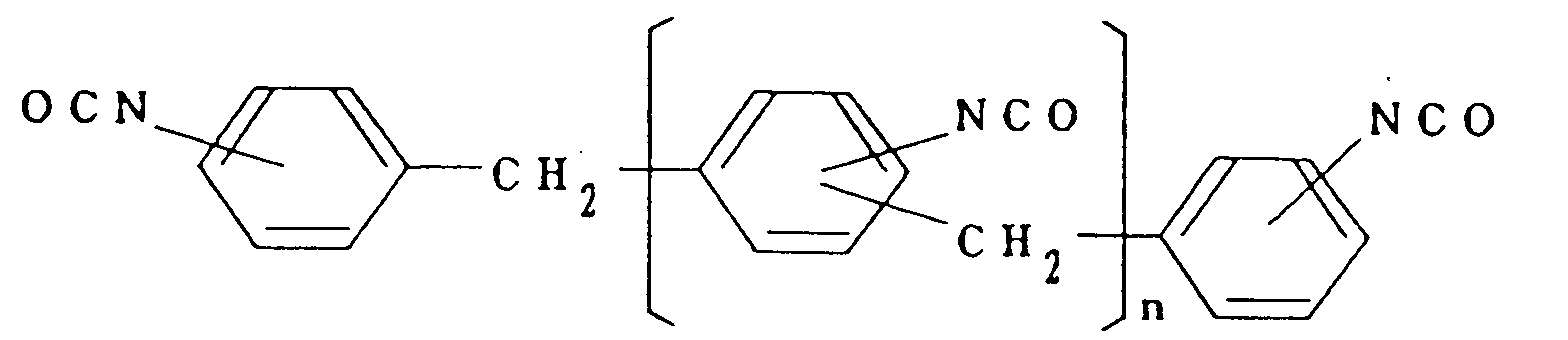
(wherein n is an integer of 0 to 6)
and/or tolylene diisocyanate.
(wherein n is an integer of 0 to 6)
and/or tolylene diisocyanate.
5. The method of Claim 1 wherein the organic polyisocyanate is derived from a polymethylenepolyphenyl
isocyanate of the general formula
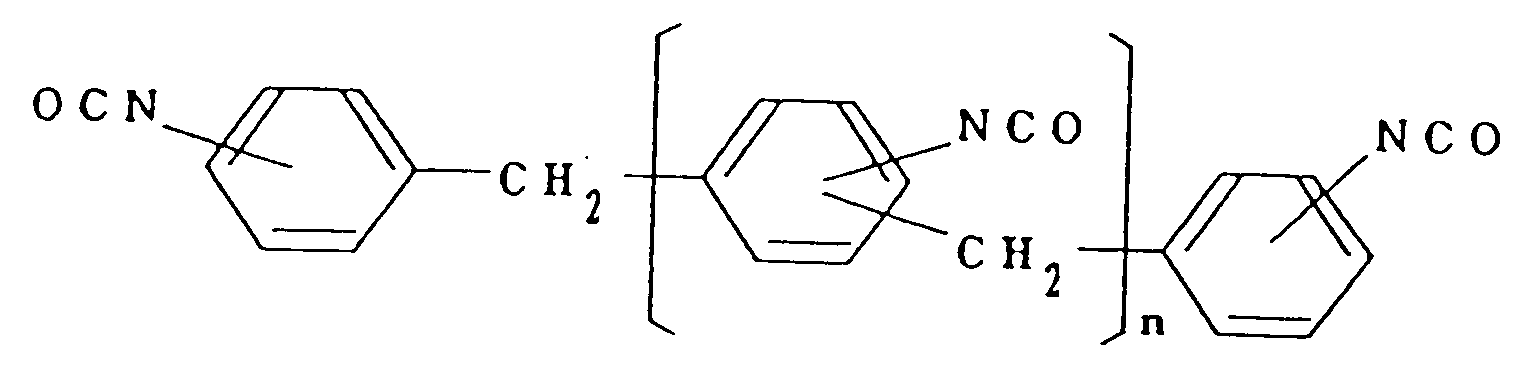
(wherein n is an integer of 0 to 6)
and/or tolylene diisocyanate and a hydroxyl-containing compound.
(wherein n is an integer of 0 to 6)
and/or tolylene diisocyanate and a hydroxyl-containing compound.
6. The method of Claim 5 wherein the hydroxyl-containing compound is at least one member
selected from the group consisting of monohydric alcohols containing one functional
group and having a molecular weight of 32 to 300, phenols containing one functional
group and having a molecular weight of 94 to 300 and polyols containing 2 or 3 functional
groups and having a molecular weight of 62 to 600.
7. The method of Claim 6 wherein the hydroxyl-containing compound is at least one member
selected from the group consisting of methanol, ethanol, n- butanol, ethylene glycol
monomethyl ether, diethylene glycol monomethyl ether, phenol, o-, m-, p-cresol, ethylene
glycol, diethylene glycol, propylene glycol, 1,4-butanediol, 1,6-hexanediol, glycerol,
trimethylolpropane, bi- or tri-functional polyether polyols and bi- or tri-functional
polyester polyols.
8. The method of Claim 1 wherein the blowing agent 1,1-dichloro-1-fluoroethane is used
in an amount of 1 to 100% on the polyol weight basis.
9. The method of Claim 1 wherein the stabilizer is at least one member selected from
the group consisting of nitro compounds, selected from nitroalkanes with the exception
of nitromethane, nitroethane and 1-nitropropane, nitrobenzene, dinitrobenzene, trinitrobenzene,
halogenated nitrobenzene, nitroanisole, nitrostyrene, nitrophenol and nitrocatechol;
alkenyl compounds containing at least one double bond, selected from hexadiene, allene,
butadiene, isoprene, pentadiene, β-myrcene, isopropenyltoluene, diisopropenylbenzene
and alloocimene; epoxy-containing compounds, selected from 1,2-butylene oxide, isobutylene
oxide, glycidyl allyl ether, glycidyl phenyl ether, glycidyl p-isopropenylphenyl ether,
glycidyl p-nitrophenyl ether, 1,3-butadienyl glycidyl ether, glycidyl acrylate, glycidyl
furancarboxylate and N,N-diglycidylaniline; acrylic acid esters and methacrylic acid
esters, selected from 2-hydroxyethyl meth acrylate, diethylene glycol monomethyl methacrylate
and methoxypolyethylene glycol monoethyl methacrylate; and phenols, selected from
2,6-di-tert-butyl-p-cresol, thymol, p-tert-butylphenol, eugenol, isoeugenol, butylated
hydroxyanisole, tert-butylcatechol and 2,5-di-tert-butylhydroquinone.
10. The method of Claim 1 wherein the stabilizer is used in an amount of 0.1 to 10% on
the blowing agent weight basis.
11. The method of Claim 10 wherein the stabilizer is used in an amount of 0.3 to 6% on
the blowing agent weight basis.
12. The method of Claim 1 wherein the proportions of the polyol and organic polyisocyanate
are such that the NCO/OH equivalent ratio is within the range of 1.0 to 3.0.
13. The method of Claim 1 wherein the organic metal catalyst is at least one member of
the class consisting of stannous octoate, dibutyltin dilaurate and lead octylate.
14. The method of Claim 1 wherein the imidazole compound catalyst is at least one member
selected from the group consisting of imidazole, 1-methylimidazole, 1,2-dimethylimidazole,
1-methyl-2-propylimidazole, 1-methyl-2-isobutylimidazole and 1-n-butyl-2-methyl imidazole.
15. The method of Claim 1 wherein the catalyst is used in an amount of 0.01 to 20% on
the organic polyisocyanate weight basis.
16. A rigid polyurethane foam obtained by reacting a polyol with an organic polyisocyanate
for foaming in the presence of 1,1-dichloro-1-fluoroethane as the blowing agent and
a stabilizer therefor which is not nitromethane, nitroethane and 1-nitropropane, and
in the presence of an organic metal catalyst and/or an imidazole compound catalyst.
Claims for the following Contracting State(s): IT
1. A method of producing rigid polyurethane foams which comprises reacting a polyol with
an organic polyisocyanate for foaming in the presence of 1,1-dichloro-1-fluoroethane
as the blowing agent and a stabilizer therefor and in the presence of an organic metal
catalyst and/or an imidazole compound catalyst.
2. The method of Claim 1 wherein the polyol is selected from among polyether polyols
containing 2 to 8 functional groups and having a hydroxyl value of 300 to 600 mg KOH/g,
polyester polyols containing 2 to 4 functional groups and having a hydroxyl value
of 250 to 500 mg KOH/g and phenol resins containing reactive methylol groups.
3. The method of Claim 2 wherein the polyol is a polyether polyol derived from at least
one of trimethylolpropane, sorbitol, o-tolylenediamine and m-tolylenediamine by addition
of at least one of ethylene oxide and propylene oxide, said polyol having a hydroxyl
value of 300 to 600 mg KOH/g.
4. The method of Claim 1 wherein the organic polyisocyanate is a polymethylenepolyphenyl
isocyanate of the general formula
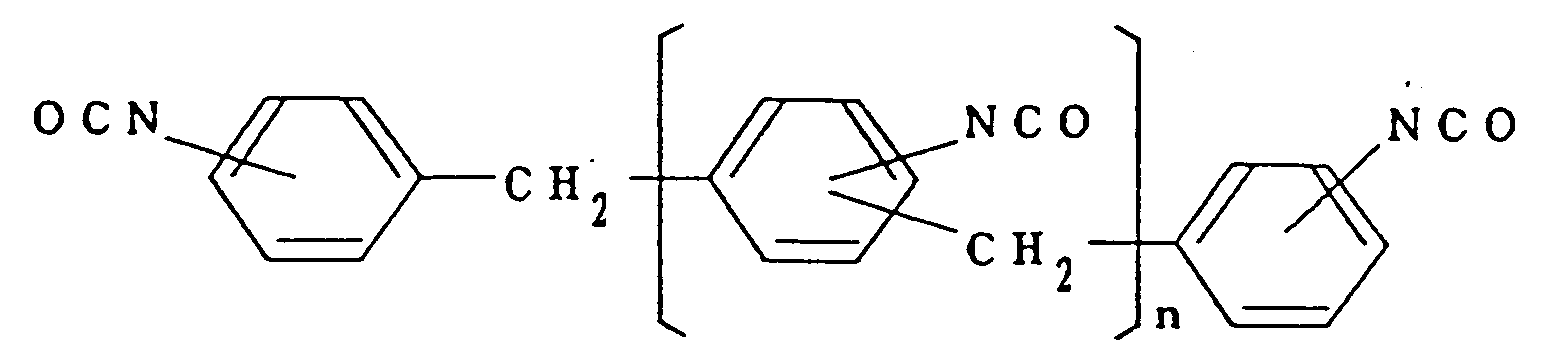
(wherein n is an integer of 0 to 6)
and/or tolylene diisocyanate.
(wherein n is an integer of 0 to 6)
and/or tolylene diisocyanate.
5. The method of Claim 1 wherein the organic polyisocyanate is derived from a polymethylenepolyphenyl
isocyanate of the general formula
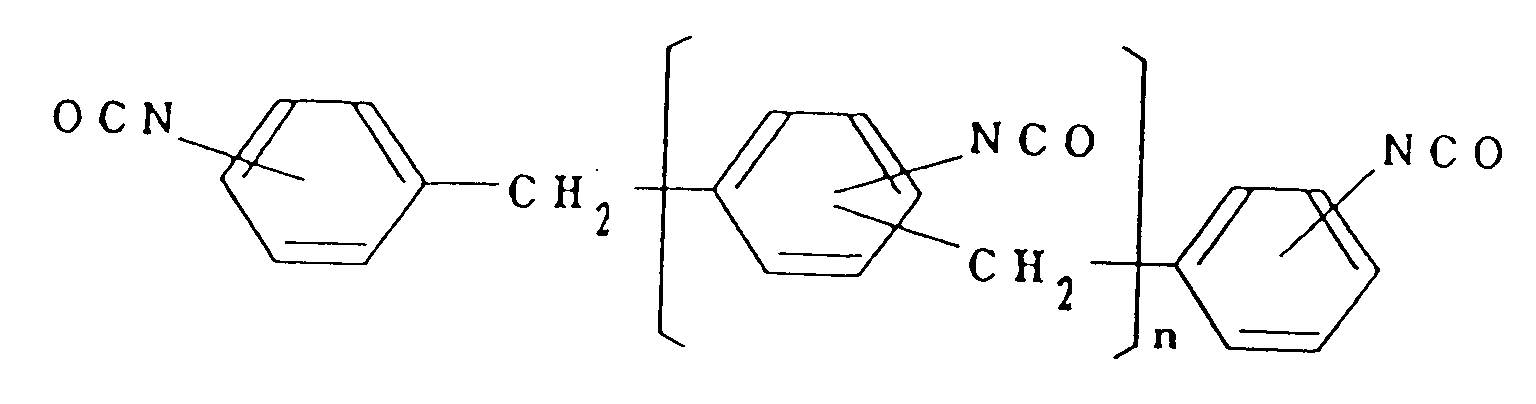
(wherein n is an integer of 0 to 6)
and/or tolylene diisocyanate and a hydroxyl-containing compound.
(wherein n is an integer of 0 to 6)
and/or tolylene diisocyanate and a hydroxyl-containing compound.
6. The method of Claim 5 wherein the hydroxyl-containing compound is at least one member
selected from the group consisting of monohydric alcohols containing one functional
group and having a molecular weight of 32 to 300, phenols containing one functional
group and having a molecular weight of 94 to 300 and polyols containing 2 or 3 functional
groups and having a molecular weight of 62 to 600.
7. The method of Claim 6 wherein the hydroxyl-containing compound is at least one member
selected from the group consisting of methanol, ethanol, n- butanol, ethylene glycol
monomethyl ether, diethylene glycol monomethyl ether, phenol, o-, m-, p-cresol, ethylene
glycol, diethylene glycol, propylene glycol, 1,4-butanediol, 1,6-hexanediol, glycerol,
trimethylolpropane, bi- or tri-functional polyether polyols and bi- or tri-functional
polyester polyols.
8. The method of Claim 1 wherein the blowing agent 1,1-dichloro-1-fluoroethane is used
in an amount of 1 to 100% on the polyol weight basis.
9. The method of Claim 1 wherein the stabilizer is at least one member selected from
the group consisting of nitro compounds, selected from nitroalkanes, nitrobenzene,
dinitrobenzene, trinitrobenzene, halogenated nitrobenzene, nitroanisole, nitrostyrene,
nitrophenol and nitrocatechol; alkenyl compounds containing at least one double bond,
selected from hexadiene, allene, butadiene, isoprene, pentadiene, β-myrcene, isopropenyltoluene,
diisopropenylbenzene and alloocimene; epoxy-containing compounds, selected from 1,2-butylene
oxide, isobutylene oxide, glycidyl allyl ether, glycidyl phenyl ether, glycidyl p-isopropenylphenyl
ether, glycidyl p-nitrophenyl ether, 1,3-butadienyl glycidyl ether, glycidyl acrylate,
glycidyl furancarboxylate and N,N-diglycidylaniline; acrylic acid esters and methacrylic
acid esters, selected from 2-hydroxyethyl methacrylate, diethylene glycol monomethyl
methacrylate and methoxypolyethylene glycol monoethyl methacrylate; and phenols, selected
from 2,6-di-tert-butyl-p-cresol, thymol, p-tert-butylphenol, eugenol, isoeugenol,
butylated hydroxyanisole, tert-butylcatechol and 2,5-di-tert-butylhydroquinone.
10. The method of Claim 1 wherein the stabilizer is used in an amount of 0.1 to 10% on
the blowing agent weight basis.
11. The method of Claim 10 wherein the stabilizer is used in an amount of 0.3 to 6% on
the blowing agent weight basis.
12. The method of Claim 1 wherein the proportions of the polyol and organic polyisocyanate
are such that the NCO/OH equivalent ratio is within the range of 1.0 to 3.0.
13. The method of Claim 1 wherein the organic metal catalyst is at least one member of
the class consisting of stannous octoate, dibutyltin dilaurate and lead octylate.
14. The method of Claim 1 wherein the imidazole compound catalyst is at least one member
selected from the group consisting of imidazole, 1-methylimidazole, 1,2-dimethylimidazole,
1-methyl-2-propylimidazole, 1-methyl-2-isobutylimidazole and 1-n-butyl-2-methyl imidazole.
15. The method of Claim 1 wherein the catalyst is used in an amount of 0.01 to 20% on
the organic polyisocyanate weight basis.
16. A rigid polyurethane foam obtained by reacting a polyol with an organic polyisocyanate
for foaming in the presence of 1,1-dichloro-1-fluoroethane as the blowing agent and
a stabilizer therefor and in the presence of an organic metal catalyst and/or an imidazole
compound catalyst.
Patentansprüche für folgende(n) Vertragsstaat(en): BE, DE, FR, GB
1. Verfahren zur Herstellung von Polyurethan-Hartschäumen, umfassend die Umsetzung eines
Polyols mit einem organischen Polyisocyanat zum Schäumen in Gegenwart von 1,1-Dichlor-1-fluorethan
als Treibmittel und eines Stabilisators für dieses, der nicht Nitromethan, Nitroethan
und 1-Nitropropan ist, sowie in Gegenwart eines organischen Metallkatalysators und/oder
einer Imidazolverbindung als Katalysator.
2. Verfahren gemäß Anspruch 1, bei dem das Polyol aus Polyetherpolyolen mit einem Gehalt
an 2-8 funktionellen Gruppen und einem Hydroxylwert von 300 bis 600 mg KOH/g, Polyesterpolyolen
mit einem Gehalt an 2 bis 4 funktionellen Gruppen und mit einem Hydroxylwert von 250
bis 500 mg KOH/g und Phenolharzen mit einem Gehalt an reaktionsfähigen Methylolgruppen
ausgewählt ist.
3. Verfahren gemäß Anspruch 2, bei dem das Polyol ein Polyetherpolyol ist, das sich von
zumindest einer der Verbindungen Trimethylolpropan, Sorbit, o-Tolylendiamin und m-Tolylendiamin
durch Zugabe von zumindest einer der Verbindungen Ethylenoxid und Propylenoxid ableitet,
wobei das Polyol einen Hydroxylwert von 300 bis 600 mg KOH/g besitzt.
4. Verfahren gemäß Anspruch 1, bei dem das organische Polyisocyanat ein Polymethylenpolyphenylisocyanat
der allgemeinen Formel
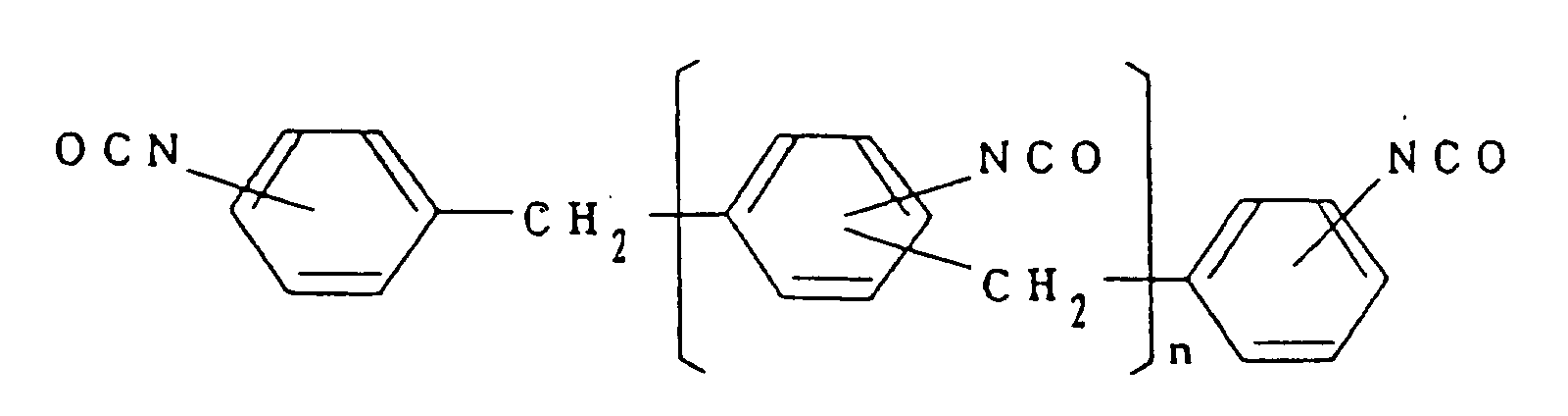
(worin n eine ganze Zahl von 0 bis 6 bedeutet)
und/oder Tolylendiisocyanat ist.
(worin n eine ganze Zahl von 0 bis 6 bedeutet)
und/oder Tolylendiisocyanat ist.
5. Verfahren gemäß Anspruch 1, bei dem das organische Polyisocyanat sich von einem Polymethylenpolyphenylisocyanat
der allgemeinen Formel
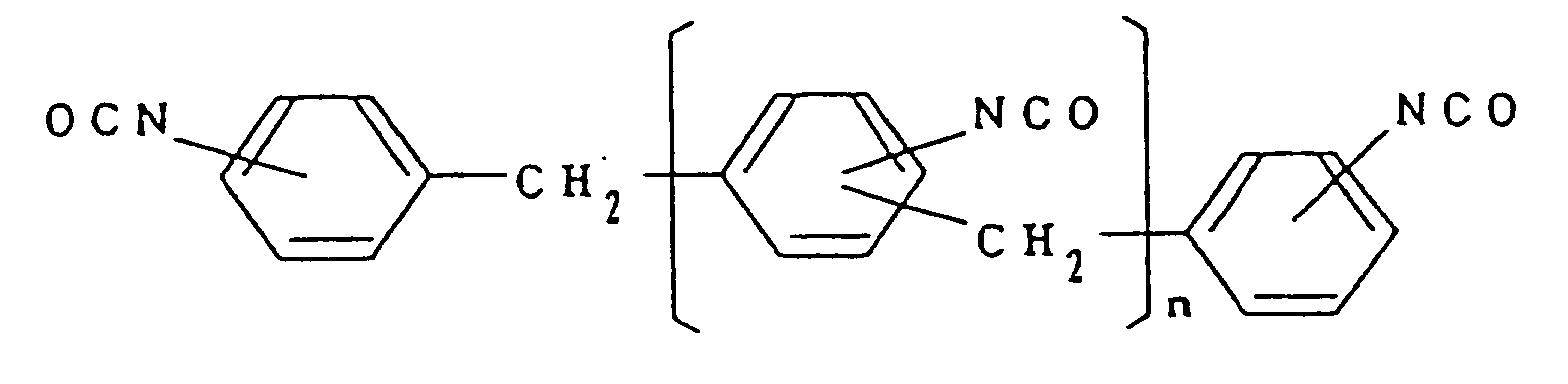
(worin n eine ganze Zahl von 0 bis 6 bedeutet)
und/oder Tolylendiisocyanat und einer hydroxylhaltigen Verbindung ableitet.
(worin n eine ganze Zahl von 0 bis 6 bedeutet)
und/oder Tolylendiisocyanat und einer hydroxylhaltigen Verbindung ableitet.
6. Verfahren gemäß Anspruch 5, bei dem die hydroxylhaltige Verbindung zumindest eine
Verbindung ist, ausgewählt aus der Gruppe, welche aus einwertigen Alkoholen mit einem
Gehalt an einer funktionellen Gruppe und einem Molekulargewicht von 32 bis 300, Phenolen
mit einem Gehalt an einer funktionellen Gruppe und einem Molekulargewicht von 94 bis
300 und Polyolen mit einem Gehalt an zwei oder drei funktionellen Gruppen und ein
Molekulargewicht von 62 bis 600 besteht.
7. Verfahren gemäß Anspruch 6, bei dem die hydroxylhaltige Verbindung zumindest eine
Verbindung ist, ausgewählt aus der Gruppe, die aus Methanol, Ethanol, n-Butanol, Ethylenglycolmonomethylether,
Diethylenglycolmonomethylether, Phenol, o-, m-, p-Cresol, Ethylenglycol, Diethylenglycol,
Propylenglycol, 1,4-Butandiol, 1,6-Hexandiol, Glycerin, Trimethylolpropan, bi- oder
tri-funktionellen Polyetherpolyolen und bi- oder tri-funktionellen Polyesterpolyolen
besteht.
8. Verfahren gemäß Anspruch 1, bei dem das Treibmittel 1,1-Dichlor-1-fluorethan in einer
Menge von 1 bis 100% auf Basis des Polyolgewichts benutzt wird.
9. Verfahren gemäß Anspruch 1, bei dem der Stabilisator zumindest eine aus der Gruppe
ausgewählte Verbindung ist, die besteht aus: Nitroverbindungen, welche aus Nitrolalkanen
mit der Ausnahme von Nitromethan, Nitroethan und 1-Nitropropan, Nitrobenzol, Dinitrobenzol,
Trinitrobenzol, halogenierten Nitrobenzolen, Nitroanisol, Nitrostyrol, Nitrophenol
und Nitrocatechol ausgewählt sind; Alkenylverbindungen mit einem Gehalt an mindestens
einer Doppelbindung, die aus Hexadien, Allen, Butadien, Isopren, Pentadien, β-Myrcen,
Isopropenyltoluol, Diisopropenylbenzol und Alloocimen ausgewählt sind; epoxyhaltigen
Verbindungen, die aus 1,2-Butylenoxid, Isobutylenoxid, Glycidylallylether, Glycidylphenylether,
Glycidyl-p-isopropenylphenylether, Glycidyl-p-nitrophenylether, 1,3-Butadienglycidylether,
Glycidylacrylat, Glycidyl-furancarboxylat und N,N-Diglycidylalanilin ausgewählt sind;
Acrylsäure- und Methacrylsäureestern, die aus 2-Hydroxyethylmethacrylat, Diethylenglycol-monomethylmethacrylat
und Methoxypolyethylen-glycolmonoethylmethacrylat ausgewählt sind, und Phenolen, die
aus 2,6-Di-tert.-butyl-p-cresol, Thymol, p-tert.-Butylphenol, Eugenol, Isoeugenol,
butyliertem Hydroxyanisol, tert.-Butylcatechol und 2,5-Di-tert.-butyl-hydrochinon
ausgewählt sind.
10. Verfahren gemäß Anspruch 1, bei dem der Stabilisator in einer Menge von 0,1 bis 10%
auf Basis des Treibmittelgewichts verwendet wird.
11. Verfahren gemäß Anspruch 10, bei dem der Stabilisator in einer Menge von 0,3 bis 6%
auf Basis des Treibmittelgewichts verwendet wird.
12. Verfahren gemäß Anspruch 1, bei dem die Anteile des Polyols und des organischen Polyisocyanats
derart sind, dass das Äquivalentverhältnis NCO/OH innerhalb des Bereichs von 1,0 bis
3,0 liegt.
13. Verfahren gemäß Anspruch 1, bei dem der metallorganische Katalysator zumindest eine
Verbindung der Klasse ist, welche aus Zinnoctoat, Dibutylzinndilaurat und Bleioctylat
besteht.
14. Verfahren gemäß Anspruch 1, bei dem der Imidazolverbindung-Katalysator zumindest eine
aus der Gruppe ausgewählte Verbindung ist, die aus Imidazol, 1-Methylimidazol, 1,2-Dimethylimidazol,
1-Methyl-2-propylimidazol, 1-Methyl-2-isobutylimidazol und 1-n-Butyl-2-methylimidazol
besteht.
15. Verfahren gemäß Anspruch 1, bei dem der Katalysator in einer Menge von 0,01 bis 20%
auf Basis des Gewichts des organischen Polyisocyanats verwendet wird.
16. Polyurethan-Hartschaum, erhalten durch Umsetzung eines Polyols mit einem organischen
Polyisocyanat zum Schäumen in Gegenwart von 1,1-Dichlor-1-fluorethan als Treibmittel
und eines Stabilisators für dieses, der nicht Nitromethan, Nitroethan und 1-Nitropropan
ist, sowie in Gegenwart eines organischen Metallkatalysators und/oder einer Imidazolverbindung
als Katalysator.
Patentansprüche für folgende(n) Vertragsstaat(en): IT
1. Verfahren zur Herstellung von Polyurethan-Hartschäumen` umfassend die Umsetzung eines
Polyols mit einem organischen Polyisocyanat zum Schäumen in Gegenwart von 1,1-Dichlor-1-fluorethan
als Treibmittel und eines Stabilisators für dieses, sowie in Gegenwart eines organischen
Metallkatalysators und/oder einer Imidazolverbindung als Katalysator.
2. Verfahren gemäß Anspruch 1, bei dem das Polyol aus Polyetherpolyolen mit einem Gehalt
an 2-8 funktionellen Gruppen und einem Hydroxlwert von 300 bis 600 mg KOH/g, Polyesterpolyolen
mit einem Gehalt an 2 bis 4 funktionellen Gruppen und mit einem Hydroxylwert von 250
bis 500 mg KOH/g und Phenolharzen mit einem Gehalt an reaktionsfähigen Methylolgruppen
ausgewählt ist.
3. Verfahren gemäß Anspruch 2, bei dem das Polyol ein Polyetherpolyol ist, das sich von
zumindest einer der Verbindungen Trimethylolpropan, Sorbit, o-Tolylendiamin und m-Tolylendiamin
durch Zugabe von zumindest einer der Verbindungen Ethylenoxid und Propylenoxid ableitet,
wobei das Polyol einen Hydroxylwert von 300 bis 600 mg KOH/g besitzt.
4. Verfahren gemäß Anspruch 1, bei dem das organische Polyisocyanat ein Polymethylenpolyphenylisocyanat
der allgemeinen Formel
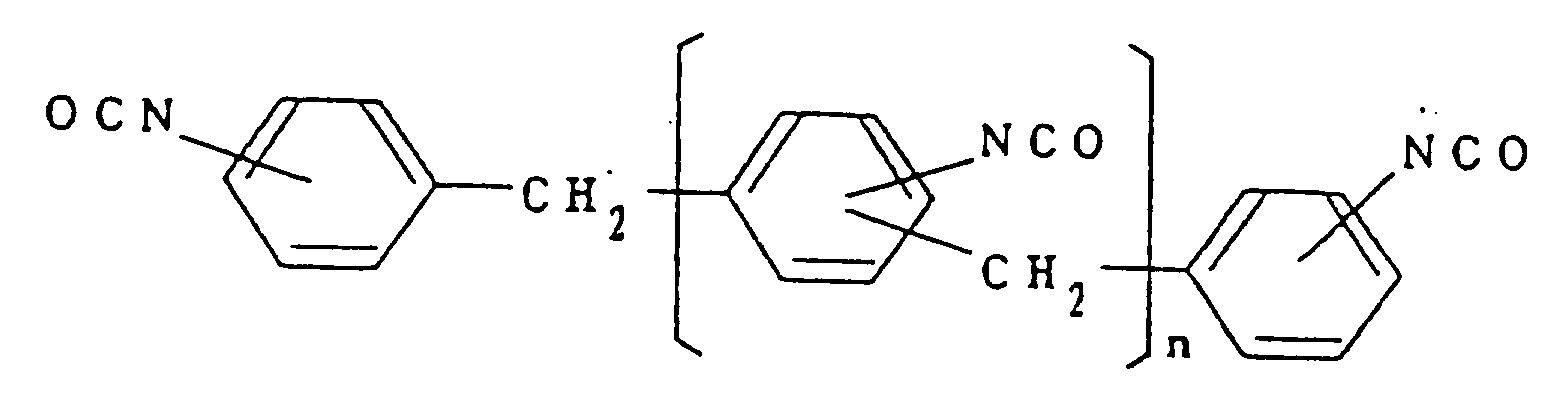
(worin n eine ganze Zahl von 0 bis 6 bedeutet)
und/oder Tolylendiisocyanat ist.
(worin n eine ganze Zahl von 0 bis 6 bedeutet)
und/oder Tolylendiisocyanat ist.
5. Verfahren gemäß Anspruch 1, bei dem das organische Polyisocyanat sich von einem Polymethylenpolyphenylisocyanat
der allgemeinen Formel
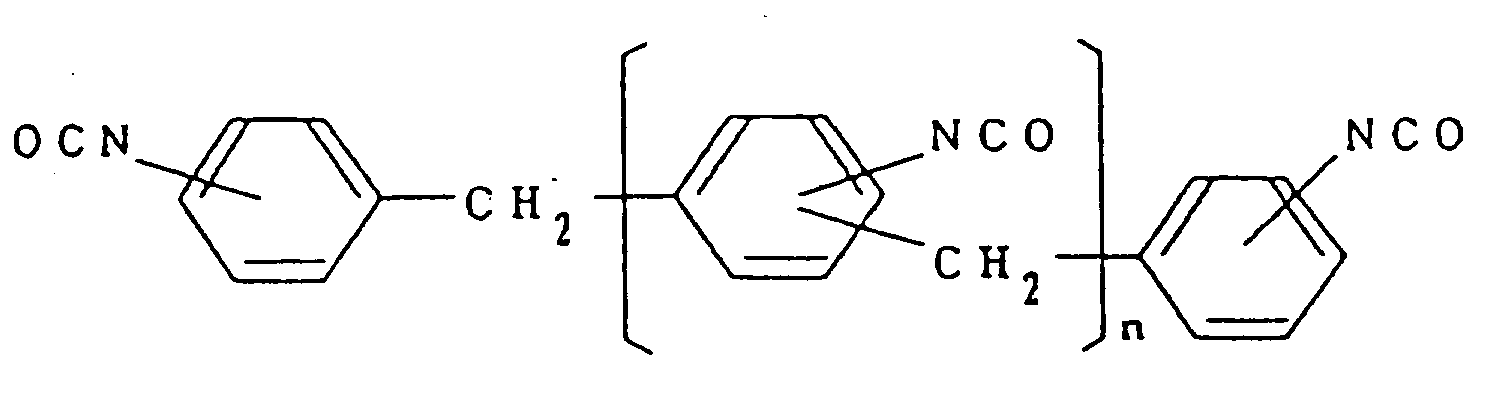
(worin n eine ganze Zahl von 0 bis 6 bedeutet)
und/oder Tolylendiisocyanat und einer hydroxylhaltigen Verbindung ableitet.
(worin n eine ganze Zahl von 0 bis 6 bedeutet)
und/oder Tolylendiisocyanat und einer hydroxylhaltigen Verbindung ableitet.
6. Verfahren gemäß Anspruch 5, bei dem die hydroxylhaltige Verbindung zumindest eine
Verbindung ist, ausgewählt aus der Gruppe, welche aus einwertigen Alkoholen mit einem
Gehalt an einer funktionellen Gruppe und einem Molekulargewicht von 32 bis 300, Phenolen
mit einem Gehalt an einer funktionellen Gruppe und einem Molekulargewicht von 94 bis
300 und Polyolen mit einem Gehalt an zwei oder drei funktionellen Gruppen und einem
Molekulargewicht von 62 bis 600 besteht.
7. Verfahren gemäß Anspruch 6, bei dem die hydroxylhaltige Verbindung zumindest eine
Verbindung ist, ausgewählt aus der Gruppe, die aus Methanol, Ethanol, n-Butanol, Ethylenglycolmonomethylether,
Diethylenglycol-Monomethylether, Phenol, o-, m-, p-Cresol, Ethylenglycol, Diethylenglycol,
Propylenglycol, 1,4-Butandiol, 1,6-Hexandiol, Glycerin, Trimethylolpropan, bi- oder
tri-funktionellen Polyetherpolyolen und bi- oder tri-funktionellen Polyesterpolyolen
besteht.
8. Verfahren gemäß Anspruch 1, bei dem das Treibmittel 1,1-Dichlor-1-fluorethan in einer
Menge von 1 bis 100% auf Basis des Polyolgewichts benutzt wird.
9. Verfahren gemäß Anspruch 1, bei dem der Stabilisator zumindest eine aus der Gruppe
ausgewählte Verbindung ist, die besteht aus: Nitroverbindungen, welche aus Nitrolalkanen
mit der Ausnahme Dinitrobenzol, Trinitrobenzol, halogenierten Nitrobenzolen, Nitroanisol,
Nitrostyrol, Nitrophenol und Nitrocatechol ausgewählt sind; Alkenylverbindungen mit
einem Gehalt an mindestens einer Doppelbindung, die aus Hexadien, Allen, Butadien,
Isopren, Pentadien, β-Myrcen, Isopropenyltoluol, Diisopropenylbenzol und Alloocimen
ausgewählt sind; epoxyhaltigen Verbindungen, die aus 1,2-Butylenoxid, Isobutylenoxid,
Glycidylallylether, Glycidylphenylether, Glycidyl-p-isopropenylphenylether, Glycidyl-p-nitrophenylether,
1,3-Butadienylglycidylether, Glycidylacrylat, Glycidyl-furancarboxylat und N,N-Diglycidylalanilin
ausgewählt sind; Acrylsäure- und Methacrylsäureestern, die aus 2-Hydroxyethylmethacrylat,
Diethylenglycolmonomethylmethacryat und Methoxypolyethylenglycolmonoethylmethacrylat
ausgewählt sind, und Phenolen, die aus 2,6-Di-tert.-butyl-p-cresol, Thymol, p-tert.-Butylphenol,
Eugenol, Isoeugenol, butyliertem Hydroxyanisol, tert.-Butylcatechol und 2,5-Di-tert.-butylhydrochinon
ausgewählt sind.
10. Verfahren gemäß Anspruch 1, bei dem der Stabilisator in einer Menge von 0,1 bis 10%
auf Basis des Treibmittelgewichts verwendet wird.
11. Verfahren gemäß Anspruch 10, bei dem der Stabilisator in einer Menge von 0,3 bis 6%
auf Basis des Treibmittelgewichts verwendet wird.
12. Verfahren gemäß Anspruch 1, bei dem die Anteile des Polyols und des organischen Polyisocyanats
derart sind, dass das Äquivalentverhältnis NCO/OH innerhalb des Bereichs von 1,0 bis
3,0 liegt.
13. Verfahren gemäß Anspruch 1, bei dem der metallorganische Katalysator zumindest eine
Verbindung der Klasse ist, welche aus Zinnoctoat, Dibutylzinndilaurat und Bleioctylat
besteht.
14. Verfahren gemäß Anspruch 1, bei dem der Imidazolverbindung-Katalysator zumindest eine
aus der Gruppe ausgewählte Verbindung ist, die aus Imidazol, 1-Methylimidazol, 1,2-Dimethylimidazol,
1-Methyl-2-propylimidazol, 1-Methyl-2-isobutylimidazol und 1-n-Butyl-2-methylimidazol
besteht.
15. Verfahren gemäß Anspruch 1, bei dem der Katalysator in einer Menge von 0,01 bis 20%
auf Basis des Gewichts des organischen Polyisocyanats verwendet wird.
16. Polyurethan-Hartschaum, erhalten durch Umsetzung eines Polyols mit einem organischen
Polyisocyanat zum Schäumen in Gegenwart von 1,1-Dichlor-1-fluorethan als Treibmittel
und eines Stabilisators für dieses sowie in Gegenwart eines organischen Metallkatalysators
und/oder einer Imidazolverbindung als Katalysator.
Revendications pour l'(les) Etat(s) contractant(s) suivant(s): BE, DE, FR, GB
1. Procédé de préparation de mousses rigides de polyuréthanne, qui comprend le fait de
faire réagir un polyol avec un polyisocyanate organique pour la transformation en
mousse en présence du 1,1-dichloro-1-fluoréthane à titre d'agent gonflant et d'un
stabilisateur pour ce dernier qui ne représente pas le nitrométhane, le nitroéthane
et le 1-nitropropane, et en présence d'un catalyseur du type d'un métal organique
et/ou d'un catalyseur du type d'un composé d'imidazole.
2. Procédé selon la revendication 1, dans lequel le polyol est choisi parmi des polyéther-polyols
contenant de 2 à 8 groupes fonctionnels et possédant un indice d'hydroxyle de 300
à 600 mg de KOH/g, des polyester-polyols contenant de 2 à 4 groupes fonctionnels et
possédant un indice d'hydroxyle de 250 à 500 mg de KOH/g, ainsi que des résines phénoliques
contenant des groupes méthylol réactifs.
3. Procédé selon là revendication 2, dans lequel le polyol représente un polyéther-polyol
qui dérive d'au moins un membre choisi parmi le groupe comprenant le triméthylolpropane,
le sorbitol, la o-tolylènediamine et la m-tolylènediamine par addition d'au moins
un oxyde choisi parmi l'oxyde d'éthylène et l'oxyde de propylène, ledit polyol possédant
un indice d'hydroxyle de 300 à 600 mg de KOH/g.
4. Procédé selon la revendication 1, dans lequel le polyisocyanate organique représente
un polyméthylènepolyphénylisocyanate répondant à la formule générale
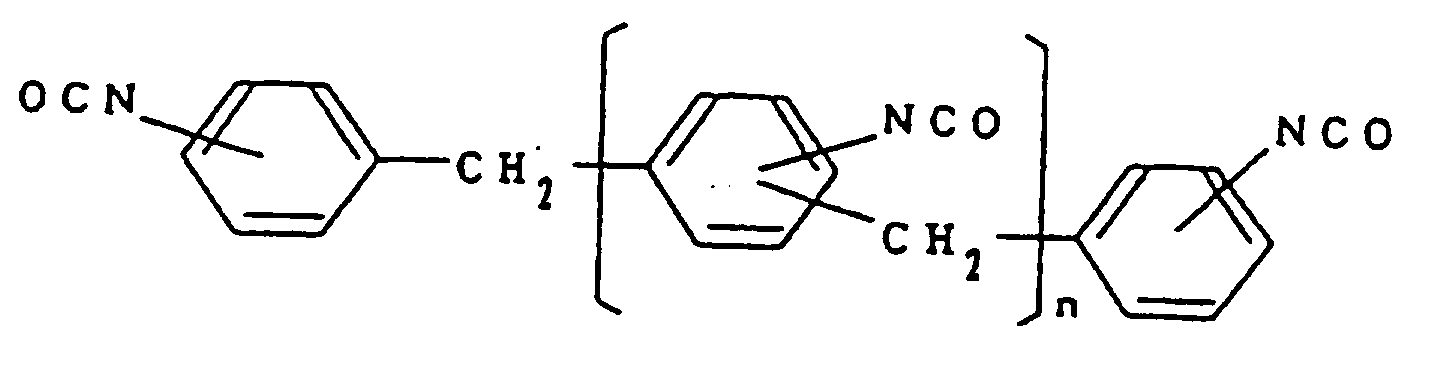
(dans laquelle n représente un entier de 0 à 6)
et/ou le tolylènediisocyanate.
(dans laquelle n représente un entier de 0 à 6)
et/ou le tolylènediisocyanate.
5. Procédé selon la revendication 1, dans lequel le polyisocyanate organique dérive d'un
polyméthylènepolyphénylisocyanate répondant à la formule générale
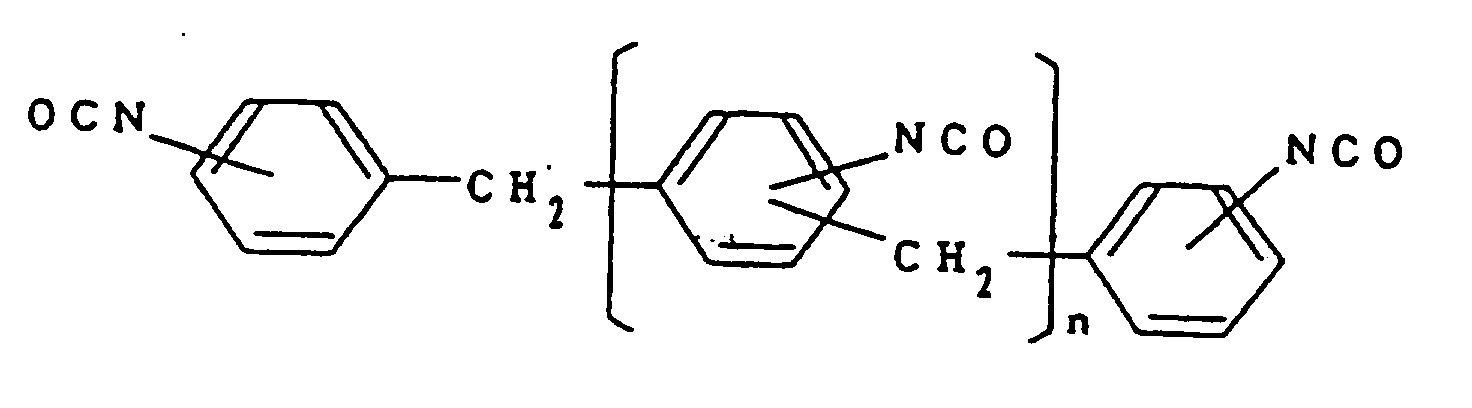
(dans laquelle n représente un entier de 0 à 6)
et/ou du tolylènediisocyanate et d'un composé contenant un ou plusieurs groupes hydroxyle.
(dans laquelle n représente un entier de 0 à 6)
et/ou du tolylènediisocyanate et d'un composé contenant un ou plusieurs groupes hydroxyle.
6. Procédé selon la revendication 5, dans lequel le composé contenant un ou plusieurs
groupes hydroxyle représente au moins un membre choisi parmi le groupe constitué par
des alcools monovalents contenant un groupe fonctionnel et possédant un poids moléculaire
de 32 à 300, des phénols contenant un groupe fonctionnel et possédant un poids moléculaire
de 94 à 300, et des polyols contenant 2 ou 3 groupes fonctionnels et possédant un
poids moléculaire de 62 à 600.
7. Procédé selon la revendication 6, dans lequel le composé contenant un ou plusieurs
groupes hydroxyle représente au moins un membre choisi parmi le groupe constitué par
le méthanol, l'éthanol, le n-butanol, l'éther monométhylique d'éthylèneglycol, l'éther
monométhylique de diéthylèneglycol, le phénol, le o-crésol, le m-crésol, le p-crésol,
l'éthylèneglycol, le diéthylèneglycol, le propylèneglycol, le 1,4-butanediol, le 1,6-hexanediol,
le glycérol, le triméthylolpropane, des polyéther-polyols bifonctionnels ou trifonctionnels
et des polyester-polyols bifonctionnels ou trifonctionnels.
8. Procédé selon la revendication 1, dans lequel l'agent gonflant, à savoir le 1,1-dichloro-1-fluoréthane,
est utilisé en une quantité de 1 à 100% sur base du poids du polyol.
9. Procédé selon la revendication 1, dans lequel le stabilisateur représente au moins
un membre choisi parmi le groupe constitué par des composés nitro choisis parmi des
nitroalcanes, à l'exception du nitrométhane, du nitroéthane et du 1-nitropropane,
le nitrobenzène, le dinitrobenzène, le trinitrobenzène, des nitrobenzènes halogénés,
le nitroanisole, le nitrostyrène, le nitrophénol et le nitrocatéchol; des composés
alcénylés contenant au moins une liaison double, choisis parmi l'hexadiène, l'allène,
le butadiène, l'isoprène, le pentadiène, le β-myrcène, l'isopropényltoluène, le diisopropénylbenzène
et l'allocimène; des composés contenant un ou plusieurs groupes époxy choisis parmi
l'oxyde de 1,2-butylène, l'oxyde d'isobutylène, l'éther glycidylallylique, l'éther
glycidylphénylique, l'éther glycidyl-p-isopropénylphénylique, l'éther glycidyl-p-nitrophénylique,
l'éther 1,3-butadiénylglycidylique, l'acrylate de glycidyle, le furannecarboxylate
de glycidyle et la N,N-diglycidylaniline; des esters d'acide acrylique et des esters
d'acide méthacrylique choisis parmi le méthacrylate de 2-hydroxyéthyle, le monométhylméthacrylate
de diéthylèneglycol et le monoéthylméthacrylate de méthoxypolyéthylèneglycol; et des
phénols choisis parmi le 2,6-di-tert.-butyl-p-crésol, le thymol, le p-tert.-butylphénol,
l'eugénol, l'isoeugénol, l'hydroxyanisole butylé, le tert.-butylcatéchol et la 2,5-di-tert.-butylhydroquinone.
10. Procédé selon la revendication 1, dans lequel le stabilisateur est utilisé en une
quantité de 0,1 à 10% sur base du poids de l'agent gonflant.
11. Procédé selon la revendication 10, dans lequel le stabilisateur est utilisé en une
quantité de 0,3 à 6% sur base du poids de l'agent gonflant.
12. Procédé selon la revendication 1, dans lequel les proportions du polyol et du polyisocyanate
organique sont telles que le rapport d'équivalents NCO/OH se situe dans le domaine
de 1,0 à 3,0.
13. Procédé selon la revendication 1, dans lequel le catalyseur du type d'un métal organique
représente au moins un membre choisi parmi la classe constituée par l'octoate stanneux,
le dilaurate de dibutylétain et l'octylate de plomb.
14. Procédé selon la revendication 1, dans lequel le catalyseur du type d'un composé d'imidazole
représente au moins un membre choisi parmi le groupe constitué par l'imidazole, le
1-méthylimidazole, le 1,2-diméthylimidazole, le 1-méthyl-2-propylimidazole, le 1-méthyl-2-isobutylimidazole
et le 1-n-butyl-2-méthylimidazole.
15. Procédé selon la revendication 1, dans lequel le catalyseur est utilisé en une quantité
de 0,01 à 20% sur base du poids du polyisocyanate organique.
16. Mousse rigide de polyuréthanne obtenue par la mise en réaction d'un polyol avec un
polyisocyanate organique à des fins de transformation en mousse en présence du 1,1-dichloro-1-fluoréthane
à titre d'agent gonflant et d'un stabilisateur pour ce dernier qui ne représente pas
le nitrométhane, le nitroéthane et le 1-nitropropane, et en présence d'un catalyseur
du type d'un métal organique et/ou d'un catalyseur du type d'un composé d'imidazole.
Revendications pour l'(les) Etat(s) contractant(s) suivant(s): IT
1. Procédé de préparation de mousses rigides de polyuréthanne, qui comprend le fait de
faire réagir un polyol avec un polyisocyanate organique pour la transformation en
mousse en présence du 1,1-dichloro-1-fluoréthane à titre d'agent gonflant et d'un
stabilisateur pour ce dernier, et en présence d'un catalyseur du type d'un métal organique
et/ou d'un catalyseur du type d'un composé d'imidazole.
2. Procédé selon la revendication 1, dans lequel le polyol est choisi parmi des polyéther-polyols
contenant de 2 à 8 groupes fonctionnels et possédant un indice d'hydroxyle de 300
à 600 mg de KOH/g, des polyester-polyols contenant de 2 à 4 groupes fonctionnels et
possédant un indice d'hydroxyle de 250 à 500 mg de KOH/g, ainsi que des résines phénoliques
contenant des groupes méthylol réactifs.
3. Procédé selon la revendication 2, dans lequel le polyol représente un polyéther-polyol
qui dérive d'au moins un membre choisi parmi le groupe comprenant le triméthylolpropane,
le sorbitol, la o-tolylènediamine et la m-tolylènediamine par addition d'au moins
un oxyde choisi parmi l'oxyde d'éthylène et l'oxyde de propylène, ledit polyol possédant
un indice d'hydroxyle de 300 à 600 mg de KOH/g.
4. Procédé selon la revendication 1, dans lequel le polyisocyanate organique représente
un polyméthylènepolyphénylisocyanate répondant à la formule générale
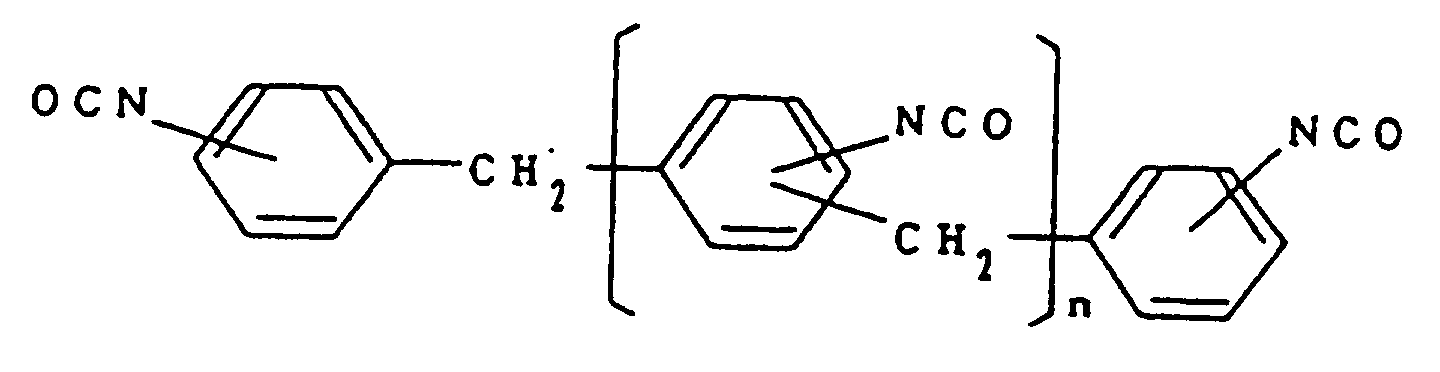
(dans laquelle n représente un entier de 0 à 6)
et/ou le tolylènediisocyanate.
(dans laquelle n représente un entier de 0 à 6)
et/ou le tolylènediisocyanate.
5. Procédé selon la revendication 1, dans lequel le polyisocyanate organique dérive d'un
polyméthylènepolyphénylisocyanate répondant à la formule générale
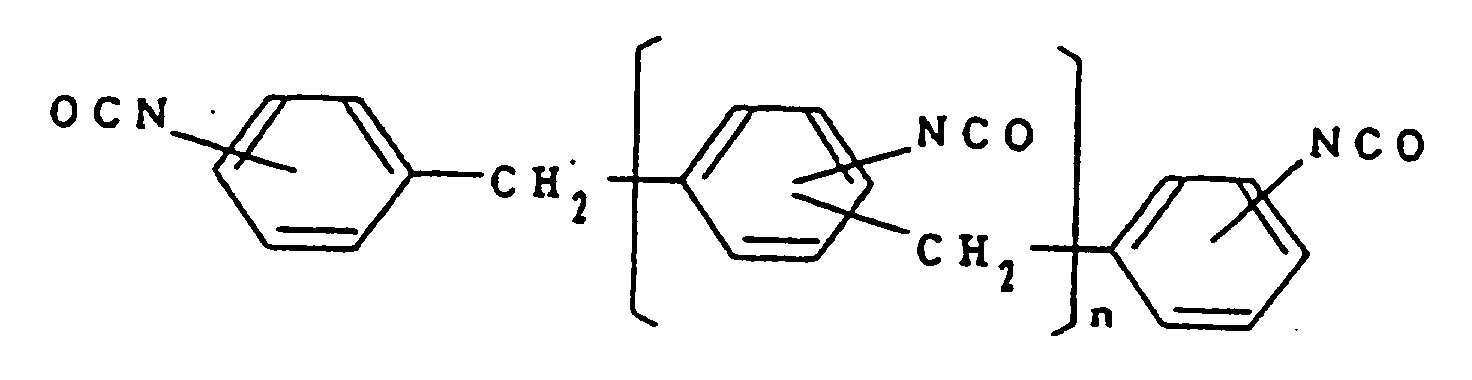
(dans laquelle n représente un entier de 0 à 6)
et/ou du tolylènediisocyanate et d'un composé contenant un ou plusieurs groupes hydroxyle.
(dans laquelle n représente un entier de 0 à 6)
et/ou du tolylènediisocyanate et d'un composé contenant un ou plusieurs groupes hydroxyle.
6. Procédé selon la revendication 5, dans lequel le composé contenant un ou plusieurs
groupes hydroxyle représente au moins un membre choisi parmi le groupe constitué par
des alcools monovalents contenant un groupe fonctionnel et possédant un poids moléculaire
de 32 à 300, des phénols contenant un groupe fonctionnel et possédant un poids moléculaire
de 94 à 300, et des polyols contenant 2 ou 3 groupes fonctionnels et possédant un
poids moléculaire de 62 à 600.
7. Procédé selon la revendication 6, dans lequel le composé contenant un ou plusieurs
groupes hydroxyle représente au moins un membre choisi parmi le groupe constitué par
le méthanol, l'éthanol, le n-butanol, l'éther monométhylique d'éthylèneglycol, l'éther
monométhylique de diéthylèneglycol, le phénol, le o-crésol, le m-crésol, le p-crésol,
l'éthylèneglycol, le diéthylèneglycol, le propylèneglycol, le 1,4-butanediol, le 1,6-hexanediol,
le glycérol, le triméthylolpropane, des polyéther-polyols bifonctionnels ou trifonctionnels
et des polyester-polyols bifonctionnels ou trifonctionnels.
8. Procédé selon la revendication 1, dans lequel l'agent gonflant, à savoir le 1,1-dichloro-1-fluoréthane,
est utilisé en une quantité de 1 à 100% sur base du poids du polyol.
9. Procédé selon la revendication 1, dans lequel le stabilisateur représente au moins
un membre choisi parmi le groupe constitué par des composés nitro choisis parmi des
nitroalcanes, le nitrobenzène, le dinitrobenzène, le trinitrobenzène, des nitrobenzènes
halogénés, le nitroanisole, le nitrostyrène, le nitrophénol et le nitrocatéchol; des
composés alcénylés contenant au moins une liaison double, choisis parmi l'hexadiène,
l'allène, le butadiène, l'isoprène, le pentadiène, le β-myrcène, l'isopropényltoluène,
le diisopropénylbenzène et l'allocimène; des composés contenant un ou plusieurs groupes
époxy choisis parmi l'oxyde de 1,2-butylène, l'oxyde d'isobutylène, l'éther glycidylallylique,
l'éther glycidylphénylique, l'éther glycidyl-p-isopropénylphénylique, l'éther glycidyl-p-nitrophénylique,
l'éther 1,3-butadiénylglycidylique, l'acrylate de glycidyle, le furannecarboxylate
de glycidyle et la N,N-diglycidylaniline; des esters d'acide acrylique et des esters
d'acide méthacrylique choisis parmi le méthacrylate de 2-hydroxyéthyle, le monométhylméthacrylate
de diéthyléneglycol et le monoéthylméthacrylate de méthoxypolyéthyleneglycol; et des
phénols choisis parmi le 2,6-di-tert.-butyl-p-crésol, le thymol, le p-tert.-butylphénol,
l'eugénol, l'isoeugénol, l'hydroxyanisole butylé, le tert.-butylcatéchol et la 2,5-di-tert.-butylhydroquinone.
10. Procédé selon la revendication 1, dans lequel le stabilisateur est utilisé en une
quantité de 0,1 à 10% sur base du poids de l'agent gonflant.
11. Procédé selon la revendication 10, dans lequel le stabilisateur est utilisé en une
quantité de 0,3 à 6% sur base du poids de l'agent gonflant.
12. Procédé selon la revendication 1, dans lequel les proportions du polyol et du polyisocyanate
organique sont telles que le rapport d'équivalents NCO/OH se situe dans le domaine
de 1,0 à 3,0.
13. Procédé selon la revendication 1, dans lequel le catalyseur du type d'un métal organique
représente au moins un membre choisi parmi la classe constituée par l'octoate stanneux,
le dilaurate de dibutylétain et l'octylate de plomb.
14. Procédé selon la revendication 1, dans lequel le catalyseur du type d'un composé d'imidazole
représente au moins un membre choisi parmi le groupe constitué par l'imidazole, le
1-méthylimidazole, le 1,2-diméthylimidazole, le 1-méthyl-2-propylimidazole, le 1-méthyl-2-isobutylimidazole
et le 1-n-butyl-2-méthylimidazole.
15. Procédé selon la revendication 1, dans lequel le catalyseur est utilisé en une quantité
de 0,01 à 20% sur base du poids du polyisocyanate organique.
16. Mousse rigide de polyuréthane obtenue par la mise en réaction d'un polyol avec un
polyisocyanate organique à des fins de transformation en mousse en présence du 1,1-dichloro-1-fluoréthane
à titre d'agent gonflant et d'un stabilisateur pour ce dernier et en présence d'un
catalyseur du type d'un métal organique et/ou d'un catalyseur du type d'un composé
d'imidazole.