|
(11) | EP 0 629 690 B1 |

| (12) | EUROPEAN PATENT SPECIFICATION |
|
|
| (54) |
Stable aqueous emulsions of nonionic surfactants Stabile wässrige nichtionische Tensidemulsionen Emulsions aqueuses stables d'agents tensioactifs non-ioniques |
|
|
||||||||||||||||||||||||||||
| Note: Within nine months from the publication of the mention of the grant of the European patent, any person may give notice to the European Patent Office of opposition to the European patent granted. Notice of opposition shall be filed in a written reasoned statement. It shall not be deemed to have been filed until the opposition fee has been paid. (Art. 99(1) European Patent Convention). |
Technical field
[0001] The present invention relates to cleaning compositions. More particularly, the cleaning compositions according to the present invention are stable aqueous emulsions of nonionic surfactants.
Background
[0002] A great variety of cleaning compositions have been described in the art. For instance, in co-pending European Patent Application EP-A-598 170, a particular type of cleaning compositions is described which are aqueous emulsions of a nonionic surfactant system. Such emulsions find a preferred application in the formulation of bleaching compositions comprising hydrogen peroxide or water soluble source thereof and a liquid hydrophobic bleach activator, or any other hydrophobic ingredient which needs to be separated from hydrogen peroxide. Alternatively, such emulsions can be used to formulate products which do not contain hydrogen peroxide. In the latter case, such emulsions can be useful because they allow to keep a given hydrophobic ingredient separate from the aqueous phase, with which said hydrophobic ingredient could react, e.g., by hydrolysis. Another advantage of such emulsions is that they provide a means to formulate ingredients with very low water solubility, without the need for using alcoholic or solvent mixtures, which are usually undesirable for aesthetic (odour) and toxicity reasons.
[0003] However, a problem with such emulsions especially with emulsions containing relatively high concentration of surfactants, e.g., about 8 %, is that important viscosity tends to build up, which makes said emulsions difficult to dispense, and thus unacceptable from a consumer viewpoint.
[0004] It is thus an object of the present invention to formulate aqueous emulsions of nonionic surfactants wherein the viscosity can be conveniently controlled.
[0005] Various viscosity agents such as sodium cumene sulphonate and polyacrylates have been tried in this context, which resulted in a decreased viscosity but also reduced phase stability.
[0006] It is thus another object of the present invention to provide aqueous emulsions of nonionic surfactants wherein the viscosity can be conveniently controlled while maintaining adequate physical stability.
[0007] US-4648 987 relates to an aqueous laundry prewash composition for treating fabric spots and stains comprising a cosurfactant system, a hydrotrope, xantham gum and water.
[0008] It has now been found that this object can be efficiently met by formulating aqueous emulsions of nonionic surfactants which comprise terephthalate-based polyesters. In other words, it has now been found that terephthalate-based polyesters reduce the viscosity of aqueous emulsions comprising a nonionic surfactant system whatever the viscosity was before the addition of said terephthalate-based polyesters.
[0009] The present invention allows for greater flexibility in formulating and provides stable aqueous emulsions suitable to be used in the most efficient manner by the consumer.
[0010] The viscosity-reducing effect of terephthalate-based polyesters is unexpected and beneficial as said terephthalate-based polymers, especially terephthalate based polyesters, are only known in the context of laundry compositions as soil release components, see for instance US-A-4 116 885, US-A-4 132 680, EP-A-185 427, EP-A-220 156, EP-A-241 984, EP-A-241 985, EP-A-518 401 and European Patent Application EP-A-576 777.
[0011] As an additional advantage it has been found that the present invention finds a preferred application in formulating aqueous activated bleaching emulsions and bleaching emulsions which comprise any hydrophobic liquid ingredient which needs to be kept separate from the hydrogen peroxide. Indeed, the addition of terephthalate-based polyesters according to the present invention to the nonionic surfactant system used to emulsify hydrophobic liquid ingredients as for instance bleach activators improves the storage stability of hydrogen peroxide.
Summary of the invention
[0012] The present invention is a stable aqueous emulsion having a pH of from 0.5 to 6, comprising a hydrophilic nonionic surfactant and a hydrophobic nonionic surfactant, as defined below and in claim 1, said stable aqueous emulsion further comprises from 0,05% to 5% by weight of the total emulsion of a terephthalate-based polyester.
Detailed description of the invention
[0013] The compositions according to the present invention are stable aqueous emulsions of nonionic surfactants. By stable emulsion it is meant an emulsion which does not substantially separate into distinct layers, upon standing for at least two weeks at 50 °C.
[0014] The compositions according to the present invention are aqueous. Accordingly, the compositions according to the present invention preferably comprise from 10% to 95% by weight of the total composition of water, more preferably from 30% to 90%, most preferably from 60% to 80%. Deionized water is preferably used.
[0015] The compositions according to the present invention are emulsions of nonionic surfactants. Said emulsions of nonionic surfactants comprise at least two nonionic surfactants. Said two nonionic surfactants in order to form emulsions which are stable must have different HLB values (hydrophilic lipophilic balance), and the difference in value of the HLBs of said two surfactants is more than 1, preferably at least 3. By appropriately combining at least two of said nonionic surfactants with different HLBs in water, emulsions according to the present invention will be formed.
[0016] One of said nonionic surfactants used herein is a nonionic surfactant with an HLB above 11 (herein referred to as hydrophilic nonionic surfactant), whereas the other one is a nonionic surfactant with an HLB below 10 (herein referred to as hydrophobic nonionic surfactant).
[0017] Suitable nonionic surfactants for use herein include alkoxylated fatty alcohols. Indeed, a great variety of such alkoxylated fatty alcohols are commercially available which have very different HLB values (hydrophilic lipophilic balance). The HLB values of such alkoxylated nonionic surfactants depend essentially on the chain length of the fatty alcohol, the nature of the alkoxylation and the degree of alkoxylation. Hydrophilic nonionic surfactants tend to have a high degree of alkoxylation and a short chain fatty alcohol, while hydrophobic surfactants tend to have a low degree of alkoxylation and a long chain fatty alcohol. Surfactants catalogs are available which list a number of surfactants including nonionics, together with their respective HLB values.
[0018] The compositions according to the present invention preferably comprise from 2 % to 50 % by weight of the total composition of said hydrophilic and hydrophobic nonionic surfactants, more preferably from 5 % to 40 %, most preferably from 8 % to 30 %.
[0019] The compositions according to the present invention may further comprise other nonionic surfactants which should however not significantly alter the weighted average HLB value of the overall composition.
[0020] The compositions according to the present invention further comprise as an essential element a viscosity reducing amount of terephthalate-based polyesters. By "viscosity reducing amount" it is meant an amount of terephthalate-based polyesters which is sufficient to provide physically stable aqueous emulsions wherein the viscosity can be conveniently controlled. The compositions according to the present invention comprise from 0.05 % to 5 % by weight of the total composition of said terephthalate-based polyesters, preferably from 0.1 % to 2 %.
[0021] Said terephthalate-based polyesters reduce the viscosity of aqueous emulsions herein whatever the viscosity was before the addition of said terephthalate-based polyesters, while maintaining also physical stability. Preferred compositions obtained according to the present invention have a viscosity of from 100 cps to 3000 cps at 50 rpm shear rate at 25°C, more preferably from 300 cps to 1500 cps, measured with a Brookfield DV II rotational viscosimeter.
[0022] Terephthalate-based polyesters have been extensively described in the art as soil release agents, see for instance US-A-4 116 885, US-A-4 132 680, EP-A-185 427, EP-A-220 156, EP-A-241 984, EP-A-241 985, EP 518 401 and European Patent Application EP-A-576 777. All polymers disclosed therein are suitable in the context of the present invention. More specifically, suitable polymers for use herein are according to the formula
X⁅(OCH2CH(Y))n(OR5)m⁆⁅(A-R1-A-R2)u(A-R3-A-R2)v⁆-A-R4-A⁅(R5O)m(CH(Y)CH2O)n⁆X
[0023] In this formula, the moiety ⁅(A-R1-A-R2)u(A-R3-A-R2)v⁆-A-R4-A- forms the oligomer or polymer backbone of the compounds.
[0024] It is believed that the backbone structure is important to the adsorption of the polymers on the fabrics while the end groups confer the soil release properties.
[0025] The linking A moieties are essentially
moieties, i.e. the compounds of the present invention are polyesters. As used herein, the term "the A moieties are essentially
moieties" refers to compounds where the A moieties consist entirely of moieties
or are partially substituted with linking moieties such as
or
(amide), and
(urethane). The degree of partial substitution with these other linking moieties should be such that the soil release properties are not adversely affected to any great extent. Preferably, linking moieties A consist entirely of (i.e., comprise 100%) moieties
i.e., each A is either
[0026] The R1 moieties are essentially 1,4-phenylene moieties. As used herein, the term "the R1 moieties are essentially 1,4-phenylene moieties" refers to compounds where the R1 moieties consist entirely of 1,4-phenylene moieties, or are partially substituted with other arylene or alkarylene moieties, alkylene moieties, alkenylene moieties, or mixtures thereof. Arylene and alkarylene moieties which can be partially substituted for 1,4-phenylene include 1,3-phenylene, 1,2-phenylene, 1,8-naphthylene, 1,4-naphthylene, 2,2-biphenylene, 4,4'-biphenylene and mixtures thereof. Alkylene and alkenylene moieties which can be partially substituted include ethylene, 1,2-propylene, 1,4-butylene, 1,5-pentylene, 1,6-hexamethylene, 1,7-heptamethylene, 1,8-octamethylene, 1,4-cyclohexylene, and mixtures thereof.
[0027] For the R1 moieties, the degree of partial substitution with moieties other than 1,4-phenylene should be such that the soil release properties of the compound are not adversely affected to any great extent. Generally, the degree of partial substitution which can be tolerated will depend upon the backbone length of the compound, i.e., longer backbones can have greater partial substitution for 1,4-phenylene moieties. Usually, compounds where the R1 comprise from about 50 to 100% 1,4-phenylene moieties (from 0 to about 50% moieties other than 1,4-phenylene) have adequate soil release activity. For example, polyesters made according to the present invention with a 40:60 mole ratio of isophthalic (1,3-phenylene) to terephthalic (1,4-phenylene) acid have adequate soil release activity. However, because most polyesters used in fiber making comprise ethylene terephthalate units, it is usually desirable to minimize the degree of partial substitution with moieties other than 1,4-phenylene for best soil release activity. Preferably, the R1 moieties consist entirely of (i.e., comprise 100%) 1,4-phenylene moieties, i.e. each R1 moiety is 1,4-phenylene.
[0028] The R2 moieties are essentially ethylene moieties, or substituted ethylene moieties having C1-C4 alkyl or alkoxy substitutents. As used herein, the term "the R2 moieties are essentially ethylene moieties, or substituted ethylene moieties having C1-C4 alkyl or alkoxy substituents" refers to compounds of the present invention where the R2 moieties consist entirely of ethylene, or substituted ethylene moieties, or are partially substituted with other compatible moieties. Examples of these other moieties include linear C3-C6 alkylene moieties such as 1,3-propylene, 1,4-butylene, 1,5-pentylene or 1,6-hexamethylene, 1,2-cycloalkylene moieties such as 1,2-cyclohexylene, 1,4-cycloalkylene moieties such as 1,4-cyclohexylene and 1,4-dimethylenecyclohexylene, polyoxyalkylated 1,2-hydroxyalkylenes such as
and oxyalkylene moieties such as
-CH2CH2OCH2CH2OCH2CH2- or -CH2CH2OCH2CH2-.
[0029] For the R2 moieties, the degree of partial substitution with these other moieties should be such that the soil release properties of the compounds are not adversely affected to any great extent. Generally, the degree of partial substitution which can be tolerated will depend upon the backbone length of the compound, i.e., longer backbones can have greater partial substitution. Usually, compounds where the R2 comprise from 20 to 100% ethylene, or substituted ethylene moieties (from 0 to 80% other compatible moieties) have adequate soil release activity. For example, polyesters made according to the present invention with a 75:25 mole ratio of diethylene glycol (-CH2CH2OCH2CH2-) to ethylene glycol (ethylene) have adequate soil release activity. However, it is desirable to minimize such partial substitution, especially with oxyalkylene moieties, for best soil release activity. (During the making of polyesters according to the present invention, small amounts of these oxyalkylene moieties (as dialkylene glycols) are typically formed from glycols in side reactions and are then incorporated into the polyester). Preferably, R2 comprises from 80 to 100% ethylene, or substituted ethylene moieties, and from 0 to 20% other compatible moieties.
[0030] For the R2 moieties, suitable ethylene or substituted ethylene moieties include ethylene, 1,2-propylene, 1,2-butylene, 1,2-hexylene, 3-methoxy-1,2-propylene and mixtures thereof. Preferably, the R2 moieties are essentially ethylene moieties, 1,2-propylene moieties or mixtures thereof. Inclusion of a greater percentage of ethylene moieties tends to improve the soil release activity of the compounds. Surprisingly, inclusion of a greater percentage of 1,2-propylene moieties tends to improve the water solubility of the compounds.
[0031] For the R3 moieties, suitable substituted C2-C18 hydrocarbylene moieties can include substituted C2-C12 alkylene, alkenylene, arylene, alkarylene and like moieties. The substituted alkylene or alkenylene moieties can be linear, branched, or cyclic. Also, the R3 moieties can be all the same (e.g. all substituted arylene) or a mixture (e.g. a mixture of substituted arylenes and substituted alkylenes). Preferred R3 moieties are those which are substituted 1,3-phenylene moieties.
[0032] The substituted R3 moieties preferably have only one - SO3M, -COOM, -O⁅(R5O)m(CH(Y)CH2O)n⁆X or -A⁅(R2-A-R4-A)
(R5O)m(CH(Y)CH2O)n⁆X substituent. M can be H or any compatible water-soluble cation. Suitable water soluble cations include the water soluble alkali metals such as potassium (K+) and especially sodium (Na+), as well as ammonium (NH4+). Also suitable are substituted ammonium cations having the formula:
where R1 and R2 are each a C1-C20 hydrocarbyl group (e.g. alkyl, hydroxyalkyl) or together form a cyclic or heterocyclic ring of from 4 to 6 carbon atoms (e.g. piperidine, morpholine); R3 is a C1-C20 hydrocarbyl group; and R4 is H (ammonium) or a C1-C20 hydrocarbyl group (quat amine). Typical substituted ammonium cationic groups are those where R4 is H (ammonium) or C1-C4 alkyl, especially methyl (quat amine); R1 is C10-C18 alkyl, especially C12-C14 alkyl; and R2 and R3 are each C1-C4 alkyl, especially methyl.
[0033] The R3 moieties having -A⁅(R2-A-R4A)⁆w ⁅(R5O)m(CH(Y)CH2O)n⁆X substituents provide branched backbone compounds. R3 moieties having -A⁅(R2-A-R4-A)
R2-A moieties provide crosslinked backbone compounds. Indeed, syntheses used to make the branched backbone compounds typically provide at least some crosslinked backbone compounds.
[0034] The moieties -(R5O)- and -(CH(Y)CH2O)- of the moieties ⁅(R5O)m(CH(Y)CH2O)n⁆ and ⁅(OCH(Y)CH2)n(OR5)m⁆ can be mixed together or preferably form blocks of -(R5O)- and -(CH(Y)CH2O)-moieties. Preferably, the blocks of -(R5O)- moieties are located next to the backbone of the compound. When R5 is the moiety -R2-A-R6-, m is 1; also, the moiety -R2-A-R6- is preferably located next to the backbone of the compound. For R5, the preferred C3-C4 alkylene is C3H6 (propylene); when R5 is C3-C4 alkylene, m is preferably from 0 to 5 and is most preferably 0. R6 is preferably methylene or 1,4-phenylene. The moiety -(CH(Y)CH2O)- preferably comprises at least about 75% by weight of the moiety ⁅(R5O)m(CH(Y)CH2O)n⁆ and most preferably 100% by weight (m is 0).
[0035] The Y substituents of each moiety ⁅(R5O)m(CH(Y)CH2O)n⁆ are the ether moiety -CH2(OCH2CH2)pO-X, or are, more typically, a mixture of this ether moiety and H; p can range from 0 to 100, but is typically 0. When the Y substituents are a mixture, moiety -(CH(Y)CH2O)n- can be represented by the following moiety:
wherein n1 is at least 1 and the sum of n1 + n2 is the value for n. Typically, n1 has an average value of from about 1 to about 10. The moieties
can be mixed together, but typically form blocks of
and
-(CH2CH2O)n2-
moieties. X can be H, C1-C4 alkyl or
wherein R7 is C1-C4 alkyl. X is preferably methyl or ethyl, and most preferably methyl. The value for each n is at least 6, but is preferably at least 10. The value for each n usually ranges from 12 to 113. Typically, the value for each n is in the range of from 12 to 43.
[0036] The backbone moieties (̵A-R1-A-R2)̵ and -(-A-R3-A-R2)̵ can be mixed together or can form blocks of (̵A-R1-A-R2)̵ and (̵A-R3-A-R2)̵ moieties. It has been found that the value of u + v needs to be at least 3 in order for the compounds of the present invention to have significant soil release activity. The maximum value for u + v is generally determined by the process by which the compound is made, but can range up to 25, i.e. the compounds of the present invention are oligomers or low molecular weight polymers. By comparison, polyesters used in fiber making typically have a much higher molecular weight, e.g. have from 50 to 250 ethylene terephthalate units. Typically, the sum of u + v ranges from 3 to 10 for the compounds of the present invention.
[0037] Generally, the larger the u + v value, the less soluble is the compound, especially when the R3 moieties do not have the substituents -COOM or -SO3M. Also, as the value for n increases, the value for u + v should be increased so that the compound will deposit better on the fabric during laundering. When the R3 moieties have the substituent -A⁅(R2- A-R4-A)
(R5O)m(CH(Y)CH2O)n⁆X (branched backbone compounds) or -A⁅(R2-A-R4-A)
R2-A- (crosslinked backbone compounds), the value for w is typically at least 1 and is determined by the process by which the compound is made. For these branched and crosslinked backbone compounds the value for u + v + w is from 3 to 25.
[0038] Preferred compounds in this class of polymers are block polyesters havinq the formula:
wherein the R1 moieties are all 1,4-phenylene moieties; the R2 moieties are essentially ethylene moieties, 1,2-propylene moieties or mixtures thereof; the R3 moieties are all potassium or preferrably sodium 5-sulfo-1,3-phenylene moieties or substituted 1,3-phenylene moieties having the substituent
position; the R4 moieties are R1 or R3 moieties, or mixtures thereof; each X is ethyl or preferably methyl; each n1 is from 1 to 5; the sum of each n1 + n2 is from 12 to 43; when w is 0, u + v is from 3 to 10; when w is at least 1, u + v + w is from 3 to 10.
[0039] Particularly preferred block polyesters are those where v is 0, i.e. the linear block polyesters. For these most preferred linear block polyesters, u typically ranges from 3 to 8. The most water soluble of these linear block polyesters are those where u is from 3 to 5.
[0041] In this formula, the moiety ⁅(A-R1-A-R2)u(A-R1-A-R3)v⁆ A-R1-A- forms the oligomer or polymer backbone of the compounds. Groups X⁅(OCH2CH(Y))n(OR4)m⁆ and ⁅(R4O)m(CH(Y)CH2O)n⁆X are generally connected at the ends of the oligomer/polymer backbone.
[0043] These other arylene, alkarylene, alkylene and alkenylene moieties can be unsubstituted or can have at least one -SO3M,-COOM or -A-R7⁅A-R1-A-R7-O
X substituent or at least one moiety -A-R7⁅A-R1-A-R7
A- cross-linked to another R1 moiety, wherein R7 is the moiety R2 or R3; and w is 0 or at least 1. Preferably, these substituted R1 moieties have only one -SO3M, -COOM or -A-R7 ⁅A-R1-A-R7-O
X substituent. M can be H or any compatible water-soluble cation. Suitable water-soluble cations include the water-soluble alkali metals such as potassium (K+) and especially sodium (Na+), as well as ammonium (NH4+). Also suitable are substituted ammonium cations having the formula:
where R1 and R2 are each a C1-C20 hydrocarbyl group (e.g. alkyl, hydroxyalkyl) or together form a cyclic or heterocyclic ring of from 4 to 6 carbon atoms (e.g. piperidine, morpholine); R3 is a C1-C20 hydrocarbyl group; and R4 is H (ammonium) or a C1-C20 hydrocarbyl group (quat amine). Typical substituted ammonium cationic groups are those where R4 is H (ammonium) or C1-C4 alkyl, especially methyl (quat amine); R1 is C10-C18 alkyl, especially C12-C14 alkyl; and R2 and R3 are each C1-C4 alkyl, especially methyl.
[0044] The R1 moieties having -A-R7⁅A-R1-A-R7-O
X substituents provide branched backbone compounds. The R1 moieties having -A-R7⁅A-R1-A-R7
A- moieties provide cross-linked backbone compounds. Indeed, syntheses used to make the branched backbone compounds typically provide at least some cross-linked backbone compounds.
[0045] The R2 moieties are essentially substituted ethylene moieties having C1-C4 alkyl or alkoxy substitutents. As used herein, the term "the R2 moieties are essentially substituted ethylene moieties having C1-C4 alkyl or alkoxy substituents" refers to compounds of the present invention where the R2 moieties consist entirely of substituted ethylene moieties, or are partially replaced with other compatible moieties. Examples of these other moieties include linear C2-C6 alkylene moieties such as ethylene, 1,3-propylene, 1,4-butylene, 1,5-pentylene or 1,6-hexamethylene, 1,2-cycloalkylene moieties such as 1,2-cyclohexylene, 1,4-cycloalkylene moieties such as 1,4-cyclohexylene and 1,4-dimethylene-cyclohexylene, polyoxyalkylated 1,2-hydroxyalkylenes such as
and oxyalkylene moieties such as
-CH2CH2OCH2CH2-.
[0046] For the R2 moieties, the degree of partial replacement with these other moieties is as described above.
[0047] The R3 moieties are essentially the polyoxyethylene moiety -(CH2CH2O)q-CH2CH2-. As used herein, the term "the R3 moieties are essentially the polyoxyethylene moiety -(CH2CH2O)q-H2CH2-" refers to compounds of the present invention in which the R3 moieties consist entirely of this polyoxyethylene moiety, or further include other compatible moieties. Examples of these other moieties incluce C3-C6 oxyalkylene moieties such as oxypropylene and oxybutylene, polyoxyalkylene moieties such as polyoxypropylene and polyoxybutylene, and polyoxyalkylated 1,2-hydroxyalkylene oxides such as
The degree of inclusion of these other moieties should be such that the soil release properties of the compounds are not adversely affected to any great extent. Usually, in compounds of the present invention, the polyoxyethylene moiety comprises from 50 to 100% of each R3 moiety. Preferably, the polyoxyethylene moiety comprises from 90 to 100% of each R3 moiety. (During the making of polyesters according to the present invention, very small amounts of oxyalkylene moieties may be attached to the polyoxyethylene moiety in side reactions and thus incorporated into the R3 moieties).
[0048] For the polyoxyethylene moiety, the value for q is at least 9, and is preferably at least 12. The value for q usually ranges from 12 to 180. Typically, the value for q is in the range of from 12 to 90.
[0049] The moieties -(R4O)- and -(CH(Y)CH2O)- of the moieties ⁅(R4O)m(CH(Y)CH2O)n⁆ and ⁅(OCH(Y)CH2)n(OR4)m⁆ can be mixed together or preferably form blocks of -(R4O)- and -(CH(Y)CH2O)- moieties. Preferably, the blocks of -(R4O)- moieties are located next to the backbone of the compound. When R4 is the moiety -R2-A-R5-, m is 1; also, the moiety -R2-A-R5- is preferably located next to the backbone of the compound. For R4, the preferred C3-C4 alkylene is C3H6 (propylene); when R4 is C3-C4 alkylene, m is preferably from 0 to 10 and is most preferably 0. R5 is preferably methylene or 1,4-phenylene. The moiety -(CH(Y)CH2O)- preferably comprises at least about 75% by weight of the moiety ⁅(R4O)m(CH(Y)CH2O)n⁆ and most preferably 100% by weight (m is 0).
[0050] The Y substituents of each moiety [(R5O)m(CH(Y)CH2O)n] are H, the ether moiety -CH2(OCH2CH2)pO-X, or a mixture of this ether moiety and H as described above.
[0052] The backbone moieties (̵A-R1-A-R2)̵ and (̵A-R1-A-R3)̵ can form blocks of (̵A-R1-A-R2)̵ and (̵A-R1-A-R3)̵ moieties but are more typically randomly mixed together. For these backbone moieties, the average value of u can range from 2 to 50; the average value of v can range from 1 to 20; and the average value of u + v can range from 3 to 70. The average values for u, v and u + v are generally determined by the process by which the compound is made. Generally, the larger the average value for v or the smaller the average value for u + v, the more soluble is the compound. Typically, the average value for u is from 5 to 20; the average value for v is from 1 to 10; and the average value for u + v is from 6 to 30. Generally, the ratio of u to v is at least 1 and is typically from 1 to 6.
[0053] Preferred compounds in this class of polymers are polyesters having the formula:
wherein each R1 is a 1,4-phenylene moiety; the R2 are essentially 1,2-propylene moieties; the R3 are essentially the polyoxyethylene moiety -(CH2H2O)q-CH2CH2-; each X is ethyl or preferably methyl; each n is from 12 to 45; q is from 12 to 90; the average value of u is from 5 to 20; the average value of v is from 1 to 10; the average value of u + v is from 6 to 30; the ratio u to v is from 1 to 6.
[0054] Highly preferred polymers for use herein are polymers of the formula :
in which X can be any suitable capping group, with each X being selected from the group consisting of H, and alkyl or acyl groups containing from 1 to 4 carbon atoms, preferably 1 to 2 carbon atoms, most preferably alkyl. n is selected for water solubility and is a range of values which generally averages from 10 to 50, preferably from 10 to 25. The selection of u is critical to formulation in a liquid detergent having a relatively high ionic strength. There should be very little material, preferably less than 10 mol %, more preferably less than 5 mol %, most preferably less than 1 mol %, in which u is greater than 5. Furthermore there should be at least 20 mol %, preferably at least 40 mol %, of material in which u ranges from 3 to 5.
[0056] For the R2 moieties, suitable ethylene or substituted ethylene moieties include ethylene, 1,2-propylene, 1,2-butylene, 1,2-hexylene, 3-methoxy-1,2-propylene and mixtures thereof. Preferably, the R2 moieties are essentially ethylene moieties, or, preferably, 1,2-propylene moieties or mixtures thereof. Although inclusion of a greater percentage of ethylene moieties tends to improve the soil release activity of the compounds, the percentage included is limited by water solubility. Surprisingly, inclusion of a greater percentage of 1,2-propylene moieties tends to improve the water solubility of the compounds and consequently the ability to formulate isotropic aqueous detergent compositions without significantly harming soil release activity.
[0057] For this invention, the use of 1,2-propylene moieties or a similar branched equivalent is extremely important for maximizing incorporation of a substantial percentage of the soil release component in the heavy duty liquid detergent compositions. Preferably, from 75% to 100%, more preferably from 90% to 100% of the R2 moieties are 1,2-propylene moieties.
[0058] In general, soil release components which are soluble in cool (15°C) ethanol are also useful in compositions of the invention.
[0059] The value for n averages at least 10, but a distribution of n values is present. The value for each n usually ranges from 10 to 50. Preferably, the value for each n averages in the range of from 10 to 25.
[0060] A preferred process for making the soil release component comprises the step of extracting a polymer having a typical distribution in which a substantial portion comprises a material in which u is equal to or greater than 6 with essentially anhydrous ethanol at low temperatures, e.g. from 10°C to 15°C, preferably less than 13°C. The ethanol soluble fraction is substantially free of the longer polymers and is much easier to incorporate into isotropic heavy duty liquids, especially those with higher builder levels. Although the polymers wherein u is less than 3 are essentially of no value in providing soil release effects, they can be more easily incorporated than higher u values.
[0062] A more comprehensive disclosure of the soil release component and methods for making it can be found in EP-A-185 427 (U.S. Serial No. 684, 511, filed December 21, 1984 by Eugene P. Gosselink).
[0063] The most preferred polymers for use herein are polymers according to the formula:
wherein X is methyl, n is 16, R1 is 1,4-phenylene moiety, R2 is 1,2-propylene moiety and u is essentially between 3 and 5.
[0064] Suitable terephthalate-based polyesters for use herein are commercially available from various companies including for instance Hoechst. An example of said preferred terephthalate-based polymers for use herein is HOES R 3639 (Hoechst).
[0065] Formulating the compositions according to the present invention in an acidic pH range contributes to the stability of the composition. The compositions of the present invention have a pH as is of from 0.5 to 6, preferably of from 1 to 5. The pH of the composition can be trimmed by all means available to the man skilled in the art.
[0066] Preferred compositions according to the present invention comprise hydrogen peroxide or a water-soluble source thereof. Suitable water-soluble sources of hydrogen peroxide include perborate, percarbonate, persilicate and persulphate salts. Hydrogen peroxide is most preferred to be used in the compositions according to the present invention. Typically, the compositions according to the present invention comprise from 0.5% to 20% by weight of the total composition of hydrogen peroxide, preferably from 2% to 15%, most preferably from 3% to 10%.
[0067] Preferred compositions according to the present invention further comprise a bleach activator. By bleach activator, it is meant herein any compound which reacts with hydrogen peroxide to form a peracid. In the case of bleach activators, such hydrophobic bleach activators typically belong to the class of esters, amides, imides, or anhydrides. A particular family of bleach activators of interest in the present invention were disclosed in applicant's European patent application EP-A-624154. Particularly preferred in that family is acetyl triethyl citrate which was also disclosed in the context of bar soaps in FR-A-2 362 210. Acetyl triethyl citrate has the advantages that it is environmentally friendly as it eventually degrades into citric acid and alcohol. Furthermore, acetyl triethyl citrate has a good hydrolytical stability in the product upon storage and it is an efficient bleach activator. As used herein and unless otherwise specified, the term bleach activator includes mixtures of bleach activators.
[0068] In a preferred embodiment of the present invention, wherein the compositions comprise a bleach activator which is a hydrophobic liquid ingredient, the nonionic surfactant system to be chosen to emulsify said bleach activator depends on the HLB value of said bleach activator. Accordingly, a suitable way to proceed is to determine the HLB value of the hydrophobic liquid ingredient (bleach activator), then select both the hydrophobic nonionic surfactants which have HLB values below said HLB value of said hydrophobic liquid ingredient and the hydrophilic nonionic surfactants which have HLB values above said HLB value of said hydrophobic liquid ingredient, wherein the difference in the HLB values of said hydrophobic and hydrophilic nonionic surfactants is preferably at least 3.
[0069] In a preferred embodiment comprising said bleach activator which is a hydrophobic ingredient, the emulsifying system meets the equation:
where X refers to the hydrophobic liquid ingredient to emulsify, A refers to one of said nonionic surfactants (hydrophilic or hydrophobic), and B refers to the other said nonionic surfactant (hydrophilic or hydrophobic).
[0070] In a particularly preferred embodiment of the present invention, wherein the compositions comprise Acetyl triethyl citrate with an HLB of about 10 as the bleach activator, an adequate nonionic surfactant system would comprise a hydrophobic nonionic surfactant with an HLB from 1 to 10, and a hydrophilic nonionic surfactant with an HLB of above 11. A particularly suitable system comprises a hydrophobic nonionic surfactant with an HLB of 6, for instance a Dobanol R 23-2 and a hydrophilic nonionic surfactant with an HLB of 15, for instance a Dobanol R 91-10. Another suitable nonionic surfactant system comprises a Dobanol R 23-6.5 (HLB about 12) and a Dobanol R 23 (HLB below 6). All these Dobanol R surfactants are commercially available from Shell.
[0071] Preferably, the compositions according to the present invention are free of other surfactant types, especially anionic surfactants.
[0072] The compositions according to the present invention may further comprise the usual optional ingredients such as perfumes, dyes, optical brighteners, builders and chelants, pigments, enzymes, dye transfer inhibitors, solvents, buffering agents and the like.
[0073] The compositions according to the present invention are particularly useful as laundry pretreaters, i.e compositions which are dispensed and left to act onto fabrics before they are washed, or as laundry additives to be used together with detergents to boost their performance, or as dishwashing compositions to be used either in the dishwashing machines or by hand, or as hard surface cleaners, or as carpet cleaners to be used either by direct application onto the carpets or as detergent for carpet cleaning machines or also alone without detergents. The compositions according to the present invention are also particularly suited to be used for delicate items.
[0074] The present invention further encompasses a process for the manufacture of the composition described herein. The process according to the present invention comprises at least three steps:
In the first step, a hydrophobic mixture is prepared which comprises said hydrophobic nonionic surfactant and the terehpthalate-based polyesters with other hydrophobic ingredients which are to be formulated in the composition, such as perfumes, solvents, enzymes, bleach activators and polymers.
[0075] In the second step, a hydrophilic mixture is prepared which comprises at least said water, and said hydrophilic nonionic surfactant. Said hydrophilic mixture preferably further comprises other hydrophilic ingredients which are to be formulated in the composition such as dyes, optical brighteners, builders, chelants, hydrogen peroxide and buffering agents. In this second step hydrogen peroxide when present is preferably added last, after said buffering agent has been added.
[0076] Naturally, said first and said second steps can be performed in any order, i.e second step first is also suitable.
[0077] In the third step of the process according to the present invention, said hydrophobic mixture and said hydrophilic mixture are mixed together.
Examples
[0079] Compositions are made which comprise the listed ingredients in the listed proportions (weight %).
| I | II | III | IV | V | |
| Dobanol R 45-7 | 6 | 6 | 6 | 6 | 6 |
| Dobanol R 91-10 | 3 | 3 | 3 | 3 | 3 |
| Dobanol R 23-2 | 6 | 6 | 6 | 6 | 6 |
| Hydrogen peroxide | 7.5 | 7.5 | 7.5 | 7.5 | 7.5 |
| Acetyl triethyl citrate | 7.0 | 7.0 | 7.0 | 7.0 | 7.0 |
| Brightener R 49 | 0.12 | 0.12 | 0.12 | 0.12 | 0.12 |
| S,S-ethylene diamino disuccinic acid | 0.10 | 0.10 | 0.10 | 0.10 | 0.10 |
| Poly(4-vinylpyridine -N-oxyde) | 0.10 | 0.10 | 0.10 | 0.10 | 0.10 |
| HOES R 3639 | 0.20 | 0.30 | 0.40 | 0.50 | ---- |
| Deionized water | ---------------balance--------------- | ||||
[0081] Measurements with a Brookfield DV II viscosimeter with spindle RD/0.4 at 25°C :
| Composition V | 664 cps at 50 rpm |
| Composition I | 360 cps at 50 rpm |
[0082] Measurements with a Brookfield DV II viscosimeter with spindle RV/6.4 at 30°C :
| Composition V | 580 cps at 60 rpm |
| Composition II | 450 cps at 60 rpm |
| Composition III | 380 cps at 60 rpm |
| Composition IV | 280 cps at 60 rpm |
[0083] Compositions I to V are each made by preparing two mixtures. A hydrophilic mixture is prepared which comprises the water, the brightener, S,S-EDDS, poly(4-vinylpyridine-N-oxide), the Dobanol R 45-7 and the Dobanol R 91-10. Hydrogen peroxide is added in said hydrophilic mixture as last step. A hydrophobic mixture is prepared which comprises the acetyl triethyl citrate, the Dobanol R 23-2 and Hoes R 3639.
[0085] According to the present invention, the compositions I to IV which comprise a terephthalate-based polymer (Hoes R 3639) have lower viscosities than the composition V which is free of any terephthalate-based polymers. The above results surprisingly show that the use of terephthalate-based polyesters in compositions according to the present invention reduces the viscosity of said compositions while maintaining physical stability.
1. A stable aqueous emulsion having a pH of from 0.5 to 6, comprising at least a hydrophilic
nonionic surfactant having an HLB above 11 and at least a hydrophobic nonionic surfactant
having an HLB below 10, characterized in that said aqueous emulsion further comprises from 0,05% to 5% by weight of the total
emulsion of a terephthalate-based polyester.
2. An emulsion according to claim 1 wherein said terephthalate-based polyester is a polymer
according to the formula:
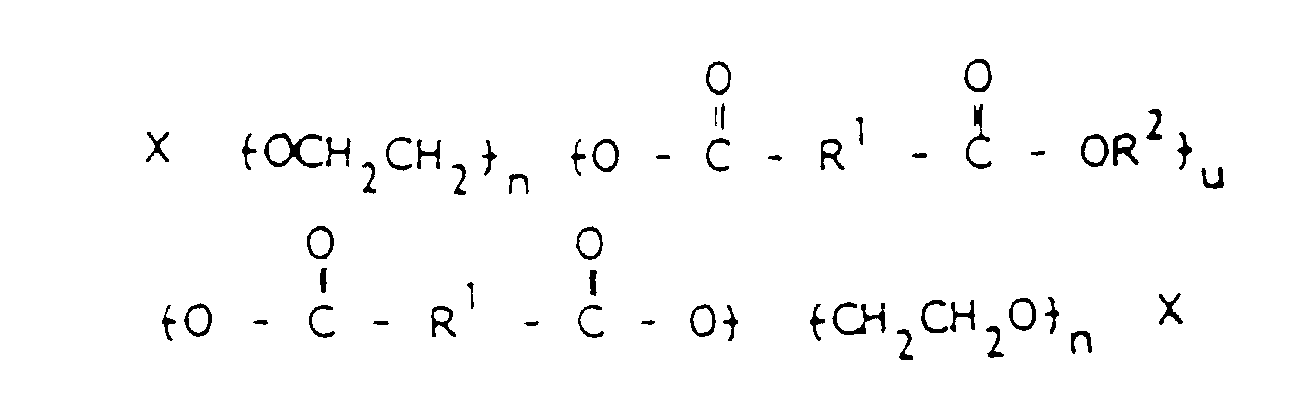
wherein X is methyl, n is 16, R1 is 1,4-phenylene moiety, R2 is 1,2-propylene moiety and u is essentially between 3 and 5.
wherein X is methyl, n is 16, R1 is 1,4-phenylene moiety, R2 is 1,2-propylene moiety and u is essentially between 3 and 5.
3. An emulsion according to any of the preceding claims wherein the level of said terephthalate-based
polyester is from 0.1% to 2 % by total weight of the emulsion.
4. An emulsion according to any of the preceding claims wherein the nonionic surfactant
amount is from 2 % to 50 % by weight of the total emulsion, preferably from 5 % to
40 %, most preferably from 8 % to 30 %.
5. An emulsion according to any of the preceding claims wherein the difference between
the HLB values of the hydrophilic nonionic surfactants and the hydrophobic nonionic
surfactants is at least 3.
6. An emulsion according to any of the preceding claims which further comprises hydrogen
peroxide or a water soluble source thereof and a bleach activator wherein said bleach
activator is emulsified by the nonionic surfactants.
7. An emulsion according to claim 6 which comprises from 0.5% to 20% by weight of the
total emulsion of said hydrogen peroxide.
8. An emulsion according to claims 6 and 7 wherein said bleach activator is acetyl triethyl
citrate.
9. An emulsion according to any of the preceding claims which has a viscosity in the
range of from 100 cps to 3000 cps at 50 rpm shear rate at 25°C, preferably from 300
cps to 1500 cps.
10. A detergent composition comprising an emulsion according to any of the preceding claims.
1. Stabile wäßrige Emulsion mit einem pH von 0,5 bis 6, umfassend mindestens ein hydrophiles
nichtionisches Tensid mit einem HLB oberhalb 11, und mindestens ein hydrophobes nichtionisches
Tensid mit einem HLB unterhalb 10, dadurch gekennzeichnet, daß die wäßrige Emulsion
weiterhin 0,05 bis 5 Gew. -% der gesamten Emulsion eines Polyesters auf Terephthalatbasis
umfaßt.
2. Emulsion nach Anspruch 1, wobei der Polyester auf Terephthalatbasis ein Polymer der
Formel
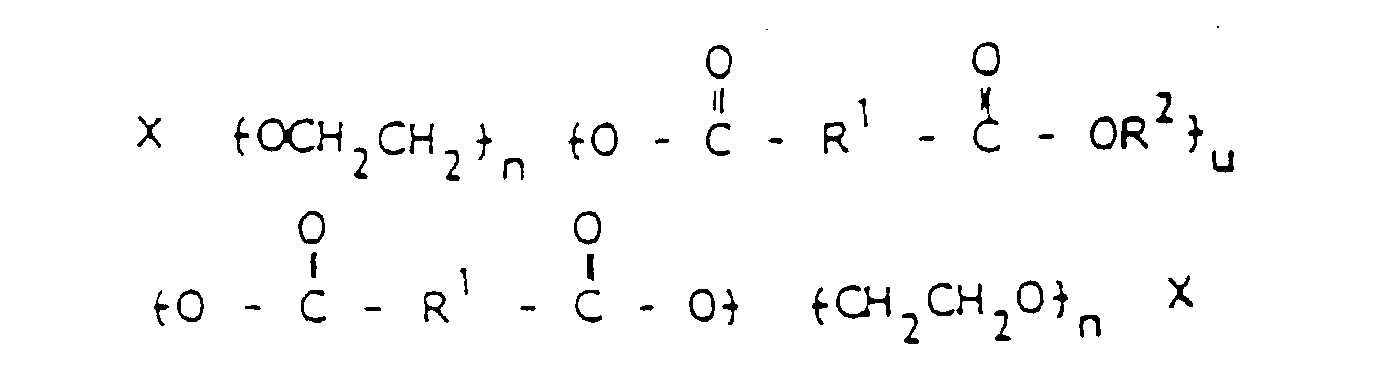
ist, worin X Methyl ist, n 16 ist, R1 eine 1,4-Phenyleneinheit ist, R2 eine 1,2-Propyleneinheit ist, und u im wesentlichen zwischen 3 und 5 liegt.
ist, worin X Methyl ist, n 16 ist, R1 eine 1,4-Phenyleneinheit ist, R2 eine 1,2-Propyleneinheit ist, und u im wesentlichen zwischen 3 und 5 liegt.
3. Emulsion nach mindestens einem der vorangehenden Ansprüche, wobei der Anteil des Polyesters
auf Terephthalatbasis 0,1 bis 2% des Gesamtgewichts der Emulsion beträgt.
4. Emulsion nach mindestens einem der vorangehenden Ansprüche, wobei die Menge des nichtionischen
Tensids 2 bis 50 Gew.-% der gesamten Emulsion, vorzugsweise 5 bis 40%, am meisten
bevorzugt 8 bis 30%, beträgt.
5. Emulsion nach mindestens einem der vorangehenden Ansprüche, wobei der Unterschied
zwischen den HLB-Werten der hydrophilen nichtionischen Tenside und der hydrophoben
nichtionischen Tenside mindestens 3 beträgt.
6. Emulsion nach mindestens einem der vorangehenden Ansprüche, welche weiterhin Wasserstoffperoxid
oder eine wasserlösliche Quelle hierfür und einen Bleichaktivator umfaßt, wobei der
Bleichaktivator durch die nichtionischen Tenside emulgiert ist.
7. Emulsion nach Anspruch 6, umfassend 0,5 bis 20 Gew.-% der gesamten Emulsion an dem
Wasserstoffperoxid.
8. Emulsion nach den Ansprüchen 6 und 7, wobei der Bleichaktivator Acetyltriethylcitrat
ist.
9. Emulsion nach mindestens einem der vorangehenden Ansprüche, welche eine Viskosität
im Bereich von 100 cps bis 3.000 cps bei einer Scherrate von 50 U/min bei 25°C, vorzugsweise
vom 300 cps bis 1.500 cps, aufweist.
10. Reinigungsmittelzusammensetzung, umfassend eine Emulsion nach mindestens einem der
vorangehenden Ansprüche.
1. Emulsion aqueuse stable ayant un pH de 0,5 à 6, comprenant au moins un agent tensioactif
hydrophile non ionique ayant une balance hydrophile-lipophile (BHL) supérieure à 11
et au moins un agent tensioactif hydrophobe non ionique ayant une BHL inférieure à
10, caractérisé en ce que ladite émulsion aqueuse comprend en outre de 0,05 % à 5
% en poids de l'émulsion totale d'un polyester à base de téréphtalate.
2. Emulsion selon la revendication 1, dans laquelle ledit polyester à base de téréphtalate
est un polymère selon la formule :
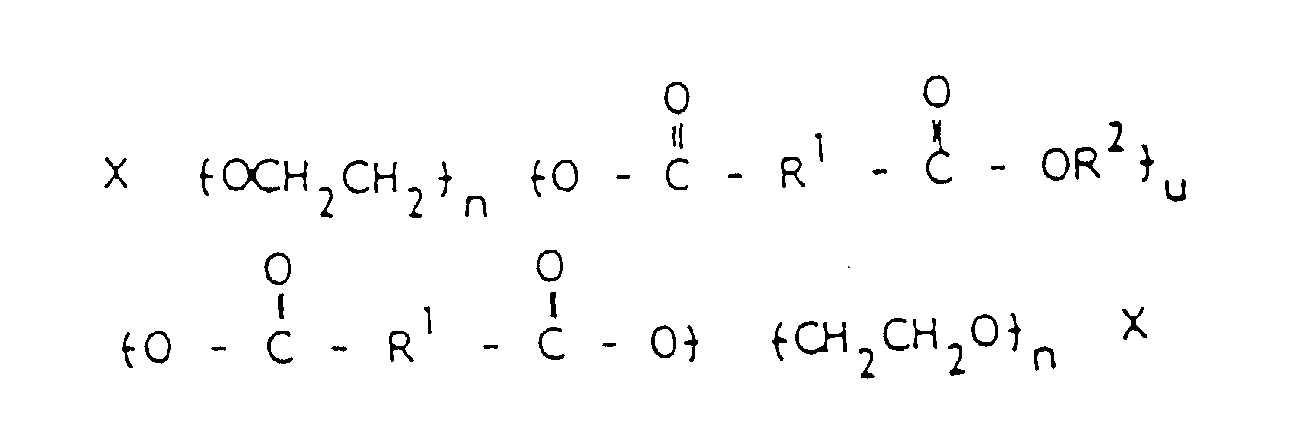
dans laquelle X représente un méthyle, n vaut 16, R1 représente un radical 1,4-phénylène, R2 représente un radical 1,2-propylène et u vaut essentiellement entre 3 et 5.
dans laquelle X représente un méthyle, n vaut 16, R1 représente un radical 1,4-phénylène, R2 représente un radical 1,2-propylène et u vaut essentiellement entre 3 et 5.
3. Emulsion selon l'une quelconque des revendications précédentes, dans laquelle le niveau
dudit polyester à base de téréphtalate vaut de 0,1 à 2 % en poids total de l'émulsion.
4. Emulsion selon l'une quelconque des revendications précédentes, dans laquelle la quantité
d'agent tensioactif non ionique représente 2 % à 50 % en poids de l'émulsion totale,
de préférence 5 % à 40 %, ou encore mieux de 8 % à 30 %.
5. Emulsion selon l'une quelconque des revendications précédentes, dans laquelle la différence
entre les valeurs de BHL des agents tensioactifs non ioniques hydrophiles et des agents
tensioactifs non ioniques hydrophobes est d'au moins 1, de préférence 3.
6. Emulsion selon l'une quelconque des revendications précédentes, qui comprend en outre
du peroxyde d'hydrogène ou une source de peroxyde d'hydrogène soluble dans l'eau et
un activateur de blanchiment, où ledit activateur de blanchiment est émulsifié par
les agents tensioactifs non ioniques.
7. Emulsion selon la revendication 6, qui comprend de 0,5 % à 20 % en poids de l'émulsion
totale dudit peroxyde d'hydrogène.
8. Emulsion selon les revendications 6 et 7, où ledit activateur de blanchiment est le
citrate d'acétyle et de triéthyle.
9. Emulsion selon l'une quelconque des revendications précédentes, qui a une viscosité
comprise dans un intervalle de 100 cP à 3 000 cP à une vitesse de cisaillement de
50 tpm à 25°C, de préférence de 300 cP à 1 500 cP.
10. Composition détergente comprenant une émulsion selon l'une quelconque des revendications
précédentes.