| (19) |
 |
|
(11) |
EP 0 633 342 B1 |
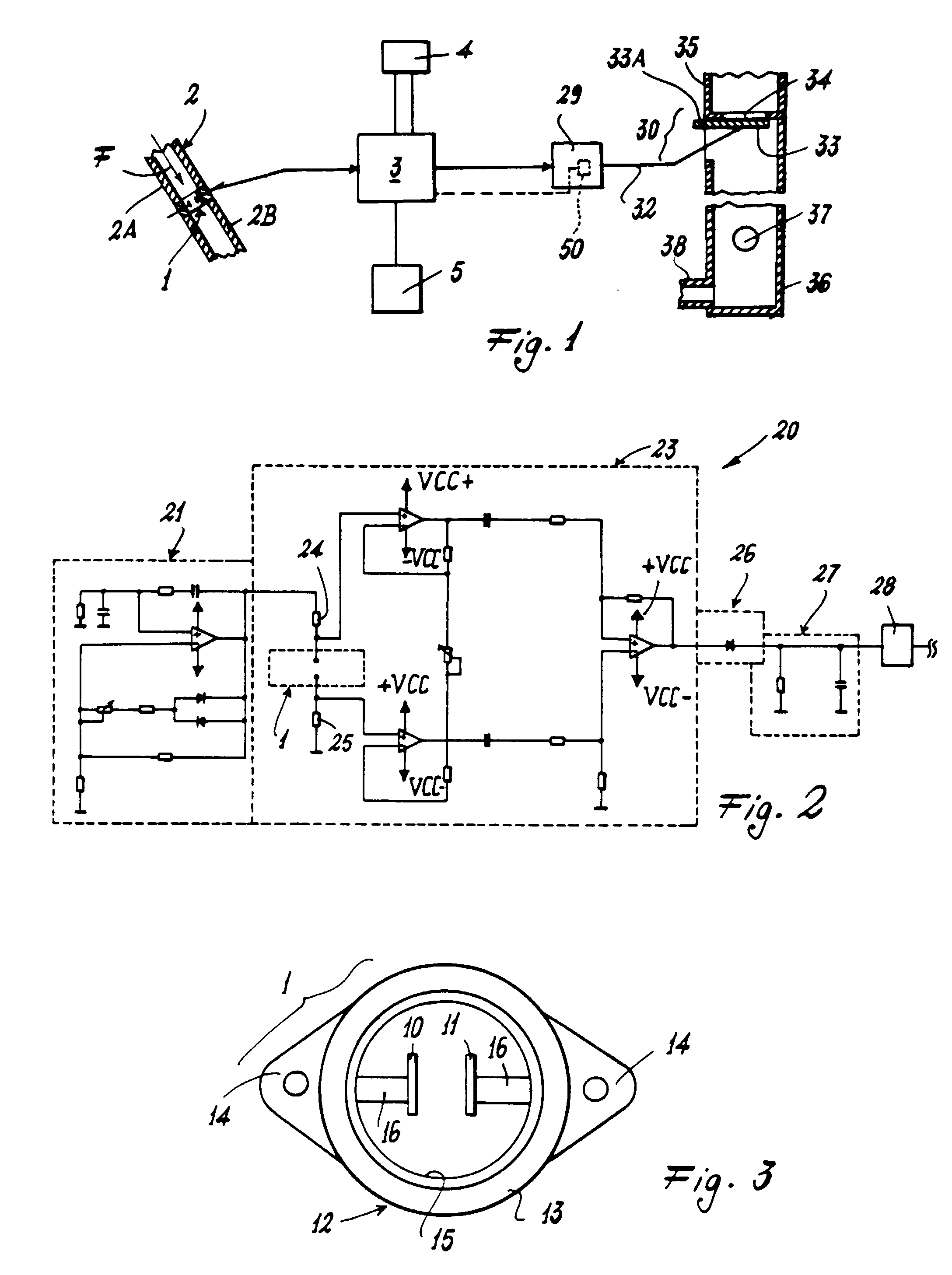
| (12) |
EUROPEAN PATENT SPECIFICATION |
| (45) |
Mention of the grant of the patent: |
|
13.01.1999 Bulletin 1999/02 |
| (22) |
Date of filing: 06.07.1993 |
|
|
| (54) |
Method and device for automatically optimising the use of detergent in a washing machine,
washing-drying machine, dishwasher or the like, by measuring the water hardness
Verfahren und Vorrichtung zum automatischen Optimieren der Waschmittelmenge in einer
Waschmaschine, einem Waschtrockner, einer Geschirrspülmaschine oder Dergleichen durch
Messung der Wasserhärte
Procédé et dispositif pour optimiser automatiquement la quantité de détergent dans
une machine à laver, une machine à laver et à sècher, un lave vaisselle ou similaire
en mesurant la dureté de l'eau
|
| (84) |
Designated Contracting States: |
|
DE FR GB |
| (43) |
Date of publication of application: |
|
11.01.1995 Bulletin 1995/02 |
| (73) |
Proprietor: WHIRLPOOL EUROPE B.V. |
|
5507 SK Veldhoven (NL) |
|
| (72) |
Inventor: |
|
- Turetta, Daniele,
c/o Whirlpool Italia s.r.l.
I-21025 Comerio (VA) (IT)
|
| (74) |
Representative: Guerci, Alessandro |
|
Whirlpool Europe S.r.l.
Patent Department
Viale G. Borghi 27
21025 Comerio (VA)
21025 Comerio (VA) (IT) |
| (56) |
References cited: :
EP-A- 0 506 137
US-A- 3 223 108
|
DD-A- 232 518
US-A- 3 645 669
|
|
| |
|
|
|
|
| |
|
| Note: Within nine months from the publication of the mention of the grant of the European
patent, any person may give notice to the European Patent Office of opposition to
the European patent
granted. Notice of opposition shall be filed in a written reasoned statement. It shall
not be deemed to
have been filed until the opposition fee has been paid. (Art. 99(1) European Patent
Convention).
|
[0001] This invention relates to a washing domestic appliance, i.e. washing machine, washing-drying
machine, dishwasher or the like, which automatically optimizes the use of detergent
by measuring the hardness of the wash water. Hardness is known to be an intrinsic
characteristic of water and is due mainly to the presence of magnesium and calcium
salts. In general, using a given detergent in said machine, the harder the water (i.e.
its richness in said salts) the lesser the washing efficiency of the detergent.
[0002] US-A-3 223 108 discloses a washing machine with three sensing cells. The detergent
quantity can be automatically adjusted according to water hardness. The control system
used in such machine is a feedback system in which one of the three cells senses the
conductivity of the washing solution with consequent problems in term of contamination
of the cell.
[0003] An object of the invention is to provide a washing domestic appliance in which the
automatic optimization of detergent on the basis of the particular hardness of the
wash water is highly reliable with time.
[0004] A further object is to provide a washing domestic appliance which is of simple construction
and low cost. These and further objects which will be apparent to the expert of the
art are attained by a washing domestic appliance in accordance with the appended claims.
[0005] The present invention will be apparent from the accompanying drawing, which is provided
by way of non-limiting example and in which:
Figure 1 is a block diagram of the device of the present invention;
Figure 2 is a circuit scheme of part of the device of the invention, this scheme comprising
usual electrical and/or electronic components which are of clear understanding to
the expert of the art and are hence not described in detail; and
Figure 3 is a front view of part of the scheme of Figure 2 when implemented.
[0006] With reference to said figures, the device of the invention comprises a conductivity
sensor 1 positioned in a pipe 2 through which water enters the tub for example of
a washing machine (not shown). The sensor is associated with a unit 3 for evaluating
the conductivity measured by the sensor 1. For this purpose, the evaluation unit 3
cooperates with a memory 4 containing conductivity reference values. The unit 3, which
is connected to the usual washing machine timer 5, controls the feed of detergent
into the said tub in a quantity proportional to the measured conductivity value.
[0007] More specifically, the sensor 1 is a conductivity cell and measures the conductivity
or impedance between two flat plates 10, 11 arranged parallel to each other and spaced
apart within a support 12 positioned along the water path to the washing machine tub
(represented by the arrow F in Figure 1). This support comprises for example an annular
body 13 provided with lateral lugs 14 for its fixing to any known fixed part of the
washing machine. Internally, the body 13 comprises an annular seal 15 and by means
of arms 16 supports said plates 10, 11. The body 13 is positioned between two portions
2A and 2B of the pipe 2 and is traversed by the water entering the machine.
[0008] The plates 10, 11 are connected to an electrical discriminator circuit 20 for the
conductivity data obtained by the sensor 1.
[0009] This discriminator circuit (shown in Figure 2) comprises a circuit block 21 operating
as an alternating oscillator and hence generating a sinusoidal signal preferably of
frequency between 900 Hz and 1200 Hz to prevent the water undergoing electrolysis
on passing between the plates 10 and 11. The block 21 is connected to a circuit block
23 acting as a high impedance differential amplifier. Before reaching the block 23,
the output signal from the block 21 is fed to the plates 10 and 11 arranged in "bridge"
configuration together with two resistors 24 and 25. The output from the amplifier
23 is fed to a rectifier 26 and then to an integrator 27 so that at the output of
the circuit 20 there is a direct current signal which is fed to a control and operating
unit 28 which acts on an actuator 29 for moving a metering member 30 for the detergent
to be fed to the washing machine tub. The circuit 20 and the unit 28 form the said
evaluation unit 3.
[0010] The actuator 29 is for example an electric stepping motor acting on an arm 32 connected
to a movable flap 33 (hinged at 33A to a fixed part of the machine) which closes an
aperture 34 in a detergent container 35 connected to a vessel 36 to which water flows
from a pipe 37 and from which the detergent can pass into the washing machine tub
via a pipe 38. The arm 32 and flap 33 define said metering member 30.
[0011] The method of the invention will now be described in relation to the use of the device
shown in the aforesaid figures.
[0012] It will be assumed that a wash cycle is commenced in the washing machine. On initial
entry of water into the tub, the sensor 1 positioned in the feed pipe 2 measures the
conductivity of the water by means of a signal generated within the circuit 20 by
the "bridge" defined by the plates 10 and 11 and the resistors 24 and 25. In this
respect, when the hardness of the water varies, the signal emitted by the plates 10
and 11 varies, as consequently does that emitted by said bridge.
[0013] The circuit 20 hence generates a continuous signal as heretofore described,, and
this is fed to the unit 28. This latter is for example a microprocessor circuit or
a logic gate comparison circuit. It compares the signal received from the circuit
20 with predetermined values present in the memory 4 corresponding to particular quantities
of detergent to be fed to the tub.
[0014] Following this comparison and on the basis of it, and following an enabling signal
from the timer 5 (fed when the wash program requires detergent to be fed into the
tub), the unit 28 activates the actuator (or stepping motor) 29 which moves the flap
33 so that it uncovers the aperture 34 to cause a predetermined quantity of detergent
to be delivered. Sensor means (such as an encoder on the usual output shaft of the
motor 29) are provided to determine the movement of the arm 32 and of the flap 33.
These sensors are shown generically and are indicated by 50, they being connected
to the unit 3. On the basis of the signals originating from the sensors 50, the evaluation
unit 3 is able to indirectly know the quantity of detergent which has passed from
the vessel 35 to the vessel 36.
[0015] Alternatively the actuator 29 can be a positive displacement pump which acts directly
on the detergent contained in the vessel 35.
[0016] Other actuators are possible within the scope of the present document.
[0017] Returning to the method of the invention, the control and operating unit 28 therefore
enables detergent to be fed from the container 35 to the vessel 36 in a quantity proportional
to the measured water conductivity (or hardness). The harder the water the greater
the detergent quantity fed to the vessel 36, from which it is fed to the washing machine
tub in known manner.
[0018] A particular embodiment of the invention has been described. Other embodiments falling
within the scope of the present invention are however possible.
1. Washing domestic appliance, i.e. washing machine, washing-drying machine, dishwasher
or the like, comprising a pipe (2) for feeding water into the wash tub or environment,
a detergent container or drawer (35), a member (36) for dispensing this latter into
said tub, a programmer or timer (5) controlling the various operational stages of
the machine, means (1) for measuring the conductivity of the water entering the wash
tub or environment, said means being connected to means (3) for evaluating the measured
conductivity value which, on the basis of this latter value, controlsselector means
(30) for feeding a suitable quantity of detergent into the wash tub or environment,
characterized in that such measuring means (1) comprise one conductivity sensor (1)
placed in said pipe (2) for feeding water into the wash tub or environment, the evaluation
means (3) comprising a control unit (28) connected to the conductivity sensor (1)
via an electrical circuit (20) and cooperating with a memory unit (4) containing predefined
conductivity values and corresponding quantities of detergent to be fed to the wash
tub or environment.
2. Washing domestic appliance according to claim 1, characterized in that said conductivity
sensor (1) is of resistive type.
3. Washing machine appliance according to claim 1, characterized in that the conductivity
sensor (1) is supported by a member (12) associated with the pipe (2) by which the
water is fed into the tub, said member comprising an annular body (13) in which supports
(16) for the conductivity sensor are provided, said body (13) being traversed by the
water entering the wash tub or environment.
4. Washing machine appliance according to claim 1, characterized in that the control
unit (28) is a microprocessor unit.
5. Washing machine appliance according to claim 1, characterized in that the electrical
circuit (20) comprises a circuit block (21) generating an alternating oscillating
signal and connected to a circuit block (23) acting as a differential amplifier with
a high input impedance, the signal emitted by this latter being handled by a circuit
block (26) acting as a rectifier to which there is connected a circuit block (27)
acting as an integrator, this latter being connected to the control unit (28).
6. Washing machine appliance according to claim 5, characterized in that the conductivity
sensor (1) comprises flat elements (10, 11) arranged as a "bridge" with resistive
elements (24, 25) in the electrical circuit (20) downstream of the circuit block (21)
generating the oscillating signal and before the block (23) acting as the amplifier.
7. Washing machine appliance according to claim 5, characterized in that the oscillating
signal generation block (23) generates this signal at a frequency between 900 and
1200 Hz.
8. Washing machine appliance according to claim 1, characterized in that the evaluation
means (3) are connected to the machine programmer or timer (15).
9. Washing machine appliance according to claim 1, characterized in that the selector
means are at least one member (30) acting on the detergent container or drawer such
as to cause the detergent to leave said drawer in a metered quantity, said member
being controlled by actuator means (29) the operation of which is controlled by the
evaluation means (3).
10. Washing machine appliance according to claim 1, characterized by comprising enabling
means (50) operationally connected to the selector means (30) and connected to the
evaluation means (3), to enable these latter to ascertain when the metering of the
detergent has been effected following operation of the selector means (30).
1. Haushaltswaschgerät, nämlich Waschmaschine, Wasch-Trocknungs-Maschine, Geschirrspülmaschine
oder dergleichen, mit einer Wasserleitung (2) zur Zuführung von Wasser zu einer Waschwanne
oder einem Maschinenteil, einem Waschmittelbehälter oder -spender (35), einem Gefäß
(36) zur Abgabe des Waschmittels an die Waschwanne, einem Programm- oder Zeitgeber
(5) zur Steuerung der verschiedenen Betriebsphasen der Maschine, Mitteln (1) zur Messung
der elektrischen Leitfähigkeit des in die Waschwanne oder den Maschinenteil eintretenden
Wassers, wobei die Mittel (1) mit Mitteln (3) zur Auswertung des gemessenen Leitfähigkeitswerts
verbunden sind und diese Auswertemittel (3) auf der Basis dieses Leitfähigkeitswerts
Auswahlmittel (30) zur Abgabe einer geeigneten Menge an Waschmitteln an die Waschwanne
oder den Maschinenteil steuern, dadurch gekennzeichnet, daß die Meßmittel (1) einen Leitfähigkeitssensor (1) aufweisen, der in der Wasser
zur Waschwanne oder zum Maschinenteil zuleitenden Wasserleitung (2) angeordnet ist,
und daß die Auswertemittel (3) eine Steuereinheit (28) aufweisen, die mit dem Leitfähigkeitssensor
(1) über eine elektrische Schaltung (20) verbunden ist und die mit einer Speichereinheit
(4) zusammenarbeitet, die bestimmte Leitfähigkeitswerte enthält, die Mengen des der
Waschwanne oder dem Maschinenteil zuzuführenden Waschmittels entsprechen.
2. Haushaltswaschgerät nach Anspruch 1, dadurch gekennzeichnet, daß der Leitfähigkeitssensor
(1) ein elektrischer Widerstand ist.
3. Waschmaschine nach Anspruch 1, dadurch gekennzeichnet, daß der Leitfähigkeitssensor
(1) von einem Glied (12) getragen wird, das mit der Wasser zur Wanne führenden Wasserleitung
(2) verbunden ist, und daß dieses Glied (12) einen Ringkörper (13) aufweist, in dem
Träger (16) für den Leitfähigkeitssensor vorgesehen sind und durch den das in die
Waschwanne oder den Maschinenteil eintretende Wasser fließt.
4. Waschmaschine nach Anspruch 1, dadurch gekennzeichnet, daß die Steuereinheit (28)
eine Mikroprozessoreinheit ist.
5. Waschmaschine nach Anspruch 1, dadurch gekennzeichnet, daß die elektrische Schaltung
(20) einen ersten Schaltungsteil (21), der ein Oszillatorsignal erzeugt, einen mit
diesem Schaltungsteil verbundenen, zweiten Schaltungsteil (23), der als Differenzverstärker
mit einem hohen Eingangswiderstand arbeitet, einen dritten Schaltungsteil (26), dem
das vom Differenzverstärker abgegebene Signal zugeführt wird und der als Gleichrichter
arbeitet, und einen mit diesem Gleichrichter verbundenen, vierten Schaltungsteil (27)
aufweist, der als Integrator arbeitet und mit der Steuereinheit (28) verbunden ist.
6. Waschmaschine nach Anspruch 5, dadurch gekennzeichnet, daß der Leitfähigkeitssensor
(1) flache Elemente (10, 11) aufweist, die zusammen mit Widerständen (24, 25) in der
elektrischen Schaltung (20) zwischen dem ersten Schaltungsteil (21) und dem zweiten
Schaltungsteil (23) eine Brückenschaltung bilden.
7. Waschmaschine nach Anspruch 5, dadurch gekennzeichnet, daß der erste Schaltungsteil
(21) ein Oszillatorsignal mit einer Frequenz zwischen 900 und 1200Hz erzeugt.
8. Waschmaschine nach Anspruch 1, dadurch gekennzeichnet, daß die Auswertemittel (3)
mit dem Maschinenprogramm- oder Zeitgeber (15) verbunden sind.
9. Waschmaschine nach Anspruch 1, dadurch gekennzeichnet, daß die Auswahlmittel durch
mindestens ein Glied (30) gebildet sind, das auf den Waschmittelbehälter oder Waschmittelspender
so einwirkt, daß das Waschmittel von diesem Behälter in einer bestimmten Menge abgegeben
wird, und daß dieses Glied (30) von Stellmitteln (29) gesteuert wird, deren Betrieb
von den Auswertemitteln (3) gesteuert wird.
10. Waschmaschine nach Anspruch 1, dadurch gekennzeichnet, daß Freigabemittel (50) vorgesehen
sind, die mit den Auswahlmitteln (30) betrieblich und mit den Auswertemitteln (3)
verbunden sind und die den Auswertemitteln (3) zur Kenntnis bringen, wenn die Abmessung
des Waschmittels nach dem Betrieb der Auswahlmittel (30) bewirkt worden ist.
1. Appareil domestique de lavage, c'est-à-dire un lave-linge, un lave-linge séchant,
un lave-vaisselle ou analogue, comprenant une conduite (2) de transmission d'eau dans
la cuve de lavage ou à proximité, un tiroir ou récipient de détergent (35), un organe
(36) de distribution du détergent dans la cuve, une minuterie ou un programmateur
(5) qui commande les diverses étapes du fonctionnement de la machine, un dispositif
(1) de mesure de la conductivité de l'eau entrant dans la cuve de lavage ou à proximité,
le dispositif étant raccordé à un dispositif (3) d'évaluation de la valeur mesurée
de la conductivité et qui, en fonction de cette dernière valeur, commande un dispositif
sélecteur (30) pour la transmission d'une quantité convenable de détergent dans la
cuve de lavage ou à proximité, caractérisé en ce que le dispositif de mesure (1) comprend
un capteur (1) de conductivité placé dans la conduite (2) de transmission d'eau à
la cuve de lavage ou à proximité, le dispositif d'évaluation (3) comprenant une unité
de commande (28) raccordée au capteur de conductivité (1) par un circuit électrique
(20) et coopérant avec une unité à mémoire (4) contenant des valeurs prédéfinies de
la conductivité et des quantités correspondantes de détergent à transmettre à la cuve
de lavage ou à proximité.
2. Appareil domestique de lavage selon la revendication 1, caractérisé en ce que le capteur
de conductivité (1) est de type résistif.
3. Appareil pour machine de lavage selon la revendication 1, caractérisé en ce que le
capteur de conductivité (1) est supporté par un organe (12) associé à la conduite
(2) par laquelle l'eau est transmise à la cuve, l'organe comprenant un corps annulaire
(13) dans lequel sont placés les supports (16) du capteur de conductivité, le corps
(13) étant parcouru par l'eau qui pénètre dans la cuve de lavage ou à proximité.
4. Appareil pour machine de lavage selon la revendication 1, caractérisé en ce que l'unité
de commande (28) est une unité à microprocesseur.
5. Appareil pour machine de lavage selon la revendication 1, caractérisé en ce que le
circuit électrique (20) comprend un bloc (21) de circuit qui crée un signal oscillant
alternatif et connecté à un bloc (23) de circuit jouant le rôle d'un amplificateur
différentiel ayant une impédance d'entrée élevée, le signal émis par ce dernier étant
traité par un bloc de circuit (26) jouant le rôle d'un redresseur auquel est raccordé
un bloc de circuit (27) jouant le rôle d'un intégrateur, ce dernier étant connecté
à l'unité de commande (28).
6. Appareil pour machine de lavage selon la revendication 5, caractérisé en ce que le
capteur de conductivité (1) comprend des éléments plats (10, 11) disposés en "pont"
avec des éléments résistifs (24, 25) dans le circuit électrique (20) en aval du bloc
de circuit (21) qui crée le signal oscillant et avant le bloc (23) qui joue le rôle
de l'amplificateur.
7. Appareil pour machine de lavage selon la revendication 5, caractérisé en ce que le
bloc (23) qui crée le signal oscillant crée ce signal à une fréquence comprise entre
900 et 1 200 Hz.
8. Appareil pour machine de lavage selon la revendication 1, caractérisé en ce que le
dispositif d'évaluation (3) est connecté au programmateur ou à la minuterie de la
machine (15).
9. Appareil pour machine de lavage selon la revendication 1, caractérisé en ce que le
dispositif sélecteur est au moins un organe (30) qui agit sur le tiroir ou récipient
de détergent afin qu'il provoque la sortie du détergent du tiroir en quantité dosée,
cet organe étant commandé par un dispositif de manoeuvre (29) dont le fonctionnement
est commandé par le dispositif d'évaluation (3).
10. Appareil pour machine de lavage selon la revendication 1, caractérisé en ce qu'il
comprend un dispositif (50) de validation connecté pendant le fonctionnement au dispositif
sélecteur (30) et connecté au dispositif d'évaluation (3) afin qu'il permette à ce
dernier de déterminer lorsque le dosage du détergent a été réalisé après le fonctionnement
du dispositif sélecteur (30).