|
(11) | EP 0 638 554 B1 |

| (12) | EUROPEAN PATENT SPECIFICATION |
|
|
| (54) |
Process for producing a N-phenyl-N-(4-piperidinyl) amide derivative Verfahren zur Herstellung von N-Phenyl-N-(4-Piperidinyl)Amid-Derivaten Procédé de production d'un dérivé de N-phényl-N-(4-piperidinyl)amide |
|
|
|||||||||||||||||||||||||||||||||||
| Note: Within nine months from the publication of the mention of the grant of the European patent, any person may give notice to the European Patent Office of opposition to the European patent granted. Notice of opposition shall be filed in a written reasoned statement. It shall not be deemed to have been filed until the opposition fee has been paid. (Art. 99(1) European Patent Convention). |
[0001] This invention relates to a process for preparing a piperidine derivative which is useful in the preparation of compounds having analgesic activity.
[0002] A number of N-phenyl-N-(4-piperidinyl)amide derivatives have been described as analgesics and examples of such compounds are described in USP 3998834 and USP 5019583. A subclass of these N-phenyl-N-(4-peridinyl)amide derivatives having analgesic activity are those containing the grouping
and such compounds are conveniently prepared from the N-benzyl compound (I)
USP 3998834 specifically teaches that the N-benzyl compound (I) may be prepared from the carboxylic acid (II) by the route outlined below.
[0003] The carboxylic acid (II) is converted into the corresponding sodium salt (III) which is then reacted with methyl iodide to give the ester (IV). Reaction of the ester (IV) with propionic anhydride then yields the required N-benzyl compound (I) which is purified by column chromatography.
[0004] The present invention relates to an improved process for preparing the N-benzyl compound (I) from the carboxylic acid (II) in a high yield. Furthermore the process has the advantage that relatively low reaction temperatures may be used, short reaction times, a simple isolation procedure and avoids the use of toxic reagents (methyl iodide or dimethyl sulphate) and thus is particularly convenient for the large scale manufacture of (I).
[0005] Accordingly the present invention provides a process for the preparation of the N-benzyl compound of formula (I) which comprises reacting the carboxylic acid (II) or an acid addition salt thereof with propionic anhydride in the presence of a base and then without prior isolation treating the resultant product with methanol.
[0006] The reaction of the compound of formula (II) with propionic anhydride is conveniently carried out in an aprotic solvent such as a hydrocarbon e.g. toluene or an ester e.g. ethyl acetate or isopropyl acetate and in the presence of a base. Examples of suitable bases include tertiary amines such as trialkylamines e.g. triethylamine or heteroaryl amines e.g. pyridine. This reaction is also conveniently carried out at a temperature within the range 15-120° e.g. 15-80° and more particularly at ambient temperature or with heating e.g. 50-80°.
[0008] In a preferred aspect of the invention, the compound of formula (II) or an acid addition salt thereof is reacted with an excess of propionic anhydride in an aprotic solvent such as ethyl acetate and in the presence of an excess of the tertiary base e.g. triethylamine and at a reaction temperature between 15-80° e.g. ambient temperature or with heating e.g. 50-80°. The product of this reaction without prior isolation is then reacted with methanol and conveniently this reaction is carried out with heating e.g. 50-80°C.
[0009] The compound of formula (I) is conveniently isolated in the form of an acid addition salt thereof and in particular an oxalate salt thereof.
[0010] The compound of formula (I) and acid addition salts thereof is a particularly useful intermediate for preparing compounds described in USP 5019583 and in particular 3-[4-methoxycarbonyl-4-[(1-oxopropyl)phenylamino]-1-piperidine]-propanoic acid, methyl ester and acid addition salts thereof e.g. the hydrochloride. A particularly convenient method for preparing 3-[4-methoxycarbonyl-4-[(1-oxopropyl)phenylamino]-1-piperidine]propanoic acid methyl ester from the compound of formula (I) is described in USP 5019583.
[0011] In order that the invention may be more fully understood the following examples are given by way of illustration only.
Methyl 4-[N-(1-oxopropyl)-N-phenylamino]-1-(phenylmethyl)-4-piperidinecarboxylate oxalate
[0012] A suspension of (4-phenylamino)-1-(phenylmethyl)-4-piperidine carboxylate hydrochloride (3.93kg) in ethyl acetate (25.5 l) was treated with propionic anhydride (8.7 l) washed in with ethyl acetate (2 l) and the suspension heated to reflux. Triethylamine (4.7 l) was added, washed in with ethyl acetate (2 l) and the mixture held at reflux for 1h. Methanol (7.9 l) was added to give a clear solution, which was heated at reflux for a further 2h and cooled to room temperature. 5M sodium hydroxide solution (22 l) was added and the phases were separated. The aqueous phase was extracted with ethyl acetate (20 l). The combined organic phase extracts were washed with 2M sodium hydroxide solution (20 l) and water (2 x20 l). The organic phase was treated with water (20 l) and phosphoric acid solution (2.5M, 10.5 l) was added until the pH of the aqueous phase was 6.1. The phases were separated and the aqueous phase discarded. A solution of oxalic acid (1.14kg) in methanol (4 l) was added to the organic phase to give a white suspension which was stirred for 1h, filtered and the product washed with ethyl acetate (2 x 4 l) and dried to give the title compound (4.543kg).
Example 2
Methyl 4-[N-(1-oxopropyl)-N-phenylamino]-1-(phenylmethyl)-4-piperidinecarboxylate oxalate
[0013] A suspension of (4-phenylamino)-1-(phenylmethyl)-4-piperidine carboxylate hydrochloride (20g), and propionic anhydride (52ml) in ethyl acetate (150ml) was treated with triethylamine (24ml) and the mixture was stirred at ambient temperature for 16h. The suspension was heated to about 60°, and methanol (40ml) was added to give a clear solution, which was heated at reflux for a further 3h. The solution was cooled to room temperature, sodium hydroxide solution (5M, 112ml), was added, and the phases were separated. The aqueous phase was extracted with ethyl acetate (100ml). The combined organic extracts were washed with sodium hydroxide solution (2M, 100ml) and water (2x100ml). The organic phase was treated with water (100ml) and then phosphoric acid solution (25% w/v, ca 35ml) was added until the pH of the aqueous phase was 6.0-6.2. The phases were separated and the aqueous phase was discarded. A solution of oxalic acid dihydrate (7.26g) in methanol (20ml) was added to give a white suspension. The suspension was stirred for 40 min and filtered. The product was washed with ethyl acetate (2x20ml) and dried in vacuo at 45° overnight to give the title compound (24g).
1. A process for the preparation of the compound of formula (I)
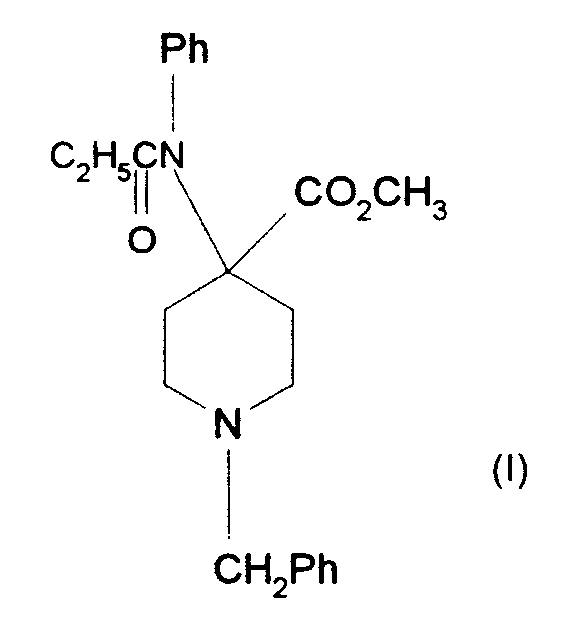
which comprises reacting a compound of formula (II) or an acid addition salt thereof
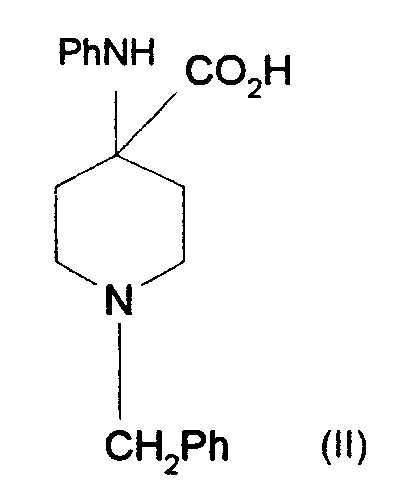
with propionic anhydride in the presence of a base and then without prior isolation treating the resultant product with methanol.
which comprises reacting a compound of formula (II) or an acid addition salt thereof
with propionic anhydride in the presence of a base and then without prior isolation treating the resultant product with methanol.
2. A process as claimed in Claim 1 wherein the base is a tertiary amine.
3. A process as claimed in Claims 1 or 2 wherein the reaction of the compound of formula
(II) with propionic anhydride is carried out in an aprotic solvent.
4. A process as claimed in any of Claims 1 to 3 wherein the reaction is carried out at
a temperature within the range 15-120°.
5. A process as claimed in any of Claims 1 to 4 wherein the reaction of the compound
of formula (II) with propionic anhydride is carried out at a temperature within the
range 15-80°.
6. A process as claimed in any of Claims 1 to 5 wherein subsequent reaction with methanol
is carried out at a temperature within the range 50-80°.
7. A process as claimed in any of Claims 1 to 6 wherein the compound of formula (I) is
isolated in the form of an acid addition salt thereof.
1. Verfahren zur Herstellung der Verbindung der Formel (I):
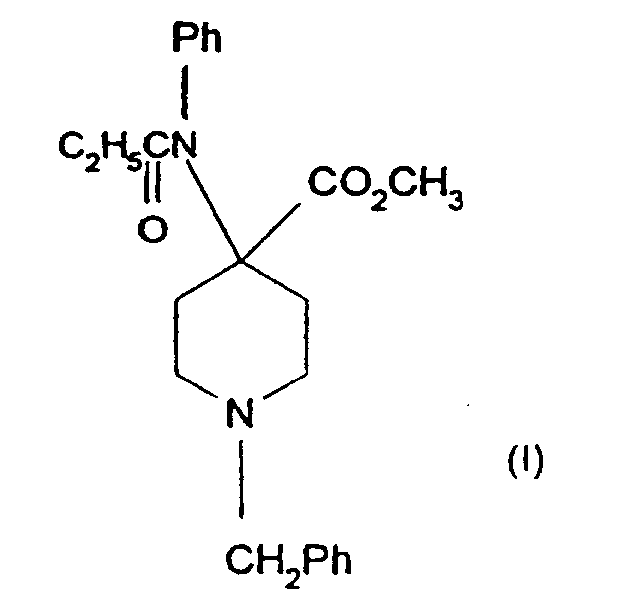
umfassend die Umsetzung einer Verbindung der Formel (II) oder eines Säureadditionssalzes davon:
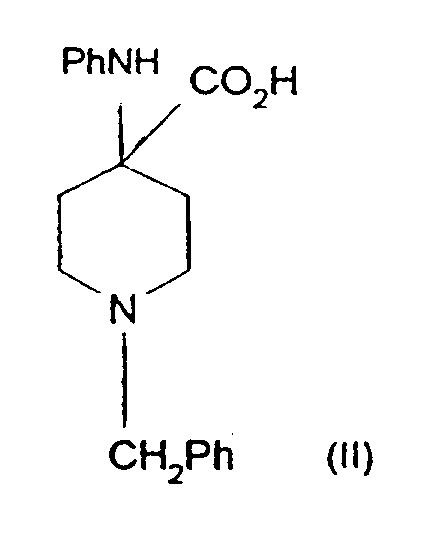
mit Propionsäureanhydrid in Anwesenheit einer Base und dann ohne vorherige Isolierung die Behandlung des entstehenden Produkts mit Methanol.
umfassend die Umsetzung einer Verbindung der Formel (II) oder eines Säureadditionssalzes davon:
mit Propionsäureanhydrid in Anwesenheit einer Base und dann ohne vorherige Isolierung die Behandlung des entstehenden Produkts mit Methanol.
2. Verfahren nach Anspruch 1, dadurch gekennzeichnet, daß die Base ein tertiäres Amin ist.
3. Verfahren nach einem der Ansprüche 1 oder 2, dadurch gekennzeichnet, daß die Reaktion der Verbindung der Formel (II) mit Propionsäureanhydrid in einem
aprotischen Lösungsmittel durchgeführt wird.
4. Verfahren nach einem der Ansprüche 1 bis 3, dadurch gekennzeichnet, daß die Reaktion bei einer Temperatur im Bereich von 15 bis 120°C durchgeführt wird.
5. Verfahren nach einem der Ansprüche 1 bis 4, dadurch gekennzeichnet, daß die Reaktion der Verbindung der Formel (II) mit Propionsäureanhydrid bei einer
Temperatur im Bereich von 15 bis 80°C durchgeführt wird.
6. Verfahren nach einem der Ansprüche 1 bis 5, dadurch gekennzeichnet, daß die darauffolgende Reaktion mit Methanol bei einer Temperatur im Bereich von
50 bis 80°C durchgeführt wird.
7. Verfahren nach einem der Ansprüche 1 bis 6, dadurch gekennzeichnet, daß die Verbindung der Formel (I) in Form ihres Säureadditionssalzes isoliert wird.
1. Procédé de préparation du composé de la formule (I) :
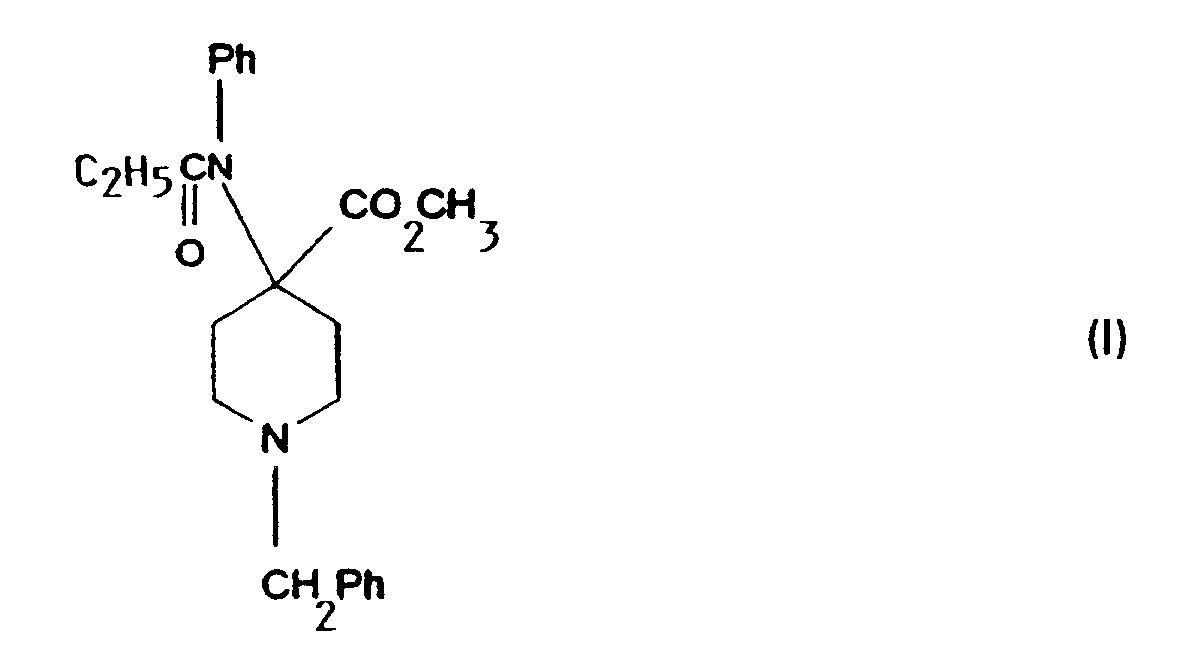
caractérisé en ce qu'on fait réagir un composé de la formule (II) ou un sel d'addition d'acide de celui-ci
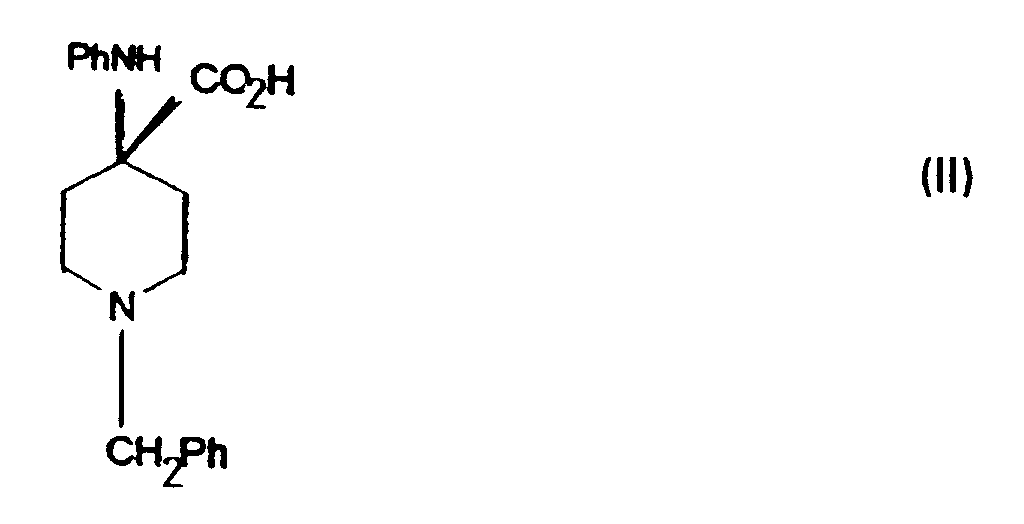
avec de l'anhydride propionique, en présence d'une base et on traite le produit ainsi obtenu par le méthanol sans isolement préalable.
caractérisé en ce qu'on fait réagir un composé de la formule (II) ou un sel d'addition d'acide de celui-ci
avec de l'anhydride propionique, en présence d'une base et on traite le produit ainsi obtenu par le méthanol sans isolement préalable.
2. Procédé suivant la revendication 1, caractérisé en ce que la base est une amine tertiaire.
3. Procédé suivant la revendication 1 ou 2, caractérisé en ce que l'on entreprend la
réaction du composé de la formule (II) avec l'anhydride propionique dans un solvant
aprotique.
4. Procédé suivant l'une quelconque des revendications 1 à 3, caractérisé en ce que l'on
entreprend la réaction à une température de 15 à 120°.
5. Procédé suivant l'une quelconque des revendications 1 à 4, caractérisé en ce que l'on
entreprend la réaction du composé de la formule (II) avec l'anhydride propionique
à une température qui varie dans la plage de 15 à 80°.
6. Procédé suivant l'une quelconque des revendications 1 à 5, caractérisé en ce que l'on
entreprend la réaction subséquente avec le méthanol à une température qui varie de
50 à 80°.
7. Procédé suivant l'une quelconque des revendications 1 à 6, caractérisé en ce que l'on
isole le composé de la formule (I) sous la forme d'un sel d'addition d'acide de celui-ci.