|
(11) | EP 0 652 045 B1 |

| (12) | EUROPEAN PATENT SPECIFICATION |
|
|
| (54) |
Aromatic polyethersulfone gas separation membranes Gastrennungsmembranen aus aromatischem Polyethersulfon Membranes de séparation de gaz en polyéthersulfone aromatique |
|
|
|||||||||||||||||||||||||||||||
| Note: Within nine months from the publication of the mention of the grant of the European patent, any person may give notice to the European Patent Office of opposition to the European patent granted. Notice of opposition shall be filed in a written reasoned statement. It shall not be deemed to have been filed until the opposition fee has been paid. (Art. 99(1) European Patent Convention). |
FIELD OF THE INVENTION
[0001] The present invention relates to aromatic polyethersulfone gas separation membranes and to a process for separating one or more gases from a gaseous, mixture using such membranes. The polyethersulfones are derived from certain alkyl substituted aromatic alcohols. The inventive gas separation membranes exhibit exceptionally good permeation rates with good selectivity.
PRIOR ART
[0002] Aromatic polyethersulfones, particularly polyethersulfones made from aromatic alcohols are well known in the art. Gas separation membranes made from polyethersulfones are also known in the art. For example, U.S. Patent No. 5,071,448 describes gas separation membranes made from alkyl substituted aromatic polyethersulfones. U.S. Patent No. 5,163,977 describes a method of applying a non-ionic surfactant to polymeric gas separation membranes, including membranes made from substituted aromatic polyethersulfones. U.S. Patent No. 5,152,811 describes a gas separation membrane made from aromatic polyethersulfones substituted with multiple radicals such as hydrocarbon radicals.
[0003] In addition, U.S. Patent Nos. 3,709,841; 3,855,122 and 4,625,000 describe sulfonated aromatic polyethersulfones which may be fabricated into membranes which are useful for reverse osmosis processes.
[0004] The polyethersulfone membrane compositions of the prior art, although useful as gas separating membranes, not only suffer from the disadvantages of having to satisfy specific structural constraints, but are also difficult to fabricate into configurations such as hollow fiber membranes because these compositions tend to be soluble in relatively few solvents. Moreover, the membranes of the prior art tend to have relatively low flux. A need therefore exists for fluid separation membranes that avoid the fabrication and solubility problems of the prior art that also provide improved gas separation properties.
SUMMARY OF THE INVENTION
[0005] The present invention relates to certain substituted aromatic polyethersulfone separation membranes which are particularly useful for separating gases and the process for using them. This class of membrane materials compositionally contain units derived from certain alkyl substituted biphenols, preferably a certain tertiary butyl substituted biphenol. Membranes formed from this class of polyethersulfone materials exhibit superior gas permeability and good selectivity. It is believed that the high permeabilities of some gases from multicomponent mixtures is due to the molecular free volume in the polymer which is created by the alkyl substituents on the biphenol units.
DETAILED DESCRIPTION OF THE INVENTION
[0006] The present invention relates to the discovery that gas separation membranes exhibiting exceptional gas permeability can be obtained by forming such gas separation membranes from polyethersulfones as defined in Claim 1.
[0007] Polyethersulfone separation membranes according to the invention possess an excellent balance of gas permeation rates and selectivities of one gas over other gases in a multicomponent gas mixture. The high gas permeability of these membranes is believed to be due to optimization of the molecular free volume in the polymer structure resulting from the incorporation of said alkyl substituted aromatic units in the polyethersulfone chain.
[0008] Generally, an inverse relationship between the gas permeation rate (flux) and the selectivity of the gas over other gases in a multicomponent gas mixture has been exhibited within polymer classes, such as polyethersulfones, polyesters, polyimides, polyamides and polyamide-imides. Because of this, prior art polyethersulfone gas separation membranes generally tend to exhibit either high gas permeation rates at the sacrifice of high gas selectivities or high gas selectivities at the sacrifice of high permeation rates. It would be highly desirable for gas separation membranes to exhibit high gas permeation rates while maintaining high gas selectivities.
[0009] The present invention circumvents the above shortcomings and provides exceptionally high permeation polyethersulfone gas separation membranes while maintaining good selectivity.
[0010] Polyethersulfone materials useful in the present invention can be made from the respective 4,4'-dihydroxybiphenyls, optionally 4,4'-isopropylidenediphenol, phenolphthalein or 4,4'-[2,2,2-trifluoro(trifluoromethyl)ethylidene] bisphenol, and 4,4'-dihalogenodiphenyl sulfone, such as 4,4'-difluorodiphenylsulfone.
[0011] The polyethersulfones have the following repeating structure:
where q,r,s and t are fractions from 0 to 1 where q + s = 1 and r + t = 1 and r is 0.5 to 1.0. (Z)n either represents two t-butyl groups which are respectively located at the 3 and 3' position of the diphenoxy group, and Ar is the moiety derived from 4,4'-[2,2,2-trifluoro (trifluoromethyl)ethylidene] bisphenol or the moiety derived from 4,4'-isopropylidene diphenol, or (Z)n represents four methyl groups which are respectively located at the 3,3',5 and 5' positions of the diphenoxy group, and Ar is the moiety derived from 4,4'-isopropylidene diphenol or the moiety derived from phenolphthalein.
[0012] In general, the polyethersulfones to be used according to this invention have a weight average molecular weight within the preferred range of from 10,000 up to 1,000,000 and more preferably from 50,000 up to 200,000.
[0013] In the preferred process for preparing the polyethersulfone of this invention, approximately equimolar quantities of the alkyl-substituted dihydroxy diphenyl (and optionally the further bisphenols) and the aromatic dihalogenated-sulfone are reacted by well-established procedures known in the art, such as condensation polymerization or solution polymerization. Melt polymerization may also be used.
[0014] The resulting polyethersulfone may then, if desired, be blended with another polymer such as another polyether-sulfone using conventional solution blending technology to yield a blend having specifically tailored properties.
[0015] The polyethersulfone compositions to be used according to the present invention are soluble in a wide range of ordinary organic solvents including most amide solvents such as N-methyl pyrrolidone, and several chlorinated solvents such as dichloromethane and trichloromethane. This is a great advantage for the ease of fabrication of industrially useful gas separation membranes. To prepare membranes in accordance with this invention, the polymer solution is cast as a sheet onto a support, or spun through a cored spinneret to yield a hollow fiber. The solvent is then removed. For example, if a uniform membrane is desired, the solvent is evaporated by heating. On the other hand, if an asymmetric membrane is desired, the film or fiber structure is quenched in a liquid which is a nonsolvent for the polymer and a solvent for the organic solvent already present.
[0016] Gas separation membranes of the present invention possess an excellent balance of gas permeation rates and selectivities for one gas over other gases in a multicomponent gas mixture. Generally, prior polyethersulfone gas separation materials exhibit an inverse relationship between the gas permeation rate and the selectivity of said gas over other gases in a multicomponent gas mixture. The preferred materials of the present invention (Example 1) have been found to have a permeation rate for oxygen of 7.79 Barrer while maintaining a good oxygen/nitrogen selectivity of 4.31.
[0017] The polyethersulfones described in this invention also have high inherent thermal stabilities. They are generally stable up to 350°C in air or inert atmospheres. The glass transition temperatures of these polyethersulfones are generally above 150°C. The high temperature characteristics of these compositions can help to prevent the membrane compaction problems observed in other polymers at even moderate temperatures.
[0018] The polyethersulfone membranes disclosed herein have found use in gas separations. The present invention finds use in the enrichment of oxygen and nitrogen from air for increased combustion or inerting systems, respectively; in recovery of hydrogen in refinery and ammonia plants; separation of carbon monoxide from hydrogen in syngas systems; and separation of carbon dioxide or hydrogen sulfide from hydrocarbons.
[0019] The permeability of gasses through membranes is defined as the Barrer (B).
wherein
(STP) is the flux (flow rate) in cm3 volume per second of permeated gas at standard temperature and pressure,
d is the thickness of the film (in cm),
a is the area of the film (in cm2) and
p is the pressure (or driving force) in cm. Hg.
[0020] The selectivity of a membrane in separating a two component fluid mixture is defined as the ratio of the rate of passage of the more readily passed component to the rate of passage of the less readily passed component. Selectivity may be obtained directly by contacting a membrane with a known mixture of gasses and analyzing the permeate. Alternatively, a first approximation of the selectivity is obtained by calculating the ratio of the rates of passage of the two components determined separately on the same membrane. Rates of passage may be expressed in Barrer (B) units. As an example of selectivity, a O2/N2 = 10 indicates that the subject membrane allows oxygen gas to pass through at a rate 10 times that of nitrogen.
[0021] The invention will now be further illustrated by way of the following Examples, which are considered to be illustrative only, and non-limiting.
EXAMPLES
General Solution Polymerization Procedure
[0022] The polyethersulfones of Examples 1-4 were prepared by the following procedure: A 3-necked round-bottomed flask equipped with a mechanical stirrer and a nitrogen inlet and a Dean-Stark trap was charged with the aromatic diols (Diol 1 and Diol 2 in the mole ratios indicated in Table 1) (1 equivalent), potassium carbonate (2.2 equivalents), the aromatic dihalogenated sulfones (Dihal 1 and Dihal 2 in the mole ratios indicated in Table 1) (1 equivalent). The condensation occurs under anhydrous conditions in an aprotic solvent (NMP or DMAC) with the azeotropic removal of water at elevated temperatures (150-200°C). Toluene is used as the azeotroping solvent. The polymer was precipitated into water and ground up in a blender, washed with water and then methanol (2 times), and air-dried overnight. The polymer was further dried in a vacuum oven at 230°C for 2 hours.
General Film Forming Procedure
[0023] A film of each of the above polyethersulfone was cast from a 10 to 20% by weight N-methylpyrrolidone solution onto a glass plate at 120°C with a 15-mil (38 x 105 m) knife gap. The film was dried on the plate at 120°C for 60-90 minutes and then removed from the plate. The film was air dried overnight. The film was then further dried in a vacuum oven (2.67 kPa) at 230°C for 18 hours.
[0024] The above films (film thicknesses = 1-2.5 mils or 25,4-63 µm) were tested for oxygen permeability (PO2) and mixed gas oxygen/nitrogen (21/79 mole ratio) permeabilities (PO2/PN2) at 500 psig (34.5 x 10⁻⁵ Pa) at 25°C. The results are reported in Table 1.
Table 1
| Ex. | Diol 1 (a) |
Diol 2 (b) |
Mole% (a)/Mole% (b) | Dihal 1 (c) |
dihal 2 (b) |
Mole% (c)/Mole% (d) | PO2 (Barres) |
PO2/PN2 |
| 1 | A | D | 75/25 | X | ---- | 100 | 7.79 | 4.31 |
| 2 | A | E | 50/50 | X | ---- | 100 | 2.62 | 6.04 |
| 3 | B | E | 50/50 | X | ---- | 100 | 4.31 | 5.99 |
| 4 | B | F | 50/50 | X | ---- | 100 | 4.96 | 5.27 |
| Legend A = 3,3'-Di-t-butyl-4n4'-dihydroxybiphenyl (DBBP) D = 4,4-[2,2,2-trifluoromethyl)ethylidene] bisphenol (TMBPF) E = 4,4-Isopropyledenediphenol, Bisphenol A (BPA) X = 4,4-Difluorodiphenylsulfone (DFDPS) B = 3,3',5,5'-tetramethyl-4,4'-dihydroxybiphenyl (TMBP) F = Phenolphthalein |
||||||||
1. A gas separation membrane formed from an aromatic polyethersulfone depicted by the
following repeating formula :
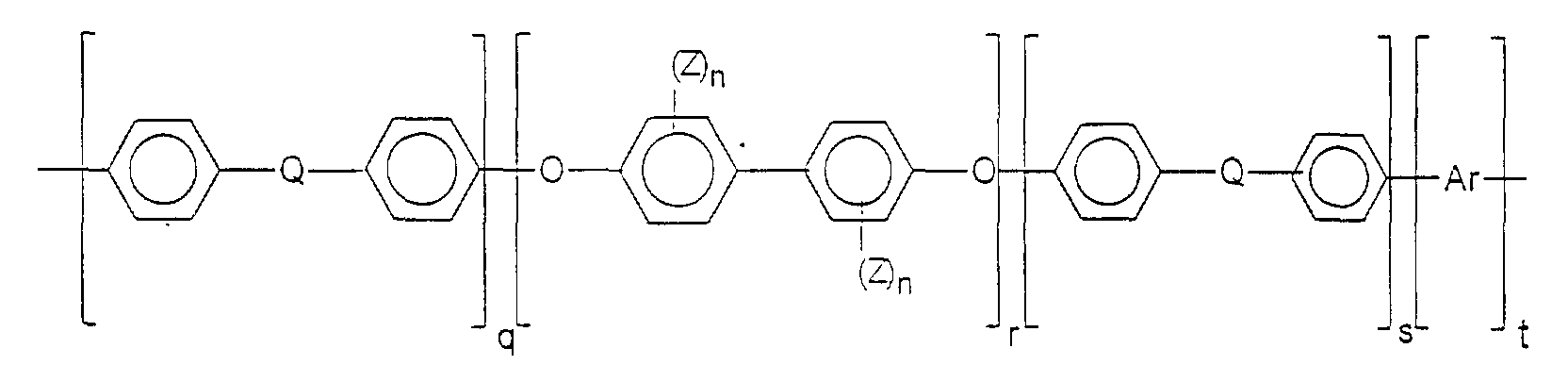
where q, r, s, and t are fractions from 0 to 1, q + s = 1 and r + t = 1 with r is between 0.5 to 1.0 ; Q is -S(=O)2-, and
either (Z)n represents two t-butyl groups which are respectively located at the 3 and 3' positions of the diphenoxy group, and Ar is the moiety derived from 4,4'-[2,2,2-trifluoro (trifluoromethyl) ethylidene] bisphenol or the moiety derived from 4,4'-isopropylidenediphenol,
on (Z)n represents four methyl groups which are respectively located at the 3, 3',5 and 5' positions of the diphenoxy group, and Ar is the moiety derived from 4,4'-isopropylidenediphenol or the moiety derived from phenolphthalein.
where q, r, s, and t are fractions from 0 to 1, q + s = 1 and r + t = 1 with r is between 0.5 to 1.0 ; Q is -S(=O)2-, and
either (Z)n represents two t-butyl groups which are respectively located at the 3 and 3' positions of the diphenoxy group, and Ar is the moiety derived from 4,4'-[2,2,2-trifluoro (trifluoromethyl) ethylidene] bisphenol or the moiety derived from 4,4'-isopropylidenediphenol,
on (Z)n represents four methyl groups which are respectively located at the 3, 3',5 and 5' positions of the diphenoxy group, and Ar is the moiety derived from 4,4'-isopropylidenediphenol or the moiety derived from phenolphthalein.
2. A process for separating one or more gases from a gaseous mixture comprising bringing
said gaseous mixture into contact with the first side of the gas separation membrane
according to claim 1 in a manner to cause a portion of the mixture to pass through
the membrane to a permeate side, the resulting gas mixture on the permeate side being
enriched in one or more components over that of the mixture on the first side.
1. Gastrennmembran aus einem aromatischen Polyethersulfon der folgenden wiederkehrenden
Formel:
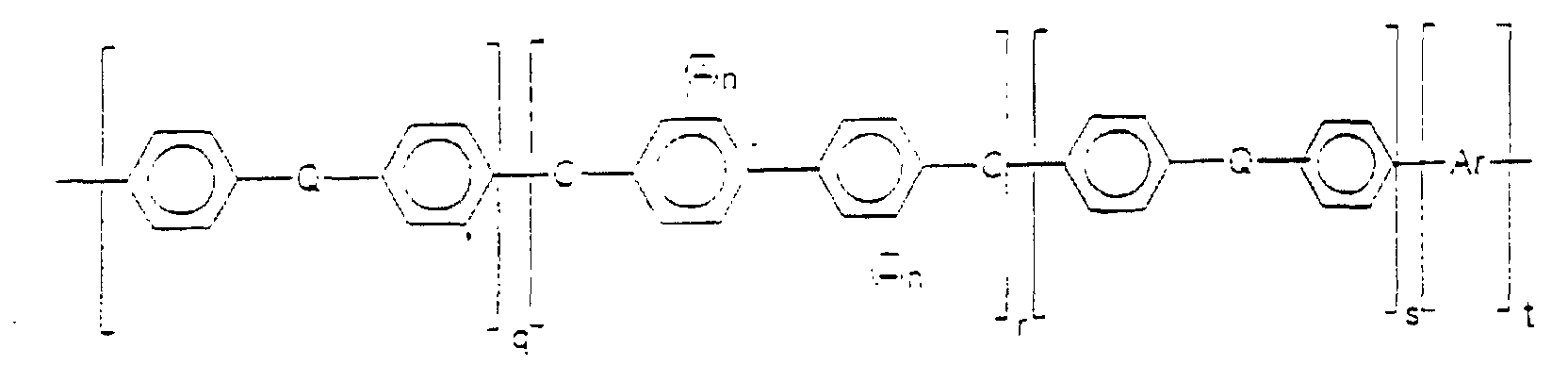
worin q, r, s und t gebrochene Zahlen von 0 bis 1 sind, q + s = 1 und r + t = 1, wobei r zwischen 0,5 und 1,0 liegt; Q für -S(=O)2- steht und entweder (Z)n für zwei t-Butylgruppen steht, die in 3- bzw. 3'-Position der Diphenoxygruppe stehen, und Ar die von 4,4'-[2,2,2-Trifluor(trifluormethyl)ethyliden]bisphenol oder die von 4,4'-Isopropylidendiphenol abgeleitete Gruppierung darstellt,
oder (Z)n für 4 Methylgruppen steht, die in 3-, 3'-, 5- bzw. 5'-Position der Diphenoxygruppe stehen, und Ar die von 4,4'-Isopropylidendiphenol oder die von Phenolphthalein abgeleitete Gruppierung darstellt.
worin q, r, s und t gebrochene Zahlen von 0 bis 1 sind, q + s = 1 und r + t = 1, wobei r zwischen 0,5 und 1,0 liegt; Q für -S(=O)2- steht und entweder (Z)n für zwei t-Butylgruppen steht, die in 3- bzw. 3'-Position der Diphenoxygruppe stehen, und Ar die von 4,4'-[2,2,2-Trifluor(trifluormethyl)ethyliden]bisphenol oder die von 4,4'-Isopropylidendiphenol abgeleitete Gruppierung darstellt,
oder (Z)n für 4 Methylgruppen steht, die in 3-, 3'-, 5- bzw. 5'-Position der Diphenoxygruppe stehen, und Ar die von 4,4'-Isopropylidendiphenol oder die von Phenolphthalein abgeleitete Gruppierung darstellt.
2. Verfahren zur Abtrennung eines oder mehrerer Gase aus einem Gasgemisch, bei dem man
das Gasgemisch mit der ersten Seite der Gastrennmembran nach Anspruch 1 so in Kontakt
bringt, daß ein Teil des Gemischs durch die Membran zu einer Permeatseite hindurchgeht,
wobei das auf der Permeatseite anfallende Gasgemisch gegenüber dem Gasgemisch auf
der ersten Seite mit einer oder mehreren Komponenten angereichert ist.
1. Membrane de séparation de gaz formée d'une polyéthersulfone aromatique décrite par
la formule récurrente suivante:
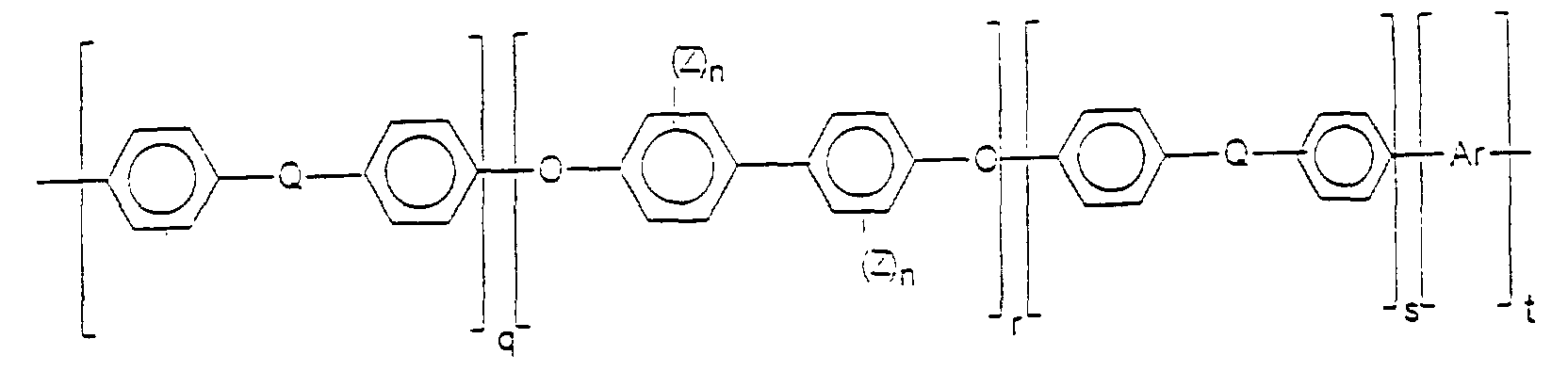
dans laquelle q, r, s et t sont des fractions de 0 à 1, q + s = 1 et r + t = 1, r étant compris entre 0,5 et 1,0; Q est -S(=O)2-, et
soit (Z)n représente deux groupes t-butyle qui sont respectivement situés en positions 3 et 3' du groupe diphénoxy, et Ar est le groupement dérivé du 4,4'-[2,2,2-trifluoro-trifluorométhyl)éthylidène]bisphénol ou du groupement dérivé du 4,4'-isopropylidènediphénol, soit (Z)n représente quatre groupes méthyle qui sont respectivement situés en positions 3, 3', 5 et 5' du groupe diphénoxy, et Ar est le groupement dérivé du 4,4'-isopropylidènediphénol ou le groupement dérivé de la phénolphtaléine.
dans laquelle q, r, s et t sont des fractions de 0 à 1, q + s = 1 et r + t = 1, r étant compris entre 0,5 et 1,0; Q est -S(=O)2-, et
soit (Z)n représente deux groupes t-butyle qui sont respectivement situés en positions 3 et 3' du groupe diphénoxy, et Ar est le groupement dérivé du 4,4'-[2,2,2-trifluoro-trifluorométhyl)éthylidène]bisphénol ou du groupement dérivé du 4,4'-isopropylidènediphénol, soit (Z)n représente quatre groupes méthyle qui sont respectivement situés en positions 3, 3', 5 et 5' du groupe diphénoxy, et Ar est le groupement dérivé du 4,4'-isopropylidènediphénol ou le groupement dérivé de la phénolphtaléine.
2. Procédé de séparation d'un ou plusieurs gaz d'un mélange gazeux comprenant le fait
de mettre en contact ledit mélange gazeux avec le premier côté de la membrane de séparation
de gaz selon la revendication 1 de manière à faire passer une partie du mélange à
travers la membrane vers un côté de perméat, le mélange gazeux résultant du côté du
perméat étant enrichi en un
ou plusieurs composants par rapport au mélange du premier côté.
ou plusieurs composants par rapport au mélange du premier côté.