|
(11) | EP 0 652 273 B1 |

| (12) | EUROPEAN PATENT SPECIFICATION |
|
|
| (54) |
Organic material for electroluminescent device and electroluminescent device Organisches Material für elektrolumineszente Vorrichtung und elektrolumineszente Vorrichtung Matériau organique pour dispositif électroluminescent et dispositif électroluminescent |
|
|
|||||||||||||||||||||||||||||||
| Note: Within nine months from the publication of the mention of the grant of the European patent, any person may give notice to the European Patent Office of opposition to the European patent granted. Notice of opposition shall be filed in a written reasoned statement. It shall not be deemed to have been filed until the opposition fee has been paid. (Art. 99(1) European Patent Convention). |
BACKGROUND OF THE INVENTION
1. Field of the Invention
[0001] The present invention relates to organic luminescent materials for EL (electroluminescent) devices and to EL devices, and more particularly it relates to organic luminescent materials for EL devices which exhibit electroluminescence upon the application of a voltage, and to EL devices which employ the above-mentioned organic luminescent materials for EL devices.
2. Description of the Related Art
[0002] EL devices employing luminescent materials which exhibit electroluminescence upon the application of a voltage are conventionally used in backlights for displays of OA machines such as word processors and for automobile meters.
[0003] Although inorganic luminescent materials have conventionally been used as the luminescent materials for such EL devices, high driving voltages have been required when inorganic luminescent materials for EL devices are caused to emit high-intensity light.
[0004] Recently, therefore, research has been conducted in regard to organic luminescent materials for EL devices which allow lower driving voltages (see, for example, C.W. Tang and S.A. VanSlyke: Appl. Phys. Lett. 51. 913 (1987)).
[0005] Thin-film EL devices employing such organic luminescent materials make it possible to use lower driving voltages than with EL devices which employ the conventional inorganic luminescent materials for EL devices.
[0006] There have also been reported organic luminescent materials which exhibit blue luminescence, and which may be suitably used in backlights for OA machine displays and for automobile meters (see, for example, Jpn. J. Appl. Phys. Vol. 32 (1993) L511).
[0007] However, because of the inadequate luminescent intensity of conventional organic luminescent materials exhibiting blue luminescence, organic luminescent materials for EL devices and EL devices have been sought which are capable of blue luminescence of ever higher intensities.
SUMMARY OF THE INVENTION
[0008] Here, it is an object of the present invention to provide organic luminescent materials for EL devices which are capable of high-intensity blue or blueish green luminescence, as well as EL devices employing them.
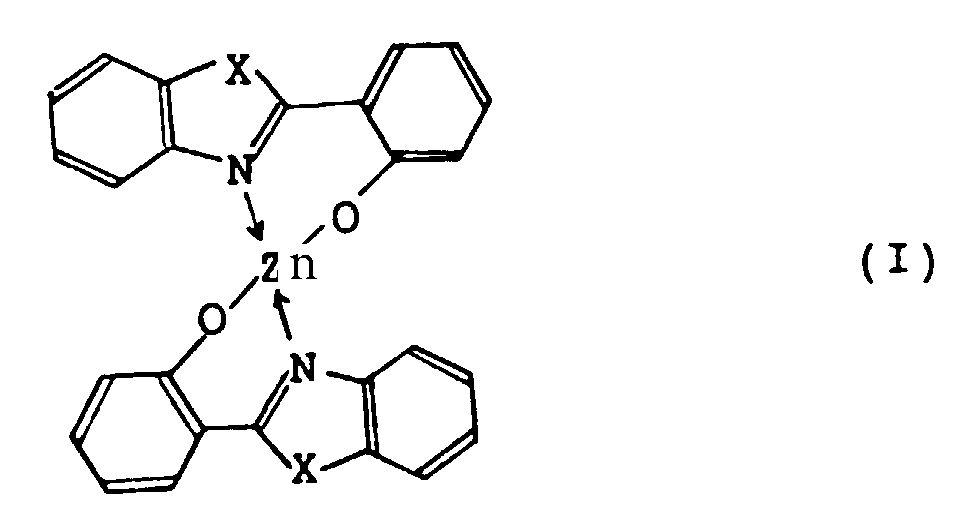
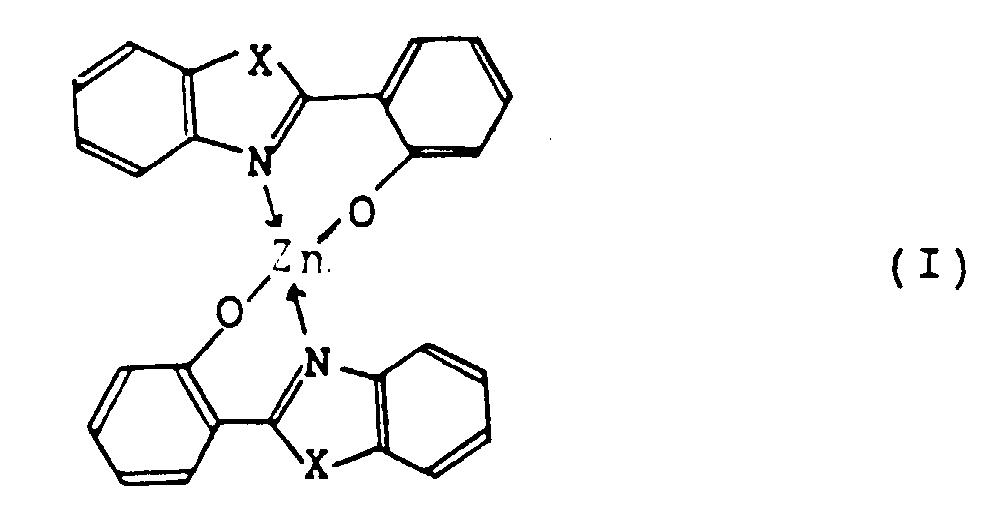
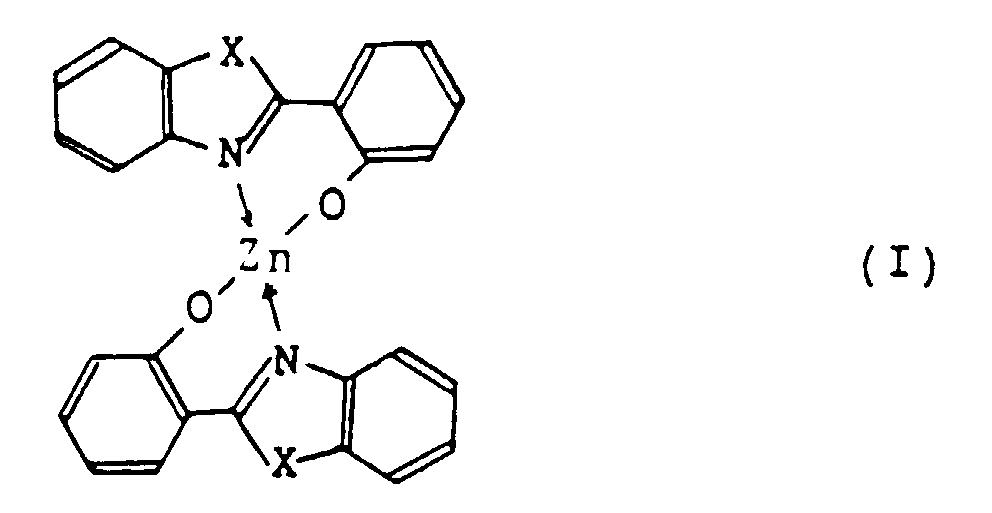
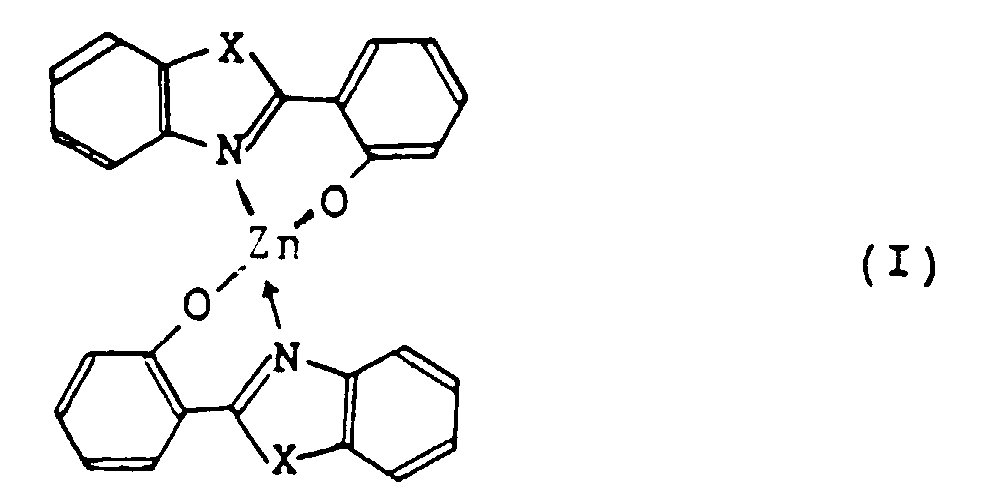
[0009] As a result of study aimed at achieving the above-mentioned object, the present inventors have found that an EL device employing a 2-(O-hydroxyphenyl)-benzoxazole or -benzothiazole zinc complex as the luminescent material produces high-intensity blue or blueish green luminescence upon the application of a driving voltage, and thus the present invention has been completed.
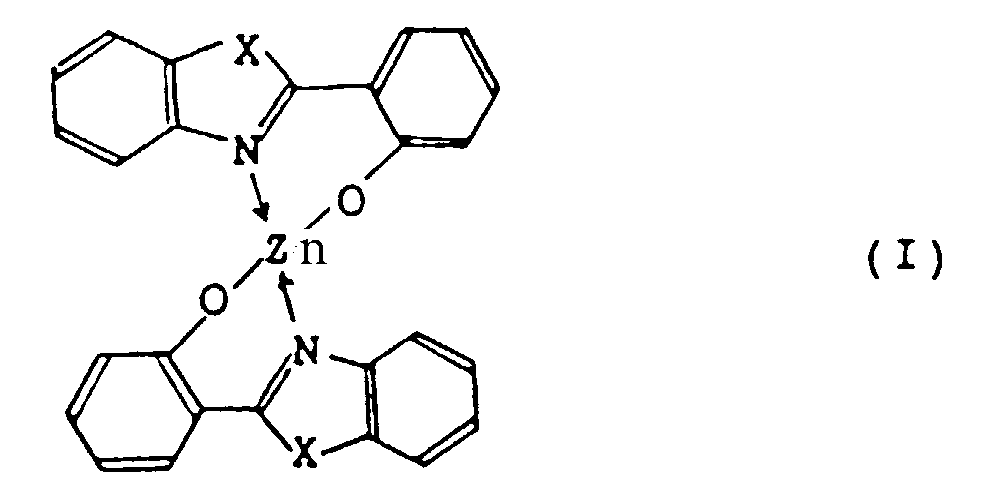
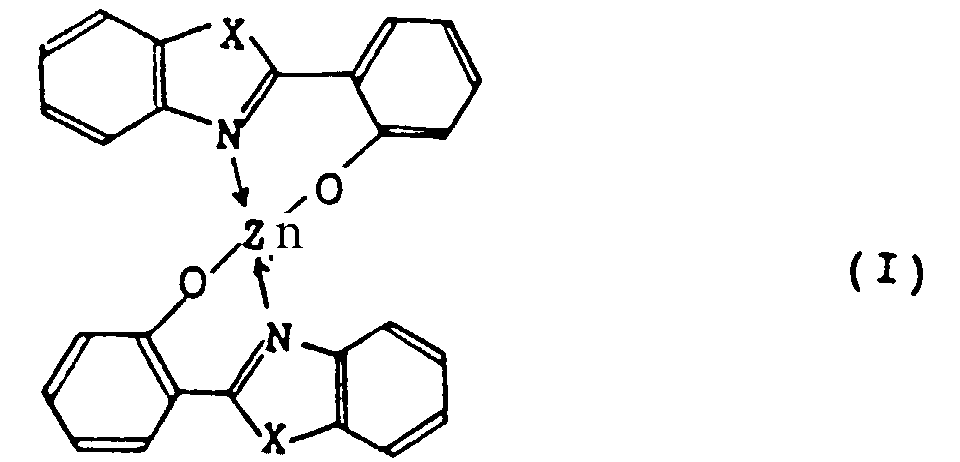
[0010] In other words, the present invention provides organic luminescent materials for EL devices comprising a 2-(O-hydroxyphenyl)-benzoxazole or -benzothiazole zinc complex represented by the following general formula (I), and EL devices employing the organic luminescent materials.
wherein X represents -O- or -S-.
BRIEF DESCRIPTION OF THE DRAWINGS
[0011] Fig. 1 is a drawing for explanation of an embodiment of an EL device according to the present invention.
[0012] Fig. 2 is a drawing for explanation of another embodiment of an EL device according to the present invention.
[0013] Fig. 3 is a mass spectrogram of a 2-(O-hydroxyphenyl)-benzoxazole zinc complex used in the present invention.
[0014] Fig. 4 is a mass spectrogram of a 2-(O-hydroxyphenyl)-benzothiazole zinc complex used in the present invention.
DESCRIPTION OF THE PREFERRED EMBODIMENTS
[0016] The organic luminescent material of the present invention is used as a material for the luminescent layer of an EL device. That is, the EL device comprises, in order, an anode layer, a hole injection layer, a luminescent layer and a cathode layer, and according to the present invention the material used as the luminescent layer is an organic luminescent material comprising the zinc complex represented by the above general formula (I). This EL device of the present invention is capable of emitting high-intensity blue or blueish green light when a driving voltage is applied thereto.
[0017] The zinc complex of general formula (I) of the present invention may be obtained by, for example, reacting a 2-(O-hydroxyphenyl)-benzoxazole or -benzothiazole represented by the following formula (II) with zinc acetate.
wherein X represents the same species specified previously.
[0018] This reaction may be carried out by adding a solution of zinc acetate to a solution of 2-(O-hydroxyphenyl)-benzoxazole or -benzothiazole represented by formula (II) dissolved in a solvent such as methanol, and stirring the mixture at room temperature for a specified period of time.
[0019] The reaction product is purified if necessary and then used as the luminescent material for an EL device.
[0020] The EL device used may have the construction shown, for example, in Fig. 1. The EL device 10 shown in Fig. 1 comprises an ITO transparent electrode (anode) 14 (indium/tin alloy) formed on a transparent glass plate 12, on which are formed in order a hole injection layer 16 composed of a tetraphenyldiamine derivative, a luminescent layer 18 composed of the 2-(O-hydroxyphenyl)-benzoxazole or -benzothiazole zinc complex represented by general formula (I), and an upper electrode 20 composed of a metal such as aluminum.
[0021] The hole injection layer 16, luminescent layer 18 and upper electrode 20 may be formed by vacuum deposition. Especially, the hole injection layer 16 and the luminescent layer 18 may be formed by continuous deposition in a high vacuum of about 1,33.10-9 bar (10-6 Torr) without interrupting the vacuum state.
[0022] The anode of this EL device 10 is the ITO transparent electrode 14 and the cathode is the upper electrode 20, and upon the application of a direct current or pulse voltage from a electric source, the luminescent material of the luminescent layer 18 is excited and emits light.
[0023] The EL device of the present invention may also have the construction shown in Fig. 2. The EL device 50 shown in Fig. 2 comprises an ITO transparent electrode (anode) 54 (indium/tin alloy) formed on a transparent glass plate 52, on which are formed in order a hole injection layer 56 composed of a polycarbonate or other resin, a luminescent layer 58 composed of the 2-(O-hydroxyphenyl)-benzoxazole or -benzothiazole zinc complex represented by general formula (I), and an upper electrode (cathode) 60 composed of a metal such as aluminum.
[0024] Here, the hole injection layer 56 may be formed by dissolution of a polycarbonate or other resin in a solvent such as chloroform, followed by dip coating or spin coating, and the luminescent layer 58 and upper electrode 60 may be formed by continuous deposition in a high vacuum of about 1,33.10-9 to 1,33.10-8 bar (10-6 to 10-5 Torr) without interrupting the vacuum state.
[0025] The anode of this EL device 50 is the ITO transparent electrode 54 and the cathode is the upper electrode 60, and upon the application of a direct current or pulse voltage from a electric source, the luminescent layer 58 emits light.
[0026] This type of EL device according to the present invention makes it possible to obtain, at low driving voltages, blue luminescence at a higher intensity than with conventional blue light-emitting EL devices. Furthermore, since it is capable of long-term luminescence, it may be suitably used in backlights for displays of OA machines such as computers and for automobile meters.
Example 1
Synthesis of 2-(O-hydroxyphenyl)benzoxazole zinc complex
[0028] A 2.147 g (10.16 mmol) portion of 2-(O-hydroxyphenyl)-benzoxazole was placed in a 300 ml conical flask, 200 ml of methanol was added thereto, and the mixture was stirred while heating at 50°C to complete dissolution. Also, 1.108 g (5.50 mmol) of zinc acetate dihydrate was placed in a 100 ml conical flask, 10 ml of methanol was added thereto and the mixture was stirred at room temperature to complete dissolution. The methanol solution containing the 2-(O-hydroxyphenyl)benzoxazole was slowly added to the methanol solution containing the zinc acetate, while being kept at 50°C. The mixture was stirred for 3 hours while being heated at 50°C. Combination of the solutions rapidly produced a white precipitate. After 3 hours, the precipitate was filtered out and washed with water, a saturated aqueous solution of sodium bicarbonate, and water, after which it was introduced into 200 ml of water and stirred for one hour while heating at 80°C. The insoluble portion was filtered and introduced into 200 ml of methanol, and then stirred for one hour while heating at 50°C. The insoluble portion was again filtered, washed with methanol and hexane, and then vacuum dried. The yield of the white powder was 2.152 mg (87.8%), and its melting point was 351°C (DSC measurement).
[0029] The wavelength of the photoluminescence peak of this zinc complex was 473 nm. Also, upon measurement of the mass spectrum of the complex, the mass spectrogram shown in Fig. 3 was obtained. As shown in Fig. 3, a main peak was observed at a mass number of 484 which is a spectrum specific to the 2-(O-hydroxyphenyl)benzoxazolezinc complex.
Preparation of EL device
[0030] The EL device 10 shown in Fig. 1 was prepared by forming in order, on an ITO transparent electrode 14 (indium/tin alloy) having a thickness of about 200 nm formed on a transparent glass plate 12, a hole injection layer 16 having a thickness of about 100 nm and composed of N,N'-diphenyI-N,N'-bis(3-methylphenyl)-[1,1'-biphenyl]-4,4'-diamine, a luminescent layer 18 having a thickness of about 100 nm and composed of the 2-(O-hydroxyphenyl)benzoxazole zinc complex synthesized earlier, and an upper electrode 20 having a thickness of about 100 nm and composed of a metal such as aluminum.
[0031] The hole injection layer 16, luminescent layer 18 and upper electrode 20 were each formed by vacuum deposition. Specifically, the hole injection layer 16 and luminescent layer 18 were both formed by continuous deposition in a high vacuum of about 1,33.10-9 bar (10-6 Torr) without interrupting the vacuum state. Consequently, the surface areas of the hole injection layer 16 and the luminescent layer 18 were equal.
Luminescence test
[0032] The anode of the EL device 10 shown in Fig. 1 is the ITO transparent electrode 14 and the cathode is the upper electrode 20, and upon the application of a direct current or pulse voltage of 18 V from a electric source, blue light of an intensity exceeding a few hundred cd/m2 was emitted from the luminescent layer 18. The emission spectrum obtained at this time is shown in Fig. 5. The peak wavelength of the device was 475 nm.
[0033] In addition, during the continuous luminescence test the emission of blue light was stable and continued for over a few hundred hours.
Comparative Example
[0034] An EL device was prepared in the same manner as in Example 1, except that instead of the 2-(O-hydroxyphenyl)-benzoxazole zinc complex used as the luminescent material in Example 1, there was used an azomethine zinc complex represented by the following formula, which is indicated as a blue light-emitting luminescent material in Jpn. J. Appl. Phys. Vol. 32 (1993) L511, cited earlier.
where R represents -(CH2)7-.
[0035] Next, a pulse voltage of 40 Hz, 25 V was applied to the EL device prepared in the Comparative Example and the EL device prepared in Example 1, and visual comparison was made of the degrees of luminescence of both.
[0036] As a result, the blue luminescence of the EL device prepared in Example 1 was clearly of higher intensity than the blue luminescence of the EL device prepared in the Comparative Example.
Example 2
[0037] A luminescence test was conducted in the same manner as in Example 1, except that instead of the EL device 10 of Example 1 having the construction shown in Fig. 1, there was used the EL device 50 having the construction shown in Fig. 2.
[0038] The EL device 50 with the construction shown in Fig. 2 was prepared by forming in order, on an ITO transparent electrode 54 (indium/tin alloy) having a thickness of about 200 nm formed on a transparent glass plate 52, a hole injection layer 56 having a thickness of about 100 nm and composed of a polycarbonate resin, a luminescent layer 58 composed of the 2-(O-hydroxyphenyl)benzoxazole zinc complex synthesized in Example 1, and an upper electrode 60 having a thickness of about 100 nm and composed of a metal such as aluminum.
[0039] The hole injection layer 56 was formed by dissolution of the polycarbonate resin in chloroform, followed by dip coating or spin coating, and the luminescent layer 58 and upper electrode 60 were formed by continuous deposition in a high vacuum of about 1,33.10-9 to 1,33.10-8 bar (10-6 to 10-5 Torr) without interrupting the vacuum state. Consequently, the surface areas of the luminescent layer 58 and the upper electrode 60 were equal.
[0040] For the luminescence test of the obtained EL device 50, the anode was the ITO transparent electrode 54 and the cathode was the upper electrode 60, and upon the application of a direct current or pulse voltage of 18 V from a electric source, blue light of an intensity exceeding 1000 cd/m2 was emitted from the luminescent layer 58. In addition, during the continuous luminescence test the emission of blue light was stable and continued for over a few hundred hours.
Example 3
Synthesis of 2-(O-hydroxyphenyl)benzothiazole zinc complex
[0041] A 484 mg (2.13 mmol) portion of 2-(O-hydroxyphenyl)-benzothiazole was placed in a 100 ml conical flask, 40 ml of methanol was added thereto, and the mixture was stirred while heating at 50°C to complete dissolution. Also, 226 mg (1.03 mmol) of zinc acetate dihydrate was placed in a 50 ml conical flask, 20 ml of methanol was added thereto and the mixture was stirred while heating at 50°C to complete dissolution. The methanol solution containing the 2-(O-hydroxyphenyl)benzothiazole was slowly added to the methanol solution containing the zinc acetate, while being kept at 50°C. Combination of the solutions rapidly produced a green precipitate, and this mixture was further stirred for 1 hour and 45 minutes while heating at 50°C. The precipitate was filtered out and washed with water, a saturated aqueous solution of sodium bicarbonate, water, methanol and hexane, and then vacuum dried. The yield of the green powder was 316 mg (59%), and its melting point was 304°C (DSC measurement).
[0042] The wavelength of the photoluminescence peak of this zinc complex was 500 nm. Also, upon measurement of the mass spectrum of the complex, the mass spectrogram shown in Fig. 4 was obtained. As shown in Fig. 4, a main peak was observed at a mass number of 515 which is a spectrum specific to the 2-(O-hydroxyphenyl)benzothiazole zinc complex.
Preparation of EL device
[0043] The EL device 10 shown in Fig. 1 was prepared by forming in order, on an ITO transparent electrode 14 (indium/tin alloy) of a thickness of about 200 nm formed on a transparent glass plate 12, a hole injection layer 16 of a thickness of about 100 nm composed of N,N'-diphenyl-N,N'-bis(3-methylphenyl)-[1,1'-biphenyl]-4,4'-diamine, a luminescent layer 18 of a thickness of about 100 nm composed of the 2-(O-hydroxyphenyl)benzothiazole zinc complex synthesized earlier, and an upper electrode 20 of a thickness of about 100 nm composed of a metal such as aluminum.
[0044] The hole injection layer 16, luminescent layer 18 and upper electrode 20 were each formed by vacuum deposition. Specifically, the hole injection layer 16 and luminescent layer 18 were both formed by continuous deposition in a high vacuum of about 1,33.10-9 bar (10-6 Torr) without interrupting the vacuum state. Consequently, the surface areas of the hole injection layer 16 and the luminescent layer 18 were equal.
Luminescence test
[0045] The anode of the EL device 10 shown in Fig. 1 is the ITO transparent electrode 14 and the cathode is the upper electrode 20, and upon the application of a direct current or pulse voltage of 18 V from a electric source, blueish green light of an intensity exceeding a few hundred cd/m2 was emitted from the luminescent layer 18.
1. A 2-(O-hydroxyphenyl)-benzoxazole or -benzothiazole zinc complex represented by the
following general formula (I):
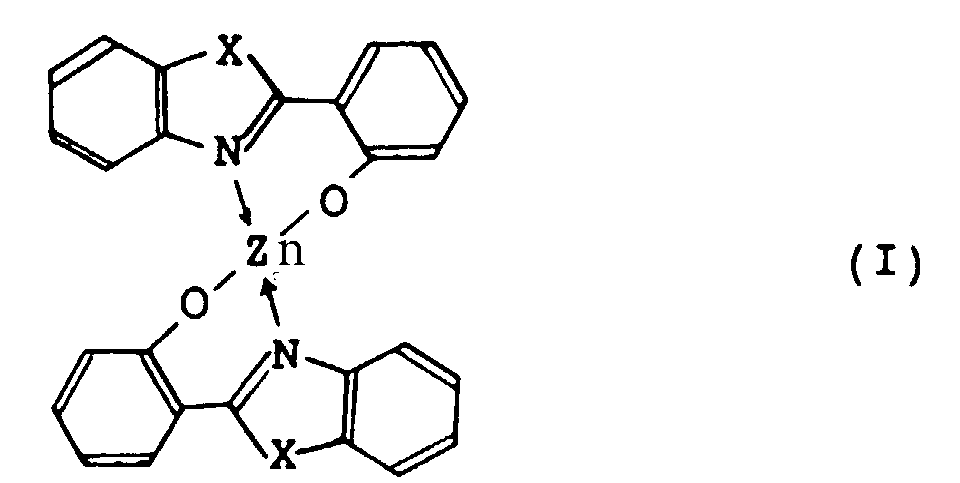
wherein X represents -O- or -S-.
wherein X represents -O- or -S-.
2. A zinc complex according to claim 1, which is a 2-(O-hydroxyphenyl)benzoxazole zinc
complex.
3. A zinc complex according to claim 1, which is a 2-(O-hydroxyphenyl)benzothiazole zinc
complex.
4. An electroluminescent device which includes in order, an anode layer, a hole injection
layer, a luminescent layer and a cathode layer, wherein said luminescent layer comprises
a 2-(O-hydroxyphenyl)-benzoxazole or -benzothiazole zinc complex represented by the
following general formula (I):
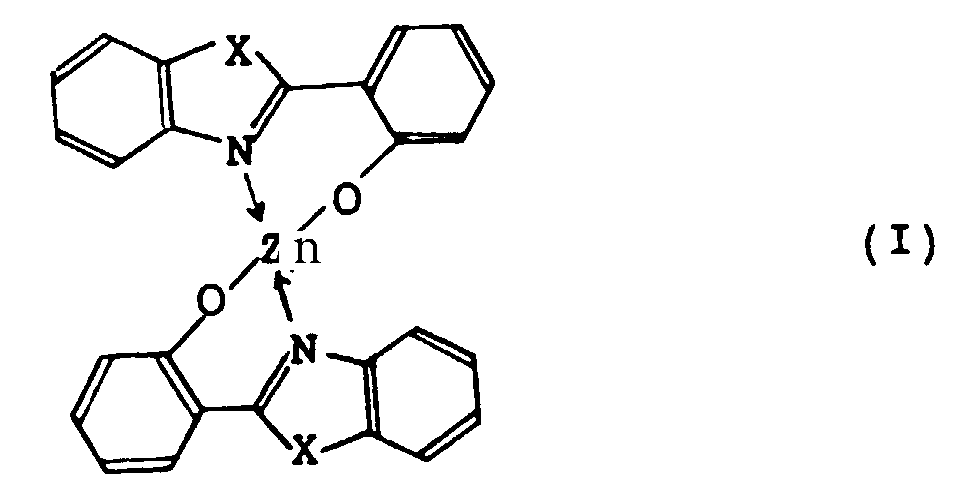
wherein X represents -O- or -S-.
wherein X represents -O- or -S-.
5. An electroluminescent device according to claim 4, wherein the zinc complex of general
formula (I) is a 2-(O-hydroxyphenyl)benzoxazole zinc complex.
6. An electroluminescent device according to claim 4, wherein the zinc complex of general
formula (I) is a 2-(O-hydroxyphenyl) benzothiazole zinc complex.
7. An electroluminescent device according to any of claims 4 to 6 wherein the hole injection
layer comprises a tetraphenyldiamine derivative.
8. An electroluminescent device according to any of claims 4 to 6 wherein the hole injection
layer comprises a polycarbonate resin.
9. An electroluminescent device according to any of claims 4 to 8 wherein the anode layer
is an ITO transparent electrode.
10. A method for the manufacture of an electroluminescent device comprising an anode,
a cathode and a luminescent layer between the anode and the cathode, the luminescent
layer comprising a 2-(-O-hydroxyphenyl)-benzoxazole or -benzothiazole zinc complex
represented by the following formula (I):
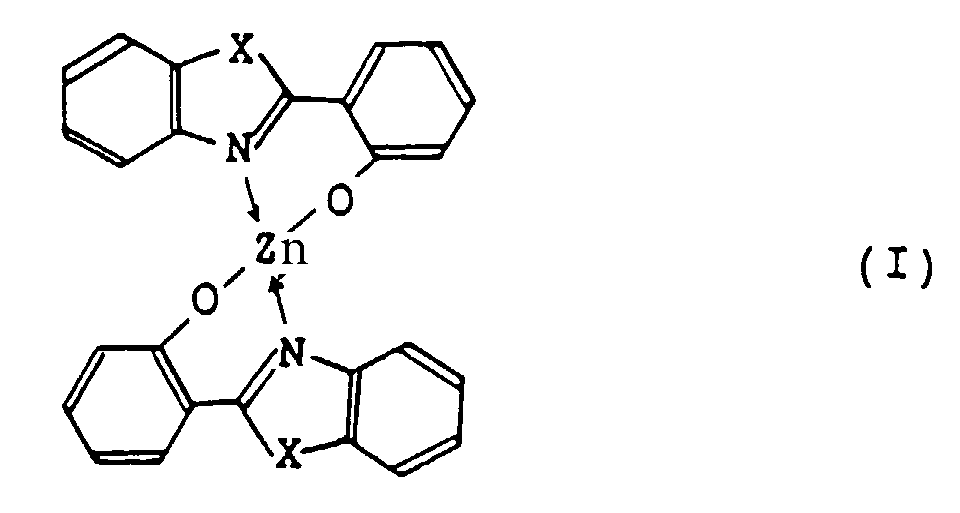
wherein X represents -O- or -S-, the method comprising deposition of the luminescent layer in a high vacuum, preferably 1,33.10-9 to 1,33.10-8 bar (10-6 to 10-5 Torr).
wherein X represents -O- or -S-, the method comprising deposition of the luminescent layer in a high vacuum, preferably 1,33.10-9 to 1,33.10-8 bar (10-6 to 10-5 Torr).
11. A method according to claim 10 in which the electroluminescent device comprises in
order a lower electrode layer, a hole injection layer, a luminescent layer and an
upper electrode, each of the upper and lower electrode providing one of an anode and
a cathode, respectively, in which the luminescent layer and the upper electrode layer
are formed by continuous vacuum deposition.
12. A method according to claim 11 in which the hole injection layer and the luminescent
layer are formed by continuous vacuum deposition.
13. Use of a 2-(O-hydroxyphenyl)-benzoxazole or -benzothiazole zinc complex represented
by the following general formula (I):
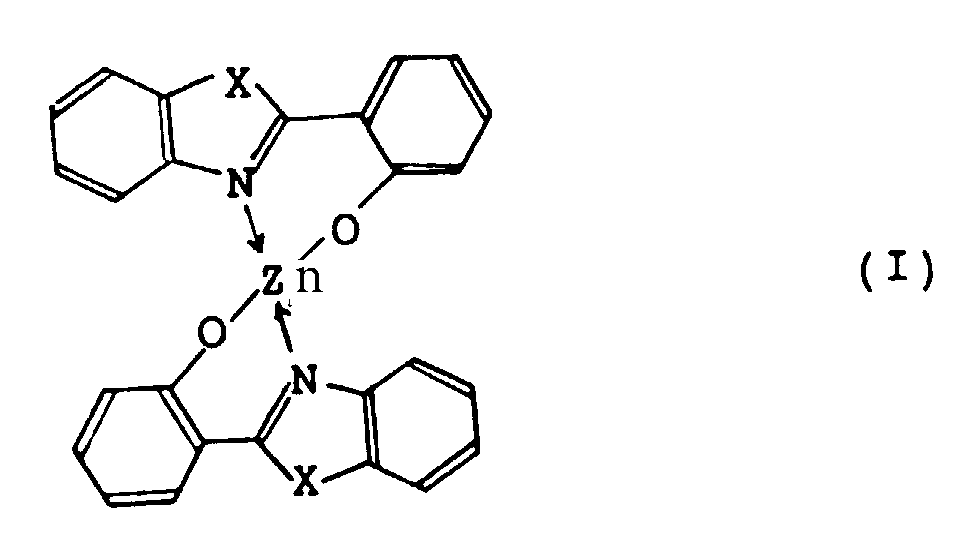
wherein X represents -O- or -S-, for the manufacture of an electroluminescent composition.
wherein X represents -O- or -S-, for the manufacture of an electroluminescent composition.
14. Use of a 2-(O-hydroxyphenyl)-benzoxazole or benzothiazole zinc complex represented
by the following general formula (I):
wherein X represents -O- or -S-, for the manufacture of an electroluminescent device.
wherein X represents -O- or -S-, for the manufacture of an electroluminescent device.
1. Ein 2-(O-Hydroxyphenyl)-benzoxazol- oder -benzothiazol-Zinkkomplex gemäß der folgenden
allgemeinen Formel (I):
worin X steht für -O- oder -S-.
worin X steht für -O- oder -S-.
2. Zinkkomplex gemäß Anspruch 1, der ein 2-(O-Hydroxyphenyl)benzoxazol-Zinkkomplex ist.
3. Zinkkomplex nach Anspruch 1, der ein 2-(O-Hydroxyphenyl)benzothiazol-Zinkkomplex ist.
4. Elektrolumineszierendes Gerät, das in folgender Reihenfolge aufweist eine Anodenschicht,
eine Defektelektronen-Injektionsschicht, eine lumineszierende Schicht und eine Kathodenschicht,
worin die lumineszierende Schicht einen 2-(O-Hydroxyphenyl)-benzoxazol- oder -benzothiazol-Zinkkomplex
aufweist, der durch die folgende allgemeine Formel (I) wiedergegeben wird:

worin X steht für -O- oder -S-.
worin X steht für -O- oder -S-.
5. Elektrolumineszierendes Gerät nach Anspruch 4, in dem der Zinkkomplex der allgemeinen
Formel (I) ein 2-(O-Hydroxyphenyl)benzoxazol-Zinkkomplex ist.
6. Elektrolumineszierendes Gerät nach Anspruch 4, in dem der Zinkkomplex der allgemeinen
Formel (I) ein 2-(O-Hydroxyphenyl)benzothiazol-Zinkkomplex ist.
7. Elektrolumineszierendes Gerät nach einem der Ansprüche 4 bis 6, in dem die Defektelektronen-Injektionsschicht
ein Tetraphenyldiamin-Derivat enthält.
8. Elektrolumineszierendes Gerät nach einem der Ansprüche 4 bis 6, in dem die Defektelektronen-Injektionsschicht
ein Polycarbonatharz aufweist.
9. Elektrolumineszierendes Gerät nach einem der Ansprüche 4 bis 8, in dem die Anodenschicht
eine transparente ITO-Elektrode ist.
10. Verfahren zur Herstellung eines elektrolumineszierenden Gerätes mit einer Anode, einer
Kathode und einer lumineszierenden Schicht zwischen der Anode und der Kathode, wobei
die lumineszierende Schicht einen 2-(O-Hydroxyphenyl)-benzoxazol- oder -benzothiazol-Zinkkomplex
aufweist, der durch die folgende Formel (I) wiedergegeben wird:
worin X steht für -O- oder -S-, wobei das Verfahren umfaßt die Abscheidung der lumineszierenden Schicht in einem hohen Vakuum, vorzugsweise bei 1,33 x 10⁻⁹ bis 1,33 x 10⁻⁸ bar (10-6 bis 10-5 Torr).
worin X steht für -O- oder -S-, wobei das Verfahren umfaßt die Abscheidung der lumineszierenden Schicht in einem hohen Vakuum, vorzugsweise bei 1,33 x 10⁻⁹ bis 1,33 x 10⁻⁸ bar (10-6 bis 10-5 Torr).
11. Verfahren nach Anspruch 10, bei dem das elektrolumineszierende Gerät in der folgenden
Reihenfolge aufweist eine untere Elektrodenschicht, eine Defektelektronen-Injektionsschicht,
eine lumineszierende Schicht und eine obere Elektrode, wobei eine jede der oberen
und unteren Elektroden eine Anode bzw. eine Kathode darstellen, wobei die lumineszierende
Schicht und die obere Elektrodenschicht durch kontinuierliche Vakuumabscheidung erzeugt
wurden.
12. Verfahren nach Anspruch 11, bei dem die Defektelektronen-Injektionsschicht und die
lumineszierende Schicht durch kontinuierliche Vakuumabscheidung erzeugt wurden.
13. Verwendung eines 2-(O-Hydroxyphenyl)-benzoxazol- oder -benzothiazol-Zinkkomplexes
gemäß der folgenden allgemeinen Formel (I):
worin X steht für -O- oder -S- zur Herstellung einer elektrolumineszierenden Zusammensetzung.
worin X steht für -O- oder -S- zur Herstellung einer elektrolumineszierenden Zusammensetzung.
14. Verwendung eines 2-(O-Hydroxyphenyl)-benzoxazol- oder -benzothiazol-Zinkkomplexes,
wiedergegeben durch die folgende allgemeine Formel (I):
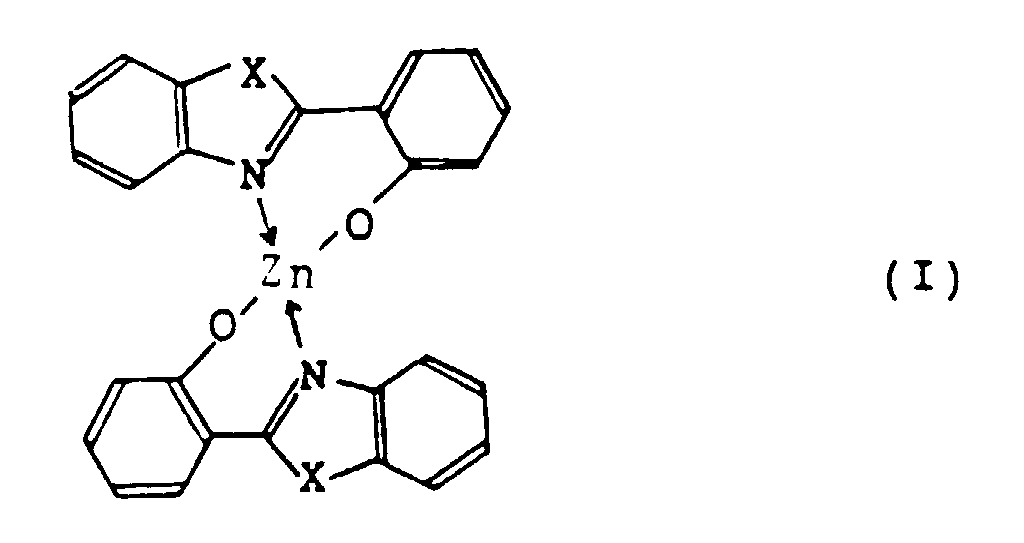
worin X steht für -O- oder -S- zur Herstellung eines elektrolumineszierenden Gerätes.
worin X steht für -O- oder -S- zur Herstellung eines elektrolumineszierenden Gerätes.
1. Complexe de zinc du 2-(O-hydroxyphényl)-benzoxazole ou -benzothiazole, représenté
par la formule générale (I) suivante :
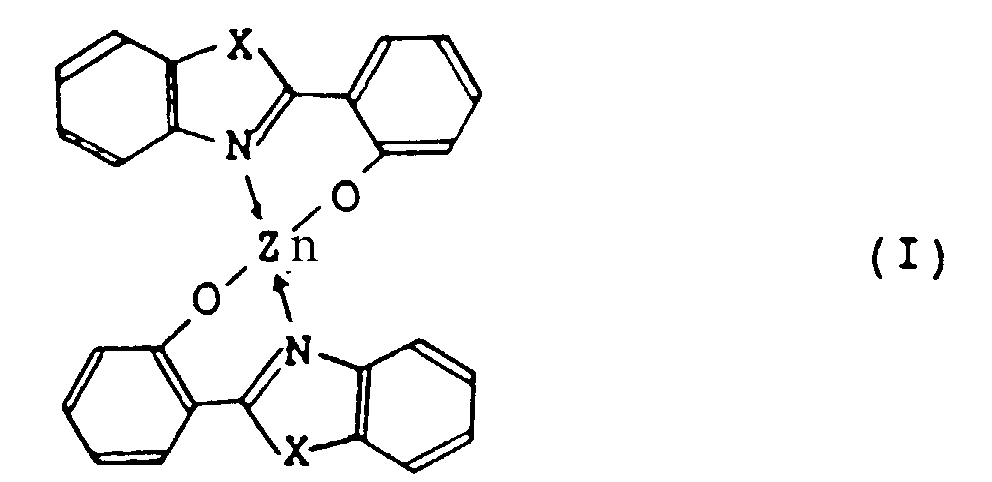
dans laquelle X représente -O- ou -S-.
dans laquelle X représente -O- ou -S-.
2. Complexe de zinc suivant la revendication 1, qui est un complexe de zinc du 2-(O-hydroxyphényl)-benzoxazole.
3. Complexe de zinc suivant la revendication 1, qui est un complexe de zinc du 2-(O-hydroxyphényl)-benzothiazole.
4. Dispositif électroluminescent qui comporte, dans l'ordre, une couche anodique, une
couche d'injection de trous, une couche luminescente et une couche cathodique, dans
lequel la couche luminescente comprend un complexe de zinc du 2-(O-hydroxyphényl)-benzoxazole
ou -benzothiazole représenté par la formule générale (I) suivante :
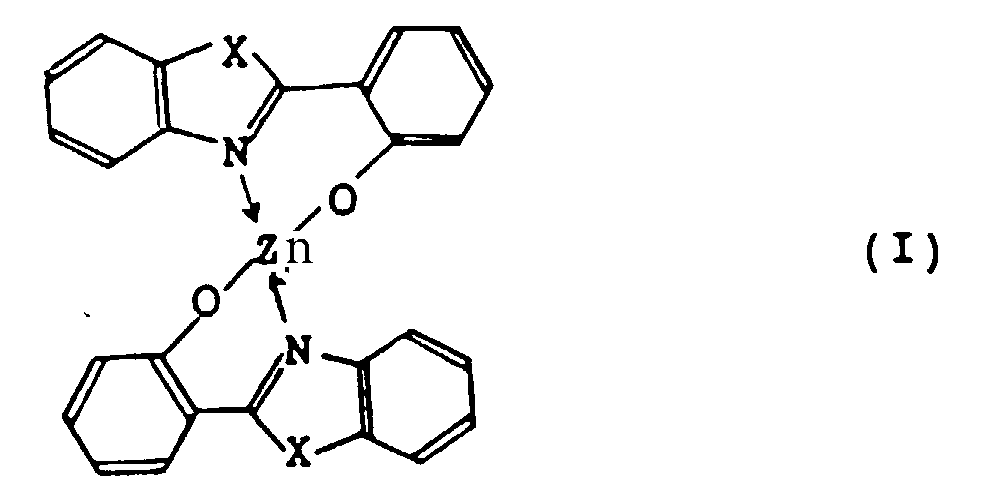
dans laquelle X représente -O- ou -S-.
dans laquelle X représente -O- ou -S-.
5. Dispositif électroluminescent suivant la revendication 4, dans lequel le complexe
de zinc de formule générale (I) est un complexe de zinc du 2-(O-hydroxyphényl)-benzoxazole.
6. Dispositif électroluminescent suivant la revendication 4, dans lequel le complexe
de zinc de formule générale (I) est un complexe de zinc du 2-(O-hydroxyphényl)-benzothiazole.
7. Dispositif électroluminescent suivant l'une quelconque des revendications 4 à 6, dans
lequel la couche d'injection de trous comprend un dérivé de tétraphényl-diamine.
8. Dispositif électroluminescent suivant l'une quelconque des revendications 4 à 6, dans
lequel la couche d'injection de trous comprend une résine polycarbonate.
9. Dispositif électroluminescent suivant l'une quelconque des revendications 4 à 8, dans
lequel la couche anodique est une électrode transparente en alliage indium/étain.
10. Procédé de fabrication d'un dispositif électroluminescent comportant une anode, une
cathode et une couche luminescente entre l'anode et la cathode, la couche luminescente
comprenant un complexe de zinc du 2-(O-hydroxy-phényl)benzoxazole ou -benzothiazole
représenté par la formule (I) suivante :
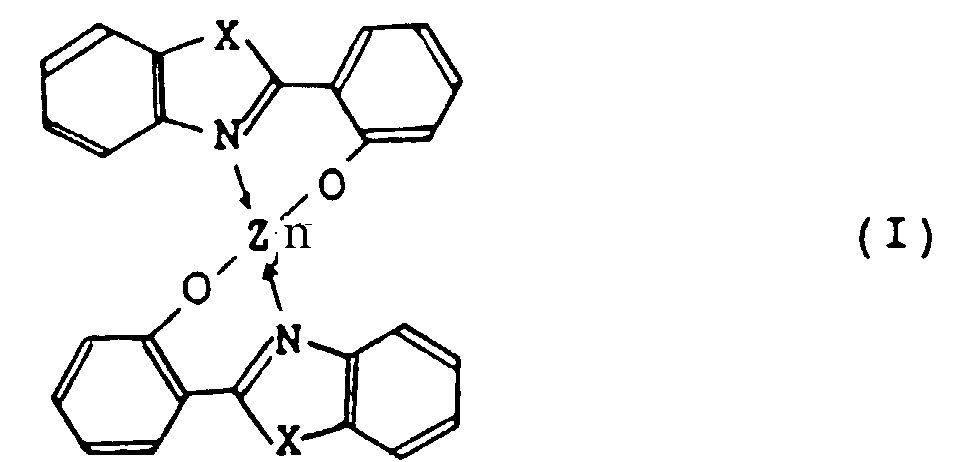
dans laquelle X représente -O ou -S-, le procédé comprenant le dépôt de la couche luminescente sous vide poussé, de préférence sous vide de 1,33.10-9 à 1,33.10-8 bar (10-6 à 10-5 torr).
dans laquelle X représente -O ou -S-, le procédé comprenant le dépôt de la couche luminescente sous vide poussé, de préférence sous vide de 1,33.10-9 à 1,33.10-8 bar (10-6 à 10-5 torr).
11. Procédé suivant la revendication 10, dans lequel le dispositif électroluminescent
comporte, dans l'ordre, une couche formant l'électrode inférieure, une couche d'injection
de trous, une couche luminescente et une électrode supérieure, chacune des électrodes
supérieure et inférieure jouant respectivement le rôle soit d'anode soit de cathode,
dans lequel la couche luminescente et la couche d'électrode supérieure sont formées
par dépôt continu sous vide.
12. Procédé suivant la revendication 11, dans lequel la couche d'injection de trous et
la couche luminescente sont formées par dépôt continu sous vide.
13. Utilisation d'un complexe de zinc du 2-(O-hydroxyphényl)-benzoxazole ou -benzothiazole
représenté par la formule générale (I) suivante :
dans laquelle X représente -O- ou -S-, pour la production d'une composition électroluminescente.
dans laquelle X représente -O- ou -S-, pour la production d'une composition électroluminescente.
14. Utilisation d'un complexe de zinc du 2-(O-hydroxyphényl)-benzoxazole ou -benzothiazole
représenté par la formule qénérale (I) suivante :
dans laquelle X représente -O- ou -S-, pour la fabrication d'un dispositif électroluminescent.
dans laquelle X représente -O- ou -S-, pour la fabrication d'un dispositif électroluminescent.