|
(11) | EP 0 656 879 B1 |

| (12) | EUROPEAN PATENT SPECIFICATION |
|
|
| (54) |
Process for the bromination of methyl-2-(2-methylphenyl)-3-methoxy-propenoate Verfahren zur Bromierung von Methyl-2-(2-methylphenyl)-3-methoxy-propenoat Procédé pour la bromation de méthoxy-3-(méthyl-2-phényl)-2-propénoate de méthyle |
|
|
|||||||||||||||||||||||||||||||
| Note: Within nine months from the publication of the mention of the grant of the European patent, any person may give notice to the European Patent Office of opposition to the European patent granted. Notice of opposition shall be filed in a written reasoned statement. It shall not be deemed to have been filed until the opposition fee has been paid. (Art. 99(1) European Patent Convention). |
[0001] This invention relates to a bromination process and more particularly to a process for the bromination of methyl 2-(2-methylphenyl)-3-methoxypropenoate.
[0002] A process for brominating (E)-methyl 2-(2-methylphenyl)-3-methoxypropenoate with bromine in chloroform in the presence of azodiisobutyronitrile and light is described in EP-A-0278595. A process for brominating (Z)-methyl 2-(2-methylphenyl)-3-methoxypropenoate to form (E)-methyl 2-(2-bromomethylphenyl)-3-methoxypropenoate using N-bromosuccinimide is described in EP-A-0299694. The side chain bromination of aromatic molecules with a bromine complex of poly(styrene-co-4-vinylpyridine) is described in J. Org. Chem. 1986, 51, 929-931.
[0003] According to the present invention there is provided an improved process for preparing a compound of formula (I) which comprises contacting with bromine the (E)- or (Z)-isomer of a compound of formula (II) or a mixture of both isomers, in an inert organic solvent, in the presence of a polymeric base (as hereinafter defined) and light.
[0004] By "inert organic solvent" is meant an organic solvent which does not react chemically to any significant extent with bromine under the conditions of the process. Suitable solvents include halogenated, for example chlorinated, aliphatic and aromatic organic solvents having a boiling point not less than 20°C, for instance carbon tetrachloride and chlorobenzene.
[0005] By the term "polymeric base" is meant an organic polymer comprising repeat units containing a basic group which will form a salt with an inorganic acid, in this case hydrogen bromide, without generating water. For example, the basic group may be an amino group, such as a tertiary amino group. Typically the polymeric base will comprise repeat units containing a tertiary nitrogen atom which is a member of a heterocyclic ring. The heterocyclic ring may be aromatic, for example a pyridine ring, or non-aromatic, for example, a pyrrolidine ring. Suitable polymeric bases include cross-linked poly(vinylpyridine) polymers, cross-linked copolymers of styrene and vinylpyridine, for instance 4-vinylpyridine, and poly(N-vinylpyrrolidone) polymers. Commercially available examples include poly(4-vinylpyridine) 2% cross-linked with divinylbenzene, poly(2-vinylpyridine-co-styrene) having a styrene content of 30%; poly(4--vinylpyridine-co-styrene) having a styrene content of 10%; polyvinylpyrrolidone, cross-linked (PVPDC) mp >300°C; and polyvinylpyrrolidone (povidone, PVP) of varying average molecular weights of 10,000, 24,000, 40,000 and 360,000. Ideally, the polymeric base should be insoluble in the solvent under the conditions of the process, thereby facilitating recovery after use. The recovered polymeric material may then be regenerated by treatment with, for example, an aqueous base and dried ready for re-use.
[0006] The process of the invention is suitably carried out at a temperature of from 20°C to 80°C, typically from 25°C to 75°C, but may be limited by the boiling point of the solvent used. Examples of suitable operating temperatures are 55°C to 70°C, for instance 60°C to 65°C or 65°C to 70°C, and 20°C to 25°C.
[0007] The process of the invention is conveniently carried out by the slow, for example dropwise, addition of bromine to a stirred mixture of the compound (II) and the pre-dried polymeric base in the inert organic solvent whilst irradiating the mixture with visible light. The visible light may be supplied by a tungsten-halogen lamp.
[0008] The starting materials, which may be the (E)- or (Z)-isomers of compound (II) or a mixture of both, and their methods of preparation are already described in the chemical literature. For example, the preparation of (E)-methyl 2-(2-methylphenyl)-3-methoxypropenoate is described in EP-A-0203606 and the preparation of the (Z)-isomer is described in EP-A-0299694.
[0009] The invention provides a high-yielding process for an intermediate chemical useful in the manufacture of fungicides of the type described in, for example, EP-A-0370629.
[0010] The invention is illustrated by the following examples in which solutions, when dried, were dried over magnesium sulphate and, when concentrated, were concentrated under reduced pressure. Materials were dried before use, as appropriate. Where shown, infrared and NMR data are selective. No attempt is made to list every absorption in all cases. 1H NMR spectra were recorded using CDCl3 solutions unless otherwise stated. The following abbreviations are used throughout:
- m.p. =
- melting point
- GC =
- gas chromatography
- HPLC =
- High performance liquid chromatography
- NMR =
- nuclear magnetic resonence
- IR =
- infrared
EXAMPLE 1
[0011] This Example illustrates the preparation of (E)-methyl 2-[2-(bromomethyl)phenyl-3-methoxypropenoate, using poly(vinylpyrrolidone) in carbon tetrachloride at 60°C to 62°C.
[0012] Bromine (178ml) was added over 5.25 hours to a stirred mixture of (E)-methyl 3-methoxy-2-(2-methylphenyl)propenoate (309g) and poly(vinylpyrrolidone) (cross-linked, m.p. >300°C ex Aldrich Chemical Co. Ltd.; pre-dried by vacuum drying, 534g) in carbon tetrachloride (1750ml), whilst irradiating at 60°C to 62°C with two 500 watt tungsten-halogen lamps.
[0013] After a further 5 hours irradiation at 60°C to 62°C, the reaction mixture was cooled to room temperature and solid material was filtered off and washed with dichloromethane. The combined filtrates were concentrated to give a pale yellow crystalline solid (403g).
[0014] Recrystallisation from cyclohexane yielded a white powder (234g), m.p. 88°C to 91°C; IR (Nujol): 1704, 1627 cm-1; 1H NMR (270 MHz), δ: 3.70(3H,s), 3.83(3H,s), 4.41(2H,s), 7.1-7.6(4H,m), 7.64(1H,s)ppm.
EXAMPLE 2
[0015] This Example illustrates the preparation (E)-methyl 2-[2-(bromomethyl)phenyl]-3-methoxypropenoate using poly(4-vinylpyridine) in carbon tetrachloride at 65°C.
[0016] Bromine (37ml) was added over 6.5 hours to a stirred mixture of (E)-methyl 3-methoxy-2-(2-methylphenyl)propenoate (103g) and poly(4-vinylpyridine) (2% cross-linked with divinylbenzene, 100-200 mesh, ex Fluka Chemie AG; pre-dried by azeotropic distillation/vacuum drying, 153g) in carbon tetrachloride (380ml), whilst irradiating at 65°C with a 500 watt tungsten-halogen lamp.
[0017] After a further 7 hours irradiation at 65°C the reaction mixture was cooled to room temperature and solid material was filtered off and washed with carbon tetrachloride. The combined filtrates were dried and concentrated to give a pale yellow waxy solid (146g), 78% pure by GC. Recrystallisation from isopropanol yielded a white powder (90g), the major component (96%) of which had an identical GC retention time to the material prepared in Example 1.
EXAMPLE 3
[0018] This Example illustrates the preparation of (E)-methyl 2-[2-(bromomethyl)phenyl]-3-methoxypropenoate, using poly(vinylpyrrolidone) in chlorobenzene at 63°C to 67°C.
[0019] Bromine (3ml) was added over 95 minutes to a stirred mixture of (E)-methyl 3-methoxy-2-(2-methylphenyl)propenoate (5.05g) and poly(vinylpyrrolidone) (cross-linked, m.p. >300°C ex Aldrich Chemical Co. Ltd.; pre-dried by vacuum drying, 8.7g) in chlorobenzene (45ml), containing Synperonic NP13 surfactant (0.05ml), whilst irradiating at 63°C to 67°C with a 500 watt tungsten-halogen lamp.
[0020] After a further 5.75 hours irradiation at 63°C to 67°C, the reaction mixture was cooled to room temperature and solid material was filtered off and washed with chlorobenzene.
[0021] The combined filtrates were concentrated to give an orange oil (6.5g), slowly crystallising on standing, whose major component (68%) had an identical GC retention time to the material prepared as described in Example 1.
[0022] Trituration in a cyclohexane/diethyl ether mixture yielded a cream solid (2.42g), where the major component was 94.4% by GC, with identical GC and HPLC retention times to the material from Example 1; m.p. 86°C to 89°C; IR (Nujol):1704, 1627cm-1.
EXAMPLE 4
[0023] This Example illustrates the preparation of (E)-methyl 2-[2-(bromomethyl)phenyl]-3-methoxypropenoate using poly(vinylpyrrolidone) in chlorobenzene at 21°C to 24°C.
[0024] Bromine (3ml) was added over 100 minutes to a stirred mixture of (E)-methyl 3-methoxy-2-(2-methylphenyl)propenoate (5.05g) and poly(vinylpyrrolidone) (cross-linked, m.p. >300°C ex Aldrich Chemical Co. Ltd.; pre-dried by vacuum drying, 8.7g) in chlorobenzene (45ml), containing Synperonic NP13 surfactant (0.05ml), whilst irradiating at 21°C to 24°C with a 500 watt tungsten-halogen lamp.
[0025] After a further 6.25 hours irradiation at 21°C to 24°C, the reaction mixture was cooled to room temperature and solid material was filtered off and washed with chlorobenzene.
1. A process for preparing a compound of formula (I):
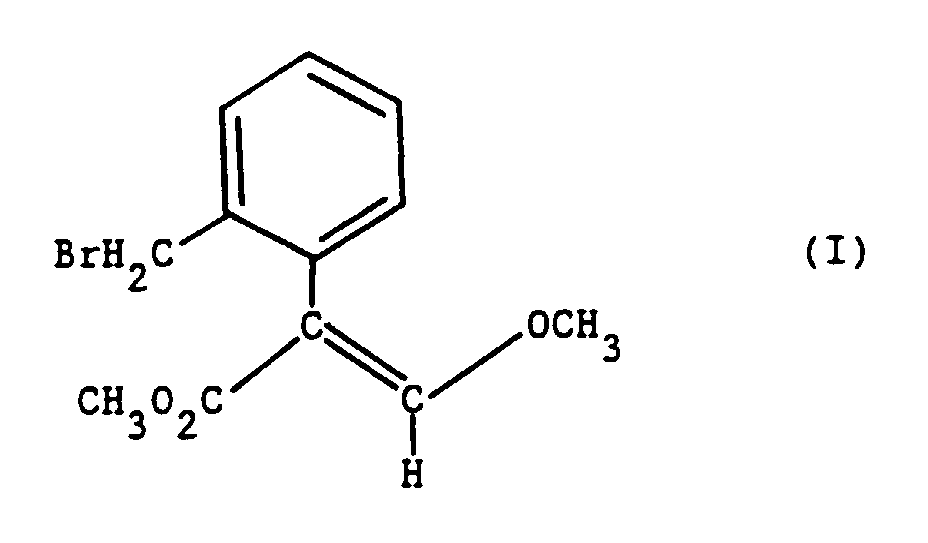
which comprises contacting with bromine the (E)- or (Z)-isomer of a compound of formula (II):
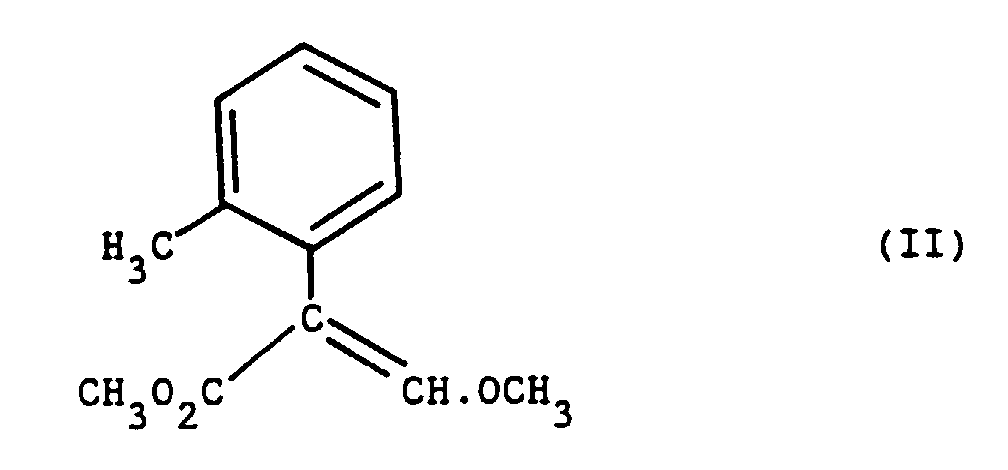
or a mixture of both isomers, in an inert organic solvent, in the presence of a polymeric base and light, the polymeric base being an organic polymer comprising repeat units containing a basic group which will form a salt with hydrogen bromide without generating water.
which comprises contacting with bromine the (E)- or (Z)-isomer of a compound of formula (II):
or a mixture of both isomers, in an inert organic solvent, in the presence of a polymeric base and light, the polymeric base being an organic polymer comprising repeat units containing a basic group which will form a salt with hydrogen bromide without generating water.
2. A process according to claim 1 in which the organic solvent is a chlorinated aliphatic
or aromatic organic solvent having a boiling point not less than 20°C.
3. A process according to claim 1 in which the organic solvent is carbon tetrachloride
or chlorobenzene.
4. A process according to claim 1 in which the polymeric base comprises repeat units
containing a tertiary nitrogen atom which is a member of a heterocyclic ring.
5. A process according to claim 4 in which the heterocyclic ring is a pyridine or pyrrolidone
ring.
6. A process according to claim 1 in which the polymeric base is a cross-linked polyvinylpyridine
polymer, a cross-linked copolymer of styrene and vinylpyridine or a poly(N-vinylpyrrolidone) polymer.
7. A process according to claim 1 in which the polymeric base is a poly(4-vinylpyridine)
or polyvinylpyrrolidone polymer.
8. A process according to claim 1 in which the compound of formula (II) is contacted
with bromine at a temperature of from 20°C to 80°C.
9. A process according to claim 8 in which the temperature is from 55°C to 70°C.
10. A process according to claim 8 in which the temperature is from 20°C to 25°C.
1. Procédé de production d'un composé de formule (I) :
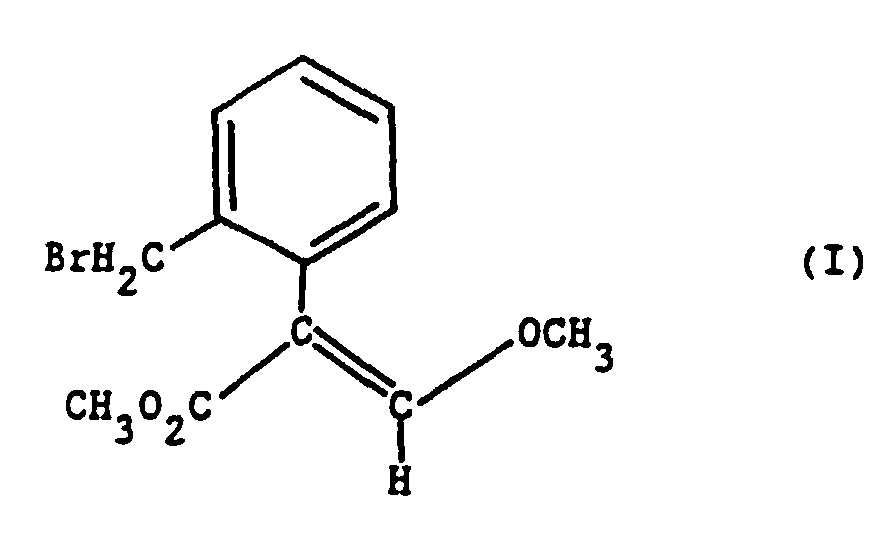
qui comprend la mise en contact avec du brome de l'isomère (E) ou (Z) d'un composé de formule (II) :
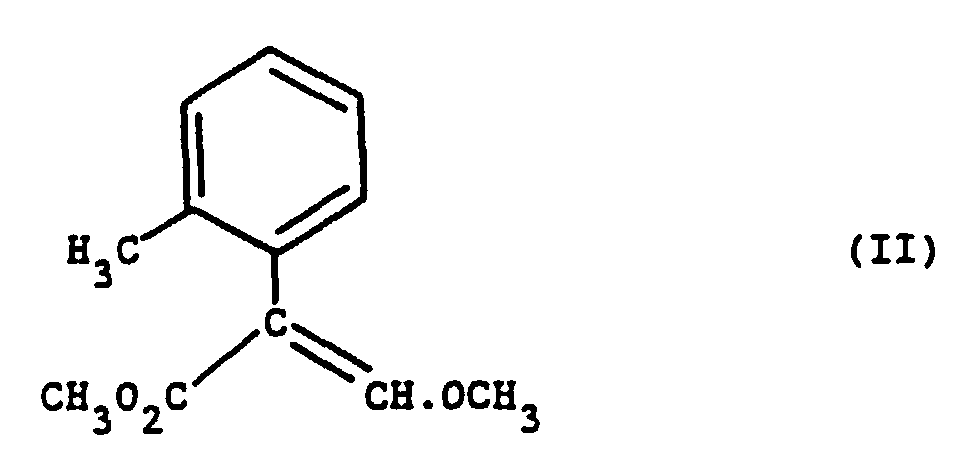
ou d'un mélange des deux isomères, dans un solvant organique inerte, en présence d'une base polymérique et de lumière, la base polymérique étant un polymère organique comprenant des motifs répétés contenant un groupe basique qui forme un sel avec le bromure d'hydrogène sans engendrer d'eau.
qui comprend la mise en contact avec du brome de l'isomère (E) ou (Z) d'un composé de formule (II) :
ou d'un mélange des deux isomères, dans un solvant organique inerte, en présence d'une base polymérique et de lumière, la base polymérique étant un polymère organique comprenant des motifs répétés contenant un groupe basique qui forme un sel avec le bromure d'hydrogène sans engendrer d'eau.
2. Procédé suivant la revendication 1, dans lequel le solvant organique est un solvant
organique aliphatique ou aromatique chloré ayant un point d'ébullition non inférieur
à 20°C.
3. Procédé suivant la revendication 1, dans lequel le solvant organique est le tétrachlorure
de carbone ou le chlorobenzène.
4. Procédé suivant la revendication 1, dans lequel la base polymérique comprend des motifs
répétés contenant un atome d'azote tertiaire qui appartient à un noyau hétérocyclique.
5. Procédé suivant la revendication 4, dans lequel le noyau hétérocyclique est un noyau
de pyridine ou de pyrrolidone.
6. Procédé suivant la revendication 1, dans lequel la base polymérique est un polymère
du type d'une polyvinylpyridine réticulée, un copolymère réticulé de styrène et de
vinylpyridine ou un polymère du type d'une poly(N-vinylpyrrolidone).
7. Procédé suivant la revendication 1, dans lequel la base polymérique est une poly(4-vinylpyridine)
ou un polymère du type d'une polyvinylpyrrolidone.
8. Procédé suivant la revendication 1, dans lequel le composé de formule (II) est mis
en contact avec du brome à une température de 20°C à 80°C.
9. Procédé suivant la revendication 8, dans lequel la température va de 55°C à 70°C.
10. Procédé suivant la revendication 8, dans lequel la température va de 20°C à 25°C.
1. Verfahren zur Herstellung einer Verbindung mit der Formel (I):
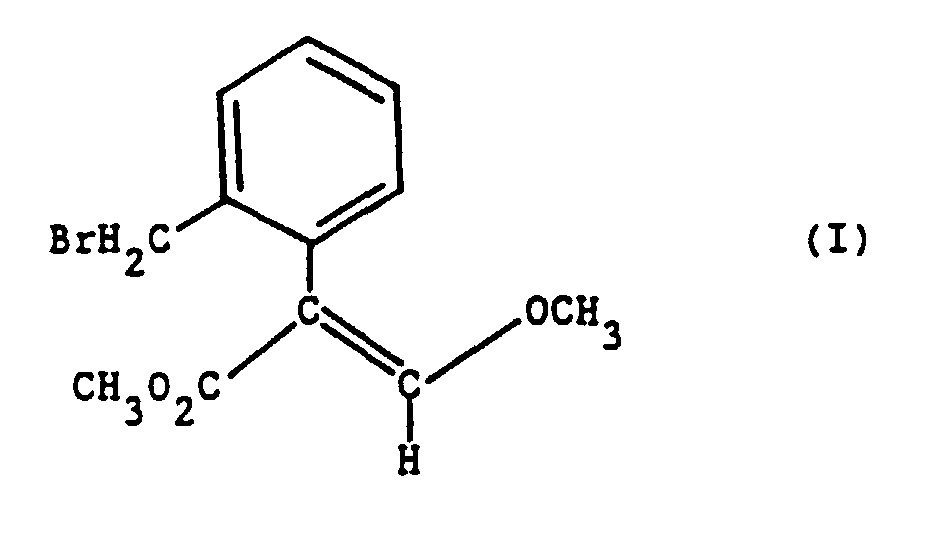
bei dem das (E)- oder (Z)-Isomer einer Verbindung mit der Formel (II):
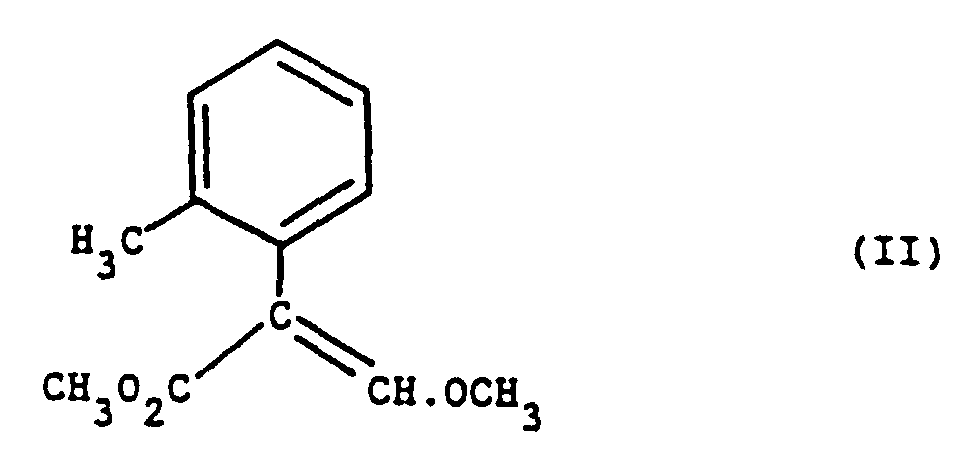
oder ein Gemisch aus beiden Isomeren in einem inerten organischen Lösungsmittel in Gegenwart einer polymeren Base und Licht mit Brom in Kontakt gebracht wird, wobei die polymere Base ein organisches Polymer ist, das Wiederholungseinheiten aufweist, die eine basische Gruppe enthalten, welche ein Salz mit Bromwasserstoff ohne Bildung von Wasser bildet.
bei dem das (E)- oder (Z)-Isomer einer Verbindung mit der Formel (II):
oder ein Gemisch aus beiden Isomeren in einem inerten organischen Lösungsmittel in Gegenwart einer polymeren Base und Licht mit Brom in Kontakt gebracht wird, wobei die polymere Base ein organisches Polymer ist, das Wiederholungseinheiten aufweist, die eine basische Gruppe enthalten, welche ein Salz mit Bromwasserstoff ohne Bildung von Wasser bildet.
2. Verfahren nach Anspruch 1, wobei das organische Lösungsmittel ein chloriertes aliphatisches
oder aromatisches organisches Lösungsmittel mit einem Siedepunkt von nicht niedriger
als 20°C ist.
3. Verfahren nach Anspruch 1, wobei das organische Lösungsmittel Tetrachlorkohlenstoff
oder Chlorbenzol ist.
4. Verfahren nach Anspruch 1, wobei die polymere Base Wiederholungseinheiten aufweist,
die ein tertiäres Stickstoffatom enthalten, das ein Teil eines heterocyclischen Rings
ist.
5. Verfahren nach Anspruch 4, wobei der heterocyclische Ring ein Pyridin- oder Pyrrolidon-Ring
ist.
6. Verfahren nach Anspruch 1, wobei die polymere Base ein vernetztes Polyvinylpyridin-Polymer,
ein vernetztes Copolymer aus Styrol und Vinylpyridin oder ein Poly(N-vinylpyrrolidon)-Polymer
ist.
7. Verfahren nach Anspruch 1, wobei die polymere Base ein Poly(4-vinylpyridin)- oder
Polyvinylpyrrolidon-Polymer ist.
8. Verfahren nach Anspruch 1, wobei die Verbindung mit der Formel (II) bei einer Temperatur
von 20°C bis 80°C mit Brom in Kontakt gebracht wird.
9. Verfahren nach Anspruch 8, wobei die Temperatur 55°C bis 70°C beträgt.
10. Verfahren nach Anspruch 8, wobei die Temperatur 20°C bis 25°C beträgt.