| (19) |
 |
|
(11) |
EP 0 660 000 A1 |
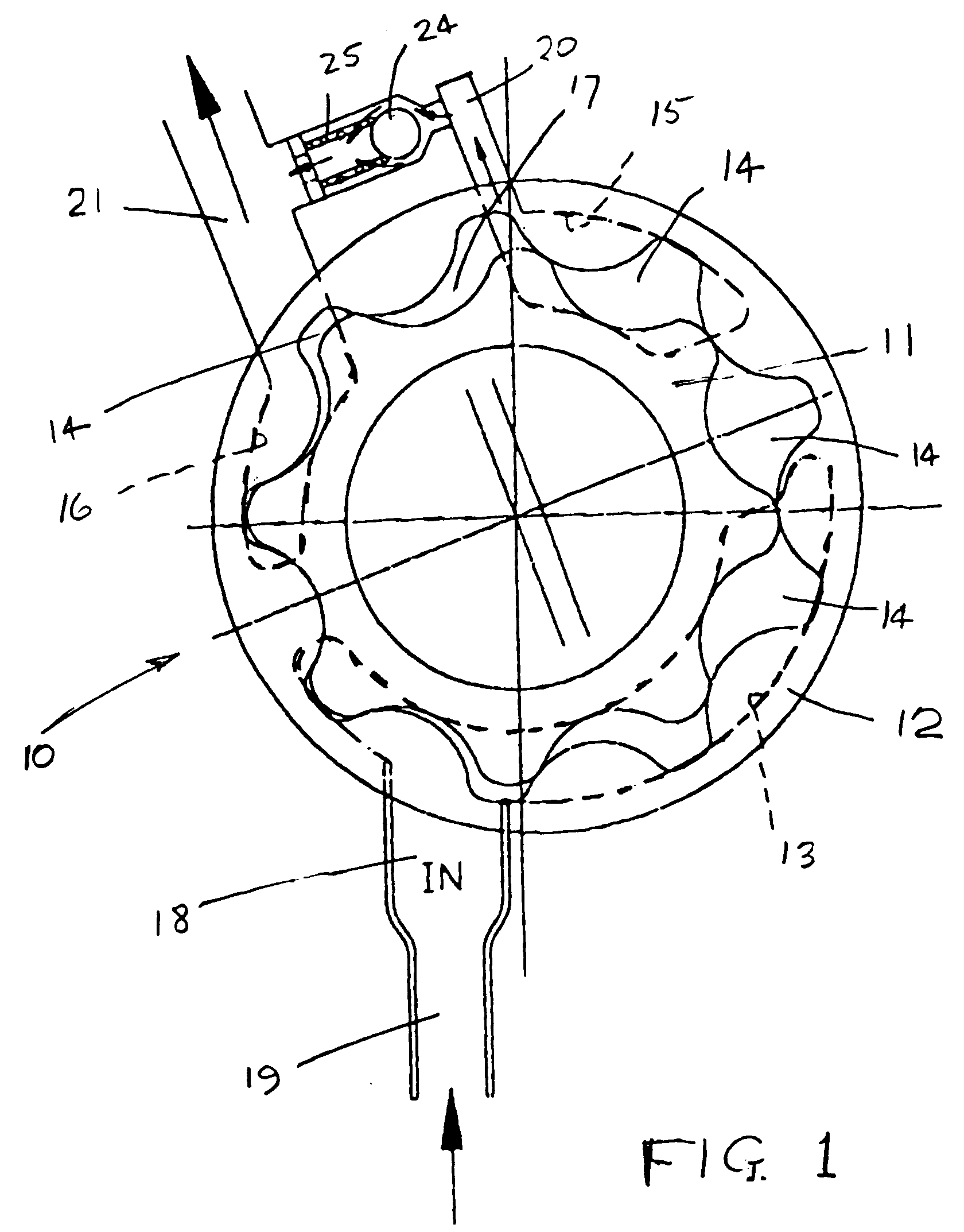
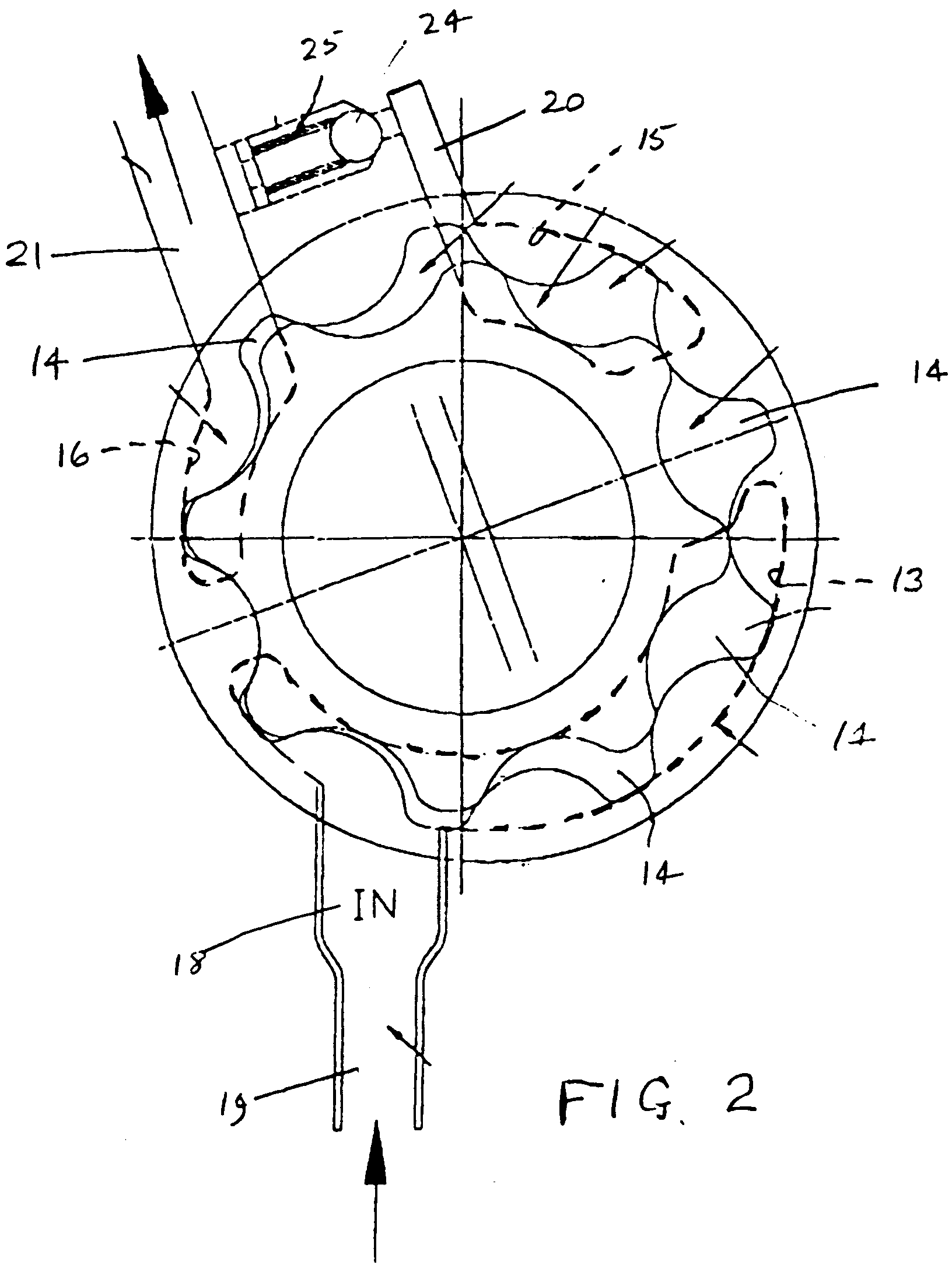
| (12) |
EUROPEAN PATENT APPLICATION |
| (43) |
Date of publication: |
|
28.06.1995 Bulletin 1995/26 |
| (22) |
Date of filing: 30.11.1994 |
|
|
| (84) |
Designated Contracting States: |
|
DE FR GB IT |
| (30) |
Priority: |
30.11.1993 GB 9324501
|
| (71) |
Applicant: HOBOURN AUTOMOTIVE LIMITED |
|
Rochester,
Kent ME2 2BD (GB) |
|
| (72) |
Inventors: |
|
- Thornilow, Alec
Chatham,
Kent (GB)
- Baseley, Simon
Orpington,
Kent BR6 8PG (GB)
|
| (74) |
Representative: Perkins, Sarah |
|
Stevens, Hewlett & Perkins
1 Serjeants' Inn
Fleet Street
London EC4Y 1LL
London EC4Y 1LL (GB) |
|
| |
|
| (54) |
Positive displacement pumps |
(57) A pump has inner and outer lobed rotors (11,12) which define between them a series
of pumping chambers. An inlet passage (18) to the pump has a restriction (19) which
causes cavitation in the pump when the pump speed rises above a predetermined value.
Two outlet passages (20,21) are also provided and interconnect via a non-return valve
(24). The interconnection of the two outlet passages ensures that even when cavitation
is caused in the pump there is no reverse flow in the outlet passages. In this way
less noisy operation of the pump may be achieved.
|

|
[0001] This invention relates to positive displacement pumps and has a particularly useful
but not exclusive application in pumps for supplying lubricant to internal combustion
engines.
[0002] According to this invention in one aspect there is provided a gerotor or lobe-type
pump comprising a housing in which inner and outer lobed rotors are mounted for rotation,
said rotors defining between them a series of pumping chambers, said housing having
an inlet passage leading to an inlet port for admitting a working fluid to the chambers,
a restriction in said inlet passage, and two outlet ports through which the working
fluid from said inlet port is discharged into respective discharge passages, said
outlet ports being sealed from each other, the discharge passage leading from one
of said outlet ports communicating through a spring-loaded non-return valve with the
(main) discharge passage leading from the second of said outlet ports, said valve
being opened by the pressure of the working fluid in said one discharge passage when
said pressure rises to a value sufficient to overcome the loading on said valve.
[0003] The restriction may be fixed. Alternatively the restriction may be controlled by
means responsive to the temperature of the working fluid so as to reduce the restriction
when said temperature is low.
[0004] The invention will now be described in more detail with reference by way of example
to the accompanying diagrammatic drawings in which:
[0005] Figures 1 and 2 respectively show a positive displacement pump according to the invention
in operating in its low-speed and high speed conditions respectively.
[0006] Referring first to Figure 1 of the drawings, the system is intended to supply lubricating
oil to the main oil gallery of an internal combustion engine. For this purpose a gerotor
or N(N+1) pump 10 is employed comprising in the known manner inner and outer lobed
rotors 11, 12 the outer rotor 12 being rotatable in a recess in the pump housing (only
part of which is shown), and the inner rotor 11 being mounted eccentrically with respect
to the outer rotor on a drive shaft (not shown). The housing provides axial faces
at opposite axial sides of the assembly of the two rotors 11, 12 and an inlet port
13 formed in one of the axial faces extends over the part of the cycle during which
the pumping chambers 14 formed between the rotors are increasing in volume. Two outlet
ports 15, 16 are also formed at circumferentially spaced locations in the housing
and are sealed from each other by a sealing land 17 in the said one axial face of
the housing. The two outlet ports jointly extend over the part of the cycle during
which the pumping chambers 14 are decreasing in volume. The sealing land 17 has a
circumferential extent such that as each pumping chamber becomes cut off from the
first outlet port 15 it comes into communication with the second outlet port 16. The
working fluid, which is oil in this instance, is fed to the inlet port 13 through
an inlet passage 18 and is discharged under pressure, partly through port 15 and partly
through port 16. First and second discharge passages 20, 21, lead from the respective
outlet ports. The second discharge passage constitutes the main discharge passage
and leads to the main oil gallery (not shown) of the engine.
[0007] The first discharge passage 20 communicates with the main discharge passage 21 through
a non-return valve 24 loaded by a light spring 25, so that when the pressure in the
first discharge passage exceeds that in the second discharge passage the valve is
opened and oil flows from the first into the main discharge passage.
[0008] A restriction 19, which may be fixed or adjustable, is provided in the inlet passage
18 to the pump and is designed to cause cavitation in the pump when the pump speed
rises above a value at which the pump delivery pressure and volume reach values which
are adequate for engine speeds up to the maximum. In consequence the pump chambers
begin to be filled with oil vapour and liquid oil instead of just liquid oil, and
since compression of the vapour requires the expenditure of less energy than for liquid
oil, the power expended in compressing the contents of the pumping chambers is reduced
and the load on the engine is reduced correspondingly. Also, since the discharge through
the second outlet port determines the pressure in the outlet passage, no reverse flow
of oil and vapour from the second discharge passage into the pumping chambers will
occur, and since the valve is a non-return valve and will not permit flow from the
first into the second discharge passage until the pressure in the first discharge
passage equals that in second discharge passage, there is no reverse flow into the
first discharge passage, and consequently the cavitation results in less noisy operation
than would otherwise be the case.
[0009] It will be understood that the position of the sealing land between the first and
second outlet ports can be selected to alter the proportion of the oil discharged
through the two ports in relation to each other.
[0010] The cavitation effect may be achieved by using an inlet pipe to the pump of appropriately
small diameter, instead of a restrictor, but it may be advantageous to employ a restrictor
controlled by a thermostat responsive to the oil temperature to avoid cavitation at
too low a pump speed when the ambient air temperature is low and the oil is more viscous,
or under starting conditions of the engine.
1. A gerotor or lobe-type pump comprising a housing in which inner and outer lobed rotors
are mounted for rotation, said rotors defining between them a series of pumping chambers,
said housing having an inlet passage leading to an inlet port for admitting a working
fluid to the chambers, a restriction in said inlet passage, and two outlet ports through
which the working fluid from said inlet port is discharged into respective discharge
passages, said outlet ports being sealed from each other, the discharge passage leading
from one of said outlet ports communicating through a spring-loaded non-return valve
with the main discharge passage leading from the second of said outlet ports, said
valve being opened by the pressure of the working fluid in said one discharge passage
when said pressure rises to a value sufficient to overcome the loading on said valve.
2. A pump as claimed in claim 1, wherein the restriction is a fixed restriction.
3. A pump as claimed in claim 2, wherein the restriction is provided by a small diameter
inlet pipe to the inlet port.
4. A pump as claimed in claim 1, wherein the restriction is a variable restriction controlled
by means responsive to the temperature of the working fluid so as to reduce the restriction
when said temperature is low.