| (19) |
 |
|
(11) |
EP 0 662 573 B1 |
| (12) |
EUROPEAN PATENT SPECIFICATION |
| (45) |
Mention of the grant of the patent: |
|
29.04.1998 Bulletin 1998/18 |
| (22) |
Date of filing: 10.01.1995 |
|
| (51) |
International Patent Classification (IPC)6: F16H 25/20 |
|
| (54) |
Linear actuator
Linearer Antrieb
Actuateur linéaire
|
| (84) |
Designated Contracting States: |
|
BE CH DE DK ES FR GB IT LI NL SE |
| (30) |
Priority: |
10.01.1994 DK 4094
|
| (43) |
Date of publication of application: |
|
12.07.1995 Bulletin 1995/28 |
| (73) |
Proprietor: LINAK A/S |
|
DK-6430 Nordborg (DK) |
|
| (72) |
Inventor: |
|
- Jensen, Bent
DK-6430 Nordborg (DK)
|
| (74) |
Representative: Pedersen, Soeren Skovgaard |
|
Hofman-Bang & Boutard,
Lehmann & Ree A/S
Ryesgade 3
P.O. Box 367
8100 Aarhus C
8100 Aarhus C (DK) |
| (56) |
References cited: :
EP-A- 0 226 065
EP-A- 0 259 641
FR-A- 2 088 239
|
EP-A- 0 258 571
EP-A- 0 577 541
US-A- 4 246 991
|
|
| |
|
|
|
|
| |
|
| Note: Within nine months from the publication of the mention of the grant of the European
patent, any person may give notice to the European Patent Office of opposition to
the European patent
granted. Notice of opposition shall be filed in a written reasoned statement. It shall
not be deemed to
have been filed until the opposition fee has been paid. (Art. 99(1) European Patent
Convention).
|
[0001] The present invention relates to a linear actuator comprising an actuator housing
and a screw spindle rotatable in either direction, a drive nut axially displaceable
on the screw spindle and connected to a driving rod, and a reversible electric motor
driving the screw spindle via a gear and project the driving rod or retracting it
respectively depending on the direction of the direction of rotation of the spindle.
[0002] A linear actuator of this kind is known from EP-A-0 577 541. For certain purposes
and constructions it is necessary to furnish actuators with a self-locking spindle,
which requires a considerably higher effect, up to 50%. Furthermore, self-locking
spindles have a very fine innate pitch. However, by the invention it is reckoned that
also in said situations spindles of the non-self-locking type can be used by using
a braking spring in the shape of a flat coil spring with one end fixed in the actuator
housing and which with a number of winding is laid around one end of the spindle or
power transmission coupling for this. The braking spring is arranged such that it
allows the spindle to rotate freely when it is loaded which normally is the projecting
movement. In the reversing movement a braking force is applied to the spindle, this
braking force being a compromise such that the spindle is locked against rotation
when the motor is inoperable, but being sufficiently small such that it can be overcome
by the motor. In other words the spring is arranged with its winding direction such
that it is loosened i.e. unwound in the projecting movement while the windings are
tightened around the spindle or power transmission coupling wherever the spring may
be placed and thereby exerts a braking effect. The necessary braking force is in fact
very modest as it shall only support the inertia in the construction and can be determined
exactly by the number of windings.
[0003] The invention will be described further in the following with reference to the accompanying
drawing in which,
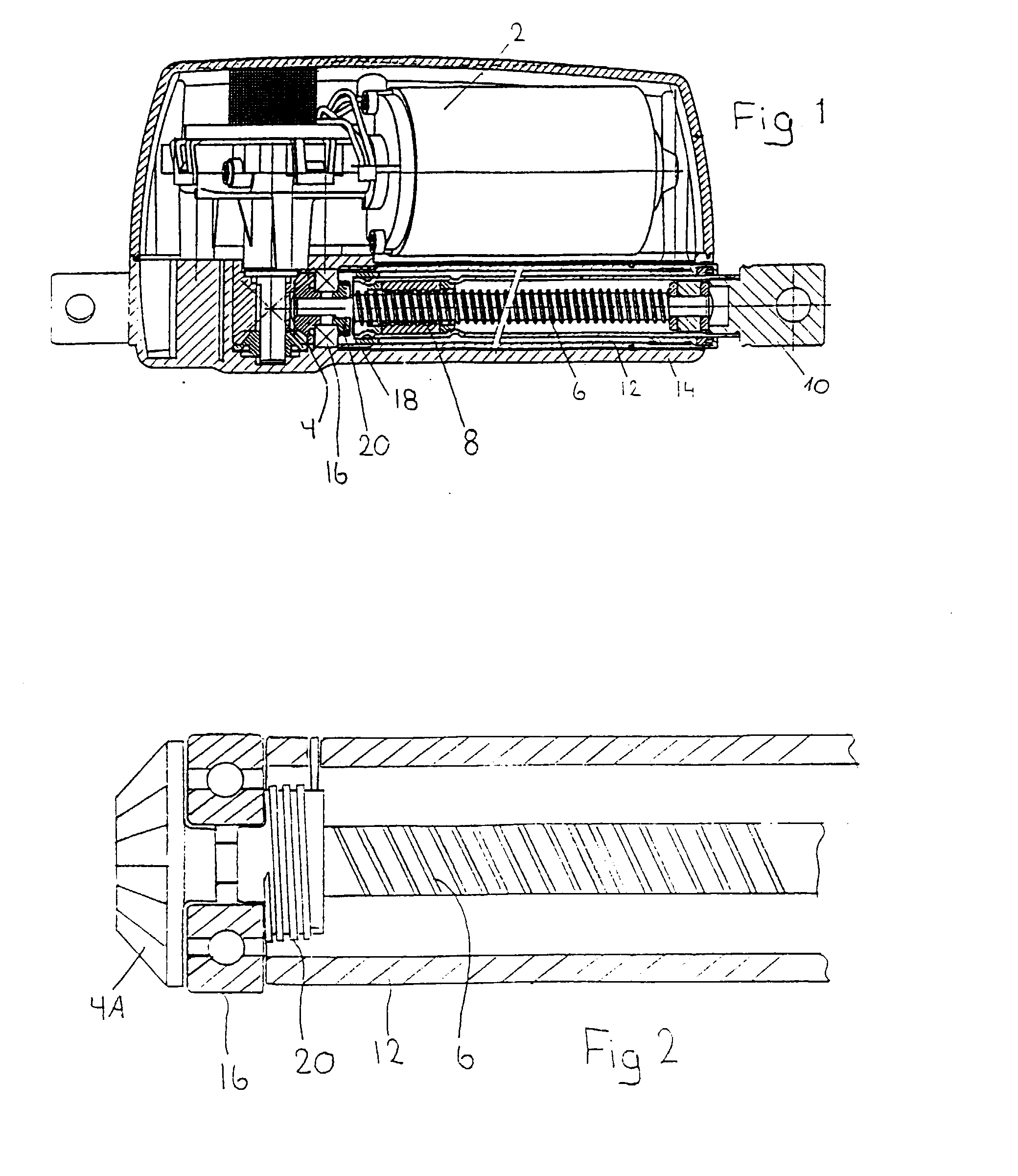
Fig. 1 shows a longitudinal section through a linear actuator according to the invention,
Fig. 2 shows an enlarged view seen from above of the driven end of the actuator spindle,
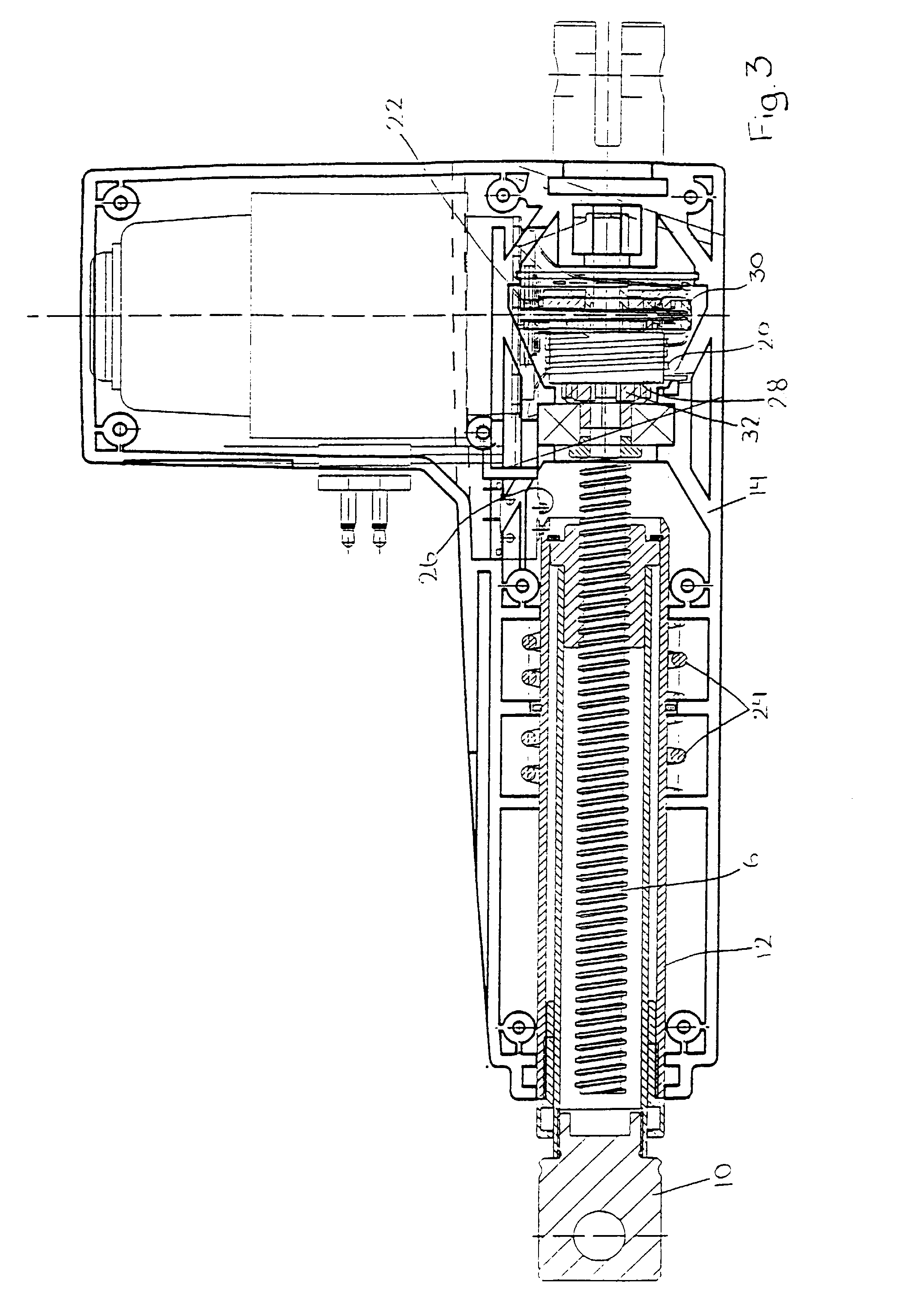
and
Fig. 3 shows a longitudinal section through another embodiment of a linear actuator
according to the invention.
[0004] In fig. 1 is shown a longitudinal section through a linear actuator comprising a
reversible electric motor 2 which by a set of bevelled gears 4 is driving a spindle
6. On the spindle is arranged a longitudinal displaceable ball drive nut 8 to which
is attached a drive rod 10 in the nature of a tube telescopically arranged in a protective
tube embedded in the actuator housing 14. The driven end of the spindle is resting
in a ball bearing 16 arranged between one of the two bevelled gears 4A and a cylindrical
element 18. Around the cylindrical element is laid a braking spring in the nature
of a flat helical spring 20 with one end fixed in the actuator housing. The spring
has its windings arranged around the cylindrical element in such a manner that it
does not oppose the spindle in the rotating direction for projecting the drive rod
10, but when reversing the rotating direction for reversing the drive rod then the
spring applies a braking force on the cylindrical element the size of which is tuned
such that the spindle appears self-locking when the motor is cut off. At projecting
the drive rod the direction of rotation of the spindle causes the spring which lies
tightly against the cylindrical element metaphoriclaly speaking to open as the friction
from the cylindrical element acts against the winding direction of the spring and
thereby does not or only to a negligible extent influences on the spindle rotation.
During reversing the spring on the contrary is tightened around the cylindrical element
and causes the self-locking braking effect on the spindle. An enlarged view of the
end of the spindle is shown in fig. 2 of the drawing.
[0005] In fig. 3 of the drawing is shown a linear actuator which differs from the previous
one especially in that the spindle is driven by a worm gear 22, and in that the outer
tube 12 is arranged axially displaceable between two springs 24 for operating an end
stop switch 26 for cutting off the motor when the drive 26 reaches the end positions.
Further the braking spring 20 is here laid around a cylindrical element 28 in the
worm gear. This is an cylindrical element 28 in a multi-spline transmission between
the worm wheel and the spindle. The cylindrical element is integrated with the worm
wheel 30 and contains a cylindrical piece 32 on the end of the spindle as the spring
rests in grooves internally in the cylindrical piece. The braking spring is fixed
with one end in the part of the actuator housing which houses the transmission. The
braking spring acts as before namely such that it does not counteract the rotation
of the spindle during projection of the drive rod but loads the transmission during
reversing of the drive rod with a force sufficient to the spindle appears self-locking
when the motor is cut off.
[0006] Where one previously was forced to use spindles of the selflocking type, the invention
allows the possibility also in said cases of using spindles of the non-selflocking
type and achieving the associated advantages such as less friction and thereby a reduced
power consumption.
1. A linear actuator comprising an actuator housing and a non-self-locking screw spindle
(6) rotatable in either direction, a driving nut (8) axially displaceable on the screw
spindle and connected to a drive rod (10), and a reversible electric motor (2) driving
the screw spindle via a gear and respectively projecting or retracting the drive rod
depending on the direction of rotation of the spindle, characterised in that the actuator
further comprises a coil spring (20) with one end fixed in the actuator housing and
with a number of windings arranged around one end of the spindle or a cylindrical
element of a power transmission coupling associated therewith, and arranged such that
it allows free rotation of the spindle during the projection movement but applies
a braking force on the spindle in the retracting movement, balanced such that the
spindle appears self-locking.
1. Ein Linearantrieb, umfassend ein Antriebsgehäuse und eine nicht selbstgehemmente Schraubenspindel
(6), die nach beiden Richtungen drehbar ist, eine Antriebsmutter (8), die auf einer
Schraubenspindel axial verlagerbar ist und mit einer Antriebswelle (10) verbunden
ist, und einen reversierbaren Elektromotor (2), der die Schraubenspindel über ein
Getriebe antreibt und die Antriebswelle, abhängig von der Drehrichtung der Spindel
nach vorn schiebt bzw. zurückbewegt, dadurch gekennzeichnet, daß der Antrieb weiterhin eine Schraubenfeder (20) umfaßt, die mit einem Ende in
dem Antriebsgehäuse befestigt ist und bei der eine Anzahl Wandungen um ein Ende der
Spindel oder ein zylindrisches Element einer diesem zugeordneten Kraftübertragungskupplung
angeordnet sind, und die so angeordnet ist, daß sie während der Vorwärts-/Ausfahrbewegung
freie Drehung der Spindel zuläßt, aber bei der Rückwärts-/Rückzugsbewegung eine Bremskraft
auf die Spindel ausübt, die so ausgewogen ist, daß die Spindel selbstgehemment zu
sein scheint.
1. Actionneur linéaire comprenant un boîtier d'actionneur et une broche filetée (6) dépourvue
d'auto-verrouillage, pouvant tourner dans chaque sens, un écrou d'entraînement (8)
axialement déplaçable sur la broche filetée et relié à une tige d'entraînement (10),
et un moteur électrique réversible (2) entraînant la broche filetée via un pignon
et sortant ou rétractant respectivement la tige d'entraînement selon le sens de rotation
de la broche filetée,
caractérisé en ce que l'actionneur comprend, de plus, un ressort hélicoïdal (20) ayant
une extrémité fixée dans le boîtier d'actionneur et ayant un nombre d'enroulements
agencés autour d'une extrémité de la broche filetée ou d'un élément cylindrique d'un
accouplement de transmission de puissance associé à celle-ci, et agencé de telle sorte
qu'il permet une libre rotation de la broche filetée pendant le mouvement de sortie
mais applique une force de freinage sur la broche filetée dans le mouvement de rétraction,
équilibrée, de sorte que la broche acquiert un auto-verrouillage.