|
(11) | EP 0 663 394 A1 |

| (12) | EUROPEAN PATENT APPLICATION |
|
|
|
|
|||||||||||||||||||||||||||
| (54) | Process for preparing 5-aminodihydropyrrole, intermediate thereof and process for preparing said intermediate |
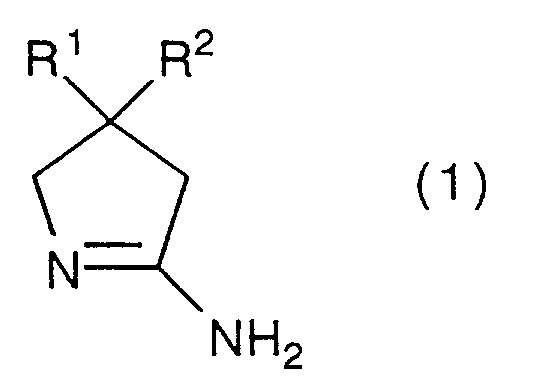
| (57) A 5-aminodihydropyrrole of the formula (1):
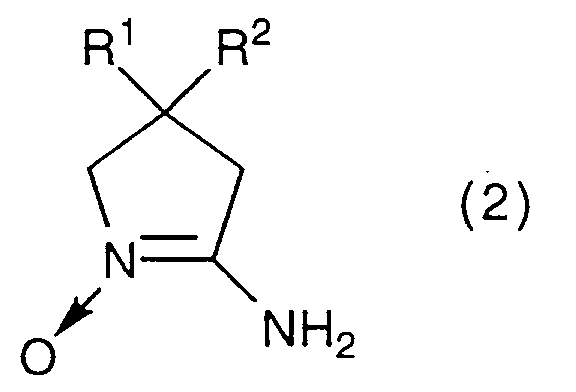
in which R¹ and R² independently represent a hydrogen atom, a lower alkyl group or a lower haloalkyl group, or together form a C₂-C₁₀ alkylene group optionally substituted with a halogen by reducing an oxidepyrrole of the formula (2): in which R¹ and R² are the same as defined above, with hydrogen in the presence of a catalyst. |
[0001] The present invention relates to a process for preparing 5-aminodihydropyrrole which is useful as a raw material of agrochemicals, an oxidepyrrole which is a key intermediate for the preparation of 5-aminodihydropyrrole, and a process for preparing said intermediate.
[0002] A 5-aminodihydropyrrole of the formula (1):
wherein R¹ and R² are the same or different and represent a hydrogen atom, a lower alkyl group or a lower haloalkyl group, or together form a C₂-C₁₀ alkylene group which may be substituted with a halogen
is known to be useful as a raw material of agrochemicals such as benzoxadine or benzoxazoline type herbicides. But, its preparation process has not been known.
[0003] As a related process, there is known a process for preparing a 2-substituted-5-aminodihydropyrrole from a corresponding N-oxide compound using sodium and an alcohol, or distilling it in the presence of zinc, or using iron and hydrochloric acid (cf. J. Chem. Soc., (1947) 1508). However, this process is unsatisfactory in the technical production, since sodium, zinc or iron should be used in a large amount and a yield of the desired compound is low.
[0004] There is also known a process for preparing 3-phenyl-5-aminodihydropyrrole by treating a 4-phenyl-2-pyrrolidone compound with phosphorus oxychloride and ammonia (cf. Monatsh. Chem., 101 (5), 1970, 1263). However, this process cannot be used for the preparation of a 5-aminodihydropyrrole having no phenyl group at the 3-position such as the 5-aminodihydropyrrole of the formula (1), which is an important raw material of agrochemicals cannot be obtained by this method.
[0005] Accordingly, it is highly desired to find a process for preparing the 5-aminodihydropyrrole (1), in particular, which is excellent for industrial scale production.
[0006] One object of the present invention is to provide an industrially excellent process for preparing the 5-aminodihydropyrrole (1).
[0007] Another object of the present invention is to provide a compound which is a key intermediate in the preparation of the 5-aminodihydropyrrole (1).
[0008] According to a first aspect of the present invention, there is provided a process for preparing a 5-aminodihydropyrrole of the formula (1):
wherein R¹ and R² are the same or different and represent a hydrogen atom, a lower alkyl group or a lower haloalkyl group, or together form a C₂-C₁₀ alkylene group which may be substituted with a halogen
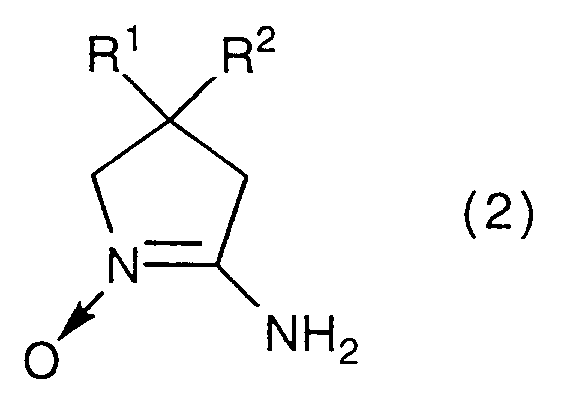
comprising reducing an oxidepyrrole of the formula (2):
wherein R¹ and R² are the same as defined above with hydrogen in the presence of a catalyst.
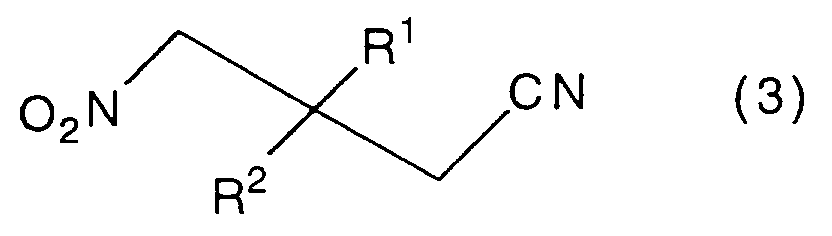
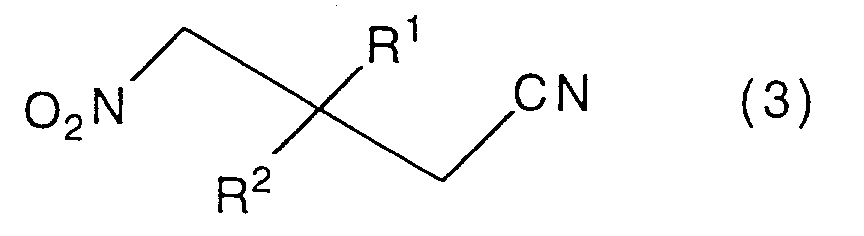
[0009] According to a second aspect of the present invention, there is provided a process for preparing an oxidepyrrole of the formula (2) comprising reducing a 4-nitrobutanenitrile of the formula (3):
wherein R¹ and R² are the same as defined above with hydrogen in the presence of a catalyst.
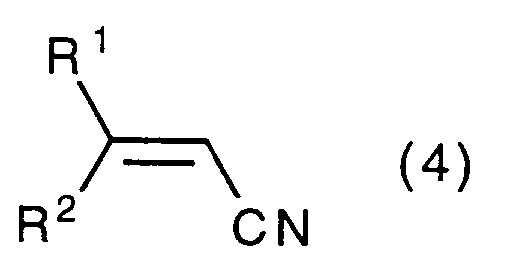
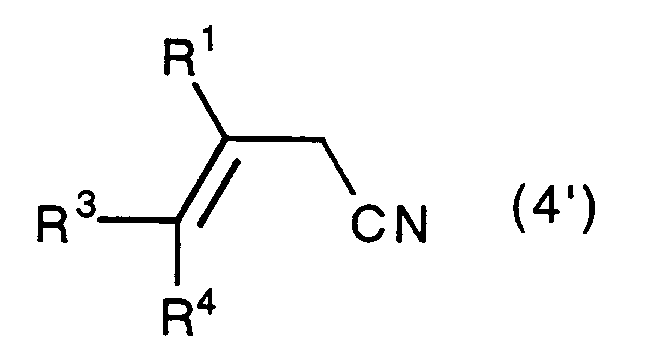
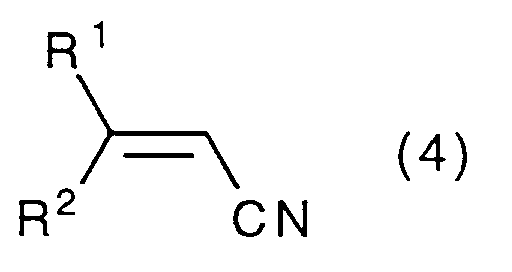
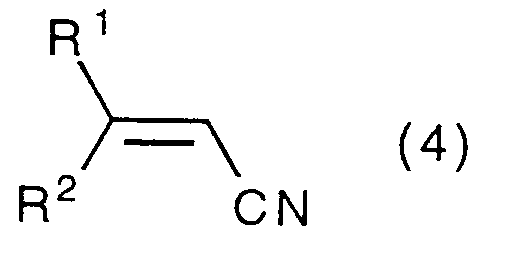
[0010] According to a third aspect of the present invention, there is provided a process for preparing a 4-nitrobutanenitrile of the formula (3) comprising reacting an alkenylnitrile of the formula (4):
or the formula (4'):
wherein R¹ and R² are the same as defined above and R³ and R⁴ are the same or different and represent a hydrogen atom, a C₁-C₄ alkyl group or a lower C₁-C₄ haloalkyl group
with nitromethane in the presence of a base.
[0011] According to a fourth aspect of the present invention, there is provided an oxidepyrrole of the formula (2).
[0012] According to a fifth aspect of the present invention, there is provided a 4-nitrobutanenitrile of the formula (3).
[0014] The lower alkyl or haloalkyl group for R¹ and R² has usually 1 to 5 carbon atoms and may be a straight or branched group. Examples of the lower alkyl group are a methyl group, an ethyl group, a propyl group, an isopropyl group, a butyl group, a sec.-butyl group, a tert.-butyl group, an amyl group, a tert.-amyl group, and the like. Example of the lower haloalkyl group are a fluoromethyl group, a difluoromethyl group, a trifluoromethyl group, a pentafluoroethyl group.
[0015] Alternatively, R¹ and R² together form a C₂-C₁₀ alkylene group which may be substituted with at least one halogen atom (e.g. a chlorine atom, a fluorine atom, a bromine atom, or an iodine atom).
[0016] Specific examples of the oxidepyrrole (2) are 5-amino-3,4-dihydro-1-oxide-2H-pyrrole, 5-amino-3,4-dihydro-3,3-dimethyl-1-oxide-2H-pyrrole, 5-amino-3,4-dihydro-3,3-diethyl-1-oxide-2H-pyrrole, 5-amino-3,4-dihydro-3,3-dipropyl-1-oxide-2H-pyrrole, 5-amino-3,4-dihydro-3,3-bis(fluoromethyl)-1-oxide-2H-pyrrole, 5-amino-3,4-dihydro-3,3-bis(difluoromethyl)-1-oxide-2H-pyrrole, 5-amino-3,4-dihydro-3,3-bis(trifluoromethyl)-1-oxide-2H-pyrrole, 5-amino-3,4-dihydro-3,3-bis(pentafluoroethyl)-1-oxide-2H-pyrrole, 5-amino-3,4-dihydro-3-methyl-1-oxide-2H-pyrrole, 5-amino-3,4-dihydro-3-ethyl-1-oxide-2H-pyrrole, 5-amino-3,4-dihydro-3-propyl-1-oxide-2H-pyrrole, 5-amino-3,4-dihydro-3-isopropyl-1-oxide-2H-pyrrole, 5-amino-3,4-dihydro-3-butyl-1-oxide-2H-pyrrole, 5-amino-3,4-dihydro-3-tert.-butyl-1-oxide-2H-pyrrole, 5-amino-3,4-dihydro-3-sec.-butyl-1-oxide-2H-pyrrole, 5-amino-3,4-dihydro-3-fluoromethyl-1-oxide-2H-pyrrole, 5-amino-3,4-dihydro-3-difluoromethyl-1-oxide-2H-pyrrole, 5-amino-3,4-dihydro-3-trifluoromethyl-1-oxide-2H-pyrrole, 5-amino-3,4-dihydro-3-pentafluoroethyl-1-oxide-2H-pyrrole, 5-amino-3,4-dihydro-3-ethyl-3-methyl-1-oxide-2H-pyrrole, 5-amino-3,4-dihydro-3-isopropyl-3-methyl-1-oxide-2H-pyrrole, 5-amino-3,4-dihydro-3-butyl-3-methyl-1-oxide-2H-pyrrole, 5-amino-3,4-dihydro-3-tert.-butyl-3-methyl-1-oxide-2H-pyrrole, 5-amino-3,4-dihydro-3-sec.-butyl-3-methyl-1-oxide-2H-pyrrole, 5-amino-3,4-dihydro-3-fluoromethyl-3-methyl-1-oxide-2H-pyrrole, 5-amino-3,4-dihydro-3-difluoromethyl-3-methyl-1-oxide-2H-pyrrole, 5-amino-3,4-dihydro-3-trifluoromethyl-3-methyl-1-oxide-2H-pyrrole, 5-amino-3,4-dihydro-3-fluoromethyl-3-ethyl-1-oxide-2H-pyrrole, 5-amino-3,4-dihydro-3-difluoromethyl-3-ethyl-1-oxide-2H-pyrrole, 5-amino-3,4-dihydro-3-trifluoromethyl-3-ethyl-1-oxide-2H-pyrrole, 5-amino-3,4-dihydro-3-fluoromethyl-3-isopropyl-1-oxide-2H-pyrrole, 5-amino-3,4-dihydro-3-difluoromethyl-3-isopropyl-1-oxide-2H-pyrrole, 5-amino-3,4-dihydro-3-trifluoromethyl-3-isopropyl-1-oxide-2H-pyrrole, 5-amino-3,4-dihydro-3-fluoromethyl-3-tert.-butyl-1-oxide-2H-pyrrole, 5-amino-3,4-dihydro-3-difluoromethyl-3-tert.-butyl-1-oxide-2H-pyrrole, 5-amino-3,4-dihydro-3-trifluoromethyl-3-tert.-butyl-1-oxide-2H-pyrrole, 5-amino-3,4-dihydro-3-fluoromethyl-3-sec.-butyl-1-oxide-2H-pyrrole, 5-amino-3,4-dihydro-3-difluoromethyl-3-sec.-butyl-1-oxide-2H-pyrrole, 5-amino-3,4-dihydro-3-trifluoromethyl-3-sec.-butyl-1-oxide-2H-pyrrole, 5-amino-3,4-dihydro-3,3-ethylene-1-oxide-2H-pyrrole, 5-amino-3,4-dihydro-3,3-tetramethylene-1-oxide-2H-pyrrole, 5-amino-3,4-dihydro-3,3-pentamethylene-1-oxide-2H-pyrrole, 5-amino-3,4-dihydro-3,3-hexamethylene-1-oxide-2H-pyrrole, 5-amino-3,4-dihydro-3,3-octamethylene-1-oxide-2H-pyrrole, and the like.
[0017] The aminodihydropyrrole (1) can be effectively obtained by reducing the oxidepyrrole (2) with hydrogen in the presence of a catalyst.
[0018] Examples of the catalyst to be used are metal catalysts, for example, platinum catalysts such as Pt/C, palladium catalysts such as Pd/C, Raney nickel catalysts, Raney cobalt catalysts, and the like.
[0019] The amount of the catalyst is, per one part by weight of the oxidepyrrole (1), usually from 0.00001 to 0.1 part by weight of the platinum catalyst or the palladium catalyst, or 0.01 to 5 parts by weight of the Raney nickel or cobalt catalyst containing about 50 % of water.
[0020] Usually, the above reduction reaction is carried out under a pressure of hydrogen. The pressure is generally from 1 to 50 bar , preferably from 5 to 30 bar.
[0021] The reduction reaction is usually carried out in the presence of a solvent. Examples of the solvent are alcohols (e.g. methanol, ethanol, isopropanol, etc.), aromatic hydrocarbons (e.g. toluene, etc.), esters (e.g. ethyl acetate, etc.), organic acids which can be used as the solvent (e.g. acetic acid, etc.), and the like.
[0023] The amount of the solvent is usually from 2 to 500 parts by weight per one part by weight of the oxidepyrrole (2).
[0024] Preferably, an organic acid is added to the reduction reaction system. Examples of the organic acid are carboxylic acids (e.g. formic acid, acetic acid, propionic acid, etc.), sulfonic acids (e.g. methanesulfonic acid, p-toluenesulfonic acid, etc.) and so on. These organic acids may be used independently or as a mixture of two or more of them.
[0026] When the organic acid is used, its amount is usually from 0.1 to 100 moles per one mole of the oxidepyrrole (2).
[0027] In the above reduction reaction, the reaction temperature is usually from 50 to 150°C. The reaction time is usually from 1 to 10 hours.
[0028] After the reaction, the formed 5-aminodihydropyrrole (1) can be isolated by, for example, removing the catalyst by filtration and evaporating the solvent off. If necessary, the isolated product may be purified by a conventional purification method such as recrystallization.
[0029] Examples of the 5-aminodihydropyrrole (1) are 5-amino-3,4-dihydro-2H-pyrrole, 5-amino-3,4-dihydro-3,3-dimethyl-2H-pyrrole, 5-amino-3,4-dihydro-3,3-diethyl-2H-pyrrole, 5-amino-3,4-dihydro-3,3-dipropyl-2H-pyrrole, 5-amino-3,4-dihydro-3,3-bis-(fluoromethyl)-2H-pyrrole, 5-amino-3,4-dihydro-3,3-bis(difluoromethyl)-2H-pyrrole, 5-amino-3,4-dihydro-3,3-bis(trifluoromethyl)-2H-pyrrole, 5-amino-3,4-dihydro-3,3-bis(pentafluoroethyl)-2H-pyrrole, 5-amino-3,4-dihydro-3-methyl-2H-pyrrole, 5-amino-3,4-dihydro-3-ethyl-2H-pyrrole, 5-amino-3,4-dihydro-3-propyl-2H-pyrrole, 5-amino-3,4-dihydro-3-isopropyl-2H-pyrrole, 5-amino-3,4-dihydro-3-butyl-2H-pyrrole, 5-amino-3,4-dihydro-3-tert.-butyl-2H-pyrrole, 5-amino-3,4-dihydro-3-sec.-butyl-2H-pyrrole, 5-amino-3,4-dihydro-3-fluoromethyl-2H-pyrrole, 5-amino-3,4-dihydro-3-difluoromethyl-2H-pyrrole, 5-amino-3,4-dihydro-3-trifluoromethyl-2H-pyrrole, 5-amino-3,4-dihydro-3-pentafluoroethyl-2H-pyrrole, 5-amino-3,4-dihydro-3-ethyl-3-methyl-2H-pyrrole, 5-amino-3,4-dihydro-3-isopropyl-3-methyl-2H-pyrrole, 5-amino-3,4-dihydro-3-butyl-3-methyl-2H-pyrrole, 5-amino-3,4-dihydro-3-tert.-butyl-3-methyl-2H-pyrrole, 5-amino-3,4-dihydro-3-sec.-butyl-3-methyl-2H-pyrrole, 5-amino-3,4-dihydro-3-fluoromethyl-3-methy-2H-pyrrole, 5-amino-3,4-dihydro-3-difluoromethyl-3-methyl-2H-pyrrole, 5-amino-3,4-dihydro-3-trifluoromethyl-3-methyl-2H-pyrrole, 5-amino-3,4-dihydro-3-fluoromethyl-3-ethyl-2H-pyrrole, 5-amino-3,4-dihydro-3-difluoromethyl-3-ethyl-2H-pyrrole, 5-amino-3,4-dihydro-3-trifluoromethyl-3-ethyl-2H-pyrrole, 5-amino-3,4-dihydro-3-fluoromethyl-3-isopropyl-2H-pyrrole, 5-amino-3,4-dihydro-3-difluoromethyl-3-isopropyl-2H-pyrrole, 5-amino-3,4-dihydro-3-trifluoromethyl-3-isopropyl-2H-pyrrole, 5-amino-3,4-dihydro-3-fluoromethyl-3-tert.-butyl-2H-pyrrole, 5-amino-3,4-dihydro-3-difluoromethyl-3-tert.-butyl-2H-pyrrole, 5-amino-3,4-dihydro-3-trifluoromethyl-3-tert.-butyl-2H-pyrrole, 5-amino-3,4-dihydro-3-fluoromethyl-3-sec.-butyl-2H-pyrrole, 5-amino-3,4-dihydro-3-difluoromethyl-3-sec.-butyl-2H-pyrrole, 5-amino-3,4-dihydro-3-trifluoromethyl-3-sec.-butyl-2H-pyrrole, 5-amino-3,4-dihydro-3,3-ethylene-2H-pyrrole, 5-amino-3,4-dihydro-3,3-tetramethylene-2H-pyrrole, 5-amino-3,4-dihydro-3,3-pentamethylene-2H-pyrrole, 5-amino-3,4-dihydro-3,3-hexamethylene-2H-pyrrole, 5-amino-3,4-dihydro-3,3-octamethylene-2H-pyrrole, and the like.
[0030] The oxidepyrrole (2) may be effectively obtained by reducing the 4-nitrobutanenitrile of the formula (3) with hydrogen in the presence of a catalyst.
[0031] Examples of the 4-nitrobutanenitrile (3) are 4-nitrobutanenitrile, 3,3-dimethyl-4-nitrobutanenitrile, 3,3-diethyl-4-nitrobutanenitrile, 3,3-dipropyl-4-nitrobutanenitrile, 3,3-bis(fluoromethyl)-4-nitrobutanenitrile, 3,3-bis(difluoromethyl)-4-nitrobutanenitrile, 3,3-bis(trifluoromethyl)-4-nitrobutanenitrile, 3,3-bis(pentafluoroethyl)-4-nitrobutanenitrile, 3-methyl-4-nitrobutanenitrile, 3-ethyl-4-nitrobutanenitrile, 3-propyl-4-nitrobutanenitrile, 3-isopropyl-4-nitrobutanenitrile, 3-butyl-4-nitrobutanenitrile, 3-tert.-butyl-4-nitrobutanenitrile, 3-sec.-butyl-4-nitrobutanenitrile, 3-fluoromethyl-4-nitrobutanenitrile, 3-difluoromethyl-4-nitrobutanenitrile, 3-trifluoromethyl-4-nitrobutanenitrile, 3-pentafluoroethyl-4-nitrobutanenitrile, 3-ethyl-3-methyl-4-nitrobutanenitrile, 3-isopropyl-3-methyl-4-nitrobutanenitrile, 3-tert.-butyl-3-methyl-4-nitrobutanenitrile, 3-sec.-butyl-3-methyl-4-nitrobutanenitrile, 3-fluoromethyl-3-methyl-4-nitrobutanenitrile, 3-difluoromethyl-3-methyl-4-nitrobutanenitrile, 3-trifluoromethyl-3-methyl-4-nitrobutanenitrile, 3-fluoromethyl-3-ethyl-4-nitrobutanenitrile, 3-difluoromethyl-3-ethyl-4-nitrobutanenitrile, 3-trifluoromethyl-3-ethyl-4-nitrobutanenitrile, 3-fluoromethyl-3-isopropyl-4-nitrobutanenitrile, 3-difluoromethyl-3-isopropyl-4-nitrobutanenitrile, 3-trifluoromethyl-3-isopropyl-4-nitrobutanenitrile, 3-fluoromethyl-3-tert.-butyl-4-nitrobutanenitrile, 3-difluoromethyl-3-tert.-butyl-4-nitrobutanenitrile, 3-trifluoromethyl-3-tert.-butyl-4-nitrobutanenitrile, 3-fluoromethyl-3-sec.-butyl-4-nitrobutanenitrile, 3-difluoromethyl-3-sec.-butyl-4-nitrobutanenitrile, 3-trifluoromethyl-3-sec.-butyl-4-nitrobutanenitrile, 1-cyanomethyl-1-nitromethylcyclopropane, 1-cyanomethyl-1-nitromethylcyclopentane, 1-cyanomethyl-1-nitromethylcyclohexane, 1-cyanomethyl-1-nitromethylcycloheptane, 1-cyanomethyl-1-nitromethylcyclooctane, and the like.
[0032] Examples of the catalyst to be used in the reduction of the 4-nitrobutanenitrile (3) are metal catalysts, for example, platinum catalysts such as Pt/C, palladium catalysts such as Pd/C, Raney nickel catalysts, Raney cobalt catalysts, and the like.
[0033] An amount of the catalyst is, per one part by weight of the 4-nitrobutanenitrile (3), usually from 0.00001 to 0.1 part by weight of the platinum catalyst or the palladium catalyst, or 0.01 to 5 parts by weight of the Raney nickel or cobalt catalyst containing about 50 % of water.
[0034] Usually, this reduction reaction is carried out under a pressure of hydrogen. The pressure is generally from 1 to 50 bar, preferably from 5 to 30 bar.
[0035] The reduction reaction is usually carried out in the presence of a solvent. Examples of the solvent are alcohols (e.g. methanol, ethanol, isopropanol, etc.), aromatic hydrocarbons (e.g. toluene, etc.), esters (e.g. ethyl acetate, etc.), organic acids which can be used as the solvent (e.g. acetic acid, etc.), and the like.
[0037] The amount of the solvent is usually from 2 to 500 parts by weight per one part by weight of the 4-nitrobutanenitrile (3).
[0039] When about two equivalents of hydrogen based on the 4-nitrobutanenitrile (3) is consumed, an absorption rate of hydrogen decreases. This point can be regarded as termination of the reduction reaction. The reaction time is usually from 1 to 10 hours.
[0040] After the reaction, the formed 2-oxidepyrrole (2) can be isolated by, for example, removing the catalyst by filtration and evaporating off the solvent. If necessary, the isolated product may be purified by a conventional purification method such as recrystallization.
[0041] Alternatively, after the termination of the reduction of the 4-nitrobutanenitrile (3), the reduction with hydrogen can be continued further to obtain the 5-aminodihydropyrrole (1) without isolating the oxidepyrrole (2). In this case, it is not necessary to newly add the catalyst or the solvent. In this continuous reduction mode, the amounts and kinds of the solvent and the catalyst may be the same as those in the reduction reaction of the 4-nitrobutanenitrile (3) to the oxidepyrrole (2).
[0042] When the 5-aminodihydropyrrole (1) is prepared from the 4-nitrobutanenitrile (3) without isolating the intermediately formed oxidepyrrole (2), the organic acid is preferably added to the reaction system. The kind and amount of the organic acid are the same as those in the reduction reaction of the oxidepyrrole (2) to the 5-aminodihydropyrrole (1). The reaction temperature is usually from 50 to 150°C.
[0043] The 4-nitrobutanenitrile (3) may be prepared by reacting the alkenylnitrile of the formula (4) or (4') with nitromethane in the presence of the base.
[0044] Examples of the C₁-C₄ alkyl group for R³ and R⁴ are methyl group, an ethyl group, a propyl group, an isopropyl group, a butyl group, a sec.-butyl group, a tert.-butyl group, and the like. Examples of the C₁-C₄ haloalkyl group for R³ and R⁴ are a fluoromethyl group, a difluoromethyl group, a trifluoromethyl group, a pentafluoroethyl group, and the like.
[0045] Examples of the alkenylnitrile (4) are acrylonitrile, 3,3-dimethylacrylonitrile, 3,3-diethylacrylonitrile, 3,3-dipropylacrylonitrile, 3,3-bis(fluoromethyl)acrylonitrile, 3,3-bis(difluoromethyl)acrylonitrile, 3,3-bis(trifluoromethyl)acrylonitrile, 3,3-bis(pentafluoroethyl)acrylonitrile, 3-methylacrylonitrile, 3-ethylacrylonitrile, 3-propylacrylonitrile, 3-isopropylacrylonitrile, 3-butylacrylonitrile, 3-tert.-butylacrylonitrile, 3-sec.-butylacrylonitrile, 3-fluoromethylacrylonitrile, 3-difluoromethylacrylonitrile, 3-trifluoromethylacrylonitrile, 3-pentafluoroethylacrylonitrile, 3-ethyl-3-methylacrylonitrile, 3-isopropyl-3-methylacrylonitrile, 3-tert.-butyl-3-methylacrylonitrile, 3-sec.-butyl-3-methylacrylonitrile, 3-fluoromethyl-3-methylacrylonitrile, 3-difluoromethyl-3-methylacrylonitrile, 3-trifluoromethyl-3-methylacrylonitrile, 3-fluoromethyl-3-ethylacrylonitrile, 3-difluoromethyl-3-ethylacrylonitrile, 3-trifluoromethyl-3-ethylacrylonitrile, 3-fluoromethyl-3-isopropylacrylonitrile, 3-difluoromethyl-3-isopropylacrylonitrile, 3-trifluoromethyl-3-isopropylacrylonitrile, 3-fluoromethyl-3-tert.-butylacrylonitrile, 3-difluoromethyl-3-tert.-butylacrylonitrile, 3-trifluoromethyl-3-tert.-butylacrylonitrile, 3-fluoromethyl-3-sec.-butylacrylonitrile, 3-difluoromethyl-3-sec.-butylacrylonitrile, 3-trifluoromethyl-3-sec.-butylacrylonitrile, cyclopropylideneacetonitrile, cyclopentylideneacetonitrile, cyclohexylideneacetonitrile, and the like.
[0046] Examples of the alkenylnitrile (4') are 3-butenenitrile, 3-methyl-3-butenenitrile, 3-ethyl-3-butenenitrile, 3-butyl-3-butenenitrile, 3-tert.-butyl-3-butenenitrile, 3-sec.-butyl-3-butenenitrile, 3,4-dimethyl-pentenenitrile, 3,4-dimethyl-3-hexenenitrile, 4-ethyl-3-methyl-3-hexenenitrile, 3-ethyl-4-methyl-3-hexnenenitrile, 3,4-diethyl-3-hexenenitrile, 3-trifluoromethyl-3-butenenitrile, 4-chloromethyl-3-methyl-3-butenenitrile, and the like.
[0047] An amount of nitromethane to be used is usually from 1 to 50 parts by weight per one part by weight of the alkenylnitrile (4) or (4').
[0048] As the base, an organic base such as 1,8-diazabicyclo[5.4.0]-7-undecene, 1,5-diazabicyclo[4.3.0]-5-nonene, etc. is used.
[0049] An amount of the base is usually from 0.01 to 2 moles per one mole of the alkenylnitrile (4) or (4').
[0050] In this reaction, an organic solvent may be used. Examples of the optionally used solvent are water-insoluble solvents (e.g. toluene, xylene, monochlorobenzene, dichlorobenzene etc.), water-soluble solvents (e.g. methanol, ethanol, tert.-butanol, dioxane, etc.), and the like.
[0051] The amount of the solvent is usually from 1 to 50 parts by weight per one part weight of the alkenylnitrile (4) or (4').
[0052] The reaction temperature is usually from 0 to 140°C, and a reaction time is usually from 1 to 20 hours.
[0053] After the reaction, the formed 4-nitrobutanenitrile (3) may be isolated by, for example, adding the organic solvent and an acidic water to the reaction mixture to extract the 4-nitrobutanenitrile (3) in the organic solvent and evaporating the solvent off. If necessary, the 4-nitrobutanenitrile (3) may be purified by a conventional method such as column chromatography.
[0054] The oxidepyrrole (2) of the present invention is useful as an intermediate of the 5-aminodihydropyrrole (1) which is an important raw material of various agrochemicals such as herbicides. According to the present invention, the 5-aminodihydropyrrole (1) can be easily prepared from the oxidepyrrole (2) advantageously in the industrial scale.
Example 1
1-(1): Preparation of 3,3-dimethyl-4-nitrobutanenitrile
[0057] In a one liter glass reactor equipped with a thermometer, a cooling apparatus and a stirrer, 3-methyl-3-butenenitrile (37.0 g, 0.456 mol) and nitromethane (557.0 g, 9.125 mol) were charged. Then, 1,8-diazabicyclo[5.4.0]-7-undecene (13.9 g, 0.091 mol) was dropwise added over a period of 5 minutes at room temperature while stirring. After the dropwise addition, the mixture was heated and refluxed at 103°C for 13.5 hours. After cooling the mixture to room temperature, unreacted nitromethane was evaporated off under reduced pressure. To the residue, dichloromethane (300 g) and 5 % sulfuric acid (300 g) were added and stirred. Thereafter, the mixture was phase separated to obtain a dichloromethane layer. To the aqueous layer, dichloromethane (300 g) was added and the mixture was phase separated to obtain a dichloromethane layer. Two dichloromethane layers were combined and washed with water (300 g). After drying the dichloromethane solution over anhydrous sodium sulfate, dichloromethane was evaporated off under reduced pressure to obtain brown crystal 3,3-dimethyl-4-nitrobutanenitrile (60.7 g), a purity of which was 92.0 %. Its yield was 86.1 % based on 3-methyl-3-butenenitrile.
[0058] The brown crystal was purified by silica gel column chromatography (hexane : ethyl acetate = 9 : 1 to 3 : 1) to obtain white crystal 3,3-dimethyl-4-nitrobutanenitrile having a purity of 99.7 %.
¹H-NMR: δ (ppm) (CDCl₃) = 1.25 (s, 6H), 2.58 (s, 2H), 4.40 (s, 2H).
GC/MS: M/Z = 96 (100), 69 (33), 55 (62).
Melting point: 95-98°C.
1-(2): Preparation of 5-amino-3,4-dihydro-3,3-dimethyl-1-oxide-2H-pyrrole
[0059] In a 300 ml autoclave, brown crystal 3,3-dimethyl-4-nitrobutanenitrile which was obtained in the above step 1-(1) (1.42 g, 9.19 mmol, purity: 92.0 %), 5 % palladium/carbon (water content of 50 %) (0.2 g) and methanol (80 g) were charged and reacted with hydrogen under hydrogen pressure of 12 bar at 70°C for 2 hours and then under hydrogen pressure of 20 bar at 100°C for 30 minutes. After cooling to room temperature, the catalyst was filtrated off, and from the filtrate, methanol was evaporated off to obtain pale yellow crystal (1.22 g). The pale yellow crystal (0.80 g) was washed with dichloromethane (3 g) three times and dried to obtain white crystal 5-amino-3,4-dihydro-3,3-dimethyl-1-oxide-2H-pyrrole (0.55 g). According to the analysis by high performance liquid chromatography (UV 210 nm), a purity of 5-amino-3,4-dihydro-3,3-dimethyl-1-oxide-2H-pyrrole was 98.7 %, and its yield was 70.3 % based on 3,3-dimethyl-4-nitrobutanenitrile.
¹H-NMR: δ (ppm) (CDCl₃) = 1.19 (s, 6H), 2.52 (s, 2H), 3.47 (s, 2H), 5.00 (bs, 2H).
FD/MS: M/Z = 128.
Melting point: 246-249°C.
1-(3): Preparation of 5-amino-3,4-dihydro-3,3-dimethyl-2H-pyrrole
[0060] In a 300 ml autoclave, white crystal 5-amino-3,4-dihydro-3,3-dimethyl-1-oxide-2H-pyrrole obtained in the step of 1-(2) (0.20 g, 1.56 mmol), 5 % palladium/carbon (water content of 50 %) (0.1 g) and methanol (80 g) were charged and reacted with hydrogen under hydrogen pressure of 20 bar at 100°C for 2 hours. After cooling to room temperature, the catalyst was filtrated off, and from the filtrate, methanol was evaporated off to obtain white crystal. According to the analysis by high performance liquid chromatography, a yield of 5-amino-3,4-dihydro-3,3-dimethyl-2H-pyrrole was 83.0 % based on 5-amino-3,4-dihydro-3,3-dimethyl-1-oxide-2H-pyrrole. After recrystallization from toluene and drying, white crystal 5-amino-3,4-dihydro-3,3-dimethyl-2H-pyrrole having a purity of 99.0 % was obtained.
¹H-NMR: δ (ppm) (CDCl₃) = 1.12 (s, 6H), 2.25 (s, 2H), 3.30 (s, 2H), 4.74 (bs, 1H), 7.30 (s, 1H).
GC/MS: M/Z = 112 (48), 97 (31), 56 (100).
Melting point: 118-122°C.
Example 2
[0061] In a 300 ml autoclave, brown crystal 3,3-dimethyl-4-nitrobutanenitrile which was obtained in the above step 1-(1) (7.00 g, 0.0453 mol, purity: 92.0 %), 5 % palladium/carbon (water content of 50 %) (1.0 g), methanol (40 g) and acetic acid (50 g) were charged and reacted with hydrogen under hydrogen pressure of 20 bar at 100°C for 4 hours. After cooling to room temperature, the catalyst was filtrated off, and from the filtrate, methanol and acetic acid were evaporated off. The product was analyzed by high performance liquid chromatography to find that a yield of 5-amino-3,4-dihydro-3,3-dimethyl-2H-pyrrole was 90.9 % based on 3,3-dimethyl-4-nitrobutanenitrile.
Comparative Example
[0062] In a 50 ml glass reactor equipped with a thermometer, a cooling apparatus and a stirrer, 4,4-dimethyl-2-pyrrolidinone (0.50 g, 4,4 mmol) and phosphorus oxychloride (6.7 g, 44.0 mmol) were charged and refluxed for 4 hours. After cooling to room temperature, unreacted phosphorus oxychloride was evaporated off at a temperature of 50°C or lower under reduced pressure. The concentrated reaction mixture was cooled to 0°C and 6 % ammonia/methanol solution (5.0 g) was dropwise added over a period of 10 minutes while stirring. After stirring at 0°C for further 30 minutes, the temperature was raised to 70°C, and the mixture was stirred at that temperature for 1.5 hours. A part of the reaction mixture was diluted with dichloromethane, washed with 0.1 N aqueous sodium hydroxide solution and analyzed by high performance liquid chromatography to find that no desired 5-amino-3,4-dihydro-3,3-dimethyl-2H-pyrrole was formed.
1. A process for preparing a 5-aminodihydropyrrole of the formula (1):
wherein R¹ and R² are the same or different and represent a hydrogen atom, a lower alkyl group or a lower haloalkyl group, or together form a C₂-C₁₀ alkylene group which may be substituted with a halogen
comprising reducing an oxidepyrrole of the formula (2):
wherein R¹ and R² are the same as defined above with hydrogen in the presence of a catalyst.
wherein R¹ and R² are the same or different and represent a hydrogen atom, a lower alkyl group or a lower haloalkyl group, or together form a C₂-C₁₀ alkylene group which may be substituted with a halogen
comprising reducing an oxidepyrrole of the formula (2):
wherein R¹ and R² are the same as defined above with hydrogen in the presence of a catalyst.
2. The process according to claim 1, wherein said oxidepyrrole (2) is prepared by reducing
a 4-nitrobutanenitrile of the formula (3):
wherein R¹ and R² are the same as defined above
with hydrogen in the presence of a catalyst.
wherein R¹ and R² are the same as defined above
with hydrogen in the presence of a catalyst.
3. The process according to claim 1 or 2, wherein said catalyst is a metal catalyst.
4. The process according to claim 3, wherein said metal catalyst is a catalyst selected
from the group consisting of a platinum catalyst, a palladium catalyst, a Raney nickel
catalyst and a Raney cobalt catalyst.
5. The process according to claim 2, wherein the prepared oxidepyrrole (2) is used in
the subsequent reduction without isolation.
6. The process according to claim 2, wherein said 4-nitrobutanenitrile (3) is prepared
by reacting an alkenylnitrile of the formula (4):
or the formula (4'):
wherein R¹ and R² are the same as defined above and R³ and R⁴ are the same or different and represent a hydrogen atom, a C₁-C₄ alkyl group or a lower C₁-C₄ haloalkyl group
with nitromethane in the presence of a base.
or the formula (4'):
wherein R¹ and R² are the same as defined above and R³ and R⁴ are the same or different and represent a hydrogen atom, a C₁-C₄ alkyl group or a lower C₁-C₄ haloalkyl group
with nitromethane in the presence of a base.
7. The process according to claim 6, wherein said base is an organic base.
8. The process according to claim 7, wherein said organic base is at least one compound
selected from the group consisting of 1,8-diazabicyclo[5.4.0]-7-undecene and 1,5-diazabicyclo[4.3.0]-5-nonene.
9. A process for preparing an oxidepyrrole of the formula (2):
wherein R¹ and R² are the same or different and represent a hydrogen atom, a lower alkyl group or a lower haloalkyl group, or together form a C₂-C₁₀ alkylene group which may be substituted with a halogen
comprising reducing a 4-nitrobutanenitrile of the formula (3):
wherein R¹ and R² are the same as defined above
with hydrogen in the presence of a catalyst.
wherein R¹ and R² are the same or different and represent a hydrogen atom, a lower alkyl group or a lower haloalkyl group, or together form a C₂-C₁₀ alkylene group which may be substituted with a halogen
comprising reducing a 4-nitrobutanenitrile of the formula (3):
wherein R¹ and R² are the same as defined above
with hydrogen in the presence of a catalyst.
10. The process according to claim 9, wherein said 4-nitrobutanenitrile (3) is prepared
by reacting an alkenylnitrile of the formula (4):
or the formula (4'):
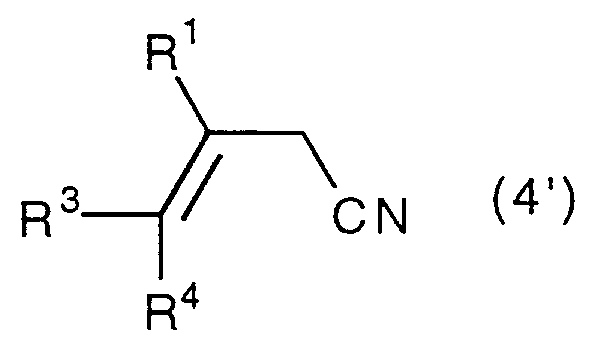
wherein R¹ and R² are the same as defined above and R³ and R⁴ are the same or different and represent a hydrogen atom, a C₁-C₄ alkyl group or a lower C₁-C₄ haloalkyl group
with nitromethane in the presence of a base.
or the formula (4'):
wherein R¹ and R² are the same as defined above and R³ and R⁴ are the same or different and represent a hydrogen atom, a C₁-C₄ alkyl group or a lower C₁-C₄ haloalkyl group
with nitromethane in the presence of a base.
11. A process for preparing a 4-nitrobutanenitrile of the formula (3):
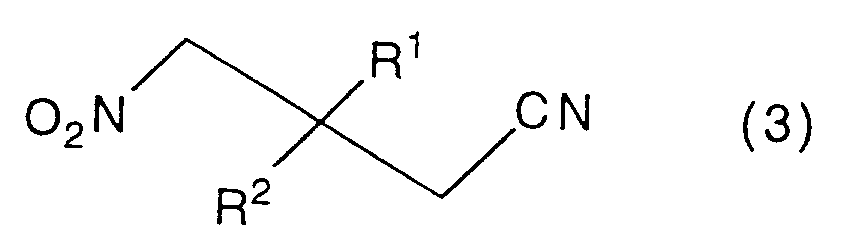
wherein R¹ and R² are the same or different and represent a hydrogen atom, a lower alkyl group or a lower haloalkyl group, or together form a C₂-C₁₀ alkylene group which may be substituted with a halogen
comprising reacting an alkenylnitrile of the formula (4):
or the formula (4'):
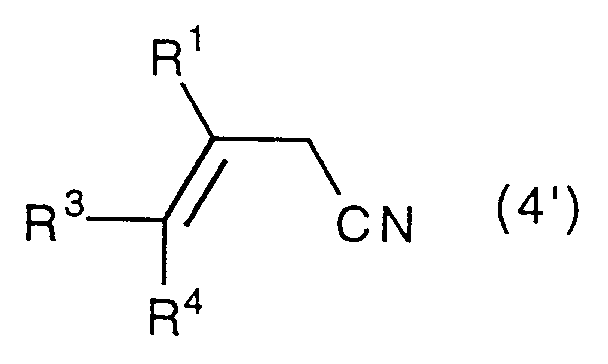
wherein R¹ and R² are the same as defined above and R³ and R⁴ are the same or different and represent a hydrogen atom, a C₁-C₄ alkyl group or a lower C₁-C₄ haloalkyl group
with nitromethane in the presence of a base.
wherein R¹ and R² are the same or different and represent a hydrogen atom, a lower alkyl group or a lower haloalkyl group, or together form a C₂-C₁₀ alkylene group which may be substituted with a halogen
comprising reacting an alkenylnitrile of the formula (4):
or the formula (4'):
wherein R¹ and R² are the same as defined above and R³ and R⁴ are the same or different and represent a hydrogen atom, a C₁-C₄ alkyl group or a lower C₁-C₄ haloalkyl group
with nitromethane in the presence of a base.
12. The process according to any of claims 1 to 11, wherein R¹ and R² are both lower alkyl
groups having 1 to 5 carbon atoms.
13. An oxidepyrrole of the formula (2):
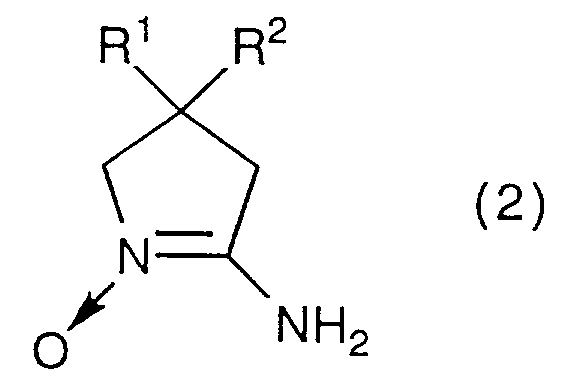
wherein R¹ and R² are the same or different and represent a hydrogen atom, a lower alkyl group or a lower haloalkyl group, or together form a C₂-C₁₀ alkylene group which may be substituted with a halogen.
wherein R¹ and R² are the same or different and represent a hydrogen atom, a lower alkyl group or a lower haloalkyl group, or together form a C₂-C₁₀ alkylene group which may be substituted with a halogen.
14. A 4-nitrobutanenitrile of the formula (3):
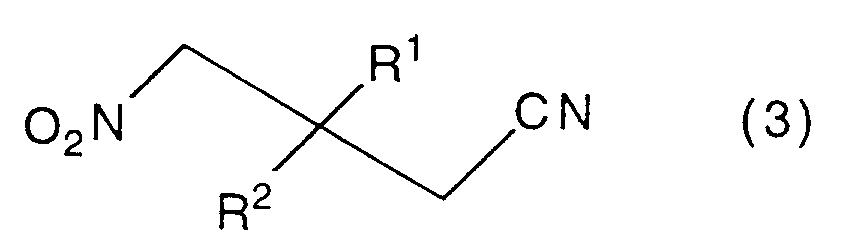
wherein R¹ and R² are the same or different and represent a hydrogen atom, a lower alkyl group or a lower haloalkyl group, or together form a C₂-C₁₀ alkylene group which may be substituted with a halogen.
wherein R¹ and R² are the same or different and represent a hydrogen atom, a lower alkyl group or a lower haloalkyl group, or together form a C₂-C₁₀ alkylene group which may be substituted with a halogen.
15. The compounds according to claim 13 or 14, wherein R¹ and R² are both lower alkyl
groups having 1 to 5 carbon atoms.
16. Use of the oxidepyrrole of the formula (2) as defined in claim 13 as an intermediate
in the production of the 5-aminodihydropyrrole of the formula (1) as defined in claim
1.
17. Use of the 4-nitrobutanenitrile of the formula (3) as defined in claim 14 as an intermediate
in the production of the oxidepyrrole of the formula (2) as defined in claim 13.