|
(11) | EP 0 665 007 A1 |

| (12) | EUROPEAN PATENT APPLICATION |
|
|
|
|
|||||||||||||||||||||||||||
| (54) | Method of making clear antiperspirant gels |
| (57) A clear antiperspirant gel is made by combining and mixing together (A) an astringent
compound having a refractive index of 1.48 to 1.53 which is an antiperspirant salt
in the form of (i) a tray dried compound, (ii) an encapsulated salt or (iii) a solvent
solution of a salt compound; and (B) a clear anhydrous organic oil free gel formed
with a gelator which is 12-hydroxystearic acid or its metal salts and an aromatic
containing silicone fluid or blend of silicone fluids. |
[0001] This invention is directed to a clear gel suitable for use as an antiperspirant which includes an aromatic containing silicone fluid.
[0002] Recent trends in consumer buying has shifted in its emphasis to a demand for clear products. These products may range from fuels for automotive vehicles to household and personal care items including dish washing and laundry detergents, as well as skin and hair care products in the form of lotions, solutions and gels. One is apt to find on store shelves such clear consumer items as shampoos, sunscreens, bath oils, deodorants and dentifrices. Consumers tend to equate clarity with environmental friendliness and purity and therefore the demand for clear products is likely to continue.
[0003] It is difficult to produce a clear product. Not all of the basic ingredients necessary to formulate a clear product lend themselves to clarity, particularly when they are combined with other necessary ingredients in the formulated product. This is especially true in the formulation of antiperspirant gels.
[0004] Thus, the problem solved by the present invention is the production of a clear gel product suitable for use as an antiperspirant. This problem is solved according to our invention by combining only "certain" basic ingredients into the formulation which meet "certain" criteria.
[0005] The benefits and advantages derived from our invention are that a product which is effective as an antiperspirant can effectively be produced which will meet consumer demands in the marketplace for clarity.
[0006] In order to produce a clear antiperspirant gel according to this invention, several essential criteria must be present.
[0007] First, when the aromatic group on silicon is phenyl, our aromatic containing silicone, which is used as the fluid to be gelled, must have a viscosity of less than fifty centistokes (mm²/s), a number average molecular weight of less than 1,000, a refractive index of 1.48 to 1.53 and at least two aromatic groups as substituents on silicon atoms, with the remaining substituents on silicon atoms of the silicone fluid being methyl groups.
[0008] When the aromatic group on silicon is other than phenyl, such as a methylstyrene silicone, our aromatic containing silicone, used as the fluid to be gelled, must have a refractive index of 1.48 to 1.53. In those instances where two or more silicone fluids are blended, the refractive index of the blend must have a value of 1.48 to 1.53.
[0009] Second, the gelator used to gel our silicone fluid is either (i) 12-hydroxystearic acid or (ii) a metal salt of 12-hydroxystearic acid. The acid is a C₁₈ straight-chain fatty acid with an OH group attached to the carbon chain. The acid has the formula CH₃(CH₂)₅CH(OH)(CH₂)₁₀COOH.
[0010] Third, the refractive index of any astringent antiperspirant compound used in our formulation must have a refractive index which matches the refractive index of the aromatic containing silicone fluid or in other words a refractive index of 1.48 to 1.53.
[0011] Fourth, the astringent antiperspirant compound must be an antiperspirant salt having a refractive index of 1.48 to 1.53. Such a compound is provided by employing an antiperspirant salt which is (i) a tray dried astringent antiperspirant salt compound; (ii) an encapsulated astringent antiperspirant salt compound; or (iii) a solution of an astringent antiperspirant salt compound in a solvent such as ethanol or propylene glycol. As used herein, the terms "tray dried" and "air dried" are considered synonymous.
[0012] By meeting the above criteria, a product can be produced which provides a satisfactory solution to the problem to be solved.
[0013] The gelator is 12-hydroxystearic acid or a metal salt of 12-hydroxystearic acid. The acid has the formula CH₃(CH₂)₅CH(OH)(CH₂)₁₀COOH. Metal salts of 12-hydroxystearic acid can also be employed as gelator. Such salts have the formula [C₆H₁₃-CH(OH)-(CH₂)₁₀-COO]nM in which M indicates a metal such as Li+, Na+, K+, Rb+, Cs+, Mg(2+), Ca(2+), Sr(2+), Ba(2+), Mn(2+), Ni(2+), Cu(2+), Zn(2+), Cd(2+), Hg(2+) and Pb(2+); and the value of n is one for monovalent cations and two for divalent cations. An example of metal salts suitable for the invention are calcium 12-hydroxystearate and lithium 12-hydroxystearate. These metal salts can be prepared by the direct neutralization of 12-hydroxystearic acid with a metal base such as sodium hydroxide or potassium hydroxide. The metal salts can also be prepared by a metathesis reaction of a simple metal salt such as sodium 12-hydroxystearate with a metal sulfate salt or a metal chloride salt such as zinc chloride or copper sulfate.
[0014] The astringent antiperspirant salt compound used in the present invention is an inorganic or organic salt form of aluminum or zirconium including mixtures thereof. Representative compounds which may be employed are aluminum chloride, aluminum chlorohydrate, aluminum dichlorohydrate, aluminum chlorohydrex, aluminum sesquichlorohydrate, aluminum-zirconium chlorohydrate, aluminum-zirconium trichlorohydrate, aluminum-zirconium pentachlorohydrate, aluminum-zirconium octachlorohydrate, aluminum-zirconium chlorohydroglycine, aluminum-zirconium tetrachloro hydrex glycine complex, zirconium chlorohydrate and zirconium hydroxychloride.
[0015] The most preferred astringent antiperspirant salt compounds according to this invention are encapsulated aluminum chlorohydrates and air dried aluminum chlorohydrates.
[0016] As indicated above, the refractive index of our astringent antiperspirant salt compound matches the refractive index of our aromatic containing silicone fluid (refractive index of 1.48 to 1.53).
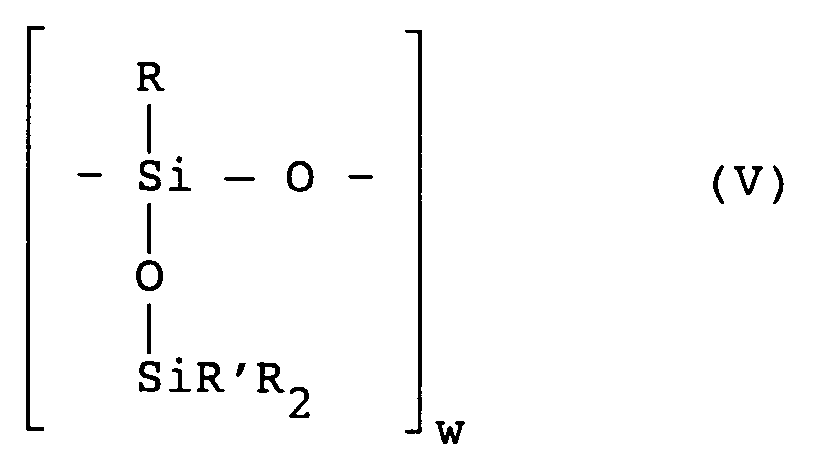
[0017] The aromatic containing silicone fluid which is used according to the present invention is a compound having one of the following formulas:
[0018] In formulas (I) to (V), R is R', an aromatic radical such as a phenyl radical or an aralkyl radical such as 2-phenylethyl, 2-phenylpropyl and 2-phenlybutyl; R' is an alkyl radical having from one to seven carbon atoms; x is an integer having a value of zero to one thousand; w is an integer having a value of three to six; y and z are integers the sum of which is between two and one thousand. For purposes of this invention, R' is most preferably methyl, R is most preferably methyl, phenyl or 2-phenylpropyl; and x preferably has a value of 1 to 1,000.
[0019] The aromatic containing silicone used as the fluid to be gelled is most preferably phenyl substituted, has a viscosity of less than fifty centistokes (mm²/s), a number average molecular weight of less than 1,000, a refractive index of 1.48 to 1.53 and at least two phenyl groups as substituents on silicon atoms, with the remaining substituents on silicon atoms being methyl groups.
[0020] Representative of aromatic containing silicones including phenyl substituted and 2-phenylpropyl functional fluids which can be used according to the present invention are (i) a methylphenylpolysiloxane fluid having a viscosity of twenty centistokes (mm²/s) measured at 25°C.; (ii) a tetramethyltetraphenyltrisiloxane fluid (TMTPTS) having a viscosity of thirty-seven centistokes (mm²/s) measured at 25°C.; (iii) a diphenyltetramethyldisiloxane fluid having a viscosity of 3.5 centistokes (mm²/s) measured at 25°C.; (iv) a phenylmethyldimethylcyclosiloxane fluid having a viscosity of forty-five centistokes (mm²/s) measured at 25°C.; (v) a methylstyrene-methicone fluid of the formula (CH₃)₃SiO(CH₃RSiO)7.06Si(CH₃)₃ in which R is -CH₂CH(CH₃)C₆H₅ and having a viscosity of one hundred seventy centistokes (mm²/s) measured at 25°C.; (vi) a methylstyrene-methicone fluid of the formula (CH₃)₃SiO(CH₃RSiO)₃Si(CH₃)₃ in which R is -CH₂CH(CH₃)C₆H₅ and having a viscosity of fifty-two centistokes (mm²/s) measured at 25°C.; and (vii) a copolymeric methylstyrene-methicone fluid of the formula (CH₃)₃SiO[(CH₃)₂SiO]₄(CH₃RSiO)4.5Si(CH₃)₃ in which R is -CH₂CH(CH₃)C₆H₅ and having a viscosity of forty-eight centistokes (mm²/s) measured at 25°C. Chemically, fluids (v) and (vi) are poly(2-phenylpropylmethylsiloxane) and fluid (vii) is poly(2-phenylpropylmethylsiloxane-dimethylsiloxane).
[0021] These aromatic containing silicone fluids can be used alone or as blends by combining two or more of the fluids as blended mixtures. In addition, one or more of the aromatic containing silicone fluids can be combined with other types of silicone fluids such as a volatile silicone. Where two or more silicone fluids are blended, at least one of the fluids should have at least two phenyl groups or two aralkyl groups, as substituents on silicon atoms with the remaining substituents on silicon atoms being methyl groups. Furthermore, the refractive index of the blend should have a value of 1.48 to 1.53.
[0022] Methods of making aromatic silicone fluids are known in the art and can be found in US-A(s) 3,088,964; 3,186,944; 3,221,040 and 3,839,384. Phenylpropylalkylcyclosiloxanes can be made according to a method described in an article entitled "Addition of Silicon Hydrides to Olefinic Double Bonds, IV. The Addition to Styrene and alpha-Methylstyrene", by John L. Speier and John W. Ryan, Journal of Organic Chemistry, Volume 24, Pages 2052-2053, December 1959. Generally such methods involve either (i) hydrolyzing phenylpropylmethylsiloxanes or (ii) reacting alpha-methylstyrene with an organosiloxane containing ≡SiH groups in the molecule.
[0023] A volatile silicone suitable for use in a blend according to present invention is a low viscosity methylsilicone fluid. Volatile low viscosity methylsilicone fluids correspond to the average unit formula (CH₃)aSiO(4-a)/2 wherein a is an integer having an average value of from two to three. The methylsilicone fluid contains siloxane units joined by Si-O-Si bonds. Representative units are (CH₃)₃SiO1/2, (CH₃)₂SiO2/2, (CH₃)SiO3/2 and SiO4/2. These units are present in molar amounts such that there is provided an average of from two to three methyl groups per silicon atom in the methylsilicone fluid, whereby the methylsilicone fluid has a viscosity of less than one hundred centistokes (mm²/s) measured at 25°C.
[0024] The volatile low viscosity methylsilicone fluid contains dimethylsiloxane units and optionally contains trimethylsiloxane units. Preferably, the methylsilicone fluid has a viscosity of less than ten centistokes (mm²/s). Representative compounds are cyclopolysiloxane compounds of the general formula [(CH₃)₂SiO]x and linear siloxane compounds of the formula (CH₃)₃SiO[(CH₃)₂SiO]ySi(CH₃)₃, in which x is an integer having a value of from three to ten and y is an integer having a value of from zero to ten.
[0025] Volatile low viscosity methylsilicones generally have boiling points less than 250°C. and have viscosities generally less than ten centistokes (mm²/s) measured at 25°C. Most preferably, the viscosity is 0.65 to 5.0 centistokes (mm²/s). Volatile cyclopolysiloxane compounds have been assigned the adopted name "CYCLOMETHICONE" by The Cosmetics, Toiletries and Fragrance Association, Inc., Washington, D.C. (CTFA). Both the cyclopolysiloxanes and the linear siloxanes are clear fluids and are essentially odorless, nontoxic, nongreasy and nonstinging. Cosmetically, these methylsilicone fluids are nonirritating to skin and exhibit enhanced spreadability and ease of rub-out when applied. Once applied, the materials evaporate leaving behind no residue.
[0026] Methylsilicone fluids which are useful in the present invention leave substantially no residue after thirty minutes at room temperature when one gram of fluid is placed at the center of a No. 1 circular filter paper having a diameter of 185 mm supported at its perimeter in open room atmosphere. By methylsilicone fluid is meant a composition containing two or more silicon atoms, all of which are bonded by way of at least one oxygen atom to at least one other silicon atom and at least one methyl radical, each silicon valence not satisfied by oxygen being satisfied by a methyl radical.
[0027] Representative methylsilicone fluids found to be especially useful in this invention are hexamethyldisiloxane which has a boiling point of 99.5°C. and the formula Me₃SiOSiMe₃; octamethyltrisiloxane which has a boiling point of 152°C. and the formula Me₃SiOMe₂SiOSiMe₃; hexamethylcyclotrisiloxane which has a boiling point of 133°C. and the formula [(Me₂)SiO]₃; octamethylcyclotetrasiloxane which has a boiling point of 171°C. and the formula [(Me₂)SiO]₄; and decamethylcyclopentasiloxane (DMCPS) which has a boiling point of 205°C. and the formula [(Me₂)SiO]₅.
[0028] These methylsilicone fluids may be used alone or can be blended together as mixtures of two or more of the fluids. Mixtures of the methylsilicone fluids will result in a volatile silicone material having an evaporating behavior different from any one of the individual methylsilicone fluids.
[0029] The procedure for making the clear antiperspirant gel of the invention is simply a matter of combining and mixing together two components, one of which is (A) 0.1 to 25.0 percent by weight of the appropriate astringent salt compound which has a refractive index of 1.48 to 1.53. The astringent salt compound is mixed with (B) a clear anhydrous organic oil free gel that has been formed from 0.1 to 10.0 percent by weight of 12-hydroxystearic acid or a metal salt of 12-hydroxystearic acid as the gelator and 30.0 to 98.0 percent by weight of the appropriate aromatic containing silicone or the blend of fluids to be gelled. The mixture is heated to dissolve the gelator. The gel is formed when the mixture is cooled or allowed to cool.
[0030] The invention will be illustrated in more detail in the following examples and tables. An explanation of the procedures used in these examples precedes the examples.
[0031] Gel samples were prepared in one-half ounce (14.8 ml) glass vials which fit into an Orbeco-Hellige™ Series 965 Digital Direct-Reading Turbidimeter. The gel formulas were prepared and cast into the sample cells, allowed to set overnight or longer, measured on the turbidimeter by inserting the cell into the sample well and recording the reading. The measurements are shown in Nephelometric Turbidity Units (NTU). The readings were all taken in the 000-999 NTU range which was calibrated daily. Readings of less than 400 NTU are considered clear; greater than 400 NTU are considered translucent; and readings under 100 NTU are considered water clear. The same samples prepared for turbidity were measured for penetration once the turbidity measures were recorded. The instrument was a Precision Penetrometer™ fitted with a Humboldt H1310™ wax needle. The needle was lowered to the surface of the gel, the clutch released for five seconds and the reading recorded in millimeters. Refractive indices (RI) were measured on a Bausch & Lomb™ Refractometer at 25°C unless noted otherwise.
Example 1
[0032] 7.55 grams of twenty centistoke (mm²/s) methylphenylpolysiloxane fluid having a RI of 1.46 were added to 8.05 grams of tetramethyltetraphenyltrisiloxane having a viscosity of 37 centistokes (mm²/s) and a RI of 1.56, resulting in a blend that had a RI of 1.510. 0.60 gram of 12-hydroxystearic acid was added to the blend and heated until the gellant dissolved. The solution gelled upon cooling. The turbidity of the gel measured 140 NTU.
Example 2
[0033] 5.98 grams of the same methylphenylpolysiloxane in Example 1 were added to 6.22 grams of tetramethyltetraphenyltrisiloxane resulting in a solution with a RI of 1.510. 0.60 gram of 12-hydroxystearic acid was added to the blend and heated until the gellant dissolved. 3.2 grams of an encapsulated aluminum chlorohydrate was dispersed into the solution. The solution was placed in an ice bath and gelled upon cooling. The turbidity was 240 NTU.
Example 2b
[0034] Preparation of encapsulated aluminum chlorohydrate used in Example 2 consisted of adding 40.0 grams of stearic acid to 2000 grams of cyclomethicone and heating with stirring to 80°C. 1000 grams of a 50% aluminum chlorohydrate solution [Al₂(OH)₅Cl·XH₂O] were heated to greater than 80°C. and slowly added to the cyclomethicone solution while stirring. The dispersion was heated and stirred until it reached 125°C., at which point it was filtered and the salt collected and dried in a desiccator. The collected salt consisted of spherical particles essentially ranging from 110 to 150 µm in diameter. Elemental analysis indicated 23.3% Al, 16.2% Cl, 0.43% C and 4.07% H, with a metal/chlorides ratio of 1.89. The RI of this salt was 1.510.
Example 3
[0035] 6.21 grams of methylphenylpolysiloxane as in Example 1 were added to 7.59 grams of tetramethyltetraphenyltrisiloxane resulting in a solution with a RI of 1.514. 0.60 gram of 12-hydroxystearic acid was added to the blend and heated until the gellant dissolved. 1.6 grams of aluminum chlorohydrate that were air dried from a 50% solution and then ball milled were dispersed into the solution. The solution was placed in an ice bath and gelled upon cooling. The turbidity was measured at 272 NTU. The RI of the salt used was 1.514.
Example 4 (Comparative)
[0036] 3.7 grams of octamethylcyclotetrasiloxane were added to 8.8 grams of tetramethyltetraphenyltrisiloxane resulting in a solution with a RI of 1.507. 0.50 gram of 12-hydroxystearic acid was added to the blend and heated until the gel dissolved. Three grams of controlled particle size powdered spray dried aluminum chlorohydrate [Al₂(OH)₅Cl·XH₂O] was dispersed into the solution. The solution was placed in an ice bath and gelled upon cooling. The turbidity was measured at 1,000 NTU. The RI of the salt was 1.521.
Example 5
[0037] 17.9 grams of diphenyltetramethyldisiloxane having a viscosity of 3.5 centistokes (mm²/s) and a RI of 1.517 was blended with 22.9 grams of phenylmethyldimethylcyclosiloxane having a viscosity of 45 centistokes (mm²/s) and a RI of 1.578, resulting in a blend with a RI of 1.514. 2.2 grams of myristyl dimethicone [Me₃SiO(Me₂SiO)₃(C₁₄H₂₉MeSiO)₆SiMe₃] were added as well as 2.0 grams of 12-hydroxystearic acid and the mixture was heated until the gelator dissolved. 5 grams of aluminum chlorohydrate that were air dried and then milled were dispersed into the solution. The solution was placed into an ice bath and gelled upon cooling. The turbidity was 340 NTU. The RI of the salt was 1.514.
Example 6
[0038] Six blends of tetramethyltetraphenyltrisiloxane and decamethylcyclopentasiloxane fluids with different refractive indices were gelled with 12-hydroxystearic acid to determine how the refractive indices of the fluid effected the clarity of the gelled fluid. The ingredients were combined and heated to dissolution, poured into containers and cooled. Gels formed upon cooling. Turbidities of the gels and the blends are shown in Table I.
TABLE I
| Component | A | B | C | D | E | F | G | H |
| 12-OH stearic acid | 3 | 3 | 3 | 3 | 3 | 3 | 3 | 3 |
| TMTPTS | 100 | 80 | 75 | 70 | 65 | 60 | 50 | - |
| DMCPS | - | 20 | 25 | 30 | 35 | 40 | 50 | 100 |
| refractive index @ 21°C | 1.558 | 1.526 | 1.518 | 1.510 | 1.502 | 1.494 | 1.478 | 1.3976 |
| turbidity (NTU) | 830 | 158 | 118 | 95 | 89 | 111 | 287 | 1000 |
[0039] In Table I, the amounts of the three components used are shown in parts. TMTPTS indicates the phenyl fluid and DMCPS indicates the cyclic silicone.
Example 7
[0040] Three gels were prepared using poly (2-phenylpropylmethylsiloxane) fluids as shown below in Table II. The 12-hydroxystearic acid gelator was added to the fluids, heated to dissolution and cooled. The fluids gelled upon cooling. The first fluid was a methylstyrene-methicone fluid having the formula (CH₃)₃SiO(CH₃RSiO)7.06Si(CH₃)₃ where R is -CH₂CH(CH₃)C₆H₅. Viscosity of the fluid was 170 centistokes (mm²/s) measured at 25°C. The second fluid was a copolymeric methylstyrene-dimethicone of the formula (CH₃)₃SiO[(CH₃)₂SiO]₄(CH₃RSiO)4.5Si(CH₃)₃ where R is -CH₂CH(CH₃)C₆H₅ and the viscosity at 25°C. was 48 centistokes (mm²/s). The third fluid was a methylstyrene-methicone fluid having the formula (CH₃)₃SiO(CH₃RSiO)₃Si(CH₃)₃ where R is -CH₂CH(CH₃)C₆H₅. The viscosity of the fluid was 52 centistokes (mm²/s) at 25°C. As noted above, the first and third fluids are chemically poly(2-phenylpropylmethylsiloxane) and the second fluid is poly(2-phenylpropylmethylsiloxane-dimethylsiloxane). However, for the sake of convenience, their CTFA adopted names have been used in Table II.
TABLE II
| Components | A | B | C |
| 12-hydroxystearic acid | 0.5 | 0.6 | 0.6 |
| methylstyrene-methicone fluid 1 | 12 | - | - |
| methylstyrene-dimethicone fluid 2 | - | 14.4 | - |
| methylstyrene-methicone fluid 3 | - | - | 14.4 |
| Refractive index @21°C | 1.522 | 1.483 | 1.5025 |
| Turbidity (NTU) | 55 | 443 | 240 |
| Penetration (mm) | 17.6 | 20.8 | 21.6 |
[0042] In Example 1, a basic blend of two aromatic containing silicones was prepared and the blend was gelled without an astringent salt. Both silicone fluids had a viscosity of less than fifty centistokes (mm²/s) and at least one of the silicone fluids used to make the blend had at least two phenyl substituents on the silicon atom in the molecule. Example 2 is similar to Example 1 but includes an astringent salt as one of the components of the gel. Example 2b shows the method used to prepare the encapsulated antiperspirant salt used in Example 2. Example 3 is similar to Example 2 but a different antiperspirant salt was employed.
[0043] Example 4 is comparative and is set forth to show the relatively poor results obtained when the RI of the astringent salt does not match the RI of the silicone. As noted in Example 4, a high turbidity is the result. Example 4 is not representative of this invention.
[0044] Example 5 is similar to Example 3 but other types of aromatic containing silicone fluids are employed. However, both silicone fluids had a viscosity of less than fifty centistokes (mm²/s) and at least one of the silicone fluids used to make the blend had at least two phenyl substituents on the silicon atoms in the molecule. In addition, the phenyl fluid in Example 5 is a cyclic molecule. Example 5 further shows the use in the gel of another type of silicone. The silicone used was myristyl dimethicone which is a compound having the structural formula Me₃SiO(Me₂SiO)₃(C₁₄H₂₉MeSiO)₆SiMe₃ where Me is methyl. Other silicone compounds can be used, however, including alkylmethylsiloxanes such as polymethylstearylsiloxane. Such compounds have the formula Me₃SiO(Me₂SiO)x(MeRSiO)ySiMe₃ in which Me denotes methyl, R is CnH2n+1 in which n is an integer having a value of at least twelve, x is zero to 200, preferably 3 to 70 and y is 1 to 40, preferably 6 to 20.
[0045] Example 6 and Table I show the especially good results obtained including a very low turbidity, when the gels are prepared at RI ranges which are in accordance with this invention (B, C, D, E, F and G); in comparison to the poor results obtained including high turbidity, when the gels are prepared at RI ranges not according to the invention (A and H). Example 6 is further exemplary of an embodiment of the invention in which an aromatic containing silicone is blended with a volatile cyclic methylsilicone fluid. This blend is formed using a ratio of aromatic containing silicone (TMTPTS) to volatile silicone (DMCPS) of from 4:1 to 1:1. As in the preceding examples, both silicone fluids had a viscosity of less than fifty centistokes (mm²/s) and at least one of the silicone fluids used to make the blend had at least two phenyl substituents on the silicon atoms in the molecule.
[0046] Example 7 and Table II show that clear gels can be obtained by using aromatic containing silicones which have in the molecule an aromatic group other than phenyl. Thus, the gels in Example 7 were prepared with aralkyl (arylalkyl) containing fluids, more particularly 2-phenylpropyl functional polymeric and copolymeric silicone fluids. Not all of the fluids in Example 7 had a viscosity of less than fifty centistokes (mm²/s).
[0047] With respect to the problem sought to be solved by the present invention which is the production of a clear gel product suitable for use as an antiperspirant, particular note should be taken of blend "D" and blend "E" in Table I and gel "A" in Table II. Blend "D" and blend "E" in Table I and gel "A" in Table II, each exhibited a turbidity of less than one hundred NTU, which as explained above, is considered "water clear".
1. A method of making a clear antiperspirant gel comprising forming a mixture of (A)
0.1 to 25.0 percent by weight of an astringent compound having a refractive index
of 1.48 to 1.53, the astringent compound being an antiperspirant salt in a form selected
from (i) a tray dried astringent salt compound, (ii) an encapsulated astringent salt
compound, and (iii) a solvent solution of an astringent salt compound; and (B) a clear
anhydrous organic oil free gel formed from 0.1 to 10.0 percent by weight of a gelator
selected from 12-hydroxystearic acid or metal salts of 12-hydroxystearic acid and
30.0 to 98.0 percent by weight of an aromatic containing silicone; the aromatic containing
silicone having a viscosity of less than fifty centistokes (mm²/s), a number average
molecular weight of less than 1,000, a refractive index of 1.48 to 1.53 and at least
two aromatic groups as substituents on silicon atoms with the remaining substituents
on silicon atoms being methyl groups; heating the mixture to dissolve the gelator;
and allowing the mixture to cool.
2. A method according to claim 1 in which the aromatic containing silicone is a compound
having a formula selected from the formulas:


wherein R is selected from an alkyl radical with 1 to 7 carbon atoms, a phenyl radical and an arylalkyl radical; R' is an alkyl radical of 1 to 7 carbon atoms; x has a value of zero to 1,000; w has a value of 3 to 6; y and z are each integers with a sum of 2 to 1,000; provided the compound has at least two aromatic groups as substituents on silicon atoms.
wherein R is selected from an alkyl radical with 1 to 7 carbon atoms, a phenyl radical and an arylalkyl radical; R' is an alkyl radical of 1 to 7 carbon atoms; x has a value of zero to 1,000; w has a value of 3 to 6; y and z are each integers with a sum of 2 to 1,000; provided the compound has at least two aromatic groups as substituents on silicon atoms.
3. A method according to claim 2 in which the aromatic containing silicone is a compound
selected from (i) a tetramethyltetraphenyltrisiloxane fluid having a viscosity of
thirty-seven centistokes (mm²/s) measured at 25°C.; and (ii) a diphenyltetramethyldisiloxane
fluid having a viscosity of 3.5 centistokes (mm²/s) measured at 25°C.
4. A method according to claim 1 in which the aromatic containing silicone is present
as a blend with a volatile silicone fluid which is selected from cyclopolysiloxanes
of the formula [(CH₃)₂SiO]x or linear siloxane compounds of the formula (CH₃)₃SiO[(CH₃)₂SiO]ySi(CH₃)₃, in which x is an integer having a value of from three to ten and y is an
integer having a value of from zero to ten.
5. A method according to claim 1 in which the antiperspirant salt is a compound selected
from encapsulated aluminum chlorohydrate or air dried aluminum chlorohydrate.
6. A method of making a clear antiperspirant gel comprising forming a mixture of (A)
0.1 to 25.0 percent by weight of an astringent compound having a refractive index
of 1.48 to 1.53, the astringent compound being an antiperspirant salt in a form selected
from (i) a tray dried astringent salt compound, (ii) an encapsulated astringent salt
compound and (iii) a solvent solution of an astringent salt compound; and (B) a clear
anhydrous organic oil free gel formed from 0.1 to 10.0 percent by weight of a gelator
selected from 12-hydroxystearic acid or metal salts of 12-hydroxystearic acid and
30.0 to 98.0 percent by weight of a blend of more than one aromatic containing silicone,
each aromatic containing silicone having a viscosity of less than fifty centistokes
(mm²/s), a number average molecular weight of less than 1,000, a refractive index
of 1.48 to 1.53 and at least one of the aromatic containing silicones in the blend
having at least two aromatic groups as substituents on silicon atoms with the remaining
substituents on silicon atoms of the silicone being methyl groups; heating the mixture
to dissolve the gelator; and allowing the mixture to cool.
7. A method of making a clear antiperspirant gel comprising forming a mixture of (A)
0.1 to 25.0 percent by weight of an astringent compound having a refractive index
of 1.48 to 1.53, the astringent compound being an antiperspirant salt in a form selected
from (i) a tray dried astringent salt compound, (ii) an encapsulated astringent salt
compound, and (iii) a solvent solution of an astringent salt compound; and (B) a clear
anhydrous organic oil free gel formed from 0.1 to 10.0 percent by weight of a gelator
selected from 12-hydroxystearic acid or metal salts of 12-hydroxystearic acid and
30.0 to 98.0 percent by weight of a blend of an aromatic containing silicone and a
volatile silicone, the aromatic containing silicone having a viscosity of less than
fifty centistokes (mm²/s), a number average molecular weight of less than 1,000, a
refractive index of 1.48 to 1.53 and at least two aromatic groups as substituents
on silicon atoms with the remaining substituents on silicon atoms being methyl groups;
the volatile silicone in the blend being a compound selected from cyclopolysiloxanes
of the formula [(CH₃)₂SiO]x or linear siloxane compounds of the formula (CH₃)₃SiO[(CH₃)₂SiO]ySi(CH₃)₃, in which x is an integer having a value of from three to ten and y is an
integer having a value of from zero to ten; the aromatic containing silicone and volatile
silicone being blended in a ratio of 4:1 to 1:1, respectively; heating the mixture
to dissolve the gelator; and allowing the mixture to cool.
8. A method of making a clear antiperspirant gel comprising forming a mixture of (A)
0.1 to 25.0 percent by weight of an astringent compound having a refractive index
of 1.48 to 1.53, the astringent compound being an antiperspirant salt in a form selected
from (i) a tray dried astringent salt compound, (ii) an encapsulated astringent salt
compound, and (iii) a solvent solution of an astringent salt compound; and (B) a clear
anhydrous organic oil free gel formed from 0.1 to 10.0 percent by weight of a gelator
selected from 12-hydroxystearic acid or metal salts of 12-hydroxystearic acid and
30.0 to 98.0 percent by weight of an aromatic containing silicone fluid; the aromatic
containing silicone fluid having a refractive index of 1.48 to 1.53; heating the mixture
to dissolve the gelator; and allowing the mixture to cool.
9. A method according to claim 8 in which the aromatic containing silicone fluid is a
compound selected from (i) a fluid of the formula (CH₃)₃SiO(CH₃RSiO)7.06Si(CH₃)₃ in which R is -CH₂CH(CH₃)C₆H₅ and having a viscosity of one hundred seventy
centistokes (mm²/s) measured at 25°C.; (ii) a fluid of the formula (CH₃)₃SiO(CH₃RSiO)₃Si(CH₃)₃
in which R is -CH₂CH(CH₃)C₆H₅ and having a viscosity of fifty-two centistokes (mm²/s)
measured at 25°C.; and (iii) a fluid of the formula (CH₃)₃SiO[(CH₃)₂SiO]₄(CH₃RSiO)4.5Si(CH₃)₃ in which R is -CH₂CH(CH₃)C₆H₅ and having a viscosity of forty-eight centistokes
(mm²/s) measured at 25°C.