| (19) |
 |
|
(11) |
EP 0 670 012 B1 |
| (12) |
EUROPEAN PATENT SPECIFICATION |
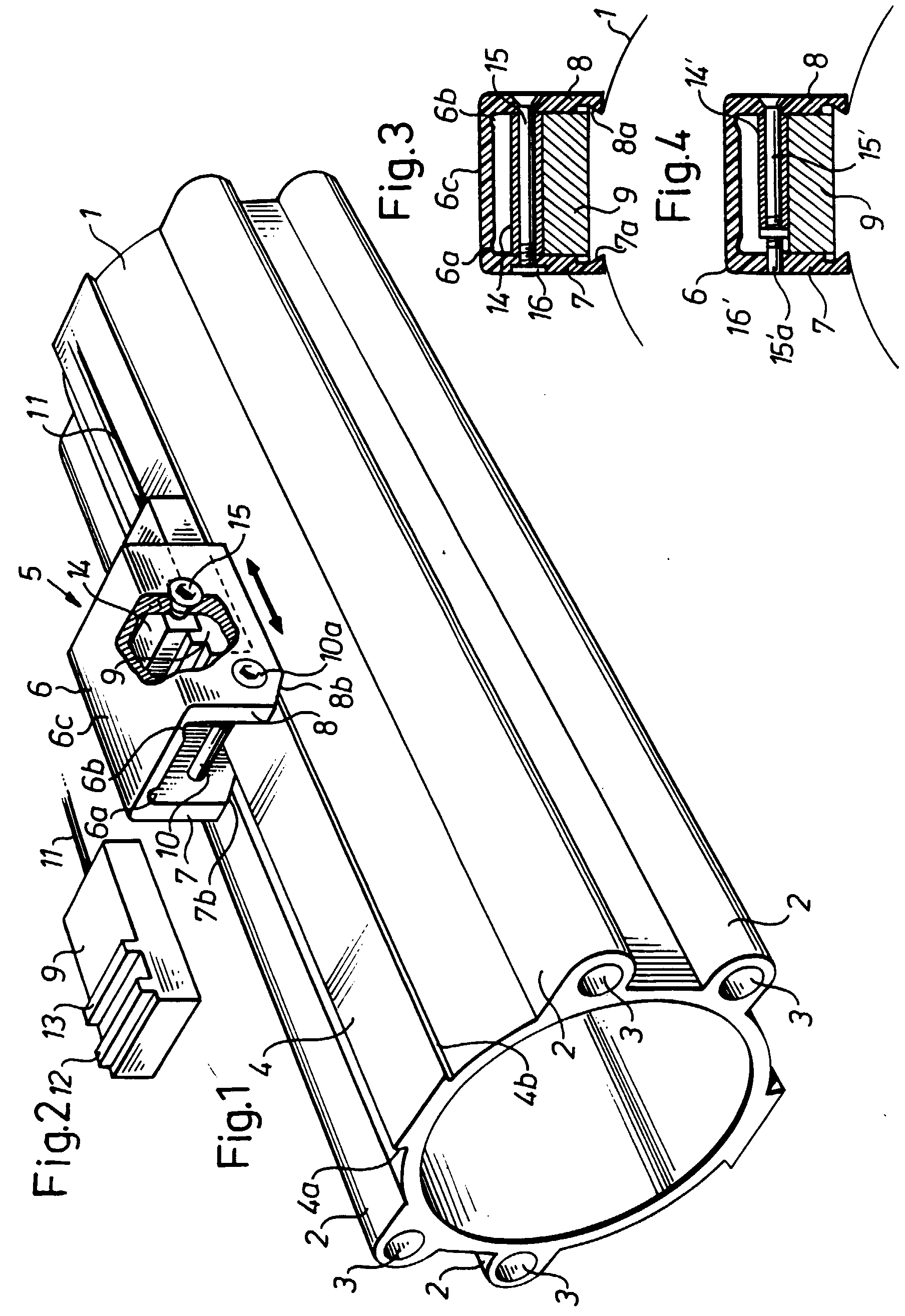
| (45) |
Mention of the grant of the patent: |
|
26.03.1997 Bulletin 1997/13 |
| (22) |
Date of filing: 28.11.1990 |
|
| (51) |
International Patent Classification (IPC)6: F15B 15/28 |
| (86) |
International application number: |
|
PCT/SE9000/787 |
| (87) |
International publication number: |
|
WO 9110/070 (11.07.1991 Gazette 1991/15) |
|
| (54) |
HOLDING DEVICE FOR PISTON POSITION DETECTOR
HALTEVORRICHTUNG FÜR KOLBENPOSITIONSDETEKTOR
DISPOSITIF DE BRIDAGE POUR DETECTEUR DE POSITION DE PISTON
|
| (84) |
Designated Contracting States: |
|
CH DE FR GB IT LI |
| (30) |
Priority: |
22.12.1989 SE 8904356
|
| (43) |
Date of publication of application: |
|
06.09.1995 Bulletin 1995/36 |
| (73) |
Proprietor: AKTIEBOLAGET REXROTH MECMAN |
|
125 81 Stockholm (SE) |
|
| (72) |
Inventor: |
|
- PIRHADI, Ebrahim
S-122 37 Enskede (SE)
|
| (74) |
Representative: Modin, Jan et al |
|
c/o Axel Ehrners Patentbyra AB
Box 10316
100 55 Stockholm
100 55 Stockholm (SE) |
| (56) |
References cited: :
DE-C- 3 516 346
US-A- 4 230 023
|
GB-A- 2 195 711
|
|
| |
|
|
|
|
| |
|
| Note: Within nine months from the publication of the mention of the grant of the European
patent, any person may give notice to the European Patent Office of opposition to
the European patent
granted. Notice of opposition shall be filed in a written reasoned statement. It shall
not be deemed to
have been filed until the opposition fee has been paid. (Art. 99(1) European Patent
Convention).
|
[0001] The invention concerns a holding device, which is displaceably mounted on the outside
of a fluid pressure cylinder, of the kind defined in the preamble of claim 1.
[0002] Such a holding device is previously known from DE-C-3 516 346 (Daimler-Benz AG).
This previously known device comprises a bracket like holder with two hook shaped
clamping elements, which are jointly displaceable along a tension rod associated with
the fluid pressure cylinder. One of the clamping elements is provided with a radially
extending holding plate, to which a casing incorporating a piston position detector
is detachably mounted by means of two screws, while the other clamping element, which
is pivotable relative to the first one, is provided, on the one hand, with a fastening
screw for application against the tension rod and, on the other hand, with a clamping
screw effective between the clamping elements and, upon tightening, causing the two
clamping elements to pivot in opposite directions, so that the casing and a protruding
tongue element of the second clamping element is pressed against the exterior of the
cylinder tube under clamping action.
[0003] On the basis of the above mentioned prior art and other similar arrangements (US-A-4
230 023, EP-A-0 125 992 and EP-A-0 309 304) the present invention mainly aims to achieve
a simple and reliable holding device, which
- includes the least possible number of screws or similar fastening elements;
- enables simple detachment of the casing of the piston position detector also when
the holder is positioned and fastened in the desired position; and
- protects the casing (and thereby the piston position detector) against external influences.
[0004] Further objects are to assure a fixation without play of the casing to the holding
device with reproducable precision, so that the casing, and thereby the piston position
detector, is placed in exactly the same position after detachment and remounting,
and to faciliate a protected placing of a signal cable which is connected to the piston
position detector, so that the latter is also protected against external influences.
[0005] The above stated objects of the invention are achieved by the features given in claim
1. Thus, the holder consists of a U-shaped yoke, into which the casing is at least
partly insertable, whereby the casing together with a piston position detector contained
therein is protected by the surrounding yoke. Further, only two fastening means are
needed, namely a first fastening means for the fixation of the two shank ends of the
yoke to the mutually parallel guides and a second fastening means for the fixation
of the casing in the inserted position in the yoke. It is essential that the casing
can be detached from and remounted into the yoke, also when the latter is held in
a fixed position by the first fastening means.
[0006] Other suitable features are stated in the claims 2 - 12. According to a preferred
embodiment (cf. claims 5-11) of the invention, the second fastening means includes
a (second) fastening screw, which upon insertion of the casing between the shanks
of the yoke is inserted transversally between the shanks, and which by means of an
elastic sleeve (which is compressed axially and thereby expanded radially) engages
between two stop means arranged at a longitudinal distance from each other on the
casing.
[0007] The invention will be explained in greater detail below with reference to the accompanying
drawing.
Fig. 1 shows in a perspective view a cylinder tube (the end plates and the piston
of the fluid pressure cylinder are not shown) with a holding device according to the
invention displaceably arranged on the outside thereof, the holding device being partly
cut away to show a casing for a piston position detector inserted therein;
Fig. 2 shows, likewise in a perspective view, said piston position detector casing;
Fig. 3 shows a cross-section through the holding device in a vertical plane and through
a fastening screw for fastening said casing; and
Fig. 4 shows a cross-section corresponding to the one shown in Fig. 3 of a modified
embodiment.
[0008] In Fig. 1 is thus shown a cylinder tube 1 of a fluid pressure cylinder, where the
cylinder end plates at the ends of the cylinder tube and a piston with an associated
piston rod moveable therein are not shown in the figure. The cylinder tube 1 is preferably
manufactured from a light metal alloy and has, on the one hand, longitudinal beads
2 with through holes 3 therein for fastening screws (not shown) for the end plates
and, on the other hand, a dovetail-shaped longitudinal bead 4, which at its longitudinal
edges form undercut, mutually parallel guide slots 4a, 4b for a holding device 5 according
to the invention displaceable along the cylinder tube.
[0009] The holding device 5 for a piston position detector includes a U-shaped yoke 6, the
shanks 7 and 8 of which at their ends are formed with inwardly projecting gripping
edges 7a, 8a, which engage with the guide slots 4a, 4b. The yoke 6 may be made of
metal but is preferably produced out of a rigid plastic material rendering the yoke
a certain dimensional flexibility as well as good sliding properties relative to the
guide slots 4a, 4b. The dimensional flexibility, which is also increased by the longitudinal
weakenings 6a, 6b in the web portion 6c of the yoke adjacent to the respektive shank,
is utilized for the detachable fastening of a casing 9 incorporating a piston position
detector at the inside of the yoke 6 between its shanks 7, 8. At one end, as seen
lengthwise, the shanks are provided with bevels or recesses 7b, 8b in the respective
corner area to enable the displacement of the yoke all the way to the associated cylinder
end plate. The yoke 6, serving as holder, is thus displacable along the whole length
of the cylinder tube 1 (for the positioning close to the second end plate, the yoke
can be snapped out of the guide slots 4a, 4b and turned 180°, so that the bevelled
corner portions 7b, 8b abut said second plate) and may be positioned and fixed in
a desired position by means of a transverse fastening screw 10, which when tightened
presses the shanks 7, 8 of the yoke towards each other in the area of the fastening
screw 10, i.e. near one end of the yoke 6 close to the gripping edges 7a, 8a, so that
the latter will frictionally engage the guide slots 4a, 4b and thereby fix the yoke
6 in a well-defined position. The head 10a of the fastening screw 10 is countersunk
in a corresponding conical recess in the shank 8, while the threaded end portion (not
visible in the figures) is in threaded engagement with a nut, which is non-rotatably
guided in a recess at the outside of the opposite shank 7 (in the same way as the
fastening screw shown in Fig. 3).
[0010] The casing 9, which contains a piston position detector (not shown) connected to
a signal cable 11, is essentially box-shaped and dimensioned to fit into the yoke
with its mutually parallel side surfaces between the shanks 7, 8. On the upper side
of the casing it is provided with two transverse ridges 12, 13 serving as stop means
forming therebetween a rectangular channel. Before inserting the casing 9 into the
position shown in Fig. 1, a sleeve of a relatively stiff elastic material is placed
in the rektangular channel between the ridges 12, 13. Upon placing the casing 9 in
position, a second transverse fastening screw 15 can be inserted through a hole in
the shank 8 and through the central hole of the sleeve 14 to an opposite hole in the
shank 7, where a nut 16 is non-rotatably arranged in a recess in the outside of the
shank 7 for threaded engagement with the fastening screw 15. When the fastening screw
15 is tightened, the shanks 7, 8 are pressed together, so that they will be mutually
parallel along the full length of the yoke 6 (by tightening of only the fastening
screw 10 the shanks will diverge somewhat in the direction towards the rear opening
through which the casing 9 is inserted). At the same time, the engagement of the gripping
edges 7a, 8a to the guide slots 4a, 4b will increase, and the elastic sleeve will
be compressed axially, so that it is somewhat deformed radially, thereby eliminating
the play against the associated fastening screw 15. Thus, the casing 9 is fixed effectively
without play in the inserted position inside the yoke 6.
[0011] Instead of placing the nut 16 in a recess in the shank 7, the nut 16' (see Fig. 4)
may be non-rotatably arranged in the rectangular slot between the ridges 12, 13, so
that the nut 16' engages directly with the end of the sleeve 14' (and not via the
shank wall). Hereby, a great deformation of the sleeve 14' is assured. The free end
portion 15'a of the fastening screw 15', formed as a guiding pin, is guided with a
close fit in a corresponding circular hole in the shank 7. To achieve the best possible
fastening action, the nut 16' is of square section, so that it will fit well into
the rectangular slot between the ridges 12 and 13.
[0012] It is obvious that the second fastening screw 15 or 15' can be loosened easily, so
that the casing 9 can be withdrawn from the yoke 6, also when the latter is locked
in a well-defined position by means of the first fastening screw 10.
[0013] If desired, the signal cable 11 may be protected by a covering strip (not shown),
which is cut into a desired length (corresponding to the distance between the rear
end of the casing 9 and the rear end plate) and snapped onto the dovetailed bead 4.
At the same time, the casing 9, with the piston position detector contained therein,
will be protected by the entirely or partly surrounding yoke 6.
[0014] The second fastening screw 15 may cooperate with the casing 9 in another way, e.g.
without the intermediary of the sleeve 14 by direct cooperation with a transverse
recess or hole in the casing. Alternatively, the ridges 12, 13 may be replaced by
a number of upward projections distributed transversally in a suitable manner for
the forming of stop means on both sides of the second fastening screw 15 (with or
without a sleeve) or by fastening means formed in some other way.
[0015] Further, the mutually parallel guide slots 4a, 4b may be formed differently and do
not have to be made in one piece with the cylinder tube. They may, e.g., be formed
in a separate longitudinal rail or consist of two separate guide strips. The yoke
6 may likewise be modified, e.g. consisting of two parts with a longitudinal joint
in the web portion. It should, however, be of sufficient length to contain a substantial
part of the casing 9. Also, the latter may have a different external shape provided
that it is entirely or partly insertable between the shanks of the yoke and is lockable
in a well-defined position by means of the second fastening means. These second means
may, e.g., consist of a fence bar, arresting pins or the like, being movable into
locking engagement with the casing from the web portion 6c of the yoke.
1. Holding device (5) for a piston position detector being displaceably mounted on the
outside of a fluid pressure cylinder, comprising a holder (6) being displaceable along
and lockable in any desired position at a longitudinal guide (4) on the outside of
the cylinder tube, the piston position detector being disposed in a casing (9) detachably
mounted at the holder (6), characterized in that the displaceable holder consists of an essentially U-shaped yoke (6), the
shank ends (7a,8a) of which being guided along two mutually parallel guides (4a,4b)
and being fixable thereto by first fastening means (10), being effective between the
shanks (7,8) of the yoke (6) and bringing the shank ends into frictional contact with
the guides (4a,4b), and that the casing (9) of the piston position detector is at
least partly insertable between the two shanks (7,8) of the yoke and fixable to the
yoke (6) in an inserted, well-defined position by second fastening means (15), also
when the yoke (6) is fixed to said guides (4a,4b).
2. Holding device according to claim 1, characterized in that said first fastening means comprises a first fastening screw (10).
3. Holding device according to claim 2, characterized in that the first fastening screw (10) is arranged at one end of the yoke (6), as
seen in the longitudinal direction of the cylinder and the guides, and that said casing
(9) is entirely or partly insertable through the other end of the yoke.
4. Holding device according to claim 3, characterized in that the first fastening screw (10) is located near the shank ends (7a,8a), where
the latter engage with the guides (4a,4b).
5. Holding device according to any one of the claims 1-4, characterized in that said second fastening means comprises a second fastening screw (15) extending
transversally between the shanks (7,8) of the yoke (6), which screw (15) is inserted
in its position upon insertion of the casing (9) between the shanks of the yoke and
which screw (15), when tightened, locks the casing (9) against displacement in the
longitudinal direction of the cylinder and the guides.
6. Holding device according to claim 5, characterized in that the casing (9) is provided with two stop means (12,13) arranged at a distance
from one another, as seen in the longitudinal direction, between which the second
transverse fastening screw (15) extends in the inserted position.
7. Holding device according to claim 6, characterized in that said stop means consist of transverse ridges (12,13), recess walls or transversally
distributed projections.
8. Holding device according to claim 5 or 6, characterized in that a sleeve (14'), consisting of an elastic material, is insertable transversally,
between the stop means (12,13), and is provided with a through hole for the second
fastening screw (15), said sleeve (14') being caused to expand radially upon tightening
of the fastening screw for positioning the casing (9) without play.
9. Holding device according to claim 8, characterized in that the second fastening screw (15), upon being tightened, is arranged to bring
the shanks (7,8) closer to one another and thereby expand the sleeve (14') radially
when the inner sides of the shanks (7,8) compress the sleeve axially.
10. Holding device according to claim 8, characterized in that the second fastening screw (15') acts between one of the shanks and a nut
being non-rotatably guided by the casing (9), whereby the sleeve (14') is compressed
axially between said shank (8) and said nut (16').
11. Holding device according to claim 10, characterized in that the free end of the fastening screw forms a guiding pin (15'a), being guided
in a hole in the other shank (7) essentially without play.
12. Holding device according to any one of the preceding claims, characterized in that said two guides are constituted by dovetail slots (4a,4b) formed on the outside
of the cylinder tube (1), the shank ends being provided with gripping edges (7a,8a)
engaging with said dovetail slots.
1. Haltevorrichtung (5) für einen Kolbenlagedetektor, welcher außen an einem Flüssigkeitsdruckzylinder
verschiebbar montiert ist, mit einem Halter (6), welcher entlang einer longitudinalen
Führung (4) an der Außenseite des Zylinderrohres verschiebbar und in jeder gewünschten
Position an der longitudinalen Führung (4) feststellbar ist, wobei der Kolbenlagedetektor
in einem am Halter (6) lösbar montierten Gehäuse (9) untergebracht ist, dadurch gekennzeichnet,
daß der verschiebbare Halter aus einem im wesentlichen U-förmigen Bügel (6) besteht,
dessen Schenkelenden (7a, 8a) entlang zweier zueinander paralleler Führungen (4a,
4b) geführt werden und daran über ein erstes Befestigungsmittel (10) befestigbar sind,
welches zwischen den Schenkeln (7, 8) des Bügels (6) wirksam ist und die Schenkelenden
mit den Führungen (4a, 4b) in Reibungskontakt bringt, und daß das Gehäuse (9) des
Kolbenlagedetektors wenigstens teilweise zwischen den beiden Schenkeln (7, 8) des
Bügels einführbar und an dem Bügel (6) in einer eingeführten, vorgegebenen Position
durch ein zweites Befestigungsmittel (15) befestigbar ist, auch wenn der Bügel (6)
an den Führungen (4a, 4b) befestigt ist.
2. Haltevorrichtung nach Anspruch 1, dadurch gekennzeichnet, daß das erste Befestigungsmittel
(15) eine erste Befestigungsschraube (10) umfaßt.
3. Haltevorrichtung nach Anspruch 2, dadurch gekennzeichnet, daß die erste Befestigungsschraube
(10) in longitudinaler Richtung des Zylinders und der Führungen gesehen an einem Ende
des Bügels (6) angeordnet und daß das Gehäuse (9) vollständig oder teilweise durch
das andere Ende des Bügels einführbar ist.
4. Haltevorrichtung nach Anspruch 3, dadurch gekennzeichnet, daß die erste Befestigungsschraube
(10) in der Nähe der Schenkelenden (7a, 8a) angeordnet ist, wo letztere mit den Führungen
(4a, 4b) in Eingriff stehen.
5. Haltevorrichtung nach einem der Ansprüche 1 bis 4, dadurch gekennzeichnet, daß das
zweite Befestigungsmittel eine zweite Befestigungsschraube (15) umfaßt, welche transversal
zwischen den Schenkeln (7, 8) des Bügels (6) verläuft, wobei die Schraube (15) in
ihrer Position nach Einführen des Gehäuses (6) zwischen den Schenkeln des Bügels eingeführt
wird und beim Anziehen das Gehäuse (9) gegenüber einer Verschiebung in die longitudinale
Richtung des Zylinders und der Führungen festhält bzw. sperrt.
6. Haltevorrichtung nach Anspruch 5, dadurch gekennzeichnet, daß das Gehäuse (9) mit
zwei Sperrmitteln (12, 13) ausgestattet ist, welche in longitudinaler Richtung gesehen
in einem Abstand voneinander angeordnet sind und zwischen welchen sich die zweite
Befestigungsschraube (15) in der eingeführten Position erstreckt.
7. Haltevorrichtung nach Anspruch 6, dadurch gekennzeichnet, daß die Sperrmittel aus
Querrippen (12, 13), mit einer Vertiefung versehenen Wänden oder in Querrichtung verteilten
Vorsprüngen bestehen.
8. Haltevorrichtung nach Anspruch 5 oder 6, dadurch gekennzeichnet, daß eine Hülse (14'),
welche aus einem elastischen Material besteht, zwischen den Sperrmitteln (12, 13)
in transversaler Richtung einführbar und mit einer Durchgangsbohrung für die zweite
Befestigungsschraube (15) versehen ist, wobei sich die Hülse (14') beim Anziehen der
Befestigungsschraube zum spiellosen Positionieren des Gehäuses (9) in radialer Richtung
ausdehnt.
9. Haltevorrichtung nach Anspruch 8, dadurch gekennzeichnet, daß die zweite Befestigungsschraube
(15) nach dem Anziehen derart angeordnet ist, daß sich die Schenkel (7, 8) einander
annähern und dabei die Hülse (14) in radialer Richtung ausdehnen, sobald die Innenseiten
der Schenkel (7, 8) die Hülse axial zusammenpressen.
10. Haltevorrichtung nach Anspruch 8, dadurch gekennzeichnet, daß die zweite Befestigungsschraube
(15) zwischen einem der Schenkel und einer durch das Gehäuse (9) drehfest geführten
Schraubenmutter wirksam ist, wobei die Hülse (14') axial zwischen dem Schenkel (8)
und der Schraubenmutter (16') zusammengepreßt wird.
11. Haltevorrichtung nach Anspruch 10, dadurch gekennzeichnet, daß das freie Ende der
Befestigungsschraube (15) einen Führungsstift (15'a) ausbildet, welcher in einer Bohrung
in dem anderen Schenkel (7) im wesentlichen spiellos geführt ist.
12. Haltevorrichtung nach einem der vorstehenden Ansprüche, dadurch gekennzeichnet, daß
die zwei Führungen durch schwalbenschwanzförmige Nuten (4a, 4b) ausgebildet sind,
welche an der Außenseite des Zylinderrohrs (1) geformt sind, wobei die Schenkelenden
mit Klemmkanten (7a, 8a) ausgestattet sind, welche mit den schwalbenschwanzförmigen
Nuten in Eingriff stehen.
1. Dispositif de fixation (5) pour détecteur de position de piston étant monté avec possibilité
de déplacement sur l'extérieur d'un cylindre à pression de fluide, comprenant un support
(6) étant adapté à être déplacé le long d'une guide longitudinal (4) et à être bloqué
en n'importe quelle position souhaitée sur le guide sur l'extérieur du tube de cylindre,
le détecteur de position de piston étant disposé dans un boîtier (9) monté avec possibilité
de démontage dans le support (6), caractérisé en ce que le support mobile consiste
en un étrier (6) sensiblement en forme de U, dont les extrémités de jambages (7a,
8a) sont guidées le long de deux guides parallèles (4a, 4b) et peuvent être fixées
à ceux-ci par un premier moyen de fixation (10), opérant entre les jambages (7, 8)
de l'étrier (6) et amenant les extrémités des jambages en contact de frottement avec
les guides (4a, 4b), et en ce que le boîtier (9) du détecteur de position de piston
est au moins en partie adapté à être inséré entre les deux jambages (7, 8) de l'étrier
et à être fixé à l'étrier (6) dans une position d'insertion, bien définie, par un
second moyen de fixation (15), également lorsque l'étrier (6) est fixé auxdits guides
(4a, 4b).
2. Dispositif de fixation selon la revendication 1, caractérisé en ce que ledit premier
moyen de fixation comprend une première vis de fixation (10).
3. Dispositif de fixation selon la revendication 2, caractérisé en ce que la première
vis de fixation (10) est disposée à une extrémité de l'étrier (6), dans la direction
longitudinale du cylindre et des guides, et en ce que ledit boîtier (9) est adapté
à être inséré entièrement ou en partie via l'autre extrémité de l'étrier.
4. Dispositif de fixation selon la revendication 3, caractérisé en ce que la première
vis de fixation (10) est située près des extrémités de jambages (7a, 8a), à l'emplacement
où celles-ci s'engagent avec les guides (4a, 4b).
5. Dispositif de fixation selon l'une quelconque des revendications 1 à 4, caractérisé
en ce que ledit second moyen de fixation comprend une seconde vis de fixation (15)
s'étendant transversalement entre les jambages (7, 8) de l'étrier (6), laquelle vis
(15) est insérée dans sa position au moment de l'insertion du boîtier (9) entre les
jambages de l'étrier et laquelle vis (15), lorsqu'elle est serrée, bloque le boîtier
(9) pour l'empêcher de se déplacer dans la direction longitudinale du cylindre et
des guides.
6. Dispositif de fixation selon la revendication 5, caractérisé en ce que le boîtier
(9) est doté de deux moyens d'arrêt (12, 13) à une distance l'un de l'autre, vus dans
la direction longitudinale, entre lesquels la seconde vis de fixation transversale
(15) s'étend dans la position d'insertion.
7. Dispositif de fixation selon la revendication 6, caractérisé en ce que lesdits moyens
d'arrêt consistent en crêtes transversales (12, 13), parois évidées ou projections
réparties transversalement.
8. Dispositif de fixation selon la revendication 5 ou 6, caractérisé en ce qu'un manchon
(14'), consistant en un matériau élastique, est adapté à être inséré transversalement,
entre les moyens d'arrêt (12, 13), et est doté d'un trou traversant pour la seconde
vis de fixation (15), ledit manchon (14') étant amené à se dilater radialement lors
du serrage de la vis de fixation pour positionner le boîtier (9) sans jeu.
9. Dispositif de fixation selon la revendication 8, caractérisé en ce que la seconde
vis de fixation (15), lorsqu'elle est serrée, est adaptée à amener les jambages (7,
8) plus près l'un de l'autre et donc à dilater le manchon (14') radialement lorsque
les faces internes des jambages (7, 8) compriment le manchon axialement.
10. Dispositif de fixation selon la revendication 8, caractérisé en ce que la seconde
vis de fixation (15') opère entre l'un des jambages et un écrou étant guidé sans rotation
par le boîtier (9), de sorte que le manchon (14') soit comprimé axialement entre ledit
jambage (8) et ledit écrou (16').
11. Dispositif de fixation selon la revendication 10, caractérisé en ce que l'extrémité
libre de la vis de fixation forme une tige de guidage (15'a), étant guidée dans un
trou dans l'autre jambage (7) sensiblement sans aucun jeu.
12. Dispositif de fixation selon l'une quelconque des revendications précédentes, caractérisé
en ce que lesdits deux guides sont constitués par des fentes en queue d'aronde (4a,
4b) formées sur l'extérieur du tube de cylindre (1), les extrémités de jambages étant
dotées de bords de prise (7a, 8a) s'engageant avec lesdites fentes en queue d'aronde.