| (19) |
 |
|
(11) |
EP 0 672 000 B1 |
| (12) |
EUROPEAN PATENT SPECIFICATION |
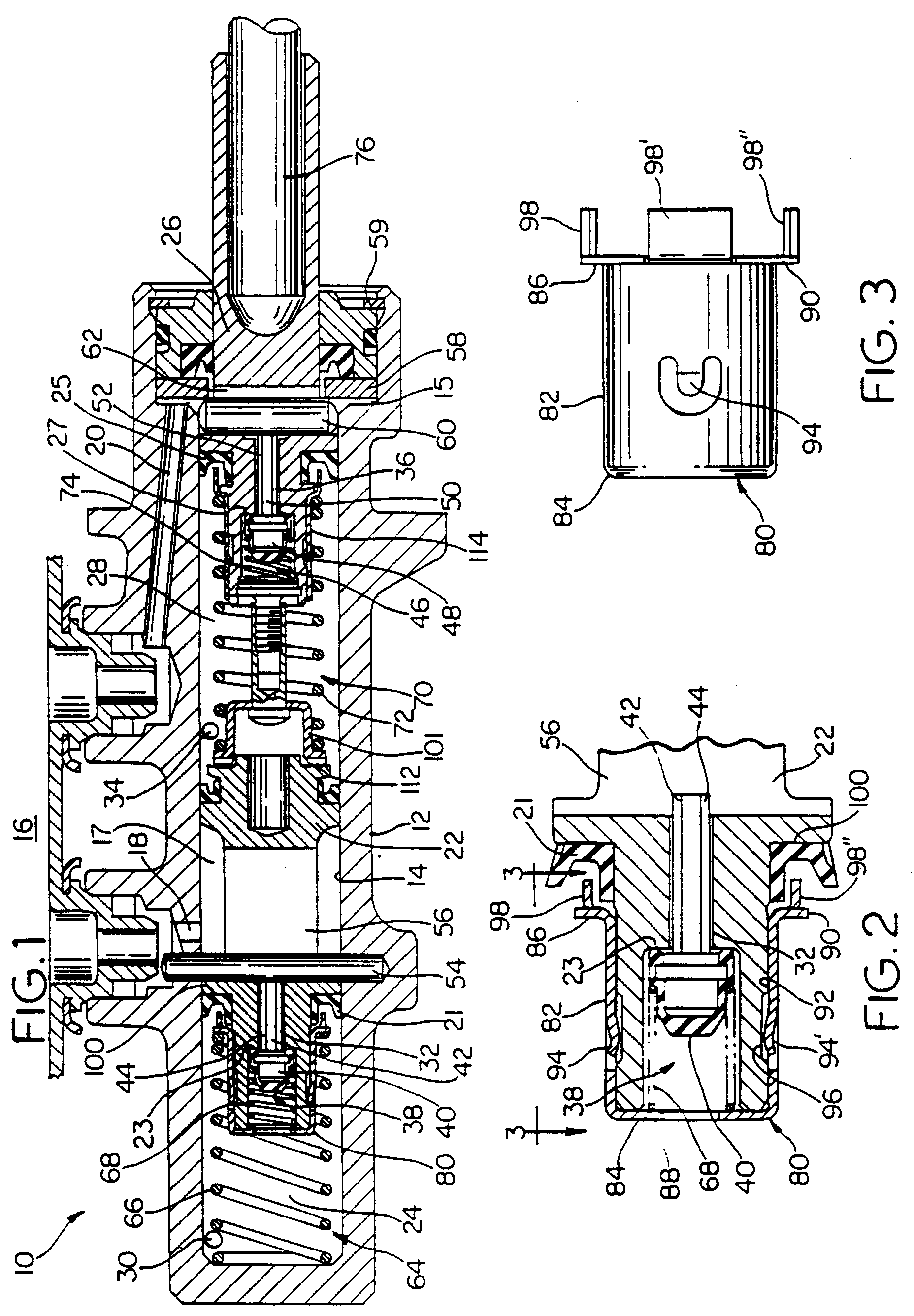
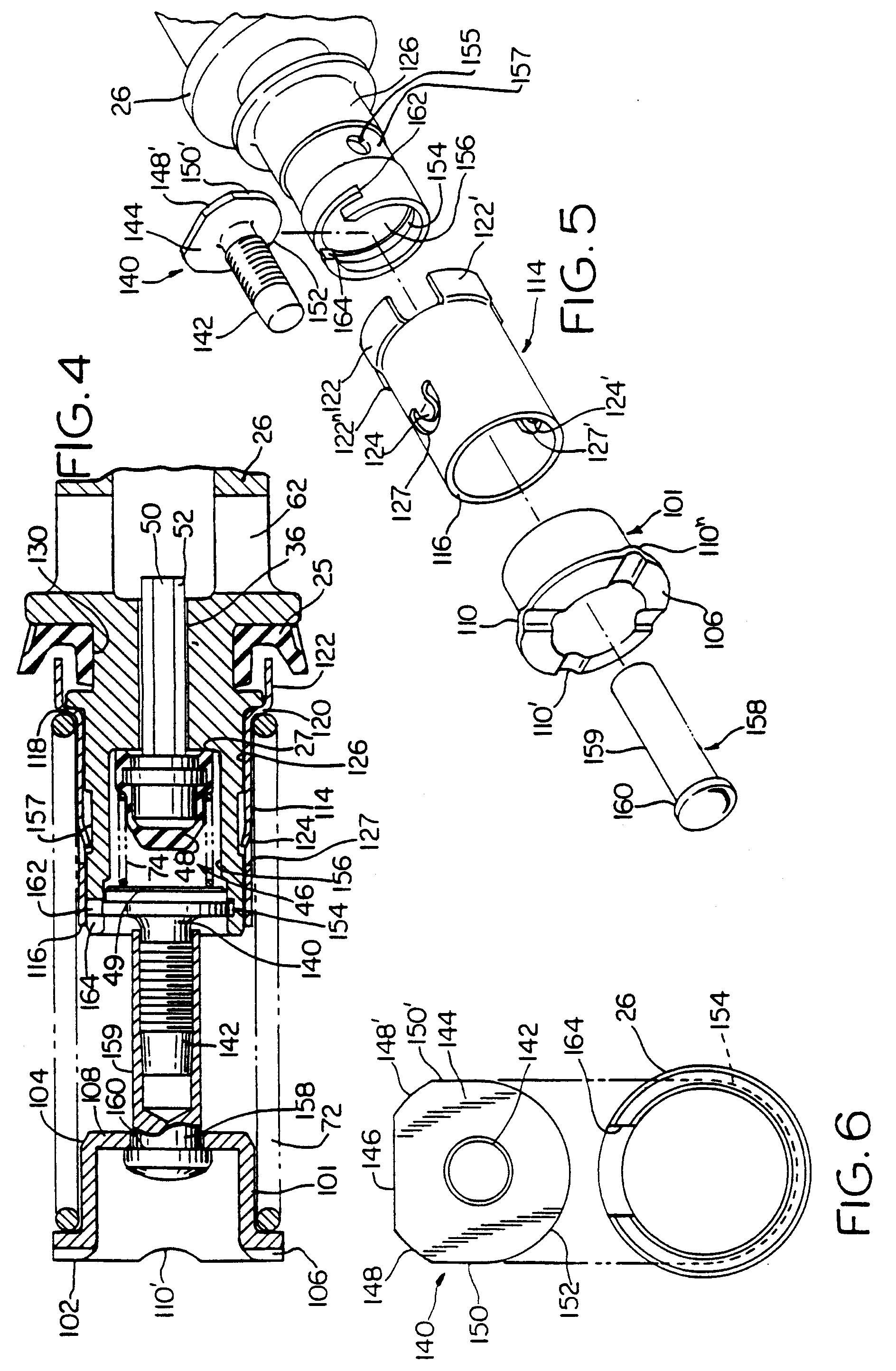
| (45) |
Mention of the grant of the patent: |
|
19.06.1996 Bulletin 1996/25 |
| (22) |
Date of filing: 18.11.1993 |
|
| (51) |
International Patent Classification (IPC)6: B60T 11/20 |
| (86) |
International application number: |
|
PCT/US9311/205 |
| (87) |
International publication number: |
|
WO 9413/519 (23.06.1994 Gazette 1994/14) |
|
| (54) |
SPRING CAGING MEANS
SPANNVORRICHTUNG FÜR EINE FEDER
SYSTEME DE BLOCAGE DE RESSORT
|
| (84) |
Designated Contracting States: |
|
DE ES FR GB |
| (30) |
Priority: |
08.12.1992 US 986813
|
| (43) |
Date of publication of application: |
|
20.09.1995 Bulletin 1995/38 |
| (73) |
Proprietor: AlliedSignal Inc. |
|
Morristown,
New Jersey 07962-2245 (US) |
|
| (72) |
Inventors: |
|
- KEYES, Hugh, E.
South Bend, IN 46628 (US)
- WILSON, Robert, K.
Granger, IN 46530 (US)
- CRUMB, Donald, A.
Granger, IN 46530 (US)
|
| (74) |
Representative: Bentz, Jean-Paul |
|
AlliedSignal Europe Services Techniques S.A.
Division Technique
126 Rue de Stalingrad
93700 Drancy
93700 Drancy (FR) |
| (56) |
References cited: :
DE-A- 1 405 812
DE-A- 4 018 494
GB-A- 2 251 902
US-A- 4 939 901
US-A- 5 207 062
|
DE-A- 3 424 513
GB-A- 2 098 294
US-A- 4 296 604
US-A- 5 161 375
|
|
| |
|
|
|
|
| |
|
| Note: Within nine months from the publication of the mention of the grant of the European
patent, any person may give notice to the European Patent Office of opposition to
the European patent
granted. Notice of opposition shall be filed in a written reasoned statement. It shall
not be deemed to
have been filed until the opposition fee has been paid. (Art. 99(1) European Patent
Convention).
|
[0001] This invention relates to a center port compensating master cylinder wherein a caging
arrangement for a piston return spring and compensation valve return spring is fixed
to a piston of the master cylinder.
[0002] In an effort to improve the operational characteristics of a master cylinder, it
has been disclosed in U.S. Patents 4,550,567 and 4,939,901 that compensation between
a reservoir and the pressurization chambers can effectively occur through center ports
in operational pistons. A variety of caging arrangements such as disclosed in U.S.
Patent 5,161,375 which shows all the features of the preamble of claim 1 and 5,207,062,
which was published after the priority date of the instant application, have been
developed for retaining return springs and valve springs in the bore of such master
cylinders. These caging arrangements function in a satisfactory manner when installed
in a master cylinder however it has been determined that a more positive connection
is desirable between the return spring and an operational piston.
[0003] To achieve the above-mentioned objective, the present invention provides a master
cylinder, for a brake system, as defined in claim 1, wherein we have developed a caging
arrangement for securing the return spring to the operational piston of the master
cylinder.
[0004] It is an object of this invention to provide a master cylinder with a caging arrangement
attached to a piston for retaining a return spring within a bore of a housing.
[0005] It is a further object of this invention to provide a caging arrangement for a return
spring which is secured to a piston by a stud retained in a groove by a cylindrical
member.
[0006] An advantage provided by this invention resides in the subassembly of a portion of
a caging arrangement with a piston whereby various strength return springs which can
be matched with the piston as a function of a desired operational characteristic of
the master cylinder.
[0007] These advantages and objects should be apparent from reading this specification while
viewing the drawings wherein:
Figure 1 is a cross sectional view of a schematic illustration of a master cylinder
wherein the return springs for the pistons and compensation valves are caged in the
bore in accordance with the principals of this invention;
Figure 2 is an enlarged view of a cylindrical member shown in Figure 1 for caging
a first compensation valve;
Figure 3 is a view of the cylindrical member of Figure 2 taken along lines 3-3 of
Figure 2;
Figure 4 is an enlarged view of the caging arrangement for the return spring and second
compensating valve of Figure 1;
Figure 5 is an isometric exploded view of the caging arrangement of Figure 4; and
Figure 6 is an end view of the piston of Figure 5 showing the groove for retaining
the end member of the stud.
[0008] The master cylinder 10 for a brake system as shown in Figure 1 has a housing 12 with
a bore 14 connected to a reservoir 16 through first 18 and second 20 ports. A first
piston 22 is located in bore 14 to define a first pressure chamber 24 and a second
piston 26 is located in bore 14 to define a second pressure chamber 28 in housing
12. The first pressure chamber 24 is connected to a brake system through outlet port
30 and to reservoir 16 through a passageway 32 in the first piston 22. The second
pressure chamber 28 is connected to the brake system through an outlet port 34 and
to the reservoir 16 through a second passageway 36 in the second piston 26. A first
valve 38 located in the first piston 22 has head 40 with a stem 42 attached thereto.
Stem 42, which is located in passageway 32, has ribs 44 thereon to provide a flow
path between a portion 17 of bore 14 connected to reservoir 16 and chamber 24. A second
valve 46 located in the second piston 25 has head 48 with a stem 50 attached thereto.
Stem 50, which is located in passageway 36, has ribs 52 thereon to provide a flow
path between portion 15 of bore 14 and chamber 28. A first pin 54 attached to housing
12 and extending through a slot 56 in piston 22 forms a stop for limiting the movement
of the first piston 22 within bore 14. A second pin 60 retained in the bore 14 by
bearing seal assembly 58 is located in a slot 62 in piston 26 to form a stop for limiting
the movement of the second piston 26 within bore 14.
[0009] First resilient means 64 is located in the bottom of bore 15 to urge the first piston
22 and head 40, respectively, toward the first pin 54. When piston 22 engages pin
54 as shown in Figure 1, stem 42 engages pin 54 to position head 40 away from face
seat 23 and allow communication of fluid from reservoir 16 into chamber 24 through
the flowpath in the first passageway 32. Similarly, second resilient means 70 which
includes return springs 72 and 74 urge the second piston 26 and head 46 toward the
second pin 60. When piston 26 engages pin 60 as shown in Figure 1, stem 50 engages
pin 60 to position head 48 away from face seat 27 and allow communication of fluid
from reservoir 16 into chamber 28 through the flowpath in the second passageway 36.
In response to an actuation force from an operator, input member 76 connected to the
second piston 26 simultaneously moves the second piston 26 and first piston 22 by
way of return spring 72 in bore 14. At the same time valve return springs 74 and 68,
respectively move heads 48 and 40 associated with valves 46 and 38 into correspondingly
engagement with face seats 27 and 23, to interrupt fluid communication through the
flowpath of the second 36 and first 32 passageways. Thereafter, further movement of
the second 26 and first 22 pistons in bore 14 pressurizes fluid in the second 28 and
first 22 chambers. Thus master cylinder 10 center port compensation valve 38 and 40
function in an adequate manner to prevent damage to the lip seals 21 and 25 located
on pistons 22 and 26, respectively, during a brake application.
[0010] In more particular detail, the caging structure for the first 64 and second 70 resilient
means includes several components which should simplify the construction of the master
cylinder 10.
[0011] The retainer 80 of the caging structure for the first resilient means 64 is shown
in Figures 2 and 3. Retainer 80 has a cylindrical body 82 with a first end 84 and
a second end 86. The first end 84 has an inwardly projecting flange 88 while the second
end 86 has an outwardly projecting flange 90. The cylindrical body 82 which is concentric
with peripheral surface 92 on piston 22 has a plurality of tabs 94, 94' which snap
into groove 96 on surface 92. Flange 90 has a plurality of axial projections 98, 98'...98
n which are adapted to retain seal 21 adjacent face 100 on piston 22. Valve return
spring 68 which engages the inwardly projecting flange 88 urges head 40 toward face
23 to control the flow communication through passageway 32. When retainer 80 is located
on piston 22 and inserted into bore 14, return spring 66 engages flange 90 to transmit
a return force through retainer 80 into piston 22 by way of the inwardly projecting
flange 88.
[0012] The caging arrangement for resilient means 70 is shown in Figure 4, 5 and 6 and includes
a first cylindrical member 101, a second cylindrical member 114, a stud 140 and a
head 158. The first cylindrical member 101 has a first end 102 and a second end 104.
The first end 102 has an outwardly projecting flange 106 while the second end 104
has an inwardly projecting flange 108. A plurality of set-off members 110, 110'...110
n, which are located on the first end 102, engage a face 112 on piston 22. The set-off
members 110, 110'...110
n are designed to allow the free flow of fluid between the interior of cylindrical
member 101 and chamber 28. The second cylindrical member or body 114 has a first end
116 and a second end 118. The second end 118 has an outwardly projecting flange 120
with a plurality of axial projections 122, 122'...122
n extending therefrom which help retain seal 25 in groove 130 on peripheral surface
126 on piston 26. The cylindrical member 114 has a plurality of U-shaped openings
127, 127' located adjacent the first end 116 to create tabs 124, 124' to retain the
cylindric member 114 on peripheral surface 126. Return spring 72 is located between
flanges 106 and 120 to define the size of chamber 28. The stud 140 as best shown in
Figures 5 and 6 has a threaded stem 142 attached to an end member 144. The end member
144 has an irregular shape with a base 146, arcuate segment 148, 148', parallel side
sections 150, 150' that are tangent with a semi-circle 152. The diameter of the semi-circle
is approximately the same radius as interior groove 154 in bore 156 of piston 26 while
the arcuate segment 148, 148' have a radius that approximates the peripheral surface
126 of piston 26. The head member 158 has a cylindrical body 159 that extends from
a shoulder 160.
[0013] The cylindrical body 114 is joined with piston 26 in the following manner. Stem 50
of valve 46 is inserted into passageway 36 with spring 74 attached to head 48. Spring
74 is compressed as star washer 49 is inserted into bore 156 of piston 26 to retain
valve 46 in bore 156. Thereafter, end member 144 is inserted into slot 162 associated
with groove 154. Stud 140 is vertically moved through slot 162 until stem 142 is in
approximate axial alignment with the center of piston 26. The end member 144 forms
the base for caging spring 74 of valve 46 within passageway 36. Cylindrical body 114
is pushed onto peripheral surface 126 of piston 26 and engages arcuate segment 148,
148' on end member 144 to hold the stud 140 in groove 154 in a manner to prevent rattling
and to assure that stem 142 remains in the axial center of piston 26. As cylindrical
body 114 moves onto peripheral surface 126, tabs 124, 124' snap into groove 157 and
under some circumstances tabs 124, 124' may need to be crimped to assure that they
do not come out of groove 157. Spring 72 is placed on cylindrical member 144 and compressed
after cylindrical member 101 is placed on the end of spring 72. Cylindrical body 159
of head member 158 passes through the opening formed by the inwardly projecting flange
108 and is mated with threads on stem 142 and a torque applied through a drive key
157 to move head member 158 toward end member 144 on stud 140 to establish the maximum
limits for spring 72. Thereafter, piston 26 is inserted in bore 14 and snap ring 59
of bearing seal assembly 58 attached to housing 12 to complete the installation of
pistons 22 and 26 in housing 12.
[0014] In operation, an input applied by input member 76 simultaneously moves piston 26
and 22 through spring 72 as spring 66 is compressed. Movement of pistons 26 and 22
with respect to stops 60 and 54 allow valve return springs 74 and 68 to independently
move heads 48 and 40 toward seats 27 and 23 to interrupt communication between chambers
28 and 24 and reservoir 16 to thereafter allow the input force to move pistons 26
and 22 and pressurize fluid in chambers 28 and 24 and effect a brake application.
On termination of the input force, return springs 66 and 72 move pistons 26 and 22
into the position shown in Figure 1 wherein fluid communication is again provided
between chamber 24 and reservoir 16 via slots 44 in stem 42 of valve 38 located in
passageway 32 and between chamber 28 via slots 52 in stem 50 of valve 46, opening
155, groove 157 and out U-shaped openings 127, 127'.
1. A master cylinder (10) for a brake system having a housing (12) with a bore (14) therein
connected to a reservoir (16) through first (18) and second (20) ports, first (22)
and second (26) pistons located in said bore (14), a first spring (66) located between
said housing (12) and first piston (22) to define a first chamber (24) within said
bore (14), a second spring (72) located in said bore (14) between said first (22)
and second (26) pistons to define a second chamber (28) within said bore (14), said
first piston (22) having a first passageway (32) therein for connecting said reservoir
(16) to said first chamber (24), said second piston (26) having a second passageway
(36) therein for connecting said reservoir (16) to said second chamber (28), a first
valve (38) located in said first passageway (32) for controlling communication between
said reservoir (16) and said first chamber (24), a second valve (46) located in said
second passageway (36) for controlling communication between said reservoir (16) and
said second chamber (28) and input means (76) for initially moving said first (22)
and second (26) pistons in said bore (14) to allow said first (38) and second (46)
valves to simultaneously interrupt communication through said first (32) and second
(36) passageways and thereafter develop pressurized fluid in said first (24) and second
(28) chambers with further movement of said first (22) and second (26) pistons, a
first cylindrical member (101) having a first end (102) with a first outwardly projecting
flange (106) that contacts said first piston (22) and a second end (104) has an inwardly
projecting flange (108), a second cylindrical member (114) with a first end (116)
which surrounds a portion of said second piston (26) and a second end (118) with a
second outwardly projecting flange (120) that engages a shoulder on said second piston
(26), and linkage which joins said second piston (26) with said first cylindrical
member (101), said linkage being characterized by a stud (140) retained in a first
groove (154) in said second passageway (36) of said second piston (26), said stud
(140) having a end member (144) with an irregular surface (146,148,148',150,150',152)
that engages said second piston (26) to prevent said stud (140) from rotating with
respect to said second piston (126) and a head member (158) that engages said inwardly
projecting flange (108) on said first cylindrical member (101) and mates with said
stud (140) for limiting the extension of said second spring (72) to define a maximum
distance between said first (106) and second (120) outwardly projecting flanges and
correspondingly the maximum size of said second chamber (28), said second cylindrical
member (114) engaging said irregular surface (146,148,148',150,150',152) on said end
member (144) of said stud (140) to assure that said end member (144) remains in said
first groove (154) in said second piston (26).
2. The master cylinder (10) as recited in claim 1 wherein said second cylindrical member
(114) is further characterized by a plurality of tabs (124) that engage a shoulder
of a groove (157) on the peripheral surface of said second piston (26) to connect
said second cylindrical member (114) with said second piston (26).
3. The master cylinder (10) as recited in claim 2 wherein said linkage is further characterized
by the engagement of said second cylindrical member (114) with said irregular surface
(146,148,148',150,150',152) on said end member (144) which holds said stud (140) in
the axial center of said bore (14).
4. The master cylinder (10) as recited in claim 3 wherein said second cylindrical member
(114) is further characterized by a plurality of axial projections (122,122'... 122n) that extend from said second outwardly projecting flange (120) to assist in retaining
a seal (25) in a second groove (130) on the peripheral surface of said second piston
(26).
5. The master cylinder (10) as recited in claim 4 wherein the linkage is further chacterized
by the engagement of said second cylindrical member (114) with an arcuate segment
(152) on said irregular surface (146,148,148',150,150',152) of said end member (144)
to prevent the development of any noise that may occur through independent movement
of the stud (140) within said first groove (154).
6. The master cylinder (10) as recited in claim 5 wherein said second piston (26) is
further characterized by a slot (162) that allows a stem (142) of said stud (140)
to be positioned in the axial center of said bore (14).
7. The master cylinder (10) as recited in claim 6 further characterized by a star washer
(49) located in said second passageway (36) which engages said second piston (26)
to retain a closure spring (74) of said second valve means (46) in said second passageway
(36).
8. The master cylinder (10) as recited in claim 7 wherein said second cylindrical member
(114) is further characterized by a plurality of openings (127,127') through which
fluid is communicated from corresponding openings (155) in said second piston (26)
connected to said second passageway (36).
1. Hauptbremszylinder (10) für ein Bremssystem mit einem Gehäuse (12) mit einer Bohrung
(14), die an ein Reservoir (16) über erste (18) und zweite (20) Kanäle angeschlossen
ist, mit einem ersten (22) und zweiten (26) Kolben in der Bohrung (14), einer ersten
Feder (66) zwischen dem Gehäuse (12) und dem ersten Kolben (22) zum Abteilen einer
ersten Kammer (24) in der Bohrung (14), einer zweiten Feder (72) in der Bohrung (14)
zwischen dem ersten (22) und dem zweiten (26) Kolben zum Abteilen einer zweiten Kammer
(28) in der Bohrung (14), wobei der erste Kolben (22) einen ersten Strömungsweg (32)
zum Anschluß des Reservoirs (16) an die erste Kammer (24) aufweist, der zweite Kolben
(26) einen zweiten Strömungsweg (36) zum Anschluß des Reservoirs (16) an die zweite
Kammer (28) aufweist, ein erstes Ventil (38) im ersten Strömungsweg (32) zum Steuern
der Verbindung zwischen dem Reservoir (16) und der ersten Kammer (26) angeordnet ist,
ein zweites Ventil (46) in dem zweiten Strömungsweg (36) zum Steuern der Verbindung
zwischen den Reservoirs (16) und der zweiten Kammer (28) angeordnet ist, und mit einer
Eingabe (76) zum anfänglichen Verschieben des ersten (22) und zweiten (26) Kolbens
in der Bohrung (14), so daß das erste (38) und zweite (46) Ventil gleichzeitig die
Verbindung durch den ersten (32) und zweiten (36) Strömungsweg unterbricht und anschließend
Strömungsmittel in der ersten (24) und zweiten (28) Kammer bei weiterer Verschiebung
des ersten (22) und zweiten (26) Kolbens unter Druck gesetzt wird, mit einem ersten
zylindrischen Bauteil (101) mit einem ersten Ende (102), an dem ein erster nach außen
vorspringender Flansch (106) in Anlage an den ersten Kolben (122) ist, und mit einem
zweiten Ende (104), das einen nach innen vorspringenden Flansch (108) aufweist, mit
einem zweiten zylindrischen Bauteil (114) mit einem ersten Ende (116), das einen Teil
des zweiten Kolbens (26) umschließt und mit einem zweiten Ende (118), dessen zweiter
nach außen vorspringender Flansch (120) an einer Schulter des zweiten Kolbens (26)
in Anlage ist und mit einer Gelenkverbindung zur Verbindung des zweiten Kolbens (26)
mit dem ersten zylindrischen Bauteil (101), wobei die Gelenkverbindung durch einen
in einer ersten Nut (154) im zweiten Strömungsweg (36) des zweiten Kolbens (26) gehaltenen
Bolzen (140) gekennzeichnet ist, der (140) ein Endteil (144) mit einer unregelmäßigen
Fläche (146, 148, 148', 150, 150', 152) aufweist, die in Eingriff mit dem zweiten
Kolben (26) ist, um ein Verdrehen des Bolzens (140) gegenüber dem zweiten Kolben (126)
zu verhindern und der ein Kopfteil (158) aufweist, das in Eingriff mit dem nach innen
vorspringenden Flansch (108) des ersten zylindrischen Bauteils (101) ist und mit dem
Bolzen (140) verbunden ist, um die Verlängerung der zweiten Feder (72) zu begrenzen
und damit einen maximalen Abstand zwischen dem ersten (106) und zweiten (120) nach
außen vorspringenden Flansch zu definieren und damit die maximale Größe der zweiten
Kammer (28), wobei das zweite zylindrische Bauteil (114) mit der unregelmäßigen Fläche
(146, 148, 148', 150, 150', 152) an dem Endteil (144) des Bolzens (140) in Eingriff
ist, so daß das Endteil (144) in der ersten Nut (154) des zweiten Kolbens (26) verbleibt.
2. Hauptbremszylinder (10) nach Anspruch 1, bei dem das zweite zylindrische Bauteil (114)
ferner durch mehrere Laschen (124) gekennzeichnet ist, die an einer Schulter einer
Nut (157) am Umfang des zweiten Kolbens (26) in Eingriff sind, um das zweite zylindrische
Bauteil (114) an dem zweiten Kolben (26) zu befestigen.
3. Hauptbremszylinder (10) nach Anspruch 2, bei dem die Gelenkverbindung ferner von dem
Eingriff des zweiten zylindrischen Bauteils (114) an der unregelmäßigen Fläche (146,
148, 148', 150, 150', 152) an dem Endteil (144) gekennzeichnet ist, das den Bolzen
(140) im axialen Zentrum der Bohrung (14) hält.
4. Hauptbremszylinder (10) nach Anspruch 3, bei dem das zweite zylindrische Bauteil (114)
ferner durch mehrere axiale Vorsprünge (122, 122'... 122n) gekennzeichnet ist, die von dem zweiten nach außen vorspringenden Flansch (120)
ausgehen, um das Festhalten einer Dichtung (25) in einer zweiten Nut (130) am Umfang
des zweiten Kolbens (26) zu unterstützen.
5. Hauptbremszylinder (10) nach Anspruch 4, bei dem die Gelenkverbindung ferner von dem
Eingriff des zweiten zylindrischen Bauteils (114) an einem bogenförmigen Segment (152)
der unregelmäßigen Fläche (146, 148, 148', 150, 150', 152) des Endteils (144) gekennzeichnet
ist, um Geräuschbildung zu vermeiden, die von der unabhängigen Bewegung des Bolzens
(40) in der ersten Nut (154) herrühren kann.
6. Hauptbremszylinder (10) nach Anspruch 5, bei dem der zweite Kolben (26) ferner durch
einen Schlitz (162) gekennzeichnet ist, mit dessen Hilfe ein Schaft (142) des Bolzens
(140) im axialen Zentrum der Bohrung (14) positioniert ist.
7. Hauptbremszylinder (10) nach Anspruch 6, ferner gekennzeichnet durch eine Sternscheibe
(49) im zweiten Strömungsweg (36) in Anlage an dem zweiten Kolben (26), um eine Schließfeder
(74) des zweiten Ventils (46) in dem zweiten Strömungsweg (36) zu halten.
8. Hauptbremszylinder (10) nach Anspruch 7, bei dem das zweite zylindrische Bauteil (114)
ferner durch mehrere Öffnungen (127, 127') gekennzeichnet ist, durch welche Strömungsmittel
aus entsprechenden mit dem zweiten Strömungsweg (36) verbundenen Öffnungen (155) im
zweiten Kolben (26) strömt.
1. Un maître-cylindre (10) pour un système de freinage ayant un boîtier (12) comprenant
un alésage (14) relié à un réservoir (16) à travers des premier (18) et deuxième (20)
ports, des premier (22) et deuxième (26) pistons situés dans ledit alésage (14), un
premier ressort (66) situé entre ledit boîtier (12) et le premier piston (22) pour
définir une première chambre (24) à l'intérieur dudit alésage (14), un deuxième ressort
(72) situé dans ledit alésage (14) entre lesdits premier (22) et deuxième (26) pistons
pour définir une deuxième chambre (28) à l'intérieur dudit alésage (14), ledit premier
piston (22) comprenant un premier passage (32) pour relier ledit réservoir (16) à
ladite première chambre (24), ledit deuxième piston (26) comprenant un deuxième passage
(36) pour relier ledit réservoir (16) à ladite deuxième chambre (28), une première
soupape (38) située dans ledit premier passage (32) pour commander la communication
entre ledit réservoir (16) et ladite première chambre (24), une deuxième soupape (46)
située dans ledit deuxième passage (36) pour commander la communication entre ledit
réservoir (16) et ladite deuxième chambre (28) et des moyens d'entrée (76) pour déplacer
initialement lesdits premier (22) et deuxième (26) pistons dans ledit alésage (14)
pour permettre auxdites première (38) et deuxième (46) soupapes d'interrompre simultanément
la communication à travers lesdits premier (32) et deuxième (36) passages et ensuite
de développer un fluide sous pression dans lesdites première (24) et deuxième (28)
chambres avec un mouvement supplémentaire desdits premier (22) et deuxième (26) pistons,
un premier élément cylindrique (101) ayant une première extrémité (102) avec une première
bride se projetant vers l'extérieur (106) qui touche ledit premier piston (22) et
une deuxième extrémité (104) a une bride se projetant vers l'intérieur (108), un deuxième
élément cylindrique (114) avec une première extrémité (116) qui entoure une partie
dudit deuxième piston (26) et une deuxième extrémité (118) avec une deuxième bride
se projetant vers l'extérieur (120) qui touche un épaulement sur ledit deuxième piston
(26), et une liaison qui relie ledit deuxième piston (26) audit premier élément cylindrique
(101), ladite liaison étant caractérisée par un boulon (140) retenu dans une première
rainure (154) dans ledit deuxième passage (36) dudit deuxième piston (26), ledit boulon
(140) ayant un élément d'extrémité (144) avec une surface irrégulière (146, 148, 148',
150, 150', 152) qui touche ledit deuxième piston (26) pour empêcher ledit boulon (140)
de tourner par rapport audit deuxième piston (126) et un élément de tête (158) qui
touche ladite bride se projetant vers l'intérieur (108) sur ledit premier élément
cylindrique (101) et se couple avec ledit boulon (140) pour limiter l'extension dudit
deuxième ressort (72) pour définir une distance maximum entre lesdites première (106)
et deuxième (120) brides se projetant vers l'extérieur et de façon correspondante
la dimension maximum de ladite deuxième chambre (28), ledit deuxième élément cylindrique
(114) touchant ladite surface irrégulière (146, 148, 148', 150, 150', 152) sur ledit
élément d'extrémité (144) dudit boulon (140) pour assurer que ledit élément d'extrémité
(144) reste dans ladite première rainure (154) dans ledit deuxième piston (26).
2. Le maître-cylindre (10) tel qu'exposé dans la revendication 1, dans lequel ledit deuxième
élément cylindrique (114) est en outre caractérisé par une pluralité d'agrafes (124)
qui touchent un épaulement d'une rainure (157) sur la surface périphérique dudit deuxième
piston (26) pour relier ledit deuxième élément cylindrique (114) audit deuxième piston
(26).
3. Le maître-cylindre (10) tel qu'exposé dans la revendication 2, dans lequel ladite
liaison est en outre caractérisée par le contact dudit deuxième élément cylindrique
(114) avec ladite surface irrégulière (146, 148, 148', 150, 150', 152) sur ledit élément
d'extrémité (144) qui maintient ledit boulon (140) dans le centre axial dudit alésage
(14).
4. Le maître-cylindre (10) tel qu'exposé dans la revendication 3, dans lequel ledit deuxième
élément cylindrique (114) est en outre caractérisé par une pluralité de projections
axiales (122, 122',...122n) qui s'étendent à partir de la deuxième bride se projetant vers l'extérieur (120)
pour contribuer à la retenue d'un joint (25) dans une deuxième rainure (130) sur la
surface périphérique dudit deuxième piston (26).
5. Le maître-cylindre (10) tel qu'exposé dans la revendication 4, dans lequel ladite
liaison est en outre caractérisée par le contact dudit deuxième élément cylindrique
(114) avec un segment courbe (152) sur ladite surface irrégulière (146, 148, 148',
150, 150', 152) dudit élément d'extrémité (144) pour empêcher le développement de
tout bruit qui puisse se produire par l'intermédiaire du mouvement indépendant du
boulon (140) à l'intérieur de ladite première rainure (154).
6. Le maître-cylindre (10) tel qu'exposé dans la revendication 5, dans lequel ledit deuxième
piston (26) est en outre caractérisé par une fente (162) qui permet à une tige (142)
dudit boulon (140) d'être positionnée dans le centre axial dudit alésage (14).
7. Le maître-cylindre (10) tel qu'exposé dans la revendication 6, caractérisé en outre
par une rondelle en étoile (49) située dans ledit deuxième passage (36) qui touche
ledit deuxième piston (26) pour retenir un ressort de fermeture (74) desdits deuxièmes
moyens de soupape (46) dans ledit deuxième passage (36).
8. Le maître-cylindre (10) tel qu'exposé dans la revendication 7, dans lequel ledit deuxième
élément cylindrique (114) est en outre caractérisé par une pluralité d'ouvertures
(127, 127') à travers lesquelles un fluide est transmis à partir d'ouvertures correspondantes
(155) dans ledit deuxième piston (26) relié audit deuxième passage (36).