|
(11) | EP 0 673 959 B1 |

| (12) | EUROPEAN PATENT SPECIFICATION |
|
|
| (54) |
Process for producing aromatic polycarbonate Verfahren zur Herstellung aromatischer Polycarbonate Procédé pour la préparation de polycarbonates aromatiques |
|
|
|||||||||||||||||||||||||||||||
| Note: Within nine months from the publication of the mention of the grant of the European patent, any person may give notice to the European Patent Office of opposition to the European patent granted. Notice of opposition shall be filed in a written reasoned statement. It shall not be deemed to have been filed until the opposition fee has been paid. (Art. 99(1) European Patent Convention). |
FIELD OF THE INVENTION
[0001] This invention relates to a process for producing a polycarbonate by interesterification. More particularly, it relates to a process for producing an aromatic polycarbonate having improved heat resistance and improved hue by melt polycondensation of an aromatic diol compound and a diaryl carbonate compound.
BACKGROUND OF THE INVENTION
[0002] Aromatic polycarbonates have excellent mechanical characteristics such as impact resistance as well as heat resistance and transparency and have been employed as engineering plastics in a broad range of fields, such as bottles for carbonated beverages, electronic bases (CD bases) and transfer belts.
[0003] Industrially established processes for producing aromatic polycarbonate include the so-called phosgene process comprising reacting an aromatic diol, e.g., bisphenol, and phosgene by interfacial polycondensation. However, the phosgene process has many disadvantages, such as high toxicity of phosgene, the necessity of handling quantities of sodium chloride as a by-product, incorporation of the sodium chloride into the polymer produced, and influences of methylene chloride usually used as a reaction solvent on the environment. That is, the phosgene process incurs high costs for taking countermeasures against these health and environmental problems.
[0004] The so-called melt process or non-phosgene process is also well known. It consists of an interesterification reaction between an aromatic diol compound and a diaryl carbonate compound. It is received that the non-phosgene process is free of the above-mentioned problems associated with the phosgene process and also is more economical.
[0005] However, the aromatic polycarbonate obtained by the non-phosgene process using, for example, bisphenol A and diphenyl carbonate generally has a higher content of terminal hydroxyl groups than that obtained by the phosgene process using, for example, bisphenol A, phosgene, and a terminal blocker. As a result, the former aromatic polycarbonate is generally inferior to the latter in heat resistance and hue. The residue of the catalyst used in the non-phosgene process also has adverse influences on the aromatic polycarbonate produced.
[0006] For example, the heat resistance in terms of temperature causing a 5% weight loss on heating (Td5%) of an aromatic polycarbonate obtained by the non-phosgene process is generally lower than that of an aromatic polycarbonate prepared by the phosgene process, i.e., about 500°C, sometimes lower by several tens of degrees C or more, although it varies depending upon a kind and an amount of a catalyst for an interesterification reaction and a content of terminal hydroxyl groups of resulting aromatic polycarbonates.
[0007] Because molding of aromatic polycarbonates should be conducted at high temperatures, e.g., of around 320°C, in order to decrease the melt viscosity thereof, low heat resistance of aromatic polycarbonates gives rise to problems, such as cleavage of the polymer main chain, coloration, and reduction in mechanical strength. In particular, a high molding temperature is needed for obtaining thin-walled articles such as containers having a wall thickness of from 0.3 to 0.6 mm or articles with complicated shapes. Therefore, in order that an aromatic polycarbonate obtained by the non-phosgene process may be put to practical use, improvement in heat resistance and prevention of coloration are much desired.
[0008] It has been proposed to prepare an aromatic polycarbonate having an improved hue by using, as a catalyst for interesterification, a quaternary ammonium salt or phosphonium salt, e.g., tetraphenylphosphonium tetraphenylboranate or triphenylbutylphosphonium tetraphenylboranate (see JP-B-47-17978, the term "JP-B" as used herein means an "examined published Japanese patent application") or a boron hydride compound represented by the formula R'4PBHnR4-n (R, R': hydrocarbon group) (see U.S. Patents 4,330,664 and 5,221,761).
[0009] However, while the aromatic polycarbonates obtained by using these catalysts have improved hue, they have insufficient molecular weight and poor heat resistance, or have a Td5% as low as 475 to 480°C while having an improved hue and a high molecular weight.
[0010] U.S. Patent 4,363,905 mentions production of an aromatic polycarbonate having a weight average molecular weight of 400 and a satisfactory hue by melt polycondensation of bisphenol A and diphenyl carbonate in the presence a combination of Bu4PBr and sodium phenolate as a catalyst system for interesterification (see Column 6, Table III, Run No. VIII). However, such a low-molecular weight polycarbonate encounters difficulty in injection molding or extrusion molding. The aforementioned U.S. patent also mentions production of an aromatic polycarbonate having a weight average molecular weight of 8,400 and an excellent hue by melt polycondensation of bisphenol A and bis(o-nitrophenyl) carbonate using the same catalyst system (Run No. III). In Run No. III, because of the use of bis(o-nitrophenyl) carbonate as a starting diaryl carbonate, the cost of material is high, the heat stability during the reaction is poor, and a decomposition product is incorporated into the produced aromatic polycarbonate resulting in deterioration of the hue and low mechanical strength, such as low impact strength.
[0011] EP-A-0 360 578 discloses a process for producing a polycarbonate by melt polycondensation of an aromatic dihydroxy compound and a carbonic acid diester. The polycondensation is carried out in the presence of a catalyst which comprises a nitrogen-containing basic compound, an alkali metal or alkaline earth metal compound, and optionally boric acid or a boric ester. The nitrogen containing basic compound may be e.g. Me4NOH or BU4NOH.
SUMMARY OF THE INVENTION
[0012] An object of the present invention is to provide a non-phosgene process (i.e., an interesterification polycondensation process) for producing a heat-resistant aromatic polycarbonate having an improved hue and a high thermal decomposition temperature and showing substantially no change in molecular weight on heat melting, which process does not involve formation of a polymer gel.
[0013] The present invention provides a process for producing an aromatic polycarbonate having a weight average molecular weight of 7,000 to 60,000, which comprises melt polycondensing an aromatic diol compound and a diaryl carbonate compound represented by formula (I):
wherein R1 and R2 each represent an alkyl group having 1 to 10 carbon atoms or an alkoxy group; and m and n each represent 0 or an integer of 1 or 2,
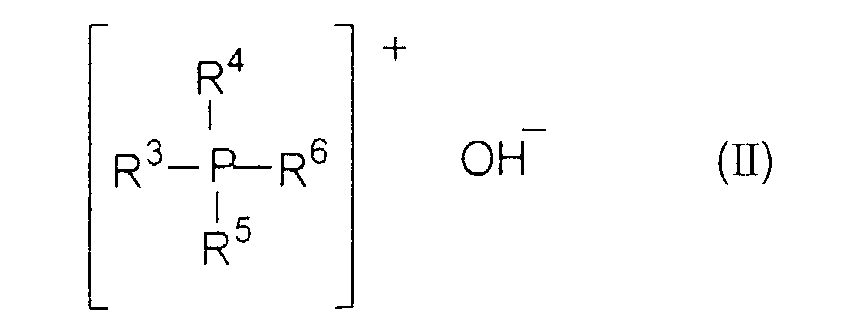
in the presence of a combination of (a) an alkali metal compound and (b) a phosphonium hydroxide compound represented by formula (II):
wherein R3, R4, R5, and R6 each represent an alkyl group having 1 to 12 carbon atoms, an aryl group, an aralkyl group or a cycloalkyl group, which groups are optionally substituted with a polar group, as a catalyst for interesterification.
[0014] According to the present invention, the catalyst for interesterification exhibits sufficient activity even at small amounts to provide an aromatic polycarbonate with excellent hue and high heat resistance.
DETAILED DESCRIPTION OF THE INVENTION
[0015] The aromatic diol compound which can be used in the present invention is represented by formula (III):
wherein A represents a simple bond or a divalent group selected from the group consisting of a substituted or unsubstituted, straight-chain, branched or cyclic divalent hydrocarbon group having 1 to 15 carbon atoms, -O-, -S-, -CO-, -SO-, and -SO2-; X and Y, which may be the same or different, each represent a hydrogen atom, a halogen atom or a hydrocarbon group having 1 to 6 carbon atoms; and p and q each represent 0, 1 or 2.
[0016] Typical examples of the aromatic diols include bisphenols, e.g., bis(4-hydroxydiphenyl)methane, 2,2-bis(4-hydroxyphenyl)propane (i.e., bisphenol A), 2,2-bis(4-hydroxy-3-methylphenyl)propane, 2,2-bis(4-hydroxy-3-t-butylphenyl)propane, 2,2-bis(4-hydroxy-3,5-dimethylphenyl)propane, 2,2-bis(4-hydroxy-3,5-dibromo)propane, 4,4-bis(4-hydroxyphenyl)heptane, and 1,1-bis(4-hydroxyphenyl)cyclohexane; biphenyls, e.g., 4,4'-dihydroxybiphenyl and 3,3',5,5'-tetramethyl-4,4'-biphenyl; bis(4-hydroxyphenyl)sulfone, bis(4-hydroxyphenyl) sulfide, bis(4-hydroxyphenyl) ether, and bis(4-hydroxyphenyl) ketone. Preferred of these is 2,2-bis(4-hydroxyphenyl)propane.
[0017] These aromatic diol compounds may be used either individually or as a combination of two or more thereof. In preparing a branched aromatic polycarbonate, a tri- or higher hydric phenol may be copolymerized in a small proportion. For the purpose of improving heat stability or resistance to hydrolysis of the resulting aromatic polycarbonate, a monohydric phenol, such as p-t-butylphenol or p-cumylphenol, may be used in combination for blocking of a terminal hydroxyl group.
[0018] Typical examples of the diaryl carbonate compound represented by formula (I) which can be used in the present invention are diphenyl carbonate, ditolyl carbonate, dixylyl carbonate, bisbutylphenyl carbonate, bisnonylphenyl carbonate, bismethoxyphenyl carbonate, and bisbutoxyphenyl carbonate. Of these, diphenyl carbonate is preferred.
[0019] The diaryl carbonate compound is usually used in excess, preferably in an amount of from 1.01 to 1.30 mol, still preferably from 1.02 to 1.20 mol, per mole of the aromatic diol compound.
[0020] The catalyst for interesterification according to the present invention is a combination of (a) an alkali metal compound and (b) a phosphonium hydroxide compound represented by formula (II).
[0021] Suitable alkali metal compounds (a) include inorganic alkali metal compounds, such as a hydroxide, a carbonate or a hydrogencarbonate of lithium, sodium, potassium, rubidium or cesium; and organic alkali metal compounds, such as an alcoholate, a phenolate or an Organic carboxylate of the alkali metal. From the standpoint of heat resistance and hue of the produced aromatic polycarbonate, of these, cesium compounds are preferred of them. Still preferred of cesium compounds are cesium carbonate, cesium hydrogencarbonate, and cesium hydroxide.
[0022] While it is known that many phosphonium salt compounds are useful as a catalyst for interesterification, halogen salts are not favorable in the practice of the present invention. Phosphonium hydroxide compounds (b) which are used in the present invention are the compounds represented by formula (II). In formula (II), R3, R4, R5, and R6 may be substituted with a polar group.
[0023] Specific examples of phosphonium hydroxide compounds of formula (II) are tetraethylphosphonium hydroxide, tetrabutylphosphonium hydroxide, tetraphenylphosphonium hydroxide, methyltriphenylphosphonium hydroxide, allyltriphenylphosphonium hydroxide, butyltriphenylphosphonium hydroxide, amyltriphenylphosphonium hydroxide, heptyltriphenylphosphonium hydroxide, hexyltriphenylphosphonium hydroxide, benzyltriphenylphosphonium hydroxide, and cinnamyltriphenylphosphonium hydroxide.
[0024] Examples of phosphonium hydroxide compounds of formula (II) in which R3, R4, R5 or R6 is substituted with a polar group are 4-carboxybutyltriphenylphosphonium hydroxide, 2-dimethylaminoethyltriphenylphosphonium hydroxide, 2-(1,3-dioxolan-2-yl)ethyltriphenylphosphonium hydroxide, 4-ethoxybenzyltriphenylphosphonium hydroxide, ethoxycarbonylmethyltriphenylphosphonium hydroxide, formylmethyltriphenylphosphonium hydroxide, methoxymethyltriphenylphosphonium hydroxide, and tetrakis(hydroxymethyl)phosphonium hydroxide. Tetraethylphosphonium hydroxide, tetrabutylphosphonium hydroxide, tetraphenylphosphonium hydroxide, and allyltriphenylphosphonium hydroxide are preferred compounds for their activity in producing polycarbonates having a high molecular weight.
[0025] The above-mentioned interesterification catalyst components (a) and (b) are preferably employed in the form of an aqueous or alcoholic solution thereof.
[0026] Alkali metal compound (a) is used in an amount of from 10-10 to 10-5 mol, preferably from 10-8 to 10-6 mol, per mole of the aromatic diol compound.
[0027] When alkali metal compound (a) is introduced into a reaction system in the form of an aqueous solution thereof, water is used in an amount of from 10-6 to 1 mol, preferably from 1 x 10⁻⁴ to 0.3 x 10⁻¹ mol, per mole of the aromatic diol compound.
[0028] Phosphonium hydroxide compound (b) is used in an amount of from 10-6 to 10-3 mol, preferably from 10-5 to 10-3 mol, per mole of the aromatic diol compound.
[0029] A preferred molar ratio of alkali metal compound (a) to phosphonium hydroxide compound (b) is from 10-6:1 to 1:1.
[0030] If the amount of the catalyst used is too large or if the (a)/(b) ratio is inadequate, the reaction tends to form a polymer gel or to form isomeric structures other than a carbonate bond, such as a salicylic ester structure, a dihydroxybenzophenone structure, and a xanthone structure, in the main polymer chain, resulting in adverse affects on the physical properties of the resulting aromatic polycarbonate. It follows that the resulting aromatic polycarbonate has reduced heat resistance or a deteriorated hue, which, combined with the influences of the residue of the catalyst, results in reductions in performance properties in melt molding or use.
[0031] If the amount of the catalyst is too small, an aromatic polycarbonate having a sufficiently high molecular weight for mechanical strength is scarcely obtained.
[0032] The interesterification melt polycondensation can be carried out in accordance with known melt polycondensation techniques for production of aromatic polycarbonates except for using a combination of alkali metal compound (a) and phosphonium hydroxide compound (b) as a catalyst.
[0033] In greater detail, the starting materials are subjected to melt polycondensation by interesterification under heating at atmospheric pressure or under reduced pressure while removing by-product produced. The reaction is usually carried out in two or more separate stages. A first stage reaction is performed by heating the starting materials and the catalyst at 100° to 200°C in an inert gas atmosphere under atmospheric pressure or under increased pressure. During this stage, an interesterification reaction and a reaction of formation of a low-molecular weight oligomer having a number average molecular weight of from 400 to 1,000 occur. To effect a second stage reaction, the reaction temperature is increased to 200° to 250°C, and the pressure is diminished, e.g., to 2.7 kPa (20 Torr) or less, whereby the interesterification reaction, the formation of the low-molecular weight oligomer, and chain growth of the oligomer (to a number average molecular weight of from 1,000 to 7,000) are allowed to proceed while driving the phenol by-product out of the reaction system. For further chain growth of the oligomer, the phenol and a diaryl carbonate are driven out of -the system at a further increased temperature (e.g., 250° to 330°C) under higher vacuum (e.g., 0.13 kPa (1 Torr) or less) thereby obtaining a high-molecular weight aromatic polycarbonate.
[0034] The reaction time in each reaction stage is determined appropriately depending on the progress of the reaction. For consideration of the hue of the resulting polymer, while the hue is not appreciably affected by the length of the reaction time under temperatures around 200°C, the reaction time at a temperature of 200°C or lower is usually from 0.5 to 5 hours, and the reaction time at an elevated temperature of from 200° to 250°C is usually from 0.1 to 3 hours. At temperatures exceeding 250°C, a prolonged reaction gives significantly adverse influences on the hue. Accordingly, a recommended reaction time of the final reaction stage is within 1 hour, and particularly from 0.1 to 1 hour.
[0035] The reaction may be conducted either in a batch system or in a continuous system, and various reaction apparatus may be used. Different types of apparatus are usually selected for each reaction stage. While not limiting, an apparatus having a stirring function for high viscosity liquid is preferred for the final stage where the viscosity of the reaction system greatly increases.
[0036] The aromatic polycarbonate obtained by the process of the present invention has a high molecular weight, namely a number average molecular weight (Mn) of from about 2,500 to about 25,000 and a weight average molecular weight (Mw) of from 7,000 to 60,000, with an Mw/Mn ratio preferably ranging from 2 to 3.
[0037] When the aromatic polycarbonate specifically weighing about 10 mg is heated in a nitrogen stream at a rate of temperature increase of 20°C/min using a thermogravimetric analyzer "200-TG/DTA 220" manufactured by Seiko Densi Kogyo Co., Ltd., the temperature at which the weight loss of the aromatic polycarbonate reaches 5% (based on the initial weight) is not less than 480°C, and preferably from 490° to 520°C. The above-identified temperature is taken as a heat resistance temperature and hereinafter is referred to as Td5%.
[0038] The hydroxyl group content of the resulting aromatic polycarbonate is preferably not more than about 0.1% by weight.
[0039] The aromatic polycarbonate obtained by the process of the present invention may be compounded with various additives, such as catalyst stabilizers, heat stabilizers, ultraviolet absorbents, antistatic agents, colorants, fluidity modifiers, parting agents, and reinforcing fillers.
[0040] If desired, the aromatic polycarbonate obtained by the process of the present invention may be blended with other resins, such as an ethylene-vinyl acetate copolymer, a polyamide resin, a polystyrene resin and polypropylene.
[0041] The present invention will now be illustrated in greater detail by way of Examples, but the present invention should not be construed as being limited thereto. Unless otherwise indicated herein, all the percents are by weight.
1) Molecular Weight:
[0043] Measured by gel-permeation chromatography using "HLC-8020", manufactured by Tosoh Corporation, in chloroform at 35°C on polycarbonate conversion.
2) Td5%:
[0044] An aromatic polycarbonate sample specifically weighing about 10 mg is heated in a nitrogen stream at a rate of temperature increase of 20°C/min using a thermogravimetric analyzer "200-TG/DTA 220" manufactured by Seiko Densi Kogyo Co., Ltd., and the temperature at which the weight loss of the sample reached 5% based on the initial weight is obtained.
3) Hue:
[0045] An aromatic polycarbonate sample is heat-melted at 320°C for 30 minutes and dissolved in methylene chloride to prepare a 4% solution, and the UV absorbance at 345 nm is measured. The greater the absorbance, the higher the degree of coloration.
EXAMPLE 1
[0046] In a 300 ml-volume SUS-316-made reactor equipped with a stirrer and a distillation column were charged 228 g (0.1 mol) of bisphenol A (BPA) and 23.1 g (0.107 mol) of diphenyl carbonate (DPC). After purging the reactor with nitrogen gas, 2.0 µl of a 2% aqueous solution containing 0.039 mg (1.2 x 10⁻⁷ mol) of cesium carbonate (Cs2CO3) and 15.2 µl of a 15% aqueous solution containing 2.28 mg (8.2 x 10⁻⁶ mol) of tetrabutylphosphonium hydroxide (BU4POH) (synthesized from an aqueous solution of a corresponding bromide using an anion-exchange resin) were added thereto as catalyst components in a nitrogen atmosphere.
[0047] The reactor was heated to 150°C, and the mixture was maintained in a molten state at that temperature under atmospheric pressure for 1 hour. After the temperature was increased to 200°C, the pressure was gradually decreased to 2.7 kPa (20 Torr), and the reaction mixture was maintained under these conditions for 1 hour to distill off phenol. Then, the temperature was further elevated to 250°C, and the inner pressure was dropped to 0.13 kPa (0.5 Torr) at that temperature, and a polycondensation reaction was conducted for 1 hour to obtain about 25 g of an aromatic polycarbonate.
EXAMPLES 2 TO 5
[0049] An aromatic polycarbonate was synthesized in the same manner as in Example 1, except for changing the amount of Bu4POH as shown in Table 1.
COMPARATIVE EXAMPLE 1
[0051] An aromatic polycarbonate was synthesized in the same manner as in Example 5, except for using Bu4POH alone as a catalyst.
COMPARATIVE EXAMPLE 2
[0053] An aromatic polycarbonate was synthesized in the same manner as in Example 1, except for replacing the Bu4POH aqueous solution with 15.8 µl of a 15% aqueous solution containing 2.37 mg (8.2 x 10⁻⁶ mol) of tetrabutylphosphonium bromide (Bu4PBr).
[0054] The resulting polycarbonate was slightly colored when observed with the naked eye. Coloration of the inner wall of the reactor was also observed. The analytical results of the polymer obtained are shown in Table 1.
COMPARATIVE EXAMPLE 3
[0055] An aromatic polycarbonate was synthesized in the same manner as in Example 1, except for replacing Bu4POH with 1.66 mg (8.2 x 10⁻⁶ mol) of tributyl phosphine (Bu3P).
EXAMPLE 6
[0057] In a 1.5 ℓ-volume SUS-made reactor equipped with a stirrer and a distillation column were charged 343 g (1.5 mol) of BPA and 345 g (1.61 mol) of DPC. After purging the reactor with nitrogen gas, the mixture was heated to 180°C in a nitrogen atmosphere and kept at that temperature in a molten state with stirring. To the mixture were added 122 µl of a 0.4% aqueous solution containing 4.89 x 10⁻¹ mg (1.5 x 10⁻⁶ mol) of Cs2CO3 and 208 µl of a 5% aqueous solution containing 10.4 mg (3.75 x 10⁻⁵ mol) of Bu4POH as catalyst components. The molar ratio of Cs2CO3 and Bu4POH to BPA was 1 x 10⁻⁶ and 2.5 x 10⁻⁵, respectively.
[0058] The stirring was continued under these conditions for an additional period of 30 minutes, the temperature increased to 210°C over a period of 30 minutes, the inner pressure dropped to 27 kPa (200 Torr), and the reaction was continued for 30 minutes under these conditions while removing the distillate. The inner temperature was further elevated to 240°C over 30 minutes while decreasing the inner pressure to 2 kPa (15 Torr), and the reaction was continued under these conditions for 1 hour to obtain 379 g of a polycarbonate prepolymer having an Mw of 8,300.
[0059] A 120 g portion of the resulting polycarbonate prepolymer was put in a 200 ml-volume twin-cylinder mixer manufactured by Tosoku Seimitsusha K.K. and allowed to react at 270°C and at 67 Pa (0.5 Torr) for 60 minutes while removing by-products.
EXAMPLE 7
[0061] An aromatic polycarbonate was obtained in the same manner as in Example 6, except for using 245 µl of a 2 x 10⁻³% aqueous solution containing 4.89 x 10⁻³ mg of Cs2CO3 as a catalyst component.
COMPARATIVE EXAMPLE 4
[0063] An aromatic polycarbonate was obtained in the same manner as in Example 6, except for using only 122 µl of a 0.4% aqueous solution containing 4.89 x 10⁻¹ mg (1.5 x 10⁻⁶ mol) of Cs2CO3 as a catalyst.
EXAMPLES 8 TO 18
[0065] A polycarbonate was obtained in the same manner as in Example 1, except for changing the kind and the amount of a phosphonium hydroxide compound as shown in Table 3. The phosphonium hydroxide compound was used as a 5% aqueous-solution unless where noted. The Cs2CO3/BPA molar ratio was 1.2 x 10⁻⁶.
EXAMPLES 19 TO 21
1. A process for producing an aromatic polycarbonate having a weight average molecular
weight of from 7,000 to 60,000, which comprises melt polycondensing an aromatic diol
compound and a diaryl carbonate compound represented by formula (I):
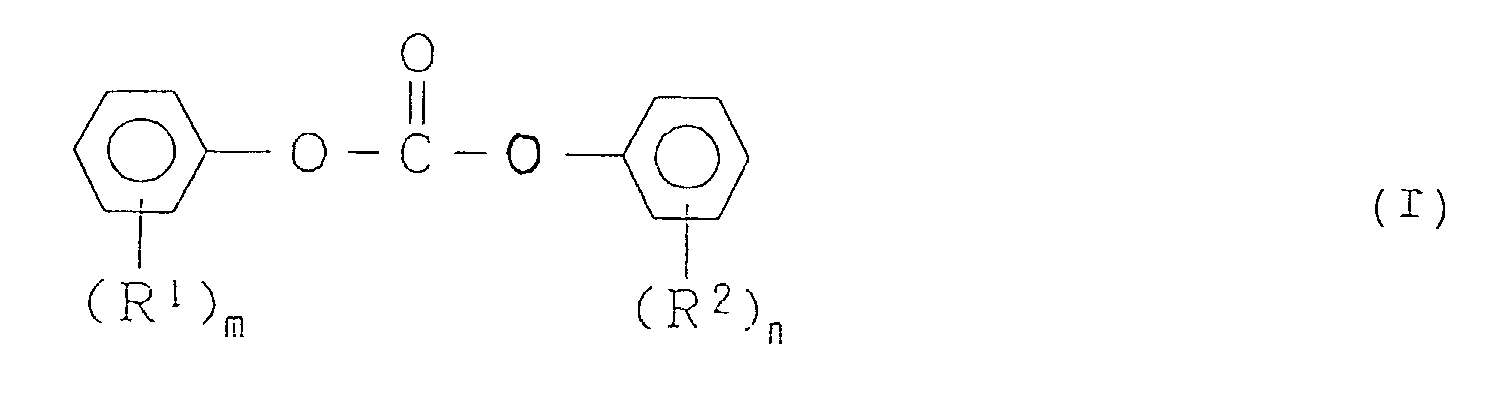
wherein R1 and R2 each represent an alkyl group having 1 to 10 carbon atoms or an alkoxy group; and m and n each represent 0 or an integer of 1 or 2,
in the presence of a combination of (a) an alkali metal compound and (b) a phosphonium hydroxide compound represented by formula (II):
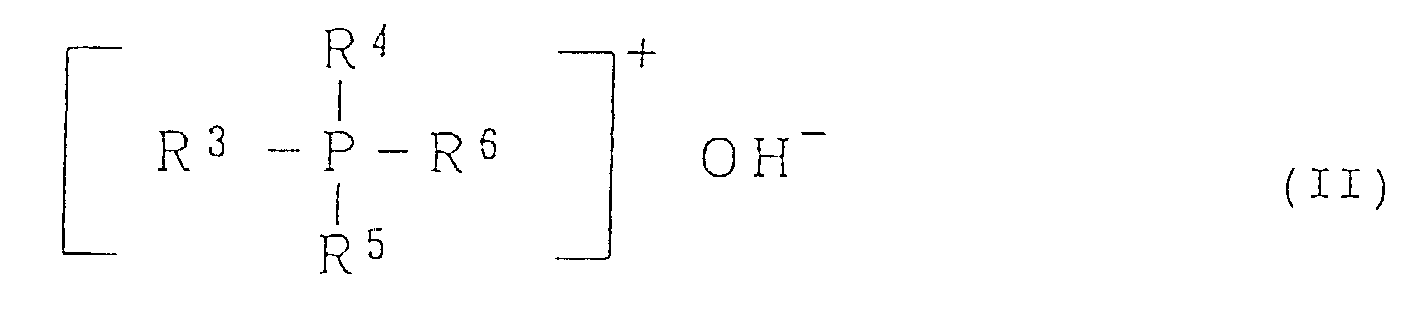
wherein R3, R4, R5, and R6 each represent an alkyl group having 1 to 12 carbon atoms, an aryl group, an aralkyl group or a cycloalkyl group, which groups are optionally substituted with a polar group, as a catalyst for interesterification.
wherein R1 and R2 each represent an alkyl group having 1 to 10 carbon atoms or an alkoxy group; and m and n each represent 0 or an integer of 1 or 2,
in the presence of a combination of (a) an alkali metal compound and (b) a phosphonium hydroxide compound represented by formula (II):
wherein R3, R4, R5, and R6 each represent an alkyl group having 1 to 12 carbon atoms, an aryl group, an aralkyl group or a cycloalkyl group, which groups are optionally substituted with a polar group, as a catalyst for interesterification.
2. A process as claimed in claim 1, wherein said alkali metal compound is a cesium compound.
3. A process as claimed in claim 2, wherein said cesium compound is selected from the
group consisting of cesium carbonate, cesium hydrogencarbonate, and cesium hydroxide.
4. A process as claimed in any one of claims 1 to 3 wherein said phosphonium hydroxide
compound is selected from the group consisting of tetraethylphosphonium hydroxide,
tetrabutylphosphonium hydroxide, tetraphenylphosphonium hydroxide, methyltriphenylphosphonium
hydroxide, allyltriphenylphosphonium hydroxide, butyltriphenylphosphonium hydroxide,
amyltriphenylphosphonium hydroxide, heptyltriphenylphosphonium hydroxide, hexyltriphenylphosphonium
hydroxide, benzyltriphenylphosphonium hydroxide, cinnamyltriphenylphosphonium hydroxide,
4-carboxybutyltriphenylphosphonium hydroxide, 2-dimethylaminoethyltriphenylphosphonium
hydroxide, 2-(1,3-dioxolan-2-yl)ethyltriphenylphosphonium hydroxide, 4-ethoxybenzyltriphenylphosphonium
hydroxide, ethoxycarbonylmethyltriphenylphosphonium hydroxide, formylmethyltriphenylphosphonium
hydroxide, methoxymethyltriphenylphosphonium hydroxide, and tetrakis(hydroxymethyl)phosphonium
hydroxide.
5. A process according to any preceding Claim, wherein said catalyst for interesterification
is a combination of cesium carbonate and a phosphonium hydroxide compound selected
from the group consisting of tetraethylphosphonium hydroxide, tetrabutylphosphonium
hydroxide, tetraphenylphosphonium hydroxide, and allyltriphenylphosphonium hydroxide.
6. A process according to any preceding Claim, wherein said phosphonium hydroxide compound
is present in an amount of from 10-6 to 10-3 mol per mole of the aromatic diol compound, and the molar ratio of alkali metal compound
(a) to phosphonium hydroxide compound (b) is from 10-6:1 to 1:1.
7. A process according to any preceding Claim, wherein the aromatic polycarbonate has
a 5% weight loss heating temperature (Td5%) of 480°C or higher determined by heating
a sample of the polycarbonate weighing about 10 mg in a nitrogen stream at a rate
of temperature increase of 20°C/min., and measuring the temperature at which the weight
loss of the polycarbonate reaches 5% based on the initial weight of the sample.
8. A process according to any preceding Claim, wherein said aromatic diol compound is
bisphenol A.
9. A process according to any preceding Claim, wherein said diaryl carbonate compound
is diphenyl carbonate.
10. A process according to any preceding Claim, wherein said polycarbonate has a number
average molecular weight of from 2,500 to 25,000.
1. Verfahren zur Herstellung eines aromatischen Polycarbonats mit einem massegemittelten
Molekulargewicht von 7.000 bis 60.000, umfassend die Schmelzpolykondensation einer
aromatischen Diolverbindung und einer Diarylcarbonatverbindung, dargestellt durch
die Formel (I):

worin R1 und R2 jedes eine Alkylgruppe mit 1 bis 10 Kohlenstoffatomen oder eine Alkoxygruppe, und m und n jedes 0 oder eine ganze Zahl von 1 oder 2 bedeuten,
in Gegenwart einer Kombination von (a) einer Alkalimetallverbindung und (b) einer Phosphoniumhydroxidverbindung, dargestellt durch die Formel (II):
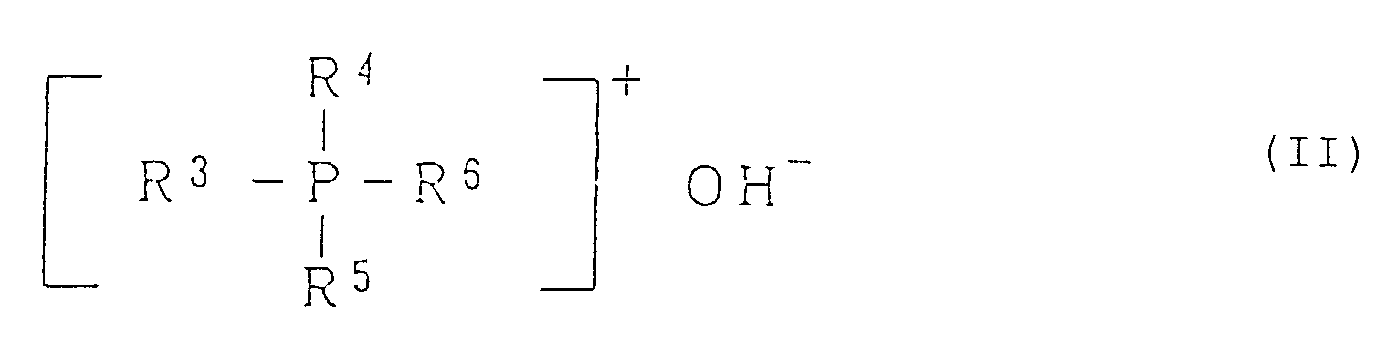
worin R3, R4, R5 und R6 jedes eine Alkylgruppe mit 1 bis 12 Kohlenstoffatomen, eine Arylgruppe, eine Aralkylgruppe oder eine Cycloalkylgruppe bedeuten, wobei diese Gruppen gegebenenfalls durch eine polare Gruppe substituiert sind, als Katalysator für die intermolekulare Esterbildung.
worin R1 und R2 jedes eine Alkylgruppe mit 1 bis 10 Kohlenstoffatomen oder eine Alkoxygruppe, und m und n jedes 0 oder eine ganze Zahl von 1 oder 2 bedeuten,
in Gegenwart einer Kombination von (a) einer Alkalimetallverbindung und (b) einer Phosphoniumhydroxidverbindung, dargestellt durch die Formel (II):
worin R3, R4, R5 und R6 jedes eine Alkylgruppe mit 1 bis 12 Kohlenstoffatomen, eine Arylgruppe, eine Aralkylgruppe oder eine Cycloalkylgruppe bedeuten, wobei diese Gruppen gegebenenfalls durch eine polare Gruppe substituiert sind, als Katalysator für die intermolekulare Esterbildung.
2. Verfahren, wie es im Anspruch 1 beansprucht wird, worin die genannte Alkalimetallverbindug
eine Cäsiumverbindung ist.
3. Verfahren, wie es im Anspruch 2 beansprucht wird, worin die genannte Cäsiumverbindung
aus der Gruppe ausgewählt ist, die aus Cäsiumcarbonat, Cäsiumhydrogencarbonat und
Cäsiumhydroxid besteht.
4. Verfahren, wie es in jedem der Ansprüche 1 bis 3 beansprucht wird, worin die genannte
Phosphoniumhydroxidverbindung aus der Gruppe ausgewählt ist, die aus Tetraethylphosphoniumhydroxid,
Tetrabutyl-phosphoniumhydroxid, Tetraphenyl-phosphoniumhydroxid, Methyltriphenylphosphoniumhydroxid,
Allyltriphenyl-phosphoniumhydroxid, Butyltriphenyl-phosphoniumhydroxid, Amyltriphenylphosphoniumhydroxid,
Heptyltriphenyl-phosphoniumhydroxid, Hexyltriphenyl-phosphoniumhydroxid, Benzyltriphenylphosphoniumhydroxid,
Cinnamylyltriphenyl-phosphoniumhydroxid, 4-Carboxybutyltriphenyl-phosphoniumhydroxid,
2-Dimethylaminoethyltriphenyl-phosphoniumhydroxid, 2-(1,3-Dioxolan-2-yl)ethyl-triphenyl-phosphoniumhydroxid,
4-Ethoxybenzyltriphenylphosphoniumhydroxid, Ethoxycarbonylmethyltriphenyl-phosphoniumhydroxid,
Formylmethyltriphenyl-phosphoniumhydroxid, Methoxymethyltriphenyl-phosphoniumhydroxid
und Tetrakis(hydroxymethyl)-phosphoniumhydroxid besteht.
5. Verfahren gemäß jedem der vorhergehenden Ansprüche, worin der genannte Katalysator
für die intermolekulare Esterbildung eine Kombination ist von Cäsiumcarbonat und einer
Phosphoniumhydroxidverbindung, ausgewählt aus der Gruppe, die aus Tetraethyl-phosphoniumhydroxid,
Tetrabutyl-phosphoniumhydroxid, Tetraphenylphosphoniumhydroxid und Allyltriphenyl-phosphoniumhydroxid
besteht.
6. Verfahren gemäß jedem der vorhergehenden Ansprüche, worin die genannte Phosphoniumhydroxidverbindung
in einer Menge von 10-6 bis 10-3 Mol pro Mol der aromatischen Diolverbindung vorhanden ist und das molare Verhältnis
der Alkalimetallverbindung (a) zu der Phosphoniumhydroxidverbindung (b) von 10-6:1 bis 1:1 beträgt.
7. Verfahren gemäß jedem der vorhergehenden Ansprüche, worin das aromatische Polycarbonat
eine Temperatur, die beim Erhitzen ein Gewichtsverlust von 5% (Td5%) verursacht, von
480°C oder höher aufweist, bestimmt durch Erhitzen einer Probe des Polycarbonats mit
einem Gewicht von etwa 10 mg in einem Stickstoffstrom mit einer Temperatursteigerungsrate
von 20°C/Min und Messung der Temperatur, bei welcher der Gewichtsverlust des Polycarbonats
5% erreicht, bezogen auf das Ausgangsgewicht der Probe.
8. Verfahren gemäß jedem der vorhergehenden Ansprüche, worin die genannte aromatische
Diolverbindung Bisphenol A ist.
9. Verfahren gemäß jedem der vorhergehenden Ansprüche, worin die genannte Diarylcarbonatverbindung
Diphenylcarbonat ist.
10. Verfahren gemäß jedem der vorhergehenden Ansprüche, worin das genannte Polycarbonat
ein Zahlenmittel-Molekulargewicht von 2.500 bis 25.000 aufweist.
1. Procédé de préparation d'un polycarbonate aromatique ayant une masse moléculaire moyenne
en poids de 7 000 à 60 000, qui comprend la polycondensation à l'état fondu d'un composé
diol aromatique et d'un composé carbonate de diaryle représenté par la formule (I)
:
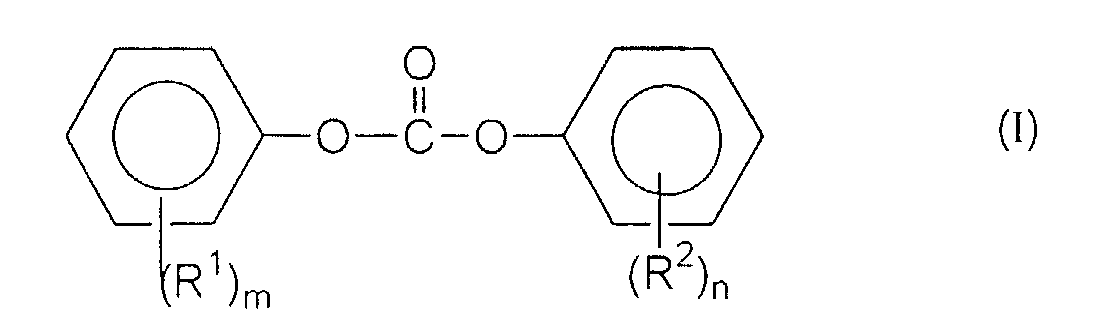
dans laquelle R1 et R2 représentent chacun un groupe alkyle ayant de 1 à 10 atomes de carbone ou un groupe alcoxy ; et m et n représentent chacun 0 ou un entier de 1 ou 2,
en présence d'une combinaison de (a) un composé de métal alcalin et (b) un composé hydroxyde de phosphonium représenté par la formule (II) :
dans laquelle R3, R4, R5 et R6 représentent chacun un groupe alkyle ayant de 1 à 12 atomes de carbone, un groupe aryle, un groupe aralkyle ou un groupe cycloalkyle, ces groupes étant éventuellement substitués par un groupe polaire, en tant que catalyseur pour l'interestérification.
dans laquelle R1 et R2 représentent chacun un groupe alkyle ayant de 1 à 10 atomes de carbone ou un groupe alcoxy ; et m et n représentent chacun 0 ou un entier de 1 ou 2,
en présence d'une combinaison de (a) un composé de métal alcalin et (b) un composé hydroxyde de phosphonium représenté par la formule (II) :
dans laquelle R3, R4, R5 et R6 représentent chacun un groupe alkyle ayant de 1 à 12 atomes de carbone, un groupe aryle, un groupe aralkyle ou un groupe cycloalkyle, ces groupes étant éventuellement substitués par un groupe polaire, en tant que catalyseur pour l'interestérification.
2. Procédé selon la revendication 1, caractérisé en ce que ledit composé de métal alcalin
est un composé de césium.
3. Procédé selon la revendication 2, caractérisé en ce que ledit composé de césium est
choisi dans le groupe constitué par le carbonate de césium, le carbonate de césium
hydrogéné, et l'hydroxyde de césium.
4. Procédé selon l'une quelconque des revendications 1 à 3, caractérisé en ce que le
composé d'hydroxyde de phosphonium est choisi dans le groupe constitué par l'hydroxyde
de tétraéthylphosphonium, l'hydroxyde de tétrabutylphosphonium, l'hydroxyde de tétraphénylphosphonium,
l'hydroxyde de méthyltriphénylphosphonium, l'hydroxyde d'allyltriphénylphosphonium,
l'hydroxyde de butyltriphénylphosphonium, l'hydroxyde d'amyltriphénylphosphonium,
l'hydroxyde d'heptyltriphénylphosphonium, l'hydroxyde d'hexyltriphénylphosphonium,
l'hydroxyde de benzyltriphénylphosphonium et l'hydroxyde de cinnamyltriphénylphosphonium,
l'hydroxyde de 4-carboxybutyltriphénylphosphonium, l'hydroxyde de 2-diméthylaminoéthyltriphénylphosphonium,
l'hydroxyde de 2-(1,3-dioxolan-2-yl)éthyltriphénylphosphonium, l'hydroxyde de 4-éthoxybenzyltriphénylphosphonium,
l'hydroxyde d'éthoxycarbonylméthyltriphénylphosphonium, l'hydroxyde de formylméthyltriphénylphosphonium,
l'hydroxyde de méthoxyméthyltriphénylphosphonium, et l'hydroxyde de tétrakis(hydroxyméthyl)phosphonium.
5. Procédé selon l'une quelconque des revendications précédentes, caractérisé en ce que
ledit catalyseur pour l'interestérification est une combinaison de carbonate de césium
et d'un composé hydroxyde de phosphonium choisi dans le groupe constitué par l'hydroxyle
de tétraéthylphosphonium, l'hydroxyde de trétrabutylphosphonium, l'hydroxyde de tétraphénylphosphonium,
et l'hydroxyde d'allyltriphénylphosphonium.
6. Procédé selon l'une quelconque des revendications précédentes, caractérisé en ce que
le composé hydroxyde de phosphonium est présent en une quantité de 10-6 à 10-3 par mole de composé diol aromatique, et le rapport molaire du composé de métal alcalin
(a) au composé hydroxyde de phosphonium (b) est de 10-6 : 1 à 1 : 1.
7. Procédé selon l'une quelconque des revendications précédentes, caractérisé en ce que
le polycarbonate aromatique a une perte en poids de 5 % pour une température de chauffage
(Td5%) de 480 °C ou plus déterminée en chauffant un échantillon de polycarbonate pesant
environ 10 mg dans un courant d'azote à un taux d'augmentation de température de 20°C
/ min, et en mesurant la température à laquelle la perte de poids du polycarbonate
atteint 5 % sur la base du poids initial de l'échantillon.
8. Procédé selon l'une quelconque des revendications précédentes, caractérisé en ce que
ledit composé diol aromatique est un bisphénol A.
9. Procédé selon l'une quelconque des revendications précédentes, caractérisé en ce que
ledit composé carbonate de diaryle est un carbonate de diphényle.
10. Procédé selon l'une quelconque des revendications précédentes, caractérisé en ce que
ledit polycarbonate a une masse moléculaire moyenne en nombre de 2 500 à 25 000.