|
(11) | EP 0 675 402 B1 |

| (12) | EUROPEAN PATENT SPECIFICATION |
|
|
| (54) |
Protective top layer and photographic materials containing this top layer Schutzschicht und diese enthaltende photographische Materialien Surcouche protectrice et matériaux photographiques comprenant cette surcouche |
|
|
|||||||||||||||||||||||||||||||
| Note: Within nine months from the publication of the mention of the grant of the European patent, any person may give notice to the European Patent Office of opposition to the European patent granted. Notice of opposition shall be filed in a written reasoned statement. It shall not be deemed to have been filed until the opposition fee has been paid. (Art. 99(1) European Patent Convention). |
[0001] The present invention concerns a photographic material comprising, in addition to the conventional light-sensitive silver halide layers, a protective top layer. More particularly, the invention concerns a photographic material comprising a protective top layer which prevents marks from appearing during photographic processing.
[0002] The use of photographic materials comprising a protective top layer is known. Such top layers are useful, for example, for protecting the photographic materials from fingermarks, abrasion or scratches which appear either during the preparation of the photographic materials or during photographic processing. These protective top layers may also provide a special surface texture such as matt surfaces, or they may be used as an anti-reflective layer.
[0004] Such layers are obtained by applying to a photographic material a coating of solutions or dispersions with particular compositions. For example, US patent 2 536 764 describes a top layer containing transparent solid particles with sizes smaller than one micrometre.
[0005] The patent application WO 91/18325 describes a photographic material comprising a protective layer consisting of (a) a hydroxylated latex, (b) a hydrolysed metal alkoxide and (c) a polyfluoroalkylether surfactant. The combination of these three compounds enables the photographic materials to be protected against abrasion.
[0006] European patent application 245 090 concerns a photographic material comprising a top layer consisting of a fluorinated compound and/or an anionic surfactant and a hardener with a high molecular weight. Such a top layer has antistatic properties.
[0007] The use, in protective layers, of surfactants in combination with a large number of compounds of very different kinds such as polymers, matting agents, hardeners, etc is therefore known.
[0008] It is, however, very difficult in photography to obtain photographic materials comprising a protective layer which protects from processing marks due to mechanical action without impairing the sensitometric and/or physical properties of this photographic material.
[0009] For example, in addition to their protective effect, these top layers must be completely transparent and flexible. Their components must not dissolve in photographic baths during photographic processing. In addition, these protective layers must not delay the kinetics of development.
[0010] The present invention concerns a novel protective layer which enables the problems of marks during photographic processing to be totally eliminated, but without altering the sensitometric properties.
[0011] In particular, the invention concerns a photographic material comprising a support covered with at least one light sensitive silver halide emulsion layer and a protective layer covering the emulsion layer. According to the invention, the protective layer comprises a hydrophilic colloïdal binder containing, in combination, a surface-active fluorinated polyether and a vinyl polymer obtained from monomers as recited in Claim 1.
[0012] According to the invention, the vinyl polymer is a terpolymer consisting of monomers (A), (B) and (C) having the following formula :
(A) (R3)2C = CR3 - COOR1
(B) (R3)2C = CR3 - COOR2OCOR2COR1
(C) (R3)2C = CR3 - CONR3R2SO3⊖ X
in which R1 groups, which may be identical or different, are alkyl radicals with a straight or branched chain of 1 to 12 carbon atoms ; R2 groups, which may be identical or different, are alkylene groups with a straight or branched chain of 1 to 10 carbon atoms ; R3 groups, which may be identical or different, are hydrogen or alkyl groups with a straight or branched chain having from 1 to 5 carbon atoms, and X is the cation associated with the sulfo group selected from alkali metal ions, ammonium or alkyl ammonium groups.
[0013] R3 is preferably hydrogen or an alkyl group having from 1 to 4 carbon atoms. R2 and R1 preferably comprise from 1 to 4 carbon atoms.
[0014] For example, monomer (A) can be selected from CH2=CH-COOCH3, CH2=CCH3-COOCH3, CH3CH=CCH3-COOCH3, CH2=CH-COOC2H5, CH2=CH-COOC(CH3)3, CH2=CH-COOC3H7; monomer (B) can be selected from CH2=CH-COOCH2OCOCH2COCH3, CH2=CCH3-COOCH2OCOCH2COCH3, CH2=CH-COOCH2CH2OCOCH2COC2H5, CH2=CCH3-COOCH2CH2OCOCH2COC2H5, CH3CH=CH-COOCH2CH2OCOCH2COCH3, CH3CH=CH-COOCH2CH2OCOCH2COC2H5, CH2=CH-COOCH2CH2OCOCH2COCH3, CH2=CCH3-COOCH2CH2OCOCH2COCH3 ; monomer (C) can be selected from CH2=CH-CONHCH2SO3-,Na+, CH2=CH-CONHCH2CH2SO3-,Na+, CH2=CH-CONHC(CH3)2OH2SO3-, Na+, H3CCH=CH-CONHC(CH3)2CH2SO3-, Na+ CH2=CCH3-CONHC(CH3)2CH2SO3-,Na+, etc.
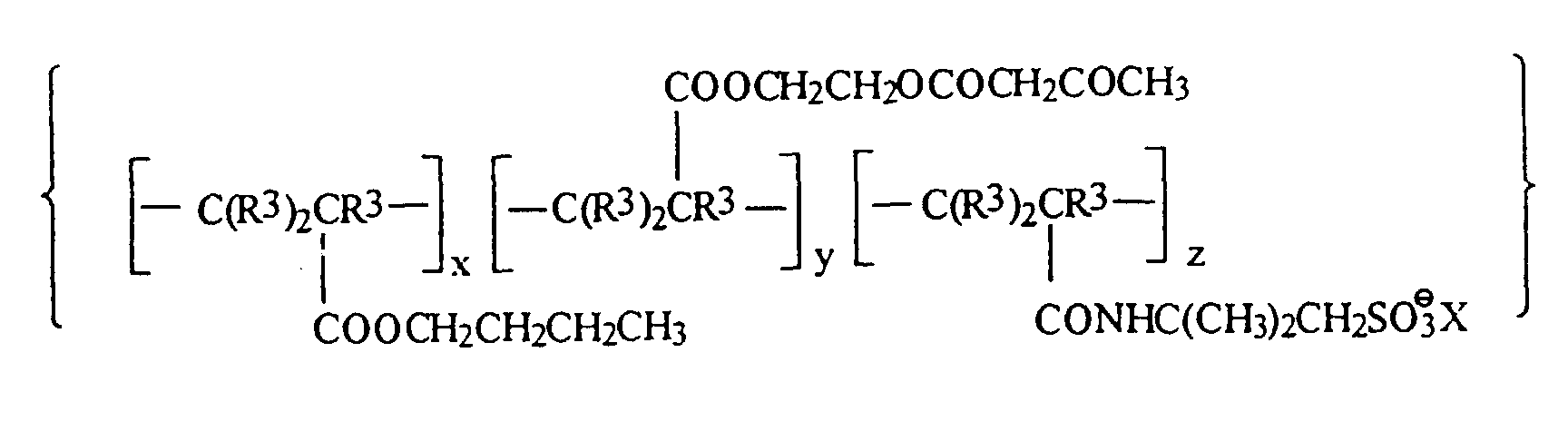
[0015] According to a preferred embodiment, the vinyl polymer is a vinyl terpolymer consisting of :
in which R3 and X are such as defined above, x represents between 10% and 95% and preferably between 85% and 95% by weight of terpolymer, y represents between 3% and 50% and preferably between 5% and 10% by weight of terpolymer and z represents between 2% and 80% and preferably between 4% and 10% by weight of terpolymer, provided that the sum of x, y and z is 100%.
[0016] The preferred terpolymer according to the invention is the terpolymer in which x represents 88%, y represents 7% and z represents 5%.
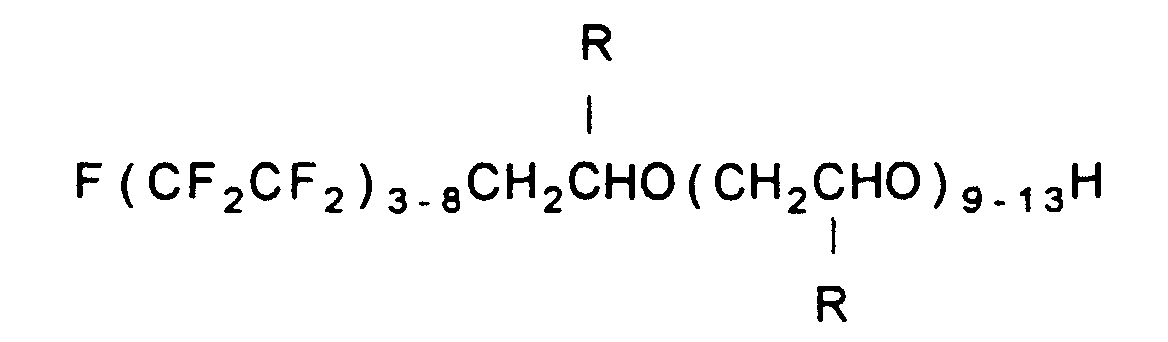
[0017] Within the scope of the claims, the surface-active fluorinated polyethers are surfactants which contain an aliphatic moiety having from 3 to 16 carbon atoms at least partially substituted by fluorine atoms, and optionally aliphatic moieties having from 3 to 16 carbon atoms not substituted by fluorine. The polyether moiety preferably comprises at least 3 ether functions, more preferably from 9 to 14 ether functions. The polyether moiety may contain alkylene chains such as polyethylene or polypropylene chains.
[0018] According to one embodiment, the surface-active fluorinated polyethers are compounds or a mixture of compounds of the formula :
in which R is a hydrogen atom or an alkyl group, for example methyl. A surfactant corresponding to this definition is Zonyl-FSN® manufactured by DuPont.
[0019] The quantity of surfactant which is used in the protective layer of the present invention is between 0.2 and 5.0 mg/dm2, preferably 0.8 to 2.0 mg/dm2.
[0020] The quantity of vinyl terpolymer which is used in the protective layer of the present invention is between 0.5 and 10 mg/dm2, preferably between 1 and 5 mg/dm2.
[0021] According to one embodiment, a fine grain silver halide emulsion which does not participate in the formation of the image is introduced into the protective layer. Such an emulsion has been described in detail in the patent application WO 93/19397. This emulsion is preferably a silver bromochloride fine-grain emulsion containing 50% molar silver bromide.
[0022] The protective layer can contain other compounds useful in photography. The protective layer of the invention may be used on any type of colour or black and white photographic material, such as negative, positive or reversible materials.
[0023] The colour photographic materials generally comprise a support carrying at least one blue-sensitive silver halide emulsion layer with which is associated a yellow dye forming coupler, at least one green-sensitive silver halide emulsion layer with which is associated a magenta dye forming coupler, and at least one red-sensitive silver halide emulsion layer with which is associated a cyan dye forming coupler.
[0024] These materials may contain other layers which are conventional in photographic materials, such as spacing layers, filter layers and anti-halo layers. The support may be any appropriate support used for photographic materials. Conventional supports include polymer films, paper (including paper coated with polymer), glass and metal. Research Disclosure, December 1978, No 17643, Section XVII, provides details concerning supports and auxiliary layers for photographic materials.
[0025] The preparation of light-sensitive silver halide emulsions is described, for example, in Research Disclosure, No 17643, Sections I and II. Silver halide emulsions may be chemically sensitised according to the methods described in Section III of the Research Disclosure referred to above. The chemical sensitisers generally used are sulphur and/or selenium and gold compounds. Sensitisation by reduction can also be used. The halide grains may have different compositions. It is possible for example to use silver bromide, silver iodobromide, silver chloride, silver chloroiodide or silver chlorobromoiodide grains. The silver halide grains may be spherical, cubic, octahedral, cubo-octahedral or tabular. The silver halide grains may be core/shell grains, for example as in US patent 3 505 068, or may have epitaxial deposits as in US patent 4 713 320. These silver halide emulsions may also contain doping agents, such as rhodium, indium, osmium, iridium, etc ions, generally in small quantities.
[0026] The silver halide emulsions and other layers for photographic materials of this invention may contain, as a carrier, hydrophilic colloids, used alone or in combination with other polymer substances (for example latexes). The appropriate hydrophilic substances comprise both natural substances such as cellulose derivatives - for example cellulose esters, proteins or protein derivatives, gelatin, gelatin treated with a base (bone gelatin or tanned gelatin) or gelatin treated with an acid (pigskin gelatin), gelatin derivatives, for example acetylated gelatin, phthalated gelatin etc, or polysaccharides such as dextran, gum arabic, zein, casein, pectin, collagen derivatives, collodion, agar-agar and albumin.
[0027] The emulsions may be polydisperse or monodisperse, or may consist of a mixture of emulsions having different grain sizes and/or compositions.
[0028] The spectral sensitisation, or chromatisation, methods are described in the same publication, Section IV. The sensitising dyes may be added at various stages in the preparation of the emulsion, particularly before, during or after chemical sensitisation.
[0029] The silver halide emulsions may be spectrally sensitised with dyes from various classes, including the class of polymethine dyes, which comprises cyanines, merocyanines, complex cyanines and merocyanines (ie tri-, tetra- and polynuclear cyanines and merocyanines), oxonols, hemioxonols, styryls, merostyryls and streptocyanines. The Research Disclosure No 17643 cited above, Section IV, describes representative spectral sensitising dyes.
[0030] The photographic materials of the invention may contain, inter alia, optical brighteners, anti-fogging compounds, surfactants, plasticisers, lubricants, hardeners, stabilisers, and absorption and/or diffusion agents as described in Sections V, VI, VIII, XI, XII and XVI of the Research Disclosure cited above.
[0031] The methods for adding these different compounds and the methods for coating and drying are described in Sections XIV and XV.
[0032] The photographic materials, after being exposed, undergo a photographic process comprising a silver development of the latent image (black and white development), and a chromogenic development in the presence of a chromogenic developer and a coupler, which in certain cases may be incorporated into the photographic material.
[0033] The photographic materials are then washed and subjected to a bleaching and then a fixing bath, before being processed in a stabilising bath. The bleaching and fixing baths may be replaced by a single bleach/fixing bath.
[0034] The silver development is carried out in the presence of a reducing compound which enables the exposed silver halide grains to be transformed into metal silver grains. These compounds are chosen from the dihydroxybenzenes such as hydroquinone, the 3-pyrazolidones, the aminophenols, etc. These compounds may be used alone or in a mixture. This first bath may, in addition, contain a stabiliser such as sulphites, a buffer such as carbonates, boric acid, borates or alkanolamines.
[0035] The chromogenic developer contained in the chromogenic development bath which enables the colour image to be obtained is generally an aromatic primary amine such as the p-phenylenediamines, and more particularly the N,N-dialkyl-p-phenylenediamines, where the alkyl radicals and the aromatic nucleus may be substituted or not. The p-phenylenediamines used as chromogenic developers are for example N,N-diethyl-p-phenylenediamine monochlorhydrate, 4-N,N-dimethyl-2-methylphenylenediamine monochlorhydrate, or 4-(N-ethyl-N-2-hydroxyethyl)-2-methylphenylenediamine sulphate. This chromogenic developing bath may contain other compounds such as stabilisers, development accelerators, which are generally pyridinium compounds, or other compounds.
[0036] The essential compound of the bleaching bath is an oxidising compound which transforms the metal silver into silver ions such as, for example, the alkaline metal salts of a ferric complex of an aminocarboxylic acid, or persulphate compounds.
[0037] The bleaching compounds commonly used are ferric complexes of nitrolotriacetic acid, ethylenediamine tetracetic acid, 1,3-propylenediamine tetracetic acid, triethylenetriamine pentacetic acid, orthodiaminocyclohexane tetracetic acid, ethyliminodiacetic acid, etc.
[0038] The fixing bath enables the silver halide to be completely transformed into a soluble silver complex which is then eliminated from the layers of the photographic material. The compounds used for fixing are, for example, thiosulphates such as ammonium thiosulphates or alkaline metal thiosulphates. Stabilisers or sequestering agents may be added to the fixing bath.
[0039] The processing generally comprises a stabilising bath containing a colour stabiliser such as formaldehyde, and a wetting agent.
[0040] According to one embodiment, the photographic materials of the invention are reversal materials as described in the patent application WO 93/19397.
[0041] After being exposed, the reversal materials undergo photographic processing comprising, after the silver development step, a reversal step which consists of making the unexposed residual silver halide grains developable by means of a fogging exposure or a chemical fogging and subjecting these fogged silver halide grains to a chromogenic development in the presence of a chromogenic developer and a coupler, the latter generally being incorporated in the material.
[0042] In the following examples, the photographic material is a colour reversal material which is exposed and then processed according to the standard method of Ektachrome® R-3 process.
EXAMPLE 1 (CONTROL)
[0043] The photographic material used in the following example is the Ektachrome® photographic material of the Radiance® type to which has been applied a protective layer comprising gelatin and a fine grain silver bromochloride emulsion (50% bromide) which does not participate in the formation of the image with an average equivalent spherical diameter of 0.11 µm, and in a proportion of 0.15 mg/dm2. The photographic material has been hardened by means of a quantity of hardener of around 0.9% by weight of total gelatin introduced into one of the light-sensitive photographic layers.
[0044] The material thus obtained is exposed to the light of a tungsten lamp (2850° K). It is then processed in a processing machine comprising conventional Ektachrome® R-3 process.
[0045] The standard Ektachrome® R-3 process comprises the following stages :
| Black and white development | 1 min 15 sec |
| Washing | 1 min 30 sec |
| Re-exposure | |
| Chromogenic development (38°C) | 2 min 15 sec |
| Washing | 0 min 45 sec |
| Bleaching/fixing | 2 min |
| Washing | 2 min 15 sec |
EXAMPLE 2 (Comp.)
[0046] A protective layer, as defined in Example 1 and containing in addition the vinyl terpolymer (PI), is applied to the Radiance® photographic material. A protective layer with a vinyl terpolymer content of 1 mg/dm2 is thus obtained.
[0047] The photographic material obtained is then processed according to the process described in Example 1.
in which x represents 88% by weight of terpolymer, y represents 7% by weight of terpolymer and z represents 5% by weight of terpolymer.
EXAMPLE 3 (Comp.)
[0048] An aqueous coating composition of Example 2 is applied to the photographic material of Example 1, modifying the vinyl terpolymer (PI) quantity in order to obtain a protective layer with a terpolymer content of 2 mg/dm2.
[0049] The photographic material obtained is then processed according to the process described in Example 1.
EXAMPLE 4
[0050] A protective layer as defined in Example 1 and containing in addition to the gelatin and fine grain emulsion which does not participate in the formation of the image, the Zonyl-FSN® and the terpolymer (PI), is applied to the Radiance® photographic material.
[0051] A protective layer is thus obtained with a Zonyl-FSN® surfactant content of 1 mg/dm2 and a copolymer content of 1 mg/dm2.
[0052] The photographic material obtained is then processed according to the process described in Example 1.
EXAMPLE 5
[0053] In this example, the protective layer of Example 4 is reproduced and the hardener content is increased from 0.9 to 1.3% by weight of total gelatin, this hardener being introduced into one of the light-sensitive photographic layers.
[0054] The photographic material obtained is then processed according to the process described in Example 1.
RESULTS
[0055] The results of Examples 1 to 5 are assembled in the table below. The number of "M" represents the mark level which appears during photographic processing and the number of "S" represents the magnitude of the impurities which appear on the surface of the processing baths after developing each photographic material described above.
[0056] In the above table, it can be seen that the combination of the invention, in the protective layer, of a fluoroalkylated polyether with a vinyl polymer enables the appearance of marks during photographic processing to be reduced without contaminating the processing baths.
[0057] The comparative Examples 2 and 3 show that the presence of the vinyl polymer used in the invention in the protective layer reduces the appearance of marks during processing. However, with such a terpolymer, the brillance of the paper is affected. In addition, the polymer dissolves in the processing baths, which causes the baths to become contaminated very rapidly.
[0058] Examples 4 and 5 show that the use of the vinyl polymer in combination with the fluorinated polyether in the protective layer enables the marks due to processing to be completely eliminated. Moreover, the development kinetics remains comparable to that obtained with the photographic material of Example 1 and no impairment of the sensitometric properties is observed. In particular the speed of the photographic material is not impaired.
1. Photographic material comprising a support, at least one light-sensitive silver halide
emulsion layer and a protective layer, the protective layer comprising a hydrophilic
colloidal binder containing at least one surface-active fluoroalkylated polyether
and at least one vinyl terpolymer obtained from the monomers (A), (B) and (C) of formula
:
(A) (R3)2C=CR3-COOR1
(B) (R3)2C=CR3-COOR2OCOR2COR1
(C) (R3)2C=CR3-CONR3R2SO3⊖ X
in which R1 groups, which may be identical or different, are alkyl radicals with a straight or branched chain of 1 to 12 carbon atoms ; R2 groups, which may be identical or different, are alkylene groups with a straight or branched chain of 1 to 10 carbon atoms ; R3 group is hydrogen or an alkyl group with a straight or branched chain having from 1 to 5 carbon atoms, and X is the cation associated with the sulfo group selected from alkali metal ions, ammonium or alkyl ammonium groups.
(A) (R3)2C=CR3-COOR1
(B) (R3)2C=CR3-COOR2OCOR2COR1
(C) (R3)2C=CR3-CONR3R2SO3⊖ X
in which R1 groups, which may be identical or different, are alkyl radicals with a straight or branched chain of 1 to 12 carbon atoms ; R2 groups, which may be identical or different, are alkylene groups with a straight or branched chain of 1 to 10 carbon atoms ; R3 group is hydrogen or an alkyl group with a straight or branched chain having from 1 to 5 carbon atoms, and X is the cation associated with the sulfo group selected from alkali metal ions, ammonium or alkyl ammonium groups.
2. Photographic material according to Claim 1, in which the surface-active fluoroalkylated
polyether is defined by the formula:
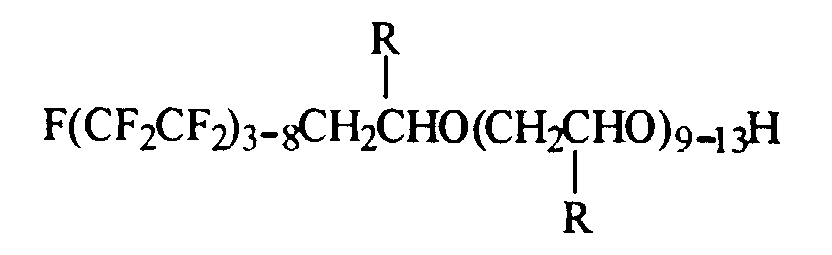
in which R is hydrogen or a methyl group.
in which R is hydrogen or a methyl group.
3. Photographic material according to Claim 2, in which the surface-active fluoroalkylated
polyether is Zonyl-FSN®.
4. Photographic material according to Claim 1, in which the vinyl polymer is a vinyl
terpolymer consisting of :
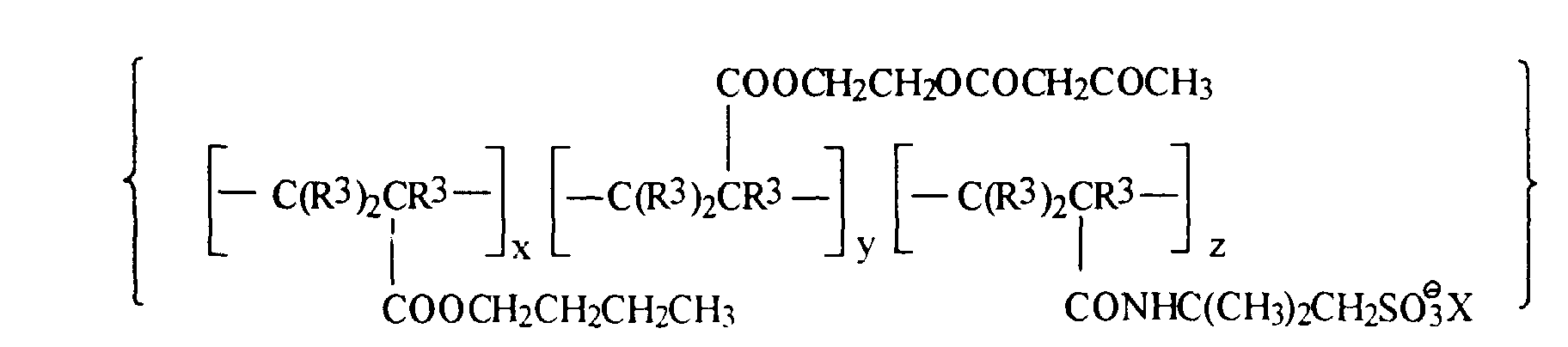
in which R3 groups, identical or different, are hydrogen atom, an alkyl radicals with a straight or branched chain of 1 to 5 carbon atoms, X is the cation associated with the sulfo group selected from alkali metal ions, ammonium or alkyl ammonium groups, and
x represents between 10% and 95% and preferably between 85% and 95% by weight of terpolymer, y represents between 3% and 50% and preferably between 5% and 10% by weight of terpolymer and z represents between 2% and 80% and preferably between 4% and 10% by weight of terpolymer, provided that the sum of x, y and z is 100% .
in which R3 groups, identical or different, are hydrogen atom, an alkyl radicals with a straight or branched chain of 1 to 5 carbon atoms, X is the cation associated with the sulfo group selected from alkali metal ions, ammonium or alkyl ammonium groups, and
x represents between 10% and 95% and preferably between 85% and 95% by weight of terpolymer, y represents between 3% and 50% and preferably between 5% and 10% by weight of terpolymer and z represents between 2% and 80% and preferably between 4% and 10% by weight of terpolymer, provided that the sum of x, y and z is 100% .
5. Photographic material according to Claim 4, in which the vinyl terpolymer is such
that x is 88%, y is 7% and z is 5%.
6. Photographic material according to Claim 5, in which the terpolymer content in the
protective layer is between 0.5 and 10 mg/dm2 and preferably between 1 and 5 mg/dm2.
7. Photographic material according to Claim 1, in which the surface-active fluoroalkylated
polyether content in the protective layer is between 0.2 and 5 mg/dm2 and preferably between 1 and 2 mg/dm2.
8. Photographic material according to any one of the preceding claims, in which the protective
layer further comprises a fine grain silver bromochloride emulsion layer which does
not participate in the formation of the image, the silver bromochloride grains having
a bromide content of about 50 mole % and an average size below 0.5 µm.
1. Fotografisches Material mit einem Träger, mindestens einer Licht-empfindlichen Silberhalogenid-Emulsionsschicht
und einer Schutzschicht, wobei die Schmutzschicht ein hydrophiles, kolloidales Bindemittel
aufweist mit mindestens einem oberflächenaktiven, fluoroalkylierten Polyether und
mindestens einem Vinylterpolymer, erhalten aus den Monomeren (A), (B) und (C) der
Formeln:
(A) (R3)2C = CR3 - COOR1
(B) (R3)2C = CR3 - COOR2OCOR2COR1
(C) (R3)2C = CR3 - CONR3R2SO3⊖ X
worin die Gruppen R1, die gleich oder verschieden sein können, Alkyl-Reste mit einer geraden oder verzweigten Kette mit 1 bis 12 Kohlenstoffatomen sind; die Gruppen R2, die gleich oder verschieden sein können, Alkylengruppen mit einer geraden oder verzweigten Kette mit 1 bis 10 Kohlenstoffatomen sind; die Gruppe R3 ein Wasserstoffatom ist oder eine Alkylgruppe mit einer geraden oder verzweigten Kette mit 1 bis 5 Kohlenstoffatomen, und X das Kation ist, das der Sulfogruppe zugeordnet ist, ausgewählt aus Alkalimetallionen, Ammonium- oder Alkylammonium-Gruppen.
(A) (R3)2C = CR3 - COOR1
(B) (R3)2C = CR3 - COOR2OCOR2COR1
(C) (R3)2C = CR3 - CONR3R2SO3⊖ X
worin die Gruppen R1, die gleich oder verschieden sein können, Alkyl-Reste mit einer geraden oder verzweigten Kette mit 1 bis 12 Kohlenstoffatomen sind; die Gruppen R2, die gleich oder verschieden sein können, Alkylengruppen mit einer geraden oder verzweigten Kette mit 1 bis 10 Kohlenstoffatomen sind; die Gruppe R3 ein Wasserstoffatom ist oder eine Alkylgruppe mit einer geraden oder verzweigten Kette mit 1 bis 5 Kohlenstoffatomen, und X das Kation ist, das der Sulfogruppe zugeordnet ist, ausgewählt aus Alkalimetallionen, Ammonium- oder Alkylammonium-Gruppen.
2. Fotografisches Material nach Anspruch 1, in dem der oberflächenaktive, fluoroalkylierte
Polyether durch die Formel definiert ist:
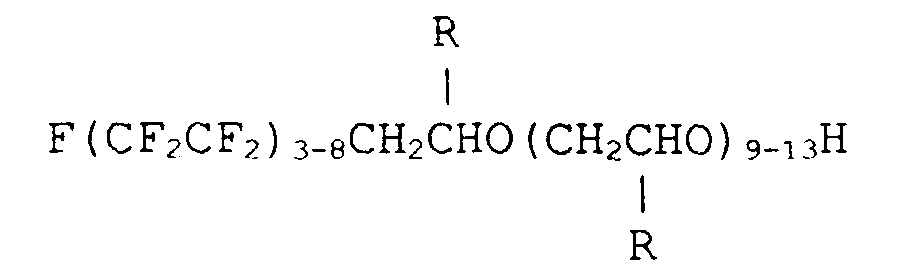
worin R für ein Wasserstoffatom oder eine Methylgruppe steht.
worin R für ein Wasserstoffatom oder eine Methylgruppe steht.
3. Fotografisches Material nach Anspruch 2, in dem der oberflächenaktive, fluoroalkylierte
Polyether Zonyl-FSN® ist.
4. Fotografisches Material nach Anspruch 1, in dem das Vinylpolymer ein Vinylterpolymer
ist, bestehend aus:
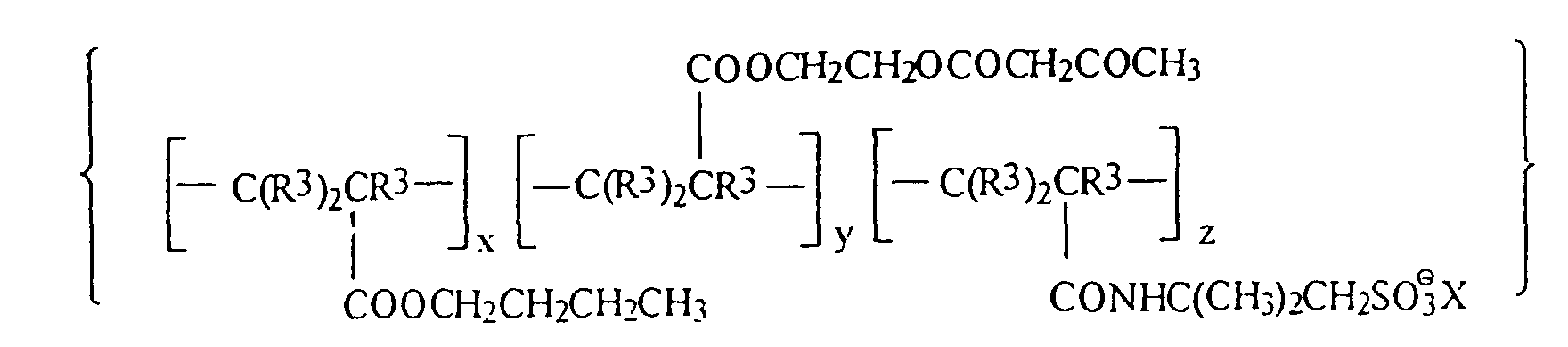
worin die Gruppen R3, gleich oder verschieden, Wasserstoffatome sind, Alkyl-Reste mit einer geraden oder verzweigten Kette mit 1 bis 5 Kohlenstoffatomen, und worin X das Kation ist, das der Sulfogruppe zugeordnet ist, ausgewählt aus Alkalimetallionen, Ammonium- oder Alkylammonium-Gruppen, und worin
x darstellt zwischen 10 und 95 Gew.-% und vorzugsweise zwischen 85 und 95 Gew.-% des Terpolymeren, y darstellt zwischen 3 und 50 Gew.-% und vorzugsweise zwischen 5 und 10 Gew.-% des Terpolymeren, und z darstellt zwischen 2 und 80 Gew.-% und vorzugsweise zwischen 4 und 10 Gew.-% des Terpolymeren, wobei gilt, daß die Summe von x, y und z gleich 100 % ist.
worin die Gruppen R3, gleich oder verschieden, Wasserstoffatome sind, Alkyl-Reste mit einer geraden oder verzweigten Kette mit 1 bis 5 Kohlenstoffatomen, und worin X das Kation ist, das der Sulfogruppe zugeordnet ist, ausgewählt aus Alkalimetallionen, Ammonium- oder Alkylammonium-Gruppen, und worin
x darstellt zwischen 10 und 95 Gew.-% und vorzugsweise zwischen 85 und 95 Gew.-% des Terpolymeren, y darstellt zwischen 3 und 50 Gew.-% und vorzugsweise zwischen 5 und 10 Gew.-% des Terpolymeren, und z darstellt zwischen 2 und 80 Gew.-% und vorzugsweise zwischen 4 und 10 Gew.-% des Terpolymeren, wobei gilt, daß die Summe von x, y und z gleich 100 % ist.
5. Fotografisches Material nach Anspruch 4, in dem das Vinylterpolymer ein solches ist,
das x 88 % ausmacht, y 7 % ausmacht und z 5 % ausmacht.
6. Fotografisches Material nach Anspruch 5, in dem der Terpolymer-Gehalt in der Schutzschicht
zwischen 0,5 und 10 mg/dm2, und vorzugsweise zwischen 1 und 5 mg/dm2, liegt.
7. Fotografisches Material nach Anspruch 1, in dem der Gehalt an oberflächenaktivem,
fluoroalkyliertem Polyether in der Schutzschicht zwischen 0,2 und 5 mg/dm2, und vorzugsweise zwischen 1 und 2 mg/dm2, liegt.
8. Fotografisches Material nach einem der vorstehenden Ansprüche, in dem die Schutzschicht
ferner eine feinkörnige Silberbromochlorid-Emulsion enthält, die nicht an der Formation
des Bildes beteiligt ist, wobei die Silberbromochlorid-Körner einen Bromidgehalt von
etwa 50 Mol-% und eine mittlere Größe unterhalb 0,5 µm aufweisen.
1. Produit photographique en couleurs comprenant un support, au moins une couche d'émulsion
aux halogénures d'argent sensible à la lumière et une couche protectrice, la couche
protectrice comprenant un liant colloïdal hydrophile contenant au moins un polyéther
fluoroalkylé tensioactif et au moins un terpolymère obtenu à partir des monomères
(A), (B) et (C) de formules :
(A) (R3)2C=CR3-COOR1
(B) (R3)2C=CR3-COOR2OCOR2COR1
(C) (R3)2C=CR3-CONR3R2SO3⊖ X
dans lesquels les groupes R1 identiques ou différents sont des radicaux alkyle à chaine droite ou ramifiée de 1 à 12 atomes de carbone, les groupes R2, identiques ou différents sont des groupes alkylène à chaine droite ou ramifiée de 1 à 10 atomes de carbone, R3 représente l'hygrogène ou un groupe alkyle à chaîne droite ou ramifier de 1 à 5 atomes de carbone et x est le cation associé au groupe sulfo choisi parmi les ions de métal alcalin, l'ammonium ou les groupes alkylammonium.
(A) (R3)2C=CR3-COOR1
(B) (R3)2C=CR3-COOR2OCOR2COR1
(C) (R3)2C=CR3-CONR3R2SO3⊖ X
dans lesquels les groupes R1 identiques ou différents sont des radicaux alkyle à chaine droite ou ramifiée de 1 à 12 atomes de carbone, les groupes R2, identiques ou différents sont des groupes alkylène à chaine droite ou ramifiée de 1 à 10 atomes de carbone, R3 représente l'hygrogène ou un groupe alkyle à chaîne droite ou ramifier de 1 à 5 atomes de carbone et x est le cation associé au groupe sulfo choisi parmi les ions de métal alcalin, l'ammonium ou les groupes alkylammonium.
2. Produit photographique selon la revendication 1 dans lequel le polyéther fluoroalkylé
tensioactif est défini par la formule :
dans laquelle R est un hydrogène ou un groupe méthyle.
dans laquelle R est un hydrogène ou un groupe méthyle.
3. Produit photographique selon la revendication 2 dans lequel le polyéther fluoroalkylé
tensioactif est le Zonyl-FSN®.
4. Produit photographique selon la revendication 1 dans lequel le polymère est un terpolymère
de formule :
les groupes R3, identiques ou différents, sont l'hydrogène, des radicaux alkyle à chaîne droite ou ramifiée de 1 à 5 atomes de cartone, x est le cation associé au groupe sulfo, choisi parmi les ions de métal alcalin, l'ammonium, les groupes alkylammonium, et,
x représente entre 10 et 95, de préférence entre 85 et 95 % en poids de terpolymère, y représente entre 3 et 50, de préférence entre 5 et 10 % en poids de terpolymère et z représente entre 2 et 80, de préférence entre 4 et 10 % en poids de terpolymère, la somme de x, y et z étant égale à 100 % en poids de terpolymère.
les groupes R3, identiques ou différents, sont l'hydrogène, des radicaux alkyle à chaîne droite ou ramifiée de 1 à 5 atomes de cartone, x est le cation associé au groupe sulfo, choisi parmi les ions de métal alcalin, l'ammonium, les groupes alkylammonium, et,
x représente entre 10 et 95, de préférence entre 85 et 95 % en poids de terpolymère, y représente entre 3 et 50, de préférence entre 5 et 10 % en poids de terpolymère et z représente entre 2 et 80, de préférence entre 4 et 10 % en poids de terpolymère, la somme de x, y et z étant égale à 100 % en poids de terpolymère.
5. Produit photographique selon la revendication 4 dans lequel le terpolymère est tel
que x est égal à 88 %, y est égal à 7 % et z est égal à 5 %.
6. Produit photographique selon la revendication 5 dans lequel la teneur en terpolymère
dans la couche protectrice est comprise entre 0,5 et 10 mg/dm2, de préférence entre 1 et 5 mg/dm2.
7. Produit photographique selon la revendication 1 dans lequel la teneur en polyéther
fluoroalkylé tensioactif dans la couche protectrice est comprise entre 0,2 et 5 mg/dm2, de préférence entre 1 et 2 mg/dm2.
8. Produit photographique selon l'une quelconque des revendications précédentes dans
lequel la couche protectrice comprend de plus une émulsion aux halogénures d'argent
constituée de grains de bromochlorure d'argent qui ne participent pas à la formation
de l'image ayant une teneur en bromure de l'ordre de 50% en moles dont la taille moyenne
est inférieure à 0,5 µm.