|
(11) | EP 0 676 428 A1 |

| (12) | EUROPEAN PATENT APPLICATION |
|
|
|
|
|||||||||||||||||||||||||||
| (54) | Composition for low-specific gravity urethane-base plastic lens |
| (57) The present invention is concerned with a composition for a low-specific gravity
urethane-base plastic lens which comprises an iso(thio)cyanate compound and an active
hydrogen compound selected so as to meet the formula (1) wherein
a process for preparing a low-specific gravity urethane-base plastic lens which comprises the steps of mixing and then heating the composition to harden the same, and a plastic lens obtained by the preparation process, which lens has a low specific gravity of 1.22 or less. |
BACKGROUND OF THE INVENTION
[0001] The present invention relates to a low-specific gravity urethane-base plastic lens preferably having good optical properties and excellent impact resistance which are required for various kinds of optical lenses such as lenses for spectacles, and it also relates to a process for preparing the lens and to a composition therefor.
[0002] In recent years, plastics have rapidly spread as materials for optical elements such as lenses for spectacles and cameras, because they are light-weight and more difficult to break as compared with inorganic lenses and they can also be dyed. Nowadays, as a resin which has been widely used for these purposes, there is a product obtained by the radical polymerization of diethylene glycol bis(allyl carbonate) (hereinafter referred to as "D.A.C."). This resin has some features, for example, it is excellent in impact resistance, dyeing properties and workability of cutting, polishing and the like, and it is also light-weight.
[0003] However, the refractive index of this resin is as low as nd = 1.50, as compared with a glass lens (nd = 1.52), and in order to obtain equivalent optical properties to the glass lens, it is necessary to increase the central thickness, the edge thickness and a curvature of the lens. Therefore, it is not avoidable that the lens of this resin becomes thick on the whole. Accordingly, a plastic lens has been desired which has excellent characteristics corresponding to those of D.A.C. and a refractive index higher than the inorganic lens.
[0004] As a lens which can meet these requirements, a polyurethane plastic lens is known. As this polyurethane lens, the present inventors have already suggested a polyurethane lens made of a polymer of a xylylene diisocyanate compound and a polythiol compound, for example, in Japanese Patent Application Laid-open No. 63-46213 (46213/1988), and this kind of polyurethane lens is now spreading as optical lenses such as lenses for spectacles.
[0005] However, the reduction of the specific gravity of the lenses has been presently required in addition to the above-mentioned physical properties, and in reply to this further requirement, the present inventors have already suggested a urethane-base plastic lens made from isophorone diisocyanate (hereinafter abbreviated to "IPDi") and 1,2-bis(2-mercaptoethylthio)-3-mercaptopropane (hereinafter abbreviated to "GST") in Japanese Patent Application Laid-open No. 2-270859 (270859/1990).
[0006] The specific gravity of the plastic lens made from IPDi and GST is 1.23, which specific gravity is much lower than in the conventional urethane-base plastic lens. Nevertheless, this plastic lens does not sufficiently meet the requirement of the further reduction of the specific gravity.
[0007] Hence, the development of the urethane-base plastic lens having the further low specific gravity has strongly been desired.
[0008] Preferred embodiments of the present invention may provide one or more of the following objects:
a low-specific gravity urethane-base plastic lens having excellent optical properties by reducing the specific gravity of the plastic lens;
a composition for the urethane-base plastic lens which can be used to obtain this low-specific gravity urethane-base plastic lens;
a process for preparing the plastic lens by the use of this composition.
[0009] The present inventors have intensively investigated and as a result,
it has been found that when the following process is used, a urethane-base plastic lens having excellent optical properties and a low specific gravity of 1.22 or less can be surprisingly obtained. In consequence, the present invention has now been attained.
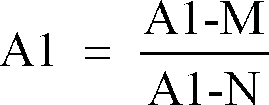
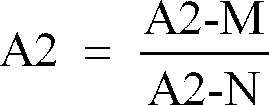
[0010] That is to say, a first aspect of the present invention is directed to a composition for a low-specific gravity urethane-base plastic lens which comprises an iso(thio)cyanate compound and an active hydrogen compound selected so as to meet the formula (1)
wherein
- A1-M:
- the molecular weight of the iso(thio)cyanate compound, and
- A1-N:
- the number of the functional group of the iso(thio)cyanate compound,
- A2-M:
- the molecular weight of the active hydrogen compound, and
- A2-N:
- the number of the functional group of the active hydrogen compound,
D1 = the specific gravity of the iso(thio)cyanate compound,
D2 = the specific gravity of the active hydrogen compound, and
[0011] A second aspect of the present invention is directed to a process for preparing a low-specific gravity urethane-base resin plastic lens which comprises the steps of mixing and then heating the composition to harden the same.
[0012] A third aspect of the present invention is directed to a plastic lens obtained by the preparation process.
[0013] The above-mentioned iso(thio)cyanate compound and active hydrogen compound may be used in the state of a mixture of separately two or more kinds thereof, and in this case, A1, D1, A2 and D2 are weighted averages of each mixture.
[0015] A composition for lenses of the present invention comprises one or more iso(thio)cyanate compounds selected from the group consisting of isocyanate compounds and isothiocyanate compounds which may have an isocyanate group, and one or more active hydrogen compounds preferably selected from hydroxy compounds and mercapto compounds which may have a hydroxy group.
[0016] Examples of the iso(thio)cyanate compounds which can be used in the present invention include monoiso(thio) cyanates and polyiso(thio)cyanates.
[0017] Typical examples of the monoiso(thio)cyanates include monoisocyanates such as phenyl isocyanate, butyl isocyanate and cyclohexyl isocyanate, and monoisothiocyanates such as phenyl isothiocyanate, butyl isothiocyanate and cyclohexyl isothiocyanate. In addition, there can also be used these compounds which are substituted with halogens such as chlorine and bromine, alkyl groups, alkoxy groups and a nitro group. They may be used singly or in a combination of two or more thereof.
[0018] Examples of the polyisiocyanate compounds include aliphatic polyisocyanates such as ethylene diisocyanate, trimethylene diisocyanate, tetramethylene diisocyanate, hexamethylene diisocyanate, octamethylene diisocyanate, nonamethylene diisocyanate, 2,2'-dimethylpentane diisocyanate, 2,2,4-trimethylhexane diisocyanate, decamethylene diisocyanate, butene diisocyanate, 1,3-butadiene-1,4-diisocyanate, 2,4,4-trimethylhexamethylene diisocyanate, 1,6,11-undecane triisocyanate, 1,3,6-hexamethylene triisocyanate, 1,8-diisocyanato-4-isocyanatomethyloctane, 2,5,7-trimethyl-1,8-diisocyanato-5-isocyanatomethyloctane, bis(isocyanatoethyl) carbonate, bis(isocyanatoethyl) ether, 1,4-butylene glycol dipropyl ether-ω,ω '-diisocyanate, lysine diisocyanatomethyl ester, lysine triisocyanate, 2-isocyanatoethyl-2,6-diisocyanatohexanoate, 2-isocyanatopropyl-2,6-diisocyanatohexanoate, xylylene diisocyanate, bis(isocyanatoethyl)benzene, bis(isocyanatopropyl)benzene, α, α, α', α'-tetramethylxylylene diisocyanate, bis(isocyanatobutyl)benzene, bis(isocyanatomethyl)naphthalene, bis(isocyanatomethyl) diphenyl ether, bis(isocyanatoethyl) phthalate, mesitylene triisocyanate and 2,6-di(isocyanatomethyl)furan; alicyclic polyisocyanates such as isophorone diisocyanate, bis(isocyanatomethyl)cyclohexane, dicyclohexylmethane diisocyanate, cyclohexane diisocyanate, methylcyclohexane diisocyanate, dicyclohexyldimethylmethane diisocyanate, 2,2'-dimethyldicyclohexylmethane diisocyanate, bis(4-isocyanato-n-butylidene)pentaerythritol, dimer acid diisocyanate, 2-isocyanatomethyl-3-(3-isocyanatopropyl)-5-isocyanatomethyl-bicyclo[2.2.1]-heptane, 2-isocyanatomethyl-3-(3-isocyanatopropyl)-6-isocyanatomethyl-bicyclo[2.2.1]-heptane, 2-isocyanatomethyl-2-(3-isocyanatopropyl)-5-isocyanatomethyl-bicyclo[2.2.1]-heptane, 2-isocyanatomethyl-2-(3-isocyanatopropyl)-6-isocyanatomethyl-bicyclo[2.2.1]-heptane, 2-isocyanatomethyl-3-(3-isocyanatopropyl)-6-(2-isocyanatoethyl)-bicyclo[2.2.1]-heptane, 2-isocyanatomethyl-3-(3-isocyanatopropyl)-6-(2-isocyanatoethyl)-bicylco[2.1.1]-heptane, 2-isocyanatomethyl-2-(3-isocyanatopropyl)-5-(2-isocyanatoethyl)-bicyclo[2.2.1]-heptane and 2-isocyanatomethyl-2-(3-isocyanatopropyl)-6-(2-isocyanatoethyl)-bicyclo[2.2.1]-heptane; aromatic polyisocyanates such as phenylene diisocyanate, tolylene diisocyanate, ethylphenylene diisocyanate, isopropylenephenylene diisocyanate, dimethylphenylene diisocyanate, diethylphenylene diisocyanate, diisopropylphenylene diisocyanate, trimethylbenzene triisocyanate, benzene triisocyanate, naphthalene diisocyanate, methylnaphthalene diisocyanate, biphenyl diisocyanate, tolidine diisocyanate, 4,4'-diphenylmethane diisocyanate, 3,3'-dimethyldiphenylmethane-4,4'-diisocyanate, bibenzyl-4,4'-diisocyanate, bis(isocyanatophenyl)ethylene, 3,3'-dimethoxybiphenyl-4,4'-diisocyanate, triphenylmethane triisocyanate, polymeric MDI, naphthalene triisocyanate, diphenylmethane-2,4,4'-triisocyanate, 3-methyldiphenylmethane-4,6,4'-triisocyanate, 4-methyl-diphenylmethane-3,5,2',4',6'-pentaisocyanate, phenylisocyanatomethyl isocyanate, phenylisocyanatoethylethyl isocyanate, tetrahydronaphthylene diisocyanate, hexahydrobenzene diisocyanate, hexahydrodiphenylmethane-4,4'-diisocyanate, diphenyl ether diisocyanate, ethylene glycol diphenyl ether diisocyanate, 1,3-propylene glycol diphenyl ether diisocyanate, benzophenone diisocyanate, diethylene glycol diphenyl ether diisocyanate, dibenzofuran diisocyanate, carbazole diisocyanate, ethylcarbazole diisocyanate and dichlorocarbazole diisocyanate; sulfur-containing aliphatic isocyanates such as thiodiethyl diisocyanate, thiodipropyl diisocyanate, thiodihexyl diisocyanate, dimethylsulfone diisocyanate, dithiodimethyl diisocyanate, dithiodiethyl diisocyanate, dithiodipropyl diisocyanate and dicyclohexyl sulfide-4,4'-diisocyanate; aromatic sulfide isocyanates such as diphenyl sulfide-2,4'-diisocyanate, diphenyl sulfide-4,4'-diisocyanate, 3,3'-dimethoxy-4,4'-diisocyanatobenzyl thioether, bis(4-isocyanatomethylbenzene) sulfide and 4,4'-methoxybenzene thioethylene glycol-3,3'-diisocyanate; aromatic disulfide isocyanates such as diphenyl disulfide-4,4'-diisocyanate, 2,2'-dimethyldiphenyl disulfide-5,5'-diisocyanate, 3,3'-dimethyldiphenyl disulfide-5,5'-diisocyanate, 3,3'-dimethyldiphenyl disulfide-6,6'-diisocyanate, 4,4'-dimethyldiphenyl disulfide-5,5'-diisocyanate, 3,3'-dimethoxydiphenyl disulfide-4,4'-diisocyanate and 4,4'-dimethoxydiphenyl disulfide-3,3'-diisocyanate; aromatic sulfone isocyanates such as diphenylsulfone-4,4'-diisocyanate, diphenylsulfone-3,3'-diisocyanate, benzidinesulfone-4,4'-diisocyanate, diphenylmethanesulfone-4,4'-diisocyanate, 4-methyldiphenylmethanesulfone-2,4'-diisocyanate, 4,4'-dimethoxydiphenylsulfone-3,3'-diisocyanate, 3,3'-dimethoxy-4,4'-diisocyanate dibenzylsulfone, 4,4'-dimethyldiphenylsulfone-3,3'-diisocyanate, 4,4'-di-tert-butyldiphenylsulfone-3,3'-diisocyanate, 4,4'-dimethoxybenzeneethylenedisulfone-3,3'-diisocyanate and 4,4'-dichlorodiphenylsulfone-3,3'-diisocyanate; sulfonate isocyanates such as 4-methyl-3-isocyanatobenzenesulfonyl-4'-isocyantophenol ester and 4-methoxy-3-isocyanatobezenesulfonyl-4'-isocyanatophenol ester; aromatic sulfonamides such as 4-methyl-3-isocyanatobenzenesulfonylanilide-3'-methyl-4'-isocyanate, dibenzenesulfonyl-ethylenediamine-4,4'-diisocyanate, 4,4'-methoxybenzenesulfonyl-ethylenediamine-3,3'-diisocyanate and 4-methyl-3-isocyanatobenzenesulfonylanilide-4-methyl-3'-isocyanate; and sulfur-containing heterocyclic compounds such as thiophene-2,5-diisocyanate, thiophene-2,5-diisocyanatomethyl, 1,4-dithian-2,5-diisocyanate, 4,5-bis(isocyanatomethyl)-1,3-dithiolane, bis(isocyanatomethyl)tetrahydrothiophene and 2,5-bis(isocyanatomethyl)-1,4-dithian.
[0019] Furthermore, there can also be used the above-mentioned compounds which are substituted with halogens such as chlorine and bromine, alkyl groups, alkoxy groups and a nitro group, prepolymer type compounds thereof modified with polyvalent alcohols, the above-mentioned compounds which are modified with carbodiimide, urea and biuret, and dimerized and trimerized reaction products thereof.
[0020] The polyisothiocyanate compound which can be use in the present invention has two or more -NCS groups in one molecule and may have another sulfur atom in addition to the isothiocyanate groups.
[0021] Typical examples of the polyisothiocyanate compound include aliphatic isothiocyanates such as 1,2-diisothiocyanatoethane, 1,3-diisothiocyanatopropane, 1,4-diisothiocyanatobutane, 1,6-diisothiocyanatohexane and p-phenylenediisopropylidene diisothiocyanate; alicyclic isothiocyanates such as cyclohexane diisothiocyanate; aromatic isothiocyanates such as 1,2-diisothiocyanatobenzene, 1,3-diisothiocyanatobenzene, 1,4-diisothiocyanatobenzene, 2,4-diisothiocyanatotoluene, 2,5-diisothiocyanato-m-xylene, 4,4'-diisothiocyanato-1,1'-biphenyl, 1,1'-methylenebis(4-isothiocyanatobenzene), 1,1'-methylenebis(4-isothiocyanato-2-methylbenzene), 1,1'-methylenebis(4-isothiocyanato-3-methylbenzene), 1,1'-(1,2-ethanediyl)bis(4-isothiocyanatobenzene), 4,4'-diisothiocyanatobenzophenone, 4,4'-diisothiocyanato-3,3'-dimethylbenzophenone, benzanilide-3,4'-diisothiocyanate, diphenyl ether-4,4'-diisothiocyanate and diphenylamine-4,4'-diisothiocyanate; heterocyclic ring-containing isothiocyanates such as 2,4,6-triisothiocyanato-1,3,5-triazine; and carbonyl isothiocyanates such as hexanedioyl diisothiocyanate, nonanedioyl diisothiocyanate, carbonic diisothiocyanate, 1,3-benzenedicarbonyl diisothiocyanate, 1,4-benzenedicarbonyl diisothiocyanate and (2,2'-bipyridine)-4,4'-dicarbonyl diisothiocyanate.
[0022] Examples of the di- or more functional polyisothiocyanate having one or more sulfur atoms in addition to the isothiocyanate groups which can be used as a raw material in the present invention include sulfur-containing aliphatic isothiocyanates such as thiobis(3-isothiocyanato propane), thiobis(2-isothiocyanatoethane) and dithiobis(2-isothiocyanatoethane); sulfur-containing aromatic isothiocyanates such as 1-isothiocyanato-4-[(2-isothiocyanato)sulfonyl]benzene, thiobis(4-isothiocyanatobenzene), sulfonylbis(4-isothiocyanatobenzene), sulfinylbis(4-isothiocyanatobenzene), dithiobis(4-isothiocyanatobenzene), 4-isothiocyanato-1-[(4-isothiocyanatophenyl)sulfonyl]-2-methoxybenzene, 4-methyl-3-isothiocyanatobenzenesulfonyl-4'-isothiocyanatophenyl ester and 4-methyl-3-isothiocyanatobenzenesulfonylanilide-3'-methyl-4'-isothiocyanate; and sulfur-containing heterocyclic compounds such as thiophenone-2,5-diisothiocyanate and 1,4-dithian-2,5-diisothiocyanate.
[0023] Furthermore, there can also be used the above-mentioned polyisothiocyanate compounds which are substituted with halogens such as chlorine and bromine, alkyl groups, alkoxy groups and a nitro group, prepolymer type compounds thereof modified with polyvalent alcohols, the above-mentioned compounds which are modified with carbodiimide, urea and biuret, and dimerized and trimerized reaction products thereof.
[0024] Examples of the isothiocyanate compound having the isocyanate group which can be used as the raw material in the present invention include aliphatic and alicyclic compounds such as 1-isocyanato-3-isothiocyanatopropane, 1-isocyanato-5-isothiocyanatopentane, 1-isocyanato-6-isothiocyanatohexane, isocyanatocarbonyl isothiocyanate and 1-isocyanato-4-isothiocyanatocyclohexane; aromatic compounds such as 1-isocyanato-4-isothiocyanatobenzene and 4-methyl-3-isocyanato-1-isothiocyanatobenzene; heterocyclic compounds such as 2-isocyanato-4,5-diisothiocyanato-1,3,5-triazine; and compounds containing one or more sulfur atoms in addition to an isothiocyanato group such as 4-isocyanato-4'-isothiocyanatodiphenyl sulfide and 2-isocyanto-2'-isothiocyanatodiethyl disulfide.
[0025] Furthermore, there can also be used the above-mentioned compounds which are substituted with halogens such as chlorine and bromine, alkyl groups, alkoxy groups and a nitro group, prepolymer type compounds thereof modified with polyvalent alcohols, the above-mentioned compounds which are modified with carbodiimide, urea and biuret, and dimerized and trimerized reaction products thereof.
[0026] Of these iso(thio)cyanate compounds, particularly preferable are isophorone diisocyanate, dicyclohexylmethane diisocyanate, trimethylhexamethylene diisocyanate, hexamethylene diisocyanate, α , α , α ',α '-tetramethylxylylene diisocyanate and these isocyanates which are modified with biuret and trimerized. The employment of these preferable compounds often leads to preferable results.
[0027] These iso(thio)cyanate compounds may be used singly or in a combination of two or more thereof.
[0028] Examples of the active hydrogen compounds which can be used in the present invention are as follows.
[0029] Examples of hydroxy compounds include alcohols such as methanol, ethanol, isopropyl alcohol, butanol, benzyl alcohol, phenol, phenylphenol, ethoxyethanol, methoxypropanol, ethoxypropanol; aliphatic polyols such as ethylene glycol, diethylene glycol, triethylene glycol, tetraethylene glycol, propylene glycol, dipropylene glycol, butylene glycol, neopentyl glycol, glycerin, trimethylolethane, trimethylolpropane, butanetriol, 1,2-methylglycoside, pentaerythritol, dipentaerythritol, tripentaerythritol, sorbitol, erythritol, threitol, ribitol, arabinitol, xylitol, allitol, mannitol, dulcitol, iditol, glycol, inositol, hexanetriol, triglycerol, diglycerol, triethylene glycol, polyethylene glycol, tris(2-hydroxyethyl) isocyanurate, cyclobutanediol, cyclopentanediol, cyclohexanediol, cycloheptanediol, cyclooctanediol, cyclohexanedimethanol, hydroxypropylcyclohexanol, tricyclo[5.2.1.0.2.6]decanedimethanol, bicyclo[4.3.0]-nonanediol, dicyclohexanediol, tricyclo[5.3.1.1]-dodecanediol, bicyclo[4.3.0]nonanedimethanol, tricyclo[5.3.1.1]dodecanediethanol, hydroxypropyltricyclo[5.3.1.1]dodecanol, spiro[3.4]octanediol, butylcyclohexanediol, 1,1'-bicyclohexylidenediol, cyclohexanetriol, multitol and lactitol; aromatic polyols such as dihydroxynaphthalene, trihydroxynaphthalene, tetrahydroxynaphthalene, dihydroxybenzene, benzenetriol, biphenyltetraol, pyrogallol, (hydroxynaphthyl)pyrogallol, trihydroxyphenanthrene, bisphenol A, bisphenol F, xylylene glycol, di(2-hydroxyethoxy)benzene, bisphenol A-bis(2-hydroxy ethyl ether), tetrabromobisphenol A and tetrabromobisphenol A-bis(2-hydroxy ethyl ether); halogenated polyols such as dibromoneopentyl glycol; high-molecular weight polyols such as an epoxy resin; condensation reaction products of the above-mentioned polyols with oragnic acids such as oxalic acid, glutamic acid, adipic acid, acetic acid, propionic acid, cyclohexanecarboxylic acid, β -oxocyclohexanepropionic acid, dimer acids, phthalic acid, isophthalic acid, salicylic acid, 3-bromopropionic acid, 2-bromoglycol, dicarboxycyclohexane, pyromellitic acid, butanetetracarbo-xylic acid and bromophthalic acid; addition reaction products of the above-mentioned polyols and alkylene oxides such as ethylene oxide and propylene oxide; addition reaction products of alkylene polyamines and alkylene oxides such as ethylene oxide and propylene oxide; sulfur atom-containing polyols such as bis[4-(hydroxyethoxy)phenyl] sulfide, bis[4-(2-hydroxypropoxy)phenyl] sulfide, bis[4-(2,3-dihydroxypropoxy)phenyl] sulfide, bis[4-(4-hydroxycyclohexyloxy)phenyl] sulfide, bis[2-methyl-4-(hyroxyethoxy)-6-butylphenyl] sulfide and compounds obtained by adding 3 or less molecules of ethylene oxide and/or propylene oxide per hydroxyl group on the average to these compounds, di(2-hydroxyethyl) sulfide, 1,2-bis(2-hydroxyethylmercapto)-ethane, bis(2-hydroxyethyl) disulfide, 1,4-dithian-2,5-diol, bis(2,3-dihydroxypropyl) sulfide, tetrakis(4-hydroxy-2-thiabutyl)-methane, bis(4-hydroxyphenyl)sulfone (trade name Bisphenol S), tetrabromobisphenol S, tetramethylbisphenol S, 4,4'-thiobis(6-tert-butyl-3-methylphenol), 3,6-dithiaoctane-1,8-diol and 1,3-bis(2-hydroxyethylthioethyl)-cyclohexane.
[0030] Examples of mercapto compounds include monothiols such as methyl mercaptan, ethyl mercaptan, thiophenol and benzylthiol; aliphatic or alicyclic polythiols such as methanedithiol, 1,2-ethanedithiol, 1,1-propanedithiol, 1,2-propanedithiol, 1,3-propanedithiol, 2,2-propanedithiol, 1,6-hexanedithiol, 1,2,3-propanetrithiol, tetrakis(mercaptomethyl)methane, 1,1-cyclohexanedithiol, 1,2-cylcohexanedithiol, 2,2-dimethylpropane-1,3-dithiol, 3,4-dimethoxybutane-1,2-dithiol, 3,6-dioxaoctane-1,8-dimercaptane, 2-methylcyclohexane-2,3-dithiol, bicyclo[2.2.1]hepta-exo-cis-2,3-dithiol, 1,1-bis(mercaptomethyl)-cyclohexane, thiomalic acid bis(2-mercaptoethyl ester), 2,3-dimercaptosuccinic acid (2-mercaptoethyl ester) , 2,3-dimercapto-1-propanol (2-mercaptoacetate), 2,3-dimercapto-1-propanol (3-mercaptoacetate), diethylene glycol bis(2-mercaptoacetate), diethylene glycol bis(3-mercaptopropionate), 1,2-dimercaptopropyl methyl ether, 2,3-dimercaptopropyl methyl ether, 2,2-bis(mercaptomethyl)-1,3-propanedithiol, bis(2-mercaptoethyl) ether, ethylene glycol bis(2-mercaptoacetate), ethylene glycol bis(3-mercaptopropionate), trimethylolpropane tris(2-mercaptoacetate), trimethylolpropane tris(3-mercaptopropionate), pentaerythritol tetrakis(2-mercaptoacetate), pentaerythritol tetrakis(3-mercaptopropionate) and 1,2-bis(2-mercaptoethylthio)-3-mercaptopropane; aromatic polythiols such as 1,2-dimercaptobenzene, 1,3-dimercaptobenzene, 1,4-dimercaptobenzene, 1,2-bis(mercaptomethyl)benzene, 1,3-bis(mercaptomethyl)benzene, 1,4-bis(mercaptomethyl)benzene, 1,2-bis(mercaptoethyl)benzene, 1,3-bis(mercaptoethyl)benzene, 1,4-bis(mercaptoethyl)benzene, 1,2-bis(mercaptomethyleneoxy)benzene, 1,3-bis(mercaptomethyleneoxy)benzene, 1,4-bis(mercaptomethyleneoxy)benzene, 1,2-bis(mercaptoethyleneoxy)benzene, 1,3-bis(mercaptoethyleneoxy)benzene, 1,4-bis(mercaptoethyleneoxy)benzene, 1,2,3-trimercaptobenzene, 1,2,4-trimercaptobenzene, 1,3,5-trimercaptobenzene, 1,2,3-tris(mercaptomethyl)benzene, 1,2,4-tris(mercaptomethyl)benzene, 1,3,5-tris(mercaptomethyl)benzene, 1,2,3-tris(mercaptoethyl)benzene, 1,2,4-tris-(mercaptoethyl)benzene, 1,3,5-tris(mercaptoethyl)benzene, 1,2,3-tris(mercaptomethyleneoxy)benzene, 1,2,4-tris(mercaptomethyleneoxy)bezene, 1,3,5-tris(mercaptomethyleneoxy)-benzene, 1,2,3-tris(mercaptoethyleneoxy)benzene, 1,2,4-tris(mercaptoethyleneoxy)benzene, 1,3,5-tris(mercaptoethyleneoxy)benzene, 1,2,3,4-tetramercaptobenzene, 1,2,3,5-tetramercaptobenzene, 1,2,4,5-tetramercaptobenzene, 1,2,3,4-tetrakis(mercaptomethyl)benzene, 1,2,3,5-tetrakis-(mercaptomethyl)benzene, 1,2,4,5-tetrakis(mercaptomethyl)benzene, 1,2,3,4-tetrakis(mercaptoethyl)benzene, 1,2,3,5-tetrakis(mercaptoethyl)benzene, 1,2,4,5-tetrakis(mercaptoethyl)benzene, 1,2,3,4-tetrakis(mercaptoethyl)benzene, 1,2,3,5-tetrakis(mercaptomethyleneoxy)benzene, 1,2,4,5-tetrakis(mercaptomethyleneoxy)benzene, 1,2,3,4-tetrakis-(mercaptoethyleneoxy)benzene, 1,2,3,5-tetrakis(mercapto-ethyleneoxy)benzene, 1,2,4,5-tetrakis(mercaptoethylene-oxy)benzene, 2,2'-dimercaptobiphenyl, 4,4'-dimercaptobiphenyl, 4,4'-dimercaptobibenzyl, 2,5-toluenedithiol, 3,4-toluenedithiol, 1,4-naphthalenedithiol, 1,5-naphthalene-dithiol, 2,6-naphthalenedithiol, 2,7-naphthalenedithiol, 2,4-dimethylbenzene-1,3-dithiol, 4,5-dimethylbenzene-1,3-dithiol, 9,10-anthracenedimethanethiol, 1,3-di(p-methoxy-phenyl)propane-2,2-dithiol, 1,3-diphenylpropane-2,2-dithiol, phenylmethane-1,1-dithiol and 2,4-di(p-mercaptophenyl)pentane; halogen-substituted aromatic polythiols, i.e., chlorine-substituted and bromine-substituted polythiols such as 2,5-dichlorobenzene-1,3-dithiol, 1,3-di(p-chlorophenyl)propane-2,2-dithiol, 3,4,5-tribromo-1,2-dimercaptobenzene and 2,3,4,6-tetrachloro-1,5-bis(mercaptomethyl)benzene; heterocyclic ring-containing polythiols such as 2-methylamino-4,6-dithiol-sym-triazine, 2-ethylamino-4,6-dithiol-sym-triazine, 2-amino-4,6-dithiol-sym-triazine, 2-morpholino-4,6-dithiol-sym-triazine, 2-cyclohexyl-amino-4,6-dithiol-sym-triazine, 2-methoxy-4,6-dithiol-sym-triazine, 2-phenoxy-4,6-dithiol-sym-triazine, 2-thiobenzeneoxy-4,6-dithiol-sym-triazine and 2-thiobutyloxy-4,6-dithiol-sym-triazine; aromatic polythiols containing a sulfur atom in addition to the mercapto group such as 1,2-bis(mercaptomethylthio)benzene, 1,3-bis(mercaptomethylthio)benzene, 1,4-bis(mercaptomethylthio)benzene, 1,2-bis(mercaptoethylthio)benzene, 1,3-bis(mercaptoethylthio)benzene, 1,4-bis(mercaptoethylthio)benzene, 1,2,3-tris(mercaptomethylthio)benzene, 1,2,4-tris(mercaptomethylthio)benzene, 1,3,5-tris(mercaptomethylthio)benzene, 1,2,3-tris(mercaptoethylthio)benzene, 1,2,4-tris(mercaptoethylthio)benzene, 1,3,5-tris(mercaptoethylthio)benzene, 1,2,3,4-tetrakis(mercaptomethylthio)benzene, 1,2,3,5-tetrakis(mercaptomethylthio)benzene, 1,2,4,5-tetrakis(mercaptoethylthio)benzene, 1,2,3,4-tetrakis(mercaptoethylthio)benzene, 1,2,3,5-tetrakis(mercaptoethylthio)benzene, 1,2,4,5-tetrakis(mercaptoethylthio)benzene, bis(4-mercaptophenyl) sulfide and alkylated compounds thereof; aliphatic polythiols having one or more sulfur atoms in addition to the mercapto group such as bis(mercaptomethyl) sulfide, bis(mercaptoethyl) sulfide, bis(mercaptopropyl) sulfide, bis(mercaptomethylthio)methane, bis(2-mercaptoethylthio)methane, bis(3-mercaptopropylthio)methane, 1,2-bis(mercaptomethylthio)ethane, 1,2-bis(2-mercaptoethylthio)ethane, 1,2-bis(3-mercaptopropylthio)ethane, 1,3-bis(mercaptomethylthio)propane, 1,3-bis(2-mercaptoethylthio)propane, 1,3-bis(3-mercaptopropylthio)propane, 1,2-bis(2-mercaptoethylthio)-3-mercaptopropane, 2-mercaptoethylthio-1,3-propanedithiol, 1,2,3-tris(mercaptomethylthio)propane, 1,2,3-tris(2-mercaptoethylthio)propane, 1,2,3-tris(3-mercaptopropylthio)propane, tetrakis(mercaptomethylthiomethyl)methane, tetrakis(2-mercaptoethylthiomethyl)methane, tetrakis(3-mercaptopropylthiomethyl)methane, bis(2,3-dimercaptopropyl) sulfide, 2,5-dimercapto-1,4-dithian, bis(mercaptomethyl) disulfide, bis(mercaptoethyl) disufide, bis(mercaptopropyl) disulfide, thioglycolates and mercaptopropionates thereof, hydroxymethyl sulfide bis(2-mercaptoacetate), hydroxymethyl sulfide bis(3-mercaptopropionate), hydroxyethyl sulfide (2-mercaptoacetate), hydroxyethyl sulfide bis(3-mercaptopropionate), hydroxypropyl sulfide bis(2-mercaptoacetate), hydroxypropyl sulfide bis(3-mercaptopropionate), hydroxymethyl disulfide bis(2-mercaptoacetate), hydroxymethyl disulfide bis(3-mercaptopropionate), hydroxyethyl disulfide bis(2-mercaptoacetate), hydroxyethyl disulfide bis(3-mercaptopropionate), hydroxypropyl disulfide bis(2-mercaptoacetate), hydroxypropyl disulfide bis(3-mercaptopropionate), 2-mercaptoethyl ether bis(2-mercaptoacetate), 2-mercaptoethyl ether bis(3-mercaptopropionate), 1,4-dithian-2,5-diolbis(2-mercaptoacetate), 1,4-dithian-2,5-diolbis(3-mercaptopropionate), thioglycol ic acid bis(2-mercaptoethyl ester), thiodipropionic acid bis(2-mercaptoethyl ester), 4,4-thiodibutylic acid bis(2-mercaptoethyl ester), dithiodiglcolic acid bis(2-mercaptoethyl ester), dithiodipropionic acid bis(2-mercaptoethyl ester), 4,4-dithiodibutylic acid bis(2-mercaptoethyl ester), thiodiglycolic acid bis(2,3-dimercaptopropyl ester), thiodipropionic acid bis(2,3-dimercaptopropyl ester), dithioglycolic acid bis(2,3-dimercaptopropyl ester) and dithiodipropionic acid (2,3-dimercaptopropyl ester); and heterocyclic compounds having one or more sulfur atoms in addition to the mercapto group such as 3,4-thiophenedithiol, 2,5-bis(mercaptomethyl)tetrahydrothiophene, bis(mercaptomethyl)-1,3-dithiolane, 2,5-dimercapto-1,3,4-thiadiazole, 2,5-dimercapto-1,4-dithian and 2,5-dimercaptomethyl-1,4-dithian.
[0031] Examples of mercapto compounds having one or more hydroxy groups include 2-mercaptoethanol, 3-mercapto-1,2-propanediol, glycelin di(mercaptoacetate), 1-hydroxy-4-mercaptocyclohexane, 2,4-dimercaptophenol, 2-mercaptohydroquinone, 4-mercaptophenol, 1,3-dimercapto-2-propanol, 2,3-dimercapto-1-propanol, 1,2-dimercapto-1,3-butanediol, pentaerythritol tris(3-mercaptopropionate), pentaerythritol mono(3-mercaptopropionate), pentaerythritol bis(3-mercaptopropionate), pentaerythritol tris(thioglycolate), pentaerythritol pentakis(3-mercaptopropionate), hydroxymethyltris(mercaptoethylthiomethyl)methane, 1-hydroxyethylthio-3-mercapto-ethylthiobenzene, 4-hydroxy-4'-mercaptodiphenylsulfone, 2-(2-mercaptoethylthio)ethanol, dihydroxyethyl sulfide mono(3-mercaptopropionate), dimercaptoethane mono(salicylate) and hydroxyethylthiomethyl-tris(mercaptoethylthio)methane.
[0032] Furthermore, these active hydrogen compounds which are substituted with halogens such as chlorine and bromine may also be used.
[0033] Of these active hydrogen compounds, particularly preferable are glycerin, thioglycerin, dithioglycerin, trithioglycerin, 3,6-dioxaoctane-1,8-dimercaptan, bis(2-mercaptoethyl) sulfide, xylylenedithiol, trimethylolpropane tris(3-mercaptopropionate), ethylene glycol bis(3-mercaptopropionate) and butanediol bis(3-mercaptopropionate), because the employment of these compounds often leads to preferable results.
[0034] These active hydrogen compounds may be used singly or in a combination of two or more thereof.
[0035] With regard to the blend ratio of the active hydrogen compound to the iso(thio)cyanate compound, the molar ratio of (SH + OH)/(NCO + NCS) is preferably in the range of 0.9 to 1.1.
[0036] In some cases, if the blend ratio is less than 0.9 or more than 1.1 , a resin having a low specific gravity may not be obtained and/or the heat resistance of the resin may be impaired.
[0037] In a plastic lens of the present invention, a urethane resin is used as a raw material and it contains a urethane bond of an iso(thio)cyanato group and an active hydrogen group as a main bond. Needless to say, however, the urethane resin may contain an allophanate bond, a urea bond, a thiourea bond, a biuret bond or the like in addition to the urethane bond in compliance with the use purpose of the plastic lens.
[0038] For example, the isocyanato group can be further reacted with the urethane bond, or the isothiocyanato group can be further reacted with the dithiourethane bond to increase crosslinking density, which often leads to preferable results. In this case, a reaction temperature is raised to 100°C or more, and a large amount of the isocyanate component or the isothiocyanate component is used. Alternatively, an amine can be partially used as an additional component to utilize the urea bond or the biuret bond. In the case that such a material other than the active hydrogen compound which can react with the iso(thio)cyanate compound is used, it is necessary that much attention should be particularly paid to the point of coloring.
[0039] Moreover, for the purpose of modifying the resin, an olefin compound, an epoxy compound or the like may be blended.
[0040] Examples of the olefin compound include methyl methacrylate, styrene, divinylbenzene, 5-vinylbicyclo-[2.2.1]hepto-2-ene, diethylene glycol bis(allyl carbonate), dicyclopentadiene, diallyl phthalate, triallyl isocyanurate, allyl methacrylate, glycerol diallyl ether, bisphenol A bis(methacryloxyethyl), glycerin dimethacrylate, butadiene, isoprene and 3-isopropenyl-α , α -dimethylbenzyl isocyanate.
[0041] Examples of the epoxy compounds include vinylcyclohexene dioxide, 2-(3,4-epoxycyclohexyl-5,5-spiro-3,4-epoxy)cyclohexane-meta-dioxane, bis(3,4-epxoycyclohexyl) adipate, 1,2-epoxy-p-vinylcyclohexene, 3,4-epoxycyclohexylmethyl-3,4-epoxycyclohexane carboxylate, triglycidyl isocyanurate, bisphenol A diglycidyl ether, hydrogenated bisphenol A diglycidyl ether, bisphenol F diglycidyl ether, hydrogenated bisphenol F diglycidyl ether, N,N,N',N'-tetraglycidyldiaminodiphenylmethane, N,N,N',N'-tetraglycidylxylylenediamine, N,N,N',N'-tetraglycidyldiaminodicyclohexylmethane, N,N,N',N'-tetraglycidylisophoronediamine, N,N-diglycidylaniline, N,N-diglycidylcyclohexylamine, trimethylolpropane triglycidyl ether, diglycidyl phthalate and diglycidyl hexahydrophthalate.
[0042] Furthermore, there can also be used the above-mentioned modifiers which are substituted with halogens such as chlorine and bromine, alkyl groups, alkoxy groups and a nitro group and which are modified into prepolymer type.
[0043] As in a known molding method, various kinds of additives may be added in compliance with a use purpose, and examples of the additives include an internal mold release agent, a chain extender, a crosslinking agent, a light stabilizer, an ultraviolet light absorber, an anti-oxidant, an oil-soluble dye and a filler.
[0044] In order to regulate a reaction rate into a desirable level, a known urethane reaction catalyst, radical polymerization catalyst, epoxy curing catalyst, epoxy curing agent and the like can be suitably added.
[0045] The lens of the present invention can usually be obtained by cast polymerization. Concretely, a combination of the iso(thio)cyanate compound and the active hydrogen compound which meet the requirement of the formula (1) is mixed, and bubbles are then removed from the mixture by a suitable method, if necessary. Afterward, the mixture is poured into a mold, and polymerization is then carried out, while usually slowly heated from a low temperature of 0 to 50°C to a high temperature of 100 to 180°C. In this case, in order to facilitate mold release after the polymerization, a known mold release treatment may be carried out in the mold.
[0046] The thus obtained urethane resin in preferred embodiments is colorless and transparent and has a low specific gravity of 1.22 or less, a high refractive index and a low dispersion, and therefore the resin is suitable as optical elements such as lenses for spectacles and cameras, a glazing material, and materials for coating compositions and adhesives. Furthermore, in order to realize the prevention of reflection, the increase of hardness, the improvement of wear resistance and chemical resistance, the impartment of fog resistance and fashion sense, and the like, the lenses made from the urethane resin regarding the present invention, if necessary, can be subjected to a physical or a chemical treatment such as surface polishing, an antistatic treatment, a hard coat treatment, a nonreflective coat treatment, a dyeing treatment or a dimming treatment.
[0047] Next, the present invention will be described in detail with reference to examples and comparative examples. The refractive index, Abbe's number, specific gravity and appearance of obtained lenses were evaluated as follows.
[0048] The refractive index and Abbe's number were measured at 20°C by the use of a Pulfrich refractometer.
Example 1
[0051] First, 46.6 parts (0.210 mole) of isophorone diisocyanate (hereinafter abbreviated to "IPDi"), 8.0 parts (0.074 mole) of thioglycerin (hereinafter abbreviated to "TG"), 12.0 parts (0.078 mole) of bis(2-mercaptoethyl) sulfide (hereinafter abbreviated to "MES") and 0.4% by weight (based on the whole mixture) of dibutyltin dichloride were mixed, and bubbles were then removed from the mixture to obtain a uniform solution. Afterward, the thus obtained solution was poured into a mold comprising a glass mold and a gasket which were subjected to a mold release treatment. Next, the mold was slowly heated from 30°C to 130°C over 24 hours to harden the same. After the completion of the polymerization, the mold was cooled, and a lens was then taken out from the mold.
[0052] The thus obtained lens was colorless and transparent, and it had a refractive index nd = 1.545, an Abbe's number νd = 46, and a specific gravity d = 1.17.
[0053] The value of k in the formula (1) was 0.900. Moreover, the calculated value of the formula (1) of the composition was 1.105 which was less than 1.136. The results are also shown in Table 1.
Examples 2 to 28, and Comparative Examples 1 to 7
[0054] Urethane-base plastic lenses were prepared by the same procedure as in Example 1. The results of the examples are shown in Table 1, and those of the comparative examples are shown in Table 2.
- IPDi:
- Isophorone diisocyanate
- HMDi:
- Dicyclohexylmethane-4,4'-diisocyanate
- HDi:
- Hexamethylene diisocyanate
- TMDi:
- Trimethylhexamethylene diisocyanate
- TMXDi:
- α , α , α ',α '-Tetramethylxylylene diisocyanate
- XDi:
- Xylylene diisocyanate
- G:
- Glycerin
- TG:
- Thioglycerin
- DTG:
- Dithioglycerin
- TTG:
- Trichioglycerin
- MES:
- Bis(2-mercaptoethyl) sulfide
- TMP:
- Trimethylolpropane tris(3-mercaptopropionate)
- DOM:
- 3,6-Dioxaoctane-1,8-dimercaptan
- EGTP:
- Ethylene glycol bis(3-mercaptopropionate)
- BDTP:
- Butanediol bis(3-mercaptopropionate)
- PEMP:
- Pentaerythritol tetrakis(3-mercaptopropionate)
- GST:
- 1,2-Bis(2-mercaptoethylthio)-3-propanethiol
- EDT:
- 1,2-Ethanedithiol
- XDT:
- Xylenedithiol
[0055] As is apparent from the above-mentioned examples and comparative examples, the urethane-base plastic lenses obtained by the above-mentioned procedure have excellent optical properties and low specific gravities of 1.22 or less. Thus, according to the present invention, the plastic lenses can be obtained whose specific gravity is much lower as compared with conventional urethane-base plastic lenses.
1. A composition for a low-specific gravity urethane-base plastic lens which comprises
an iso(thio)cyanate compound and an active hydrogen compound selected so as to meet
the formula (1)

wherein
D2 = the specific gravity of the active hydrogen compound, and

wherein
A1-M: the molecular weight of the iso(thio)cyanate compound, and
A1-N: the number of the functional group of the iso(thio)cyanate compound,
A2-M: the molecular weight of the active hydrogen compound, and
A2-N: the number of the functional group of the active hydrogen compound,
D1 = the specific gravity of the iso(thio)cyanate compound,D2 = the specific gravity of the active hydrogen compound, and
2. The composition according to Claim 1 wherein k is in the range of 0.9 to 1.1.
3. The composition according to Claim 1 or 2 wherein the active hydrogen compound is
one or more selected from hydroxy compounds and mercapto compounds which may have
a hydroxy group.
4. The composition according to any preceding claim wherein the iso(thio)cyanate compound
is one or more selected from isophorone diisocyanate, dicyclohexylmethane diisocyanate,
trimethylhexamethylene diisocyanate, hexamethylene diisocyanate, α,α,α',α' -tetramethylxylylene
diisocyanate and these isocyanates which are modified with biuret and trimerized.
5. The composition according to any preceding claim wherein the active hydrogen compound
is one or more selected from glycerin, thioglycerin, dithioglycerin, trithioglycerin,
3,6-dioxaoctane-1,8-dimercaptan, bis(2-mercaptoethyl) sulfide, xylylenedithiol, trimethylolpropane
tris(3-mercaptopropionate), ethylene glycol bis(3-mercaptopropionate) and butanediol
bis(3-mercaptopropionate).
6. A process for preparing a row-specific gravity urethane-base plastic lens which comprises
heating and hardening the composition of any preceding claim in a mold.
7. A low-specific gravity urethane-base plastic lens obtainable by the process of Claim
6.