|
(11) | EP 0 678 542 A1 |

| (12) | EUROPEAN PATENT APPLICATION |
|
|
|
|
||||||||||||||||||||||||
| (54) | Photocurable silicone composition |
| (57) A photocurable silicone composition easy to manufacture, free of variations in adhesion
and effective as a potting material or the like is provided. The composition is prepared
by adding a silanol terminated organosiloxane to an amino group-containing organodialkoxysilane,
then reacting the resulting amino group-containing organopolysiloxane with a vinyl
group-containing isocyanate, acrylic anhydride, methacrylic anhydride, acrylic halide
or methacrylic halide and combining the resulting photocurable organopolysiloxane
with a photopolymerization catalyst. |
[Background of the Invention]
[0001] The present invention relates to a photocurable silicone composition useful as a potting material or an adhesive.
[0002] Silicone gel has a low elastic modulus and a strong bonding force, so it is in wide use as a potting material for hybrid IC as well as a potting material or an adhesive in the production of various electronic parts. Heretofore, the silicone gel has been prepared by an addition reaction involving reaction of an unsaturated group bonded to silicon atom with hydrogen atom bonded to silicon atom in the presence of a platinum catalyst. However, such an addition reaction requires a curing temperature of 80° to 150°C, and the platinum catalyst is apt to undergo curing inhibition. In view of these problems there has also been proposed an ultraviolet curing type silicone gel. For example, in Japanese Patent Laid Open No. JP64-14226A there is disclosed an organosiloxane having an acrylate or methacrylate group at one end. However, the production of this organosiloxane involves many manufacturing steps and the cost thereof is high, so that the utility thereof is low and the organosiloxane obtained is expensive as a potting material. Besides, it is difficult to control acryl group to be attached to the silicone chain, thus causing variations in the resulting adhesion. Further, in the case of an acrylofunctional silicone which is disclosed in Japanese Patent Laid Open No. JP61-145227A, its cured product is too hard for use as a potting material, an adhesive or the like though it is suitable for coating or the like.
[0003] It is the object of the present invention to solve the above-mentioned problems of the prior art.
[Summary of the Invention]
[0004] The photocurable silicone composition of the present invention comprises a photocurable organopolysiloxane and a photopolymerization catalyst, the photocurable organopolysiloxane being prepared by reacting an amino group-containing organopolysiloxane with a vinyl group-containing isocyanate, acrylic anhydride, methacrylic anhydride, acrylic halide or methacrylic halide, the amino group-containing organopolysiloxane being prepared by adding a silanol terminated organopolysiloxane to an amino group-containing organodialkoxysilane.
[Detailed Description of the Invention]
[0005] In the present invention, acryl and methacryl are generically termed (meth)acryl hereinunder.
[0006] The photocurable organopolysiloxane which is a main essential ingredient in the composition of the present invention is prepared by adding a silanol terminated organopolysiloxane to an amino group-containing organodialkoxysilane to prepare an amino group containing organopolysiloxane and then reacting the amino group organopolysiloxane with an isocyanate compound having at least one vinyl group as a photocurable functional group for the addition of amino group and isocyanate group or with (meth)acrylic anhydride or (meth)acrylic halide for the addition of (meth)acryloyl group to the amino group.
[0007] The above reaction proceeds extremely easily and quantitatively without the need of using any catalyst.
[0008] The reaction components can each be selected suitably from among compounds known in this field. Typical examples of the amino group-containing organodialkoxysilane are those represented by the following
wherein R¹ and R² are each a divalent hydrocarbon group, preferably an alkylene group having 1 to 4 carbon atoms or an arylene group such as phenylene, R³ is a monovalent hydrocarbon group, preferably an alkyl group having 1 to 4 carbon atoms or an aryl group, R⁴ is hydrogen, a monovalent hydrocarbon group or substituted monovalent hydrocarbon group, preferably an alkyl group such as methyl, an aralkyl group such as benzyl or a substituted alkyl group such as -C₃H₆-Si(OCH₃)₃, -C₂H₄-COOCH₃ or
R⁵ is hydrogen or a monovalent hydrocarbon group or substituted hydrocarbon group, preferably allyl, alkyl or dialkoxysilylalkyl, X is an alkoxy group. More concrete examples are (β-aminoethyl)-β-aminoethylmethyldialkoxysilane, (β-aminoethyl)-γ-aminopropylmethyldialkoxysilane, (γ-aminopropyl)-β-aminoethylmethyldialkoxysilane, (γ-aminopropyl)-γ-aminopropylmethyldialkoxysilane, aminopropylmethyldialkoxysilane, 3-[N-allyl-N(2-aminoethyl)]aminopropylmethyldimethoxysilane, and aminosilane compounds represented by the following formulae:
(CH₃O)₂Si-C₃H₆NH-C₂H₄-COOCH₃
Typical examples of the silanol terminated organosiloxane are those represented by the following general formula:
wherein R⁶ is a monovalent hydrocarbon group preferably an alkyl group having 1 to 4 carbon atoms, an alkenyl group such as vinyl or allyl or an aryl group such as phenyl, and m is an integer of 50 to 10,000.
[0009] By reacting the components of the above general formulae (1) and (2) there typically is obtained an end amino group-containing organosiloxane represented by the following general formula:
wherein n is an integer of 0 to 100. As to the ratio of both components, it is preferred that the component (2) be usually used in an amount of more than 1 mol, preferably 1.01 to 2.3 mols, per mol of the component (1).
[0010] As examples of the vinyl group-containing isocyanate there are mentioned methacryloyl isocyanate, 2-isocyanatoethyl methacrylate, isopropenyl-2,2-dimethylbenzyl isocyanate, and isocyanate group-containing (meth)acrylates obtained by the reaction of polyisocyanate compounds having two or more isocyanate groups such as 2,4-tolylene diisocyanate, 2,6-tolylene diisocyanate and 1,5-naphthalene diisocyanate with hydroxyl group-containing (meth)acrylates such as 2-hydroxyethyl methacrylate and 2-hydroxypropyl methacrylate. In place of these isocyanate compounds there may be used (meth)acrylic anhydride or (meth)acrylic halides, e.g. acrylic chloride (CH₂=CHCOCl).
[0011] This reaction proceeds easily by mixing 1 mol of the amino group-containing organosiloxane of the general formula (3) with at least 1 mol, preferably 1 to 1.5 mols, of a vinyl group-containing isocyanate under heating at a temperature of 50°C or so.
[0012] As the photopolymerization catalyst there may be used a known photopolymerization catalyst. Examples are acetophenone, propiophenone, benzophenone, xanthol, fluorein, benzaldehyde, anthraquinone, triphenylamine, carbazole, 3-methylacetophenone, 4-methylacetophenone, 3-pentylacetophenone, 4-methoxyacetophenone, 3-bromoacetophenone, p-diacetylbenzene, 3-methoxybenzophenone, 4-allylacetophenone, 4-methylbenzophenone, 4-chloro-4-benzylbenzophenone, 3-chloroxanthone, 3,9-dichloroxanthone, 3-chloro-8-nonylxanthone, benzoylmethyl ether, benzoylbutyl ether, bis(4-dimethylaminophenyl)ketone, benzyl methoxy ketal and 2-chlorothioxanthone. As to the amount of the photopolymerization catalyst to be used, an amount thereof which permits the polymerization system to be rendered slightly sensitive to light will do.
More specifically, its amount is in the range of 0.01 to 10 wt%, preferably 0.1 to 5 wt%, based on the total weight of photocurable organopolysiloxane (which may be oligomer) present in the composition.
[0013] Although the composition of the present invention basically comprises the components described above, there may be used various additives as necessary. Particularly, the use of fumed silica is preferred because it leads to the improvement in physical properties of a cured product obtained from the composition. It is also possible to effect wet curing by the utilization of a terminal silanol group, or in the case where the terminal silanol group poses some problem, there may be used triethylchlorosilane for example to eliminate activity.
[0014] As a radical polymerization initiator there may be used the photopolymerization initiator alone or in combination with a thermopolymerization initiator or a redox polymerization initiator, thereby allowing thermal polymerization or redox polymerization to take place. Further, for the adjustment of viscosity there may be added dimethyl silicone oil or a reactive diluent.
Production Example 1
[0015] 16.3 g (0.1 mol) of aminopropylmethyldimethoxysilane was added to 2,000g (0.2 mol) of silanol terminated polydimethylsiloxane (molecular weight: 10,000) and reaction was allowed to take place with stirring in a nitrogen atmosphere at 100°C for 2 hours, followed by evacuation to remove excess aminopropylmethyldimethoxysilane, affording polydimethylsiloxane having an amino group and having a viscosity of 10,000 cPs.
Production Example 2
[0016] 15.17g (0.1025 mol) of aminoethylaminopropylmethyldimethoxysilane was added to 3,150g (0.1050 mol) of silanol terminated polydimethylsiloxane (molecular weight: 30,000) and reaction was allowed to take place with stirring in a nitrogen atmosphere at 100°C for 2 hours, followed by evacuation to remove excess aminoethylaminopropylmethyldimethoxysilane, affording polydimethylsiloxane having an amino group and having a viscosity of 14,500 cPs.
[Examples]
Example 1
[0017] 0.77 g of 2-isocyanatoethyl methacrylate was added to 100 g of the resin obtained in Production Example 1 and reaction was allowed to take place with stirring in a nitrogen atmosphere at 50°C for 1 hour. Further, 0.5 g of 1-hydroxycyclohexyl phenyl ketone was added as a photocuring catalyst to afford an ultraviolet-curing silicone composition.
Example 2
[0018] 0.55 g of methacrylate was added to 100 g of the resin obtained in Production Example 1 and reaction was allowed to take place with stirring at room temperature in a nitrogen atmosphere for 1 hour. Further, 40 g of dimethyl silicone oil having a viscosity of 100 cPs and 0.5 g of dimethoxyacetophenone as a photocuring catalyst were added to afford an ultraviolet-curing silicone composition.
Example 3
[0019] 0.17 g of methacrylic acid anhydride was added to 100 g of the resin obtained in Production Example 2 and reaction was allowed to take place with stirring at room temperature in a nitrogen atmosphere for 1 hour. Further, 0.5 g of 1-hydroxycyclohexyl phenyl ketone was added as a photocuring catalyst to afford an ultraviolet-curing silicone composition.
Example 4
[0020] 0.10 g of acrylic acid chloride was added to 100 g of the resin obtained in Production Example 2 and reaction was allowed to take place with stirring in a nitrogen atmosphere at 50°C for 1 hour. Further, 40 g of dimethyl silicone oil having a viscosity of 100 cPs and 0.5 g of dimethoxyacetophenone as a photocuring catalyst were added to afford an ultraviolet-curing silicone composition.
Example 5
[0021] 35.9 g of aminopropyltrimethoxysilane was added to 1,000 g of silanol terminated polydimethylsiloxane (molecular weight: 10,000) and reaction was allowed to take place with stirring in a nitrogen atmosphere at 100°C for 2 hours, followed by evacuation to remove excess aminopropyltrimethoxysilane, affording polydimethylsiloxane having amino groups at both ends and having a viscosity of 15,000 cPs.
[0022] 3.0 g of 2-isocyanatoethyl methacrylate was added to 100 g of this resin and reaction was allowed to proceed with stirring in a nitrogen atmosphere at 50°C for 1 hour. Further, 1 g of 1-hydroxycyclohexyl phenyl ketone was added as a photocuring catalyst to afford an ultraviolet-curing silicone composition.
[0023] The resin compositions obtained in the above Examples and Comparative Example were each charged into a container at a volume of 20 mm deep by 20 mm in diameter and then irradiated at 150 mW/cm² for 20 seconds using a high-pressure mercury vapor lamp of 4 kW.
The resulting cured products, which were gel-like, were measured for penetration.
1. A photocurable silicone composition comprising a photocurable organopolysiloxane and
a photopolymerization catalyst, said photocurable organopolysiloxane being prepared
by reacting an amino group-containing organopolysiloxane with a vinyl group-containing
isocyanate, acrylic anhydride, methacrylic anhydride, acrylic halide or methacrylic
halide, said amino group-containing organopolysiloxane being prepared by adding a
silanol terminated organosiloxane to an amino group-containing organoalkoxysilane
2. A silicon composition as set forth in Claim 1, wherein said amino group-containing
organoalkoxysilane is a compound represented by the following general formula:
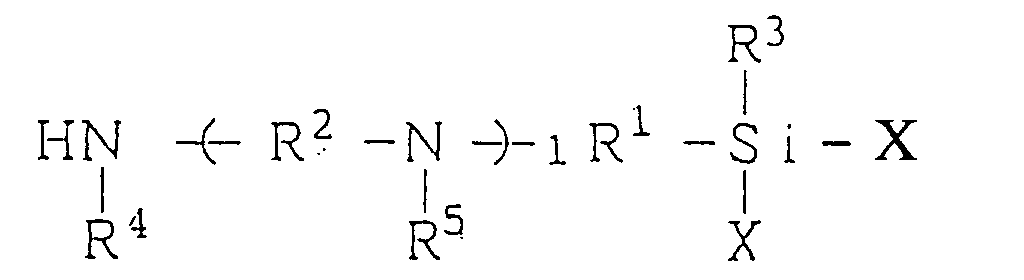
where R¹ and R² are each independently a divalent hydrocarbon group, R³ is a monovalent hydrocarbon group, R⁴ is hydrogen, a monovalent hydrocarbon group or a substituted monovalent hydrocarbon group, R⁵ is hydrogen or a monovalent hydrocarbon group or substituted hydrocarbon group, X is an alkoxy group, and 1 is an integer of 0 to 4.
where R¹ and R² are each independently a divalent hydrocarbon group, R³ is a monovalent hydrocarbon group, R⁴ is hydrogen, a monovalent hydrocarbon group or a substituted monovalent hydrocarbon group, R⁵ is hydrogen or a monovalent hydrocarbon group or substituted hydrocarbon group, X is an alkoxy group, and 1 is an integer of 0 to 4.
3. A silicon composition as set forth in Claim 1, wherein said vinyl group-containing
isocyanate is methacryloyl isocyanate, 2-isocyanatoethyl methacrylate isopropenyl-2,2-dimethylbenzyl
isocyanate or an isocyanate group-containing (meth)acrylate obtained by the reaction
of a polyisocyanate compound having two or more isocyanate groups with a (meth)acrylate
having a hydroxyl group.