| (19) |
 |
|
(11) |
EP 0 678 869 B1 |
| (12) |
EUROPEAN PATENT SPECIFICATION |
| (45) |
Mention of the grant of the patent: |
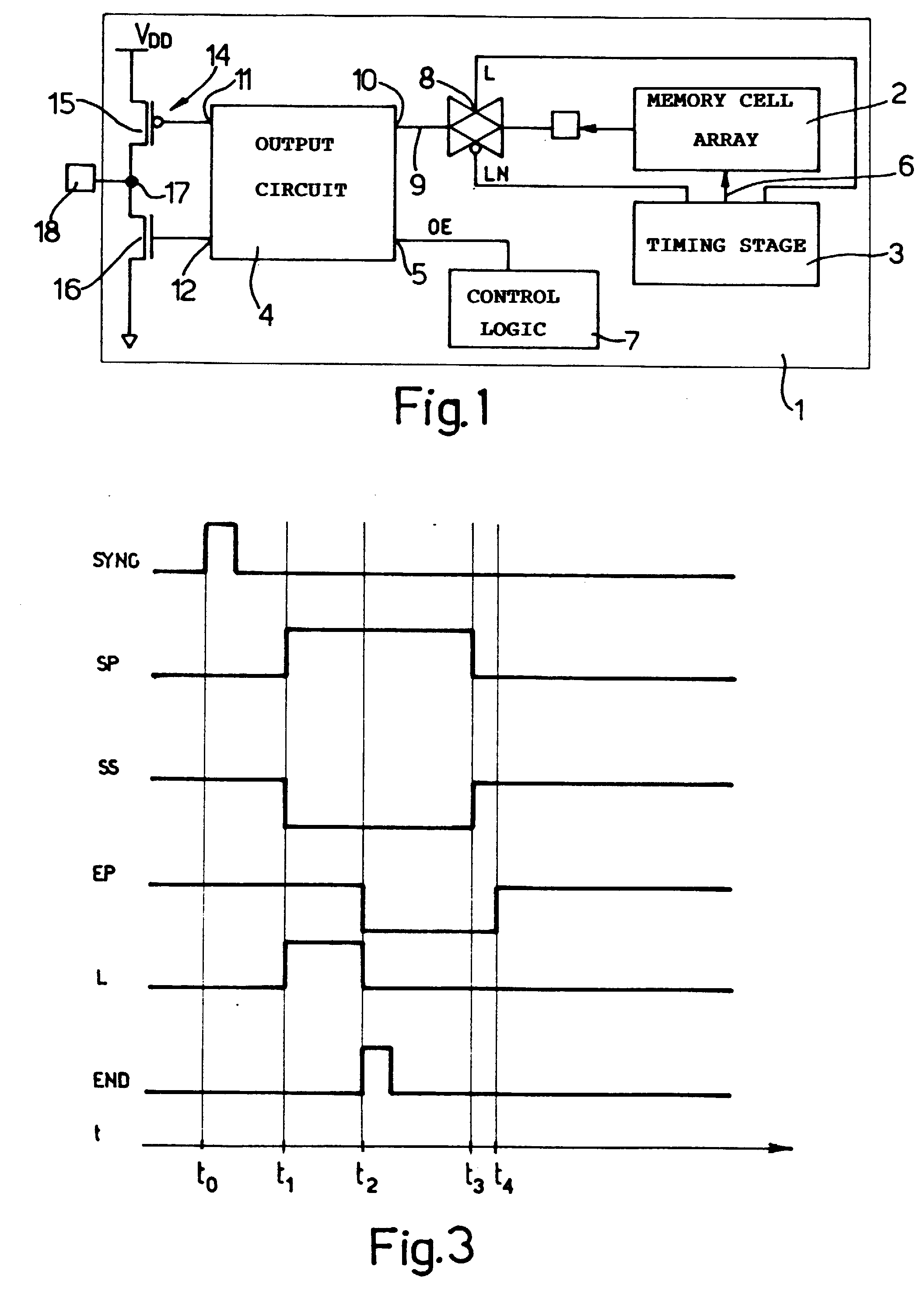
|
07.07.1999 Bulletin 1999/27 |
| (22) |
Date of filing: 18.02.1994 |
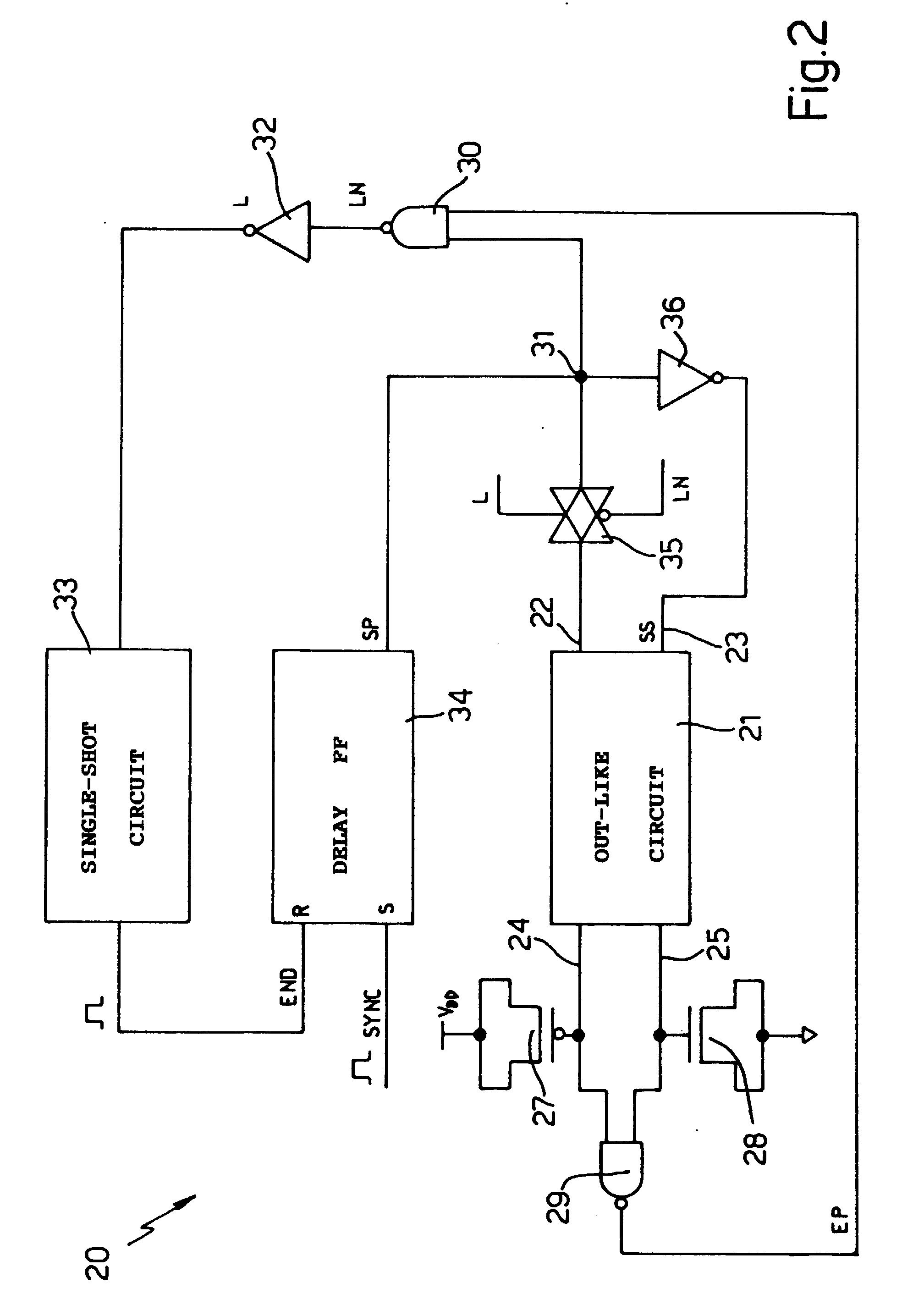
|
|
| (54) |
Method and circuit for timing the loading of non-volatile memory output data.
Verfahren und Schaltung für Ladetaktsteuerung für nichflüchtige Speicherausgabedaten
Procédé et circuit de temporisation de chargement de données de sortie dans une mémoire
non-volatile
|
| (84) |
Designated Contracting States: |
|
DE FR GB IT |
| (43) |
Date of publication of application: |
|
25.10.1995 Bulletin 1995/43 |
| (73) |
Proprietor: STMicroelectronics S.r.l. |
|
20041 Agrate Brianza (Milano) (IT) |
|
| (72) |
Inventors: |
|
- Pascucci, Luigi
I-20099 Sesto San Giovanni (IT)
- Maccarrone, Marco
I-27030 Palestro (IT)
- Olivo, Marco
I-24100 Bergamo (IT)
|
| (74) |
Representative: Cerbaro, Elena et al |
|
STUDIO TORTA S.r.l.,
Via Viotti, 9
10121 Torino
10121 Torino (IT) |
| (56) |
References cited: :
EP-A- 0 017 990
|
EP-A- 0 322 901
|
|
| |
|
|
- PATENT ABSTRACTS OF JAPAN vol. 15, no. 309 (P-1235) 7 August 1991 & JP-A-03 108 185
(HITACHI MAXELL) 8 May 1991
|
|
| |
|
| Note: Within nine months from the publication of the mention of the grant of the European
patent, any person may give notice to the European Patent Office of opposition to
the European patent
granted. Notice of opposition shall be filed in a written reasoned statement. It shall
not be deemed to
have been filed until the opposition fee has been paid. (Art. 99(1) European Patent
Convention).
|
[0001] The present invention relates to a method and circuit for timing the loading of nonvolatile
memory output data.
[0002] As is known, when reading a memory, the content (data) of the read memory cells is
transferred to output buffers by which the internal data is transferred externally;
and the buffers comprise drivers for loading the data into the respective buffer at
the right time.
[0003] In known memories, under certain conditions and at certain points of the device,
switching of the output buffers may result in noise affecting the output data from
the memory as a result of bouncing (repeat switching) at the outputs. To prevent such
noise, the drivers of the output buffers must therefore be isolated from the internal
memory circuits as soon as the data is loaded, to prevent bouncing or at least minimize
it as far as possible. Such isolation, however, involves precise timing for ensuring
effective noise suppression on the one hand, and, on the other, correct data transfer
from the memory cells to the output buffers.
[0004] It is an object of the present invention to provide a system for timing the transfer
of data from the memory to the output buffers, and which provides for reliable noise
suppression while at the same time ensuring correctly timed transfer of the output
data from the memory.
[0005] According to the present invention, there are provided a method and circuit for timing
the loading of nonvolatile memory output data, as claimed respectively in Claims 1
and 3.
[0006] In practice, according to the present invention, a latch type out-like circuit identical
to the output circuits of the memory is employed; the out-like circuit is supplied
with a data simulating signal; loading of the data simulating signal in the out-like
circuit is enabled simultaneously with data loading by the output circuits; and upon
the data simulating signal reaching the out-like circuit output, loading is disabled
and the timing circuit reset.
[0007] The timing achievable in this way is perfectly synchronized with transmission of
the signal, and supplies a signal of such short duration as to reduce the effects
of noise induced by switching of the buffers. In practice, it provides for a timing
circuit which is substantially unaffected by noise.
[0008] A preferred, non-limiting embodiment of the present invention will be described by
way of example with reference to the accompanying drawings, in which:
Figure 1 shows a highly simplified diagram of a known memory array;
Figure 2 shows a block diagram of the circuit according to the present invention;
Figure 3 shows a graph of a number of signals in the Figure 2 diagram.
[0009] Figure 1 shows a schematic diagram of a nonvolatile memory 1 of which are shown only
a memory cell array 2 (also including the sense amplifiers) in which data is stored;
a timing stage 3 for generating all the timing signals for operation of the memory;
one of the output circuits 4 provided in any known manner with latch elements, and
comprising drivers and output buffers (not shown); and a control logic circuit 7.
[0010] More specifically, control logic 7 generates an enabling signal OE which is supplied
to input 5 of output circuit 4; and timing stage 3 generates enabling signals (not
shown) which are supplied to array 2 over line 6, and a pair of load signals L, LN,
inverted in relation to each other, which are supplied to the control terminals of
a controlled switch 8 along an output data line 9 connecting array 2 to a second input
10 of output circuit 4. Output circuit 4 presents a pair of outputs 11, 12 connected
to a push-pull unit 14 comprising a pair of MOS transistors 15, 16 of opposite types.
More specifically, P-channel transistor 15 presents the source terminal connected
to supply line V
DD, the gate terminal connected to output 11 of output circuit 4, and the drain terminal
connected to the drain terminal of N-channel transistor 16, which presents the gate
terminal connected to output 12 of output circuit 4, and a grounded source terminal.
Node 17 between the two drain terminals of transistors 15, 16 is connected to the
output terminal 18 of memory 1.
[0011] To prevent noise arising and being transmitted back from output circuit 4 to array
2, which noise could result in overwriting of the data supplied by the memory array
and hence in further (erroneous) switching of the output circuit, generation of signals
L and LN by timing stage 3 must be accurately timed to ensure immediate transmission
of the data from array 2 to output circuit 4, and to interrupt data line 9 as soon
as the data is loaded into output circuit 4. In this way, the buffers of output circuits
4 are isolated and any noise generated by them is prevented from being transmitted
back.
[0012] For this purpose, timing stage 3 comprises an output data load timing circuit which,
according to the present invention, is as shown in Figure 2.
[0013] With reference to Figure 2, the timing circuit, indicated by 20, comprises an out-like
circuit 21 which, like output circuit 4 of memory 1 in Figure 1, presents two inputs
22, 23, two outputs 24, 25, and the same structure as output circuit 4 so as to reproduce
exactly the same propagation delay. Output 24 is connected to the gate terminal of
a P-channel MOS transistor 27, the drain and source terminals of which are short-circuited
and connected to supply line V
DD; while output 25 is connected to the gate terminal of an N-channel MOS transistor
28, the drain and source terminals of which are short-circuited and grounded. Transistors
27 and 28 thus act as capacitive elements for simulating the gate capacitances of
transistors 15 and 16 of array 1 in Figure 1, and ensuring the same geometry at the
outputs of output circuit 4 and in the out-like circuit.
[0014] Outputs 24 and 25 are also connected to the inputs of a first NAND circuit 29, the
output of which is connected to one input of a second NAND circuit 30 having a second
input connected to a node 31. The output of NAND circuit 30 (generating signal LN)
is connected to an inverter 32 which generates output signal L inverted with respect
to LN. Signals L and LN are the exact load signals supplied to switch 8 in Figure
1.
[0015] The output of inverter 32 is connected to the input of a single-shot (monostable)
circuit 33 enabled by the trailing edge of load enabling signal L. The output of single-shot
circuit 33, which generates a pulse signal END, is connected to the reset input R
of a synchronizing and delay block 34 substantially formed by an asymmetrical delay
flip-flop. Block 34 presents a second set input S supplied with a synchronizing signal
SYNC generated by other sections of timing circuit 3 and which enables data loading
into the output buffers.
[0016] The output of block 34 (supplying data simulating signal SP) is connected to node
31 and via controlled switch 35 to input 22, and via inverter 36 to input 23 of out-like
circuit 21. Like switch 8 in Figure 1, the control terminals of controlled switch
35 are supplied with load signals L and LN generated by inverter 32 and NAND circuit
30, so that, as regards inputs and outputs (and internal structure, as already stated),
out-like circuit 21 operates in exactly the same conditions as output circuit 4 in
Figure 1.
[0017] Operation of timing circuit 20 in Figure 2 will now be described with reference also
to Figure 3 which, excluding the delays caused by switching of logic circuits 29-32
and single-shot circuit 33, shows only the far more considerable propagation delays
of out-like circuit 21 and block 34.
[0018] To begin with, in the reset state, signals SYNC, SP, L and END are low; signals SS
and EP are high; outputs 24 and 25 of out-like circuit 21 are low; and switch 35 is
open.
[0019] At instant t
0, block 34 receives the SYNC signal pulse. With a given delay determined at the design
stage or depending on the operations of array 1, output signal SP of block 34 switches
(instant t
1) so that signal SS switches to low; NAND circuit 30 switches and is supplied with
two "1" so that signal LN switches to low; inverter 32 switches so that output signal
L switches to high; and switch 35 closes to supply data simulating signal SP to input
22. At the same time, switch 8 in Figure 1 - which, as stated, is controlled by the
same load enabling signal L, LN as out-like circuit 21 - also closes, so that signal
SP is transmitted to out-like circuit 21 in the same way and simultaneously with the
data to output circuits 4 in Figure 1.
[0020] Upon signal SP reaching out-like circuit 21, bearing in mind also the delay caused
by the capacitance of transistors 27, 28 (and upon the data supplied by array 2 to
input 10 reaching output circuit 4, bearing in mind the capacitance at the gate terminals
of transistors 15, 16), outputs 24 and 25 of out-like circuit 21 switch to high, thus
switching NAND circuit 29 (instant t
2); signal EP switches to low, thus successively switching NAND circuit 30 and inverter
32; and signal LN switches back to high, and signal L to low, thus opening switch
8 (Figure 1) and switch 35 to terminate the data loading phase which thus lasts exactly
long enough for the data to be transmitted to output circuit 4.
[0021] On receiving the trailing edge of signal L, single-shot circuit 33 generates an output
pulse (END signal) to reset block 34; after a given delay, signal SP switches back
to low at instant t
3, thus switching signal SS to high and resetting out-like circuit 21 which, after
a given delay, switches outputs 24 and 25 to low (instant t
4); and circuit 29 switches so that its output signal EP switches to high to restore
the start conditions.
[0022] The advantages of the circuit described are as follows. Firstly, it provides for
generating a load enabling signal of minimum duration, but nevertheless capable of
ensuring signal transmission to the output circuits. As a result, the output circuits
are connected to the memory array only long enough to ensure correct data transmission
(and storage in the output circuits), and are disconnected immediately after loading
to prevent (or at least minimize) harmful reflections due to the noise produced by
switching of the output circuits. The load enabling signal is also synchronized with
switching of the outputs to avoid phase differences preventing the data from being
loaded into the output circuits.
[0023] Secondly, by virtue of the circuit being immune to noise, it is possible to increase
the size of the final push-pull transistors and so improve dynamic transitional performance
in high fan-out applications involving high capacitive loads.
[0024] Finally, the timing circuit described is also extremely simple, provides for a high
degree of reliability, and is easily integratable.
[0025] Clearly, changes may be made to the timing circuit as described and illustrated herein
without, however, departing from the scope of the present invention.
1. A method for timing the loading of nonvolatile memory output data, comprising the
step of generating a data loading signal (L, LN) for loading data from an internal
memory unit (2) into at least one output circuit (4); characterized in that said step
of generating a data loading signal comprises steps of:
generating a data simulating signal (SP);
simultaneously enabling loading of data into said output circuit (4) and loading of
said data simulating signal into an out-like circuit (21) identical to said output
circuit;
disabling loading of said data simulating signal and said data after propagation of
said data simulating signal to the output of said out-like circuit (21); and
resetting said out-like circuit.
2. A method as claimed in Claim 1, characterized in that said enabling step comprises
the step of generating a load enabling signal (L, LN) and simultaneously enabling
a first line (9) supplying said data to said output circuit (4), and a second line
supplying said data simulating signal (SP) to said out-like circuit (21).
3. A circuit for timing the loading of nonvolatile memory output data, comprising at
least one output circuit (4); said timing circuit (20) generating a load enabling
signal (L, LN) for loading the memory data inter said output circuit (4); characterized
in that it comprises an out-like circuit (21) identical to said output circuit (4);
simulating signal generating means (34) for generating a data simulating signal (SP)
and output-connected to a first input (22) of said out-like circuit; simultaneous
enabling means (8, 35, 30, 32) connected to said load enabling signal (L, LN) for
simultaneously enabling transfer of said data simulating signal (SP) to said out-like
circuit (21) and said data to said output circuit (4); and propagation detecting means
(29-33) connected to the output (24, 25) of said out-like circuit, for disabling said
simultaneous enabling means (8, 35) by disabling said load enabling signal (L, LN)
and resetting said simulating signal generating means (34).
4. A circuit as claimed in Claim 3, wherein said simultaneous enabling means (8, 35,
30, 32) comprises a first controlled switch (8) connected to at least one input (10)
of said output circuit (4), and a second controlled switch (35) interposed between
said simulating signal generating means (34) and said first input (22) of said out-like
circuit (21); said first and second controlled switches (8, 35) comprising at least
one control terminal supplied with said load enabling signal (L, LN).
5. A circuit as claimed in Claim 4, characterized in that said second controlled switch
(35) is identical to said first controlled switch (8).
6. A circuit as claimed in any one of the foregoing Claims from 3 to 5, characterized
in that said simultaneous enabling means (8, 35, 30, 32) and said propagation detecting
means (29-33) comprise logic circuits (29-32) connected to said simulating signal
generating means (34) and to said out-like circuit (21), for enabling said load enabling
signal (L, LN) on receiving said data simulating signal (SP), and disabling said load
enabling signal on detecting propagation of said data simulating signal (SP) to said
output (24, 25) of said out-like circuit (21).
7. A circuit as claimed in Claimed 6, characterized in that said logic circuits (29-32)
comprise a NAND circuit (30) having an input connected to said simulating signal generating
means (34) and an input connected to said output (24, 25) of said out-like circuit
(21), and which generates said load enabling signal (LN, L).
8. A circuit as claimed in Claim 6 or 7, characterized in that said propagation detecting
means (29-33) also comprises a single-shot circuit (33) for detecting a predetermined
switching edge of said load enabling signal (L) and generating a pulse signal (END)
for resetting said simulating signal generating means (34).
9. A circuit as claimed in one of the foregoing Claims from 3 to 8, characterized in
that said simulating signal generating means (34) comprises an input (S) supplied
with a synchronizing signal (SYNC), for generating said data simulating signal (SP)
on receiving said synchronizing signal.
10. A circuit as claimed in one of Claims 3 to 9, wherein said output circuit (4) of said
nonvolatile memory (1) presents two output terminals (11, 12) connected to respective
capacitive elements (15, 16); characterized in that said out-like means (21) comprises
a first and second output terminal (24, 25) connected to a respective capacitive load
(27, 28) of substantially the same value as said capacitive elements.
11. A circuit as claimed in any one of Claims 3 to 10, characterized in that said out-like
circuit (21) comprises a second reset input (23) connected to the output of said simulating
signal generating means (34), for resetting said out-like circuit upon detection of
a predetermined switching edge of said data simulating signal (SP).
1. Verfahren zur Zeitabstimmung für das Laden von Ausgabe-Daten aus einem nichtflüchtigen
Speicher, das den Schritt eines Erzeugens eines Daten-Ladesignals (L, LN) zum Laden
von Daten aus einer internen Speichereinheit (2) in mindestens einen Ausgabeschaltkreis
(4) hinein aufweist; dadurch gekennzeichnet, daß der Schritt eines Erzeugens eines
Daten-Ladesignals die Schritte aufweist:
Erzeugen eines Daten-Simulationssignals (SP);
simultane Freigabe zum Laden von Daten in den Ausgabeschaltkreis (4) hinein und Laden
des Daten-Simulationssignals in einen Quasi-Ausgabe-Schaltkreis (21) hinein, der zu
dem Ausgabeschaltkreis identisch ist;
Sperren des Ladens des Daten-Simulationssignals und der Daten nach Propagation des
Daten-Simulationssignals zu dem Ausgang des Quasi-Ausgabe-Schaltkreises (21); und
Rücksetzen des Quasi-Ausgabe-Schaltkreises.
2. Verfahren nach Anspruch 1, dadurch gekennzeichnet, daß der Freigabeschritt den Schritt
eines Erzeugens eines Lade-Freigabesignals (L, LN) und gleichzeitig Freigeben einer
ersten Leitung (9), die die Daten zu dem Ausgabeschaltkreis (4) zuführt, und einer
zweiten Leitung, die das Daten-Simulationssignal (SP) zu dem Quasi-Ausgabe-Schaltkreis
(21) zuführt, aufweist.
3. Schaltkreis zur Zeitabstimmung für das Laden von Ausgabe-Daten aus einem nichtflüchtigen
Speicher, der mindestens einen Ausgabeschaltkreis (4) aufweist; wobei der Schaltkreis
(20) für die Zeitabstimmung ein Lade-Freigabesignal (L, LN) zum Laden der Speicher-Daten
in den Ausgabeschaltkreis (4) hinein aufweist, dadurch gekennzeichnet, daß er einen
Quasi-Ausgabe-Schaltkreis (21) aufweist, der identisch zu dem Ausgabeschaltkreis (4)
aufgebaut ist; eine ein Simulationssignal erzeugende Einrichtung (34) zum Erzeugen
eines Daten-Simulationssignals (SP) und ausgangsmäßig verbunden ist mit einem ersten
Eingang (22) des Quasi-Ausgabe-Schaltkreises; eine simultan freigebende Einrichtung
(8, 35, 30, 32), die mit dem Lade-Freigabesignal (L, LN) verbunden ist, zum simultanen
Freigeben einer Übertragung des Daten-Simulationssignals (SP) zu dem Quasi-Ausgabe-Schaltkreis
(21) und der Daten zu dem Ausgabeschaltkreis (4); und eine Propagations-Erfassungseinrichtung
(29-33), die mit dem Ausgang (24, 25) des Quasi-Ausgabe-Schaltkreises verbunden ist.
zum Sperren der simultanen Freigabeeinrichtung (8, 35) durch Sperren des Lade-Freigabesignals
(L, LN) und Rücksetzen der Simulationssignal-Erzeugungseinrichtung (34).
4. Schaltkreis nach Anspruch 3, wobei die simultane Freigabeeinrichtung (8, 35, 30, 32)
einen ersten, gesteuerten Schalter (8), der mit mindestens einem Eingang (10) des
Ausgabeschaltkreises (4) verbunden ist, und einen zweiten, gesteuerten Schalter (35),
der zwischen der Simulationssignal-Erzeugungseinrichtung (34) und dem ersten Eingang
(22) des Quasi-Ausgabe-Schaltkreises (21) zwischengefügt ist, aufweist; wobei der
erste und der zweite gesteuerte Schalter (8, 35) mindestens einen Steueranschluß aufweisen,
der mit dem Lade-Freigabesignal (L, LN) versorgt wird.
5. Schaltkreis nach Anspruch 4, dadurch gekennzeichnet, daß der zweite gesteuerte Schalter
(35) identisch zu dem ersten, gesteuerten Schalter (8) ist.
6. Schaltkreis nach einem der vorhergehenden Ansprüche von 3 bis 5, dadurch gekennzeichnet,
daß die simultane Freigabeeinrichtung (8, 35, 30, 32) und die Propagations-Erfassungseinrichtung
(29-33) logische Schaltkreise (29-32), die mit der Simulationssignal-Erzeugungseinrichtung
(34) und dem Quasi-Ausgabe-Schaltkreis (21) verbunden sind, aufweist, zum Freigeben
des Lade-Freigabesignals (L, LN) beim Empfangen des Daten-Simulationssignals (SP),
und Sperren des Lade-Freigabesignals beim Erfassen einer Propagation des Daten-Simulationssignals
(SP) zu dem Ausgang (24, 25) des Quasi-Ausgabe-Schaltkreises (21).
7. Schaltkreis nach Anspruch 6, dadurch gekennzeichnet, daß die logischen Schaltkreise
(29-32) einen NAND-Schaltkreis (30) aufweisen, der einen Eingang besitzt, der mit
der Simulationssignal-Erzeugungseinrichtung (34) verbunden ist, und einen Eingang,
der mit dem Ausgang (24, 25) des Quasi-Ausgabe-Schaltkreises (21) verbunden ist, und
der das Lade-Freigabesignal (LN, L) erzeugt.
8. Schaltkreis nach Anspruch 6 oder 7, dadurch gekennzeichnet, daß die Propagations-Erfassungseinrichtung
(29-33) auch einen monostabilen Schaltkreis (33) zum Erfassen einer vorbestimmten
Umschaltflanke des Lade-Freigabesignals (L) und zum Erzeugen eines Impulssignals (END)
zum Zurücksetzen der Simulationssignal-Erzeugungseinrichtung (34) aufweist.
9. Schaltkreis nach einem der vorhergehenden Ansprüche von 3 bis 8, dadurch gekennzeichnet,
daß die Simulationssignal-Erzeugungseinrichtung (34) einen Eingang (S) aufweist, der
mit einem Synchronisierungssignal (SYNC) versorgt wird, zum Erzeugen des Daten-Simulationssignals
(SP) beim Empfangen des Synchronisierungssignals.
10. Schaltkreis nach einem der Ansprüche 3 bis 9, wobei der Ausgabeschaltkreis (4) des
nichtflüchtigen Speichers (1) zwei Ausgangsanschlüsse (11, 12) hat, die mit jeweiligen
kapazitiven Elementen (15, 16) verbunden sind; dadurch gekennzeichnet, daß die Quasi-Ausgabe-Einrichtung
(21) einen ersten und einen zweiten Ausgabeanschluß (24, 25), verbunden mit einer
jeweiligen, kapazitiven Last (27, 28) mit im wesentlichen demselben Wert wie die kapazitiven
Elemente, aufweist.
11. Schaltkreis nach einem der Ansprüche 3 bis 10, dadurch gekennzeichnet, daß der Quasi-Ausgabe-Schaltkreis
(21) einen zweiten Rücksetzeingang (23) aufweist, der mit dem Ausgang der Simulatianssignal-Erzeugungseinrichtung
(34) verbunden ist, zum Zurücksetzen des Quasi-Ausgabe-Schaltkreises unter Erfassung
einer vorbestimmten Umschaltflanke des Daten-Simulationssignals (SP).
1. Procédé de synchronisation du chargement de données de sortie d'une mémoire non-volatile
comprenant l'étape consistant à produire un signal de chargement de données (L, LN)
pour charger des données à partir d'un module mémoire interne (2) dans au moins un
circuit de sortie (4), caractérisé en ce que l'étape de production d'un signal de
chargement de données comprend les étapes suivantes :
produire un signal de simulation de données (SP) ;
valider simultanément le chargement des données dans le circuit de sortie (4) et le
chargement du signal de simulation de données dans un circuit analogue à une sortie
(21) identique au circuit de sortie ;
invalider le chargement du signal de simulation de données après propagation du signal
de simulation de données vers la sortie du circuit analogue à une sortie (21) ; et
remettre à zéro le circuit analogue à une sortie.
2. Procédé selon la revendication 1, caractérisé en ce que l'étape de validation comprend
l'étape de génération d'un signal de validation de chargement (L, LN) et la validation
simultanée d'une première ligne (9) fournissant les données au circuit de sortie (4)
et une seconde ligne fournissant le signal de simulation de données (SP) au circuit
analogue à une sortie (21).
3. Circuit de synchronisation du chargement des données de sortie d'une mémoire non-volatile
comprenant au moins un circuit de sortie (4) ; le circuit de synchronisation (20)
produisant un signal de validation de chargement (L, LN) pour le chargement de données
de mémoire dans le circuit de sortie (4) ; caractérisé en ce qu'il comprend un circuit
analogue à une sortie (21) identique au circuit de sortie (4) ; un moyen de génération
de signal de simulation (34) pour produire un signal de simulation de données (SP)
connecté en sortie à une première entrée (22) du circuit analogue à une sortie ; un
moyen de validation simultanée (8, 35, 30, 32) connecté au signal de validation de
chargement (L, LN) pour valider simultanément le transfert du signal de simulation
de données (SP) vers le circuit analogue à une sortie (21) et des données vers le
circuit de sortie (4) ; et un moyen de détection de propagation (29-33) connecté à
la sortie (24, 25) du circuit analogue à une sortie pour invalider le moyen de validation
simultané (8, 35) en invalidant le signal de validation de chargement (L, LN) et remettre
à zéro le moyen de génération de signal de simulation (34).
4. Circuit selon la revendication 3, dans lequel le moyen de validation simultané (8,
35, 30, 32) comprend un premier commutateur commandé (8) connecté à au moins une entrée
(10) du circuit de sortie (4), et un second commutateur commandé (35) interposé entre
le moyen de génération de signal de simulation (34) et la première entrée (22) du
circuit analogue à une sortie (21) ; les premier et second commutateurs commandés
(8, 35) ayant au moins une borne de commande alimentée par le signal de validation
de chargement (L, LN).
5. Circuit selon la revendication 4, caractérisé en ce que le second commutateur commandé
(35) est identique au premier commutateur commandé (8).
6. Circuit selon l'une quelconque des revendications 3 à 5, caractérisé en ce que le
moyen de validation simultanée (8, 35, 30, 32) et le moyen de détection de propagation
(29-33) comprennent des circuits logiques (29-32) connectés au moyen de génération
de signal de simulation (34) et au circuit analogue à une sortie (21) pour valider
le signal de validation de chargement (L, LN) lors de la réception du signal de simulation
de données (SP), et invalider le signal de validation de chargement lors de la détection
de la propagation du signal de simulation de données (SP) à la sortie (24, 25) du
circuit analogue à une sortie (21).
7. Circuit selon la revendication 6, caractérisé en ce que les circuits logiques (29-32)
comprennent une porte NON ET (30) ayant une entrée connectée au moyen de génération
de signal de simulation (34) et une entrée connectée à la sortie (24, 25) du circuit
analogue à une sortie (21) et qui produit le signal de validation de chargement (LN,
L).
8. Circuit selon la revendication 6 ou 7, caractérisé en ce que le moyen de détection
de propagation (29, 33) comprend également un circuit monostable (33) pour détecter
un front de commutation prédéterminé du signal de validation de chargement (L) et
produire un signal en impulsion (END) pour remettre à zéro le moyen de génération
de signal de simulation (34).
9. Circuit selon l'une quelconque des revendications 3 à 8, caractérisé en ce que le
moyen de génération de signal de simulation (34) comporte une entrée (S) alimentée
par un signal de synchronisation (SYNC) pour produire le signal de simulation de données
(SP) à la réception du signal de synchronisation.
10. Circuit selon l'une quelconque des revendications 3 à 9, dans lequel le circuit de
sortie (4) de la mémoire non volatile (1) comporte deux bornes de sortie (11, 12)
connectées à des éléments capacitifs (15, 16), caractérisé en ce que le circuit analogue
à une sortie (21) comporte des première et seconde bornes de sortie (24, 25) connectées
à une charge capacitive respective (27, 28) ayant sensiblement la même valeur que
lesdits éléments capacitifs.
11. Circuit selon l'une quelconque des revendications 3 à 10, caractérisé en ce que le
circuit analogue à une sortie (21) comporte une seconde entrée de remise à zéro (23)
connectée à la sortie du moyen de génération de signal de simulation (34) pour remettre
à zéro le circuit analogue à une sortie après détection d'un front de commutation
prédéterminé du signal de simulation de données (SP).