|
(11) | EP 0 679 812 A1 |

| (12) | EUROPEAN PATENT APPLICATION |
| published in accordance with Art. 158(3) EPC |
|
|
|
|
|||||||||||||||||||||||||||
| (54) | STREAMLINED SURFACE |
| (57) A streamlined surface has concavities (1) (convexities), the cross-section of the
concavity (1) (convexity) has the form of a smoothly curved closed line described
by a certain relationship, the depth of the concavities (1) (convexities) h=0.005-0.3
of the thickness of the boundary layer, the curved areas (2) of the concavities or
convexities have a common tangent in any cross-section transversal to the initial
surface with a transitional section (3) in the form of a surface of double curvature
with radii /Rcurv1/ ≧ 3h and /Rcurv2/ ≧ 3h. The size of the concavities (1) (convexities) along the streamlined surface
equals D=(2-40)h, the size of the curved area (2) along the streamlined surface is
l₃=(0.05-0.3)D, the size of the transitional section (3) along the line connecting
the centres of the concavities or convexities is ln=(0.05-3)h, and the centres of the concavities (1) or convexities are located in the
vertices of a parallelogram with the sides equal to (1.05-4)D and with an angle at
the vertex αp=20-90o. |
Art
[0001] The invention relates to hydroaerodynamics and to thermal physics and concerns devices to control the boundary and near wall layers in the flows of continuous media such a gases, liquids, their two-phase or multicomponent mixtures and the like, moving along ducts under no pressure or under pressure.
Prior State of Art
[0002] The majority of widely used devices intended for heat-end-mass transfer intensification require considerable power consumption for pumping the heat carrier.
[0003] In the last ten years approaches to the problems under discussions have been developed, which are based on the utilization of the peculiarities of vortex dynamics of a continuous medium flowing past three-dimensional reliefs. Thus, according to USA Patent 3741285 devices are proposed, which are provided with wavy surfaces or with surface elements of such an amplitude such a deflection in the direction of the flow, bypassing these devices, and such a longitudinal and lateral distribution of these properties, which result in the creation and intensification of the vertices in the boundary layer.
[0004] In this case, in particular for elements having the shape of concavities, the recommended depth is 0.5 to 1.0 δ , where δ is the depth of the boundary layer, whereas the period of location of such elements is 3 to 20 δ . This limits the quantitative measures of the elements of the devices discussed by the author. In this connection it should be noted that the author of this Patent failed to make any advance towards the solution of the stated problem or to propose any concrete shapes of three-dimensional elements of the relief, with the exception of the geometrical constructions, which are directly not connected with the vortex dynamics mechanism.
[0005] Let us examine the inventions, in which claimed are these or other kinds of reliefs in the shape of convexities or concavities and which are mostly close to those proposed in the present Application.
[0006] In the known USA Patent No. 4690211 the heat exchange tube is provided with at least one row of projections (convexities) on its internal surface along the spiral curve, and the outline of the cross section of these convexities consists of smooth curves in any part along the height of the projections, including the base. In this case the section area monotonically decreases towards the projection top, whereas the projection height is from 0.45 to 0.6 mm. The spiral curve is selected so that a "circumferential" pitch of 3.5 to 5 mm is obtained, whereas the pitch along the axis is 5 to 15 mm. In particular, the sections of the projections may have a circular, elliptical or extended shape.
[0007] However, the authors of the Patent failed to point out the relations between the dimensions of the projections and pitches characterizing the layout of the projection, and the diameter of the tube and the conditions of flow of the heat carrier. The data presented by the authors are naturally applicable to tubes, the diameter of which is about 15 mm - the authors indicate the results of the thermophysical experiments only for tubes of the given diameter. Besides, the authors do not indicate the radii of the curvatures of the sections, on which the smooth portion of the tube changes over to form the projection surface. If one judges by the drawings of the given Patent, such a transition is supposed to have a zero curvature radius. At the same time it is known that these curvature radii determine the value of the hydraulic resistance and hence the thermophysical efficiency. In addition, the Patent contains no indications concerning the optimum, from the thermophysical point of view, relation of the projection height to its diameter though this relation strongly influences the heat transfer and hydraulic resistance measures.
[0008] It is obvious that since the turbulent flows of the heat carriers are three-dimensional even in case of establishing two-dimensional boundary conditions and since a three-dimensional relief is distinguished for its greater variety, thus ensuring the realizability of a larger number of degrees of freedoms in the velocity field in the near wall area of the flow, one should expect a high degree of thermophysical efficiency in case the appropriate three-dimensional relief is selected. However, even the simplest streamlining laws for three-dimensional reliefs have been investigated less than those of two-dimensional reliefs. This is connected both with the relative "young age" of the heat-and-mass transfer intensification methods by means of three-dimensional reliefs and with a larger variety of possibilities and parameters, which are characteristic of three-dimensional reliefs. This also explains the schematism and absence of important geometrical parameters of three-dimensional reliefs in the above Application, as well as the absence of the relation between these parameters and the conditions of flow and other flow characteristics of the heat carriers.
Disclosure of the Invention
[0009] The main aim of this invention is to develop a device for controlling the heat-and-mass transfer processes, hydraulic resistance, boiling, deposition of admixtures from the flows in the boundary or near wall layers of gas, liquid, their two-phase or multicomponent mixtures moving in ducts under no pressure or under pressure; control shall be achieved by initiating the generation of large-scale vortex structures and by controlling their development.
[0010] The forwarded problem is solved by means of a device - a streamlined surface or a heat-and-mass transfer surface, which is the separation boundary between the flowing continuous medium: gas, liquid, their two-phase or multicomponent mixtures and a solid wall (initially smooth, cylindrical, conical, or of any other profile), which permits controlling the process in the boundary layer or in the near wall layers of the flow due to the creation on its surface of a three-dimensional concave or convex relief with smooth outlines and ranges of dimensions characterizing this relief and being associated with the hydrodynamical lengths decribing the processes in the boundary and near wall layers of the flow. The three-dimensional relief is made in the form of concavities or convexities with rounded sections and a transition located in a checkered or unstaggered order, and any section of the concavities or convexities along the streamlined surface will have the shape of a smooth closed line described by the relation
where:
r(φ,Z) - is the section radius in the direction of angle φ , counted from the line interconnecting the centers of the adjacent concavities or convexities, or from any other line, which lies in the indicated section;
Z - is the section height over the lowermost point of the concavity or the section distance from the uppermost point of the convexity;
r(h,O) - is the radius of the concavity or convexity section in the direction of angle φ = 0o;
- is the difference between the radii of the concavities or convexities in the direction of angles φ = 180o and φ = 0o;
lc - is the dimension of the curvature area along the streamlined surface; k = 0.3 to 0.7 is the coefficient;
the depth of the cavities or convexities h is in this case 0.005 to 0.3 of the thickness of the boundary layer or of the equivalent hydraulic diameter of the duct, the curvature area of the concavities or convexities has, in any cross section with regard to the streamlined surface, a common tangent with the transition area, which is located between the adjacent concavities or convexities and which is made in the shape of a bicurvature surface with radii meeting the following relations
and in this case the dimension of the concavities or convexities along the streamlined surface is:
the dimension of the curvature area along the streamlined surface is:
whereas the dimension of the transition area along the line interconnecting the centers of the adjacent concavities or convexities is:
[0011] The concavities or convexities may be located in the vertices of the parallegrams, the lengths of the sides of which are within the range of 1.05 to 4 dimensions of the concavities or convexities and the vertex angle αρ is 20 to 90°.
[0012] The relations, which characterize the indicated relief of the concavities and convexities, have been obtained as a result of processing the thermophysical measurements.
Brief Description of Drawings
Best Embodiment
[0015] The convexities relief section across the streamlined surface is similar to the relief section of the concavities shown in Fig. 1.
[0016] The streamlined surface consists of concavities (1) (convexities), which include curvature areas (2) and transition areas (3).
[0017] When a continuous medium flow runs past a surface provided with concavities (convexities) containing elements of the indicated dimensions in the near wall area at a distance of 0.005 to 0.3 thickness of the boundary layer or an equivalent hydraulic diameter of the duct, three-dimensional velocity and pressure fields of the continuous medium are formed. The three-dimensional features of the velocity and pressure fields alongside with the inertia forces, which originate in the near wall layers of the flow due to running of the flow past the convexities or concavities, result in the generation of Goertler vortices and other large-scale vortex structures, including tornado-like ones. The indicated ranges of the dimensions of the concavity or convexity elements ensure generation of vortex structures resulting in their self-organization, which is favourable from the point of view of the intensification of the heat-and-mass transfer and of the other processes, which take place in the boundary or near well layers of the continuous medium flow.
[0018] The smooth shapes of the three-dimensional relief of concavities or convexities, the presence of a transition in the shape of a bicurvature surface between the concavities or convexities ensure, according to proposed invention, the dynamical properties of the large-scale vortex structures and the possibility of their alignment with the main flow; this has found its expression in the lagging increase of the hydraulic resistance as compared with the increase of the heat or mass transfer intensity, and in some cases there is even a decrease of the hydraulic resistance as compared with the hydraulic resistance of smooth surfaces.
[0019] In addition, the realization of the proposed device results in a visible decrease of deposition of foreign impurities from the heat carrier onto the streamlined surface. This fact is connected with the directness of the generation of Goertler and tornado-like vortex structures, which increase the transfer of the mass, the admixtures included, from the wall away into the flow core.
[0020] According to the invention, the smoothness of the streamlined relief ensures also an increased corrosion resistance of the streamlined surface when continuous media are used, which usually involve corrosion processes. According to the data of the experiments, the peculiarities of the mass transfer, originating due to the generation of large-scale vortex structures, decrease the probability of the origination of electrochemical processes on the surface of the claimed device provided with a relief.
[0021] The use of a three-dimensional concavity or convexity relief of the indicated parameters results in a noticeable increase of the critical heat flows within a wide range of liquid pressure, mass velocity of the heat carrier and a relative vapour content. The shift of the critical heat transfer towards high thermal loads as the flow runs past the surface, provided with the indicated relief, is caused by the formation of a heated surface of large-scale self-organizing structures, tornado-like structures included, by means of which the vapour bubbles are evacuated from the area surrounding the concavity or convexity and taken away from the near wall layer into the flow core. Favourable to this is also the smoothness and the three-dimensional features of the relief, since they contribute to the change of the directions of the orientation and twisting of the vortex structures.
Industrial Use
[0022] The invention may be used in various power engineering and heat-and-mass transfer systems, as well as in any other branches, where there is a demand in intensification of the heat-and-mass transfer at a limited increase of the hydraulic resistance. In particular, the invention is used with various kinds of transportation facilities, in gas turbine units with cooled blades, in nuclear power assemblies with high-flow neutron sources, in steam generators, heat exchangers, as well as in other energy transfer apparatuses and devices.
1. The streamlined surface, which ensures control of the process in the boundary and
near wall layers of the continuous medium flows and which is provided with a three-dimensional
relief is characterized by the fact that the three-dimensional relief is made in the
shape of concavities or convexities (1); there are curvature areas (2) and transition
(3), and that any section of concavities (1) or of the convexities along the streamlined
surface has the shape of a smooth closed line, described by the relation:
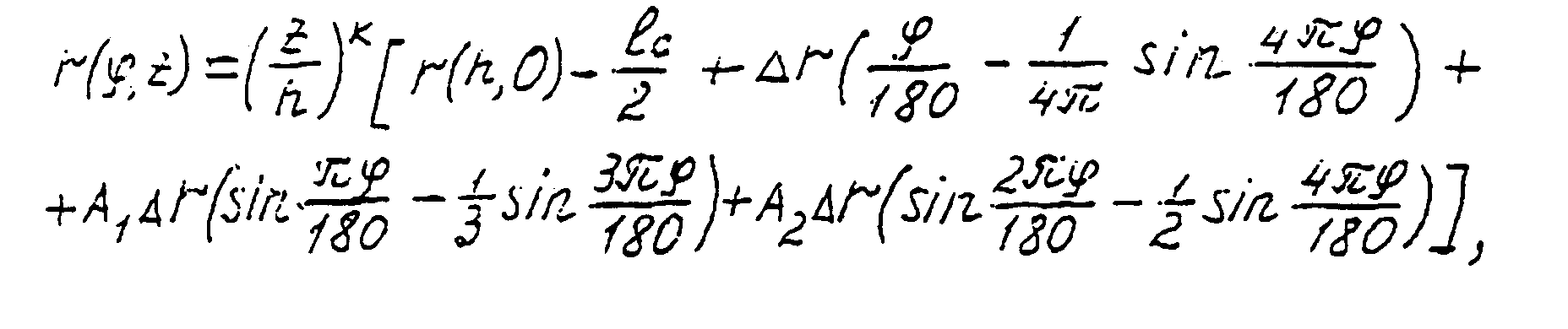
where:
r(φ,Z) - is the section radius in the direction of angle , counted from the line interconnecting the centers of the adjacent concavities or convexities, or from any line, which lies in the indicated section;
Z - is the section height over the lowermost point of the concavity or section distance from the uppermost point of the convexity;
r(h,O) - is the radius of the concavity or convexity section in the direction of angle φ = 0o.

- is the difference between the radii of the concavity or convexity section in the direction of angles φ = 180o and φ = 0o;
lc - is the dimension of the curvature area along the streamlined surface; k = 0.3 to 0.7 is the coefficient;

the depth of the concavities (1) or convexities h is in this case 0.005 to 0.3 of the thickness of the boundary layer or of the equivalent hydraulic diameter of the duct, the curvature area (2) of the concavities or convexities has, in any cross section with regard to the streamlined surface, a common tangent with the transition area (3), which is located between the adjacent concavities (1) or convexities and which is made in the shape of a bicurvature surface with radii meeting the following relations:

in this case the dimension of the concavities (1) or convexities along the streamlined surface is

the dimension of the curvature area (2) along the streamlined surface is

whereas the dimension of the transition area (3) along the line interconnecting the centers of the adjacent concavities (1) or convexities is

where:
r(φ,Z) - is the section radius in the direction of angle , counted from the line interconnecting the centers of the adjacent concavities or convexities, or from any line, which lies in the indicated section;
Z - is the section height over the lowermost point of the concavity or section distance from the uppermost point of the convexity;
r(h,O) - is the radius of the concavity or convexity section in the direction of angle φ = 0o.
- is the difference between the radii of the concavity or convexity section in the direction of angles φ = 180o and φ = 0o;
lc - is the dimension of the curvature area along the streamlined surface; k = 0.3 to 0.7 is the coefficient;
the depth of the concavities (1) or convexities h is in this case 0.005 to 0.3 of the thickness of the boundary layer or of the equivalent hydraulic diameter of the duct, the curvature area (2) of the concavities or convexities has, in any cross section with regard to the streamlined surface, a common tangent with the transition area (3), which is located between the adjacent concavities (1) or convexities and which is made in the shape of a bicurvature surface with radii meeting the following relations:
in this case the dimension of the concavities (1) or convexities along the streamlined surface is
the dimension of the curvature area (2) along the streamlined surface is
whereas the dimension of the transition area (3) along the line interconnecting the centers of the adjacent concavities (1) or convexities is
2. A surface as claimed in Claim 1 characterized in that the centers of the concavities
(1) or convexities are located in the vertices of a parallelogram, the lengths of
the sides of which are within the range of 1.05 to 4 dimensions of the concavities
(1) or convexities and the vertex angle is α p = 20 to 90o.