| (19) |
 |
|
(11) |
EP 0 682 236 B1 |
| (12) |
EUROPEAN PATENT SPECIFICATION |
| (45) |
Mention of the grant of the patent: |
|
28.11.2001 Bulletin 2001/48 |
| (22) |
Date of filing: 09.05.1994 |
|
|
| (54) |
Method and instrument for selecting personal compatible colors
Vorrichtung und Verfahren zur Auswahl individueller kompatibler Farben
Appareil et procédé pour choisir des couleurs compatibles individuelles
|
| (84) |
Designated Contracting States: |
|
AT BE CH DE DK ES FR GB GR IE IT LI LU MC NL PT SE |
|
Designated Extension States: |
|
SI |
| (43) |
Date of publication of application: |
|
15.11.1995 Bulletin 1995/46 |
| (60) |
Divisional application: |
|
01109004.0 / 1118845 |
|
01109121.2 / 1118846 |
| (73) |
Proprietor: CHROMATICS COLOR SCIENCES INTERNATIONAL, INC. |
|
New York, NY 10021 (US) |
|
| (72) |
Inventors: |
|
- Billmeyer, Fred W., Jr.
Schenectady, NY 10706 (US)
- MacFarlane, David Kenneth
Hastings-on-Hudson, NY 10706 (US)
- MacFarlane, Darby Simpson
Hastings-on-Hudson, NY 10706 (US)
|
| (74) |
Representative: Hale, Peter et al |
|
Kilburn & Strode
20 Red Lion Street
London WC1R 4PJ
London WC1R 4PJ (GB) |
| (56) |
References cited: :
EP-A- 0 446 512
US-A- 4 681 546
|
US-A- 4 561 850
|
|
| |
|
|
|
|
| |
|
| Note: Within nine months from the publication of the mention of the grant of the European
patent, any person may give notice to the European Patent Office of opposition to
the European patent
granted. Notice of opposition shall be filed in a written reasoned statement. It shall
not be deemed to
have been filed until the opposition fee has been paid. (Art. 99(1) European Patent
Convention).
|
[0001] This invention relates to a process, colour charts and swatch packs for identifying
categories of skin coloration for compatibility with colors of clothing, makeup, etc.,
and more particularly to methods and apparatus for classifying skin color based upon
its blue and yellow undertones and for assigning one of a plurality of basic categories
for which compatible colors have been selected.
[0002] Recently, numerous proposals for identifying colors of, for example, clothing, makeup,
hair colorants, and the like, based upon an individual person's coloration have been
put forth. Some of these proposed techniques have taken into account the color of
the person's complexion, but have incorrectly emphasized redness and have also wrongly
relied upon eye color, color of hair, and even racial background to assign color categories
to the person. Based on that assignment a preselected collection of colors of fabric
or other materials was chosen.
[0003] Draping techniques, whereby drapes of a series of colors are placed adjacent an individual's
face for an assessment of compatibility, have been in widespread use. The purpose
has been to better enable the evaluated individual to choose clothing and other items
of a harmonious color. These draping techniques have had some success. Being subjective,
they depend, however, upon the observational skills of the one who conducts the assessment
and cannot be relied upon for consistent accuracy.
[0004] Much has been written about the various color assessment techniques. Often this has
been misleading in that the true scientific basis for skin color categorization was
not perceived. Again, for example, writings on the subject have advised attention
to eye color, hair color, or race, or have suggested assessment of the redness or
pallor of the subject individual. Although blue and yellow have been mentioned along
with other colors and/or features said to contribute to an assessment of compatible
colors, there have been only vague mentions of these broad color families encompassing
many different colors in the blue and yellow families. There has not been any clear
expression of exact blues or yellows contributing to the proposed assessments. Nor
has there been any exact specification of a reproducible parameter derived from these
colors and capable of accurate, consistent use in skin color assessment.
[0005] Several attempts have been made to quantify color assessment.
[0006] It has been generally recognized by those who have considered the possibility that
a consistent, scientifically sound, and reproducible technique for accurately categorizing
an individual's skin coloration would be extremely desirable as would the availability
of an instrument for consistently and accurately assessing and categorizing skin color.
[0007] EP-A-0 446 512 discloses the use of the blue to yellow part of the spectra to classify
skin color and to assist in the selection of proper colors for individual wearers.
A similar method is also known from US-A-4 681 546.
[0008] In color identification utilized in other endeavors, numerous qualities, measurable
values, or parameters exist. To identify color accurately more than one characteristic,
and often three values, are used. No single value satisfactorily defines color.
[0009] Although extensive collections of colors of non-skin objects, particularly fabrics,
for each skin color category have been determined visually, there remains a need to
quickly and reliably identify new colors as compatible with one or more skin color
categories. Prior to this invention, no color characteristics have been identified
or developed to permit this.
[0010] Various aspects of the invention are defined in the independent claims. Some preferred
features are defined in the dependent claims.
[0011] By this invention skin coloration is accurately measured in a consistent, repeatable
fashion on the basis of blue and yellow undertones in any person's skin color, utilizing
a known color evaluation device and calculating a single parameter dependent on the
blue and yellow content. Recognition of skin color exclusively as the determinative
factor in arriving at personal color categorization, then the further recognition
of the blue and yellow undertones as the controlling characteristic, to the exclusion
of other color measurements, contrary to the popular techniques and writings, were
significant steps toward the establishment of a scientifically sound and readily reproducible
personal color assessment method.
[0012] In the method according to the invention, a colour measuring device is used to develop
the necessary measurements to calculate the Hunter b value. That calculation is effected,
and the value thus determined is compared with preselected ranges of this b value
that have been established empirically on the basis of analyses of thousands of test
subjects to arrive at one of several categories of skin coloration corresponding to
one of the preselected b value ranges. The instrument according to the invention incorporates
the color measuring device, a microprocessor or other central processing unit (CPU),
and memory storing the preselected ranges of b values that correspond to skin color
categories. The central processing unit calculates the Hunter b value using the color
coordinates or values measured by the measuring device. The CPU then compares the
derived Hunter b value with the stored ranges to produce an output indicative of a
particular category. In the embodiment of the method and apparatus according to the
invention that is described herein specifically, the categories are four in number
and preselected colors of fabric, cosmetics, hair colorants, and the like are assigned
to each based upon its predetermined harmonious or aesthetically pleasing appearance
when used in relation to a skin color in the particular category. The invention can
be practiced with many more or fewer categories of skin color. As the invention is
practiced with more numerous skin color categories, very narrow ranges of skin coloration
can be identified as compatible with products of a particular color.
[0013] The Hunter b value utilized to arrive at skin color categories that are repeatable
and useful in like is one of three Hunter values, L, a, and b. Like other sets of
color values, these are used, always in conjunction with one another, to define a
color. Many other color character defining coordinates and values are known and are
in use. These have been evaluated in the attempt to identify or develop a measurement
or calculated value that will enable competent, reproducible, and scientifically valid
assignment of categories. For example, the tri-stimulus calorimeter is used as the
color measuring device in preferred embodiments of the method and instrument according
to this invention. Starting with the measured standard CIE (Commission Internationale
de l'Éclairage) tri-stimulus values X, Y and Z, certain calorimeters that are commercially
available devices, with some computation capacity of their own, produce three well
known coordinates, Y, x and y. These are standard color measurements established by
the CIE and adopted by the ASTM (American Society for Testing and Materials). Neither
the three tri-stimulus values X, Y and Z nor the additionally produced x and y values,
alone or in combination, will suffice to permit acceptable categorization of skin
color in the desired manner. Either set of three values, X, Y and Z, or Y, x and y,
are, however, adequate to permit calculation of the Hunter b value. Certain commercial
calorimeters are equipped with sufficient calculating capacity to develop the Hunter
values L, a and b. If not, then the calculation of b is effected by the CPU of the
invention. It is only necessary that an instrument be capable of measuring the values
required to calculate the Hunter b value.
[0014] In a preferred practice of the method according to the invention, multiple tri-stimulus
calorimeter readings are taken and averaged by the CPU for a more accurate Hunter
b value calculation. Typically, an individual person's cheek, free of makeup, is the
site of the measurement. However, the back of the person's hand or another area can
be measured, but some shifting of the categories then may result. For example, when
the back of the hand is the measurement site, the presence and clear visibility of
numerous blood vessels shifts the ranges of Hunter b values that correspond to the
skin color categories.
[0015] Good repeatability has been demonstrated by the skin color category identifying method
and instrument of this invention and the category determination is made without resorting
to eye color, hair color, or race. Insofar as race is concerned, the methods and apparatus
of the invention have established among black people tested a wide range of colors,
in all of the categories of skin color described herein. This is completely contrary
to prior writings erroneously assigning black subjects to a single, subjective category
and clearly evidencing a lack of recognition of the color characteristics distinguishing
individuals.
[0016] In short, the recognition of the single measurable quantity, Hunter b, as the distinguishing
feature on which skin color differentiation could be based departed significantly
from the ordinary color identification on the basis of several parameters and departed
entirely from any earlier approach to skin color classification.
[0017] Extensive collections of fabric colors, called swatch packs, have been assembled
that are compatible with the skin color categories. Determination of the color defining
features that establish compatible colors is not as straightforward as the precise
measurement of skin color category discussed above. For fabrics and other non-skin
matter other than cosmetics, the color characteristics that appear to determine whether
or not a particular non-skin color will be compatible with a particular skin color
category vary from one color family to another. By "color family" is meant the broad
designation of color, e.g., yellow, red, blue, green and so on. The Hunter b value
appears to be determinative of categories of compatibility for the color families
yellow, gold, orange, red and white. Three new characteristics, Hunter hue angle h
H, Hunter chroma c
H, and Hunter saturation S
H, were developed for and appear to work satisfactorily for identifying compatible
categories from the color families beige, brown, pink, purple, blue, green, grey and
black. These developed characteristics are used alone, together with Hunter b, in
combination, or with the Hunter lightness value L to sort these families into colors
that are identified with the skin color categories with which they are compatible.
[0018] Cosmetic colors differ from other non-skin matter in their skin color compatibility
characteristics. In cosmetics, particular colors in the various color families can
be categorized for skin color compatibility based on their Hunter b values. However,
with some color families only two ranges of this characteristic can be identified,
necessary to accommodate varying degrees of skin darkness. Beige and brown foundation
cosmetics need to take into account skin darkness as well as the yellow and blue content
and a system for achieving this is presented below.
[0019] The color characteristics of non-skin matter that establish compatibility categories
of skin coloration can also be used to formulate new colors for products such as cosmetics,
fabrics, etc. By altering the content of standard blue or yellow coloring agents such
as dyes, pigments or other colorants, the color of non-skin matter can be adjusted
to be compatible with a desired skin color category. This is done by altering the
formulation sufficiently for an item or substance of a particular color family to
bring the relevant characteristic or characteristics into a range previously identified
as defining colors of that family compatible with the desired skin color category,
without changing other characteristics of the color.
[0020] The above and further advantages of this invention will be better understood with
reference to the following detailed description of the preferred embodiments taken
in combination with the attached drawings.
BRIEF DESCRIPTION OF THE DRAWINGS
[0021] Figure 1 is a block diagram illustration of an instrument for determining Hunter
b value based on tri-stimulus calorimeter development of Y, x, y and determination
of one of several skin coloration categories having b value ranges held in memory.
[0022] Figure 2 is a schematic illustration in block diagram form illustrating the steps
in the method of arriving at skin color category.
[0023] Figure 3 is a schematic illustration in block diagram form illustrating the steps
in the method of arriving at compatibility with skin color category or categories
of the color of non-skin objects.
[0024] Figure 4 is an illustration of a product color chart with product color representations
brought together into regions associated with designations of skin color compatibility.
[0025] Figure 5 is a perspective view illustrating a swatch pack of fabric samples that
are assembled together for their compatibility with one of a number of skin color
classifications.
[0026] Figure 6 is an illustration of a foundation cosmetic product color chart with beige
and brown product color representations arranged for skin color compatibility as well
as for skin darkness that must be taken into account.
DETAILED DESCRIPTION OF THE PREFERRED EMBODIMENTS
[0027] Any modern version of two general types of colormeasuring instruments is suitable
for the skin color measurement according to this invention. The basic components of
either type of instrument are a light source, a sample illumination and viewing arrangement,
a means of selecting certain wavelengths of light for the measurement, a detector
of the light reflected from the sample, and some relatively simple computing capacity.
The main purposes of the computing capacity are to store and apply calibration information
and to calculate various color coordinates for later use. In Figure 1, a color measuring
instrument 10 is illustrated. An individual person's skin 11 is illuminated by the
instrument as generally indicated by the broken line arrow 12 and the instrument receives
illumination reflected from the skin 11 as generally indicated by the broken line
arrow 13. Based on the illumination received by reflection from the skin the instrument
10 develops the coordinates Y, x and y. In Figure 1 the instrument 10 is a calorimeter,
commercially available and suitable for development of the values Y, x, and y.
[0028] Alternatively, the other type of instrument that can be used in the skin color categorization
method according to this invention is the spectrophotometer that derives tri-stimulus
values, from which can be computed the color values used to establish category of
skin color as discussed below.
[0029] Important to the use of a commercial calorimeter of the kind employed for the color
measurement instrument 10 of Figure 1 is the calibration of the instrument using a
standard. In the early development of this application, the "Light Skin" sample from
the Macbeth Color Checker, described in the publication of C.S. McCamy, H. Marcus,
and J.G. Davidson, "A Color-Rendition Chart," J. Appl. Photogr. Eng. 2, 95-99 (1976)
was used. A tile of this approximate color was selected for its greater durability
as an instrument standard. It was found, however, that the use of not adequately avoid
the phenomenon known as metamerism, by which objects that look alike (have the same
perceived color) under some kinds of light sources or to some observers do not match
under other types of light sources or to other observers. By this phenomenon calorimeters
may not read their colors the same as the average human observer would under the daylight
type light source usually employed for visual observation, hence leading to an error
in calorimeter calibration.
[0030] As an improved primary standard, the skin of a subject whose skin color measurements
were highly reproducible and in the approximate center of the range of skin colors
of the human population was selected. The spectral reflectance factors of the skin
of this subject were carefully measured on a Macbeth 1500 Plus spectrophotometer (Macbeth,
Newburgh, New York); these data are given in column 2 of Table II at the wavelengths
listed in column 1. By using well-established techniques of computer color matching,
carried out on an ACS 1800 system equipped with an ACS SpectroSensor II color measuring
instrument (Applied Color Systems, Princeton, New Jersey) a colorant formulation matching
this skin color was developed. The spectral reflectance factors for this match are
given in column 3 of Table II. It may be seen that the data closely match those of
column 2, indicating the absence of metamerism. Calculations according to the CIE
1976 CIELAB system showed that the two data sets match to within 0.27-0.36 units,
less than can be perceived by human color vision, for daylight, incandescent light,
and cool white fluorescent light, the three most commonly used light sources for the
proposed applications.
[0031] The above-mentioned formulation was made up in a stable, durable material, and tiles
were prepared as instrument standards. The spectral reflectance factors of one of
these tiles are given in column 4 of Table II. It was found, however, that the improvement
in calibration resulted in color coordinates that were significantly different from
those obtained in the many studies made with the earlier system. A decision was made
to adjust the calibration values of the new tiles in order to achieve consistent results
between the new and old methods of calibration. Column 5 of Table II gives the adjusted
set of spectral reflectance factors for the tile of column 4. The CIE and Hunter color
coordinates, for measurement with the specular component excluded and calculated for
CIE standard illuminant C and the 1931 2° CIE standard observer, are also tabulated
for each of the samples in the table.
[0032] With a suitable standard, basically, calibration is carried out by forcing the calorimeter
10 to give the desired color coordinates Y, x and y mentioned above, while utilizing
the calorimeter with the standard tile chosen. The method of calibration is known
for particular instruments and follows a series of steps prescribed by the manufacturer
that need not be detailed here.
[0033] With the instrument correctly calibrated, the measuring head or instrument orifice
is placed against the specimen to be measured. In a preferred approach, the instrument
head is pressed against the makeup-free cheek of assessed. In a calorimeter of the
type shown in Figure 1 at block 10 the instrument has an internal microprocessor or
other computing capability so that it is able to develop the color coordinates Y,
x and y from the measured values X, Y and Z (Y being the same in each case). Certain
calorimeters develop the Hunter color coordinates L, a, b, of which the coordinate
b figures prominently in the skin color categorization of the invention as explained
below. Since the degree of computation that the color measuring device 10 (i.e. calorimeter
or spectrophotometer) internally performs varies, the manner of calculating the Hunter
values from the tri-stimulus coordinates is useful to an understanding and practice
of the invention and will enable correct use of a CPU by appropriate calculation to
perform the invention with any commercially available calorimeter or spectrophotometer.
Most modern color measuring instruments begin with measurement of the tri-stimulus
values X, Y, and Z. From these can be derived the CIE chromaticity coordinates x and
y:


The instrument 10 of Figure 1 outputs the triplet of values x, y and Y as the starting
point for further calculations by a central processing unit which can be a microprocessor
or personal computer 15. The remaining two tri-stimulus values X and Z are available
by computation as follows:


The CPU can thus develop the Hunter value b discovered in accordance with this invention
to be the most useful color Hunter value is one of three values derived by Richard
S. Hunter in 1958. Richard S. Hunter, "Photoelectric Color Difference Meter", J. Opt.
Soc. Am. 48, 985-995 (1958). The equations for these are:


where L is a lightness coordinate whose values correlate better with the visual perceptions
of the lightness of object colors than do values of Y; a is a coordinate denoting
redness or greenness, for which positive values denote that the color is red rather
than green, and negative values the opposite; and b is a yellowness-blueness coordinate,
for which positive values denote that the color is yellow rather than blue, and negative
values the opposite. For yellow colors, starting with a = b = 0 and an appropriate
high value of L, which would be a light grey, increasing positive values of b result
in a series of colors that may be described as light yellowish grey, pale yellow,
light yellow, brilliant yellow, and vivid yellow, in turn. Thus b is a measure of
the "intensity" of the yellow color.
[0034] Ordinarily, all three Hunter values are utilized to describe a color. However, for
the purpose of skin color categorization, particularly as used to identify categories
of skin coloration compatible with previously identified series of colors as may be
useful in selecting clothing and the like, it was discovered by the inventor that
the Hunter value b alone was most useful to provide a reliable measure of the categories
of skin coloration best suited to that the yellow undertone of the color of human
skin. It should be pointed out that other measures of the yellowness of colors, including
those standardized by the CIE, namely, b*, v, and v*, and by the ASTM, including the
Yellowness Index of Method D 1925, are not satisfactory in the same way as Hunter
b for the purposes stated above. Thus, in the particular arrangement of Figure 1,
wherein the calorimeter 10 produces the values Y, x, y, the computer 15 derives the
Hunter value b. Clearly, development of Hunter b, for use in this invention can be
accomplished by an instrument that measures just the required variables Y and Z of
equation (7).
[0035] Y is a function, well known in the science of color, that measures the yellow content,
as well as the lightness, of a color. It has maximum weighting in the yellow to red
region of the spectrum (i.e., the region extending from the green side of purest yellow
in the spectrum into red). Z is a function, also well known in the science of color,
that measures the blue content of the color, with maximum weighting in the blue region
of the spectrum. Together these factors, or others like them, can be used to calculate
a yellow-blue factor as typified by equation (7) defining Hunter's b.
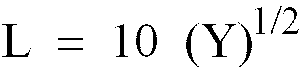
[0036] The equations (5) and (7) make it clear that Hunter's b is not independent of lightness.
L, the Hunter lightness coordinate, is 10 (Y)
1/2 and is a measure of the lightness of color, i.e., luminous reflectance. Hunter's
b is weighted by this coordinate, as follows:
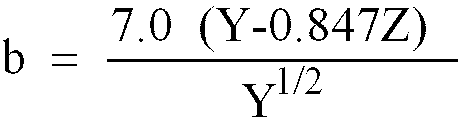
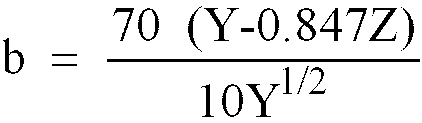
or
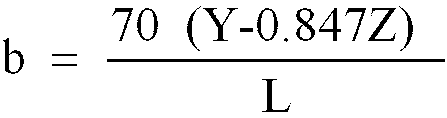
So the Hunter value b can be described as a yellow-blue factor consisting of the
difference between (1) a function measuring the yellow content of the color and (2)
a function measuring the blue content of the color, the difference being suitably
weighted by (3) a term that is a function of the lightness (luminous reflectance)
of the color, the function measuring the yellow content having maximum weighting in
what is substantially the yellow to red region of the spectrum and the function measuring
the blue content of the color having maximum weighting in what is substantially the
blue region of the spectrum.
[0037] For greater accuracy, multiple Y, x and y readings can be made with the calorimeter
10 as suggested in the steps of the method outlined in Figure 2, in which case the
computer 15 simply averages the values Y, x, y for greater accuracy in the calculation
of b. With the b value of the color of the skin 11 now available, the CPU 15 compares
that with predetermined ranges of b values empirically identified with categories
of skin coloration and stored in memory 17. This division of the total range of b
values into individual ranges that define skin color categories was quite different
from the use of multiple values to define color and proved surprisingly repeatable
and accurate. Assignments of category based on measurement and b value calculation
agree with visual assessments. The ranges of b values corresponding to, for example,
four skin color categories are stored in the memory 17. For cheek measurement, based
on assessments of thousands of individuals, the boundaries between the four ranges
appear to be at substantially 11.2, 12.7 and 14.3.
[0038] Some shifting of the ranges of b value occurs in dependence on the location of the
skin where assessment occurs. For example, utilizing the back of the subject's hand,
boundaries between the exemplary four ranges appear to occur at 9.8, 11.0 and 12.1.
This is believed to be a function of the number and visibility of blood vessels at
that location. In either case the lowermost range, that of category I, consists of
b values below the lowest boundary value. The next higher range, that of category
II, is between that lowest boundary value and the next higher boundary value, which
is the middle value. The next range, that of category III, is from the middle value
to the highest boundary value, and the fourth and highest range, that of category
IV, consists of all b values above the highest dividing value.
[0039] As for the assignment of particular colors of fabric and the like to categories compatible
with the four skin color categories, the following colors, identified by CIE Y, x,
y values have been identified and categorized. In the following tabulation of fabric
colors, color category I is the category compatible with skin category I, corresponding
to the lowest Hunter b value range of skin measurement (i.e. below about 11.2, cheek
measurement), color category II represents compatibility with the next higher skin
color category II (from about 11.2 to 12.7, cheek measurement), color category III
represents colors compatible with the to 14.3, cheek measurement), and color category
IV represents compatibility with the highest category IV of skin color (above about
14.3, cheek measurement).
TABLE I
| |
Y |
x |
y |
Category |
| Yellow Color Family |
| |
71.2 |
0.339 |
0.363 |
I |
| |
73.8 |
0.344 |
0.375 |
II |
| |
71.6 |
0.386 |
0.433 |
III |
| |
60.5 |
0.441 |
0.465 |
IV |
| |
30.9 |
0.481 |
0.438 |
III |
| |
23.5 |
0.471 |
0.410 |
III |
| Orange Color Family |
| |
22.7 |
0.543 |
0.367 |
III |
| |
46.1 |
0.443 |
0.407 |
IV |
| |
42.9 |
0.438 |
0.404 |
IV |
| |
31.1 |
0.491 |
0.415 |
IV |
| |
33.6 |
0.544 |
0.402 |
IV |
| |
14.2 |
0.520 |
0.362 |
III |
| |
9.9 |
0.481 |
0.366 |
III |
| |
24.9 |
0.529 |
0.364 |
III |
| Red Color Family |
| |
8.0 |
0.495 |
0.297 |
I |
| |
7.3 |
0.526 |
0.304 |
II |
| |
20.2 |
0.429 |
0.327 |
II |
| |
9.6 |
0.451 |
0.284 |
I |
| |
5.0 |
0.460 |
0.294 |
I |
| |
3.6 |
0.469 |
0.302 |
I |
| |
45.3 |
0.574 |
0.344 |
IV |
| |
13.9 |
0.554 |
0.335 |
III |
| |
11.4 |
0.567 |
0.328 |
III |
| |
17.0 |
0.575 |
0.344 |
IV |
| Beige Color Family |
| |
57.2 |
0.376 |
0.390 |
IV |
| |
43.7 |
0.370 |
0.380 |
IV |
| |
57.2 |
0.378 |
0.391 |
IV |
| |
55.6 |
0.358 |
0.372 |
III |
| |
31.8 |
0.370 |
0.380 |
IV |
| |
37.2 |
0.361 |
0.377 |
IV |
| |
56.9 |
0.348 |
0.359 |
II |
| Brown Color Family |
| |
2.3 |
0.355 |
0.325 |
I |
| |
20.3 |
0.354 |
0.351 |
II |
| |
5.8 |
0.359 |
0.345 |
II |
| |
7.6 |
0.362 |
0.350 |
II |
| |
39.6 |
0.396 |
0.386 |
IV |
| |
21.9 |
0.391 |
0.374 |
IV |
| |
22.3 |
0.402 |
0.385 |
IV |
| |
4.5 |
0.394 |
0.349 |
II |
| |
4.0 |
0.420 |
0.351 |
II |
| |
7.5 |
0.402 |
0.371 |
II |
| Pink Color Family |
| |
43.7 |
0.393 |
0.285 |
I |
| |
22.7 |
0.437 |
0.288 |
I |
| |
19.8 |
0.422 |
0.283 |
I |
| |
14.0 |
0.381 |
0.319 |
II |
| |
33.8 |
0.363 |
0.333 |
II |
| |
57.8 |
0.357 |
0.302 |
II |
| |
47.6 |
0.369 |
0.313 |
II |
| |
25.7 |
0.384 |
0.302 |
II |
| |
38.3 |
0.355 |
0.314 |
II |
| |
9.2 |
0.433 |
0.256 |
I |
| |
26.9 |
0.374 |
0.332 |
II |
| |
41.4 |
0.465 |
0.380 |
IV |
| |
44.9 |
0.408 |
0.350 |
III |
| |
45.2 |
0.393 |
0.366 |
IV |
| |
47.4 |
0.383 |
0.375 |
IV |
| |
26.0 |
0.463 |
0.341 |
III |
| |
37.3 |
0.419 |
0.381 |
IV |
| |
23.7 |
0.473 |
0.359 |
III |
| Purple Color Family |
| |
5.5 |
0.282 |
0.200 |
III |
| |
4.4 |
0.277 |
0.205 |
III |
| |
12.2 |
0.292 |
0.236 |
III |
| |
33.0 |
0.288 |
0.266 |
II |
| |
9.4 |
0.285 |
0.209 |
I |
| |
40.1 |
0.322 |
0.286 |
IV |
| |
15.5 |
0.355 |
0.241 |
IV |
| |
3.3 |
0.285 |
0.247 |
III |
| |
11.3 |
0.260 |
0.232 |
II |
| Blue Color Family |
| |
61.5 |
0.301 |
0.320 |
IV |
| |
18.0 |
0.245 |
0.242 |
I |
| |
9.0 |
0.226 |
0.222 |
I |
| |
4.2 |
0.237 |
0.223 |
I |
| |
2.3 |
0.278 |
0.260 |
II |
| |
47.1 |
0.281 |
0.300 |
II |
| |
38.4 |
0.264 |
0.289 |
II |
| |
26.8 |
0.247 |
0.257 |
II |
| |
21.6 |
0.248 |
0.248 |
I |
| |
10.6 |
0.271 |
0.279 |
II |
| |
5.4 |
0.267 |
0.266 |
II |
| |
8.3 |
0.253 |
0.267 |
II |
| |
3.6 |
0.240 |
0.254 |
II |
| |
4.9 |
0.258 |
0.249 |
I |
| |
35.4 |
0.229 |
0.288 |
III |
| |
26.9 |
0.233 |
0.259 |
II |
| |
7.6 |
0.193 |
0.187 |
I |
| |
38.0 |
0.266 |
0.309 |
IV |
| |
23.1 |
0.240 |
0.330 |
IV |
| |
10.3 |
0.216 |
0.281 |
III |
| Green Color Family |
| |
15.8 |
0.255 |
0.433 |
III |
| |
5.0 |
0.256 |
0.356 |
I |
| |
48.3 |
0.303 |
0.398 |
II |
| |
47.4 |
0.282 |
0.371 |
II |
| |
25.1 |
0.252 |
0.397 |
II |
| |
52.2 |
0.337 |
0.478 |
IV |
| |
54.2 |
0.328 |
0.432 |
III |
| |
59.0 |
0.336 |
0.416 |
III |
| |
15.3 |
0.364 |
0.425 |
III |
| |
18.5 |
0.275 |
0.362 |
II |
| |
13.1 |
0.269 |
0.437 |
III |
| |
3.4 |
0.275 |
0.337 |
I |
| White Color Family |
| |
67.9 |
0.334 |
0.351 |
IV |
| |
73.0 |
0.313 |
0.329 |
I |
| |
74.1 |
0.332 |
0.352 |
IV |
| Grey Color Family |
| |
44.7 |
0.314 |
0.329 |
I |
| |
45.1 |
0.317 |
0.329 |
I |
| |
42.6 |
0.311 |
0.332 |
II |
| |
32.6 |
0.313 |
0.328 |
I |
| |
16.1 |
0.315 |
0.329 |
I |
| |
52.6 |
0.313 |
0.333 |
II |
| |
55.5 |
0.313 |
0.327 |
I |
| Black Color Family |
| |
4.3 |
0.291 |
0.290 |
I |
| |
2.7 |
0.285 |
0.275 |
I |
| |
2.1 |
0.299 |
0.295 |
I |
| |
3.3 |
0.298 |
0.312 |
I |
| |
3.6 |
0.308 |
0.316 |
I |
TABLE II
| Spectral Reflectances And Color Coordinates |
| Wavelength, nm |
Skin standard |
Formulation |
Tile, correct |
Tile, adjusted |
| 400 |
19.03 |
20.70 |
21.51 |
16.67 |
| 420 |
18.96 |
20.69 |
21.10 |
16.93 |
| 440 |
21.53 |
21.68 |
20.99 |
17.65 |
| 460 |
25.35 |
24.43 |
23.27 |
20.56 |
| 480 |
28.06 |
28.30 |
27.82 |
25.67 |
| 500 |
30.13 |
30.77 |
29.03 |
27.94 |
| 520 |
31.19 |
31.31 |
29.38 |
28.24 |
| 540 |
30.01 |
30.84 |
28.48 |
27.59 |
| 560 |
31.41 |
30.76 |
28.22 |
27.33 |
| 580 |
32.85 |
34.01 |
31.49 |
30.12 |
| 600 |
44.37 |
43.54 |
42.58 |
40.52 |
| 620 |
51.24 |
51.57 |
51.27 |
47.93 |
| 640 |
54.56 |
55.09 |
55.56 |
51.10 |
| 660 |
57.09 |
57.60 |
59.22 |
53.82 |
| 680 |
58.67 |
60.41 |
61.82 |
56.55 |
| 700 |
59.95 |
62.69 |
63.93 |
58.87 |
| X |
37.14 |
37.28 |
36.14 |
33.76 |
| Y |
34.66 |
34.89 |
33.07 |
31.53 |
| Z |
28.50 |
28.54 |
27.63 |
24.20 |
| x |
0.3703 |
0.3702 |
0.3732 |
0.3732 |
| y |
0.3456 |
0.3464 |
0.3415 |
0.3523 |
| L |
58.87 |
59.07 |
57.51 |
56.15 |
| a |
9.31 |
9.02 |
11.54 |
9.05 |
| b |
12.51 |
12.70 |
11.77 |
13.75 |
[0040] From the fabric colors studied, the 117 colors of Table I, it appears that characteristics
of colors compatible with the four skin color categories identified above can be identified.
From these instrumentally derived color coordinates, rules were derived for obtaining
compatible skin color categories that agree with the categories assigned subjectively
by those skilled in the art.
[0041] It has been found that Hunter b is also satisfactory for assigning compatible skin
color categories to a wider range of colors than just those of the skin, as long as
these colors are in the color families described by the common terms yellow, gold,
orange, red, or white. For colors of fabric or other types of objects (excluding skin
and cosmetics) in families other than yellow, gold, orange, red and white, b alone
does not provide enough information to assign compatible categories correctly, nor
do any of the other color coordinates defined by the CIE or otherwise described in
the literature. Several new color coordinates were therefore devised and found suitable
for this purpose. They are modifications of the Hunter L, a, and b coordinates, based
by analogy on similar coordinates defined by the CIE in 1976. They are:

where tan
-1 stands for the arctangent function;


(where the factor of 100 has been introduced to make the range of numerical values
of s
H the same order of magnitude
[0042] Hue angle is a measure, in degrees, of the position of the color in the familiar
hue circle, whose major color families are, in order, red, orange, yellow, green,
blue, and purple. In the Hunter and CIE systems, these are arranged in counterclockwise
order starting with red on the right, with Hunter hue angles from near zero to about
30°. Oranges have h
H between 30 and 60°, yellows up to about 120°, greens to about 180°, blues to about
300°, and purples between 300 and 360° (which is the same as 0°).
[0043] Chroma is a measure of the "intensity" of a color that is valid for any color family
in the same way that Hunter b is for the pure yellow colors described above. Chroma
can be thought of as the distance, on a color chart, between the color in question
and a grey of the same lightness.
[0044] Saturation is similar to chroma in that it describes the "intensity" of color, but
it is modified to account for the effect of changing lightness on this perception.
Purists in colorimetry would say that saturation should not be defined in the Hunter
system, but it has been found to be a useful concept even if it does not meet the
strict mathematical criteria of the CIE definition.
[0045] In the following, for non-skin matter other than cosmetics, the characteristics that
appear to lead to compatibility are described for each color family represented in
the colors studied; all major families are included. Again the exemplary four category
system is used. The discussion applies to colored objects that are not fluorescent.
Fluorescence may result in departure from the first briefly described, and the rules
for assigning color categories are then presented for that family. The discussion
starts with the yellow family and proceeds clockwise around the color circle so as
to start with simple cases and progress to more complex ones. The fabric colors have
been grouped into categories (I - IV) that correspond to the categories of skin color
with which they are compatible.
Yellow
[0046] The family of yellow colors, including golds, is categorized by use of the Hunter
coordinate b. The limits on b for the various categories are:
I - b less than 19
II - b between 19 and 25
III - b between 25 and 40
IV - b greater than 40.
Orange
[0047] The orange family is limited to light colors of relatively high chroma, as lower
chroma colors are recognized as beige, if light, or brown, if dark. There are only
categories III and IV represented in the orange family. Hunter b suffices to categorize
these colors:
III - b less than 28
IV - b greater than 28.
Red
[0048] Despite the fact that these colors deviate markedly from the yellow-blue axis of
Hunter space by having positive values of a, the coordinate b still suffices to categorize
them:
I - b less than 9
II - b between 9 and 15
III - b between 15 and 20
IV - b greater than 20.
Beige
[0049] This family includes light colors with lower saturation or chroma than the yellows.
Their hue angles are near 95°. There are no category I colors in this family. The
beiges are categorized by Hunter saturation s
H as follows:
II - sH less than 25
III - sH between 25 and 28
IV - sH greater than 28.
Brown
[0050] The brown family is slightly redder and significantly darker than the beige. Its
hue angle is near 60°. It is best categorized by Hunter chroma C
H, as follows:
I - cH less than 5
II - cH between 5 and 9.5
III - cH between 9.5 and 12
IV - cH greater than 12.
Pink
[0051] This color family is difficult to categorize because it includes both yellowish pinks
(peaches) and purplish pinks. These two may be distinguished by different ranges of
Hunter b. The yellowish pinks include the category III and category IV colors, and
these are separated by their different lightness levels. The purplish pinks include
the category II and category I colors, and these are separated
I - b less than 15 and sH greater than 60
II - b less than 15 and sH less than 60
III - b greater than 15 and L less than 60
IV - b greater than 15 and L greater than 60.
Purple
[0052] This color family encompasses a wide range of hue angles. Both this quantity and
the saturation s
H must be considered to define the categories involved. The rules are:
I - sH less than 70 and hH less than 320°
II - sH between 50 and 70 and hH less than 320°
III - sH between 50 and 60 if hH less than 320° and sH greater than 50 if hH greater than 320°
IV - sH less than 50, with no restriction on hH.
Blue
[0053] The colors in the blue family cover a wide range of hue angles, and this quantity
has a major effect on their category. Together with restrictions on Hunter b, they
can be categorized as follows. Note that values of Hunter b are negative, characteristic
of blue rather than yellow colors. In this context, "less than" means more negative
and "greater than" means less negative. The rules are:
I - b less than -10 and hH greater than 270°
II - b greater than -10 for hH greater than 270° and b less than - 8.5 for hH between 270° and 230°
III - b less than -8 and hH between 230° and 210°
IV - b greater than -8 and hH less than 210°.
Green
[0054] The green family is also complex, including both this family, a variety of color
coordinates must be specified:
I - hH greater than 170°
II - hH between 140° and 170° and sH less than 70
III - sH greater than 70 for hH greater than 140°; no restriction on sH for hH less than 140°
IV - b greater than 30.
White
[0055] Although white fabric colors of category I exist, with values of Hunter b less than
approximately 5, none was included among the samples tested. Likewise, the limits
for categories III and IV are not fully defined. Tentative limits are:
I - b less than 5
II - b between 5 and 10
III or IV - b greater than 10.
Grey
[0056] This family consists of relatively light greys, all falling in categories I or II.
They are best differentiated by saturation, which is always quite small for these
near-neutral colors:
I - sH less than 8
II - sH greater than 8.
Black
[0057] All blacks, which include very dark greys, are in the category I. The family can
be defined by upper limits on its saturation and lightness:
I - s
H less than 30 and L less than 25.
Cosmetics
[0058] In a similar study of cosmetic colors, the same exemplary four color categories were
used. Again, the characteristics of colors compatible with these skin color categories
can be identified and rules can be derived from the instrumentally measured color
coordinates for obtaining compatible skin color categories that agree with the categories
assigned subjectively by those skilled in the art.
[0059] In the following, the categories that lead to compatibility for cosmetic colors are
given for the same color families described above. The same limitation to nonfluorescent
colors applies. For cosmetic colors, the characteristic Hunter b suffices to establish
the major boundary separating categories I and II from categories III and IV. In most
color families, for cosmetic colors, it is desirable to define the remaining two boundaries,
between categories I and II and between categories III and IV, in an overlapping fashion
to allow for the effect of widely differing skin colors. The second color family considered,
Red and orange, provides an example of this practice.
Yellow
[0060] The small number of cosmetics in the yellow color family, which also includes golds
and related colors, allows establishment of the major boundary separating categories
I and II from categories III and IV at b = 12.5, but does not allow estimation of
the boundaries between categories I and II and between categories III and IV.
Red and Orange
[0061] It is expedient to consider these two colors as a single color family. For these
colors, the major boundary separating categories I and II from categories III and
IV occurs at b = 9.5. The boundary between categories I and II normally occurs at
b = 5.0, but when considering many of the darker skin colors, for example, the upper
boundary of category I can be higher as required, but cannot exceed the upper boundary
of category II, b = 9.5. Similarly, the boundary between categories III and IV normally
occurs at b = 12.8, but when considering skin colors of many persons of a Hispanic
background, for example, the upper boundary of category III can be higher as required.
These statements can be summarized by the following mathematical equations:
I - b ≤ 9.5
II - 5.0 < b ≤ 9.5
III - b > 9.5
IV - b ≥ 12.8. where the signs < ("less than"), ≤ ("less than or equal to"), > ("greater
than"), and ≥ ("greater than or equal to"), have their usual mathematical meanings.
This abbreviated form of the description is used where appropriate in the following
descriptions of color families and their categories.
Beige and Brown
[0062] It is convenient to combine these two similar color families. The categories are
described by the following values of Hunter b:
I - b ≤ 7.6
III - b > 7.6
IV - b ≥ 9.6.
Pink
[0063] This color family includes such colors as peach. The categories are described by
the following values of Hunter b:
I - b ≤ 9.5
II - -2.4 < b ≤ 9.5
III - b > 9.5
IV - b ≥ 11.8.
Purple
[0064] Included in the purple family are violet, lavender, and similar colors. The majority
of these colors fall in categories I and II. The description of these categories in
terms of Hunter b is as follows:
I - b ≤ 5.6
II - -14.5 < b ≤ 5.6.
An exceptional case occurs, for reasons not now known to us, when for a color in
this family Hunter L ≤ 30, a ≤ 10, and b ≤ -25. In such a case, visual inspection
shows that the color is compatible with skin colors in category III.
Blue
[0065] The category boundaries for this color family in terms of Hunter b are as follows:
I - b ≤ -14.5
II - -18.8 < b ≤ -14.5
III - b > -14.5
IV - b ≥ -1.8.
Green
[0066] The category boundaries for this color family can be established in terms of Hunter
b as follows:
I - b ≤ -1.8
II - -3.1 < b ≤ -1.8
III - b > 1.8
IV - b ≥ 4.9.
White
[0067] The very small number of white cosmetics allows only the definition of the major
boundary separating categories I and II from categories III and IV. This occurs at
Hunter b = 6.0.
Grey
[0068] Grey cosmetics are all in categories I or II, with Hunter b < 1.0. It is not possible
to define the boundary between these categories.
Black
[0069] As with the grey family, the black cosmetics are all in categories I and II, with
Hunter b < 0. It is not possible to establish the boundary between these categories.
Foundation Colors
[0070] The above rules apply to all cosmetic colors except for the brown or beige foundation
colors. The selection of these colors depends not only on Hunter b, but also on the
lightness of the skin color to which the foundation is to be applied, as measured
by Hunter L, according to the following:
Dark skin, L < 40
Medium dark skin, L < 50
Light skin, L ≥ 59.
Within these skin-lightness categories, it is possible to establish the boundary
separating categories I and II from categories III and IV at the following values
of Hunter b:
Dark skin, b = 12.0
Medium dark skin, b = 12.3
Medium skin, b=12.5
Light skin, b=12.8.
[0071] An instrument, having the same general configuration as that of Figure 1, for carrying
out this process can make the initial choice of family (via software) based on measurement,
or can have family designation input by the operator to control the subsequent measuring,
calculating, comparing and assigning steps effected by easily accomplished programming
choosing comparison subroutines based on color family either input manually or measured.
The necessary measurements are made and calculations of the appropriate characteristics
are carried out by the CPU. Comparison with stored ranges of characteristics for the
identified family are made and a category (or categories) I - IV is assigned signifying
compatibility with a like-identified skin color category.
[0072] When new product colors are formulated, the foregoing measurable characteristics
can be used to arrive at colors compatible with each category of skin coloration.
A particular color family can thus be represented for each category of skin coloration.
In clothing, cosmetics, and accessories each prospective consumer can be assured of
a Similar product colors can also be made available to persons of differing skin color
categories. For each color family the correction of a particular color to bring it
into one or another of the categories that correspond to skin color categories can
be achieved by altering the formulation. In other words, adding or subtracting blue
or yellow can move a product's classification to a desired category. In the art, correction
of blue or yellow is achieved by appropriate adjustment of a blue or yellow content
adjusting colorant of the original formulation. Repeated measurements of the parameters
identified above for the various color families will confirm proper color correction
for a particular classification or will indicate the need for additional correction.
Correct representation of colors of products in printed advertising can be achieved
in this way and printed color charts accurately reproducing product colors for such
products as apparel and cosmetics can be achieved, whereas previously printed representations
of product colors were very often inaccurate.
[0073] Color charts can be accurately assembled for other than cosmetics and for cosmetics.
As indicated by the chart 20 in Fig. 4, product colors gathered together in association
with their compatible skin color categories can be accurately assembled by adjusting
color representations 22 associated with each skin color category designation 24 in
conformance with the ranges described above for each color family. Of course, each
product color representation 22 can be labeled by a color designating product color
name or number. For cosmetics and for products other than four classifications of
skin coloration as described above. Shown in Fig. 5, swatch packs 30 of colored fabric
samples 32, correctly colored for a particular skin coloration, should gather together
samples with fabric colorings as established above. Similarly, beige and brown foundation
colors are assembled and classified, either on the same cosmetic color charts, or
on separate charts, based on skin darkness as well as skin color classification, again
as described above. In Fig. 6, two regions 40 and 42 of a foundation cosmetic color
chart 44 are broken down by skin darkness categories 45 based on the Hunter L values
described above. The chips or representations 47 accurately portraying the brown and
beige foundation colors are then formulated and arranged to accurately identify the
classifications of these products.
[0074] The above specific preferred embodiments of the invention are illustrative and may
be modified as will be readily understood by those skilled in the art without departure
from the scope of the invention, as set out in the appended claims.
1. A process of making a color chart or a swatch pack, having representations of colors
assigned for compatibility to at least one category of a plurality of categories of
skin coloration,
characterized by the steps of:
(a) providing said at least one category of a plurality of categories of skin coloration
based exclusively upon skin color content in the bluer to yellower regions of a spectrum
as established by a color factor in the skin coloration, said factor comprising a
first function weighted in a yellower portion of the spectrum, a second function weighted
in the blue portion of the spectrum and a term that is a function of the lightness
of the color, and
(b) assigning at least one of said color representations to at least one category
of said plurality of categories of skin coloration based upon a measured color characteristic
predetermined to establish compatibility of the color representation to said at least
one category, said color characteristic being dependent at least in part on lightness.
2. A process according to claim 1, including providing at least one category of skin
coloration of a plurality of categories of skin coloration having at least one boundary
value of said color factor between bluer and yellower regions of skin coloration as
defined by ranges of values of said color factor defining the plurality of categories.
3. A process according to claim 1, wherein the representations of colors are assigned
for compatibility to a plurality of categories of skin coloration that are determined
without reference to race.
4. A process according to any of the preceding claims, wherein the colour factor is substantially
that of Hunter b.
5. A process according to claim 4 when dependent on claim 2, wherein said at least one
boundary value is within a range of values of Hunter b from substantially 11.0 to
12.7, dependent upon the physical location on an individual person where skin color
is measured.
6. A process according to claim 4 when dependent on claim 2, wherein providing said categories
of skin coloration includes establishing four categories of skin coloration having
boundaries at Hunter b values of substantially 11.2, 12.7, and 14.3, that represent
the boundaries of categories of skin color measured at the cheek.
7. A process according to claim 4 when dependent on claim 2, wherein providing said categories
of skin coloration includes establishing four categories of skin coloration having
boundaries at Hunter b values of substantially 9.8, 11.0, and 12.1 that represent
the boundaries of categories of skin color measured at the back of the hand.
8. A process according to any of the preceding claims wherein the color characteristic
is a blue or yellow content color characteristic.
9. A process according to claim 8, wherein the color characteristic is selected from
a group consisting of Hunter b, Hunter chroma CH, Hunter saturation sH and Hunter hue angle hH.
10. A process as claimed in claim 1, wherein the representations of colors of non-skin
matter include representations that are blue, green, beige, white, grey or black.
11. A process as claimed in claim 1, wherein said color characteristic of the color representations
is adjustable for skin color compatibility by a blue or yellow content colorant.
12. A color chart bearing representations of colors of non-skin matter, said chart having
at least one region thereon identified solely by a skin coloration category based
exclusively upon skin color content in the bluer and yellower regions of the spectrum,
as established by the value of a color factor in the skin coloration, said color factor
comprising a first function weighted in a yellower portion of the spectrum, a second
function weighted in the blue portion of the spectrum and a term that is a function
of the lightness of a color, a plurality of non-skin color representations in the
at least one region, each color representation in the at least one region having at
least one measured color characteristic predetermined to establish compatibility with
skin color of the associated skin coloration category, said measured color characteristic
being dependent at least in part on lightness.
13. A color chart according to claim 12, wherein said at least one region comprises a
plurality of regions that are identified solely by skin coloration categories based
on skin color content in said bluer and yellower regions of the spectrum, the skin
coloration categories being determined without reference to race.
14. A color chart according to claim 12, wherein the color characteristic is a blue or
yellow content color characteristic.
15. A color chart according to claim 12, wherein said color characteristic is selected
from the group consisting of Hunter b, Hunter chroma CH, Hunter saturation sH and Hunter hue angle hH.
16. A color chart according to claim 12, wherein said non-skin color representations in
the at least one region include representations of at least a plurality of the following
colors: yellow with a Hunter b less than 19, red with a Hunter b less than 9, brown
with a Hunter chroma CH less than 5, pink with a Hunter b less than 15 and a Hunter saturation sH greater than 60, purple with a Hunter saturation sH less than 70 and a Hunter hue angle hH less than 320°, blue with a Hunter b less than -10 and a Hunter hue angle hH greater than 270°, green with a Hunter hue angle hH greater than 170°, white with a Hunter b less than 5, grey with a Hunter saturation
sH less than 8, and black.
17. A color chart according to claim 12, wherein said non-skin color representations in
the at least one region including representations of at least a plurality of the following
colors: yellow with a Hunter b between 19 and 25, red with a Hunter b between 9 and
15, beige with a Hunter saturation sH less than 25, brown with a Hunter chroma CH between 5 and 9.5, pink with a Hunter b less than 15 and a Hunter saturation sH less than 60, purple with a Hunter saturation sH between 50 and 70 and a Hunter hue angle hH less than 320°, blue with a Hunter b greater than -10 for a Hunter hue angle hH greater than 270° and less than -8.5 for a Hunter hue angle hH between 270° and 230°, green with a Hunter hue angle hH between 140° and 170° and Hunter saturation sH less than 70, white with a Hunter b between 5 and 10, grey with a Hunter saturation
sH greater than 8.
18. A color chart according to claim 12, wherein said non-skin color representations in
the at least one region including representations of at least a plurality of the following
colors: yellow with a Hunter b between 25 and 40, orange with a Hunter b less than
28, red with a Hunter b between 15 and 20, beige with a Hunter saturation sH between 25 and 28, brown with a Hunter chroma CH between 9.5 and 12, pink with a Hunter b greater than 15 and a Hunter L less than
60, purple with a Hunter saturation sH between 50 and 60 if Hunter hue angle sH is less than 320° and greater than 50 if Hunter hue angle hH is greater than 320°, blue with a Hunter b greater than -8 and a Hunter hue angle
hH between 230° and 210°, green with a Hunter saturation sH greater than 70 for a Hunter hue angle hH greater than 140° and no restriction on Hunter saturation sH for Hunter hue angle hH less than 140°, white with a Hunter b greater than 10.
19. A color chart according to claim 12, wherein said non-skin color representations in
the at least one region including representations of at least a plurality of the following
colors: yellow with a Hunter b greater than 40, orange with a Hunter b greater than
28, red with a Hunter b greater than 20, beige with a Hunter saturation sH greater than 28, brown with a Hunter chroma CH greater than 12, pink with a Hunter b greater than 15 and a Hunter L greater than
60, purple with a Hunter saturation sH less than 50 and no color chart restriction on Hunter hue angle hH, blue with a Hunter b greater than -8 and a Hunter hue angle hH less than 210°, green with a Hunter b greater than 30, white with a Hunter b greater
than 10.
20. A color chart according to claim 12, wherein the color chart is a cosmetic color chart,
and said non-skin color representations in the at least one region including cosmetic
representations of at least a plurality of the following colors: yellow with a Hunter
b less or equal to 12.5, red with a Hunter b less than or equal to 9.5, orange with
a Hunter b less than or equal to 9.5, beige with a Hunter b less than or equal to
7.6, brown with a Hunter b less than or equal to 7.6, pink with a Hunter b less than
or equal to 9.5, purple with a Hunter b less than or equal to 5.6, blue with a Hunter
b less than or equal to -14.5, green with a Hunter b less than or equal to -1.8, white
with a Hunter b less than or equal to 6.0, grey with a Hunter b less than 1.0 and
black with a Hunter b less than 0.
21. A color chart according to claim 12, wherein the color chart is a cosmetic color chart,
and said non-skin color representations in the at least one region including cosmetic
representations of at least a plurality of the following colors: yellow with a Hunter
b less than or equal to 12.5, red with a Hunter b greater than 5.0 and less than or
equal to 9.5, orange with a Hunter b greater than 5.0 and less than or equal to 9.5,
beige with a Hunter b greater than 4.6 and less than or equal to 7.6, brown with a
Hunter b greater than 4.6 and less than or equal to 7.6, pink with a Hunter b greater
than -2.4 and less than or equal to 9.5, purple with a Hunter b greater than -14.5
and less than or equal to 5.6, blue with a Hunter b greater than -18.8 and less than
or equal to -14.5, green with a Hunter b greater than -3.1 and less than or equal
to -1.8, white with a Hunter b less than or equal to 6.0, grey with a Hunter b less
than 1.0, and black with a Hunter b less than 0.
22. A color chart according to claim 12, wherein the color chart being a cosmetic color
chart, and said non-skin color representations in the at least one region including
cosmetic representations of at least a plurality of the following colors: yellow with
a Hunter b greater than or equal to 12.5, red with a Hunter b greater than 9.5, orange
with a Hunter b greater than 9.5, beige with a Hunter b greater than 7.6, brown with
a Hunter b greater than 7.6, pink with a Hunter b greater than 9.5, purple with a
Hunter L less than or equal to 30, a Hunter a less than or equal to 10 and a Hunter
b less than or equal to -25, blue with a Hunter b greater than -14.5, green with a
Hunter b greater than 1.8, and white with a Hunter b greater than 6.0.
23. A color chart according to claim 12, wherein the color chart is a cosmetic color chart,
and said non-skin color representations in the at least one region including cosmetic
representations of at least a plurality of the following colors: yellow with a Hunter
b greater than or equal to 12.5, red with a Hunter b greater than or equal to 12.8,
orange with a Hunter b greater than or equal to 12.8, beige with a Hunter b greater
than or equal to 9.6, brown with a Hunter b greater than or equal to 9.6, pink with
a Hunter b greater than or equal to 11.8, blue with a Hunter b greater than or equal
to -1.8, green with a Hunter b greater than or equal to 4.9 and white with a Hunter
b greater than or equal to 6.
24. A color chart according to claim 12 or 20 or 21, wherein the at least one region includes
at least one of the following cosmetic foundation colors: a brown or beige foundation
color with a Hunter b less than or equal to 12.0 and designated for dark skin, a brown
or beige foundation color with a Hunter b less than or equal to 12.3 designated for
medium dark skin, a brown or beige foundation color with a Hunter b less than or equal
to 12.5 designated for medium skin, and a brown or beige foundation color with a Hunter
b less than or equal to 12.8 designated for light skin; where dark skin is skin with
a Hunter L less than 40, medium dark skin is skin with a Hunter L less than 50, medium
skin is skin with a Hunter L less than 59, and light skin is skin with a Hunter L
greater than or equal to 59.
25. A color chart according to claim 12 or 22 or 23, wherein the at least one region includes
at least one of the following cosmetic foundation colors: a brown or beige foundation
color with a Hunter b less than or equal to 12.0 and designated for dark skin, a brown
or beige foundation color with a Hunter b less than or equal to 12.3 designated for
medium dark skin, a brown or beige foundation color with a Hunter b less than or equal
to 12.5 designated for medium skin, and a brown or beige foundation color with a Hunter
b less than or equal to 12.8 designated for light skin; where dark skin is skin with
a Hunter L less than 40, medium dark skin is skin with a Hunter L less than 50, medium
skin is skin with a Hunter L less than 59, and light skin is skin with a Hunter L
greater than or equal to 59.
26. A color chart according to claim 12, wherein the color chart is a cosmetic foundation
color chart, said chart having at least two regions associated with at least two skin
color classifications and skin darkness designations based upon Hunter L values less
than 40 for a dark skin designation, less than 50 for a medium dark skin designation,
less than 59 for a medium skin designation, and greater than or equal to 59 for a
light skin designation, and brown and beige color representations having Hunter b
less than or equal to 12 for dark skin in one of the regions and Hunter b greater
than 12 for the dark skin designation in another of the regions, Hunter b less than
or equal to 12.3 for the medium dark skin designation in the one region, and Hunter
b greater than 12.3 for the medium dark skin designation in the other region, Hunter
b less than or equal to 12.5 for the medium skin designation in the one region and
Hunter b greater than 12.5 for the medium skin designation in the other region, and
Hunter b less than or equal to 12.8 for the light skin designation in the one region
and Hunter b greater than 12.8 for the light skin designation in the other region.
27. A color chart as claimed in claim 12, wherein said representations of colors of non-skin
matter include representations that are blue, green, beige, white, grey, or black.
28. A color chart as claimed in claim 12, wherein said color characteristic of the color
representation is adjustable for skin color compatability by a blue or yellow content
adjusting colorant.
29. A swatch pack of fabric samples characterized by having assembled for association with one category of skin coloration based exclusively
on skin color content in the bluer and yellower regions of the spectrum, as established
by a value of a color factor comprising a first function weighted in a yellower portion
of the spectrum, a second function weighted in the blue portion of the spectrum and
a term that is a function of the lightness, a plurality of fabric colors including
colors from at least a plurality of color families, yellow, red, brown, pink, purple,
blue, green, white, grey and black, each fabric color of any one of said color families
having at least one color factor value in a range of values of said color factor predetermined
to determine color compatability with said category of skin coloration.
30. A swatch pack of fabric samples according to claim 29, wherein the fabric colors include
at least a plurality of the following colors: yellow with a Hunter b less than 19,
red with a Hunter b less than 9, brown with a Hunter chroma CH less than 5, pink with a Hunter b less than 15 and a Hunter saturation sH greater than 60, purple with a Hunter saturation sH less than 70 and a Hunter hue angle hH less than 320°, blue with a Hunter b less than -10 and a Hunter hue angle hH greater than 270°, green with a Hunter hue angle hH greater than 170°, white with a Hunter b less than 5, grey with a Hunter saturation
sH less than 8, and black.
31. A swatch pack of fabric samples according to claim 29, wherein the fabric colors include
at least a plurality of the following colors: yellow with a Hunter b between 19 and
25, red with a Hunter b between 9 and 15, beige with a Hunter saturation sH less than 25, brown with a Hunter chroma CH between 5 and 9.5, pink with a Hunter b less than 15 and a Hunter saturation sH less than 60, purple with a Hunter saturation sH between 50 and 70 and a Hunter hue angle hH less than 320°, blue with a Hunter b greater than -10 for a Hunter hue angle hH greater than 270° and less than -8.5 for a Hunter hue angle hH between 270° and 230°, green with a Hunter hue angle hH between 140° and 170° and Hunter saturation sH less than 70, white with a Hunter b between 5 and 10, grey with a Hunter saturation
sH greater than 8.
32. A swatch pack of fabric samples according to claim 29, wherein the fabric colors include
at least a plurality of the following colors: yellow with a Hunter b between 25 and
40, orange with a Hunter b less than 28, red with a Hunter b between 15 and 20, beige
with a Hunter saturation sH between 25 and 28, brown with a Hunter chroma CH between 9.5 and 12, pink with a Hunter b greater than 15 and a Hunter L less than
60, purple with a Hunter saturation sH between 50 and 60 if Hunter hue angle sH is less than 320° and greater than 50 if Hunter hue angle hH is greater than 320°, blue with a Hunter b greater than -8 and a Hunter hue angle
hH between 230° and 210°, green with a Hunter saturation sH greater than 70 for a Hunter hue angle hH greater than 140° and no restriction on Hunter saturation sH for Hunter hue angle hH less than 140°, white with a Hunter b greater than 10.
33. A swatch pack of fabric samples according to claim 29, wherein the fabric colors include
at least a plurality of the following colors: yellow with a Hunter b greater than
40, orange with a Hunter b greater than 28, red with a Hunter b greater than 20, beige
with a Hunter saturation sH greater than 28, brown with a Hunter chroma CH, greater than 12, pink with a Hunter b greater than 15 and a Hunter L greater than
60, purple with a Hunter saturation sH less than 50 and no restriction on Hunter hue angle hH, blue with a Hunter b greater than -8 and a Hunter hue angle hH less than 210°, green with a Hunter b greater than 30, white with a Hunter b greater
than 10.
1. Verfahren zur Erstellung einer Farbtafel oder eines Musterpakets, mit Darstellungen
von Farben, die zu Zwecken der Kompatibilität zumindest einer Kategorie aus einer
Vielzahl von Hautfärbungskategorien zugeordnet werden,
gekennzeichnet durch folgende Schritte:
(a) Bereitstellen der zumindest einen Kategorie aus einer Vielzahl von Hautfärbungskategorien,
basierend ausschließlich auf Hautfarbengehalt in den bläulicheren bis gelblicheren
Bereichen eines Spektrums, so wie durch einen Farbfaktor in der Hautfärbung festgelegt, wobei der Faktor eine erste Funktion,
die in einem gelblicheren Abschnitt des Spektrums gewichtet ist, eine zweite Funktion,
die im blauen Abschnitt des Spektrums gewichtet ist und einen Term umfasst, der eine
Funktion der Helligkeit der Farbe ist, und
(b) Zuordnen von zumindest einer der Farbdarstellungen zu zumindest einer Kategorie
der Vielzahl an Hautfärbungskategorien, basierend auf einer gemessenen Farbeigenschaft,
die vorbestimmt ist, um eine Kompatibilität der Farbdarstellung mit der zumindest
einen Kategorie herzustellen, wobei die Farbeigenschaft zumindest teilweise von Helligkeit
abhängt.
2. Verfahren nach Anspruch 1, einschließlich des Bereitstellens von zumindest einer Hautfärbungskategorie
aus einer Vielzahl von Hautfärbungskategorien, welche zumindest einen Grenzwert des
Farbfaktors zwischen den bläulicheren und gelblicheren Bereichen der Hautfärbung aufweist,
so wie durch die Wertbandbreiten des Farbfaktors definiert, welcher die Vielzahl der
Kategorien definiert.
3. Verfahren nach Anspruch 1, wobei die Farbdarstellungen zu Zwecken der Kompatibilität
einer Vielzahl an Hautfärbungskategorien zugeordnet werden, die ohne Bezugnahme auf
eine Rasse bestimmt werden.
4. Verfahren nach einem der vorhergehenden Ansprüche, wobei der Farbfaktor im Wesentlichen
jener von Hunter b ist.
5. Verfahren nach Anspruch 4, wenn abhängig von Anspruch 2, wobei der zumindest eine
Grenzwert sich innerhalb einer Wertbandbreite von Hunter b von im Wesentlichen 11,0
bis 12,7 befindet, abhängig von der physikalischen Position auf einer Einzelperson,
bei der die Hautfarbe gemessen wird.
6. Verfahren nach Anspruch 4, wenn abhängig von Anspruch 2, wobei das Bereitstellen der
Hautfärbungskategorien das Erstellen von vier Hautfärbungskategorien einschließt,
welche Grenzwerte bei Werten von Hunter b von im Wesentlichen 11,2, 12,7 und 14,3
aufweisen, welche die Grenzen der Hautfarbkategorien darstellen, die an der Wange
gemessen werden.
7. Verfahren nach Anspruch 4, wenn abhängig von Anspruch 2, wobei das Bereitstellen der
Hautfärbungskategorien das Erstellen von vier Hautfärbungskategorien einschließt,
welche Grenzwerte bei Werten von Hunter b von im Wesentlichen 9,8, 11,0 und 12,1 aufweisen,
welche die Grenzen der Hautfarbkategorien darstellen, die auf der Rückseite der Hand
gemessen werden.
8. Verfahren nach einem der vorhergehenden Ansprüche, wobei die Farbeigenschaft eine
blau- oder gelbhaltige Farbeigenschaft ist.
9. Verfahren nach Anspruch 8, wobei die Farbeigenschaft aus einer Gruppe ausgewählt wird,
die aus Hunter b, Hunter-Chromatizität CH, Hunter-Sättigung SH und Hunter-Farbtonwinkel hH besteht.
10. Verfahren nach Anspruch 1, wobei die Farbdarstellungen von Nicht-Hautmaterial Darstellungen
einschließen, die blau, grün, beige, weiß, grau oder schwarz sind.
11. Verfahren nach Anspruch 1, wobei die Farbeigenschaft der Farbdarstellungen für die
Hautfarbkompatibilität durch einen blauhaltigen oder gelbhaltigen Farbstoff einstellbar
ist.
12. Farbtafel mit Darstellungen von Farben von Nicht-Hautmaterial, wobei die Farbtafel
zumindest einen Bereich aufweist, der ausschließlich durch eine Hautfärbungskategorie
gekennzeichnet wird, die ausschließlich auf Hautfarbgehalt in den bläulicheren und
gelblicheren Bereichen des Spektrums basiert, so wie durch den Wert eines Farbfaktors
in der Hautfärbung festgelegt, wobei der Farbfaktor eine erste Funktion, die in einem
gelblicheren Abschnitt des Spektrums gewichtet ist, eine zweite Funktion, die im blauen
Abschnitt des Spektrums gewichtet ist, und einen Term umfasst, der eine Funktion der
Helligkeit einer Farbe ist, eine Vielzahl an Nicht-Hautfarbendarstellungen in dem
zumindest einen Bereich, wobei jede Farbdarstellung in dem zumindest einen Bereich
zumindest eine gemessene Farbeigenschaft aufweist, die vorbestimmt ist, um die Kompatibilität
mit der Hautfarbe der zugehörigen Hautfärbungskategorie herzustellen, wobei die gemessene
Farbeigenschaft zumindest teilweise von Helligkeit abhängt.
13. Farbtafel nach Anspruch 12, wobei der zumindest eine Bereich eine Vielzahl an Bereichen
umfasst, welche ausschließlich durch Hautfärbungskategorien gekennzeichnet sind, die
auf Hautfarbgehalt in den bläulichen und gelblichen Bereichen des Spektrums basieren,
wobei die Hautfärbungskategorien ohne Bezugnahme auf eine Rasse bestimmt werden.
14. Farbtafel nach Anspruch 12, wobei die Farbeigenschaft eine blau- oder gelbhaltige
Farbeigenschaft ist.
15. Farbtafel nach Anspruch 12, wobei die Farbeigenschaft aus der Gruppe ausgewählt wird,
die aus Hunter b, Hunter-Chromatizität CH, Hunter-Sättigung SH und Hunter-Farbtonwinkel hH besteht.
16. Farbtafel nach Anspruch 12, wobei die Nicht-Hautfarbendarstellungen im zumindest einen
Bereich Darstellungen von zumindest einer Vielzahl an folgenden Farben einschließen:
Gelb mit einem Hunter b von weniger als 19, Rot mit einem Hunter b von weniger als
9, Braun mit einer Hunter-Chromatizität CH von weniger als 5, Pink mit einem Hunter b von weniger als 15 und einer Hunter-Sättigung
SH von größer als 60, Purpur mit einer Hunter-Sättigung SH von weniger als 70 und einem Hunter-Farbtonwinkel hH von weniger als 320°, Blau mit einem Hunter b von weniger als -10 und einem Hunter-Farbtonwinkel
hH von größer als 270°, Grün mit einem Hunter-Farbtonwinkel hH von größer als 170°, Weiß mit einem Hunter b von weniger als 5, Grau mit einer Hunter-Sättigung
SH von weniger als 8 und Schwarz.
17. Farbtafel nach Anspruch 12, wobei die Nicht-Hautfarbendarstellungen in dem zumindest
einen Bereich Darstellungen von zumindest einer Vielzahl der folgenden Farben einschließen:
Gelb mit einem Hunter b zwischen 19 und 25, Rot mit einem Hunter b zwischen 9 und
15, Beige mit einer Hunter-Sättigung SH von weniger als 25, Braun mit einer Hunter-Chromatizität CH zwischen 5 und 9,5, Pink mit einem Hunter b von weniger als 15 und einer Hunter-Sättigung
SH von weniger als 60, Purpur mit einer Hunter-Sättigung SH zwischen 50 und 70 und einem Hunter-Farbtonwinkel hH von weniger als 320°, Blau mit einem Hunter b von größer als -10 für einen Hunter-Farbtonwinkel
hH von mehr als 270° und weniger als -8,5 für einen Hunter-Farbtonwinkel hH zwischen 270° und 230°, Grün mit einem Hunter-Farbtonwinkel hH zwischen 140° und 170° und einer Hunter-Sättigung SH von weniger als 70, Weiß mit einem Hunter b zwischen 5 und 10, Grau mit einer Hunter-Sättigung
SH von größer als 8.
18. Farbtafel nach Anspruch 12, wobei die Nicht-Hautfarbendarstellungen in dem zumindest
einen Bereich Darstellungen von zumindest einer Vielzahl der folgenden Farben einschließen:
Gelb mit einem Hunter b zwischen 25 und 40, Orange mit einem Hunter b von weniger
als 28, Rot mit einem Hunter b zwischen 15 und 20, Beige mit einer Hunter-Sättigung
SH zwischen 25 und 28, Braun mit einer Hunter-Chromatizität CH zwischen 9,5 und 12, Pink mit einem Hunter b von größer als 15 und einem Hunter L
von weniger als 60, Purpur mit einer Hunter-Sättigung SH zwischen 50 und 60, wenn der Hunter-Farbtonwinkel SH weniger als 320° ist, und größer als 50, wenn der Hunter-Farbtonwinkel hH größer als 320° ist, Blau mit einem Hunter b von größer als -8 und einem Hunter-Farbtonwinkel
hH zwischen 230° und 210°, Grün mit einer Hunter-Sättigung SH von größer als 70 für einen Hunter-Farbtonwinkel hH größer als 140° und keine Beschränkung bei der Hunter-Sättigung SH für einen Hunter-Farbtonwinkel hH von weniger als 140°, Weiß mit einem Hunter b von größer als 10.
19. Farbtafel nach Anspruch 12, wobei die Nicht-Hautfarbendarstellungen in dem zumindest
einen Bereich Darstellungen von zumindest einer Vielzahl der folgenden Farben einschließen:
Gelb mit einem Hunter b von größer als 40, Orange mit einem Hunter b von größer als
28, Rot mit einem Hunter b von größer als 20, Beige mit einer Hunter-Sättigung SH von größer als 28, Braun mit einer Hunter-Chromatizität CH von größer als 12, Pink mit einem Hunter b von größer als 15 und einem Hunter L von
größer als 60, Purpur mit einer Hunter-Sättigung SH von weniger als 50 und keine Farbtafelbeschränkung bei dem Hunter-Farbtonwinkel hH, Blau mit einem Hunter b von größer als -8 und einem Hunter-Farbtonwinkel hH von weniger als 210°, Grün mit einem Hunter b von größer als 30, Weiß mit einem Hunter
b von größer als 10.
20. Farbtafel nach Anspruch 12, wobei die Farbtafel eine kosmetische Farbtafel ist und
die Nicht-Hautfarbendarstellungen im zumindest einen Bereich kosmetische Darstellungen
von zumindest einer Vielzahl der folgenden Farben einschließen: Gelb mit einem Hunter
b von weniger als oder gleich 12,5, Rot mit einem Hunter b von weniger als oder gleich
9,5, Orange mit einem Hunter b von weniger als oder gleich 9,5, Beige mit einem Hunter
b von weniger als oder gleich 7,6, Braun mit einem Hunter b von weniger als oder gleich
7,6, Pink mit einem Hunter b von weniger als oder gleich 9,5, Purpur mit einem Hunter
b von weniger als oder gleich 5,6, Blau mit einem Hunter b von weniger als oder gleich
-14,5, Grün mit einem Hunter b von weniger als oder gleich -1,8, Weiß mit einem Hunter
b von weniger als oder gleich 6,0, Grau mit einem Hunter b von weniger als 1,0 und
Schwarz mit einem Hunter b von weniger als 0.
21. Farbtafel nach Anspruch 12, wobei die Farbtafel eine kosmetische Farbtafel ist, und
die Nicht-Hautfarbdarstellungen in dem zumindest einen Bereich kosmetische Darstellungen
von zumindest einer Vielzahl der folgenden Farben einschließen: Gelb mit einem Hunter
b von weniger als oder gleich 12,5, Rot mit einem Hunter b von größer als 5,0 und
weniger als oder gleich 9,5, Orange mit einem Hunter b von größer als 5,0 und weniger
als oder gleich 9,5, Beige mit einem Hunter b von größer als 4,6 und weniger als oder
gleich 7,6, Braun mit einem Hunter b von größer als 4,6 und weniger als oder gleich
7,6, Pink mit einem Hunter b von größer als -2,4 und weniger als oder gleich 9,5,
Purpur mit einem Hunter b von größer als -14,5 und weniger als oder gleich 5,6, Blau
mit einem Hunter b von größer als -18,8 und weniger als oder gleich -14,5, Grün mit
einem Hunter b von größer als -3,1 und weniger als oder gleich -1,8, Weiß mit einem
Hunter b von weniger als oder gleich 6,0, Grau mit einem Hunter b von weniger als
1,0 und Schwarz mit einem Hunter b von weniger als 0.
22. Farbtafel nach Anspruch 12, wobei die Farbtafel eine kosmetische Farbtafel ist, und
die Nicht-Hautfarbendarstellungen in dem zumindest einen Bereich kosmetische Darstellungen
von zumindest einer Vielzahl an folgenden Farben einschließen: Gelb mit einem Hunter
b von größer als oder gleich 12,5, Rot mit einem Hunter b von größer als 9,5, Orange
mit einem Hunter b von größer als 9,5, Beige mit einem Hunter b von größer als 7,6,
Braun mit einem Hunter b von größer als 7,6, Pink mit einem Hunter b von größer als
9,5, Purpur mit einem Hunter L von weniger als oder gleich 30, einem Hunter a von
weniger als oder gleich 10 und einem Hunter b von weniger als oder gleich -25, Blau
mit einem Hunter b von größer als -14,5, Grün mit einem Hunter b von größer als 1,8,
und Weiß mit einem Hunter b von größer als 6,0.
23. Farbtafel nach Anspruch 12, wobei die Farbtafel eine kosmetische Farbtafel ist und
die Nicht-Hautfarbendarstellungen in dem zumindest einen Bereich kosmetische Darstellungen
von zumindest einer Vielzahl an folgenden Farben einschließen: Gelb mit einem Hunter
b von größer als oder gleich 12,5, Rot mit einem Hunter b von größer als oder gleich
12,8, Orange mit einem Hunter b von größer als oder gleich 12,8, Beige mit einem Hunter
b von größer als oder gleich 9,6, Braun mit einem Hunter b von größer als oder gleich
9,6, Pink mit einem Hunter b von größer als oder gleich 11,8, Blau mit einem Hunter
b von größer als oder gleich -1,8, Grün mit einem Hunter b von größer als oder gleich
4,9 und Weiß mit einem Hunter b von größer als oder gleich 6.
24. Farbtafel nach Anspruch 12 oder 20 oder 21, wobei der zumindest eine Bereich zumindest
eine der folgenden kosmetischen Fundierungsfarben einschließt: eine braune oder beige
Fundierungsfarbe mit einem Hunter b von weniger als oder gleich 12,0 und bestimmt
für dunkle Haut, eine braune oder beige Fundierungsfarbe mit einem Hunter b von weniger
als oder gleich 12,3, bestimmt für mitteldunkle Haut, eine braune oder beige Fundierungsfarbe
mit einem Hunter b von weniger als oder gleich 12,5, bestimmt für mittlere Haut, und
eine braune oder beige Fundierungsfarbe mit einem Hunter b von weniger als oder gleich
12,8, bestimmt für helle Haut; wobei dunkle Haut eine Haut mit einem Hunter L von
weniger als 40 ist, mitteldunkle Haute eine Haut mit einem Hunter L von weniger als
50 ist, mittlere Haut eine Haut mit einem Hunter L von weniger als 59 und helle Haut
eine Haut mit einem Hunter L von größer als oder gleich 59 ist.
25. Farbtafel nach Anspruch 12 oder 22 oder 23, wobei der zumindest eine Bereich zumindest
eine der folgenden kosmetischen Fundierungsfarben einschließt: eine braune oder beige
Fundierungsfarbe mit einem Hunter b von weniger als oder gleich 12,0 und bestimmt
für dunkle Haut, eine braune oder beige Fundierungsfarbe mit einem Hunter b von weniger
als oder gleich 12,3, bestimmt für mitteldunkle Haut, eine braune oder beige Fundierungsfarbe
mit einem Hunter b von weniger als oder gleich 12,5, bestimmt für mittlere Haut, und
eine braune oder beige Fundierungsfarbe mit einem Hunter b von weniger als oder gleich
12,8, bestimmt für helle Haut; wobei dunkle Haut eine Haut mit einem Hunter L von
weniger als 40 ist, mitteldunkle Haut eine Haut mit einem Hunter L von weniger als
50 ist, mittlere Haut eine Haut mit einem Hunter L von weniger als 59 und helle Haut
eine Haut mit einem Hunter L von größer als oder gleich 59 ist.
26. Farbtafel nach Anspruch 12, wobei die Farbtafel eine Farbtafel mit kosmetischen Fundierungsfarben
ist, wobei die Farbtafel zumindest zwei Bereiche aufweist, die mit zumindest zwei
Hautfarbenklassifizierungen und Hautdunkelheitsbestimmungen verbunden sind, basierend
auf Hunter L-Werten von weniger als 40 für die Bestimmung einer dunklen Haut, weniger
als 50 für die Bestimmung einer mitteldunklen Haut, weniger als 59 für die Bestimmung
einer mittleren Haut und größer als oder gleich 59 für die Bestimmung einer hellen
Haut, und braune und beige Farbdarstellungen mit einem Hunter b von weniger als oder
gleich 12 für dunkle Haut in einem der Bereiche und Hunter b von größer als 12 für
die Bestimmungen von dunkler Haut in einem anderen der Bereiche aufweist, Hunter b
von weniger als oder gleich 12,3 für die Bestimmung von mitteldunkler Haut in dem
einen Bereich und Hunter b von größer als 12,3 für die Bestimmung von mitteldunkler
Haut in dem anderen Bereich, Hunter b von weniger als oder gleich 12,5 für die Bestimmung
von mittlerer Haut in dem einen Bereich und Hunter b von größer als 12,5 für die Bestimmung
von mittlerer Haut im anderen Bereich, und Hunter b von weniger als oder gleich 12,8
für die Bestimmung von heller Haut in dem einen Bereich und Hunter b von größer als
12,8 für die Bestimmung von heller Haut im anderen Bereich.
27. Farbtafel nach Anspruch 12, wobei die Farbdarstellungen von Nicht-Hautmaterial Darstellungen
einschließen, die Blau, Grün, Beige, Weiß, Grau oder Schwarz sind.
28. Farbtafel nach Anspruch 12, wobei die Farbeigenschaft der Farbdarstellung für die
Hautfarbenkompatibilität durch einen blau- oder gelbhaltigen Einstellungsfarbstoff
eingestellt werden kann.
29. Musterpaket von Gewebeproben, dadurch gekennzeichnet, dass es zur Verbindung mit einer Kategorie von Hautfärbung, basierend ausschließlich auf
Hautfarbengehalt in den bläulicheren und gelblicheren Bereichen des Spektrums, so
wie durch einen Wert eines Farbfaktors festgelegt, der eine erste Funktion, die in
einem gelblicheren Bereich des Spektrums gewichtet ist, eine zweite Funktion, die
im blauen Bereich des Spektrums gewichtet ist, und einen Term umfasst, der eine Funktion
der Helligkeit ist, eine Vielzahl von Gewebefarben aufweist, einschließlich Farben
von zumindest einer Vielzahl an Farbfamilien, Gelb, Rot, Braun, Pink, Purpur, Blau,
Grün, Weiß, Grau und Schwarz, wobei jede Gewebefarbe einer der Farbfamilien zumindest
einen Farbfaktorwert in einer Wertbandbreite des Farbfaktors aufweist, der vorbestimmt
ist, die Farbkompatibilität mit der Hautfärbungskategorie zu bestimmen.
30. Musterpaket von Gewebeproben nach Anspruch 29, wobei die Gewebefarben zumindest eine
Vielzahl der folgenden Farben einschließen: Gelb mit einem Hunter b von weniger als
19, Rot mit einem Hunter b von weniger als 9, Braun mit einer Hunter-Chromatizität
CH von weniger als 5, Pink mit einem Hunter b von weniger als 15 und einer Hunter-Sättigung
SH von größer als 60, Purpur mit einer Hunter-Sättigung SH von weniger als 70 und einem Hunter-Farbtonwinkel hH von weniger als 320°, Blau mit einem Hunter b von weniger als -10 und einem Hunter-Farbtonwinkel
hH von größer als 270°, Grün mit einem Hunter-Farbtonwinkel hH von größer als 170°, Weiß mit einem Hunter b von weniger als 5, Grau mit einer Hunter-Sättigung
SH von weniger als 8 und Schwarz.
31. Musterpaket an Gewebeproben nach Anspruch 29, wobei die Gewebefarben zumindest eine
Vielzahl der folgenden Farben einschließen: Gelb mit einem Hunter b zwischen 19 und
25, Rot mit einem Hunter b zwischen 9 und 15, Beige mit einer Hunter-Sättigung SH von weniger als 25, Braun mit einer Hunter-Chromatizität CH zwischen 5 und 9,5, Pink mit einem Hunter b von weniger als 15 und einer Hunter-Sättigung
SH von weniger als 60, Purpur mit einer Hunter-Sättigung SH zwischen 50 und 70 und einem Hunter-Farbtonwinkel hH von weniger als 320°, Blau mit einem Hunter b von größer als -10 für einen Hunter-Farbtonwinkel
hH von größer als 270° und weniger als -8,5 für einen Hunter-Farbtonwinkel hH zwischen 270° und 230°, Grün mit einem Hunter-Farbtonwinkel hH zwischen 140° und 170° und einer Hunter-Sättigung SH von weniger als 70, Weiß mit einem Hunter b zwischen 5 und 10, Grau mit einer Hunter-Sättigung
SH von größer als 8.
32. Musterpaket an Gewebeproben nach Anspruch 29, wobei die Gewebefarben zumindest eine
Vielzahl der folgenden Farben einschließen: Gelb mit einem Hunter b zwischen 25 und
40, Orange mit einem Hunter b von weniger als 28, Rot mit einem Hunter b zwischen
15 und 20, Beige mit einer Hunter-Sättigung SH zwischen 25 und 28, Braun mit einer Hunter-Chromatizität CH zwischen 9,5 und 12, Pink mit einem Hunter b von größer als 15 und einem Hunter L
von weniger als 60, Purpur mit einer Hunter-Sättigung SH zwischen 50 und 60, falls der Hunter-Farbtonwinkel SH kleiner als 320° ist und größer als 50, falls der Hunter-Farbtonwinkel hH größer als 320° ist, Blau mit einem Hunter b größer als -8 und einem Hunter-Farbtonwinkel
hH zwischen 230° und 210°, Grün mit einer Hunter-Sättigung SH von größer als 70 für einen Hunter-Farbtonwinkel hH von größer als 140° und keine Beschränkung bei der Hunter-Sättigung SH für einen Hunter-Farbtonwinkel hH von weniger als 140°, Weiß mit einem Hunter b von größer als 10.
33. Musterpaket an Gewebeproben nach Anspruch 29, wobei die Gewebefarben zumindest eine
Vielzahl folgender Farben einschließen: Gelb mit einem Hunter b von größer als 40,
Orange mit einem Hunter b von größer als 28, Rot mit einem Hunter b von größer als
20, Beige mit einer Hunter-Sättigung SH von größer als 28, Braun mit einer Hunter-Chromatizität CH von größer als 12, Pink mit einem Hunter b von größer als 15 und einem Hunter L von
größer als 60, Purpur mit einer Hunter-Sättigung SH von weniger als 50, und keine Beschränkung beim Hunter-Farbtonwinkel hH, Blau mit einem Hunter b von größer als -8, und einem Hunter-Farbtonwinkel hH von weniger als 210°, Grün mit einem Hunter b von größer als 30, Weiß mit einem Hunter
b von größer als 10.
1. Procédé de fabrication d'une table de couleurs ou d'un échantillonneur de tissus,
qui ont des représentations de couleurs affectées à des fins de compatibilité à au
moins une catégorie d'une pluralité de catégories de coloration de la peau,
caractérisé par les étapes comprenant :
(a) la fourniture de ladite au moins une catégorie d'une pluralité de catégories de
coloration de la peau basées exclusivement sur la teneur en couleur de la peau dans
les régions plus bleues aux plus jaunes d'un spectre tel qu'établi par un facteur
de couleur dans la coloration de la peau, ledit facteur comprenant une première fonction
pondérée dans une partie plus jaune du spectre, une seconde fonction pondérée dans
la partie bleue du spectre et un terme qui est fonction de la luminosité de la couleur,
et
(b) l'affectation d'au moins une desdites représentations de couleurs à au moins une
catégorie de ladite pluralité de catégories de coloration de peau basées sur une caractéristique
de couleur mesurée prédéterminée pour établir une compatibilité de la représentation
de couleur avec ladite au moins une catégorie, ladite caractéristique de couleur dépendant
au moins en partie de la luminosité.
2. Procédé selon la revendication 1, comprenant la fourniture d'au moins une catégorie
de coloration de la peau d'une pluralité de catégories de coloration de la peau ayant
au moins une valeur limite dudit facteur de couleur entre des régions plus bleues
et plus jaunes de coloration de la peau, telles que définies par des plages de valeurs
dudit facteur de couleur définissant la pluralité de catégories.
3. Procédé selon la revendication 1, dans lequel les représentations de couleurs sont
affectées pour une compatibilité à une pluralité de catégories de coloration de la
peau qui sont déterminées sans référence à une race.
4. Procédé selon l'une quelconque des revendications précédentes, dans lequel le facteur
de couleur est sensiblement celui de Hunter b.
5. Procédé selon la revendication 4 dans la mesure où elle dépend de la revendication
2, dans lequel ladite au moins une valeur limite se trouve dans une plage de valeurs
de Hunter b de sensiblement 11,0 à 12,7, en fonction de la localisation physique sur
une personne individuelle où est mesurée la couleur de la peau.
6. Procédé selon la revendication 4 dans la mesure où elle dépend de la revendication
2, dans lequel la fourniture desdites catégories de coloration de peau comprend l'établissement
de quatre catégories de coloration de la peau ayant des limites à des valeurs de Hunter
b sensiblement de 11,2, 12,7 et 14,3 qui représentent les limites de catégories de
couleur de la peau mesurées sur la joue.
7. Procédé selon la revendication 4 dans la mesure où elle dépend de la revendication
2, dans lequel la fourniture desdites catégories de coloration de la peau comprend
l'établissement de quatre catégories de coloration de la peau ayant des limites à
des valeurs de Hunter b sensiblement de 9,8, 11,0 et 12,1 qui représentent les limites
de catégories de couleur de la peau mesurées au dos de la main.
8. Procédé selon l'une quelconque des revendications précédentes, dans lequel la caractéristique
de couleur est une caractéristique de couleur de teneur bleue ou jaune.
9. Procédé selon la revendication 8, dans lequel la caractéristique de couleur est sélectionnée
dans un groupe constitué du Hunter b, du chroma de Hunter CH, de la saturation de Hunter SH et de l'angle de nuance Hunter hH.
10. Procédé selon la revendication 1, dans lequel les représentations de couleurs de matériau
autre que la peau comprennent des représentations qui sont bleues, vertes, beiges,
blanches, grises ou noires.
11. Procédé selon la revendication 1, dans lequel ladite caractéristique de couleur des
représentations de couleurs est ajustable pour la compatibilité de couleur de la peau
par un colorant à teneur en bleu ou en jaune.
12. Table de couleurs portant des représentations de couleurs d'un matériau autre que
la peau, ladite table portant au moins une région identifiée uniquement par une catégorie
de coloration de la peau basée exclusivement sur la teneur en couleur de la peau dans
les régions plus bleues et plus jaunes du spectre, tel qu'établi par la valeur d'un
facteur de couleur dans la coloration de la peau, ledit facteur de couleur comprenant
une première fonction pondérée dans une partie plus jaune du spectre, une seconde
fonction pondérée dans la partie bleue du spectre et un terme qui est fonction de
la luminosité d'une couleur, une pluralité de représentations de couleur autre que
la peau dans la au moins une région, chaque représentation de couleur dans la au moins
une région ayant au moins une caractéristique de couleur mesurée prédéterminée pour
établir une compatibilité avec la couleur de la peau de la catégorie de coloration
de la peau associée, ladite caractéristique de couleur mesurée dépendant au moins
en partie de la luminosité.
13. Table de couleurs selon la revendication 12, dans laquelle ladite au moins une région
comprend une pluralité de régions qui sont identifiées uniquement par des catégories
de colorations de la peau basées sur la teneur en couleur de la peau dans lesdites
régions plus bleues et plus jaunes du spectre, les catégories de colorations de la
peau étant déterminées sans référence à la race.
14. Table de couleurs selon la revendication 12, dans laquelle la caractéristique de couleur
est une caractéristique de couleur à teneur bleue ou jaune.
15. Table de couleurs selon la revendication 12, dans laquelle ladite caractéristique
de couleur est sélectionnée dans le groupe consistant en le Hunter b, le chroma de
Hunter CH, la saturation de Hunter SH et l'angle de nuance de Hunter hH.
16. Table de couleurs selon la revendication 12, dans laquelle lesdites représentations
de couleurs autres que la peau dans la au moins une région comprennent des représentations
d'au moins une pluralité des couleurs suivantes : jaune avec un Hunter b inférieur
à 19, rouge avec un Hunter b inférieur à 9, brune avec un chroma de Hunter CH inférieur à 5, rose avec un Hunter b inférieur à 15 et une saturation de Hunter SH supérieure à 60, pourpre avec une saturation de Hunter SH inférieure à 70 et un angle de nuance de Hunter hH inférieur à 320°, bleue avec un Hunter b inférieur à -10 et un angle de nuance de
Hunter hH supérieur à 270°, verte avec un angle de nuance de Hunter hH supérieur à 170°, blanche avec un Hunter b inférieur à 5, grise avec une saturation
de Hunter SH inférieure à 8 et noire.
17. Table de couleurs selon la revendication 12, dans laquelle lesdites représentations
de couleurs autres que la peau dans la au moins une région comprennent des représentations
d'au moins une pluralité des couleurs suivantes : jaune avec un Hunter b dans la plage
de 19 à 25, rouge avec un Hunterb dans la plage de 9 à 15, beige avec une saturation
de Hunter SH inférieure à 25, brune avec un chroma de Hunter CH dans la plage de 5 à 9,5, rose avec un Hunter b inférieur à 15 et une saturation
de Hunter SH inférieure à 60, pourpre avec une saturation de Hunter SH dans la plage de 50 à 70 et un angle de nuance de Hunter hH inférieur à 320°, bleue avec un Hunter b supérieur à -10 pour un angle de nuance
de Hunter hH supérieur à 270° et inférieur à -8,5 pour un angle de nuance de Hunter hH dans la plage de 270° et 230°, verte avec un angle de nuance de Hunter hH dans la plage de 140° à 170° et une saturation de Hunter SH inférieure à 70, blanche avec un Hunter b dans la plage de 5 à 10, grise avec une
saturation de Hunter SH supérieure à 8.
18. Table de couleurs selon la revendication 12, dans laquelle lesdites représentations
de couleurs autres que la peau dans la au moins une région comprennent des représentations
d'au moins une pluralité des couleurs suivantes : jaune avec un Hunter b dans la plage
de 25 à 40, orange avec un Hunter b inférieur à 28, rouge avec un Hunter b dans la
plage de 15 à 20, beige avec une saturation de Hunter SH dans la plage de 25 à 28, brune avec un chroma de Hunter CH dans la plage de 9,5 à 12, rose avec un Hunter b supérieur à 15 et un Hunter L inférieur
à 60, pourpre avec une saturation de Hunter SH dans la plage de 50 à 60 si l'angle de nuance de Hunter SH est inférieur à 320° et supérieur à 50 si l'angle de nuance de Hunter hH est supérieur à 320°, bleue avec un Hunter b supérieur à -8 et un angle de nuance
de Hunter hH dans la plage de 230° à 210°, verte avec une saturation de Hunter SH supérieure à 70 pour un angle de nuance de Hunter hH supérieur à 140° et aucune restriction sur la saturation de Hunter SH pour un angle de nuance de Hunter hH inférieure à 140°, blanche avec un Hunter b supérieur à 10.
19. Table de couleurs selon la revendication 12, dans laquelle lesdites représentations
de couleurs autres que la peau dans la au moins une région comprennent des représentations
d'au moins une pluralité des couleurs suivantes : jaune avec un Hunter b supérieur
à 40, orange avec un Hunter b supérieur à 28, rouge avec un Hunter b supérieur à 20,
beige avec une saturation de Hunter SH supérieure à 28, brune avec un chroma de Hunter CH supérieur à 12, rose avec un Hunter b supérieur à 15 et un Hunter L supérieur à 60,
pourpre avec une saturation de Hunter SH inférieure à 50 et pas de restriction sur la table de couleurs sur un angle de nuance
de Hunter hH, bleue avec un Hunter b supérieur à -8 et un angle de nuance de Hunter hH inférieur à 210°, verte avec un Hunter b supérieur à 30, blanche avec un Hunter b
supérieur à 10.
20. Table de couleurs selon la revendication 12, dans laquelle la table de couleurs est
une table de couleurs cosmétiques et lesdites représentations de couleurs autres que
la peau dans la au moins une région comprennent des représentations cosmétiques d'au
moins une pluralité des couleurs suivantes : jaune avec un Hunter b inférieur ou égal
à 12,5, rouge avec un Hunter b inférieur ou égal à 9,5, orange avec un Hunter b inférieur
ou égal à 9,5, beige avec un Hunter b inférieur ou égal à 7,6, brune avec un Hunter
b inférieur ou égal à 7,6, rose avec un Hunter b inférieur ou égal à 9,5, pourpre
avec un Hunter b inférieur ou égal à 5,6, bleue avec un Hunter b inférieur ou égal
à -14,5, verte avec un Hunter b inférieur ou égal à -1,8, blanche avec un Hunter b
inférieur ou égal à 6,0, grise avec un Hunter b inférieur à 1,0 et noire avec un Hunter
b inférieur à 0.
21. Table de couleurs selon la revendication 12, dans laquelle la table de couleurs est
une table de couleurs cosmétiques et lesdites représentations de couleurs autres que
la peau dans la au moins une région comprennent des représentations cosmétiques d'au
moins une pluralité des couleurs suivantes : jaune avec un Hunter b inférieur ou égal
à 12,5, rouge avec un Hunter b supérieur à 5,0 et inférieur ou égal à 9,5, orange
avec un Hunter b supérieur à 5,0 et inférieur ou égal à 9,5, beige avec un Hunter
b supérieur à 4,6 et inférieur ou égal à 7,6, brune avec un Hunter b supérieur à 4,6
et inférieur ou égal à 7,6, rose avec un Hunter b supérieur à -2,4 et inférieur ou
égal à 9,5, pourpre avec un Hunter b supérieur à -14,5 et inférieur ou égal à 5,6,
bleue avec un Hunter b supérieur à -18,8 et inférieur ou égal à-14,5, verte avec un
Hunter b supérieur à -3,1 et inférieur ou égal à -1,8, blanche avec un Hunter b inférieur
ou égal à 6,0, grise avec un Hunter b inférieur à 1,0 et noire avec un Hunter b inférieur
à 0.
22. Table de couleurs selon la revendication 12, dans laquelle la table de couleurs est
une table de couleurs cosmétiques et lesdites représentations de couleurs autres que
la peau dans la au moins une région comprennent des représentations cosmétiques d'au
moins une pluralité des couleurs suivantes : jaune avec un Hunter b supérieur ou égal
à 12,5, rouge avec un Hunter b supérieur à 9,5, orange avec un Hunter b supérieur
à 9,5, beige avec un Hunter b supérieur à 7,6, brune avec un Hunter b supérieur à
7,6, rose avec un Hunter b supérieur à 9,5, pourpre avec un Hunter L inférieur ou
égal à 30, un Hunter a inférieur ou égal à 10 et un Hunter b inférieur ou égal à -25,
bleue avec un Hunter b supérieur à -14,5, verte avec un Hunter b supérieur à 1,8 et
blanche avec un Hunter b supérieur à 6,0.
23. Table de couleurs selon la revendication 12, dans laquelle la table de couleurs est
une table de couleurs cosmétiques et lesdites représentations de couleurs autres que
la peau dans la au moins une région comprennent des représentations cosmétiques d'au
moins une pluralité des couleurs suivantes : jaune avec un Hunter b supérieur ou égal
à 12,5, rouge avec un Hunter b supérieur ou égal à 12,8, orange avec un Hunter b supérieur
ou égal à 12,8, beige avec un Hunter b supérieur ou égal à 9,6, brune avec un Hunter
b supérieur ou égal à 9,6, rose avec un Hunter b supérieur ou égal à 11,8, bleue avec
un Hunter b supérieur ou égal à -1,8, verte avec un Hunter b supérieur ou égal à 4,9,
et blanche avec un Hunter b supérieur ou égal à 6.
24. Table de couleurs selon la revendication 12 ou 20 ou 21, dans laquelle la au moins
une région comprend au moins l'une des couleurs de fond de teint cosmétiques suivantes
: une couleur de fond de teint brune ou beige avec un Hunter b inférieur ou égal à
12,0 et destinée aux peaux foncées, une couleur de fond de teint brune ou beige avec
un Hunter b inférieur ou égal à 12,3 destinée aux peaux moyennement foncées, une couleur
de fond de teint brune ou beige avec un Hunter b inférieur ou égal à 12,5 destinée
aux peaux moyennes et une couleur de fond de teint brune ou beige avec un Hunter b
inférieur ou égal à 12,8, destinée aux peaux claires, où les peaux foncées sont des
peaux qui ont un Hunter L inférieur à 40, les peaux moyennement foncées sont des peaux
qui ont un Hunter L inférieur à 50, les peaux moyennes sont des peaux qui ont un Hunter
L inférieur à 59 et les peaux claires sont des peaux qui ont un Hunter L supérieur
ou égal à 59.
25. Table de couleurs selon la revendication 12 ou 22 ou 23, dans laquelle la au moins
une région comprend au moins une des couleurs de fond de teint cosmétiques suivantes
: une couleur de fond de teint brune ou beige avec un Hunter b inférieur ou égal à
12,0 et destinée aux peaux foncées, une couleur de fond de teint brune ou beige avec
un Hunter b inférieur ou égal à 12,3 destinée aux peaux moyennement foncées, une couleur
de fond de teint brune ou beige avec un Hunter b inférieur ou égal à 12,5 destinée
aux peaux moyennes et une couleur de fond de teint brune ou beige avec un Hunter b
inférieur ou égal à 12,8, destinée aux peaux claires, où les peaux foncées sont des
peaux qui ont un Hunter L inférieur à 40, les peaux moyennement foncées sont des peaux
qui ont un Hunter L inférieur à 50, les peaux moyennes sont des peaux qui ont un Hunter
L inférieur à 59 et les peaux claires sont des peaux qui ont un Hunter L supérieur
ou égal à 59.
26. Table de couleurs selon la revendication 12, dans laquelle la table de couleurs est
une table de couleurs de fond de teint cosmétiques, ladite table ayant au moins deux
régions associées à au moins deux classifications de couleurs de peau et de désignations
de couleur foncée de la peau sur la base de valeurs de Hunter L inférieures à 40 pour
une désignation de peau foncée, inférieures à 50 pour une désignation de peau moyennement
foncée, inférieures à 59 pour une désignation de peau moyenne et supérieures ou égales
à 59 pour une désignation de peau claire, et des représentations de couleurs brune
ou beige qui ont un Hunter b inférieur ou égal à 12 pour une peau foncée dans une
des régions et un Hunter b supérieur à 12 pour la désignation de peau foncée dans
une autre des régions, un Hunter b inférieur ou égal à 12,3 pour la désignation de
peau moyennement foncée dans une région et un Hunter b supérieur à 12,3 pour la désignation
de peau moyennement foncée dans l'autre région, un Hunter b inférieur ou égal à 12,5
pour la désignation de peau moyenne dans une région et un Hunter b supérieur à 12,5
pour la désignation de peau moyenne dans l'autre région et un Hunter b inférieur ou
égal à 12,8 pour la désignation de peau claire dans une région et un Hunter b supérieur
à 12,8 pour la désignation de peau claire dans l'autre région.
27. Table de couleurs selon la revendication 12, dans laquelle lesdites représentations
de couleurs de matériau autre que la peau comprennent des représentations qui sont
bleues, vertes, beiges, blanches, grises ou noires.
28. Table de couleurs selon la revendication 12, dans laquelle ladite caractéristique
de couleur de la représentation de couleur est ajustable pour assurer une compatibilité
de la couleur de la peau par un colorant d'ajustement de la teneur en bleu ou en jaune.
29. Echantillonneur de tissus caractérisé en ce qu'on y assemble pour une association avec une catégorie de coloration de la peau basée
exclusivement sur la teneur en couleur de la peau dans les régions plus bleues et
plus jaunes du spectre, tel qu'établi par une valeur d'un facteur de couleur comprenant
une première fonction pondérée dans une partie plus jaune du spectre, une seconde
fonction pondérée dans la partie bleue du spectre et un terme qui est fonction de
la luminosité, une pluralité de couleurs de tissus comprenant des couleurs choisies
parmi au moins une pluralité de familles de couleurs, jaune, rouge, brun, rose, pourpre,
bleu, vert, blanc, gris et noir, chaque couleur de tissu d'une quelconque desdites
familles de couleurs ayant au moins une valeur de facteur de couleur dans une plage
de valeurs dudit facteur de couleur prédéterminée pour déterminer la compatibilité
de couleur avec ladite catégorie de coloration de la peau.
30. Echantillonneur de tissus selon la revendication 29, dans lequel les couleurs de tissu
comprennent au moins une pluralité des couleurs suivantes : jaune avec un Hunter b
inférieur à 19, rouge avec un Hunter b inférieur à 9, brune avec un chroma de Hunter
CH inférieur à 5, rose avec un Hunter b inférieur à 15 et une saturation de Hunter SH supérieure à 60, pourpre avec une saturation de Hunter SH inférieure à 70 et un angle de nuance de Hunter hH inférieur à 320°, bleue avec un Hunter b inférieur à -10 et un angle de nuance de
Hunter hH supérieur à 270°, verte avec un angle de nuance de Hunter hH supérieur à 170°, blanche avec un Hunter b inférieur à 5, grise avec une saturation
de Hunter SH inférieure à 8 et noire.
31. Echantillonneur de tissus selon la revendication 29, dans lequel les couleurs de tissu
comprennent au moins une pluralité des couleurs suivantes : jaune avec un Hunter b
dans la plage de 19 à 25, rouge avec un Hunter b dans la plage de 9 à 15, beige avec
une saturation de Hunter SH inférieure à 25, brun avec un chroma de Hunter CH dans la plage de 5 à 9,5, rose avec un Hunter b inférieur à 15 et une saturation
de Hunter SH inférieure à 60, pourpre avec une saturation de Hunter SH dans la plage de 50 à 70 et un angle de nuance de Hunter hH inférieur à 320°, bleue avec un Hunter b supérieur à -10 pour un angle de nuance
de Hunter hH supérieur à 270° et inférieur à -8,5 pour un angle de nuance hH dans la plage de 270 et 230°, verte avec un angle de nuance de Hunter hH dans la plage de 140° à 170° et une saturation de Hunter SH inférieure à 70, blanche avec un Hunter b dans la plage de 5 à 10, grise avec une
saturation de Hunter SH supérieure à 8.
32. Echantillonneur de tissus selon la revendication 29, dans lequel les couleurs de tissu
comprennent au moins une pluralité des couleurs suivantes : jaune avec un Hunter b
dans la plage de 25 à 40, orange avec un Hunter b inférieur à 28, rouge avec un Hunter
b dans la plage de 15 à 20, beige avec une saturation de Hunter SH dans la plage de 25 à 28, brune avec un chroma de Hunter CH dans la plage de 9,5 à 12, rose avec un Hunter b supérieur à 15 et un Hunter L inférieur
à 60, pourpre avec une saturation de Hunter SH dans la plage de 50 à 60 si l'angle de nuance de Hunter SH est inférieur à 320° et supérieur à 50 si l'angle de nuance de Hunter hH est supérieur à 320°, bleue avec un Hunter b supérieur à -8 et un angle de nuance
de Hunter hH dans la plage de 230° à 210°, verte avec une saturation de Hunter SH supérieure à 70 pour un angle de nuance de Hunter hH supérieur à 140° et aucune restriction sur la saturation de Hunter SH pour un angle de nuance de Hunter hH inférieur à 140°, blanche avec un Hunter b supérieur à 10.
33. Echantillonneur de tissus selon la revendication 29, dans lequel les couleurs de tissu
comprennent au moins une pluralité des couleurs suivantes : jaune avec un Hunter b
supérieur à 40, orange avec un Hunter b supérieur à 28, rouge avec un Hunter b supérieur
à 20, beige avec une saturation de Hunter SH supérieure à 28, brune avec un chroma de Hunter CH supérieur à 12, rose avec un Hunter b supérieur à 15 et un Hunter L supérieur à 60,
pourpre avec une saturation de Hunter SH inférieure à 50 et pas de restriction sur un angle de nuance de Hunter hH, bleue avec un Hunter b supérieur à -8 et un angle de nuance de Hunter hH inférieur à 210°, verte avec un Hunter b supérieur à 30, blanche avec un Hunter b
supérieur à 10.