| (57) The invention provides rolls, belts and other biasable members having at least one
layer or coating of an elastomeric resilient polyurethane formed by reacting:
(a) a polyisocyanate prepolymer comprising the reaction product of:
(i) a saturated aliphatic polyisocyanate, a saturated cycloaliphatic polyisocyanate,
or an aromatic polyisocyanate; and
(ii) a polyol free of aliphatic unsaturation; and
(b) a hardening mixture comprising:
(i) a polyol of (a) (ii) or a diamine free of aliphatic unsaturation, or a mixture
thereof; and,
(ii) as a conductivity control agent for controlling the resistivity of the elastomeric
polyurethane, from 0.001 to 5.0 weight percent, based on the total weight of the polyurethane,
of a phosphonium tetrahaloferrate salt represented by the formula:
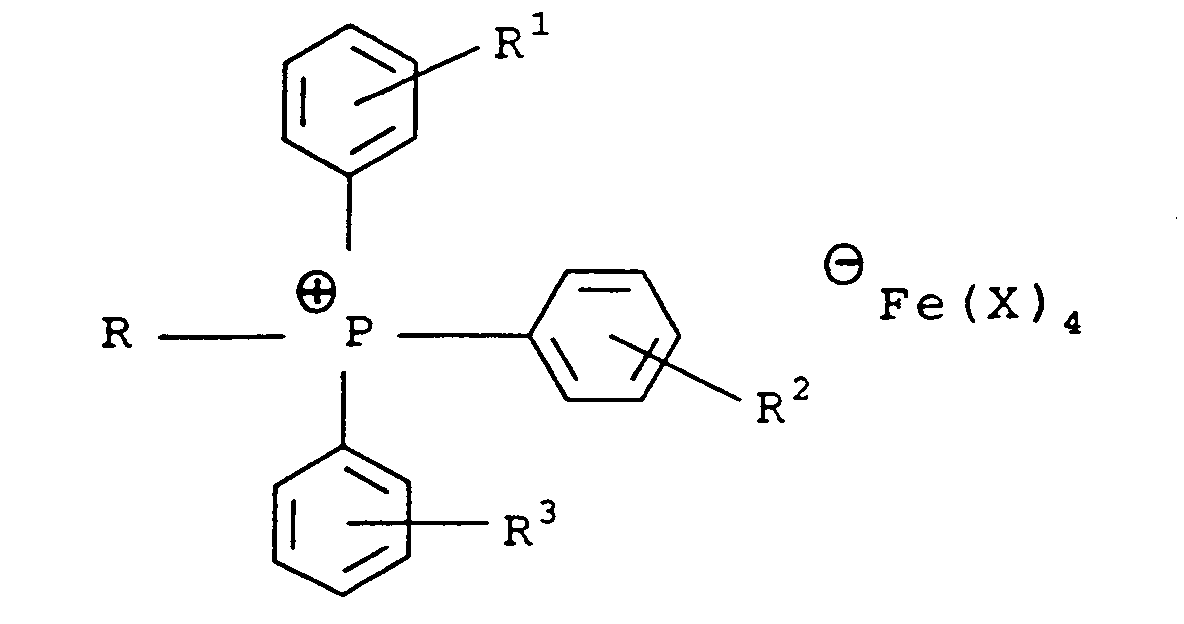
Wherein
R is selected from an unsubstituted alkyl group having from 1 to 24 carbon atoms;
a substituted alkyl group having from 1 to 24 carbon atoms substituted with one or
more hydroxy-, alkoxy-, carboalkoxy-, nitro-, cyano-, keto- or halo-groups; a cycloalkyl
group having from 3 to 7 carbon atoms; an alkaryl group having from 1 to 20 carbon
atoms in the alkyl group and 6 to 14 carbon atoms in the aryl group; an aralkyl group
having from 1 to 4 carbon atoms in the alkyl group and 6 to 14 carbon atoms in the
aryl group; an aralkyl group having from 1 to 4 carbon atoms in the alkyl group and
6 to 14 carbon atoms in the aryl group wherein the aryl group is substituted with
one or more alkyl groups containing from 1 to 18 carbon atoms, one or more alkoxy
groups containing from 1 to 12 carbon atoms, one or more hydroxy-, halo-, cyano-,
amino-, or nitro-groups; or phenyl;
R¹, R and R³, which can be the same or different, are independently selected from
hydrogen; an unsubstituted alkyl group having from 1 to 24 carbon atoms; a substituted
alkyl group having from 1 to 24 carbon atoms substituted with one or more hydroxy
groups, alkoxy groups containing from 1 to 12 carbon atoms, carboalkoxy groups containing
from 1 to 12 carbon atoms, acyloxy groups containing from 1 to 12 carbon atoms, nitro-,
cyano-, keto- or halo-groups; phenyl substituted with one or more hydroxy groups,
alkoxy groups containing from 1 to 12 carbon atoms, carboalkoxy groups containing
from 1 to 12 carbon atoms, acyloxy groups containing from 1 to 12 carbon atoms, nitro-,
cyano-keto-, or halo-groups; and
X, which can be the same or different, is independently selected from fluorine,
chlorine, bromine or iodine.
The biasable members find use in the transfer of electrostatographic toner images
from a photoconductor to a final support sheet where the member electrically cooperates
with a photoconductor to establish a directional force field therebetween.
|
|
