|
(11) | EP 0 694 549 B1 |

| (12) | EUROPEAN PATENT SPECIFICATION |
|
|
| (54) |
Synthesis of organohaloboranes and alkoxyorganoboranes Herstellung von Organohaloboranen und Alkoxyorganoboranen Préparation d'organohaloboranes et l'alkoxyorganoboranes |
|
|
|||||||||||||||||||||||||||||||
| Note: Within nine months from the publication of the mention of the grant of the European patent, any person may give notice to the European Patent Office of opposition to the European patent granted. Notice of opposition shall be filed in a written reasoned statement. It shall not be deemed to have been filed until the opposition fee has been paid. (Art. 99(1) European Patent Convention). |
Field of the Invention
[0001] The present invention relates to a novel process for the synthesis of organohaloboranes and alkoxyorganoboranes, and especially to the synthesis of diorganomonohaloboranes and organodihaloboranes.
Background of the Invention
[0002] Chloroborane complexes, the precursors to organohaloboranes, have been prepared by a variety of methods. See H.C. Brown, S. U. Kulkarni, J. Organomet. Chem. 1982, 239, 23-41. For example, lithium or sodium borohydride and boron trichloride give chloroborane-ether adduct according to the following reaction:
where M = Na, Li. See H.C. Brown, P.A. Tierney, J.Am. Chem. Soc. 1958, 80, 1552; H. Noth, H. Beyer, Ber. 1960, 93, 225; U.S. Patent No. 3,026,329.
[0003] A mixture of borane-tetrahydrofuran adduct and boron trichloride form chloroborane-tetrahydrofuran adduct according to the following reaction:
See D.J. Pasto and P. Balasubramaniyan, J. Am. Chem. Soc. 1967, 89,295; D.J. Pasto and S. Kang, J. Am. Chem. Soc. 1968, 90, 3797.
[0004] Borane-dimethylsulfide adduct (DMSB) and dimethylsulfide boron trichloride give dimethylsulfide chloroborane according to the following reaction:
See K. Kinberger and W. Sierbert, Z. Naturforsch., B 1975, 30, 55; H.C. Brown and N. Ravindran, J. Org. Chem. 1977, 42, 2533; H.C. Brown, Inorg. Chem. 1977, 16, 2938. These chloroborane ether and sulfide adducts have been used in hydroboration reactions as described in detail below.
[0005] Finally, gas phase reaction of diborane and boron trichloride gives dichloroborane according to the following reactions:
See J. Cueilleron, J. Bonix, Bull. Soc. Chim., France 1967, 2945. Although these gas phase reactions were not conducted for subsequent hydroboration reactions, they demonstrate that chloroboranes can be prepared in the absence of coordinating ether or sulfide ligands.
[0006] Diisopinocampheylchloroborane (hereafter referred to as DPC) is a very useful chiral reducing agent for prochiral ketones and imines. DPC can be prepared from α-pinene and chloroborane diethyl etherate. H.C. Brown, P.K. Jadhav. J. Am. Chem. Soc. 1983, 105, 2092. A variation of this process using dimethyl sulfide chloroborane has been elaborated by G. Bir and A.O. King. G. Bir, D. Kaufmann, Tetr. Letters 1987, 28, 777; and A.O. King et al., J. Org. Chem. 1993, 58, 3731-3735.
[0007] Brown purports to obtain high optical purity DPC through a two-step procedure. See U.S. Patent Nos. 4,772,752 and 5,043,479. In this procedure, diisopinocampheylborane, a moisture and thermally sensitive intermediate is isolated from the reaction of α-pinene and DMSB. Subsequent addition of hydrogen chloride gives the final product, DPC, as a moisture sensitive solid, which is isolated from the solution. On an industrial scale this complicated process presents several technical difficulties including the handling of thermally-sensitive solids as well as the handling of moisture sensitive product.
[0008] A.S. Thompson, in J. Org. Chem. 1992, 57, 7044-7052, and A.O. King, supra, have shown that solutions of DPC made from >70% ee α-pinene and DMSB or dimethyl sulfide chloroborane can be used in excess to achieve high optical purity reduction products, without the need for the handling of the moisture sensitive DPC solid.
[0009] All of these processes for making DPC involve use of chloroborane-diethyl ether adduct, which is thermally unstable, or dimethyl sulfide chloroborane adduct, which is notoriously malodorous. Some of the ether and sulfide ligands cause problems in the formation and use of the organochloroboranes. For example, diorganochloroborane formed from a haloborane-tetrahydrofuran adduct can cleave tetrahydrofuran rendering the borane compound unusable. Furthermore, the sulfide adducts leave a sulfur smell on the final product. Development of a method for hydroboration of α-pinene by chloroborane to form DPC without the use of ether chloroborane adduct or sulfide chloroborane adduct is, therefore, very desirable.
Summary of the Invention
[0010] Accordingly, the present invention provides a process for the generation of diorganohaloboranes and organodihaloboranes without the use of ether chloroborane adduct or sulfide chloroborane adduct. Diorganohaloboranes are useful precursors to borinic acids and esters by methods known in the art. See D.S. Matteson et al., Organometallics 1984, 7, 1284-1288; H.C. Brown ibid. 1983, 2, 1311-1316; ibid. 1986, 5, 994-997. Organodihaloboranes are precursors to boronic acids and esters See H.C. Brown, Organometallics 1982, 1, 212.
[0011] Generally, the present invention provides a novel process for the preparation of organohaloboranes of the formula, R2R3BX (a diorganohaloborane) and RBX2 (an organodihaloborane), comprising the step of reacting in a single reactor an olefin(s) and/or alkyne(s) with boron trihalide and diborane according to the following general reactions:
wherein X is a fluoro, a chloro, a bromo, or an iodo group, R is an olefin or an alkyne and R1 is an olefin or an alkyne. R1 can be the same as or different from R. In the above reactions, if R is an olefin, R2 is the corresponding alkyl group. If R is an alkyne, R2 is the corresponding alkenyl group. Likewise, if R1 is an olefin, R3 is the corresponding alkyl group. If R1 is an alkyne, R3 is the corresponding alkenyl group. In the case of R2R3BX, R2 and R3 can be linked together to form a ring or bicyclic system, such as B-chloro-9-borabicyclo[3.3.1]nonane. The reaction can be run neat or in any solvent compatible with the reagents and product. Examples of suitable solvents for a number of reactions under the present invention include the following hydrocarbon solvents: pentane, hexane, heptane, cyclohexane, methylcyclohexane toluene or benzene.
[0012] Moreover, alkoxydiorganoboranes and dialkoxyorganoboranes can be prepared under the above general reactions wherein X is an alkoxy group. In the synthesis of such alkoxyorganoboranes, a dialkylborane (or tetraalkyldiborane) may be added to the reaction mixture as a catalyst.
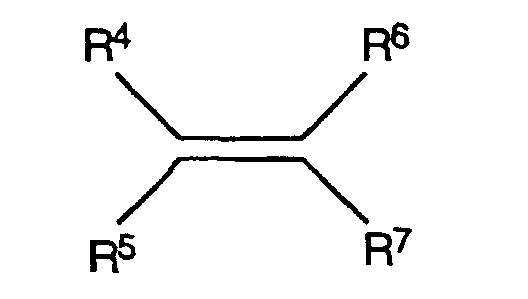
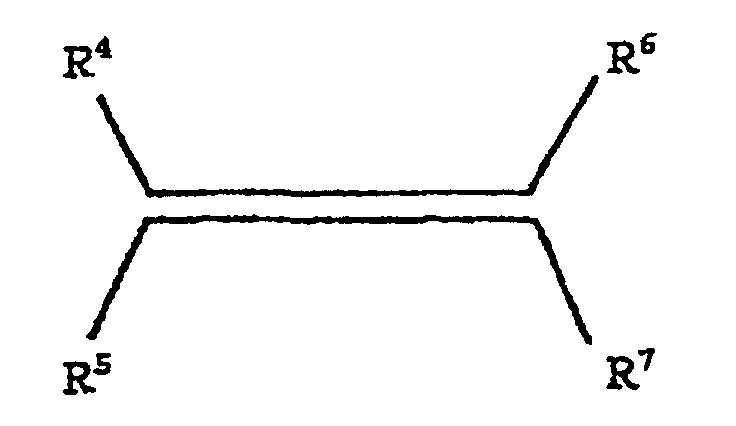
[0013] Olefins for use in the above reactions have the general formula:
wherein R4, R5, R6 and R7 are any combination of hydrogen, an aryl group, an aralkyl, a branched alkyl group, an unbranched alkyl group or a cyclic group, such groups containing from one to ten carbon atoms. Alternatively, R4 and R5 can be linked by a Cn chain wherein n=2-10 or R4 and R6 are linked by a Cn chain wherein n=2-10. The aryl and alkyl groups may comprise functionalities such as ester groups, ether groups, halo groups, silyl groups or nitro groups. The olefin group may also be a terpene from a naturally derived source.
[0014] Alkynes for use in the present reaction have the general formula:
wherein R8 and R9 are any combination of hydrogen, an aryl group, an aralkyl group, a branched alkyl group, an unbranched alkyl group or a cyclic group, such groups containing from one to ten carbon atoms. Alternatively, R8 and R9 can be linked by a Cn chain where n=8-15. The aryl and alkyl groups may comprise functionalities such as ester groups, ether groups, halo groups, silyl groups or nitro groups.
[0015] The present single reactor or "one-pot" process eliminates the need for coordinating ligands such as ethers or sulfides. The process generates substantially no waste by-products and can easily be run on a large scale.
[0016] Particularly useful compounds for preparation using the present process are DPC, diisocampheylchloroborane and dicyclohexylchloroborane. Dicyclohexylchloroborane is useful for the preparation of boron enolates.
Detailed Description of the Invention
[0017] As used in connection with the present invention, the term "alkyl" means a branched, an unbranched, or a cyclic saturated hydrocarbon group containing one to twenty carbon atoms; the term "aralkyl" means an ω-aryl-alkyl group, wherein the aryl group may be a phenyl group, a substituted phenyl group or any other aromatic ring system; the terms "halo" or "halide" mean a fluoro, a chloro, a bromo, or an iodo group; the term "alkyne" means a compound containing a carbon-carbon triple bond; the term "olefin" means a compound containing a carbon-carbon double bond; "enantiomeric excess" (or e.e.) is defined as the excess of one of a pair of enantiomers, usually expressed as a percentage derived from the formula: [(R-S)/(R+S)] x 100; the term "prochiral" describes an sp2 hybridized atom which upon conversion to sp3 hybridization yields a chiral centre at that atom.
Preparation of Diorganohaloboranes and Alkoxydiorganoboranes
[0018] Under the present invention diorganohaloboranes are synthesized by reacting an olefin and/or alkyne (neat or in a suitable solvent) with boron trihalide and diborane. In this reaction, the mole ratio of olefin/alkyne to boron trihalide is in the range of approximately 4:1 to 10:1 and preferably in the range of approximately 6:1 and 9:1. The ratio of boron trihalide to diborane is in the range of approximately 1:1.5 and 1.5:1 and preferably in the range of approximately 1:1 and 1:1.5. The resulting reaction mixture is agitated at a temperature between about -20°C and the reflux temperature of the system, preferably between ambient temperature and the reflux temperature of the system under an inert atmosphere (e.g., nitrogen, argon, etc.) at ambient or moderately superambient pressure, e.g. 1 to 10 bar, until the reaction is complete, typically for a time between 1 and 72 hours. The reflux temperature of the system is generally the boiling point of the solvent at the pressure of the reaction. The resulting diorganohaloborane may be used "as is" in solution or isolated from the solvent. For example, DPC can be crystallized and isolated as a solid with enhanced optical purity. Certain diorganohaloboranes may precipitate from the hydrocarbon solvent and can be easily filtered.
[0019] Alkoxydioganoboranes can be prepared under the above synthetic scheme by substituting an alkyl borate of the general formula B(OR10)3, wherein R10 is an alkyl group, for the boron trihalide reactant. Preferably, R10 is a methyl, an ethyl or an isopropyl group.
Preparation of Organodihaloboranes and Dialkoxyorganoboranes
[0020] Likewise, organodihaloboranes are synthesized under the present invention by reacting an olefin or alkyne (neat or in a suitable solvent) with boron trihalide and diborane. The mole ratio of olefin or alkyne to boron trihalide is typically in the range of approximately 1:1 and 2:1 and preferably 3:2. The ratio of boron trihalide to diborane is in the range of approximately 3:1 and 5:1 and preferably 4:1. The resulting reaction mixture is agitated at a temperature between -20°C and the reflux temperature of the system, preferably between ambient temperature and the reflux temperature of the system under an inert atmosphere (e.g. nitrogen, argon, etc.) at ambient or moderately superambient pressure, e.g. 1 to 10 bar, until the reaction is complete, typically for a time between 1 and 72 hours. The reflux temperature of the system is generally the boiling point of the solvent at the pressure of the reaction. The resulting organodihaloborane may be used as a solution or isolated from the solvent.
[0021] Dialkoxyorganoboranes can be prepared under the above synthetic scheme by substituting an alkyl borate of the general formula B(OR10)3, wherein R10 is an alkyl group, for the boron trihalide reactant. Preferably, R10 is a methyl, an ethyl or an isopropyl group.
Examples
General Procedures
[0022] All experiments were conducted under nitrogen in glass or stainless steel pressure vessels equipped with either magnetic or mechanical stirring. The pressure vessels were equipped with back-pressure regulators set to release excess pressure to a methanol or aqueous NaOH scrubber.
[0023] 1H NMR spectra were recorded in deuterochloroform on a Bruker-250 NMR spectrometer and reported in ppm relative to an internal standard of tetramethylsilane (as 0.0 ppm). 11B NMR spectra were taken of reaction solutions or in an appropriate non-reactive solvent on a Bruker-250 NMR spectrometer at 80.25 MHz and reported in ppm relative to BF3·Et2O (0.0 ppm) external standard. Specific rotations were determined on a JASCO DIP-370 with sodium lamp at the D line, 589 nm. Concentrations (c) for specific rotations are reported in units of g/100 mL.
[0024] Analytical gas chromatography (GC) was carried out on a Hewlett-Packard 5890A gas chromatograph with split-mode injector, flame-ionization detector and helium as the carrier gas. A chiral capillary column (30 m x 0.20 mm), Cyclodex-B (J & W Associates), was used to determine optical and chemical purity of α-pinene and oxidation products of DPC.
[0025] As necessary, solvents were dried over 4Å molecular sieves. Residual water content was determined by Karl Fisher titration. (+)-α-Pinene (Aldrich) was 87% ee as determined by optical rotation and chiral GC. (-)-α-Pinene (Glidco) was 80% ee.
[0026] The following examples illustrate the present invention without limitation of the same. The compounds prepared in the examples gave satisfactory boron and chloride analyses.
Example 1
[0027] (-)α-Pinene (958 g. 7.03 mol) (i.e., R=R1=(-)α-Pinene) and hexane (198.4 g) were loaded into a dry nitrogen-filled, stainless steel pressure reactor. Boron trichloride (118 g. 1.01 mol) was added to the α-pinene/hexane solution. A back-pressure relief valve was set at 2 bar. The mixture was stirred while diborane (31 g, 1.1. mol) was added over 150 min. No temperature increase was observed. The solution was heated to 55-60°C for 5 h, then allowed to stand at ambient temperature until conversion was completed. The solution was monitored by 11B NMR to determine reaction progress. Yield: 1305 g (76.8 wt % (+) DPC in hexane) (i.e., R2=R3=isopinocampheyl group). 1H NMR (CDCl3). 1.0-1.3 (m, 4H), 1.04 (d, 6H), 1.05 (s, 6H), 1.19 (s, 6H), 1.64-2.07 (m, 8H), 2.29 (m, 2H), 2.50 (m, 2H). 11B NMR (hexane) 676. Boron Analysis of the Solution: 76.8 wt%. Optical Purity Analysis by Chiral GC: 84% ee.
Example 2
[0028] (-)-α-pinene (1,458 g, 10.70 mol) and toluene (184 g) was loaded into a 1 gallon stainless steel pressure vessel. Boron trichloride (179.5 g, 1.532 mol) was added, followed by diborane (50 g, 1.8 mol). The reaction mixture was then heated to 60°C for 4 h. The reaction was shown to be completed by 11B NMR after 4h. After cooling to ambient temperature, the reaction mixture was transferred to glass bottles. Yield: 1,759 g of 83 wt% (+)-DPC in toluene.
11B NMR (Toluene) δ74
Boron Analysis of the Solution: 83 wt%
Density: 0.962 g/mL at 20°C
Optical Purity Analysis by Chiral GC of Oxidized Product: 88.6% ee (+) DPC
Example 3
[0029] Cyclohexene (173.5 g, 2.112 mol) and 100 ml of hexane were loaded into a dry nitrogen-filled glass pressure reactor. Boron trichloride (38 g, 0.33 mol) was added to the cyclohexene/hexane mixture. A back-pressure relief valve was set at 3.1 bar. The mixture was stirred while diborane (9 g, 0.3 mol) was added over 80 min. No temperature increase was observed. The solution was heated to 55-60°C for 10.5 h, until conversion was complete. The 11B NMR spectrum showed 93.5% dicyclohexylchloroborane. 11B NMR (hexane) δ76.5.
Example 4
[0030] 1-Hexene (224 g, 2.66 mol) and 100 mL of hexane were loaded into a dry nitrogen-filled glass pressure reactor. Boron trichloride (44 g, 0.38 mol) was added to the 1-hexene/hexane mixture. A back-pressure relief valve was set at 3.1 bar. The mixture was stirred while diborane (12 g, 0.43 mol) was added over 60 min. The solution was heated to 84°C for 24.5 h until conversion was complete. The 11B NMR spectrum showed 95% dihexyl chloroborane. 11B NMR (hexane) δ78.
Example 5
[0031] Boron trichloride (14.6 g, 0.125 mol) was added to 100 mL of hexane in a dry nitrogen-filled glass pressure reactor. 1-Hexyne (68.5 g, 0.834 mol) and 100 mL of hexane were added to the BCl3. The mixture was stirred while diborane (3.5 g, 0.13 mol) was added over 30 min. The solution was heated to 60°C and maintained for 4.5 h until 95% conversion to dihexenyl-chloroborane. 11B NMR (hexane) δ73.
Example 6
[0032] Boron trichloride (14.7 g, 0.127 mol) was added to 200 mL of hexane in a dry nitrogen-filled glass pressure reactor. 1,5-Cyclooctadiene (48.1 g, 0.445 mol) was added to the BCl3 solution. The mixture was stirred while diborane (4.0 g, 0.14 mol) was added over 20 min. The solution was heated for 10 h at a temperature between 65-85°C. 11Boron NMR analysis showed 93% conversion to B-chloro-9-borabicyclo[3.3.1]nonane. 11B NMR (hexane) δ82.
Example 7
[0033] (+)-α-pinene (100.0g, 0.734 mol) and hexane (200 ml) were loaded into a dry nitrogen-filled, glass pressure reactor. Boron trichloride (55.3 g, 0.472 mol) was added, followed by diborane (4.0 g, 0.14 mol). The reaction mixture was then heated to 40 to 60°C for 4 days. 11Boron NMR spectra of the reaction mixture showed 91% isopinocampheyldichloroborane at δ63.
Example 8
[0034] Cyclohexene (61.2 g, 0.745 mol) and hexane (200 ml) were loaded into a nitrogen-filled glass pressure reactor. Boron trichloride (59.9 g, 0.511 mol) was added. The back-pressure regulator was set to 2 bar. Diborane (50 g, 0.18 mol) was added. The reaction mixture was heated to 50-60°C for 5 days. The reaction was monitored by 11Boron NMR and shown to contain 86% cyclohexyl dichloroborane δ64.
Example 9
[0035] (+)-α-pinene (271 g, 1.98 mol) and hexane (100 ml) were loaded into a dry nitrogen-filled, glass pressure reactor. Methyl borate (29.0 g, 0.28 mol) was loaded to the α-pinene/hexane solution. A back-pressure relief valve was set at 2 bar. The mixture was stirred while diborane (7.8 g, 0.28 mol) was added over 30 minutes. The reaction was exothermic during the diborane addition. The reaction mixture was then heated to 40°C for 5 hours. 11Boron NMR analysis of the product showed 96% conversion to (-)diisopinocampheylmethoxyborane, 2% (-)isopinocampheyldimethyoxyborane and 2% unreacted methylborate. 11Boron NMR (hexane) δ53. Boron analysis of the solution: 76%.
Example 10
[0036] Tetraethyldiborane (62.5 g, 0.447 mol) was loaded into the glass pressure vessel as a catalyst. The back-pressure regulator was set to 2 bar. Diborane (5.0 g, 0.149 mol) was added followed by methylborate (62.0 g, 0.596 mol). Ethylene (50 g, 1.8 mol) was bubbled into the solution over 4.5 hours. The reaction was exothermic and was kept between 20-35°C with a refrigerated bath. When ethylene uptake ceased the reaction mixture contained 61% methoxydiethylborane, 27% trimethylborane and 10% dimethoxyethylborane as determined by 11Boron NMR.
1. A process for the preparation of a diorganohaloborane compound of the structural formula
R2R3BX, comprising the step of reacting in a single reactor a first reactant R selected
from the group consisting of an olefin and an alkyne, a second reactant R1 selected from the group consisting of an olefin and an alkyne, diborane and a boron
trihalide of the structural formula BX3, wherein X is selected from the group consisting of a fluoro, a chloro, a bromo and
an iodo group wherein R2 is an akyl group corresponding to R in the case that R is an olefin, wherein R2 is an alkenyl group corresponding to R in the case that R is an alkyne, wherein R3 is an alkyl group corresponding to R' in the case that R' is an olefin and wherein
R3 is an alkenyl group corresponding to R' in the case that R' is an alkyne.
2. A process according to claim 1, wherein the mole ratio of boron trihalide to diborane
is in the range of approximately 1:1.5 to 1.5:1, and wherein R2 is an alkyl group corresponding to R in the case that R is an olefin, and wherein
R2 is an alkenyl group corresponding to R in the case that R is an alkyne, and wherein
R3 is an alkyl group corresponding to R1 in the case that R1 is an olefin, and wherein R3 is an alkenyl group corresponding to R1 in the case that R1 is an alkyne.
3. A process according to claim 1 or 2, wherein R2 and R3 are isopinocampheyl groups and X is selected from the group consisting of a chloro
and a bromo group.
4. A process according to claim 1 or 2, wherein R2 and R3 are cyclohexyl groups and X is selected from the group consisting of a chloro, a
bromo and an iodo group.
5. A process according to any preceding claim, wherein R2 and R3 are covalently linked to form a ring system.
6. A process according to any preceding claim, wherein at least one of R and R1 is an olefin of the general formula

wherein each of R4, R5, R6 and R7 is selected from the group consisting of hydrogen, an aryl group, an aralkyl, a branched alkyl group, an unbranched alkyl group and a cyclic group containing from one to ten carbon atoms.
wherein each of R4, R5, R6 and R7 is selected from the group consisting of hydrogen, an aryl group, an aralkyl, a branched alkyl group, an unbranched alkyl group and a cyclic group containing from one to ten carbon atoms.
7. A process according to claim 6, wherein R4 and R5 are covalently linked by a Cn chain wherein n=2-10.
8. A process according to claim 6, wherein R4 and R6 are covalently linked by a Cn chain wherein n=2-10.
9. A process according to any of the preceding claim, wherein at least one of R and R1 is an alkyne of the general formula:
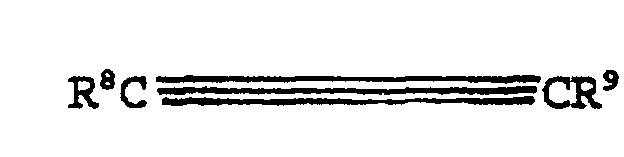
wherein each of R8 and R9 are selected individually from the group consisting of hydrogen, an aryl group, an aralkyl group, a branched alkyl group, an unbranched alkyl group and a cyclic group containing from one to ten carbon atoms.
wherein each of R8 and R9 are selected individually from the group consisting of hydrogen, an aryl group, an aralkyl group, a branched alkyl group, an unbranched alkyl group and a cyclic group containing from one to ten carbon atoms.
10. The process of claim 9, wherein R8 and R9 are covalently linked by a Cn chain wherein n=8-15.
11. A process for the preparation of an organodihaloborane compound of the structural
formula R2BX2, comprising the step of reacting in a single reactor a reactant R selected from the
group consisting of an olefin and an alkyne, diborane and a boron trihalide of the
structural formula BX3, wherein X is selected from the group consisting of a fluoro, a chloro, a bromo and
an iodo group, wherein R2 is an alkyl group corresponding to R in the case that R is an olefin, and wherein
R2 is an alkenyl group corresponding to R in the case that R is an alkyne.
12. A process according to claim 11, wherein the mole ratio of boron trihalide to diborane
is in the range of approximately 3:1 to 5:1, and wherein R2 is an alkyl group corresponding to R in the case that R is an olefin, and wherein
R2 is an alkenyl group corresponding to R in the case that R is an alkyne.
13. A process according to claim 11 or 12, wherein R is an olefin of the general formula
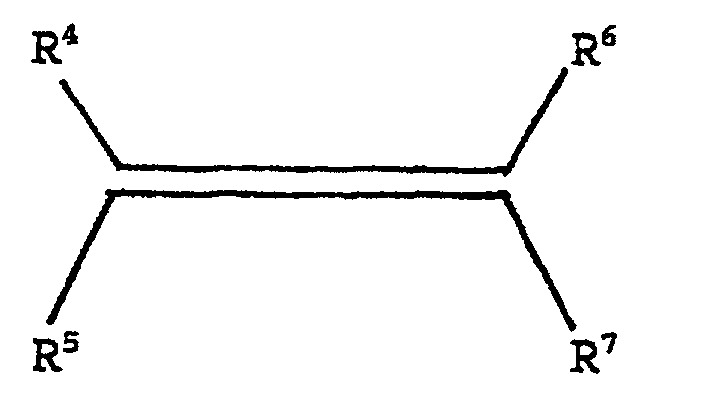
wherein each of R4, R5, R6 and R7 is selected from the group consisting of hydrogen, an aryl group, an aralkyl, a branched alkyl group, an unbranched alkyl group and a cyclic group containing from one to ten carbon atoms.
wherein each of R4, R5, R6 and R7 is selected from the group consisting of hydrogen, an aryl group, an aralkyl, a branched alkyl group, an unbranched alkyl group and a cyclic group containing from one to ten carbon atoms.
14. A process according to claim 13, wherein R4 and R5 are covalently linked by a Cn chain wherein n=2-10.
15. A process according to claim 13, wherein R4 and R6 are covalently linked by a Cn chain wherein n=2-10.
16. A process according to any one of claims 11 to 15, wherein R is an alkyne of the general
formula:
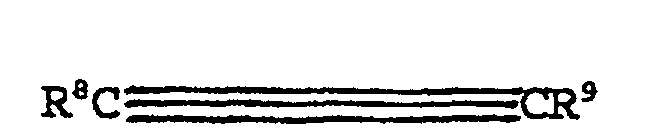
wherein each of R8 and R9 are selected individually from the group consisting of hydrogen, an aryl group, an aralkyl group, a branched alkyl group, an unbranched alkyl group and a cyclic group containing from one to ten carbon atoms.
wherein each of R8 and R9 are selected individually from the group consisting of hydrogen, an aryl group, an aralkyl group, a branched alkyl group, an unbranched alkyl group and a cyclic group containing from one to ten carbon atoms.
17. The process of claim 16 wherein R8 and R9 are covalently linked by a Cn chain wherein n=8-15.
18. A process for the preparation of an alkoxydiorganoborane compound of the structure
formula R2R3BOR10, comprising the step of reacting in a single reactor a first reactant R selected
from the group consisting of an olefin and an alkyne, a second reactant R1 selected from the group consisting of an olefin and an alkyne, diborane and an alkyl
borate of the structural formula B(OR10)3, wherein R10 is an alkyl group wherein R2 is an alkyl group corresponding to R in the case that R is an olefin, wherein R2 is an alkenyl group corresponding to R in the case that R is an alkyne, wherein R3 is an alkyl group corresponding to R' in the case that R' is an olefin and wherein
R3 is an alkenyl group carresponding to R' in the case that R' is an alkyne.
19. A process according to claim 18, wherein the mole ratio of alkyl borate to diborane
is in the range of approximately 1:1.5 to 1.5:1, wherein R2 is an alkyl group corresponding to R in the case that R is an olefin, wherein R2 is an alkenyl group corresponding to R in the case that R is an alkyne, wherein R3 is an alkyl group corresponding to R1 in the case that R1 is an olefin, and wherein R3 is an alkenyl group corresponding to R1 in the case that R1 is alkyne.
20. A process for the preparation of a dialkoxyorganoborane compound of the structural
formula of R2B(OR10)2, comprising the step of reacting in a single reactor a first reactant R selected
from the group consisting of an olefin and an alkyne, diborane and an alkyl borate
of the structural formula B(OR10)3, wherein R10 is an alkyl group.
21. A process according to claim 20, wherein the mole ratio of alkyl borate to diborane
is in the range of approximately 3:1 to 5:1, wherein R2 is an alkyl group corresponding to R in the case that R is an olefin, wherein R2 is an alkenyl group corresponding to R in the case that R is an alkyne.
1. Verfahren zur Herstellung einer Diorganohalogenboran-Verbindung der Strukturformel
R2R3BX, wobei in einer Reaktionsstufe in einem einzigen Reaktor ein erster Reaktant R
aus der Gruppe der Olefine und Alkine mit einem zweiten Reaktanten R1 aus der Gruppe der Olefine und Alkine, Diboran und einem Bortrihalogenid der Formel
BX3, worin X aus der Gruppe Fluor, Chlor, Brom und Jod ausgewählt ist, umgesetzt wird,
wobei R2 ein dem R entsprechender Alkylrest ist, wenn R ein Olefin ist, wobei R2 ein dem R entsprechender Alkenylrest ist, wenn R ein Alkin ist, wobei R3 ein dem R1 entsprechender Alkylrest ist, wenn R1 ein Olefin ist, und wobei R3 ein dem R1 entsprechender Alkenylrest ist, wenn R1 ein Alkin ist.
2. Verfahren nach Anspruch 1, wobei das Molverhältnis von Bortrihalogenid zu Diboran
im Bereich von etwa 1:1,5 bis 1,5:1 liegt, wobei R2 ein dem R entsprechender Alkylrest ist, wenn R ein Olefin ist, wobei R2 ein dem R ensprechender Alkenylrest ist, wenn R ein Alkin ist, wobei R3 ein dem R1 entsprechender Alkylrest ist, wenn R1 ein Olefin ist, und wobei R3 ein dem R1 entsprechender Alkenylrest ist, wenn R1 ein Alkin ist.
3. Verfahren nach Anspruch 1 oder 2 , wobei R2 und R3 Isopinocampheyl-Gruppen sind und X aus der Gruppe Chlor und Brom ausgewählt ist.
4. Verfahren nach Anspruch 1 oder 2 , wobei R2 und R3 Cyclohexyl-Gruppen sind und X aus der Gruppe Chlor, Brom und Jod ausgewählt ist.
5. Verfahren nach einem der voranstehenden Ansprüche, wobei R2 und R3 kovalent zu einem Ringsystem verbunden sind.
6. Verfahren nach einem der voranstehenden Ansprüche, wobei mindestens einer der Reste
R und R1 ein Olefin der allgemeinen Formel
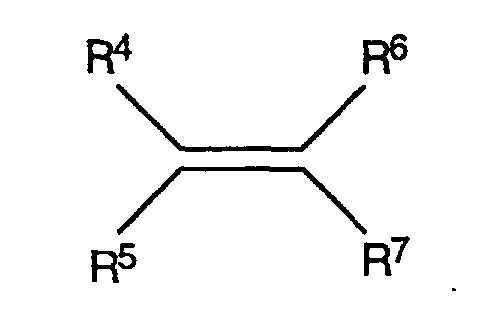
ist, wobei jeder der Reste R4, R5, R6 und R7 aus der Gruppe Wasserstoff, Aryl-, Aralkyl-, verzweigter Alkyl-, unverzweigter Alkyl- und cyclischer Rest mit 1-10 Kohlenstoffatomen ausgewählt ist.
ist, wobei jeder der Reste R4, R5, R6 und R7 aus der Gruppe Wasserstoff, Aryl-, Aralkyl-, verzweigter Alkyl-, unverzweigter Alkyl- und cyclischer Rest mit 1-10 Kohlenstoffatomen ausgewählt ist.
7. Verfahren nach Anspruch 6, wobei R4 und R5 kovalent mit einer Cn-Kette verknüpft sind, worin n = 2-10 ist.
8. Verfahren nach Anspruch 6, wobei R4 und R6 kovalent mit einer Cn-Kette verknüpft sind, worin n = 2-10 ist.
9. Verfahren nach einem der voranstehenden Ansprüche, wobei mindestens eine der Gruppen
R und R1 ein Alkin der allgemeinen Formel
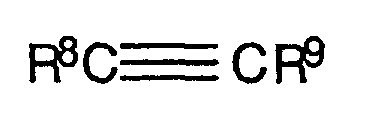
ist, wobei jeder der Reste R8 und R9 individuell aus der Gruppe Wasserstoff, Aryl-, Aralkyl-, verzweigter Alkyl-, unverzweigter Alkyl- und cyclischer Rest mit 1-10 Kohlenstoffatomen ausgewählt ist.
ist, wobei jeder der Reste R8 und R9 individuell aus der Gruppe Wasserstoff, Aryl-, Aralkyl-, verzweigter Alkyl-, unverzweigter Alkyl- und cyclischer Rest mit 1-10 Kohlenstoffatomen ausgewählt ist.
10. Verfahren nach Anspruch 9, wobei R8 und R9 kovalent mit einer Cn-Kette verknüpft sind, worin n = 8-15 ist.
11. Verfahren zur Herstellung einer Organodihalogenboran-Verbindung der Strukturformel
R2BX2, wobei in einer Reaktionsstufe in einem einzigen Reaktor ein Reaktant R aus der Gruppe
der Olefine und Alkine, mit Diboran und einem Bortrihalogenid der Formel BX3, wobei X aus der Gruppe Fluor, Chlor, Brom und Jod ausgewählt ist, umgesetzt wird,
wobei R2 ein dem R entsprechender Alkylrest ist, wenn R ein Olefin ist, und wobei R2 ein dem R entsprechender Alkenylrest ist, wenn R ein Alkin ist.
12. Verfahren nach Anspruch 11, wobei das Molverhältnis von Bortrihalogenid zu Diboran
im Bereich von etwa 3:1 bis 5:1 liegt und wobei R2 ein dem R entsprechender Alkylrest ist, wenn R ein Olefin ist, und wobei R2 ein dem R entsprechender Alkenylrest ist, wenn R ein Alkin ist.
13. Verfahren nach den Ansprüchen 11 oder 12, wobei der Rest R ein Olefin der allgemeinen
Formel
ist, wobei jeder der Reste R4, R5, R6 und R7 aus der Gruppe Wasserstoff, Aryl-, Aralkyl-, verzweigter Alkyl-, unverzweigter Alkyl- und cyclischer Rest mit 1-10 Kohlenstoffatomen ausgewählt ist.
ist, wobei jeder der Reste R4, R5, R6 und R7 aus der Gruppe Wasserstoff, Aryl-, Aralkyl-, verzweigter Alkyl-, unverzweigter Alkyl- und cyclischer Rest mit 1-10 Kohlenstoffatomen ausgewählt ist.
14. Verfahren nach Anspruch 13, wobei R4 und R5 kovalent mit einer Cn-Kette verknüpft sind, worin n = 2-10 ist.
15. Verfahren nach Anspruch 13, wobei R4 und R6 kovalent mit einer Cn-Kette verknüpft sind, worin n = 2-10 ist.
16. Verfahren nach einem der voranstehenden Ansprüche 11 bis 15, wobei der Rest R ein
Alkin der allgemeinen Formel
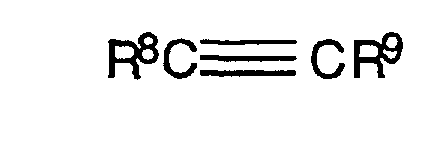
ist, wobei jeder der Reste R8 und R9 individuell ausgewählt ist aus der Gruppe Wasserstoff, Aryl-, Aralkyl-, verzweigter Alkyl-, unverzweigter Alkyl- und cyclischer Rest mit 1-10 Kohlenstoffatomen.
ist, wobei jeder der Reste R8 und R9 individuell ausgewählt ist aus der Gruppe Wasserstoff, Aryl-, Aralkyl-, verzweigter Alkyl-, unverzweigter Alkyl- und cyclischer Rest mit 1-10 Kohlenstoffatomen.
17. Verfahren nach Anspruch 16, wobei R8 und R9 kovalent mit einer Cn-Kette verknüpft sind, worin n = 8-15 ist.
18. Verfahren zur Herstellung einer Alkoxydiorganoboran-Verbindung der Strukturformel
R2R3BOR10, wobei in einer Reaktionsstufe in einem einzigen Reaktor ein erster Reaktant R aus
der Gruppe der Olefine und Alkine mit einem zweiten Reaktanten R1 aus der Gruppe der Olefine und Alkine, Diboran und einem Alkylborat der Strukturformel
B(OR10)3, wobei R10 eine Alkylgruppe ist, umgesetzt wird, wobei R2 ein dem R entsprechender Alkylrest ist, wenn R ein Olefin ist, wobei R2 ein dem R entsprechender Alkenylrest ist, wenn R ein Alkin ist, wobei R3 ein dem R1 entsprechender Alkylrest ist, wenn R1 ein Olefin ist, und wobei R3 ein dem R1 entsprechender Alkenylrest ist, wenn R1 ein Alkin ist.
19. Verfahren nach Anspruch 18, wobei das Molverhältnis von Alkylborat zu Diboran im Bereich
von etwa 1:1,5 bis 1,5:1 liegt, wobei R2 ein dem R entsprechender Alkylrest ist, wenn R ein Olefin ist, wobei R2 ein dem R entsprechender Alkenylrest ist, wenn R ein Alkin ist, wobei R3 ein dem R1 entsprechender Alkylrest ist, wenn R1 ein Olefin ist, und wobei R3 ein dem R1 entsprechender Alkenylrest ist, wenn R1 ein Alkin ist.
20. Verfahren zur Herstellung einer Dialkoxyorganoboran-Verbindung der Strukturformel
R2B(OR10)2, wobei in einer Reaktionsstufe in einem einzigen Reaktor ein erster Reaktant R aus
der Gruppe der Olefine und Alkine mit Diboran und einem Alkylborat der Strukturformel
B(OR10)3, wobei R10 ein Alkylrest ist, umgesetzt wird.
21. Verfahren nach Anspruch 20, wobei das Molverhältnis von Alkylborat zu Diboran im Bereich
von etwa 3:1 bis 5:1 liegt, wobei R2 ein dem R entsprechender Alkylrest ist, wenn R ein Olefin ist, und wobei R2 ein dem R entsprechender Alkenylrest ist, wenn R ein Alkin ist.
1. Procédé pour la préparation d'un diorganohalogénoborane de formule structurale R2R3BX, comprenant l'étape consistant à faire réagir dans un seul réacteur un premier
corps réactionnel R choisi dans le groupe consistant en une oléfine et un alcyne,
un second corps réactionnel R1 choisi dans le groupe consistant en une oléfine et un alcyne, du diborane et un trihalogénure
de bore de formule structurale BX3, dans laquelle X est choisi dans le groupe consistant en un groupe fluoro, un groupe
chloro, un groupe bromo et un groupe iodo, R2 représente un groupe alkyle correspondant à R dans le cas où R est une oléfine, R2 représente un groupe alcényle correspondant à R dans le cas où R est un alcyne, R3 représente un groupe alkyle correspondant à R1 dans le cas où R1 est une oléfine et R3 représente un groupe alcényle correspondant à R1 dans le cas où R1 est un alcyne.
2. Procédé suivant la revendication 1, dans lequel le rapport molaire du trihalogénure
du bore au diborane est compris dans l'intervalle d'approximativement 1:1,5 à 1,5:1
et dans lequel R2 représente un groupe alkyle correspondant à R dans le cas où R est une oléfine, et
dans lequel R2 représente un groupe alcényle correspondant à R dans le cas où R est un alcyne, dans
lequel R3 est un groupe alkyle correspondant à R1 dans le cas où R1 est une oléfine, et dans lequel R3 est un groupe alcényle correspondant à R1 dans le cas où R1 est un alcyne.
3. Procédé suivant la revendication 1 ou 2, dans lequel R2 et R3 représentent des groupes isopinocamphéyle et X est choisi dans le groupe consistant
en un groupe chloro et un groupe bromo.
4. Procédé suivant la revendication 1 ou 2, dans lequel R2 et R3 représente des groupes cyclohexyle et X est choisi dans le groupe consistant en un
groupe chloro, un groupe bromo et un groupe iodo.
5. Procédé suivant l'une quelconque des revendications précédentes, dans lequel R2 et R3 sont liés par covalence pour former un système cyclique.
6. Procédé suivant l'une quelconque des revendications précédentes, dans lequel au moins
un de R et R1 est une oléfine de formule générale
dans laquelle chacun des groupes R4, R5, R6 et R7 est choisi dans le groupe consistant en l'hydrogène, un groupe aryle, un groupe aralkyle, un groupe alkyle ramifié, un groupe alkyle non ramifié et un groupe cyclique, contenant un à dix atomes de carbone.
dans laquelle chacun des groupes R4, R5, R6 et R7 est choisi dans le groupe consistant en l'hydrogène, un groupe aryle, un groupe aralkyle, un groupe alkyle ramifié, un groupe alkyle non ramifié et un groupe cyclique, contenant un à dix atomes de carbone.
7. Procédé suivant la revendication 6, dans lequel R4 et R5 sont liés par covalence par une chaîne Cn dans laquelle n a une valeur de 2 à 10.
8. Procédé suivant la revendication 6, dans lequel R4 et R6 sont liés par covalence par une chaîne Cn dans laquelle n a une valeur de 2 à 10.
9. Procédé suivant l'une quelconque des revendications précédentes, dans lequel au moins
un des groupes R et R1 est un alcyne de formule générale :
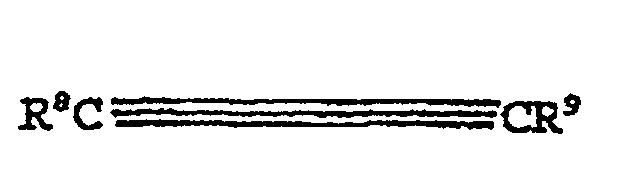
dans laquelle chacun des groupes R8 et R9 est choisi individuellement dans le groupe consistant en l'hydrogène, un groupe aryle, un groupe aralkyle, un groupe alkyle ramifié, un groupe alkyle non ramifié et un groupe cyclique contenant un à dix atomes de carbone.
dans laquelle chacun des groupes R8 et R9 est choisi individuellement dans le groupe consistant en l'hydrogène, un groupe aryle, un groupe aralkyle, un groupe alkyle ramifié, un groupe alkyle non ramifié et un groupe cyclique contenant un à dix atomes de carbone.
10. Procédé suivant la revendication 9, dans lequel R8 et R9 sont liés par covalence par une chaîne Cn dans laquelle n a une valeur de 8 à 15.
11. Procédé pour la préparation d'un organodihalogénoborane de formule structurale R2BX2, comprenant l'étape consistant à faire réagir dans un seul réacteur un corps réactionnel
R choisi dans le groupe consistant en une oléfine et un alcyne, du diborane et un
trihalogénure de bore de formule structurale BX3, dans laquelle X est choisi dans le groupe consistant en un groupe fluoro, un groupe
chloro, un groupe bromo et un groupe iodo, R2 représente un groupe alkyle correspondant à R dans le cas où R est une oléfine et
R2 représente un groupe alcényle correspondant à R dans le cas où R est un alcyne.
12. Procédé suivant la revendication 11, dans lequel le rapport molaire du trihalogénure
de bore au diborane est compris dans l'intervalle d'approximativement 3:1 à 5:1 et
dans lequel R2 représente un groupe alkyle correspondant à R dans le cas où R est une oléfine, et
dans lequel R2 représente un groupe alcényle correspondant à R dans le cas où R est un alcyne.
13. Procédé suivant la revendication 11 ou 12, dans lequel R est une oléfine de formule
générale
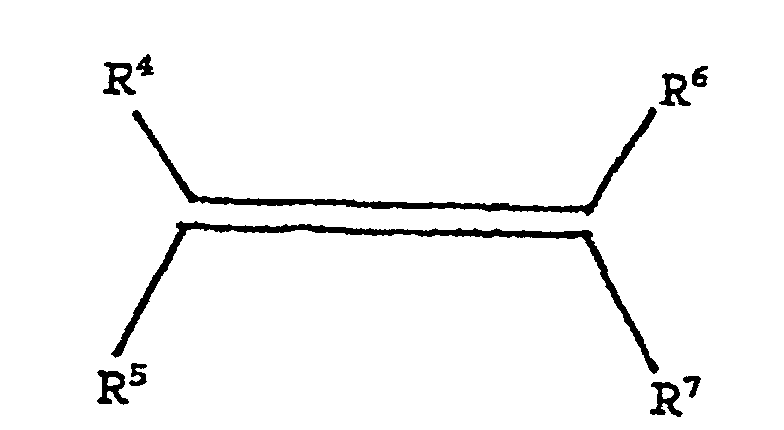
dans laquelle chacun des groupes R4, R5, R6 et R7 est choisi dans le groupe consistant en l'hydrogène, un groupe aryle, un groupe aralkyle, un groupe alkyle ramifié, un groupe alkyle non ramifié et un groupe cyclique contenant un à dix atomes de carbone.
dans laquelle chacun des groupes R4, R5, R6 et R7 est choisi dans le groupe consistant en l'hydrogène, un groupe aryle, un groupe aralkyle, un groupe alkyle ramifié, un groupe alkyle non ramifié et un groupe cyclique contenant un à dix atomes de carbone.
14. Procédé suivant la revendication 13, dans lequel R4 et R5 sont liés par covalence par une chaîne Cn dans laquelle n a une valeur de 2 à 10.
15. Procédé suivant la revendication 13, dans lequel R4 et R6 sont liés par covalence par une chaîne Cn dans laquelle n a une valeur de 2 à 10.
16. Procédé suivant l'une quelconque des revendications 11 à 15, dans lequel R représente
un alcyne de formule générale :

dans laquelle chacun des groupes R8 et R9 est choisi individuellement dans le groupe consistant en l'hydrogène, un groupe aryle, un groupe aralkyle, un groupe alkyle ramifié, un groupe alkyle non ramifié et un groupe cyclique contenant un à dix atomes de carbone.
dans laquelle chacun des groupes R8 et R9 est choisi individuellement dans le groupe consistant en l'hydrogène, un groupe aryle, un groupe aralkyle, un groupe alkyle ramifié, un groupe alkyle non ramifié et un groupe cyclique contenant un à dix atomes de carbone.
17. Procédé suivant la revendication 16, dans lequel R8 et R9 sont liés par covalence par une chaîne Cn dans laquelle n a une valeur de 8 à 15.
18. Procédé pour la préparation d'un alkoxydiorganoborane de formule structurale R2R3BOR10, comprenant l'étape consistant à faire réagir dans un seul réacteur un premier corps
réactionnel R choisi dans le groupe consistant en une oléfine et un alcyne, un second
corps réactionnel R1 choisi dans le groupe consistant en une oléfine et un alcyne, du diborane et un borate
d'alkyle de formule structurale B(OR10)3, dans laquelle R10 représente un groupe alkyle, R2 représente un groupe alkyle correspondant à R dans le cas où R est une oléfine, R2 représente un groupe alcényle correspondant à R dans le cas où R est un alcyne, R3 représente un groupe alkyle correspondant à R1 dans le cas où R1 est une oléfine et R3 représente un groupe alcényle correspondant à R1 dans le cas où R1 est un alcyne.
19. Procédé suivant la revendication 18, dans lequel le rapport molaire du borate d'alkyle
au diborane est compris dans l'intervalle d'approximativement 1:1,5 à 1,5:1, dans
lequel R2 représente un groupe alkyle correspondant à R dans le cas où R est une oléfine, dans
lequel R2 représente un groupe alcényle correspondant à R dans le cas où R est un alcyne, dans
lequel R3 représente un groupe alkyle correspondant à R1 dans le cas où R1 est une oléfine et dans lequel R3 est un groupe alcényle correspondant à R1 dans le cas où R1 est un alcyne.
20. Procédé pour la préparation d'un dialkoxyorganoborane de formule structurale R2B(OR10)2, comprenant l'étape consistant à faire réagir dans un seul réacteur un premier corps
réactionnel R choisi dans le groupe consistant en une oléfine et un alcyne, du diborane
et un borate d'alkyle de formule structurale B(OR10)3, dans laquelle R10 représente un groupe alkyle.
21. Procédé suivant la revendication 20, dans lequel le rapport molaire du borate d'alkyle
au diborane est compris dans l'intervalle d'approximativement 3:1 à 5:1, dans lequel
R2 représente un groupe alkyle correspondant à R dans le cas où R est une oléfine, et
dans lequel R2 représente un groupe alcényle correspondant à R dans le cas où R est un alcyne.