| (19) |
 |
|
(11) |
EP 0 695 386 B1 |
| (12) |
EUROPEAN PATENT SPECIFICATION |
| (45) |
Mention of the grant of the patent: |
|
05.03.1997 Bulletin 1997/10 |
| (22) |
Date of filing: 25.04.1994 |
|
| (51) |
International Patent Classification (IPC)6: E02F 3/36 |
| (86) |
International application number: |
|
PCT/DK9400/166 |
| (87) |
International publication number: |
|
WO 9425/689 (10.11.1994 Gazette 1994/25) |
|
| (54) |
IMPLEMENT COUPLING FOR EXCAVATOR OR LOADER
WERKZEUGKUPPLUNGSVORRICHTUNG FÜR EINEN BAGGER ODER EINEN LADER.
ACCOUPLEMENT D'OUTIL D'EXCAVATRICE OU DE CHARGEUSE
|
| (84) |
Designated Contracting States: |
|
AT BE CH DE DK ES FR GB GR IE IT LI LU MC NL PT SE |
|
Designated Extension States: |
|
SI |
| (30) |
Priority: |
26.04.1993 DK 473/93
|
| (43) |
Date of publication of application: |
|
07.02.1996 Bulletin 1996/06 |
| (73) |
Proprietor: Dam-Rasmussen, Kaj |
|
DK-8270 Hoejbjerg (DK) |
|
| (72) |
Inventor: |
|
- Dam-Rasmussen, Kaj
DK-8270 Hoejbjerg (DK)
|
| (74) |
Representative: Gregersen, Niels Henrik
Aarhus Patentkontor |
|
Skanderborgvej 40
8000 Aarhus C
8000 Aarhus C (DK) |
| (56) |
References cited: :
EP-A- 0 506 604
AU-A- 471 251
US-A- 4 545 720
|
EP-A- 0 569 026
DK-A- 575 389
|
|
| |
|
|
|
|
| |
|
| Note: Within nine months from the publication of the mention of the grant of the European
patent, any person may give notice to the European Patent Office of opposition to
the European patent
granted. Notice of opposition shall be filed in a written reasoned statement. It shall
not be deemed to
have been filed until the opposition fee has been paid. (Art. 99(1) European Patent
Convention).
|
[0001] The present invention relates to an implement coupling for excavators or loaders
and of the type described in the introductory part of claim 1.
[0002] Implement couplings of this type is used to be able to shift quickly and easily between
different implements, for instance between excavator buckets with different width
or between excavator and loader bucket. The implement coupling may comprise an either
manually operated shift mechanism requiring that the operator leaves the cabin, or
a remote controlled shift mechanism, which may be operated from the cabin, for instance
by means of a hydraulic hand pump.
[0003] At both manually and hydraulically operated implement couplings a good security is
required against failure and/or mis-operating of the locking function of the shift
mechanism of the implement coupling.
[0004] The purpose of the invention is to provide an implement coupling for excavators or
loaders of the type mentioned in the introducty part, and which by simple provisions
makes it possible to obtain extraordinary good security against unintended disengagement
of the implement.
[0005] The implement coupling according to the invention is distinctive in that the swing
arm mechanism opposite the locking splice comprises a basic joint being pivotally
arranged on a central, fixed pivot axle, and said basic joint via a bent axle in a
distance from the pivot axle being pivotally connected with the locking splice by
means of an intermediate arm, that the basic joint has a projecting arm part, which
is adapted to be swung into a position mainly parallel with the intermediate arm,
so that an end part of the projecting arm part is placed behind the locking splice,
when this is in lock engagement with the hook-shaped locking part of the implement,
and when said bent axle is placed in a dead center position at the opposite side of
the connecting line between the locking splice and the pivot axle, and that the basic
joint for operation of the shift mechanism furthermore is connected with a manual
operating handle and/or a hydraulic activiation cylinder. By simple technical provisions
extraordinary good security against unintended disengagement of the implement by releasing
the locking function of the coupling is hereby obtained.
[0006] Appropriately the implement coupling according to the invention is such provided
that a pressure cylinder with a piston rod, a piston and a powerful pressure spring
are inserted in said intermediate arm.
[0007] When the implement coupling according to invention is adapted to be manually operated
it appropriately may be such provided that the operating handle is connected with
the projected arm part at the side opposite the intermediate arm, and that in connection
with the operating handle is a pivoting locking pawl being adapted to lock the operating
handle, when it is swung in parallel with the intermediate arm, that is in the locking
position of the implement coupling.
[0008] While the implement coupling according to the invention, when it is adapted to be
hydraulically operated, advantageously may be such provided, that a piston rod of
the hydraulic activation cylinder is connected with an activiation arm part of the
basic joint projecting from the latter opposite the projecting arm part, that is at
the side opposite of the intermediate arm, which by means of said end part engage
behind the locking splice, when the activation arm part is led to the rear by the
piston rod, and that the hydraulic activation cylinder is provided with an internal
pressure spring affecting the piston rod in the direction towards the activation arm
part, that is maintaining the locking function of the implement coupling, if the hydraulic
pressure should disappear.
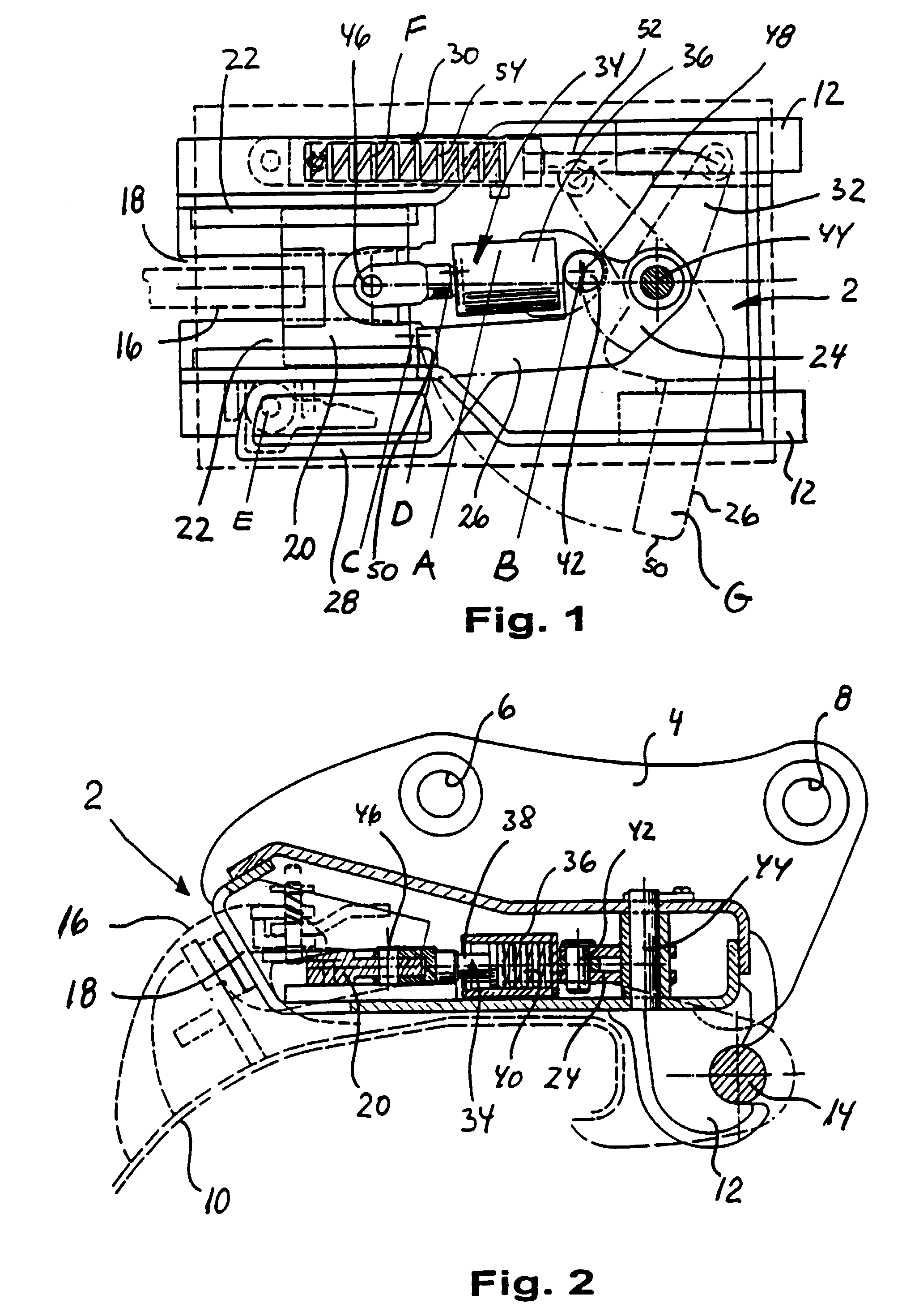
[0009] The invention is explained in more detail in the following with reference to the
drawing, in which:-
- Fig. 1
- shows a plane partial view - seen from above - of an embodiment for an implement coupling
according to the invention, while
- Fig. 2
- shows a side view - partly in section - of the implement coupling shown in Fig. 1.
[0010] The shown implement coupling 2 consists of two parallel bearing plates 4 with bearings
6 and 8 by means of which the implement coupling 2 is intended to be mounted at an
outer end of an excavator arm or a loader arm respectively to be connected with a
yoke for a hydraulic cylinder for swing of the implement coupling respectively the
implement, for instance an excavator bucket or a loader bucket 10 (Fig. 2).
[0011] The implement coupling 2 is at an end provided with hook-shaped connecting parts
12 being adapted to grasp around fixed connecting dowels at each its side of the implement,
for instance the excavator bucket 10, which at the opposite side is provided with
a hook-shaped locking part 16, which is intended to be lead into the implement coupling
2 through a central side opening 18.
[0012] When the connecting parts 12 are lead over the connecting dowels 14 the hook-shaped
locking part 16 is lead through the central side opening 18 and a locking splice 20,
which is displacable arranged between gliding rails 22 of the implement coupling 2,
is lead forward into locked position with the hook-shaped locking part 16, which is
carried out by swinging a basic joint 24
either manually by means of a projecting arm part 26 and an operating handle 28
or hydraulically by means of an activation cylinder 30 and an activation arm part 32, so that the
locking splice 20 may be lead forward by means of-an intermediate arm 34.
[0013] The intermediate arm 34, which comprises a pressure cylinder 36 with a piston rod
38 and an enormous pressure spring 40, is inserted between the locking splice 20 and
a bent axle 42 of the basic joint 24. The bent axle 42 is placed in a distance from
a fixed pivot axle 44 for the basic joint 24, so that the springy intermediate arm
34 may be displaced inwards passing the direct connecting line between the pivot axle
44 and a turning point 46 between the locking splice 20 and the intermediate arm 34
to a dead center position 48, where and end part 50 of the projecting arm part 26
is swung further inwards to a position just behind the locking splice 20, that is
that extraordinary big security is obtained that the locking splice 20 unintended
may be lead out of the locking engagement with the hook-shaped locking part 16.
[0014] The hydraulic activation cylinder 30 may appropriately be placed at the opposite
side of the implement coupling 2, so that the activiation cylinder 30 by means of
a pistion rod 52 may affect the activation arm part 32 and with that the basic joint
24 for releasing the locking engagement between the locking splice 20 and the locking
part 16. Also in this situation the displaced bent axle 42 is used for establishment
of a self-locking dead center position, where extra good security towards unintended
disengagement of the locking engagement between the locking splice 20 and the locking
part 16 by means of the projecting arm part 26 also is obtained, of which arm part
an end part is placed just behind the locking splice 20. The activation cylinder 30
is further provided with an internal pressure spring 54, which affects the piston
rod 52 in the direction towards the activation arm part 32, and which thereby assists
to maintain the locking function of the implement coupling, if the hydraulic pressure
should disappear.
[0015] Regardless the implement coupling according to the invention is adapted to be manually
or hydraulically operated extraordinary good security against unintended disengagement
of the locking engagement between the locking splice 20 and the locking part 16 is
obtained, namely because of the following:
Manual:
[0016]
A: Intermediate arm 34 comprises pressure cylinder 36
B: Intermediate arm 34 fixed in dead center position 48
C: End part 50 of projecting arm part 26 placed behind the locking splice 20
D: Short free length of stroke of the pressure cylinder 36
E: Operating handle 28 locked in locking position.
Hydraulic:
[0017]
A: Intermediate arm 34 comprises pressure cylinder 36
B: Intermediate arm 34 fixed in dead center position 48
C: End part 50 of projecting arm part 26 placed behind the locking splice 20
F: Activation cylinder 30 comprises pressure spring 54
G: Projecting arm part 26 functions as signal marker
1. An implement coupling (2) for excavators or loaders and with connecting means for
the mounting of the implement coupling at an outer end of an excavator or a loader
arm and for connection with an activation arm of a hydraulic cylinder, said implement
coupling comprises coupling means for the connection of the implement coupling to
complementary coupling means of an implement, for instance an excavator or a loader
bucket (10), and a shift mechanism with a displacable arranged locking splice (20)
being adapted to cooperate with a hook-shaped locking part (16) of the implement,
and said locking splice (20) being moved forwards and backwards by means of an articulated
swing arm mechanism, characterized in that said swing arm mechanism opposite the locking splice (20) comprises a basic
joint (24) being pivotally arranged on a central, fixed pivot axle (44), and said
basic joint (24) via a bent axle (42) in a distance from the pivot axle (44) being
pivotally connected with the locking splice (20) by means of an intermediate arm (34),
that the basic joint (24) has a projecting arm part (26), which is adapted to be swung
into a position mainly parallel with the intermediate arm (34), so that an end part
of the projecting arm part (26) is placed behind the locking splice (20), when this
is in lock engagement with the hook-shaped locking part (16) of the implement (10),
and when said bent axle (42) is placed in a dead center position at the opposite side
of the connecting line between the locking splice (20) and the pivot axle (44), and
that the basic joint (24) for operation of the shift mechanism (22) furthermore is
connected with a manual operating handle (28) and/or a hydraulic activiation cylinder
(30).
2. An implement coupling according to claim 1, characterized in that a pressure cylinder (36) with a piston rod (52), a piston and a powerful
pressure spring (54) are inserted in said intermediate arm (34).
3. An implement coupling according to claim 1 and 2 and adapted to be manually operated,
chacterized in that the operating handle (28) is connected with the projected arm part (26) at
the side opposite the intermediate arm (34), and that in connection with the operating
handle (28) is a pivoting locking pawl being adapted to lock the operating handle,
when it is swung in parallel with the intermediate arm (34), that is in the locking
position of the implement coupling.
4. An implement coupling according to claim 1 and 2 and adapted to be hydraulically operated,
characterized in that a piston rod (52) of the hydraulic activation cylinder (30) is connected
with an activiation arm part (32) of the basic joint (24) projecting from the latter
opposite the projecting arm part (26), that is at the side opposite of the intermediate
arm (34), which by means of said end part engage behind the locking splice (20), when
the activation arm part (32) is led to the rear by the piston rod (52) and that the
hydraulic activation cylinder (30) is provided with an internal pressure spring (54)
affecting the piston rod (52) in the direction towards the activation arm part (32),
that is maintaining the locking function of the implement coupling, if the hydraulic
pressure should disappear.
1. Gerätekupplung (2) für Bagger oder Lader mit Verbindungsmitteln zum Anbringen der
Gerätekupplung am äußeren Ende eines Bagger- oder Laderarms und zum Verbinden mit
dem Aktivierungshebel eines Hydraulikzylinders, die Kupplungsmittel zum Ankuppeln
an ein entsprechendes Kupplungsmittel eines Gerätes, z. B. einer Bagger- oder Ladeschaufel
(10) umfaßt, sowie eine Verschiebevorrichtung mit einem verschiebbaren Arretierspleiß
(20), der in ein hakenförmiges Einrastteil (16) des Gerätes eingreifen kann, und der
Arretierspleiß (20) mit Hilfe einer angelenkten Schwenkarmvorrichtung vorwärts und
rückwärts bewegt werden kann, dadurch gekennzeichnet, daß die dem Arretierspleiß (20) gegenüberliegende Schwenkarmvorrichtung eine Hauptverbindung
(24) hat, die um eine feststehende Mitteldrehachse (44) drehbar gelagert ist, und
die Hauptverbindung (24) über eine Biegeachse (42) im Abstand zur Drehachse (44) durch
einen Zwischenhebel (34) drehbar mit dem Arretierspleiß (20) so verbunden ist, daß
die Hauptverbindung (24) einen herausragenden Hebelteil (26) aufweist, der in Parallelstellung
zum Zwischenhebel (34) geschwenkt werden kann, so daß das Ende des herausragenden
Hebelteils (26) hinter dem Arretierspleiß (20) positioniert wird, wenn dieser in das
hakenförmige Einrastteil (16) des Gerätes (10) einrastet, und wenn die Biegeachse
(42) sich in Totpunktstellung an der gegenüberliegenden Seite der Verbindungslinie
zwischen dem Arretierspleiß (20) und der Drehachse (44) befindet, und daß die Hauptverbindung
(24) für die Betätigung der Verschiebevorrichtung (22) zusätzlich mit einem manuell
bedienbaren Griff (28) und/oder einem hydraulischen Aktivierungszylinder (30) verbunden
ist.
2. Gerätekupplung nach Anspruch 1, dadurch gekennzeichnet, daß in ihren Zwischenhebel (34) ein Druckzylinder (36) mit einer Kolbenstange (52), ein
Kolben und eine starke Druckfeder (54) eingelassen sind.
3. Manuell bedienbare Gerätekupplung nach Anspruch 1 und 2, dadurch gekennzeichnet, daß ihr Bedienungsgriff (28) mit dem herausragenden Hebelteil (26) an der gegenüberliegenden
Seite des Zwischenhebels (34) verbunden ist und ein drehbar gelagerter Sperrhebel
mit dem Bedienungsgriff (28) verbunden ist, um diesen zu arretieren, wenn er in Parallelstellung
mit dem Zwischenhebel (34) gebracht wird, d.h. in die Arretierstellung der Gerätekupplung.
4. Hydraulisch bedienbare Gerätekupplung nach Anspruch 1 und 2, dadurch gekennzeichnet, daß die Kolbenstange (52) des hydraulischen Aktivierungszylinders (30) mit einem Aktivierungshebelteil
(32) der Hauptverbindung (24) verbunden ist, der aus dieser gegenüber dem herausragenden
Hebelteil (26) hervorragt, d.h. an der dem Zwischenhebel (34) gegenüberliegenden Seite,
die mit dem Ende hinter den Arretierspleiß (20) eingreift, wenn der Aktivierungshebelteil
(32) durch die Kolbenstange (52) nach hinten geführt wird, und daß der hydraulisch
Aktivierungszylinder (30) mit einer inneren Druckfeder (54) versehen ist, die die
Kolbenstange (52) in Richtung auf den Aktivierungshebelteil (32) drückt, der die Gerätekupplung
auch dann weiterhin arretiert, wenn der Hydraulikdruck nicht mehr vorhanden ist.
1. Coupleur d'outil (2) pour pelleteuses ou chargeuses, comportant des moyens de raccordement
pour le montage du coupleur sur l'extrémité extérieure d'un bras de pelleteuse ou
de chargeuse, et pour le raccordement à un bras d'actionnement d'un vérin hydraulique,
ledit coupleur d'outil comprenant des moyens d'accouplement pour le raccordement du
coupleur d'outil sur des moyens d'accouplement complémentaires d'un outil, par exemple
un godet (10) d'une pelleteuse ou chargeuse, et un mécanisme de déplacement comportant
une éclisse de verrouillage (20) agencée de façon mobile et conçue pour coopérer avec
une pièce de verrouillage (16) en forme de crochet de l'outil, ladite éclisse de verrouillage
(20) étant déplacée en avant et en arrière au moyen d'un mécanisme articulé à bras
oscillant, caractérisé en ce que le mécanisme à bras oscillant à l'opposé de ladite
éclisse de verrouillage (20) comprend un joint de base (24) agencé de façon pivotante
sur un axe de pivot central fixe (44), et ledit joint de base (24) étant relié de
façon pivotante, par l'intermédiaire d'un axe de coude (42) situé à une distance de
l'axe de pivot (44), à l'éclisse de verrouillage (20), au moyen d'un bras intermédiaire
(34), en ce que le joint de base (24) comporte une partie saillante (26) de bras,
qui est conçue pour être basculée jusque dans une position essentiellement parallèle
au bras intermédiaire (34), de façon qu'une partie terminale de la partie saillante
(26) du bras soit placée derrière l'éclisse de verrouillage (20) lorsque celle-ci
est en engagement de verrouillage avec la partie de verrouillage (16) en forme de
crochet de l'outil (10), et lorsque ledit axe de coude (42) est placé dans une position
de point mort du côté opposé de la ligne de liaison entre l'éclisse de verrouillage
(20) et l'axe de pivot (44), et en ce que le joint de base (24), pour faire fontionner
le mécanisme de déplacement (22) est d'autre part relié à une poignée de commande
manuelle (28) et/ou à un vérin hydraulique (30) de commande.
2. Coupleur d'outil selon la revendication 1, caractérisé en ce qu'un cylindre de pression
(36) avec une tige de piston (52), un piston et un ressort de pression puissant (54)
sont insérés dans ledit bras intermédiaire (34).
3. Coupleur d'outil selon les revendications 1 et 2, et conçu pour être actionné manuellement,
caractérisé en ce que la poignée de commande (28) est reliée à la partie saillante
(26) du bras du côté opposé au bras intermédiaire (34), et en ce qu'un loquet pivotant
de verrouillage, relié à la poignée de commande (28), est conçu pour verrouiller la
poignée de commande lorsqu'elle est repliée parallèlement au bras intermédiaire (34),
c'est-à-dire en position de verrouillage du coupleur d'outil.
4. Coupleur d'outil selon les revendications 1 et 2, et conçu pour être actionné de façon
hydraulique, caractérisé en ce qu'une tige de piston (52) du vérin de commande hydraulique
(30) est reliée à une partie de bras de commande (32) du joint de base (24), en saillie
par rapport à celui-ci, à l'opposé de la partie saillante (26) de bras, c'est-à-dire
du côté à l'opposé du bras intermédiaire (34), qui s'engage derrière l'éclisse de
verrouillage (20) au moyen de ladite partie terminale, lorsque la partie de bras de
commande (32) est déplacée vers l'arrière par la tige de piston (52), et en ce que
le vérin de commande hydraulique (30) est pourvu d'un ressort de pression intérieur
(54) agissant sur la tige de piston (52) en direction de la partie de bras de commande
(32), qui maintient la fonction de verrouillage du coupleur d'outil si la pression
hydraulique devait disparaître.