|
(11) | EP 0 695 775 B1 |

| (12) | EUROPEAN PATENT SPECIFICATION |
|
|
| (54) |
Process for preparing hydrogen-terminated polyoxyperfluoroalkanes Verfahren zur Herstellung von Wasserstoffterminierten Polyoxyperfluoroalkanen Procédé pour la préparation de polyoxyperfluoroalkanes terminés par hydrogène |
|
|
|||||||||||||||||||||||||||||||
| Note: Within nine months from the publication of the mention of the grant of the European patent, any person may give notice to the European Patent Office of opposition to the European patent granted. Notice of opposition shall be filed in a written reasoned statement. It shall not be deemed to have been filed until the opposition fee has been paid. (Art. 99(1) European Patent Convention). |
[0001] The present invention relates to a process for preparing hydrogen-terminated polyoxyperfluoroalkanes having hydrogenated end groups and number average molecular weight lower than 1800 by decarboxylation of the alkaline salts obtained by hydrolysis and salification of the corresponding acylfluorides, carried out in the presence of water, at temperatures from 140 to 170°C and under a pressure of at least 4 atm.
[0002] The polyoxyperfluoroalkanes with hydrogenated end groups and molecular weight lower than 1800 have such chemical physical characteristics that they can be used as CFC and HCFC substitutes as expanding agents for polyurethanes, as refrigerants, as propellants for aerosol and as solvents.
[0003] Such polyoxyperfluoroalkanes are sufficiently free from harmful physiologic effects, have scarce influence on the global warming and as they do not contain chlorine are not damaging for the ozone layer, like CFC and HCFC.
[0004] It is known from EP patent 154,297 to prepare hydrogen-terminated polyoxyperfluoroalkanes by a decarboxylation process of the alkaline salts obtained from the corresponding polyoxperfluoroalkanes having acylfluoride -COF end groups, in the presence of solvents containing an active hydrogen as glycols and high boiling alcohols.
[0005] Polyoxyperfluoroalkanes having -OCF(CF3)H end groups are prepared with yields around 70% by reaction of the corresponding polyoxyperfluoroalkanes terminated with the -OCF(CF3)COF group with diethylene glycol and aqueous KOH at 175°C.
[0006] Such a process wherein glycols or high boiling alcohols are used does not allow to obtain high yields and shows various drawbacks:
- formation of undesired by-products, deriving from secondary reactions between glycol or alcohol with polyoxyperfluoroalkanes which hardly result separable,
- in case of the preparation of hydrogen-terminated polyoxyperfluoroalkanes having low molecular weight (lower than 1800) it is difficult to separate such products from the glycol or from the high boiling alcohol present in the reaction final mixture because of the little differences among their boiling points and their solubility parameters,
- alcoholates between glycol or alcohol and alkaline hydroxide are also formed at the decarboxylation temperatures giving rise to reactions of degradation type on the polyoxyperfluoroalkane chain, with substantial variation of molecular weights and consequent yield lowering in the product having the desired molecular weights distribution, i.e. substantially like that of the starting acylfluorides.
[0007] In USP 5,091,589 a process is described for preparing polyoxyperfluoroalkanes having an hydrogenated end group of -OCFHCF3 type and average molecular weights of 2000-4000, by reaction of the corresponding acylfluorides with -OCF(CF3)COF end group with an anhydrous solid alkali metal hydroxide, in absence of solvents, at temperatures from 90°-160°C, with yields of 93%.
[0008] By such process, however, it is not possible to prepare polyoxyperfluoroalkanes having hydrogenated end groups of -OCF2H and/or OCF2CF2H type starting from the corresponding acylfluorides with -OCF2COF and/or OCF2CF2COF end groups, since only the alkaline salts of said acylfluorides are obtained, i.e. products having -OCF2COOM and/or -OCF2CF2COOM end groups, wherein M is an alkaline metal.
[0009] It has now been surprisingly found a process for preparing neutral polyoxyperfluoroalkanes, having 1 or 2 hydrogenated end groups and number average molecular weight lower than 1800, preferably lower than 1500, starting from the corresponding acylfluorides, which does not show the drawbacks reported by the known processes and which results applicable also to acylfluorides with -OCF2COF and -OCF2CF2COF end groups, with high yields higher than 96%, substantially keeping unchanged the distribution of the molecular weights of the starting polyoxyperfluoroalkanes.
[0010] It has been in fact found that it is possible to obtain with yields higher than 96% hydrogen-terminated polyoxyperfluoroalkanes i.e. with end groups -OCF2H, -OCF2CF2H or -OCF(CF3)H, having molecular weights lower than 1800, by decarboxylation of salts, preferably of alkaline metals, obtained by hydrolysis and salification of the corresponding acylfluorides, carried out at 140°-170°C, in the presence of water and under a pressure of at least 4 atm (4.053 bar), preferably between 6 and 10 atm (6.08-10.13 bar), in particular when the process is operated continuously.
[0011] Thus, it is an object of the present invention a process for preparing neutral polyoxyperfluoroalkanes, having 1 or 2 end groups selected from -OCF2H, -OCF2CF2H and -OCF(CF3)H and a number average molecular weight lower than 1800, preferably lower than 1500, consisting in decarboxylating the salts formed by the corresponding polyoxyperfluoroalkanes having one or two end groups selected from -OCF2COOZ, -OCF2CF2COOZ and -OCF(CF3)COOZ, wherein Z is a monovalent cation, in the presence of water, at pH between 5 and 9, at a temperature from 140 to 170°C and under a pressure of at least 4 atmospheres.
[0012] Said starting salts are prepared by hydrolysis and salification, with aqueous solution of ammonium hydroxides or alkaline hydroxides, of polyoxyperfluoroalkanes having one or two end groups selected from -OCF2COF, -OCF2CF2COF and -OCF(CF3)COF and a number average molecular weight lower than 1800.
[0013] Said polyoxyperfluoroalkanes having at least an acylfluoride -COF end group are products known as such and are formed by fluorooxyalkylene units selected from the following:
wherein X is -(CF2)nCF3 and n = 0, 1, 2, 3, 4, said units being statistically distributed in the polymeric chain, having one or two end groups selected from -OCF2COF, -OCF2CF2COF and -OCF(CF3)COF.
[0014] They can be obtained by photooxidation processes of fluorinated olefins (for instance hexafluoropropene and/or tetrafluoroethylene) or by oligomerization of perfluoroolefin epoxides such as for instance C2F4O and C3F6O.
[0015] The desired molecular weights can be directly obtained by synthesis or by catalytic cracking processes from products having higher molecular weight.
[0016] In the preparation of the aforesaid salts the polyoxyperfluoroalkanes having the following structures:
RfO (CF2CF2O)m (CF2O)nCF2COF
and
RfO (CF2CF(CF3)O)p (CF2O)n (CF(CF3)O)q CF2COF
can in particular be used, wherein Rf is CF3 or CF2COF and m, n, p and q have average values such as to meet the requirements of average molecular weight lower than 1800, preferably lower than 1500.
[0017] Said salts to be decarboxylated can be prepared separately or prepared in situ, in the same decarboxylation reactor, from the corresponding polyoxyperfluoroalkanes having one or more acylfluoride -COF end groups, with substantially stoichiometric amounts of ammonium or alkaline metals hydroxides in aqueous solution.
[0018] The Z cation of said salts is preferably selected from ammonium and alkaline metals, more preferably it is potassium.
[0019] The pH between 5 and 9 is automatically set if the starting salt is an alkaline metal or can be maintained by addition of buffer solutions.
[0020] The temperature at which said salts are reacted is preferably comprised between 150°C and 160°C.
[0021] The process according to the present invention can be carried out discontinuously or continuously.
EXAMPLE 1
[0023] 180 g of potassium salt of a α-ω-perfluoropolyoxyalkandioic acid obtained by hydrolysis and salification of a fraction having fluoroacylic end groups (-OCF2COF), coming from tetrafluoroethylene and oxygen photooxidation, having the structure:
T O(CF2CF2O)m (CF2O)n T
wherein T = -CF2COOK, average MW of 514 and m/n = 2.1, are loaded with 200 ml of water into a 400 ml autoclave equipped with inner probe for the survey of the temperature, rocking stirring, manometer, automatic vent valve set at 7 atm (7.09 bar) and connected to two condensers thermostated at 15°C and 0°C respectively. The internal temperature is brought to 150°C and maintained for 10 hours.
[0024] After cooling a reaction mass is discharged consisting of two phases: upper aqueous one containing KHCO3 and lower organic one consisting of 117 g of fluorinated product which at the 19F NMR analysis results to have the following structure:
A O (CF2CF2O)m(CF2O)n A
wherein A = CF2H, average MW of 595 and m/n = 2.1 (theoretic yield = 95.45%).
EXAMPLE 2 (COMPARATIVE)
[0025] 200 g of potassium salt of a α-ω-perfluoropolyoxyalkandioic acid described in example 1, 250 ml of water and 150 g of ethylenglycol are loaded into an 1 l glass reactor equipped with blade stirrer, thermometric probe, Claisen cooled at 15°C by means of circulating water in the jacket and connected to a 500 ml collecting flask.
[0026] The mixture is brought to 160°C and maintained for 8 hours obtaining by distillation and subsequent separation from water 90.3 g (yield 66.3%) of fluorinated product which at the 19F NMR analysis results to have the following structure:
A O (CF2CF2O)m(CF2O)n A
wherein A = CF2H, average MW of 410 and m/n = 2.3.
[0027] The 1H and 19F NMR analysis show the presence in the fluorinated product of 2% of by-products having the structure HOCH2CH2OCF2H and HOCH2CH2F.
[0028] The off-gas are consisting of CO2, CF3H and CO. The residue in the reactor is consisting of ethylenglycol containing KF and KHCO3.
EXAMPLE 3 (COMPARATIVE)
[0029] 100 g of potassium salt of a α-ω-perfluoropolyoxyalkandioic acid described in example 1, 100 ml of water and 30 g of 85% KOH are loaded into a 250 ml glass reactor equipped with blade stirrer, thermometric probe, Claisen cooled at 15°C by means of circulating water in the jacket and connected to a 250 ml collecting flask.
[0030] The mixture is brought up to 155°C under stirring obtaining by distillation and subsequent separation from water 14 g (yield 20.5%) of fluorinated product which at the 19F NMR analysis results to have the following structure:
A O (CF2CF2O)m(CF2O)n A
wherein A = CF2H, average MW of 380 and m/n = 2.2.
[0031] In the dry residuum of distillation, KF and starting product are present (IR absorption 1680 cm-1).
EXAMPLE 4
[0032] 250 g of potassium salt of a perfluoropolyoxyalkanoic acid obtained by hydrolysis and salification of a fraction having fluoroacylic end groups (-OCF2COF), coming from hexafluoropropene and oxygen photooxidation, having the structure:
T O(CF2CF(CF3)O)p (CF(X)O)q T'
wherein T = CF3, T' = CF2COOK, X = F, CF3, p/q = 40 and average MW = 450, are loaded with 200 ml of water into a 400 ml autoclave equipped with inner probe for the survey of the temperature, rocking stirring, manometer, automatic vent valve set at 7 atm (7.09 bar) and connected to two condensers thermostated at 15°C and 0°C respectively. The reactor temperature is brought to 160°C and maintained for 10 hours. After cooling and separation of water, 200 g of fluorinated product are obtained which at the 19F NMR analysis results to have the following structure:
A O (CF2CF(CF3)O)p (CF(X)O)q A'
wherein A = CF3, A' = CF2H, p/q = 40 and average MW of 368 (yield = 97.8%).
EXAMPLE 5 (COMPARATIVE)
[0033] 200 g of potassium salt of a perfluoropolyoxyalkanoic acid described in example 4, 250 ml of water and 150 g of ethylene glycol are loaded into a 1 l glass reactor equipped with blade stirrer, thermometric probe, Claisen cooled at 15°C by means of circulating water in the jacket and connected to a 500 ml collecting flask.
[0034] The mixture is brought up to 160°C and maintained for 8 hours obtaining by distillation and subsequent separation from water 116 g (yield 70.9%) of fluorinated product which at the 19F NMR analysis results to have the following structure:
A O (CF2CF(CF3)O)p (CF(X)O)q A'
wherein A = CF3, A' = CF2H, X = F, CF3 and having an average MW of 390 and p/q = 40.
[0035] The 1H- and 19F-NMR analysis show the presence of 1% of products having the structure
HOCH2CH2OCF2H and HOCH2CH2F.
[0036] In the dry residuum of distillation, KF and starting product are present (IR absorption 1680 cm-1).
EXAMPLE 6 (COMPARATIVE)
[0037] 100 g of potassium salt of a perfluoropolyoxyalkanoic acid described in example 4, 100 ml of water and 15 g of 85% KOH are loaded into a 250 ml glass reactor equipped with blade stirrer, thermometric probe, Claisen cooled at 15°C by means of circulating water in the jacket and connected to a 250 ml collecting flask.
[0038] The mixture is brought up to 155°C under stirring obtaining by distillation and subsequent separation from water 29 g (yield 35.5%) of fluorinated product which at the 19F NMR analysis results to have the following structure:
A O (CF2CF(CF3)O)p (CF(X)O)q A'
wherein A = CF3, A' = CF2H, X = F, CF3 and having an average MW of 375 and p/q = 40.
EXAMPLE 7 (COMPARATIVE)
[0040] Polyoxyperfluoroalkanes having -CF2COF end groups were treated according to the process described in USP 5,091,589.
1. Process for preparing polyoxyperfluoroalkanes having one or two end groups selected
from -OCF2H, -OCF2CF2H and -OCF(CF3)H and a number average molecular weight lower than 1800, consisting in decarboxylating
the salts formed by the corresponding polyoxyperfluoroalkanes having one or two end
groups selected from -OCF2COOZ, -OCF2CF2COOZ and -OCF(CF3)COOZ, wherein Z is a monovalent cation, in the presence of water, at temperatures
from 140° to 170°C and under a pressure of at least 4 atmospheres (4.053 bar).
2. Process according to claim 1, wherein the polyoxyperfluoroalkanes are formed by fluorooxyalkylene
units selected from
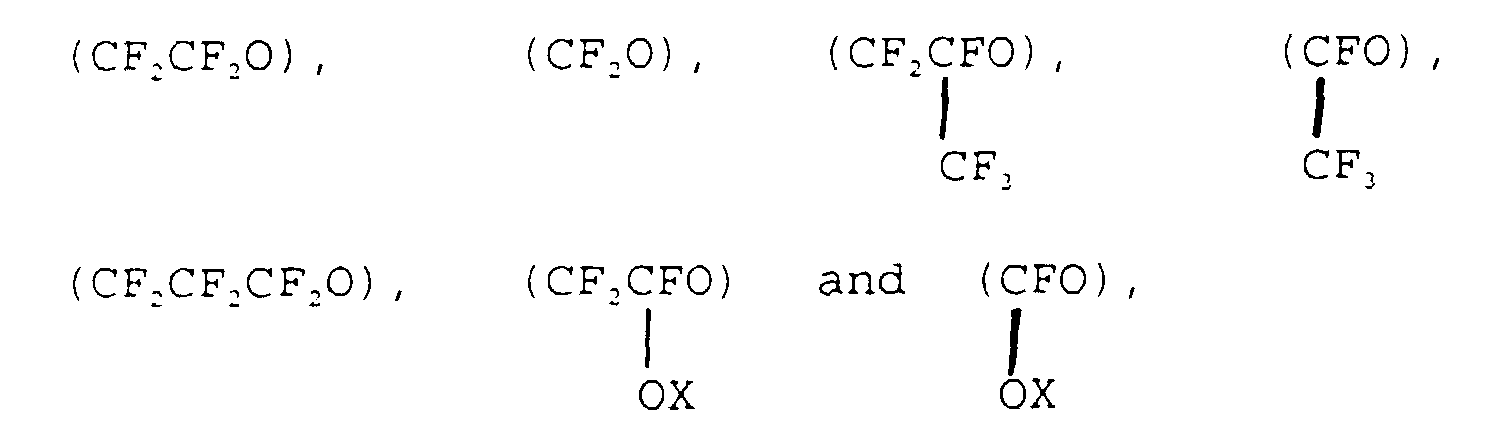
wherein X is -(CF2)nCF3 and n = 0, 1, 2, 3, 4, said units being statistically distributed in the polymeric chain, having the end groups indicated in claim 1.
wherein X is -(CF2)nCF3 and n = 0, 1, 2, 3, 4, said units being statistically distributed in the polymeric chain, having the end groups indicated in claim 1.
3. Process according to claim 2, wherein the polyoxyperfluoroalkanes salts to be decarboxylated
are selected from the structures:
RfO (CF2CF2O)m (CF2O)nCF2COOZ
and
RfO (CF2CF(CF3)O)p (CF2O)n (CF(CF3)O)q CF2COOZ
wherein m, n, p and q have average values such as to have a number average molecular weight lower than 1500 and wherein Rf is -CF3 or -CF2CO-OZ.
RfO (CF2CF2O)m (CF2O)nCF2COOZ
and
RfO (CF2CF(CF3)O)p (CF2O)n (CF(CF3)O)q CF2COOZ
wherein m, n, p and q have average values such as to have a number average molecular weight lower than 1500 and wherein Rf is -CF3 or -CF2CO-OZ.
4. Process according to claims from 1 to 3 wherein the monovalent cation is selected
from ammonium and alkaline metals.
5. Process according to claim 4 wherein the alkaline metal is potassium.
6. Process according to claims from 1 to 5 wherein the decarboxylation temperature is
150°-160°C.
7. Process according to claims from 1 to 6, wherein the pressure is comprised between
6 and 10 atmospheres (6.08 - 10.13 bar).
8. Process according to claims from 1 to 6 wherein the polyoxyperfluoroalkanes salts
to be decarboxylated are prepared in situ by reacting the corresponding polyoxyperfluoroalkanes
having one or two end groups selected from -OCF2COF, -OCF2CF2COF and -OCF(CF3)COF with stoichiometric amounts of alkaline metals or ammonium hydroxides in aqueous
solution.
1. Verfahren zur Herstellung von Polyoxyperfluoralkanen, die eine oder zwei Endgruppen
aufweisen, die ausgewählt werden aus -OCF2H, -OCF2CF2H und -OCF(CF3)H, sowie ein mittleres Zahlenmolekulargewicht von weniger als 1800, das aus der Decarboxilierung
der Salze, die durch die entsprechenden Polyoxyperfluoralkane gebildet werden, die
eine oder zwei Endgruppen aufweisen, die ausgewählt werden aus -OCF2COOZ, -OCF2CF2COOZ und -OCF(CF3)COOZ, worin Z ein einwertiges Kation ist, in Gegenwart von Wasser bei Temperaturen
von 140 bis 170°C und unter einem Druck von wenigstens 4 Athmosphären (4,053 bar)
besteht.
2. Verfahren nach Anspruch 1, worin die Polyoxyperfluoralkane aus Fluoroxyalkylen-Einheiten
gebildet werden, die ausgewählt werden aus
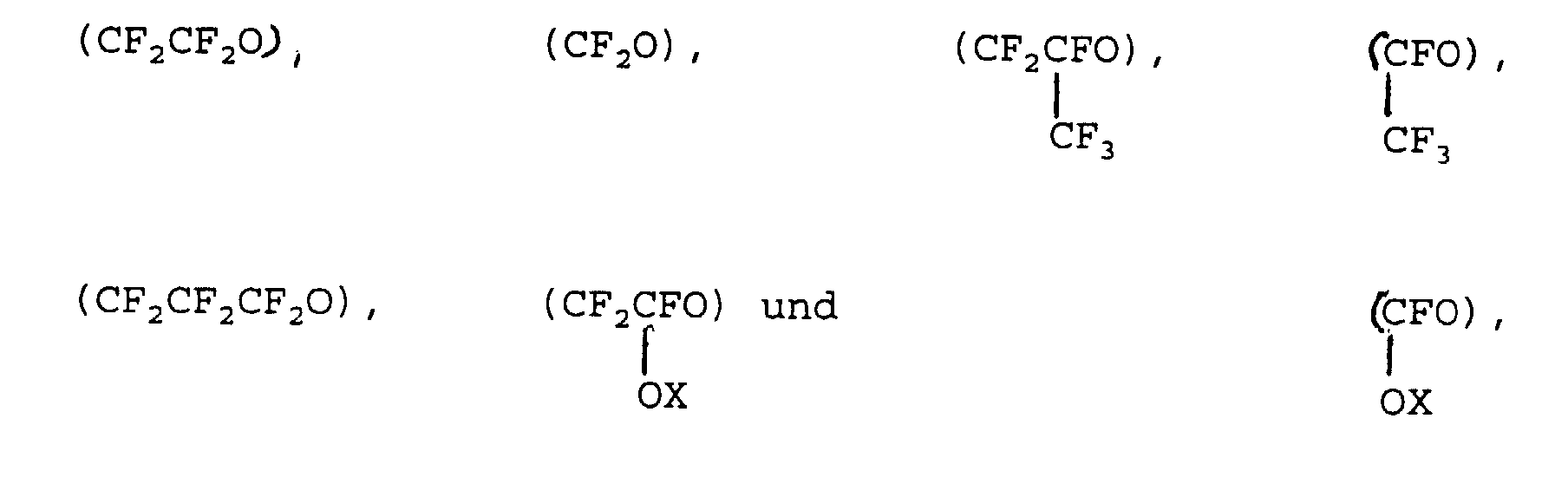
worin X - (CF2)nCF3 und n = 0, 1, 2, 3, 4 ist, wobei die besagten Einheiten statistisch in der Polymerkette verteilt sind, welche die im Anspruch 1 angegebenen Endgruppen aufweisen.
worin X - (CF2)nCF3 und n = 0, 1, 2, 3, 4 ist, wobei die besagten Einheiten statistisch in der Polymerkette verteilt sind, welche die im Anspruch 1 angegebenen Endgruppen aufweisen.
3. Verfahren nach Anspruch 2, worin die zu decarboxilierenden Polyoxyperfluoralkansalze
aus folgenden Strukturen ausgewählt werden:
RfO (CF2CF2O)m (CF2O)nCF2COOZ
und
RfO (CF2CF(CF3)O)p (CF2O)n (CF(CF3)O)q CF2COOZ
worin m, n, p und q wie das mittlere Zahlenmolekulargewicht mittlere Werte von weniger als 1500 aufweisen, und worin Rf -CF3 oder -CF2CO-OZ ist.
RfO (CF2CF2O)m (CF2O)nCF2COOZ
und
RfO (CF2CF(CF3)O)p (CF2O)n (CF(CF3)O)q CF2COOZ
worin m, n, p und q wie das mittlere Zahlenmolekulargewicht mittlere Werte von weniger als 1500 aufweisen, und worin Rf -CF3 oder -CF2CO-OZ ist.
4. Verfahren nach einem der Ansprüche 1 bis 3, worin das einwertige Kation aus Ammonium
oder Alkalimetallen ausgewählt wird.
5. Verfahren nach Anspruch 4, worin das Alkalimetall Kalium ist.
6. Verfahren nach einem der Ansprüche 1 bis 5, worin die Decarboxilierungstemperatur
150 - 160° ist.
7. Verfahren nach einem der Ansprüche 1 bis 6, worin der Druck zwischen 6 und 10 Atmosphären
(6,08 - 10,13 bar) liegt.
8. Verfahren nach einem der Ansprüche 1 bis 6, worin die zu decarboxilierenden Polyoxyperfluoralkansalze
in situ durch Reaktion der entsprechenden Polyoxyperfluoralkane hergestellt werden,
welche eine oder zwei Endgruppen aufweisen, die ausgewählt werden aus -OCF2COF, -OCF2CF2COF und -OCF(CF3)COF, mit stöchiometrischen Mengen von Alkalimetallen oder Ammoniumhydroxiden in wässrige
Lösung.
1. Procédé de fabrication de polyoxyperfluoroalcanes ayant un ou deux groupes terminaux
choisis parmi -OCF2H, -OCF2CF2H et -OCF(CF3)H et une masse moléculaire moyenne en nombre inférieure à 1800, consistant à décarboxyler
les sels formés par les polyoxyperfluoroalcanes correspondants ayant un ou deux groupes
terminaux choisis parmi -OCF2COOZ, -OCF2CF2COOZ et -OCF(CF3)COOZ, où Z est un cation monovalent, en présence d'eau, à des températures allant
de 140° à 170°C et sous une pression d'au moins 4 atmosphères (4,053 bar).
2. Procédé selon la revendication 1, dans lequel les polyoxyperfluoroalcanes sont formés
par des unités fluorooxyalkylène choisies parmi :
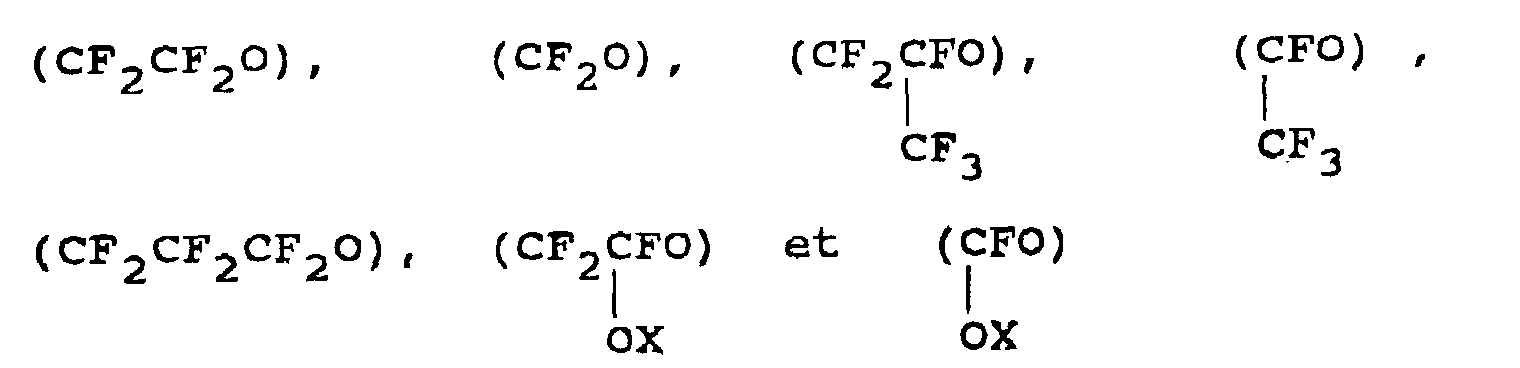
dans lesquelles X représente -(CF2)nCF3 et n = 0, 1, 2, 3, 4, lesdites unités étant distribuées statistiquement dans la chaîne polymère, ayant les groupes terminaux indiqués en revendication 1.
dans lesquelles X représente -(CF2)nCF3 et n = 0, 1, 2, 3, 4, lesdites unités étant distribuées statistiquement dans la chaîne polymère, ayant les groupes terminaux indiqués en revendication 1.
3. Procédé selon la revendication 2, dans lequel les sels de polyoxyperfluoroalcanes
devant être décarboxylés sont choisis parmi les structures :
RfO (CF2CF2O)m (CF2O)nCF2COOZ ;
et
RfO (CF2CF(CF3)O)p (CF2O)n (CF(CF3)O)q CF2COOZ
dans lesquelles m, n, p et q ont des valeurs moyennes de façon à avoir une masse moléculaire moyenne en nombre inférieure à 1500 et dans lesquelles Rf représente -CF3 ou -CF2CO-OZ.
RfO (CF2CF2O)m (CF2O)nCF2COOZ ;
et
RfO (CF2CF(CF3)O)p (CF2O)n (CF(CF3)O)q CF2COOZ
dans lesquelles m, n, p et q ont des valeurs moyennes de façon à avoir une masse moléculaire moyenne en nombre inférieure à 1500 et dans lesquelles Rf représente -CF3 ou -CF2CO-OZ.
4. Procédé selon l'une des revendications 1 à 3, dans lequel le cation monovalent est
choisi parmi l'ammonium et les métaux alcalins.
5. Procédé selon la revendication 4, dans lequel le métal alcalin est le potassium.
6. Procédé selon l'une des revendications 1 à 5, dans lequel la température de décarboxylation
est de 150°-160°C.
7. Procédé selon l'une des revendications 1 à 6, dans lequel la pression est comprise
entre 6 et 10 atmosphères (6,08-10,13 bar).
8. Procédé selon l'une des revendications 1 à 6, dans lequel les sels de polyoxyperfluoroalcanes
devant être décarboxylés sont préparés in situ par réaction des polyoxyperfluoroalcanes
correspondants ayant un ou deux groupes terminaux choisis parmi -OCF2COF, -OCF2CF2COF et -OCF(CF3)COF, avec des quantités stoechiométriques d'hydroxydes de métaux alcalins ou d'ammonium
en solution aqueuse.