|
(11) | EP 0 696 581 B1 |

| (12) | EUROPEAN PATENT SPECIFICATION |
|
|
| (54) |
Preparation of thioamides Herstellung von Thioamiden Préparation de thioamides |
|
|
|||||||||||||||||||||||||||||||
| Note: Within nine months from the publication of the mention of the grant of the European patent, any person may give notice to the European Patent Office of opposition to the European patent granted. Notice of opposition shall be filed in a written reasoned statement. It shall not be deemed to have been filed until the opposition fee has been paid. (Art. 99(1) European Patent Convention). |
[0001] The present invention is concerned with the preparation of thioamides, that is amides in which the oxygen atom is notionally replaced by a sulphur atom.
[0002] Thioamides, and in particular aliphatic thioamides, are of value as intermediates in the preparation of various products having a wide range of applications. By way of example, thioamides are useful in the preparation of thiazoles, many of which find application as pharmaceuticals. For these reasons, many different processes have been proposed for the preparation of thioamides.
[0003] The most widely practised process for this purpose entails reacting the corresponding amide with a suitable thiation agent, such as phosphorus pentasulphide or an aromatic derivative thereof known as Lawesson's Reagent. However phosphorus pentasulphide is a very difficult reagent to handle and the effluent obtained in the reaction is expensive to treat and dispose of. Lawesson's reagent is very expensive and also gives an effluent which entails disposal problems.
[0004] With a view to avoiding these foregoing difficulties, an alternative process has been proposed involving reacting a nitrile with hydrogen sulphide, to form the desired thioamide by direct addition of the hydrogen sulphide across the cyanide group. 'The reaction may be catalysed by amines. However, while this addition reaction gives good yields when applied to aromatic nitriles, aliphatic nitriles undergo reaction very slowly and give poor yields unless the reaction is carried out at elevated temperatures and pressures. See, for example, US-A-3274243, which proposes to improve the reaction rate of alkanoic nitriles by including a strongly basic amine in the reaction mixture and carrying out the reaction at temperatures up to reflux temperatures.
[0005] Against this background, it is an object of the present invention to provide a process for converting aliphatic nitriles to thioamides, by which improved reaction rates and/or improved yields of the desired product may be obtained even at ambient temperatures.
[0006] The process according to the present invention, for the preparation of aliphatic thioamides, comprises reacting a nitrile compound of the general formula
wherein the symbol R1 denotes a hydrogen atom, an alkyl radical containing from 1 to 5 carbon atoms or an aryl radical and the symbols R2 and R3 each denotes a hydrogen atom or an alkyl radical containing from 1 to 5 carbon atoms, with hydrogen sulphide, in the presence of an aliphatic amine of the general formula
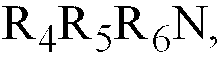
wherein the symbol R4 denotes an alkyl radical containing from 1 to 5 carbon atoms and the symbols R5 and R6 each denotes a hydrogen atom, in a water-miscible polar solvent.
[0007] The nitrile compound which is reacted in the process according to the invention is an aliphatic nitrile of the formula R1R2R3C-CN, wherein the symbols R1, R2 and R3 have the meanings given above. The alkyl groups may have straight or branched chains. Typical nitriles to which the reaction may be applied include acetonitrile, propionitrile, n- and isobutyronitrile and phenylacetonitrile and homologues of these foregoing compounds within the specified limits. Reaction of isobutyronitrile to yield thio-isobutyramide is of particular interest.
[0008] The reaction is catalysed by an aliphatic amine of the formula R4 R5R6N, wherein the symbols R4 , R5 and R6 have meanings given above. By way of example, the catalyst may be methylamine, ethylamine or n- or isopropylamine. Of these, isopropylamine is particularly preferred. The quantity of the catalyst used is not critical but typically will be in the range of 10 to 100 mole per cent in relation to the quantity of the nitrile. The preferred amount is in the range from 20 to 40 mole per cent.
[0009] The reaction is carried out in a water-miscible polar solvent, preferably an aprotic polar solvent, and such solvents are important in achieving acceptably high reaction rates. Suitable solvents for this purpose include dimethylacetamide, sulpholane, N-methylpyrrolidinone,1,3-dimethylimidazolidinone and dimethyl sulphoxide. The particularly preferred solvent is dimethylformamide. The quantity of solvent is preferably in the range from 100 to 500g per mole of the nitrile, more preferably in the range from 120 to 300g per mole of the nitrile.
[0010] The molar quantity of hydrogen sulphide preferably exceeds that of the nitrile and more preferably amounts to 110 to 300 mole per cent of the quantity of the nitrile. Typically, it amounts to 160 to 250 mole per cent based on the nitrile.
[0011] The process according to the invention may be carried out under ambient conditions of temperature and pressure and makes possible good yields of the desired thioamide. However the reaction may, if desired, be accelerated and the yield enhanced by heating the reaction mixture to a temperature a little above the ambient temperature, for example to a temperature lying in the range from 30°C to 50°C, preferably from 30°C to 40°C.
[0012] The thioamide produced by the process may readily be separated from the reaction mixture by quenching with water and solvent extraction, for example using a solvent such as dichloromethane.
Example 1
[0014] To a stirred flask fitted with a condenser attached to a caustic scrubber were charged isobutyronitrile (100g), isopropylamine (30g), and dimethylformamide (400 ml). Hydrogen sulphide gas was charged to the vessel over a period of 24 hours and the reaction mixture stirred until the consumption of the nitrile became very slow.
[0015] The reaction mixture was quenched into water (900 ml) and extracted into dichloromethane (3 x 250 ml). The combined organic phases were dried with magnesium sulphate and then concentrated on a rotary evaporator, thereby yielding an oil which, apart from residual solvent, was essentially pure thioisobutyramide (127g, 85 per cent yield).
Example 2
[0016] A solution of isobutyronitrile (80g) and isopropylamine (27.0g) in dimethyl sulphoxide (125 ml) in a stirred reaction vessel fitted with a condenser was cooled to 0-5°C and connected to a caustic scrubber. A total of 85g of hydrogen sulphide gas was added over 6 hours and the reaction mixture stirred until the reaction became very slow. Quenching into water (500 ml), extraction into dichloromethane (3 x 250 ml), followed by a small water backwash, yielded, on concentration, an oil which apart from residual solvent was essentially pure thioisobutyramide (yield 85g, 71%).
Example 3
[0017] Isopropylamine (54g), propionitrile (128g) and dimethylformamide (300 ml) were charged to a stirred reaction vessel fitted with a condenser attached to a caustic scrubber. The mixture was cooled to 0-5°C and hydrogen sulphide gas charged over 24 hours, during which time the termperature was slowly allowed to rise to ambient temperature. After standing for a further 12 hours, the solution was concentrated under vacuum to 75% of its original volume,quenched into water (1600 ml) and then extracted with dichloromethane (3 x 250 ml). The combined organic phases were dried with magnesium sulphate and concentrated on a rotary evaporator to an oil which apart from residual solvent was essentially pure thiopropionamide (145g, 70% yield).
Examples 4 to 9
[0018] Using the reaction methods and separation techniques described in Examples 1 to 3, the nitriles set forth in the following table were reacted with hydrogen sulphide gas in the solvents shown, in the presence of the catalysts specified in the table. The yields of the corresponding thioamides are shown.
1. A process for the preparation of an aliphatic thioamide, characterised in that it
comprises reacting a nitrile compound of the general formula
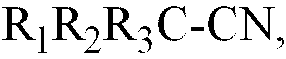
wherein the symbol R1 denotes a hydrogen atom, an alkyl radical containing from 1 to 5 carbon atoms or an aryl radical and the symbols R2 and R3 each denotes a hydrogen atom or an alkyl radical containing from 1 to 5 carbon atoms, with hydrogen sulphide, in the presence of an aliphatic amine of the general formula
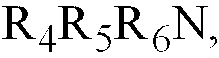
wherein the symbol R4 denotes an alkyl radical containing from 1 to 5 carbon atoms and the symbols R5 and R6 each denotes a hydrogen atom, in a water-miscible polar solvent.
wherein the symbol R1 denotes a hydrogen atom, an alkyl radical containing from 1 to 5 carbon atoms or an aryl radical and the symbols R2 and R3 each denotes a hydrogen atom or an alkyl radical containing from 1 to 5 carbon atoms, with hydrogen sulphide, in the presence of an aliphatic amine of the general formula
wherein the symbol R4 denotes an alkyl radical containing from 1 to 5 carbon atoms and the symbols R5 and R6 each denotes a hydrogen atom, in a water-miscible polar solvent.
2. A process according to Claim 1, characterised in that the nitrile compound is acetonitrile,
propionitrile, n- or isobutyronitrile or phenylacetonitrile.
3. A process according to Claim 1 or Claim 2, characterised in that the aliphatic amine
is methylamine, ethylamine, n-propylamine or isopropylamine.
4. A process according to any of the preceding claims, characterised in that the water-miscible
polar solvent is dimethylformamide, dimethylacetamide, sulpholane, N-methylpyrrolidinone,
1,3-dimethylimazolidinone, or dimethyl sulphoxide.
5. A process for the preparation of thioisobutyramide characterised in that it comprises
reacting isobutyronitrile with hydogen sulphide in the presence of isopropylamine,
in solution in dimethylformamide.
6. A process according to any of the preceding claims, characterised in that the quantity
of the aliphatic amine lies within the range of 10 to 100 mole per cent, based on
the quantity of the nitrile compound.
7. A process according to any of the preceding claims, characterised in that the quantity
of hydrogen suphide lies within the range of 110 to 300 mole per cent, based on the
quantity of the nitrile compound.
8. A process according to any of the preceding claims, characterised in that the quantity
of solvent lies within the range from 100 to 500g per mole of the nitrile.
9. A process according to any of the preceding claims, characterised in that the reaction
is carried out at a temperature lying in the range from 30°C to 50°C.
1. Verfahren zur Herstellung von aliphatischen Thioamiden, dadurch gekennzeichnet, daß
es die Umsetzung einer Nitrilverbindung der allgemeinen Formel

in der das Symbol R1 ein Wasserstoffatom, einen Alkylrest mit 1 bis 5 Kohlenstoffatomen oder einen Arylrest und die Symbole R2 und R3 jeweils ein Wasserstoffatom oder einen Alkylrest mit 1 bis 5 Kohlenstoffatomen darstellen, mit Schwefelwasserstoff in einem mit Wasser mischbaren polaren Lösungsmittel in Anwesenheit eines aliphatischen Amins der allgemeinen Formel
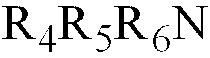
umfaßt, in der das Symbol R4 einen Alkylrest mit 1 bis 5 Kohlenstoffatomen bezeichnet und die Symbole R5 und R6 jeweils ein Wasserstoffatom darstellen.
in der das Symbol R1 ein Wasserstoffatom, einen Alkylrest mit 1 bis 5 Kohlenstoffatomen oder einen Arylrest und die Symbole R2 und R3 jeweils ein Wasserstoffatom oder einen Alkylrest mit 1 bis 5 Kohlenstoffatomen darstellen, mit Schwefelwasserstoff in einem mit Wasser mischbaren polaren Lösungsmittel in Anwesenheit eines aliphatischen Amins der allgemeinen Formel
umfaßt, in der das Symbol R4 einen Alkylrest mit 1 bis 5 Kohlenstoffatomen bezeichnet und die Symbole R5 und R6 jeweils ein Wasserstoffatom darstellen.
2. Verfahren gemäß Anspruch 1, dadurch gekennzeichnet, daß es sich bei der Nitrilverbindung
um Acetonitril, Propionitril, n- oder Isobutyronitril oder Phenylacetonitril handelt.
3. Verfahren gemäß Anspruch 1 oder Anspruch 2, dadurch gekennzeichnet, daß das aliphatische
Amin Methylamin, Ethylamin, n-Propylamin oder Isopropylamin ist.
4. Verfahren gemäß einem der vorstehenden Ansprüche, dadurch gekennzeichnet, daß es sich
bei dem mit Wasser mischbaren polaren Lösungmittel um Dimethylformamid, Dimethylacetamid,
Sulfolan, N-Methylpyrrolidinon, 1,3-Dimethylimidazolidinon oder Dimethylsulfoxid handelt.
5. Verfahren zur Herstellung von Isobutyramid, dadurch gekennzeichnet, daß es die Umsetzung
von Isobutyronitril mit Schwefelwasserstoff in Anwesenheit von Isopropylamin in Lösung
in Dimethylformamid umfaßt.
6. Verfahren gemäß einem der vorstehenden Ansprüche, dadurch gekennzeichnet, daß die
Menge an aliphatischem Amin im Bereich von 10 bis 100 Mol-%, bezogen auf die Menge
an Nitril, liegt.
7. Verfahren gemäß einem der vorstehenden Ansprüche, dadurch gekennzeichnet, daß die
Menge an Schwefelwasserstoff im Bereich von 110 bis 300 Mol-%, bezogen auf die Menge
an Nitril, liegt.
8. Verfahren gemäß einem der vorstehenden Ansprüche, dadurch gekennzeichnet, daß die
Menge an Lösungsmittel im Bereich von 100 bis 500 g pro Mol Nitril liegt.
9. Verfahren gemäß einem der vorstehenden Ansprüche, dadurch gekennzeichnet, daß die
Umsetzung bei einer Temperatur erfolgt, die im Bereich von 30 °C bis 50 °C liegt.
1. Procédé de préparation d'un thioamide aliphatique, caractérisé en ce qu'il comprend
la réaction d'un composé nitrile de formule générale :
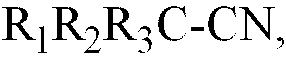
dans lequel :
le symbole R1 représente un atome d'hydrogène, un radical alcoyle contenant de 1 à 5 atomes de carbone, ou un radical aryle, et les symboles R2 et R3 représentent chacun un atome d'hydrogène ou un radical alcoyle contenant de 1 à 5 atomes de carbone, avec le sulfure d'hydrogène, en présence d'une amine aliphatique de formule générale :
dans laquelle :
le symbole R4 représente un radical alcoyle contenant de 1 à 5 atomes de carbone, et les symboles R5 et R6 représentent chacun un atome d'hydrogène, dans un solvant polaire miscible avec l'eau.
dans lequel :
le symbole R1 représente un atome d'hydrogène, un radical alcoyle contenant de 1 à 5 atomes de carbone, ou un radical aryle, et les symboles R2 et R3 représentent chacun un atome d'hydrogène ou un radical alcoyle contenant de 1 à 5 atomes de carbone, avec le sulfure d'hydrogène, en présence d'une amine aliphatique de formule générale :
dans laquelle :
le symbole R4 représente un radical alcoyle contenant de 1 à 5 atomes de carbone, et les symboles R5 et R6 représentent chacun un atome d'hydrogène, dans un solvant polaire miscible avec l'eau.
2. Procédé suivant la revendication 1, caractérisé en ce que le composé nitrile est l'acétonitrile,
le propiononitrile, le n- ou l'isobutyronitrile ou le phénylacétonitrile.
3. Procédé suivant la revendication 1 ou la revendication 2, caractérisé en ce que l'amine
aliphatique est la méthylamine, l'éthylamine, la n-propylamine ou l'isopropylamine.
4. Procédé suivant l'une quelconque des revendications précédentes, caractérisé en ce
que le solvant polaire miscible avec l'eau est le diméthylformamide, le diméthylacétamide,
le sulfolanne, la N-méthylpyrrolidone, la 1,3-diméthylimidazolidinone, ou le sulfoxyde
de diméthyle.
5. Procédé de préparation de thioisobutyramide, caractérisé en ce qu'il comprend la réaction
de l'isobutyronitrile et du sulfure d'hydrogène en présence d'isopropylamine, en solution
dans le diméthylformamide.
6. Procédé suivant l'une quelconque des revendications précédentes, caractérisé en ce
que la quantité de l'amine aliphatique se situe dans l'intervalle de 10 à 100% en
moles, sur base de la quantité du composé nitrile.
7. Procédé suivant l'une quelconque des revendications précédentes, caractérisé en ce
que la quantité du sulfure d'hydrogène se situe dans l'intervalle de 110 à 300% en
moles, sur base de la quantité du composé nitrile.
8. Procédé suivant l'une quelconque des revendications précédentes, caractérisé en ce
que la quantité du solvant se situe dans l'intervalle de 100 à 500 g par mole du nitrile.
9. Procédé suivant l'une quelconque des revendications précédentes, caractérisé en ce
que la réaction est réalisée à une température se situant dans l'intervalle de 30°C
à 50°C.