|
(11) | EP 0 697 019 B1 |

| (12) | EUROPEAN PATENT SPECIFICATION |
|
|
| (54) |
RISPERIDONE PAMOATE RISPERIDON PAMOATE PAMOATE DE RISPERIDONE |
|
|
|||||||||||||||||||||||||||||||||||
| Note: Within nine months from the publication of the mention of the grant of the European patent, any person may give notice to the European Patent Office of opposition to the European patent granted. Notice of opposition shall be filed in a written reasoned statement. It shall not be deemed to have been filed until the opposition fee has been paid. (Art. 99(1) European Patent Convention). |
[0001] EP-0,196,132 discloses the compound 3-[2-[4-(6-fluoro-1,2-benzisoxazol-3-yl)-1-piperidinyl]ethyl]-6,7,8,9-tetrahydro-2-methyl-4H-pyrido[1,2-a]pyrimidin-4-one, that is known generically as risperidone and is a potent antipsychotic. Unfortunately, the current formulations of risperidone only yield effective plasma levels during a limited time interval. Long-acting injectable risperidone dosage forms would be valuable in maintenance therapy and would enhance patient compliance.
[0002] Currently available long-acting neuroleptics include solutions in oils, e.g. sesame oil, of poorly water-soluble ester derivatives of the neuroleptic compounds. Trials to prolong the activity of some particular phenothiazine neuroleptics by the use of poorly water-soluble salts such as the pamoates proved to be little successful (e.g. Florence et al., 1976, J. Pharm. Sci., 65(11), 1665-1668). Unexpectedly, the use of the pamoate salt of risperidone in dogs significantly prolonged the release of risperidone, yielding plasma levels of risperidone and its active metabolite that were effective against apomorphine induced emesis during several weeks.
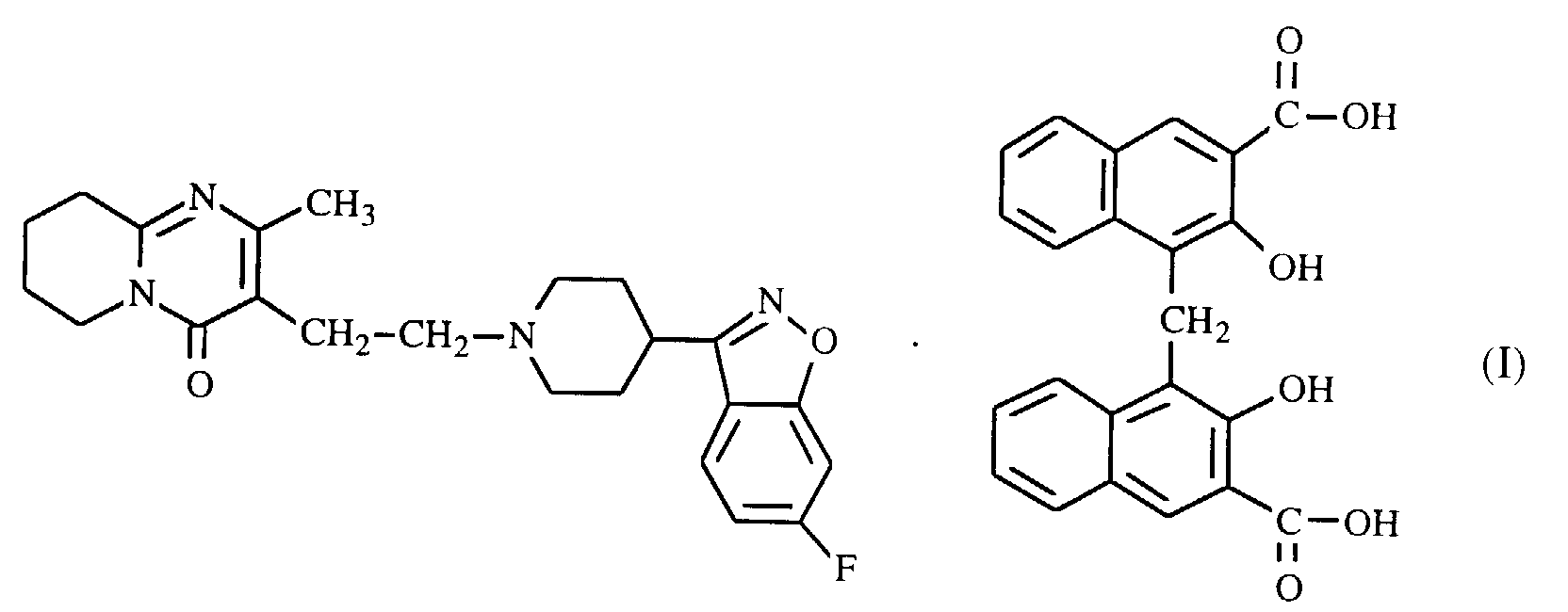
[0003] Accordingly, the present invention is concerned with the pamoate acid addition salts of risperidone. In particular, the invention is concerned with the compound having the formula
[0004] The period during which effective plasma levels are obtained depends on the physical characteristics of the risperidone pamoate powder sample, such as particle size and crystal form.
[0005] Risperidone, its preparation and the pharmacological activity thereof are described in EP-0,196,132. The pamoate salt of risperidone can be prepared by the treatment of risperidone with pamoic acid or a salt derivative thereof, e.g. the disodium pamoate, in a reaction-inen solvent. In particular, risperidone pamoate can be prepared by adding a solution of risperidone in an appropriate solvent, e.g. ethanol, to a solution of pamoic acid in an appropriate solvent, e.g. N,N-dimethylformamide, and stirring the mixture until precipitation of the risperidone pamoate salt. The reaction product may be isolated from the medium and, if necessary, further purified according to methodologies generally known in the art such as, for example, extraction, crystallization and chromatography. Micronized forms of the subject compounds can be prepared by micronization techniques known in the art, e.g. by milling in appropriate mills and sieving through appropriate sieves.
In a particular aspect, the invention relates to the mixed pamoate addition salts of risperidone, e.g. the monosodium pamoate salt of risperidone.
[0006] The subject compounds are potent antagonists of neurotransmitters and in particular of dopamine. Antagonizing said neurotransmitter suppresses a variety of phenomena induced by the release, in particular the excessive release, of dopamine. Central dopamine receptor blockers are known to have neuroleptic properties, for example, they counteract the positive symptoms of schizophrenia, e.g. hallucinations, delusional thinking, severe excitement and unusual behaviour. Therapeutic indications for using the present compound therefore are mainly in the CNS area, particularly as potent antipsychotic agents and especially as agents useful in treating chronic psychoses. The present compounds also show central serotonin antagonism. Central acting serotonin antagonists appear to improve the negative symptoms of schizophrenia, e.g. anergy, apathy, social withdrawal and depressive mood, and also to reduce the incidence of extrapyramidal side-effects (EPS) during maintenance therapy with classical neuroleptics, i.e. dopamine antagonists. Combined dopamine-serotonin antagonists are especially interesting as they offer relief of both the positive and negative symptoms of schizophrenia with low EPS liability.
The subject compounds show the advantage of being long acting dopamine antagonists by the sustained release of risperidone from the poorly water-soluble pamoate salts. This can be evidenced, for example, by measuring the plasma levels after intramuscular or subcutaneous administration to dogs and by the long acting antiemetic effect exerted by the present compounds on dogs challenged with the dopamine agonist apomorphine. Hence, the subject compounds allow administration at relatively large intervals, e.g. at several weeks, the actual time of administration depending on the physical nature of the compound used and the condition of the subject to be treated. Consequently, the present compounds allow for a more efficient therapy : the sustained release facilitates maintaining a stable plasma concentration at a non-toxic, effective level and the route of administration enhances compliance of the subject to be treated with the prescribed medication.
Unlike most of the currently available long-acting neuroleptics which are usually formulated in an oil for intramuscular administration, the subject compounds show the advantage that they can be formulated in both lipophilic (e.g. an oil) and lipophobic solvents (e.g. aqueous environment) and may be administered in various ways, e.g. intramusculary or subcutaneously.
[0007] In view of their useful pharmacological properties, the subject compounds may be formulated into various pharmaceutical forms for administration purposes. To prepare the pharmaceutical compositions of this invention, an effective amount of the subject compounds as the active ingredient is combined in intimate admixture with a pharmaceutically acceptable carrier, which carrier may take a wide variety of forms depending on the form of preparation desired for administration. These pharmaceutical compositions are desirably in unitary dosage form suitable, preferably, for administration subcutaneously or intramusculary. For the latter administration routes, the subject compounds preferably are suspended in an aqueous solvent, which may further comprise a wetting agent, such as the polyoxyethylene derivatives of sorbitan esters, e.g. polysorbate 80 (= Tween 80®) and polysorbate 20 (= Tween 20®), lecithin, polyoxyethylene- and polyoxypropylene ethers, sodium deoxycholate, and the like; a suspending agent such as a cellulose derivate, e.g. methylcellulose, sodium carboxymethylcellulose and hydroxypropyl methylcellulose, polyvinylpyrrolidone, alginates, chitosan, dextrans, gelatin, polyethylene glycols, polyoxyethylene- and polyoxypropylene ethers and the like; an acid, e.g. hydrochloric acid, and the like; a base, e.g. sodium hydroxide, and the like; a buffer comprising a mixture of appropriate amounts of an acid such as phosphoric, succinic, tartaric, lactic, acetic, maleic or citric acid, and a base, in particular sodium hydroxide or disodium hydrogen phosphate; a preservative, e.g. benzoic acid, benzyl alcohol, butylated hydroxyanisole, butylated hydroxytoluene, chlorbutol, a gallate, a hydroxybenzoate, EDTA, phenol, chlorocresol, metacresol, benzothonium chloride, myristyl-y-piccolinium chloride, phenylmercuri acetate, thimerosal and the like; a tonicity adjusting agent, e.g. sodium chloride, dextrose, mannitol, sorbitol, lactose, sodium sulfate, and the like
Alternatively, the subject compounds may be formulated in an oil. Appropriate oils for this purpose are fixed oils, for example, peanut oil, sesame oil, cottonseed oil, corn oil, safflower oil, castor oil, ethyloleate, soy bean oil, synthetic glycerol esters of long chain fatty or medium chain acids and mixtures of these and other oils.
[0008] Also thickening agents may be added to the composition, e.g. aluminum monostearate, ethylcellulose, triglycerides, hydrogenated castor oil, and the like.
[0009] In view of the usefulness of the subject compounds in the treatment of psychotic diseases it is evident that the present invention provides a method of treating warm-blooded animals, in particular humans, suffering from psychotic diseases, said method comprising the administration of a pharmaceutically effective amount of the subject compounds in admixture with a pharmaceutical carrier. In a further aspect, the present invention relates to the use of the subject compounds as a medicine, particularly as an antipsychotic. In general it is contemplated that an effective amount would be from 0.05 mg/kg to 50 mg/kg body weight, more preferably from 0.5 mg/kg to 10 mg/kg body weight.
[0010] The following examples are intended to illustrate and not to limit the scope of the present invention.
Example 1
[0011] A solution of 3-[2-[4-(6-fluoro-1,2-benzisoxazol-3-yl)-1-piperidinyl]ethyl]-6,7,8,9-tetrahydro-2-methyl-4H-pyrido[1,2-a]pyrimidin-4-one (0.048mol) in ethanol (600ml) was added to a solution of pamoic acid (0.048mol) in N,N-dimethylformamide (400ml). The mixture was stirred for 3 hours. The resulting precipitate was filtered off by suction, washed with ethanol and dried, yielding 31g (81%) of 3-[2-[4-(6-fluoro-1,2-benzisoxazol-3-yl)- 1 -piperidinyl]ethyl]-6,7,8,9-tetrahydro-2-methyl-4H-pyrido[1,2-a]pyrimidin-4-one 4,4'-methylenebis[3-hydroxy-2-naphthalenecarboxylate](1:1); mp. 269.2°C.
Example 2
[0012]
| F1 : aqueous suspension | |
| risperidone monopamoate | 25 mg |
| polysorbate 20 | 1 mg |
| benzyl alcohol | 10 mg |
| purified water | q.s. 1 ml |
[0013] The risperidone monopamoate, polysorbate 20, benzyl alcohol and purified water were intimately mixed and homogenized, thus yielding an aqueous suspension.
[0014] In a similar way there were prepared :
| F2 : aqueous suspension | |
| risperidone monopamoate | 50 mg |
| polysorbate 20 | 2 mg |
| benzyl alcohol | 15 mg |
| sodium carboxymethylcellulose | 20 mg |
| purified water | q.s. 1 ml |
| F3 : suspension in oil | |
| risperidone monopamoate | 50 mg |
| sesame oil | q.s. 1 ml |
Example 3
[0015] The prolonged action of the risperidone monopamoate salt over the risperidone free base was established by the following procedure
The apomorphine test in dogs
[0016] The method used is described by P.A.J. Janssen and C.J.E. Niemegeers in Arzneim.-Forsch. (Drug Res.), 9, 765-767 (1959). A suspension of the risperidone free base in sesame oil and the risperidone monopamoate compositions F1, F2 and F3 were administered to 3 beagle dogs at a dose between 2 and 2.5 mg/kg. The risperidone free base formula as well as F1 and F3 were administered intramusculary, whereas F2 was administered subcutaneously. At several time intervals thereafter, the animals were challenged with a standard dose of 0.31 mg/kg (subcutaneous) of apomorphine, which is a potent dopamine agonist and induces emesis. The antiemetic effect of the test compound was used as an indication of its activity.
1. A pamoate acid addition salt of risperidone having the formula
2. A composition comprising a pharmaceutically acceptable carrier and as active ingredient
a pharmaceutically effective amount of a compound as claimed in claim 1.
3. A composition according to claim 2 in an injectable dosage form.
4. A composition according to claim 3 which takes the form of an aqueous suspension.
5. A composition according to claim 4 further comprising benzyl alcohol, a sorbitan ester
and water.
6. A composition according to claim 5 further comprising a cellulose derivative.
7. A process for preparing a composition as claimed in any one of claims 2 to 5, characterized in that a pharmaceutically effective amount of a compound as claimed in claim 1 is intimately
mixed with a pharmaceutically acceptable carrier.
8. A compound as claimed in claim 1 for use as a medicine.
9. A process for preparing a compound as claimed in claim 1 characterized by the treatment of 3-[2-[4-(6-fluoro-1,2-benzisoxazol-3-yl)-1-piperidinyl]ethyl]-6,7,8,9-tetrahydro-2-methyl-4H-pyrido[1,2-a]pyrimidin-4-one with pamoic acid in a reaction-inert solvent.
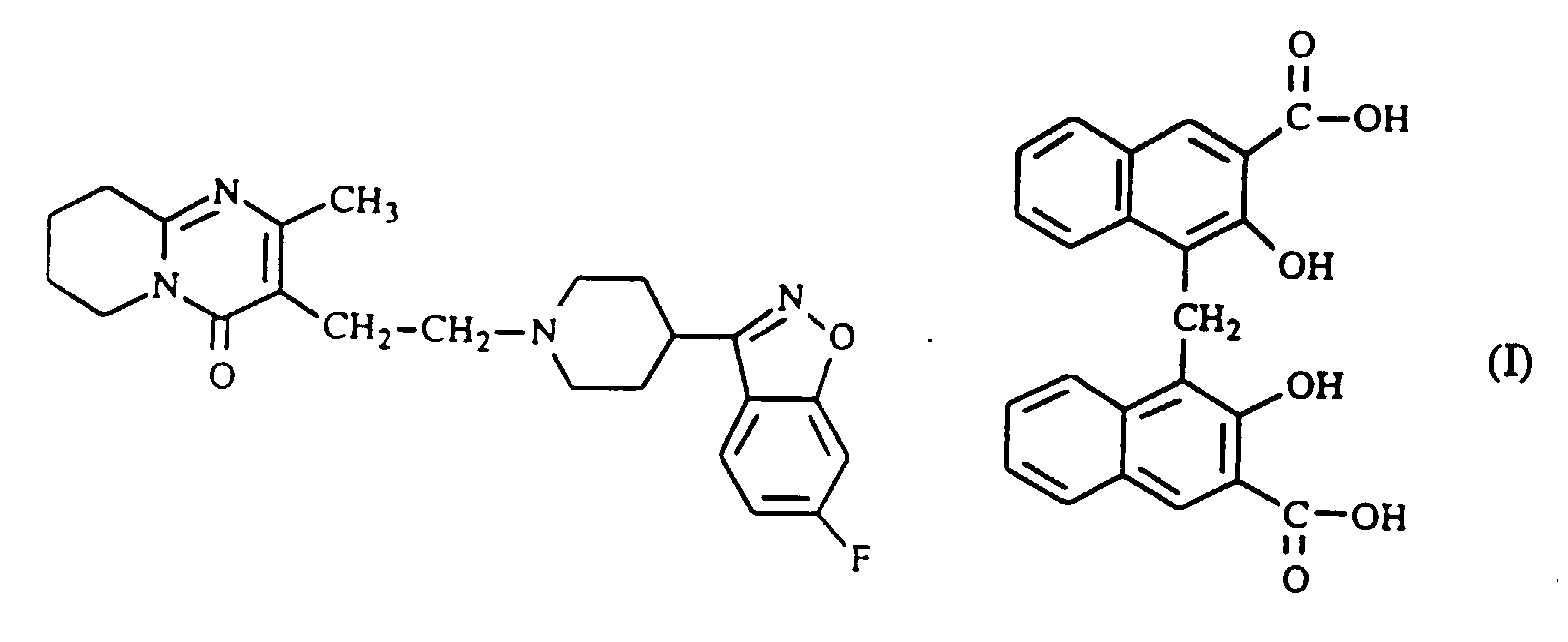
1. Pamoat-Säureadditionssalz von Risperidon mit der Formel
2. Zusammensetzung, enthaltend einen pharmazeutisch unbedenklichen Träger und als Wirkstoff
eine pharmazeutisch wirksame Menge einer Verbindung nach Anspruch 1.
3. Zusammensetzung nach Anspruch 2 in Injektions-dosisform.
4. Zusammensetzung nach Anspruch 3 in Form einer wäßrigen Suspension.
5. Zusammensetzung nach Anspruch 4, die außerdem noch Benzylalkohol, einen Sorbitanester
und Wasser enthält.
6. Zusammensetzung nach Anspruch 5, die außerdem noch ein Cellulosederivat enthält.
7. Verfahren zur Herstellung einer Zusammensetzung nach einem der Ansprüche 2 bis 5,
dadurch gekennzeichnet, daß man eine pharmazeutisch wirksame Menge einer Verbindung
nach Anspruch 1 innig mit einem pharmazeutisch unbedenklichen Träger mischt.
8. Verbindung nach Anspruch 1 zur Verwendung als Arzneimittel.
9. Verfahren zur Herstellung einer Verbindung nach Anspruch 1, dadurch gekennzeichnet,
daß man in einem unter den Reaktionsbedingungen inerten Lösungsmittel 3-[2-[4-(6-Fluor-1,2-benzisoxazol-3-yl)-1-piperidinyl]ethyl]-6,7,8,9-tetrahydro-2-methyl-4H-pyrido[1,2-a]pyrimidin-4-on mit Pamoasäure umsetzt.
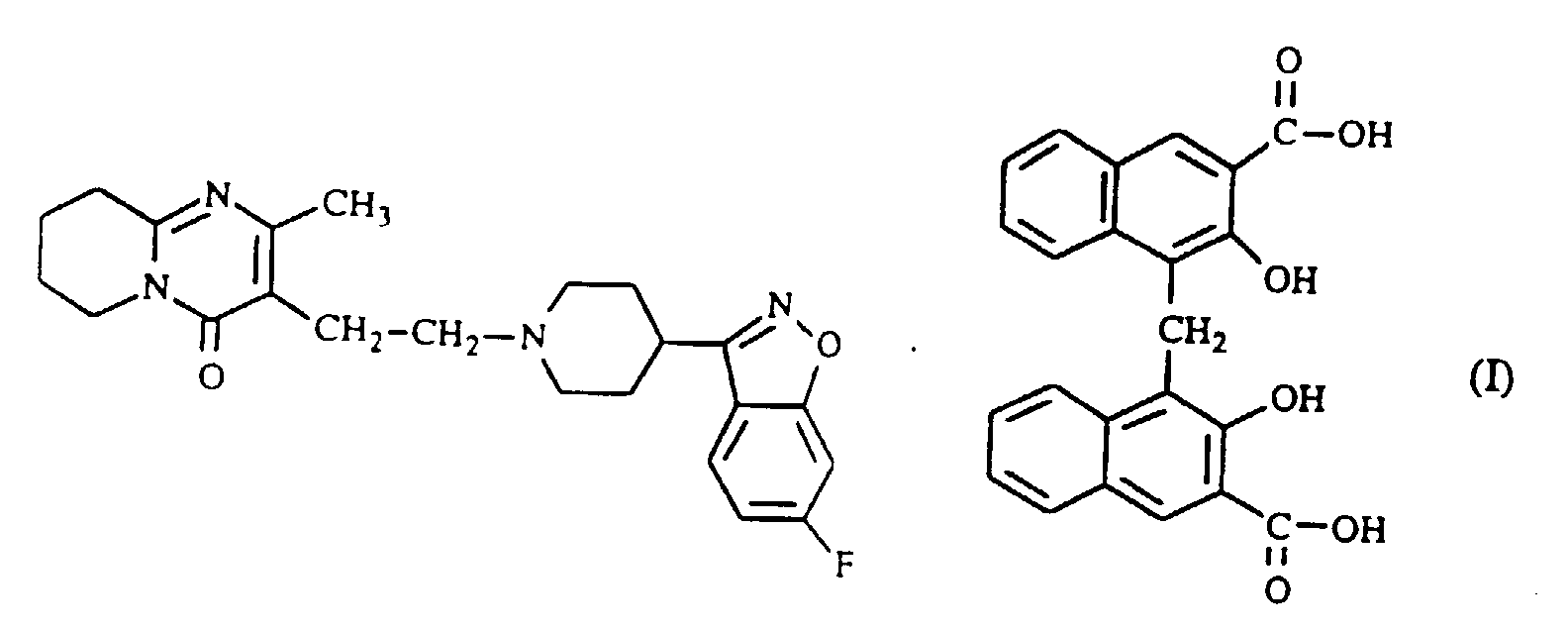
1. Sel d'addition de l'acide pamoïque avec la rispéridone ayant la formule
2. Composition comprenant un support pharmaceutiquement acceptable et, à titre de principe
actif, une quantité pharmaceutiquement efficace d'un composé selon la revendication
1.
3. Composition selon la revendication 2, sous une forme pharmaceutique injectable.
4. Composition selon la revendication 3, qui se présente sous la forme d'une suspension
aqueuse.
5. Composition selon la revendication 4, comprenant en outre de l'alcool benzylique,
un ester de sorbitanne et de l'eau.
6. Composition selon la revendication 5, comprenant en outre un dérivé de cellulose.
7. Procédé de préparation d'une composition selon l'une quelconque des revendications
2 à 5, caractérisé en ce qu'une quantité pharmaceutiquement efficace d'un composé selon la revendication 1 est mélangée
intimement avec un support pharmaceutiquement acceptable.
8. Composé selon la revendication 1 destiné à être utilisé comme médicament.
9. Procédé de préparation d'un composé selon la revendication 1, caractérisé par le traitement de la 3-[2-[4-(6-fluoro-1,2-benzisoxazol-3-yl)-1-pipéridinyl]éthyl]-6,7,8,9-tétrahydro-2-méthyl-4H-pyrido[1,2-a]pyrimidin-4-one avec l'acide pamoïque dans un solvant inerte vis-à-vis
de la réaction.