|
(11) | EP 0 709 344 B1 |

| (12) | EUROPEAN PATENT SPECIFICATION |
|
|
| (54) |
Glass having low solar radiation and ultraviolet ray transmittance Glas mit einer niedrigen Durchlässigkeit für Sonnenstrahlen und ultravioletten Strahlen Verre ayant une faible transmission des rayonnements solaires et ultraviolets |
|
|
|||||||||||||||||||||||||||||||
|
||||||||||||||||||||||||||||||||
| Note: Within nine months from the publication of the mention of the grant of the European patent, any person may give notice to the European Patent Office of opposition to the European patent granted. Notice of opposition shall be filed in a written reasoned statement. It shall not be deemed to have been filed until the opposition fee has been paid. (Art. 99(1) European Patent Convention). |
[0001] The present invention relates to glass having low transmittance of solar radiation and ultraviolet ray.
[0002] As glass for vehicles having reduced solar radiation transmittance (see JIS R3106) and ultraviolet ray transmittance (see ISO 9050), US Patent 4,792,536 discloses soda lime-silica type glass wherein the weight of FeO calculated as Fe2O3 is made at least 45% of the weight of the total iron calculated as Fe2O3. This glass has a bluish color.
[0003] With this glass, Glauber's salt used as a refining agent does not provide a refining function, since the weight of FeO calculated as Fe2O3 is at least 45% of the weight of the total iron calculated as Fe2O3. Accordingly, molten glass is required to be maintained under reduced pressure for fining, which makes the melting step of glass cumbersome.
[0004] Further, soda lime-silica type glass containing at least 0.51 wt% of Fe2O3, is known. This glass has a greenish color.
[0005] As such glass, for example, the following glass is disclosed in US Patent 5,077,133. Namely, it has a thickness of 3 mm and contains from 0.68 to 0.92 wt% of total iron, from 0.5 to 1.2 wt% of CeO2 and from 0.02 to 0.85 wt% of TiO2, wherein the amount of bivalent iron in the total iron is from 23 to 29 wt%. Another one has a thickness of 4 mm and contains from 0.61 to 0.86 wt% of total iron, from 0.3 to 0.75 wt% of CeO2 and from 0.02 to 0.45 wt% of TiO2, wherein the amount of bivalent iron in the total iron is from 23 to 29 wt%.
[0006] Japanese Unexamined Patent Publication No. 56466/1994 discloses glass having low solar radiation and ultraviolet ray transmittance, which consists essentially of a soda lime-silica type matrix glass containing from 0.53 to 0.70 wt% of total iron calculated as Fe2O3, from 0.2 to 0.4 wt% Of TiO2 and from 0.4 to 0.8 wt% of total cerium calculated as CeO2, wherein the weight of FeO calculated as Fe2O3 is from 30 to 40% of the weight of the total iron calculated as Fe2O3.
[0007] The Japanese patent abstract of JP-A-4310539 describes a glass having a low solar radiation and ultraviolet ray transmittance, comprising a soda-lime-silica glass containing 0.5-1.2 % iron oxide, of which 20-40 % is FeO, 0.1-3.0 % CeO2 and 0-1 % TiO2.
[0008] FR-A-2690437 describes a glass having a low solar radiation and ultraviolet ray transmittance, comprising a soda-lime-silica glass containing 0.1-0.8 % iron oxide, of which 15-30 % is FeO, 0.3-2.0 % CeO2 and 0-1 % TiO2.
[0009] FR-A-2672587 describes a glass having a low solar radiation and ultraviolet ray transmittance, comprising a soda-lime-silica glass containing 0.2-0.6 % iron oxide of which 23-35 % is FeO, 0.1-1.0 % CeO2 and 0-1 % TiO2.
[0010] WO-A-9107356 describes a glass having a low solar radiation and ultraviolet ray transmittance, comprising a soda-lime-silica glass containing 0.48-0.92% Fe2O3, 0.15-0.33 % FeO, 0.1-1.36 % CeO2 and 0.02-0.85 % TiO2.
[0011] In recent years, there has been an increasing demand for glass having the ultraviolet ray absorption further improved, particularly for automotive use. The present invention is to satisfy such a demand.
[0012] It is an object of the present invention to provide glass having a visible light transmittance of at least 70% and low solar radiation transmittance and having substantially reduced ultraviolet ray transmittance, particularly transmittance at a wavelength of 370 nm.
[0013] The present invention provides glass having low solar radiation and ultraviolet ray transmittance and having a dominant wavelength of from 500 to 540 nm for transmittance, which comprises a soda lime-silica type glass containing from 0.52 to 0.64 wt% of total iron calculated as Fe2O3, from 0.2 to 0.6 wt% of TiO2 and from 0.9 to 2.0 wt% of total cerium calculated as CeO2, wherein the weight of FeO calculated as Fe2O3 is from 28 to 38% of the weight of the total iron calculated as Fe2O3.
[0014] If the content of the total iron calculated as Fe2O3 is small, the solar radiation transmittance and the ultraviolet ray transmittance tend to be too high, and if it is large, the visible light transmittance tends to be too small. The content of the total iron is at most 0.64 wt%, preferably at most 0.63 wt%. If the amount of bivalent iron in this total iron is small, the solar radiation transmittance tends to be too high, and if it is large, the melting step of glass tends to be cumbersome, and the glass tends to have a bluish color.
[0015] If the CeO2 content is too large, the costs for the raw material will be high, and it will require a long time to change the composition at the time of producing glass, whereby the productivity will be low. Further, the glass tends to have a yellowish color.
[0016] If the TiO2 content is too small, the ultraviolet ray transmittance tends to be too high, and if it is large, the visible light transmittance tends to be too small, and the glass tends to have a yellowish color.
[0017] To keep the ultraviolet ray transmittance at a low level, in the second embodiment of the present invention, CeO2 + TiO2 is preferably from 1.2 to 2.3 wt%.
[0018] CoO is not an essential component. However, by incorporating it in a very small amount, the color of glass which tends to be yellowish by CeO2 and TiO2, can be adjusted to a green color. It is preferably contained in an amount of at least 0.0002 wt%.
[0020] Among various components, the contents of the total iron and CeO2 are preferably adjusted as follows depending upon the thickness of the glass. Namely, when the thickness is from 1.7 to 4.3 mm, the content of the total iron calculated as Fe2O3 is preferably from 0.59 to 0.64 wt%, and at the same time, the content of CeO2 is preferably from 1.2 to 2.0 wt%. Further, when the thickness is from 1.7 to 4.4 mm, the content of the total iron calculated as Fe2O3 is particularly from 0.60 to 0.64 wt%, the content of TiO2 is particularly from 0.3 to 0.5 wt%, the content of the total cerium calculated as CeO2 is particularly from 1.4 to 1.7 wt%, and the weight of FeO calculated as Fe2O3 is from 30 to 35% of the weight of the total iron calculated as Fe2O3. Likewise, when the thickness is from 4.4 to 5.5 mm, the content of the total iron calculated as Fe2O3 is preferably from 0.52 to 0.63 wt%, and at the same time, the content of CeO2 is preferably from 0.9 to 1.2 wt%. Further, when the thickness is from 4.4 to 7.0 mm, the content of the total iron calculated as Fe2O3 is particularly from 0.57 to 0.62 wt%, the content of TiO2 is particularly from 0.2 to 0.4 wt%, the content of the total cerium calculated as CeO2 is particularly from 0.9 to 1.4 wt%, and the weight of FeO calculated as Fe2O3 is from 30 to 35% of the weight of the total iron calculated as Fe2O3.
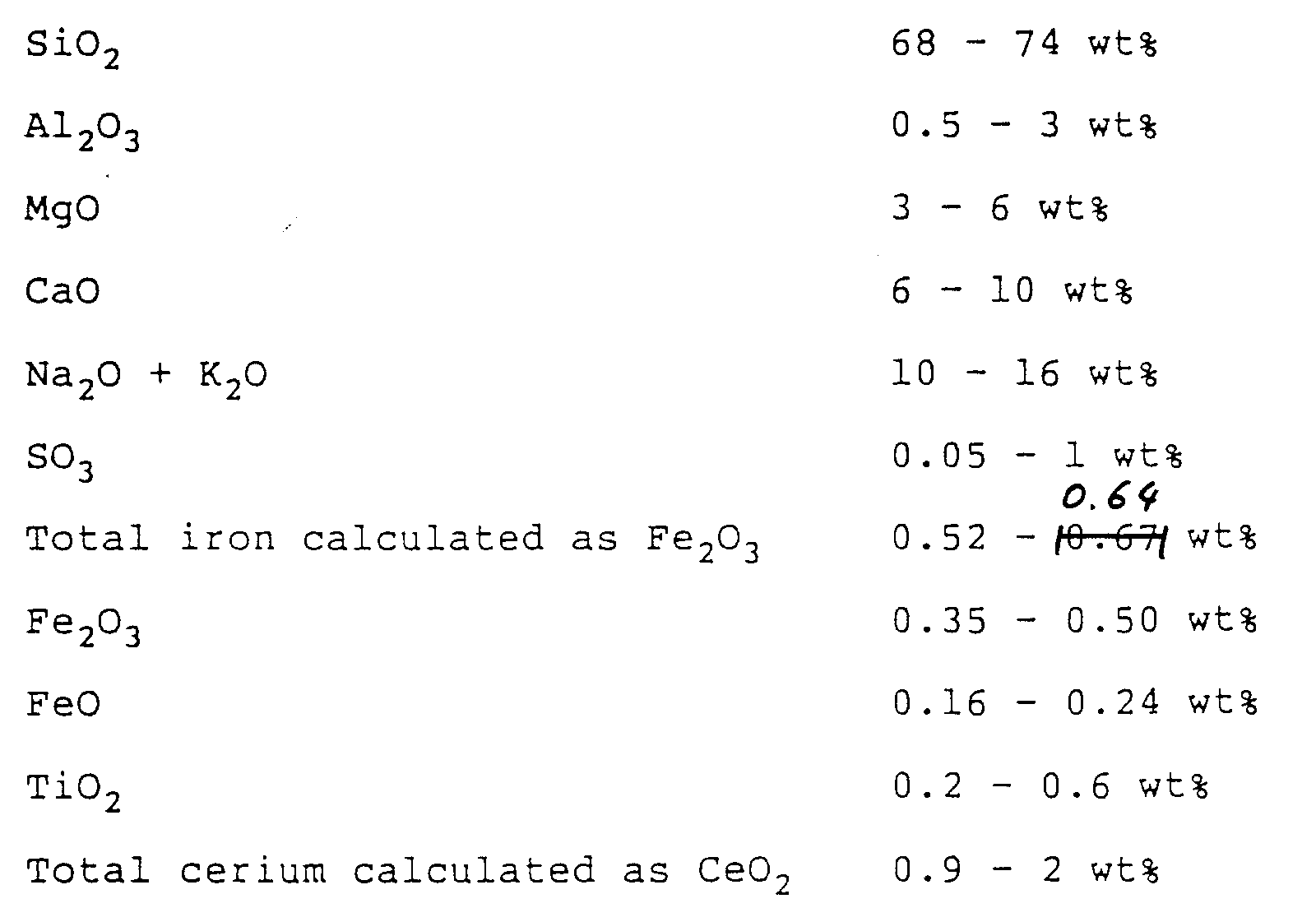
[0021] The soda lime-silica type glass can be commonly used for vehicles or architectural use. Thus, one of preferred glass compositions of the present invention is as follows:
[0022] If the SiO2 content is small, the weathering resistance tends to be low, and if it is large, devitrification is likely to result. If the Al2O3 content is small, the water resistance tends to be low, and if it is large, the meltability tends to be low.
[0023] Na2O and K2O are components which serve to promote melting of raw materials. If their total amount is small, such an effect tends to be small, and if it is large, the weathering resistance tends to be poor.
[0024] CaO and MgO are components which serve to promote meltability of the raw materials and improve the weathering resistance. If their content is small, such effects tend to be small, and if it is large, devitrification is likely to occur.
[0026] Also in the present invention, the specific gravity of the glass is adjusted preferably to a level of from 2.49 to 2.53, more preferably from 2.51 to 2.52, in conformity with usual soda lime-silica type glass, with a view to improving the efficiency for the change of the composition.
[0027] The specific gravity can be adjusted in the same manner as in the first embodiment by controlling the composition of the matrix glass. Specifically, the weight ratio of SiO2/(MgO + CaO) is adjusted to a level of from 5.0 to 7.0, preferably from 5.4 to 6.6, more preferably from 6.0 to 6.6, most preferably from 6.2 to 6.6.
[0028] The glass of the present invention has a dominant wavelength of from 500 to 540 nm, particularly from 515 to 535 nm, for transmittance, and is usually employed in a thickness of from 1.7 to 7 mm. It is characterized by a solar radiation transmittance of from 45 to 52%, a visible light transmittance (by light source A) of at least 70%, an ultraviolet ray transmittance of not higher than 15%, particularly not higher than 10%, a transmittance of light having a wavelength of 370 nm of not higher than 30%, and an excitation purity of from 2 to 3%.
[0029] The glass of the present invention having low solar radiation and ultraviolet ray transmittance can be used as single sheet glass, laminated glass or double glazing unit panes. In the case of laminated glass or double glazing unit, glass sheets of the present invention may be used for the both sides of the laminated glass or the double glazing unit. Otherwise, the glass of the present invention may be used in combination with other kinds of glass to form the laminated glass or the double glazing unit.
[0030] The glass of the present invention having low solar radiation and ultraviolet ray transmittance can be prepared, for example, as follows. Namely, various raw materials are mixed so that the desired glass composition would be obtained. With respect to the raw materials useful for this purpose, iron powder or red iron oxide may, for example, be used as the FeO and Fe2O3 source; cerium oxide, cerium carbonate or cerium hydroxide may, for example, be used as the cerium source; and titanium oxide may, for example, be used as the titanium source. As the raw materials for the matrix glass, those commonly used may be employed. Further, it is preferred to add a reducing agent such as carbon to these raw materials, so that iron in the molten glass is prevented from being oxidized to Fe2O3, and FeO will be contained in a predetermined amount.
[0031] The glass batch thus adjusted is continuously supplied to a melting furnace, and heated and melted at a temperature of about 1,500°C by e.g. heavy oil for vitrification. Then, this molten glass is refined and formed into a sheet glass having a predetermined thickness by e.g. a float process. Then, this sheet glass is cut into a predetermined shape to obtain the glass of the present invention having low solar radiation and ultraviolet ray transmittance. Further, the cut glass may be subjected to toughening, laminating or composing into double glazing unit.
[0032] Now, the present invention will be described in further detail with reference to Examples. However, it should be understood that the present invention is by no means restricted to such specific Examples.
EXAMPLES 1 to 9
[0033] Soda lime-silica glass having the total iron calculated as Fe2O3, CeO2, TiO2 and CoO incorporated in the amounts identified in the upper section of Table 1 as optical property-improving components to a matrix composition comprising 71 parts (parts by weight, the same applies hereinafter) of SiO2, 1.7 parts of Al2O3, 12.3 parts of Na2O, 0.5 part of K2O, 8 parts of CaO, 3.5 parts of MgO and 0.6 part of SO3, was prepared. The ratio of bivalent iron (in Table 1, referred simply as FeII) to the total iron was also identified in the same section.
[0034] In the preparation of the glass, the preliminarily formulated glass batch was put into a platinum pot of 300 cubic centimeters, and heated and melted in an electric furnace for vitrification. Then, the molten glass was cast on a stainless steel plate, and both sides of the formed sheet were polished to obtain a sheet glass having a thickness of 3.5 mm (5.0 mm in Examples 6, 7 and 9).
[0035] With respect to these sheets, the solar radiation transmittance Te, the visible light transmittance (by light source A) TVa, the ultraviolet ray transmittance TUV, the transmittance of wavelength at 370 nm T370, the dominant wavelength DW and the excitation purity PE were obtained, and the results are shown in the lower section of Table 1. Also with respect to the glass of the Comparative Example (Example 8), such properties were obtained in the same manner, and they are shown also in Table 1.
[0036] The solar radiation transmittance and the visible light transmittance were determined by JIS R3106, the ultraviolet ray transmittance was determined by ISO 9050, and the dominant wavelength and the excitation purity were determined by JIS Z8722.
[0037] As is evident from Table 1, the glass of the present invention has a green color and has high visible light transmittance, low solar radiation transmittance and particularly low ultraviolet ray transmittance.
[0038] According to the present invention, glass having a green color and having high visible light transmittance and low ultraviolet ray transmittance, particularly low transmittance of the wavelength of 370 nm, can be provided. Such glass is particularly suitable for windshield glass for automobiles.
1. A glass having low solar radiation and ultraviolet ray transmittance and having a
dominant wavelength of from 500 to 540 nm for transmittance, which comprises a soda
lime-silica type glass containing from 0.52 to 0.64 wt% of total iron calculated as
Fe2O3, from 0.2 to 0.6 wt% of TiO2 and from 0.9 to 2.0 wt% of total cerium calculated as CeO2, wherein the weight of FeO calculated as Fe2O3 is from 28 to 38% of the weight of the total iron calculated as Fe2O3, the visible light transmittance by light source A is at least 70%, the ultraviolet
ray transmittance is at most 15%, and the transmittance of light having a wavelength
of 370 nm is at most 30%.
2. The glass according to Claim 1, which comprises:
3. The glass according to Claim 1, which has a dominant wavelength of from 515 to 535
nm for transmittance.
4. The glass according to Claim 1, which has a specific gravity of from 2.49 to 2.53.
5. The glass according to Claim 1, which has a thickness of from 1.7 to 4.3 mm, and wherein
the total iron calculated as Fe2O3 is from 0.59 to 0.64 wt%, and CeO2 is from 1.2 to 2.0 wt%.
6. The glass according to Claim 1, which has a thickness of from 4.4 to 5.5 mm, and wherein
the total iron calculated as Fe2O3 is from 0.52 to 0.63 wt%, and CeO2 is from 0.9 to 1.2 wt%.
7. The glass according to Claim 1, which has a thickness of from 1.7 to 4.4 mm, and wherein
the total iron calculated as Fe2O3 is from 0.60 to 0.64 wt%, TiO2 is from 0.3 to 0.5 wt%, the total cerium calculated as CeO2 is from 1.4 to 1.7 wt%, and the weight of FeO calculated as Fe2O3 is from 30 to 35% of the weight of the total iron calculated as Fe2O3.
8. The glass according to Claim 1, which has a thickness of from 4.4 to 7.0 mm, and wherein
the total iron calculated as Fe2O3 is from 0.57 to 0.62 wt%, TiO2 is from 0.2 to 0.4 wt%, the total cerium calculated as CeO2 is from 0.9 to 1.4 wt%, and the weight of FeO calculated as Fe2O3 is from 30 to 35% of the weight of the total iron calculated as Fe2O3.
9. A glass sheet prepared from a glass as claimed in any one of the preceding claims
1 to 8.
10. A pair of glass sheets for a laminated glass, prepared from a glass claimed in any
one of the preceding claims 1 to 8.
1. Glas mit geringer Durchlässigkeit für Sonnenstrahlung und UV-Strahlung und einer dominierenden
Wellenlänge von 500 bis 540 nm bezüglich der Durchlässigkeit, welches ein Glas vom
Natronkalk-Silica-Typ umfaßt, das 0,52 bis 0,64 Gew.-% an gesamtem Eisen, berechnet
als Fe2O3, 0,2 bis 0,6 Gew.-% TiO2 und 0,9 bis 2,0 Gew.-% an gesamtem Cer, berechnet als CeO2, enthält, wobei das Gewicht an FeO, berechnet als Fe2O3, 28 bis 38 Gew.-% des Eisengesamtgewichts, berechnet als Fe2O3, beträgt, wobei die Durchlässigkeit für sichtbares Licht (durch Lichtquelle A) mindestens
70%, die Durchlässigkeit für UV-Strahlung höchstens 15% und die Durchlässigkeit für
Licht mit einer Wellenlänge von 370 nm höchstens 30% betragen.
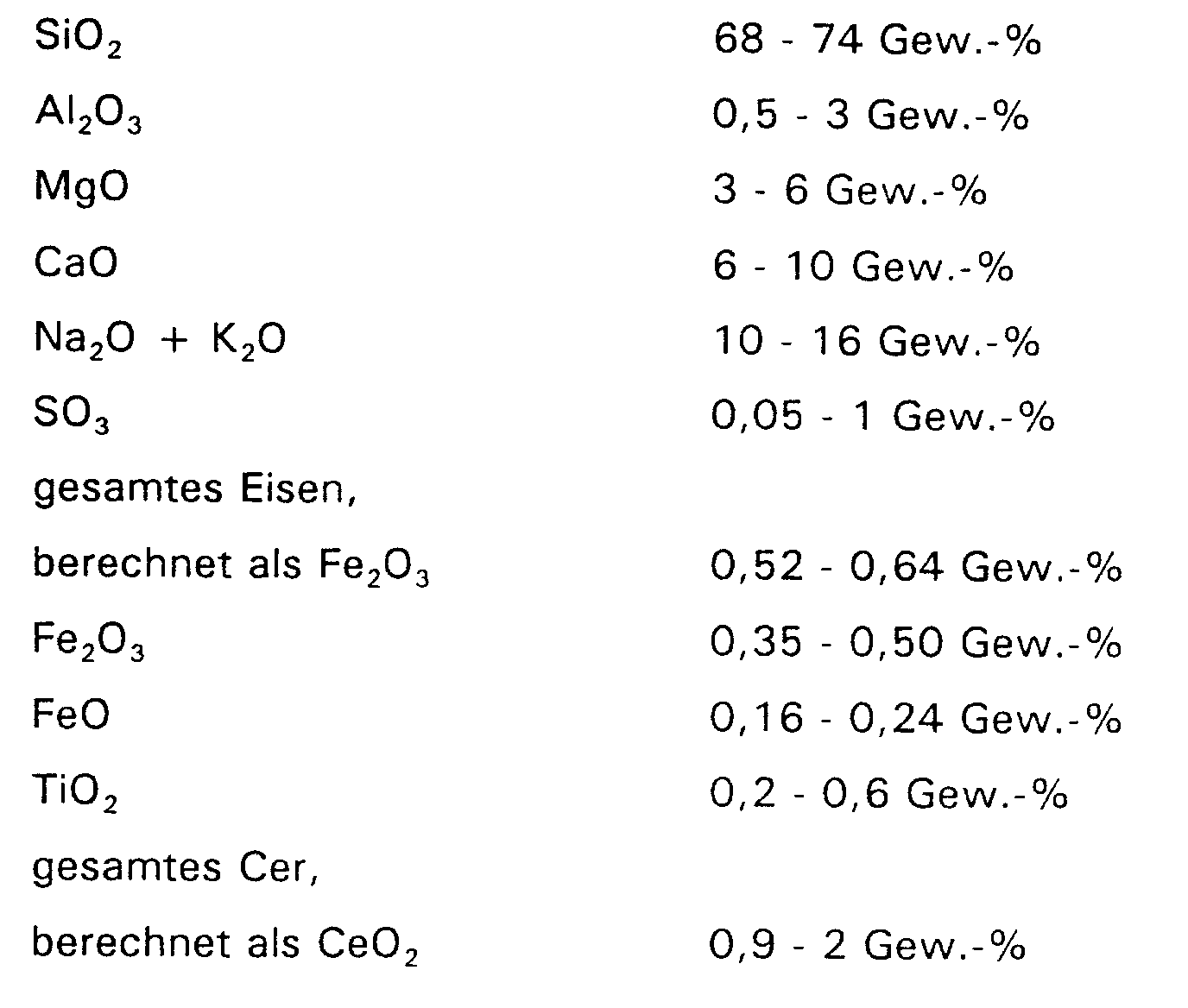
2. Glas nach Anspruch 1, welches umfaßt:
3. Glas nach Anspruch 1, welches eine dominate Wellenlänge von 515 bis 535 nm bezüglich
der Durchlässigkeit aufweist.
4. Glas nach Anspruch 1, welches eine relative Dichte von 2,49 bis 2,53 aufweist.
5. Glas nach Anspruch 1, welches eine Dicke von 1,7 bis 4,3 mm aufweist und worin das
gesamte Eisen, berechnet als Fe2O3, 0,59 bis 0,64 Gew.-% und CeO2 1,2 bis 2,0 Gew.-% betragen.
6. Glas nach Anspruch 1, welches eine Dicke von 4,4 bis 5,5 mm aufweist und worin das
gesamte Eisen, berechnet als Fe2O3, 0,52 bis 0,63 Gew.-% und CeO2 0,9 bis 1,2 Gew.-% betragen.
7. Glas nach Anspruch 1, welches eine Dicke von 1,7 bis 4,4 mm aufweist und worin das
gesamte Eisen, berechnet als Fe2O3, 0,60 bis 0,64 Gew.-%, TiO2 0,3 bis 0,5 Gew.-%, das gesamte Cer, berechnet als CeO2, 1,4 bis 1,7 Gew.-% und das Gewicht an FeO, berechnet als Fe2O3, 30 bis 35 % des Gewichts des gesamten Eisens, berechnet als Fe2O3, betragen.
8. Glas nach Anspruch 1, welches eine Dicke von 4,4 bis 7,0 mm aufweist und worin das
gesamte Eisen, berechnet als Fe2O3, 0,57 bis 0,62 Gew.-%, TiO2 0,2 bis 0,4 Gew.-%, das gesamte Cer, berechnet als CeO2, 0,9 bis 1,4 Gew.-% und das Gewicht an FeO, berechnet als Fe2O3, 30 bis 35 % des Gewichts des gesamten Eisens, berechnet als Fe2O3, betragen.
9. Glasplatte, hergestellt aus einem Glas gemäß einem der vorhergehenden Ansprüche 1
bis 8.
10. Glasplattenpaar für ein laminiertes Glas, hergestellt aus einem Glas gemäß einem der
vorhergehenden Ansprüche 1 bis 8.
1. Verre ayant un faible facteur de transmission des rayonnements solaires et ultraviolets
et ayant une longueur d'onde dominante de 500 à 540 nm pour le facteur de transmission,
qui comprend un verre de type soude-chaux-silice contenant de 0,52 à 0,64 % en poids
de fer total calculé en Fe2O3, de 0,2 à 0,6 % en poids de TiO2 et de 0,9 à 2,0 % en poids de cérium total calculé en CeO2, dans lequel le poids de FeO calculé en Fe2O3 représente de 28 à 38 % du poids du fer total calculé en Fe2O3, le facteur de transmission de la lumière visible par une source de lumière A est
d'au moins 70 %, le facteur de transmission des rayons ultraviolets est d'au plus
15 % et le facteur de transmission de la lumière ayant une longueur d'onde de 370
nm est d'au plus 30 %.
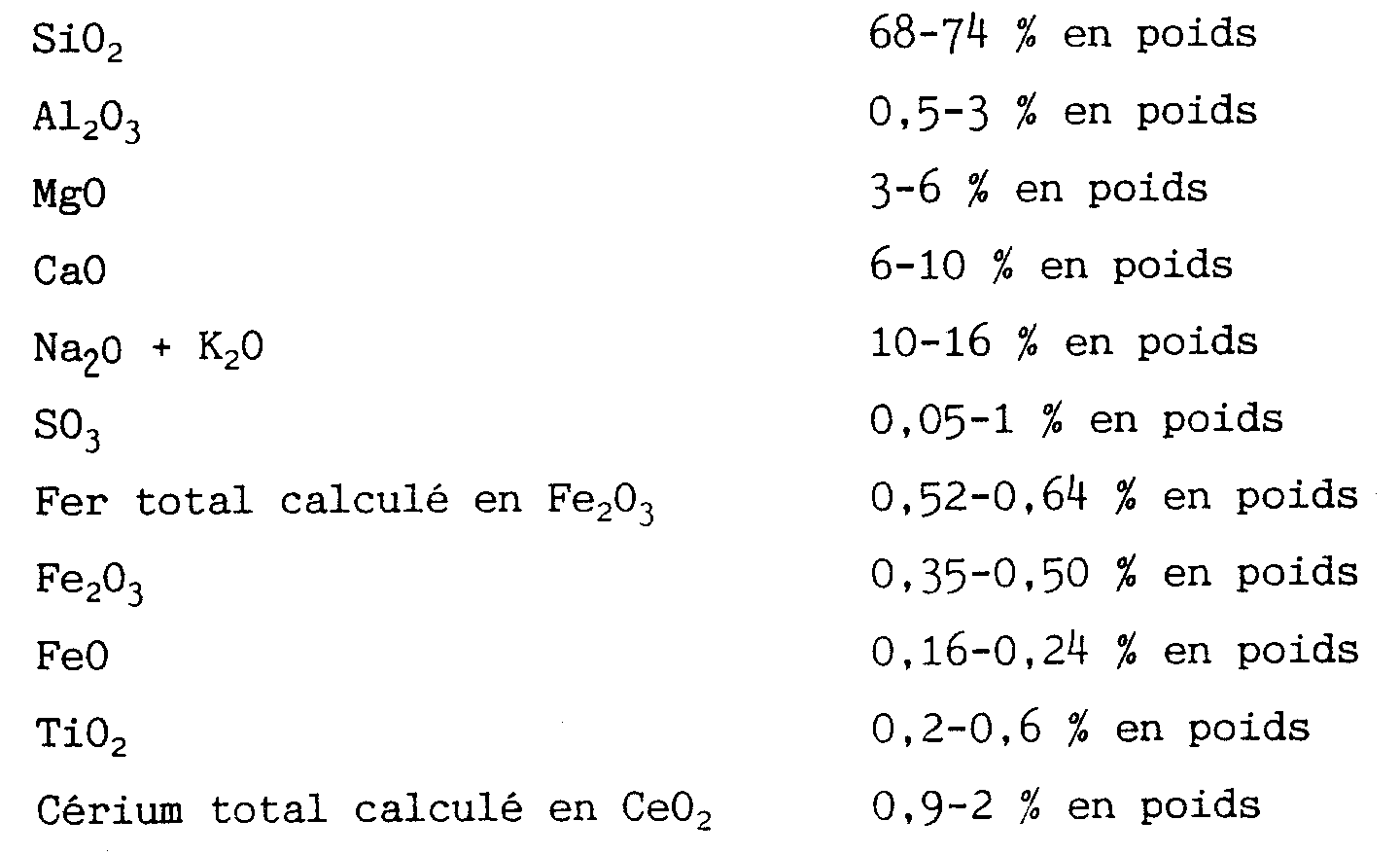
2. Verre selon la revendication 1, qui comprend :
3. Verre selon la revendication 1, qui possède une longueur d'onde dominante de 515 à
535 nm pour le facteur de transmission.
4. Verre selon la revendication 1, qui possède un poids spécifique de 2,49 à 2,53.
5. Verre selon la revendication 1, qui possède une épaisseur de 1,7 à 4,3 mm et dans
lequel le fer total calculé en Fe2O3 est de 0,59 à 0,64 % en poids, et CeO2 est de 1,2 à 2,0 % en poids.
6. Verre selon la revendication 1, qui possède une épaisseur de 4,4 à 5,5 mm et dans
lequel le fer total calculé en Fe2O3 est de 0,52 à 0,63 % en poids et CeO2 est de 0,9 à 1,2 % en poids.
7. Verre selon la revendication 1, qui possède une épaisseur de 1,7 à 4,4 mm et dans
lequel le fer total calculé en Fe2O3 est de 0,60 à 0,64 % en poids, TiO2 est de 0,3 à 0,5 % en poids, le cérium total calculé en CeO2 est de 1,4 à 1,7 % en poids et le poids de FeO calculé en Fe2O3 représente de 30 à 35 % du poids du fer total calculé en Fe2O3.
8. Verre selon la revendication 1, qui possède une épaisseur de 4,4 à 7,0 mm et dans
lequel le fer total calculé en Fe2O3 est de 0,57 à 0,62 % en poids, TiO2 est de 0,2 à 0,4 % en poids, le cérium total calculé en CeO2 est de 0,9 à 1,4 % en poids et le poids de FeO calculé en Fe2O3 représente de 30 à 35 % du poids du fer total calculé en Fe2O3.
9. Feuille de verre préparée à partir d'un verre selon l'une quelconque des revendications
précédentes 1 à 8.
10. Paire de feuilles de verre pour un verre feuilleté, préparées à partir d'un verre
revendiqué selon l'une quelconque des revendications précédentes 1 à 8.