|
(11) | EP 0 718 315 B1 |

| (12) | EUROPEAN PATENT SPECIFICATION |
|
|
| (54) |
Process for the preparation of partially protected phenolic resins Verfahren zur Herstellung von teilgeschützten Phenolharzen Procédé de préparation de résines phénoliques partiellement protégées |
|
|
|||||||||||||||||||||||||||||||
| Note: Within nine months from the publication of the mention of the grant of the European patent, any person may give notice to the European Patent Office of opposition to the European patent granted. Notice of opposition shall be filed in a written reasoned statement. It shall not be deemed to have been filed until the opposition fee has been paid. (Art. 99(1) European Patent Convention). |
BACKGROUND OF THE INVENTION
1. Field of the Invention
[0001] The present invention relates to a process for the preparation of partially protected phenolic resins by acid-catalyzed reaction of a phenolic resin with an enol ether and subsequent treatment of the reaction mixture with a basic anion exchanger.
2. Brief Description of the Revelant Art
[0002] The production of highly integrated circuits currently requires the ability for structures having a width of less than 0.35 µm to be transferred imagewise to the substrate. For this purpose, use is predominantly made of chemically reinforced resist systems which generally comprise alkali-soluble binder resins whose alkali-solubilizing groups, for example, hydroxyl groups, have been blocked by acid-labile protecting groups, thereby rendering the binder resin substantially insoluble in alkali. Exposure then initates a primary reaction of an acid photogenerator which absorbs at the appropriate wavelength, forming a strong acid which, in the subsequent secondary reaction, results in elimination of the protecting groups and thus in re-formation of the solubilizing groups.
[0003] One example which may be mentioned of such systems is poly(p-hydroxystyrene) whose phenol groups are protected by, for example, tertbutyloxycarbonyloxy (TBOC) or tetrahydropyranyl (THP) groups (see for example: M. J. Bowden and S. R. Turner (eds.) "Electronic and Photonic Application of Polymers", ACS Series 218, Washington 1988; and N. Hayashi et al., Polymer 33, 1583 (1992)). These polymers, however, have disadvantages in respect of adhesion to silicon.
[0004] Attempts have already been made to improve adhesion, reproducibility and resolution by using in the resist formulations a binder resin whose phenolic hydroxyl groups have been replaced only partially by acid-cleavable protecting groups. One example of these attempts is EP-A 447,868, which proposes a radiation-sensitive mixture whose phenolic resin is partially protected by tetrahydropyranyl groups.
[0005] It is known that, in partially protected polymers having free phenolic monomer units, there is an increased occurrence of losses of thermal stability. The thermally induced decomposition can be attributed to partial deprotection which is caused in turn by the catalytic effect of the weakly acidic phenolic hydroxyl groups.
[0006] A partial protection provided by reacting the phenolic resin with the protecting-group reagent in the presence of catalytic quantities of acid is described, for example, in EP-A 447,868. The polymers prepared are isolated by introducing the polymer solutions obtained directly after the protection reaction into a precipitating agent.
[0007] The resists known to date have been unable to solve with satisfaction the problem of inadequate thermal stability. In systems containing very acid-labile protecting groups in particular, such as acetal and ketal protecting groups, the shelf life falls short of what is required. However, it is precisely acetal and ketal protecting groups which are preferred, since with the chemically reinforced resists they permit a greater processing scope than the less acid-labile protecting groups, for example the tert-butoxycarbonyloxy (TBOC) group or the ter-butyl ester protecting group.
[0008] The object of the present invention is to develop a process for the preparation of heat-resistant polymers and to provide positive-working, highly active, radiation-sensitive systems, in particular for the production of relief structures, which systems do not have the abovementioned disadvantages; in other words, they should in particular possess good adhesion and processing stability, be sensitive to UV radiation, electron beams and X-rays and should in particular possess good storage stability (shelf life) and permit high resolution.
[0009] WO 94/14858 describes a positive photoresist composition based on poly(hydroxystyrene), whose content of metal ions and chloride ions has been drastically reduced by purification with an anion exchanger.
BRIEF SUMMARY OF THE INVENTION
[0010] Surprisingly, it has now been found that radiation-sensitive mixtures which comprise a phenolic resin having acid-labile acetal or ketal protecting groups do not have the disadvantages described above if the phenolic resin is treated, after the protection reaction, with a basic anion exchanger.
[0011] The present invention relates to a process for the preparation of phenolic resins having acid-labile acetal or ketal protecting groups by reacting a phenolic resin with an enol ether in the presence of an acidic catalyst and subsequently treating the reaction mixture with a basic anion exchanger.
DETAILED DESCRIPTION OF PREFERRED EMBODIMENTS
[0012] The term "phenolic resin" in the context of the present invention refers to all alkali-soluble polymers containing phenolic groups which are known to the person skilled in the art. These may be homopolymers, such as poly(4-hydroxystyrene), poly(4-hydroxy-α-methylstyrene), poly(3-hydroxystryrene), halo- or alkyl-substituted poly(4-hydroxystyrene), or copolymers formed from phenolic vinyl monomers and other monomer units, such as, for example, acrylic acid, methacrylic acid, alkyl methacrylate, alkyl acrylate, styrene, fumaronitrile, 4-vinylcyclohexanol, maleic anhydride or maleinimide and derivates thereof. Examples of other suitable phenolic resins are novolak resins and partially hydrogenated novolak resins.
[0013] In the process according to the invention it is preferred to use phenolic resins comprising hydroxystyrene units, especially p-hydroxystyrene units.
[0014] The enol ethers which are preferably used in the process according to the invention are the compounds of the formula I:
in which R1 is C1-C6alkyl, C5-C14aryl, C6-C20aralkyl or C3-C6cycloalkyl, R2, R3 and R4 independently of one another are hydrogen, C1-C6alkyl, C5-C14aryl, C6-C20aralkyl or C3-C12cycloalkyl, or R2 and R3 or R3 and R4, together with the carbon atoms attached to these radicals, form a five- to eight-membered ring which can if desired comprise further heteroatoms or heterogroups such as -O-, -S-, -SO2- or -NR5-, where R5 is C1-C6alkyl, C5-C14aryl or C6-C20aralkyl, as ring members, or R1 and R4, together with the oxygen and carbon atoms attached to these radicals, form a five- to eight-membered ring which can if desired comprise further heteroatoms or heterogoups such as -O-, -S-, -SO2- or -NR5-, where R5 is C1-C6alkyl, C5-C14aryl or C6-C20aralkyl, as ring members.
[0015] Alkyl group substituents R1 or R5 can be linear or branched. Examples are methyl, ethyl, n-propyl, isopropyl, n-butyl, sec-butyl, isobutyl, tert-butyl, n-pentyl, neopentyl, isopentyl, n-hexyl and isohexyl.
[0016] Cycloalkyl group substituents R1 to R4 are for example cyclopropyl, cyclopentyl or cyclohexyl.
[0019] It is preferred to employ a compound of the formula l in which R3 is hydrogen and R2 is hydrogen or methyl.
[0020] Particularly preferred compounds of the formula l are those in which R1 is methyl, ethyl, n-propyl, isopropyl, n-butyl, isobutyl, tert-butyl or cyclohexyl, or R1 and R4, together with the oxygen and carbon atoms attached to these radicals, form a tetrahydrofuranyl or tetrahydropyranyl ring.
[0021] The acid-catalyzed reaction of phenolic hydroxyl groups with enol ethers is a familiar reaction for the introduction of acetal or ketal protecting groups. The reaction conditions and appropriate catalysts are known to the person skilled in the art and are described, for example, in Houben-Weyl - "Methoden der Organischen Chemie" [Methods of Organic Chemistry], Volume E14a/1, pages 323 ff. (1991).
[0022] Examples of suitable catalysts are Bronstedt acids, such as hydrochloric acid, sulfuric acid, phosphoric acid, hydrobromic acid, carboxylic and sulfonic acids, especially p-toluene-sulfonic acid, and also compounds which are acidic and/or which can be hydrolyzed easily to liberate acids, and Lewis acids, for example, phosphorus oxychloride, boron trifluoride and aluminium chloride.
[0023] In the purification step which follows the protection reaction, it is possible in principle to employ any basic anion exchangers which are known to the person skilled in the art, with the use of both inorganic and organic anion exchangers being possible.
[0024] Examples of inorganic anion exchangers are apatite, hydroxyapatite or anion exchangers based on inorganic oxides, such as silica gel or alumina. It is also possible to use amphoteric exchangers, in which both anions and cations are exchanged in the same crystal, examples being kaolinite or montmorillonite.
[0025] Organic anion exchangers are generally organic polymers which have been modified by the incorporation of solid ions. A distinction is made in this context between strongly basic anion exchangers, which feature -NR3+ groups as solid ions, and weakly basic anion exchangers having -NHR2+-, -NH2R+, or -NH3+ groups, where R is unsubstituted or substituted alkyl or aryl.
[0026] In the process according to the invention , it is preferred to use strongly basic anion exchangers.
[0027] The most common ion exchanger resins are styrene/divinylbenzene copolymers or acrylamide/divinylbenzene copolymers.
[0028] A further distinction is made between ion exchangers in gel form (microporous ion exchangers) having pore sizes of up to 2 nm, and macroporous ion exchangers having pore sizes >2 nm, the latter being preferred in the context of this invention.
[0029] Examples of suitable ion exchanger resins are the following commercially available products: Amberlyst®, Amberlite® (Rohm & Haas), Diaion® (Mitsubishi), Dowex® (Dow), Duolite® (Diamond Shamrock), Imac® (Akzo), Ionac® (Sybron), Kastel® (Montecatini), Lewatit® (Bayer), Permutit® (Permutit), Relite® (Resin d'lon), Varion® (Chemolimpex), Wofatit® (VEB Bitterfeld) and Zerolit® (Zerolit).
[0030] The reaction mixture can be treated with the anion exchanger either by the batch method or by the column method.
[0031] In the case of the batch method, the ion exchanger resin is placed in the reaction solution and the mixture is shaken thoroughly until an equilibrium state has become established. The exchanger resin is then filtered off and washed out, and can be regenerated for the next batch. If desired, this operation is repeated.
[0032] It is more expedient to use the column process, since the effect obtained is comparable with that achieved by numerous repeat operations in the batch method. According to this method, the reaction solution passes, generally from top to bottom, through a column which is packed with the exchanger resin. In order to pack a column with ion exchanger, the latter is advantageously first of all treated with a swelling agent. The swollen ion exchanger is washed into the column and then rinsed with the solvent. The swelling agent is advantageously the same as the solvent in which the protection reaction is carried out.
[0033] The phenolic resins prepared by the process according to the invention are distinguished by an unexpectedly high decomposition temperature and a long shelf life.
[0034] In combination with acid photogenerators, the phenolic resins prepared by the process according to the invention form radiation-sensitive compositions which, in comparison with the photoresist systems known to date, exhibit increased process stability and a greatly improved shelf life.
[0035] Because of the very high resolution capacity, these resist compositions are particularly suitable for the production of highly integrated circuits.
[0036] The examples which follow illustrate the invention. All parts and percentages are by weight and temperature are degree Celsius unless explicity stated otherwise.
Synthesis Example 1:
Preparation of poly[4-(1-methoxy-1-methylethoxy)styrene/4-(1-methoxy-1-methylethoxy)vinylcylohexane/4-hydroxystyrene/4-vinylcyclohexanol]
[0037] 24.0 g of 2-methoxypropene are slowly added dropwise at 10°C to a solution of 20.0 g of partially hydrogenated poly-4-hydroxystyrene (Maruka Lyncur PHM-C, content of cycloaliphatic structural units about 10 mol%), a catalytic quantity of 4-toluenesulfonic acid and a catalytic quantity of pyridine in 140 ml of 1,4-dioxane. The reaction mixture is stirred at room temperature for 24 h; the reaction solution is subsequently eluted slowly through a column into which 50.0 g of a strongly basic macroporous anion exchanger based on sytrene/divinylbenzene copolymer (Amberlyst® A-26) have been washed. The polymer is precipitated by introducing the reaction solution into a mixture of water and isopropanol, filtered off with suction, washed with a mixture of water and isopropanol and dried to constant weight. 24.0 g of poly[4-(1-methoxy-1-methylethoxy)styrene/4-(1-methoxy-1-methylethoxy)vinylcyclohexane/4-hydroxystyrene/4-vinylcyclohexanol] are obtained, in which according to thermogravimetric analysis (TGA) 65 mol% of the original OH groups have been protected.
- Decomposition temperature:
- onset: 151°C, peak: 161°C (TGA, heating rate 10°C/min)
Synthesis Example 2 (Comparison):
[0038] Similarly to Synthesis Example 1, 20.0 g of partially hydrogenated poly-4-hydroxystyrene (Maruka Lyncur PHM-C) and 24.0 g of 2-methoxypropene are used to prepare 23.0 g of poly[4-(1-methoxy-1-methylethoxy)styrene/4-(1-methoxy-1-methylethoxy)vinylcyclohexane/4-hydroxystyrene/4-vinylcyclohexanol], but the treatment of the polymer solution with the anion exchanger is omitted. According to TGA analysis, 65 mol% of the OH groups have been protected.
- Decomposition temperature:
- onset: 125°C, peak: 148°C (TGA, heating rate 10°C/min)
Synthesis Example 3:
[0039] Similarly to Synthesis Example 1, 20.0 g of partially hydrogenated poly-4-hydroxystyrene (Maruka Lyncur PHM-C), a catalytic quantity of 4-toluenesulfonic acid and 10.0 g of ethyl vinyl ether are used to prepare 19.0 g of poly[4-(1-ethoxyethoxy)styrene/4-(1-ethoxyethoxy)vinylcyclohexane/4-hydroxystyrene/4-vinylcyclohexanol], in which according to TGA analysis 37 mol% of the OH groups have been protected.
- Decomposition temperature:
- onset: 243°C, peak: 270°C (TGA, heating rate 10°C/min)
Synthesis Example 4 (Comparison):
[0041] Similarly to Synthesis Example 1, 20.0 g of partially hydrogenated poly-4-hydroxystyrene (Maruka Lyncur PHM-C), a catalytic quantity of 4-toluenesulfonic acid and 10.0 g of ethyl vinyl ether are used to prepare 18.0 g of poly[4-(1-ethoxyethoxy)styrene/4-(1-ethoxyethoxy)vinylcyclohexane/4-hydroxystyrene/4-vinylcyclohexanol], the treatment of the polymer solution with the anion exchanger being omitted. According to TGA analysis, 37 mol% of the OH groups have been protected.
- Decomposition temperature:
- onset: 132°C, peak: 141°C (TGA, heating rate 10°C/min)
1. A process for the preparation of phenolic resins having acid-labile acetal or ketal
protecting groups by reacting a phenolic resin with an enol ether in the presence
of an acidic catalyst and subsequently treating the reaction mixture with a basic
anion exchanger.
2. A process according to claim 1, in which the phenolic resin comprises hydroxystyrene
units.
3. A process according to claim 1, in which the phenolic resin comprises p-hydroxystyrene
units.
4. A process according to claim 1, in which the enol ether is a compound of the formula
I:

in which R1 is C1-C6alkyl, C5-C14aryl, C6-C20aralkyl or C3-C12cycloalkyl, R2, R3 and R4 independently of one another are hydrogen, C1-C6alkyl, C5-C14aryl, C6-C20aralkyl or C3-C12cycloalkyl, or R2 and R3 or R3 and R4, together with the carbon atoms attached to these radicals, form a five- to eight-membered ring which can if desired comprise further heteroatoms or hetero-groups such as -O-, -S-, -SO2- or -NR5-, where R5 is C1-C6alkyl, C5-C14aryl or C6-C20aralkyl, as ring members, or R1 and R4 together, with the oxygen and carbon atoms attached to these radicals, form a five- to eight-membered ring which can if desired comprise further heteroatoms or hetero-goups such as -O-, -S-, -SO2- or -NR5-, where R5 is C1-C6alkyl, C5-C14aryl or C6-C20aralkyl, as ring members.
in which R1 is C1-C6alkyl, C5-C14aryl, C6-C20aralkyl or C3-C12cycloalkyl, R2, R3 and R4 independently of one another are hydrogen, C1-C6alkyl, C5-C14aryl, C6-C20aralkyl or C3-C12cycloalkyl, or R2 and R3 or R3 and R4, together with the carbon atoms attached to these radicals, form a five- to eight-membered ring which can if desired comprise further heteroatoms or hetero-groups such as -O-, -S-, -SO2- or -NR5-, where R5 is C1-C6alkyl, C5-C14aryl or C6-C20aralkyl, as ring members, or R1 and R4 together, with the oxygen and carbon atoms attached to these radicals, form a five- to eight-membered ring which can if desired comprise further heteroatoms or hetero-goups such as -O-, -S-, -SO2- or -NR5-, where R5 is C1-C6alkyl, C5-C14aryl or C6-C20aralkyl, as ring members.
5. A process according to claim 4, in which the enol ether is a compound of the formula
1 in which R3 is hydrogen and R2 is hydrogen or methyl.
6. A process according to claim 4, in which the enol ether is a compound of the formula
1 in which R1 is methyl, ethyl, n-propyl, isopropyl, n-butyl, isobutyl, tert-butyl or cyclohexyl,
or R1 and R4, together with the oxygen and carbon atoms attached to these radicals, form a tetrahydrofuranyl
or tetrahydropyranyl ring.
7. A process according to claim 1, in which the reaction mixture is treated with a strongly
basic anion exchanger.
8. A process according to claim 1, in which the reaction mixture is treated with a macroporous
anion exchanger.
9. The use of a phenolic resin obtained according to claim 1 in a resist formulation
for the production of highly integrated circuits.
1. Procédé pour la préparation de résines phénoliques comportant des groupes protecteurs
acétal ou cétal labiles en milieu acide, par réaction d'une résine phénolique avec
un éther d'énol en présence d'un catalyseur acide et par traitement ultérieur du mélange
réactionnel avec un échangeur d'anions basique.
2. Procédé selon la revendication 1, dans lequel la résine phénolique contient des motifs
hydroxystyrène.
3. Procédé selon la revendication 1, dans lequel la résine phénolique contient des motifs
p-hydroxystyrène.
4. Procédé selon la revendication 1, dans lequel l'éther d'énol est un composé de formule
I:
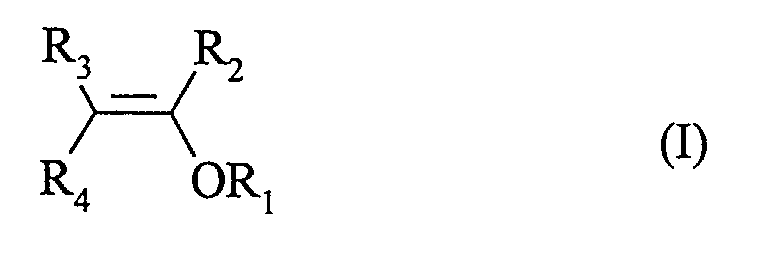
dans laquelle R1 est alkyle en C1-C6, aryle en C5-C14, aralkyle en C6-C20 ou cycloalkyle en C3-C12, R2, R3 et R4 sont indépendamment l'un de l'autre un atome d'hydrogène, alkyle en C1-C6, aryle en C5-C14, aralkyle en C6-C20 ou cycloalkyle en C3-C12, ou R2 et R3 ou R3 et R4 forment ensemble, avec les atomes de carbone liés à ces radicaux, un cycle de cinq à huit chaînons qui peut, si l'on veut, contenir de plus, comme chaînons cycliques, des hétéroatomes ou des hétéro-groupes tels que -O-, -S-, -SO2- ou -NR5-, dans lequel R5 est alkyle en C1-C6, aryle en C5-C14 ou aralkyle en C6-C20 ou bien R1 et R4 forment ensemble, avec les atomes d'oxygène et de carbone liés à ces radicaux, un cycle de cinq à huit chaînons, qui peut, si l'on veut, contenir de plus, comme chaînons cycliques, des hétéroatomes ou des hétéro-groupes tels que -O-, -S-, -SO2- ou -NR5-, dans lequel R5 est alkyle en C1-C6, aryle en C5-C14 ou aralkyle en C6-C20.
dans laquelle R1 est alkyle en C1-C6, aryle en C5-C14, aralkyle en C6-C20 ou cycloalkyle en C3-C12, R2, R3 et R4 sont indépendamment l'un de l'autre un atome d'hydrogène, alkyle en C1-C6, aryle en C5-C14, aralkyle en C6-C20 ou cycloalkyle en C3-C12, ou R2 et R3 ou R3 et R4 forment ensemble, avec les atomes de carbone liés à ces radicaux, un cycle de cinq à huit chaînons qui peut, si l'on veut, contenir de plus, comme chaînons cycliques, des hétéroatomes ou des hétéro-groupes tels que -O-, -S-, -SO2- ou -NR5-, dans lequel R5 est alkyle en C1-C6, aryle en C5-C14 ou aralkyle en C6-C20 ou bien R1 et R4 forment ensemble, avec les atomes d'oxygène et de carbone liés à ces radicaux, un cycle de cinq à huit chaînons, qui peut, si l'on veut, contenir de plus, comme chaînons cycliques, des hétéroatomes ou des hétéro-groupes tels que -O-, -S-, -SO2- ou -NR5-, dans lequel R5 est alkyle en C1-C6, aryle en C5-C14 ou aralkyle en C6-C20.
5. Procédé selon la revendication 4, dans lequel l'éther d'énol est un composé de formule
I dans laquelle R3 est un atome d'hydrogène et R2 est un atome d'hydrogène ou un groupe méthyle.
6. Procédé selon la revendication 4, dans lequel l'éther d'énol est un composé de formule
I, dans laquelle R1 est méthyle, éthyle, n-propyle, isopropyle, n-butyle, isobutyle, tert-butyle ou cyclohexyle,
ou bien R1 et R4 forment ensemble, avec les atomes d'oxygène et de carbone liés à ces radicaux, un
cycle tétrahydrofuranyle ou tétrahydropyranyle.
7. Procédé selon la revendication 1, dans lequel le mélange réactionnel est traité avec
un échangeur d'anions fortement basique.
8. Procédé selon la revendication 1, dans lequel le mélange réactionnel est traité avec
un échangeur d'anions à macropores.
9. Utilisation d'une résine phénolique obtenue selon la revendication 1 dans une formulation
de résist pour la production de circuits à haut degré d'intégration.
1. Verfahren zur Herstellung von Phenolharzen mit säurelabilen Acetal- oder Ketalschutzgruppen
durch Umsetzung eines Phenolharzes mit einem Enolether in Anwesenheit eines sauren
Katalysators und nachfolgende Behandlung des Reaktionsgemisches mit einem basischen
Anionenaustauscher.
2. Verfahren nach Anspruch 1, bei dem das Phenolharz Hydroxystyroleinheiten umfaßt.
3. Verfahren nach Anspruch 1, bei dem das Phenolharz p-Hydroxystyroleinheiten umfaßt.
4. Verfahren nach Anspruch 1, bei dem der Enolether eine Verbindung der Formel I ist:

worin R1 C1-C6-Alkyl, C5-C14-Aryl, C6-C20-Aralkyl oder C3-C12-Cycloalkyl, R2, R3 und R4 unabhängig voneinander Wasserstoff, C1-C6-Alkyl, C5-C14-Aryl, C6-C20-Aralkyl oder C3-C12-Cycloalkyl bedeuten oder R2 und R3 oder R3 und R4 zusammen mit den mit diesen Resten verknüpften C-Atomen einen fünf- bis achtgliedrigen Ring bilden, der gegebenenfalls weitere Heteroatome oder Heterogruppen wie -O-, -S-, -SO2- oder -NR5-, wobei R5 C1-C6-Alkyl, C5-C14-Aryl oder C6-C20-Aralkyl bedeutet, als Ringglieder umfassen kann, oder R1 und R4 zusammen mit den mit diesen Resten verknüpften O- und C-Atomen einen fünf- bis achtgliedrigen Ring bilden, der gegebenenfalls weitere Heteroatome oder Heterogruppen wie -O-, -S-, -SO2- oder -NR5-, wobei R5 C1-C6-Alkyl, C5-C14-Aryl oder C6-C20-Aralkyl bedeutet, als Ringglieder umfassen kann.
worin R1 C1-C6-Alkyl, C5-C14-Aryl, C6-C20-Aralkyl oder C3-C12-Cycloalkyl, R2, R3 und R4 unabhängig voneinander Wasserstoff, C1-C6-Alkyl, C5-C14-Aryl, C6-C20-Aralkyl oder C3-C12-Cycloalkyl bedeuten oder R2 und R3 oder R3 und R4 zusammen mit den mit diesen Resten verknüpften C-Atomen einen fünf- bis achtgliedrigen Ring bilden, der gegebenenfalls weitere Heteroatome oder Heterogruppen wie -O-, -S-, -SO2- oder -NR5-, wobei R5 C1-C6-Alkyl, C5-C14-Aryl oder C6-C20-Aralkyl bedeutet, als Ringglieder umfassen kann, oder R1 und R4 zusammen mit den mit diesen Resten verknüpften O- und C-Atomen einen fünf- bis achtgliedrigen Ring bilden, der gegebenenfalls weitere Heteroatome oder Heterogruppen wie -O-, -S-, -SO2- oder -NR5-, wobei R5 C1-C6-Alkyl, C5-C14-Aryl oder C6-C20-Aralkyl bedeutet, als Ringglieder umfassen kann.
5. Verfahren nach Anspruch 4, bei dem der Enolether eine Verbindung der Formel I ist,
in der R3 Wasserstoff und R2 Wasserstoff oder Methyl bedeuten.
6. Verfahren nach Anspruch 4, bei dem der Enolether eine Verbindung der Formel I ist,
in der R1 Methyl, Ethyl, n-Propyl, Isopropyl, n-Butyl, Isobutyl, tert. Butyl oder Cyclohexyl
bedeuten, oder R1 und R4 zusammen mit den mit diesen Resten verknüpften O- und C-Atomen einen Tetrahydrofuranyl-
oder Tetrahydropyranylring bilden.
7. Verfahren nach Anspruch 1, bei dem das Reaktionsgemisch mit einem starkbasischen Anionenaustauscher
behandelt wird.
8. Verfahren nach Anspruch 1, bei dem das Reaktionsgemisch mit einem makroporösen Anionenaustauscher
behandelt wird.
9. Verwendung eines nach Anspruch 1 erhaltenen Phenolharzes in einer Resistformulierung
für die Herstellung von hochintegrierten Schaltungen.