|
(11) | EP 0 719 543 A1 |

| (12) | EUROPEAN PATENT APPLICATION |
| published in accordance with Art. 158(3) EPC |
|
|
|
|
|||||||||||||||||||
| (54) | SKIN ACTIVATOR HAVING GLYCOSAMINOGLYCAN PRODUCTION ACCELERATOR ACTIVITY |
| (57) A skin activator containing a compound represented by general formula (I) as the
active ingredient and a dermatologic preparation containing the same, each having
an excellent activity of accelerating glycosaminoglycan production.
|
TECHNICAL FIELD
[0001] The present invention relates to a skin activator with a glycosaminoglycan production-accelerating effect, containing a 1-acyl-lysophospholipid derivative as an effective component. The skin activator is useful as a cosmetic and an external preparation to prevent skin aging.
BACKGROUND ART
[0002] Primary phenomena associated with skin aging include a reduction in "moisture" and "elasticity", and the resulting wrinkles and "sagging". While the causes for this are not yet completely understood, it has been reported in J. Soc. Cosmet. Chem. Japan, 15, 77 (1981), Cell Structure and Function, 9, 357 (1984), Maria, et al., Carbohydrate Research, 159, 127-136 (1987) and elsewhere that one cause is believed to be an age-related decline in the production by skin cells of glycosaminoglycans such as hyaluronic acid, leading to a decrease in the moisture content of the skin which affects skin function. Based on this understanding, and in tandem with methods of forming an oily film on the skin surface for the purpose of passively preventing loss of moisture from the cuticle by perspiration, attention has been focused on the water retention properties of glycosaminoglycans, as a result of which hyaluronic acid derived from cockscombs and Streptococcus bacteria fermentation has been formulated into a variety of cosmetics for supplementation of a hydrophilic component, as a means of preventing wrinkles and "sagging"; however, since the hyaluronic acid in these cosmetics is simply applied onto the skin surface, the macromolecular hyaluronic acid is not absorbed into the skin and thus exhibits only a water-retention effect due to its hygroscopicity. The effect, then, is lost after washing, resulting in no substantial improvement in skin function. The only disclosed substance which activates skin cell function on the cellular level and enhances the production of glycosaminoglycans as water-retention components is egg enzymolysate, with its fractional components (Japanese Unexamined Patent Publication No. 5-271049).
[0003] Simple lysophospholipids, on the other hand, form extremely fine micelles in water due to their single-stranded structure, and thus yield fine emulsions in emulsified systems. They are characterized by having the effect of stabilizing emulsions and preventing starch aging (phenomenon of hardening and emergence due to recrystallization of starch molecules), and are thus used as emulsifiers and as modifiers for bread and the like. According to reports by Uchida, et al. (The Journal of Dermatology, 18, 523-527 (1991)), it has been demonstrated that lysophosphatidylcholine penetrates to the interior of the skin when applied to the skin surface of hairless rats without causing histological damage, and is thus highly safe as a cosmetic. This has led to the development of external skin preparations taking advantage of the safety, low irritancy and stable emulsifying effect of lysophospholipids (Japanese Unexamined Patent publication No. 63-41411), but without dealing with their anti-aging effect on skin. Another example is Japanese Unexamined Patent Publication No. 3-161414 wherein lysophosphatidyl glycerol is formulated into a cosmetic for its water-retention effect; however, as in the case where hygroscopic hyaluronic acid is applied onto the skin surface, no effect can be expected once it is washed off.
DISCLOSURE OF THE INVENTION
[0004] Based on these results, cell activators which increase the amount of water-retaining glycosaminoglycans in the skin have been found to be effective for activating the skin from the inside, to prevent age-related morphological changes in the skin, typically a reduction in "moisture" and "elasticity" and resulting wrinkles. Nevertheless, it has been desired to develop skin beautifiers with higher glycosaminoglycan-producing ability than the effective components in the skin cosmetics described above. It is, therefore, an object of the present invention to provide a skin activator with a strong glycosaminoglycan production-accelerating effect.
[0005] As a result of continuous diligent searching for a glycosaminoglycan production-accelerating substance capable of dealing with the aforementioned problems, the present inventors have discovered that certain lysophospholipids have a notable glycosaminoglycan production-accelerating effect and are highly safe compounds, and upon this basis the present invention has been completed.
[0006] Therefore, the present invention provides a skin activator with a glycosaminoglycan production-accelerating effect containing as an effective component the compound represented by the following chemical formula (I):
BEST MODE FOR CARRYING OUT THE INVENTION
[0007] The compound of formula (I) shown above may be commercially obtained, or it may be obtained by treating the commercially available 1-lauroyl-2-acyl-lysophosphatidylcholine with phospholipase A2. Alternatively, the above-mentioned compound may also be obtained by treating synthesized 1-lauroyl-2-acyl-lysophosphatidylcholine with phospholipase A2. The above-mentioned compound may also be obtained with a lysophosphatidylcholine obtained by reacting 1 mole or less of a fatty acid anhydride or fatty acid halide with 1 mole of glycerophosphocholine in the presence of a catalyst (Japanese Unexamined Patent Publication No. 63-225388).
[0008] The skin activator of the present invention which has a glycosaminoglycan production-accelerating effect may be used as an anti-aging cosmetic for the purpose of preventing wrinkles. To obtain the glycosaminoglycan production-accelerating effect of the invention for the use described above, the-mixing ratio of the compound is preferably 0.1 to 10 wt% with respect to the total external skin preparation or formulation. If the amount is less than 0.1 wt%, the desired glycosaminoglycan production acceleration will not be adequately displayed, while if it exceeds much more than 10 wt%, problems such as stickiness will result, and thus neither case is practical.
[0009] The form of the cosmetic containing the skin activator of the present invention is not particularly limited, and it may contain, in addition to the aforementioned compound as the effective component, any of a variety of cosmetic components and additives commonly used in cosmetics, including inorganic pigments, organic pigments, inorganic powders, organic powders, hydrocarbons, silicones, esters, triglycerides, lanolins, waxes, cere, animal or vegetable oils, surfactants, polyhydric alcohols, sugars, vitamins, amino acids, antioxidants, preservatives, fragrances, thickeners, and the like.
[0010] The present invention is explained in more detail by way of the following examples which, however, are in no way intended to restrict its scope.
EXAMPLES
[0011] First, we present the results of experiments conducted to evaluate the effect of the compound of chemical formula (I) used according to the invention.
Evaluation of glycosaminoglycan production by NB1RGB cells
[0012] The cells used to evaluate the glycosaminoglycan production acceleration were of the human neonatal dermatofibroblast cell line NB1RGB. This cell line is often conventionally used for such experiments, and was suitable as cells for this experiment. In addition, since human derived cells were used in this experiment, they were even more appropriate as a method of evaluating a drug intended for application to the human body.
[0013] NB1RGB cells were densely seeded onto a 1.2 cm-diameter culturing dish (48 wells) at 5 x 10⁴ per dish, and cultured for 24 hours at 37°C in a Dulbecco's modified eagle medium containing 10% fetal calf serum. The test compound was then added to Dulbecco's modified eagle medium containing 0.5% fetal calf serum, to a concentration in the medium of 0.5 to 100 µM. After culturing for 24 hours, the cells were transferred to fresh 0.5% calf serum-containing medium to which the test compound had been added to the same concentration. 3H-glycosamine was also added to the medium at this time to 370 KBq/ml, and the culturing was continued for another 24 hours. After completion of the culturing, 2 mg pronase in 0.1 M Tris·HCl (pH 8) was added, and incubation was performed at 50°C for one hour. Cetylpyridium chloride was added to a final concentration of 1% in the copresence of 100 µg hyaluronic acid as a carrier, and the resulting precipitate was separated out by centrifugation. The precipitate was centrifuged and washed 3 times in 1 ml of a 1% aqueous cetylpyridium chloride solution, and then 0.2 ml of a 0.05% aqueous cetylpyridium chloride solution containing 0.5 M NaCl was added and the mixture was vigorously stirred. To this was then added 5 ml of the emulsification scintillator ACSII, and the radiation was counted with a liquid scintillation counter, making the evaluation based on standard control values. The results, along with the Comparative Examples for contrast, are given in Table 1 below.
Table 1
| Glycosaminoglycan production (ratio to control) | |||
| Examples | Comparative Examples | ||
| Concentration | Compound 1 | Comparison 1 | Comparison 2 |
| 0 µM | 1 | 1 | 1 |
| 0.5 | 1 | ||
| 5 | 1 | 1 | 1.2 |
| 10 | 1.3 | ||
| 50 | 2.1 | ||
| 100 | 4.8 | 1 | 1 |
| Compound 1: 1-lauroyl-lysophosphatidylcholine Comparison 1: 1-decanoyl-lysophosphatidylcholine Comparison 2: Lysophosphatidyl glycerol |
|||
[0014] The following are formulation examples of skin activator-containing cosmetics according to the invention.
Example 1 (ointment 1)
[0015]
| Parts by weight | ||
| A | 1-lauroyl-lysophosphatidylcholine | 1 |
| White vaseline | 25 | |
| Stearyl alcohol | 22 | |
| B | Propylene glycol | 12 |
| Sodium lauryl sulfate | 1.5 | |
| Preservative/antioxidant | q.s. | |
| Fragrance | q.s. | |
| Purified water | remainder | |
| Total | 100 |
[0016] The components listed under A were dissolved in a hot water bath (oil phase), while the components listed under B were separately heated to dissolution (aqueous phase). The aqueous phase was added to and mixed with the oil phase, and after emulsification the mixture was cooled to obtain an ointment.
Example 2 (ointment 2)
[0017]
| Parts by weight | ||
| A | 1-lauroyl-lysophosphatidylcholine | 2 |
| White vaseline | 40 | |
| Cetanol | 18 | |
| Sorbitan sesquioleate | 5 | |
| Lauromacrogol | 0.5 | |
| B | Preservative/antioxidant | q.s. |
| Fragrance | q.s. | |
| Purified water | remainder | |
| Total | 100 |
[0018] The components listed under A were dissolved in a hot water bath (oil phase), while the components listed under B were separately heated to dissolution (aqueous phase). The aqueous phase was added to and mixed with the oil phase, and after emulsification the mixture was cooled to obtain an ointment.
Example 3 (Neutralizing cream)
[0019]
| Parts by weight | |
| 1-lauroyl-lysophosphatidylcholine | 2 |
| Stearyl alcohol | 7 |
| Stearic acid | 2 |
| Hydrogenated lanolin | 2 |
| Squalene | 5 |
| 2-octyldodecyl alcohol | 6 |
| POE (25) cetyl alcohol ester | 3 |
| Glycerine monostearate ester | 2 |
| Propylene glycol | 5 |
| Preservative/antioxidant | q.s. |
| Fragrance | q.s. |
| Purified water | remainder |
| Total | 100 |
[0020] The propylene glycol was added to the purified water, heated and kept at 70°C (aqueous phase). The other components were combined, heated to dissolution and kept at 70°C (oil phase). The oil phase was added to the aqueous phase, and after pre-emulsification, homogeneous emulsification was performed with a homomixer to obtain a neutralizing cream.
Example 4 (emulsion)
[0021]
| Parts by weight | ||
| A | 1-lauroyl-lysophosphatidylcholine | 0.5 |
| Silicone KF56 | 2 | |
| Isopropyl myristate | 3 | |
| POE (20) POP (4) cetyl ether | 1 | |
| B | Glycerin | 3 |
| Hibiswaco 105 | 0.2 | |
| Preservative/antioxidant | q.s. | |
| Fragrance | q.s. | |
| Purified water | remainder | |
| Total | 100 |
[0022] The above-mentioned formulas A and B were each liquefied at 70°C, A was added to B, and the mixture was homogeneously emulsified to obtain an emulsion.
Example 5 (Skin pack)
[0023]
| Parts by weight | |
| 1-lauroyl-lysophosphatidylcholine | 3 |
| Ethyl alcohol | 10 |
| Glycerin | 5 |
| Dipropylene glycol | 5 |
| Polyethylene glycol 4000 | 1 |
| Polyvinyl alcohol | 10 |
| Vinyl acetate resin emulsion | 13 |
| Titanium oxide | 12 |
| Olive oil | 3 |
| Squalene | 0.5 |
| Preservative/antioxidant | q.s. |
| Fragrance | q.s. |
| Purified water | remainder |
| Total | 100 |
Example 6 (beauty wash)
[0025]
| Parts by weight | |
| 1-lauroyl-lysophosphatidylcholine | 0.5 |
| Glycerine | 4 |
| 1,3-butylene glycol | 4 |
| Ethanol | 7 |
| POE (25) oleyl alcohol | 0.5 |
| Preservative/antioxidant | q.s. |
| Fragrance | q.s. |
| Purified water | remainder |
| Total | 100 |
[0026] The glycerine and 1,3-butylene glycol were dissolved in the purified water. Separately, the 1-lauroyl-lysophosphatidylcholine and POE (20) oleyl alcohol were dissolved in the ethanol, and this solution was then added to and dissolved in the previous aqueous solution and filtered to obtain a beauty wash.
Example 7 (Skin lotion)
[0027]
| Parts by weight | |
| 1-lauroyl-lysophosphatidylcholine | 0.5 |
| Ethanol | 20 |
| 1,3-butylene glycol | 5 |
| Polyethylene glycol | 2 |
| Coloring | q.s. |
| Purified water | remainder |
| Total | 100 |
INDUSTRIAL APPLICABILITY
1. A skin activator with a glycosaminoglycan production-accelerating effect, containing
as an effective component the compound represented by the following chemical formula
(I):
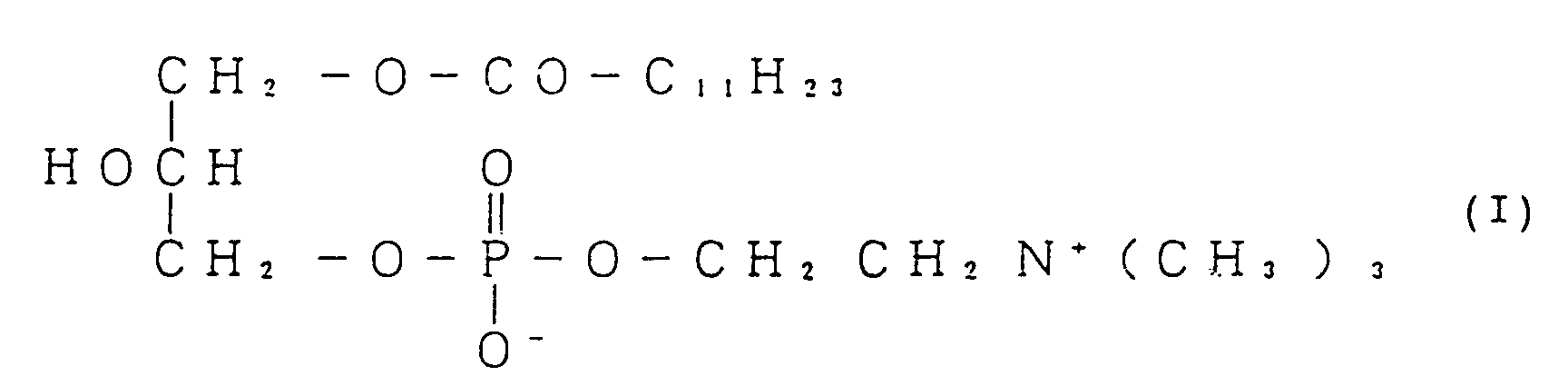
2. An external skin preparation containing a skin activator according to Claim 1.
3. An external anti-aging skin preparation containing a skin activator according to Claim
1.