|
(11) | EP 0 720 668 B1 |

| (12) | EUROPEAN PATENT SPECIFICATION |
|
|
| (54) |
NONWOVEN FABRIC FORMED FROM ALLOY FIBERS Vliesstoff aus Fasern-bestehend aus nichtmischbaren Faser-Komponenten TISSU NON TISSE PRODUIT A PARTIR DE FIBRES D'ALLIAGE |
|
|
|||||||||||||||||||||||||||||||
| Note: Within nine months from the publication of the mention of the grant of the European patent, any person may give notice to the European Patent Office of opposition to the European patent granted. Notice of opposition shall be filed in a written reasoned statement. It shall not be deemed to have been filed until the opposition fee has been paid. (Art. 99(1) European Patent Convention). |
BACKGROUND OF THE INVENTION
[0001] Thermoplastic resins have been extruded to form fibers and webs for a number of years. The common thermoplastics for this application are polyolefins, particularly polypropylene, and polyesters. Each material has its characteristic advantages and disadvantages vis a vis the properties desired in the final product to be made from such fibers.
[0002] Blends and alloys of two or more polymers are areas of some interest because of a desire to combine the desirable properties of such polymers. Dr. Leszek A. Utracki, in his work "Polymer Alloys and Blends: Thermodynamics and Rheology" (ISBN 0-19-520796-3, Oxford University Press, New York, NY, 1989) discusses the history of development in this area at some length.
[0003] From the US-A-3 137 989 the preparation of dyeable bulky yarns based on polypropylene is known. The polypropylene is mixed with various resins and this modified polypropylene mix is then spun into filaments.
[0004] There remains a need for a fabric produced from fibers of an alloy of polymers wherein the polymer melt temperature of the non-continuous phase is not at least 30 °C below that of the continuous phase (and may even be higher) and in which desired characteristics are enhanced.
DEFINITIONS
[0005] As set herein the term "nonwoven fabric or web" means a sheet material having a structure of individual fibers or threads which are interlaid, but not in a regular manner such as occurs with knitting or weaving processes. Nonwoven fabrics or webs have been formed from many processes such as for example, meltblowing processes, spunbonding processes, and bonded carded web processes.
[0006] As used herein the term "microfibers" means small diameter fibers having an average diameter not greater than about 100 microns, for example, having an average diameter of from about 0.5 microns to about 50 microns, or more particularly, microfibers may have an average diameter of from about 2 microns to about 40 microns.
[0007] As used herein the term "meltblown fibers" means fibers formed by extruding a molten thermoplastic material through a plurality of fine, usually circular, die capillaries as molten threads or filaments into a high velocity gas (e.g. air) stream which attenuates the filaments of molten thermoplastic material to reduce their diameter, which may be to microfiber diameter. Thereafter, the meltblown fibers are carried by the high velocity gas stream and are deposited on a collecting surface to form a web of randomly disbursed meltblown fibers. Such a process is disclosed, for example, in U.S. Patent no. 3,849,241 to Buntin.
[0008] As used herein the term "spunbonded fibers" refers to small diameter fibers which are formed by extruding molten thermoplastic material as filaments from a plurality of fine, usually circular capillaries of a spinnerette with the diameter of the extruded filaments then being rapidly reduced as by, for example, the process described in U.S. Patent no. 4,340,563 to Appel et al., and U.S. Patent no. 3,692,618 to Dorschner et al.
[0009] As used herein the term "bicomponent" refers to fibers which have been formed from at least two polymers extruded from separate extruders but spun together to form one fiber. The configuration of such a bicomponent fiber may be a sheath/core arrangement wherein one polymer is surrounded by another or may be a side by side arrangement.
[0010] As used herein the term "polymer" generally includes but is not limited to, homopolymers, copolymers, such as for example, block, graft, random and alternating copolymers, terpolymers, etc. and blends and modifications thereof. Furthermore, unless otherwise specifically limited, the term "polymer" shall include all possible geometrical configuration of the material. These configurations include, but are not limited to isotactic, syndiotactic and random symmetries.
[0011] As used herein the term "blend" means a mixture of two or more polymers while the term "alloy" means a sub-class of blends wherein the components are immiscible but have been compatibilized. "Miscibility" and "immiscibility" are defined as blends having negative and positive values, respectively, for the free energy of mixing. "Compatibilization" is defined as the process of modifying the interfacial properties of an immiscible polymer blend in order to make an alloy.
[0012] As used herein, the term "bonding window" means the range of temperature of the calender rolls used to bond the nonwoven fabric together, over which such bonding is successful. Calendering generally uses two roller, an upper or pattern roller and a lower or anvil roller. Such rolls are usually held at slightly different temperatures, therefore, all references to the calender temperature and bonding window herein shall mean the temperature of the upper or pattern roller. For polypropylene, the bonding window is typically from about 270 to about 310°F (132 to 154°C). Below about 270°F the polypropylene is not hot enough to melt and bond and above about 310°F the polypropylene will melt excessively and can stick to the calender rolls. Polyethylene has an even narrower bonding window, typically from about 250°F to about 258°F (121 to 125.6°C).
SUMMARY OF THE INVENTION
[0013] A nonwoven fabric is provided which is made from fibers comprising at least two thermoplastic polymers and a compatibilizer. One of the thermoplastic polymers is present as a dominant continuous phase and the other one or more polymers are present as a non-continuous phase or phases. The polymer of the non-continuous phase or phases has a polymer melt temperature less than 30 °C below the polymer melt temperature of the continuous phase. The polymer of the non-continuous phase or phases may even have a polymer melt temperature greater than the polymer melt temperature of the continuous phase.
DETAILED DESCRIPTION OF THE INVENTION
[0014] The nonwoven fabrics of this invention may be made from multicontituent fibers which are an alloy of at least two immiscible polymers which have been compatibilized through the use of a suitable compatibilizer.
[0015] The alloy of polymers used to make the fibers used in the fabric of this invention is such that the polymer melt temperature of the non-continuous phase is in the range of from less than 30 °C below to any value greater than that of the continuous phase.
[0016] Suitable polymer mixtures which may be used in the practice of this invention include, for example, polyolefins and polyamides, and polyolefins and polyesters.
[0017] The polyolefin which may be used in the practice of this invention may be amorphous or crystalline, atactic, isotactic or sydiotactic. Suitable polyolefins include polyethylene, polypropylene, polybutylenes and copolymers, blends and mixtures thereof and are available commercially from a number of suppliers. The particular properties of polyolefins used in the spunbonding and meltblowing processes are known to those skilled in the art.
[0018] The polyamide which may be used in the practice of this invention may be any polyamide known to those skilled in the art including copolymers and mixtures thereof. Examples of polyamides and their methods of synthesis may be found in "Polymer Resins" by Don E. Floyd (Library of Congress Catalog number 66-20811, Reinhold Publishing, NY, 1966). Particularly commercially useful polyamides are nylon-6, nylon 6,6, nylon-11 and nylon-12. These polyamides are available from a number of sources such as Emser Industries of Sumter, South Carolina (Grilon® & Grilamid® nylons) and Atochem Inc. Polymers Division, of Glen Rock, New Jersey (Rilsan® nylons), among others.
[0019] Modifying the interfacial properties of the immiscible polymer blend to make an alloy is accomplished through the use of a compatibilizer. It is believed, though applicants do not wish to be bound by any particular theory, that a compatibilizer has polar and non-polar parts and the polar part reacts with or is attracted to a polar part of one of the polymers to be alloyed. The non-polar part of the compatibilizer remains available for reaction with or attraction to the dominant phase polymer and this results in more intimate mixing. The reduction in the interfacial energy caused by the compatibilizer allows the size of the discontinuous phase to be reduced within the continuous phase.
[0020] Any compatibilizer known to those skilled in the art to enhance the blending of polymers may be used. An example of such compatibilizers are polypropylenes modified with maleic acid/anhydride. Another useful compatibilizer has the general formula:
wherein each R may independently be H or an alkyl group, M+ is an alkali, alkaline earth or transition metal cation, and n, x, y and z are integers. A particularly useful class of this compatibilizer is poly(olefin-methacrylic acid) where the acid groups are partially or fully neutralized by metal ions.
[0021] Commercial examples of compatibilizers useful in this invention include Exxelor® polymer modifier PO1015 or VA1803 available from Exxon Chemical Company, and the family of Surlyn® ionomers available from E.I. Dupont de Nemours Inc., particularly Surlyn® 9020 ionomer.
[0022] Exxelor® polymer modifier PO1015 is a proprietary chemical which has a melt flow rate of 120 g/10 min., a density of 0.91 g/cn3 and has 0.4 weight percent of grafted maleic acid/anhydride. Exxelor® polymer modifier VA1803 has a melt flow rate of 3 g/10 min., a density of 0.86 g/cm3 and has 0.7 weight percent of maleic acid/anhydride. Surlyn® 9020 ionomer has a melt flow rate of 1.0 g/10 min. and a density of 0.96 g/cm3. The Surlyn® ionomer resins are based on ethylene and methacrylic acid di- and terpolyers which have been partially reacted with metallic salts (generally zinc or sodium) to form ionic crosslinks between the acid groups within a chain or between neighboring chains.
[0023] The fibers of this invention may also have, in addition to the compatabilized blend of polymers, other polymers present in a structure which is known as a bicomponent. This structure may be a sheath/core or side by side orientation.
[0024] The fibers from which the fabric of this invention is made may be produced by the meltblowing or spunbonding processes which are well known in the art. These processes generally use an extruder to supply melted polymer to a spinnerete where the polymer is fiberized. The fibers are then drawn, usually pneumatically, and deposited on a foraminous mat or belt to form the nonwoven fabric. The fibers produced in the spunbond and meltblown processes are generally in the range of from about 1 to about 50 microns in diameter, depending on process conditions and the desired end use for the fabrics to be produced from such fibers.
[0025] It has been found that the fibers used to make the fabric of this invention have the polymer of the non-continuous phase or phases substantially evenly distributed throughout the continuous phase as opposed to, for example, being preferentially deposited on the surface of the fiber. It has also been found that the non-continuous phase exhibits a fibrillar structure inside the continuous phase and that the single polymer domain non-continuous phase or phases have a cross-sectional area of at least 0.1% of the cross-sectional area of the fiber.
[0026] The fabric of this invention may be used in a single layer embodiment or as a component of a multilayer laminate which may be formed by a number of different laminating techniques including but not limited to using adhesive, needle punching, thermal calendering and any other method known in the art. Such a multilayer laminate may be an embodiment wherein some of the layers are spunbond and some meltblown such as a spunbond/meltblown/spunbond (SMS) laminate as disclosed in U.S. Patent no. 4,041,203 to Brock et al. and U.S. Patent no. 5,169,706 to Collier, et al. Such a laminate may be made by sequentially depositing onto a moving forming belt first a spunbond fabric layer, then a meltblown fabric layer and last another spunbond layer and then bonding the laminate in a manner described above. Alternatively, the three fabric layers may be made individually, collected in rolls, and combined in a separate bonding step. Some or all of such SMS layers may be made from the fabric of this invention. The fabric of this invention may also be laminated with films, glass fibers, staple fibers, paper, and other web materials.
EXAMPLE 1
[0028] The polymer alloys were generally produced by compounding the ingredients in a 30 or 60 mm twin screw extruder and which was performed by a vendor. Any other method known to those skilled in the art of compounding polymers as effective may also be used.
[0029] The alloys for this example were made with each of two polyamides, nylon 6 and 12, with polyolefin and Surlyn® 9020 ionomer. The polyolefin used was Exxon Chemical Company's PD 3445 polypropylene which has a melt flow rate of 35 g/10 min. The polyamides used in these examples were polyamide 6 sold as Grilon® A23 nylon 6 by Emser Industries, having a melting point of 230°C (ASTM D792) and a specific gravity of 1.14 (ASTM D792), polyamide 11 sold as Rilsan® nylon 11 by Atochem Inc., having a melting point of 186 °C and a specific gravity of 1.03, and polyamide 12 sold as Rilsan® nylon 12 by Atochem Inc. with a melting point of 174°C and a specific gravity of 1.02.
[0030] The amounts in the initial blends were 4.5 weight percent polyamide, 0.5 weight compatibilizer and the balance polypropylene. Some blends were further diluted through the addition of polypropylene and are indicated in the table, i.e. the example in table 1 of polyamide 6 at 96.1°C (205°F) indicates that the initial mixture was diluted by 50% with polypropylene to yield a mixture with 2.25% polyamide, 0.25% compatibilizer and the balance polypropylene. The dilution was accomplished by throughly mixing pellets of polypropylene with pellets of the blend at room temperature.
The two alloys were melt spun through a standard 600 hole round pack with a pin density of 20-33 holes per cm (50 to 85 holes per inch) (hpi), a length to exit diameter (L/D) of 6 and an 0.6 mm exit diameter. The extruder and pack temperatures were between 430°F (221°C) and 460°F (238°C) and throughput was typically 0.7 grams/hole/min (ghm). The extruded fibers were thermally point bonded by calendering using an Expanded Hansen Penning bond roll with a 15% bond area to create a fabric with integrity at a calender temperature of 285°F (140.6°C) as indicated in table 1. The fibers which were calendered at 205°F (96.1°C) as indicated in table 1 used a 714 bond pattern with a 15% bond area. Mechanical data for 33.91 g/m2 (1 ounce per square yard (osy)) spunbond fabrics made from these alloy fibers is shown in table 1 in relation to fabric made from fibers of polypropylene alone, and compares well.
EXAMPLE 2
[0031] Compounded alloys were made as in example 1 with each of three polyamides, nylon 6, nylon 11 and nylon 12 with polyolefin and Exxelor® polymer modifier PO1015. The polyolefin used was Exxon PD 3445 polypropylene.
[0032] The amounts in the initial blends were 4.5 weight percent polyamide, 0.5 weight compatibilizer and the balance polypropylene. Some blends were further diluted through the addition of polypropylene and are indicated in the table, i.e. the example in table 2 of polyamide 6 at 140.6°C (285°F) indicates that the initial mixture was diluted by 50% with polypropylene to yield a mixture with 2.25% polyamide, 0.25% compatibilizer and the balance polypropylene. The dilution was accomplished by throughly mixing pellets of polypropylene with pellets of the blend at room temperature.
[0033] The alloys were melt spun into fibers and bonded under conditions and with equipment similar to those of example 1. The calender had an Expanded Hansen Penning bond roll with a 15% bond area except for the polyamide 11 fabric which used a wire weave bond roll with a 15% bond area and the fabric calendered at 96.1°C (205°F) which used a 714 bond pattern with a 15% bond area. Bonding temperatures are shown in table 2 along with the mechanical data for 33.91 g/m2 (1 osy) spunbond fabrics made from these alloy fibers, in relation to fabric made from fiber of polypropylene alone.
EXAMPLE 3
[0034] Compounded mixtures were made as in example 1 with each of three polyamides, nylon 6, nylon 11 and nylon 12 with polyolefin and Exxelor® polymer modifier VA1803. The polyolefin used was Exxon PD 3445 polypropylene.
[0035] The amounts in the initial blends were 4.5 weight percent polyamide, 0.5 weight compatibilizer and the balance polypropylene. Some blends were further diluted through the addition of polypropylene and are indicated in the table, i.e. the example in table 3 of polyamide 11 at 208°F (97.8°C) indicates that the initial mixture was diluted by 50% with polypropylene to yield a mixture with 2.25% polyamide, 0.25% compatibilizer and the balance polypropylene, the example in table 3 of polyamide 12 at 285°F indicates that the initial mixture was diluted by 50% with polypropylene to yield a mixture with 2.25% polyamide, 0.25% compatibilizer and the balance polypropylene. The polyamide 12 was mixed with about 0.9% polyamide, 0.1% compatibilizer and the balance polypropylene.
[0036] The alloys were melt spun into fibers and bonded under conditions and with equipment similar to those of example 1. The calender had an Expanded Hansen Penning bond roll with a 15% bond area except for the polyamide 12 at 140.6°C (285°F) and polyamide 11 fabric which used a wire weave bond roll with a 15% bond area and the fabrics bonded at 96.1°C (205°F) which used a 714 bond pattern with 15% bond area. Bonding temperatures were 285°F (140.6°C), 205°F (96°C) and 208°F (97.8°C) and are shown in table 3 along with the mechanical data for the 33.91 g/m2 (1 osy) spunbond fabrics made from these alloy fibers, in relation to fabric made from fibers of polypropylene alone.
EXAMPLE 4
[0037] Compounded mixtures were made as in example 1 with polyamide nylon 6, polyolefin and Surlyn® polymer modifier 9020. The polyolefin used was Dow Aspun™ 6811A polyethylene with a melt flow index at 190°C of 22 grams/10 minutes.
[0038] The amounts in the initial blends were 0.9 weight percent polyamide, 0.1 weight percent compatibilizer and the balance polyethylene. The final blend had 4.5% polyamide, 0.5% compatabilizer and the balance polypropylene.
[0039] The alloys were melt spun into fibers and bonded under conditions and with equipment similar to those of example 1. The calender had a wire weave bond roll with a 15% bond area. Bonding temperatures were 253 °F (122.8°C) and 230°C (110°C) and are shown in table 4 along with the mechanical data for the approximately 33.91 g/m2 (1 osy) spunbound fabrics made froom these alloy fibers, in relation to fabric made from fibers of polyethylene alone.
[0040] The test method for tensile strength and elongation that was used in the examples is called the grab method. This test is known in the art and conforms to the specifications of Method 5100 of the Federal Test Methods Standard No. 191A. The results are expressed in pounds to break and percent stretch before breakage. Higher numbers indicate a stronger, more stretchable fabric. The term "load" means the maximum load or force, expressed in units of weight, required to break or rupture the specimen in a tensile test. The term "energy" means the total energy under a load versus elongation curve as expressed in weight-length units. The term "elongation" means the increase in length of a specimen during a tensile test.
[0041] The results of the tests at conventional bonding temperatures (285°F) indicate that fabric made from fibers of alloys of polypropylene, polyamide and compatibilizer give results for load and energy which are comparable to or better than fabric made from fibers of polypropylene alone while the elongation for the alloy fabric is far greater than that of the polypropylene fabric.
[0042] The lower bonding temperature (205°F) results indicate that the bonding window has been enhanced or widened. Polypropylene is bonded at a temperature of typically from about 270 to 310°F (132 to 154.4°C). Bonding at lower temperatures provides energy savings and allows greater ease of processing and controllability. Bonding at temperatures in the range of 200 to 325°F (93 to 163°C) is believed possible.
[0043] The results for the polyethylene/polyamide compatibilized blends, while not an improvement over polyethylene alone for the properties measured, indicate that compatibilization, spinning and bonding of these immiscible components is indeed possible. As was the case with polypropylene, the bonding window for the polyethylene/polyamide alloy is also considerably larger than for polyethylene alone.
[0044] One example of a use of a multilayer laminate incorporating the fabric of this invention is as a sterilization wrap which is used to enclose an object to be sterilized and which allows sterilization to occur but thereafter acts as to impede the re-contamination of the object. The properties of such a wrap are discussed in U.S. Patent 4,041,203 and include the ability to permit penetration of a sterilent such as ethylene oxide at about 130°F (54.4°C), steam at about 250-280°F (121-138°C), gamma radiation, etc., and to thereafter impede to a high degree the passage of bacteria and like contaminants. The sterilization process is quite stressful and it is important that fabrics exposed to the sterilization process retain strength sufficient to function for the desired purpose.
EXAMPLE 5
[0045] Fabric made from fibers made according to this invention of, by weight, 95% polypropylene, 4.5% polyamide 6 or 12 and 0.5 % Surlyn 9020 compatibilizer, control fabrics of 100% polypropylene, and fabrics of fibers having 97% polypropylene, 2.5% polyamide 6 and 0.5% Surlyn 9020 compatibilizer were tested as described above, before and after steam sterilization.
[0046] Steam sterilization was accomplished using an AMSCO general purpose sterilizer produced by AMSCO Industrial Co., a division of American Sterilizer Co., of Erie, PA with a Partlow MIC-6000 microprocessor. The sterilization process is a five step vacuum procedure. In step one the fabric is subjected to a vacuum of 10 inches of mercury (inHg) (500 mmHg absolute pressure). In step two steam is introduced to warm the fabric in order to avoid condensation upon saturation with steam. In step three the fabric is subjected to a vacuum of 18 inHg (300 mmHg absolute pressure). In step four the fabric is subjected to 100% steam saturation at 275°F (135°C) for 4 minutes. Step five is a drying step in which the steam flow is stopped and the fabric is subjected to a vacuum of 26 inHg (100 mmHg absolute pressure) for 20 minutes and cooled to about 200°F (93°C).
1. A nonwoven fabric comprising fibers composed of at least two thermoplastic polymers
and a compatibilizer, wherein one of said thermoplastic polymers has a polymer melt
temperature and forms a dominant continuous phase, and the other one or more polymers
form a non-continuous phase or phases characterized in that the polymer of said non-continuous
phase or phases has a polymer melt temperature less than 30°C below the polymer melt
temperature of said continuous phase.
2. The nonwoven fabric of claim 1 which is made from fibers wherein any single polymer
domain cross-section of said non-continuous phase or phases is at least 0.1% of the
cross-sectional area of said fiber.
3. The nonwoven fabric of claim 1 which is made from fibers wherein said continuous phase
is at least one polyolefin and said non-continous phase is at least one polyamide.
4. The nonwoven fabric of claim 1 which is made from fibers wherein the non-continuous
phase or phases are substantially evenly distributed throughout said fiber.
5. The nonwoven fabric of claim 1 which is made from fibers wherein the fibers have diameters
of approximately 1 to 50 microns.
6. The nonwoven fabric of claim 1 which is made from fibers wherein the compatibilizer
is selected from the group consisting of polypropylenes modified with maleic anhydride
and those having a formula:
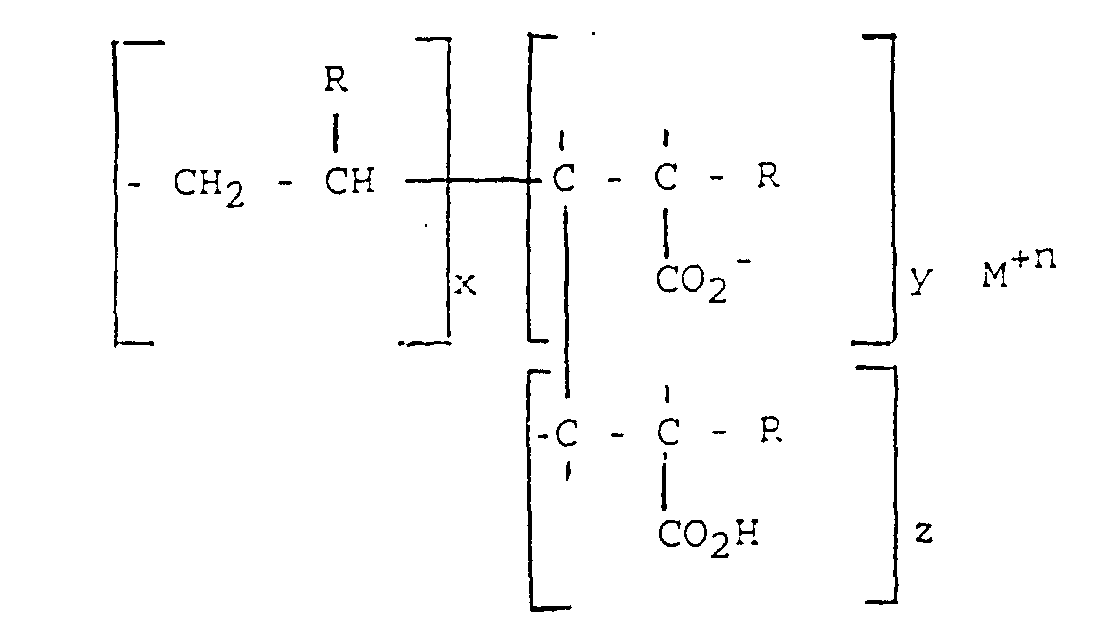
wherein each R may independently be H or an alkyl group, M+ is selected from the group consisting of alkali, alkaline earth and transition metal cations, and n, x, y and z are integers.
wherein each R may independently be H or an alkyl group, M+ is selected from the group consisting of alkali, alkaline earth and transition metal cations, and n, x, y and z are integers.
7. The nonwoven fabric of claim 6 which is made from fibers wherein the compatibilizer
is a zinc ionomer of poly(ethylene-methacrylic) acid.
8. The nonwoven fabric of claim 1 which is made from fibers which have been thermally
bonded at a temperature between about 93 and about 163°C.
9. The nonwoven fabric of claim 1 which has a percent elongation of at least 50% greater
than that of nonwoven fabric made from polypropylene fibers which have been bonded
at a similar temperature.
10. The nonwoven fabric of claim 1 which is made by the process selected from the group
consisting of spunbonding and meltblowing.
11. The nonwoven fabric of claim 3 which is made from fibers wherein the polyamides are
selected from the group consisting of polyamide 6, polyamide 11, polyamide 12, and
copolymers, blends and mixtures thereof.
12. The nonwoven fabric of claim 3 which is made from fibers wherein said polyolefin is
selected from the group consisting of polyethylene, polypropylene, polybutylenes and
copolymers, blends and mixtures thereof, and is present in an amount between approximately
50 to 99.9 weight percent, said polyamide is present in an amount between approximately
0.1 to 30 weight percent and said compatibilizer is present in amount between approximately
0.01 and 20 weight percent.
13. A nonwoven fabric sterilization wrap comprised of a plurality of layers wherein at
least one of said layers is comprised of the fabric of claim 1.
14. A nonwoven fabric according to claim 1 which is made from fibers comprising polypropylene
as the dominant continuous phase present in an amount between approximately 50 to
99.9 weight percent, and wherein the other one or more polymers are polyamides present
in an amount between approximately 0.1 to 30 weight percent, and wherein said compatibilizer
is a zinc ionomer of ethylene-methacrylic acid present in an amount between approximately
0.01 and 20 weight percent.
15. A nonwoven fabric according to claim 1 which is made from fibers comprising polypropylene
present in an amount of approximately 99 weight percent, polyamide 12 present in an
amount of approximately 0.9 weight percent and a compatibilizer which has a melt flow
rate of about 120 g/10 min., a density of about 0.9 g/cm3 and has about 0.4 weight percent of grafted maleic acid/anhydride and is present
in an amount of approximately 0.1 weight percent, and wherein said fibers have been
thermally bonded at a temperature below 140.6°C.
1. Vliesmaterial, umfassend Fasern, die aus mindestens zwei thermoplastischen Polymeren
und einem Kompatibilisator zusammengesetzt sind, wobei eines der thermoplastischen
Polymere eine Polymer-Schmelztemperatur aufweist und eine dominante kontinuierliche
Phase ausbildet, und wobei das andere oder die anderen Polymere eine nicht kontinuierliche
Phase oder Phasen ausbilden, dadurch gekennzeichnet, daß das Polymer der nicht kontinuierlichen
Phase oder Phasen eine Polymer-Schmelztemperatur von weniger als 30°C unterhalb der
Polymer-Schmelztemperatur der kontinuierlichen Phase aufweist.
2. Vliesmaterial gemäß Anspruch 1, das aus Fasern hergestellt ist, wobei jeder einzelne
Polymerdomänenquerschnitt der nicht kontinuierlichen Phase oder Phasen mindestens
0,1% der Querschnitttläche der Faser ausmacht.
3. Vliesmaterial gemäß Anspruch 1, das aus Fasern hergestellt ist, wobei die kontinuierliche
Phase mindestens ein Polyolefin ist, und wobei die nicht kontinuierliche Phase mindestens
ein Polyamid ist.
4. Vliesmaterial gemäß Anspruch 1, das aus Fasern hergestellt ist, wobei die kontinuierliche
Phase oder Phasen im wesentlichen gleichmäßig durch die Faser verteilt sind.
5. Vliesmaterial gemäß Anspruch 1, das aus Fasern hergestellt ist, wobei die Fasern einen
Durchmesser von ungefähr 1 bis 50 Mikron aufweisen.
6. Vliesmaterial gemäß Anspruch 1, das aus Fasern hergestellt ist, wobei der Kompatibilisator
aus der Gruppe bestehend aus Polypropylenen, modifiziert mit Maleinsäureanhydrid,
und denjenigen, die die folgende Formel aufweisen, ausgewählt ist:
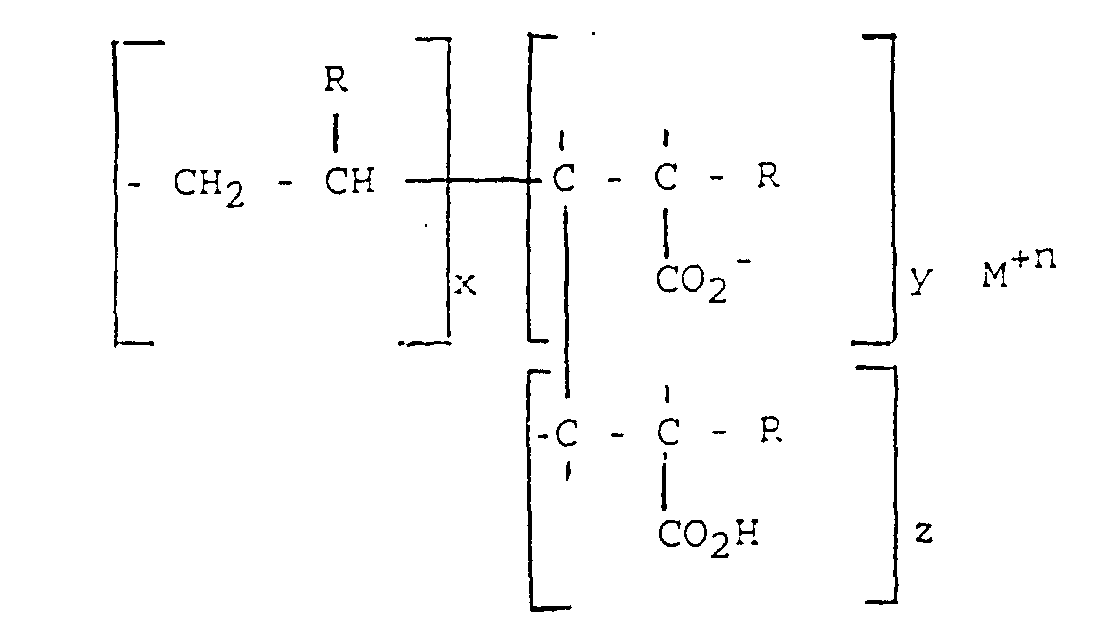
wobei jedes R unabhängig
H oder ein Alkylrest sein kann, M+ aus der Gruppe bestehend aus Alkali-, Erdalkali-, und Übergangsmetallkationen ausgewählt ist, und n, x, y und z ganze Zahlen sind.
7. Vliesmaterial gemäß Anspruch 6, das aus Fasern hergestellt ist, wobei der Kompatibilisator
ein Zink-Ionomer einer Poly(Ethylenmethacryl)säure ist.
8. Vliesmaterial gemäß Anspruch 1, das aus Fasern hergestellt ist, die thermisch bei
einer Temperatur zwischen ungefähr 93 und ungefähr 163°C gebunden worden sind.
9. Vliesmaterial gemäß Anspruch 1, das eine prozentuale Dehnung aufweist, die mindestens
50% größer ist als die eines Vliesmaterials, das aus Polypropylen-Fasern hergestellt
ist, die bei einer ähnlichen Temperatur gebunden worden sind.
10. Vliesmaterial gemäß Anspruch 1, das durch ein Verfahren, ausgewählt aus der Gruppe
bestehend aus Spinnbinden und Schmelzblasen, hergestellt ist.
11. Vliesmaterial gemäß Anspruch 3, das aus Fasern hergestellt ist, wobei die Polyamide
aus der Gruppe bestehend aus Polyamid 6, Polyamid 11, Polyamid 12 und Copolymeren,
Verschnitten und Gemischen derselben, ausgewählt sind.
12. Vliesmaterial gemäß Anspruch 3, das aus Fasern hergestellt ist, wobei das Polyolefin
aus der Gruppe bestehend aus Polyethylen, Polypropylen, Polybutylenen und Copolymeren,
Verschnitten und Gemischen derselben ausgewählt ist und in einer Menge zwischen ungefähr
50 bis 99,9 Gewichtsprozent vorliegt, wobei das Polyamid in einer Menge zwischen ungefähr
0,1 bis 30 Gewichtsprozent vorliegt, und wobei der Kompatibilisator in einer Menge
zwischen ungefähr 0,01 und 20 Gewichtsprozent vorliegt.
13. Vliesmaterial-Sterilisationshülle, umfassend eine Mehrzahl von Schichten, wobei mindestens
eine der Schichten das Vliesmaterial gemäß Anspruch 1 umfaßt.
14. Vliesmaterial gemäß Anspruch 1, das aus Fasern hergestellt ist, umfassend Polypropylen
als die dominante kontinuierliche Phase, die in einer Menge zwischen ungefähr 50 bis
99,9 Gewichtsprozent vorliegt, und wobei das oder die weiteren Polymere Polyamide
sind, die in einer Menge zwischen ungefähr 0,1 bis 30 Gewichtsprozent vorliegen, und
wobei der Kompatibilisator ein Zink-Ionomer aus Ethylenmethacrylsäure ist, die in
einer Menge zwischen ungefähr 0,01 und 20 Gewichtsprozent vorliegt.
15. Vliesmaterial gemäß Anspruch 1, das aus Fasern hergestellt ist, umfassend Polypropylen,
das in einer Menge von ungefähr 99 Gewichtsprozent vorliegt, Polyamid 12, das in einer
Menge von ungefähr 0,9 Gewichtsprozent vorliegt, und einen Kompatibilisator, der eine
Schmelzflußrate von ungefähr 120 g/10 min, eine Dichte von ungefähr 0,9 g/cm3 aufweist, und ungefähr 0,4 Gewichtsprozent von gepfropfter Maleinsäure/Anhydrid aufweist,
und in einer Menge von ungefähr 0,1 Gewichtsprozent vorliegt, und wobei die Fasern
bei einer Temperatur unter 140,6°C thermisch gebunden worden sind.
1. Etoffe non tissée comprenant des fibres composées d'au moins deux polymères thermoplastiques
et d'un agent de compatibilité, dans laquelle l'un desdits polymères thermoplastiques
a une température de fusion de polymère et forme une phase continue dominante, et
l'autre ou les autres polymères forment une ou des phases discontinues, caractérisée
en ce que le polymère de ladite ou desdites phases discontinues a une température
de fusion de polymère moins de 30°C inférieure à la température de fusion du polymère
de ladite phase continue.
2. Etoffe non tissée selon la revendication 1 qui est faite de fibres, dans lesquelles
toute section transversale d'un unique domaine polymère de ladite ou desdites phases
discontinues est égale à au moins 0,1 % de l'aire en section transversale de ladite
fibre.
3. Etoffe non tissée selon la revendication 1 qui est faite de fibres, dans lesquelles
ladite phase continue est au moins une polyoléfine et ladite phase discontinue est
au moins un polyamide.
4. Etoffe non tissée selon la revendication 1 qui est faite de fibres, dans lesquelles
la ou les phases discontinues sont distribuées sensiblement uniformément dans toute
ladite fibre.
5. Etoffe non tissée selon la revendication 1 qui est faite de fibres ayant des diamètres
d'approximativement 1 à 50 microns.
6. Etoffe non tissée selon la revendication 1 qui est faite de fibres, dans lesquelles
l'agent de compatibilité est choisi dans le groupe consistant en les polypropylènes
modifiés par l'anhydride maléique et ceux répondant à la formule :
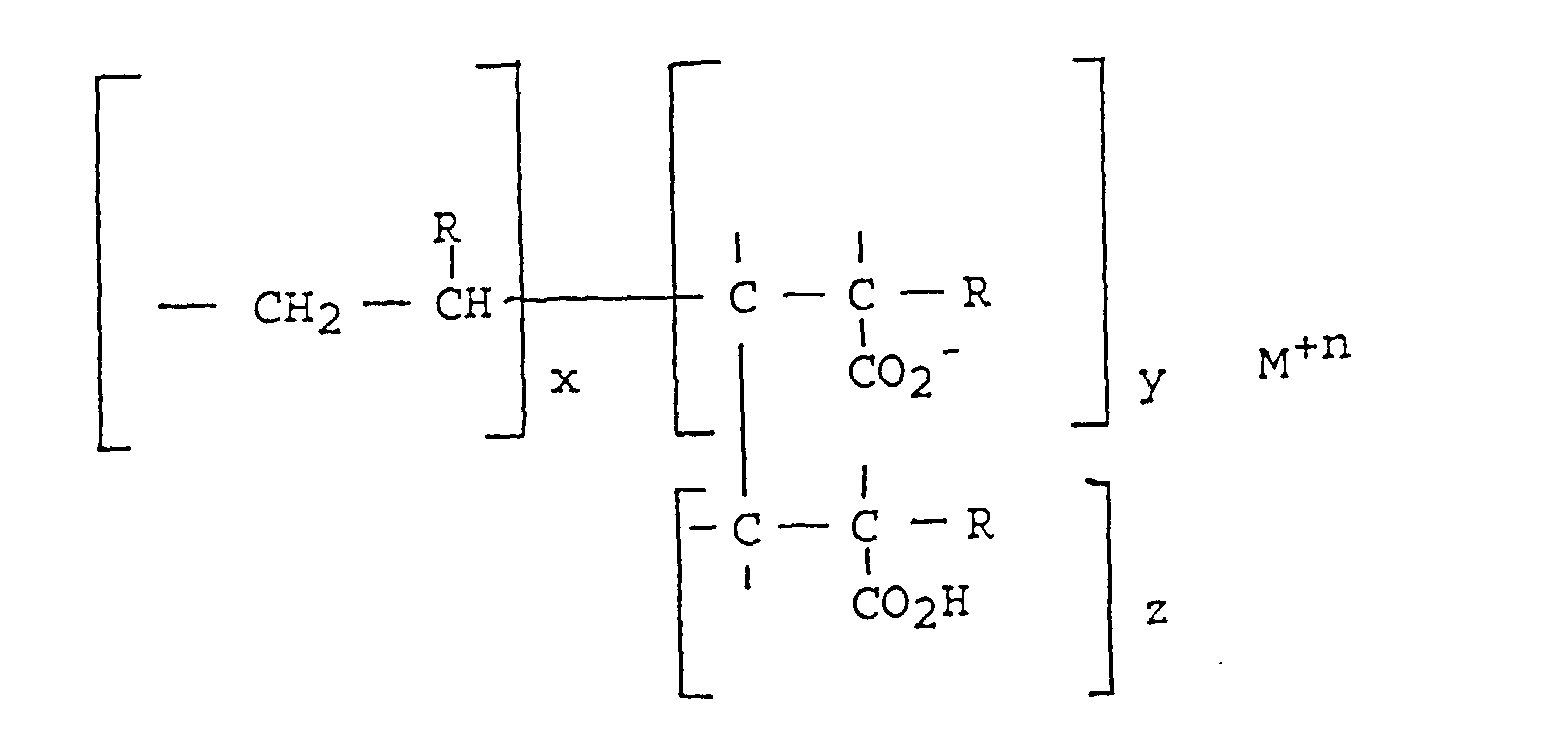
dans laquelle chaque radical R peut indépendamment représenter H ou un groupe alkyle, M+ est choisi dans le groupe comprenant les cations alcalins et alcalino-terreux et de métaux de transition, et n, x, y et z sont des nombres entiers.
dans laquelle chaque radical R peut indépendamment représenter H ou un groupe alkyle, M+ est choisi dans le groupe comprenant les cations alcalins et alcalino-terreux et de métaux de transition, et n, x, y et z sont des nombres entiers.
7. Etoffe non tissée selon la revendication 6 qui est faite de fibres, dans lesquelles
l'agent de compatibilité est un ionomère de zinc de l'acide poly(éthylène-acide méthacrylique).
8. Etoffe non tissée selon la revendication 1 qui est faite de fibres qui ont été liées
thermiquement à une température comprise entre environ 93 et environ 163°C.
9. Etoffe non tissée selon la revendication 1 qui a un allongement au moins 50 % supérieur
à celui d'une étoffe non tissée faite de fibres de polypropylène qui ont été liées
à une température similaire.
10. Etoffe non tissée selon la revendication 1 qui est faite par un procédé choisi entre
le filage-nappage et la fusion-soufflage.
11. Etoffe non tissée selon la revendication 3 qui est faite à partir de fibres, dans
lesquelles les polyamides sont choisis dans le groupe consistant en le polyamide 6,
le polyamide 11, le polyamide 12 et les copolymères et mélanges de ceux-ci.
12. Etoffe non tissée selon la revendication 3 qui est faite à partir de fibres, dans
lesquelles ladite polyoléfine est choisie dans le groupe consistant en le polyéthylène,
le polypropylène, les polybutylènes et les copolymères et mélanges de ceux-ci, et
qui est présente en une quantité comprise entre approximativement 50 et 99,9 % en
poids, ledit polyamide est présent en une quantité comprise entre approximativement
0,1 et 30 % en poids et ledit agent de compatibilité est présent en une quantité comprise
entre approximativement 0,01 et 20 % en poids.
13. Enveloppe de stérilisation en étoffe non tissée formée d'une pluralité de couches,
dans laquelle l'une au moins desdites couches est constituée de l'étoffe selon la
revendication 1
14. Etoffe non tissée selon la revendication 1 qui est faite à partir de fibres comprenant
du polypropylène comme phase continue dominante présente en une quantité comprise
entre approximativement 50 et 99,9 % en poids, et dans laquelle l'autre ou les autres
polymères sont des polyamides présents en une quantité comprise entre approximativement
0,1 et 30 % en poids, et dans laquelle ledit agent de compatibilité est un ionomère
de zinc de l'éthylène-acide méthacrylique présent en une quantité comprise entre approximativement
0,01 et 20 % en poids.
15. Etoffe non tissée selon la revendication 1 qui est faite à partir de fibres comprenant
du polypropylène présent une quantité d'approximativement 99 % en poids, de polyamide
12 présent en une quantité d'approximativement 0,9 % en poids et d'un agent de compatibilité
qui a un débit d'écoulement à l'état fondu d'environ 120 g/10 minutes, une masse spécifique
d'environ 0,9 g/cm3 et qui comporte environ 0,4 % en poids d'acide/anhydride maléique greffé et est présent
en une quantité d'approximativement 0,1 % en poids, et dans laquelle lesdites fibres
ont été liées thermiquement à une température inférieure à 140,6°C.