| (19) |
 |
|
(11) |
EP 0 746 708 B1 |
| (12) |
EUROPEAN PATENT SPECIFICATION |
| (45) |
Mention of the grant of the patent: |
|
30.12.1998 Bulletin 1998/53 |
| (22) |
Date of filing: 15.09.1993 |
|
| (51) |
International Patent Classification (IPC)6: F16K 5/10 |
| (86) |
International application number: |
|
PCT/US9308/637 |
| (87) |
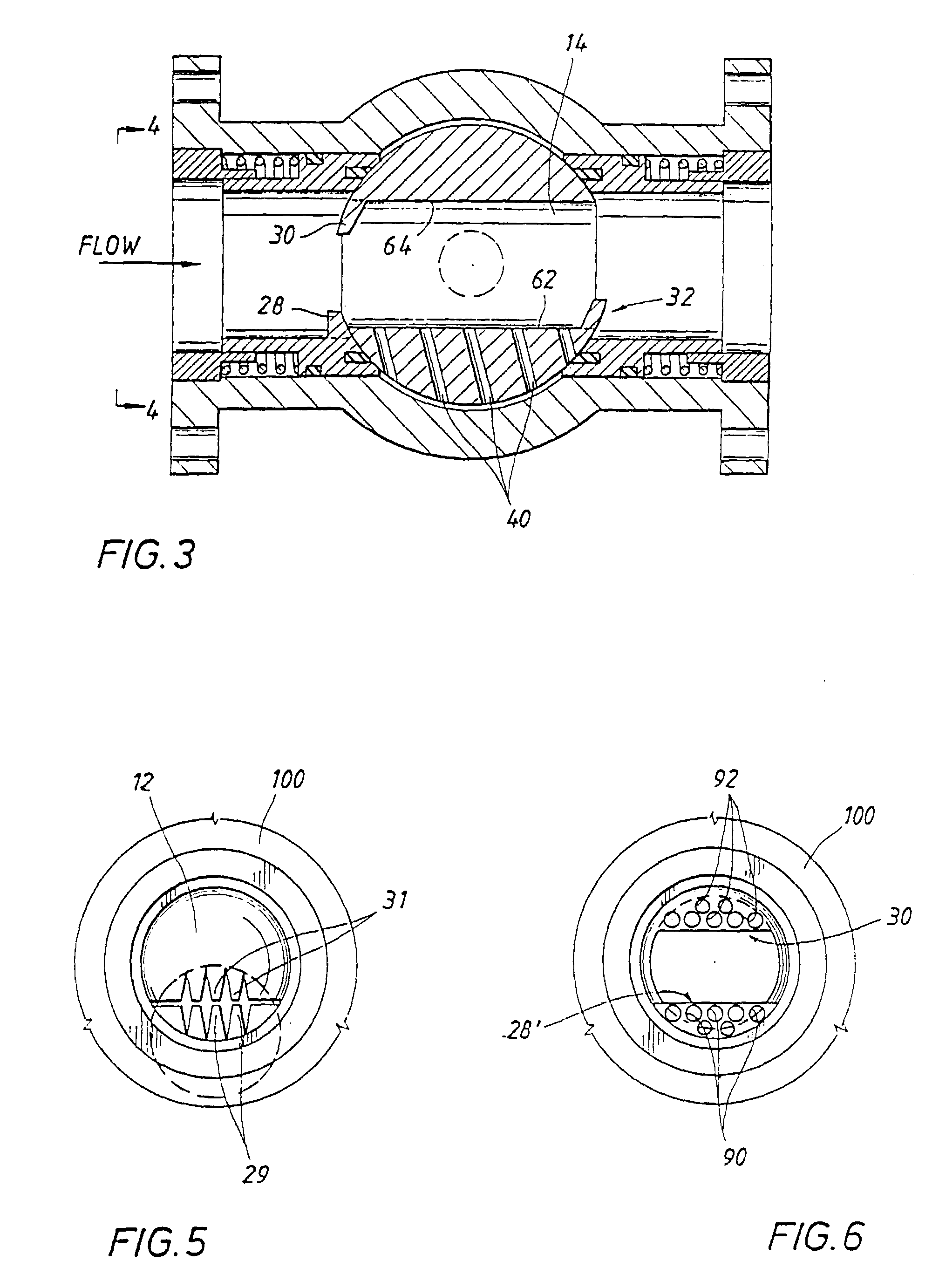
International publication number: |
|
WO 9407/063 (31.03.1994 Gazette 1994/08) |
|
| (54) |
LOW-NOISE ROTARY CONTROL VALVE
GERÄUSCHARMER REGELHAHN
CLAPET DE REGULATION A FAIBLE NIVEAU DE BRUIT
|
| (84) |
Designated Contracting States: |
|
BE DE ES FR GB IT NL |
| (30) |
Priority: |
22.09.1992 US 949459
|
| (43) |
Date of publication of application: |
|
11.12.1996 Bulletin 1996/50 |
| (73) |
Proprietor: LEINEN, Chris, M. |
|
Austin,
Texas 78746 (US) |
|
| (72) |
Inventor: |
|
- LEINEN, Chris, M.
Austin,
Texas 78746 (US)
|
| (74) |
Representative: Frankland, Nigel Howard |
|
FORRESTER & BOEHMERT
Franz-Joseph-Strasse 38
80801 München
80801 München (DE) |
| (56) |
References cited: :
US-A- 223 573
US-A- 4 774 984
|
US-A- 3 880 191
US-A- 5 070 909
|
|
| |
|
|
|
|
| |
|
| Note: Within nine months from the publication of the mention of the grant of the European
patent, any person may give notice to the European Patent Office of opposition to
the European patent
granted. Notice of opposition shall be filed in a written reasoned statement. It shall
not be deemed to
have been filed until the opposition fee has been paid. (Art. 99(1) European Patent
Convention).
|
[0001] THIS INVENTION relates generally to rotary control valves such as ball valves or cylindrical plug
valves. More particularly, the invention relates to such valves which are modified
to reduce noise and vibration produced during partial closure of such valves.
[0002] The voluminous prior art of rotary control valves has searched for solutions to the
problem of noise generation during throttling operation of such valves. US-A-5,070,909
tries to solve the problem by placing parallel conduits in entry and exit flow passages
of the valve body and also placing similar conduits in the flow path of the ball valve
in the valve body. Additionally, transverse holes between channels are provided in
the ball valve.
[0003] US-A-4,774,984 discloses a cylindrical plug valve with the plug having a flow passage
through it dividing the plug into two halves. One half serves to close the flow passage
of the valve when it is in a fully closed position. The other half has channels provided
in it, such that when the valve is in a throttling position, fluid is partially directed
through the channels in the plug element. Such channels are provided in the plug in
an effort to decrease flashing and cavitation of the fluid through the valve so as
to reduce noise.
[0004] US-A-4,530,375 discloses an attenuating rotating valve in which the rotating closure
member or valve element may be rotated from a fully closed position to a throttling
position to a fully open position.
[0005] US-A-4,364,415 discloses still another throttling ball valve in which the interior
of the flow passage of the ball valve element includes longitudinal baffles which
require fluid passing through the valve when it is in a throttling position to traverse
a tortious back and forth longitudinal path to the valve exit passage.
[0006] All of the valves identified in the above description of prior art are characterised
by high cost in fabricating attenuation devices within the valve.
[0007] US-A-223,573, which forms a basis for the preamble of claim 1 and claim 3 discloses
a valve assembly including a valve body which defines respective entry and exit flow
passages which together define a longitudinal axis. A valve member, having a passage
which extends through the valve member, is rotatably mounted in the valve body for
rotation about a predetermined axis between an open position and a closed position.
A diverter is provided in the entry flow passage of the valve body at a position adjacent
the valve member to divert flow entering the valve member. A co-operating diverter
is mounted on an edge of the valve member which faces the entry flow passage. The
two diverters co-operate increasingly to restrict the flow through the valve as the
valve is moved towards the closed position.
[0008] A primary object of this invention is to provide an improved rotary control valve
that is characterised by simplicity and low cost, yet is effective in reducing noise
during throttling operation of the valve.
[0009] According to one aspect of this invention there is provided a valve assembly including
a valve body having entry and exit flow passage formed therethrough, said entry and
exit flow passages defining a longitudinal axis; a valve member having a passage extending
therethrough, said passage dividing said valve member into an upper portion and a
lower portion, means for mounting said valve member in said valve body for rotation
about a lateral axis with respect to said valve body between a completely open position
and a completely closed position; sealing means providing in said valve body flow
passage for operatively engaging said valve member for preventing fluid flow through
said flow passage of said valve member once said valve member is in said closed position;
an entry flow passage diverter disposed in said entry flow passage of said valve body
at a position adjacent said valve member extending upwardly from said valve body into
said entry flow passage; an entry valve member diverter disposed on an edge of said
valve member, which faces said entry flow passage, said entry valve member diverter
extending downwardly from an upper portion of said passage through said valve member
when said valve member is in a fully open position with respect to said valve body;
said flow passage diverter and entry valve member diverter being co-operatively arranged
and sized in relation to said valve member passage through said valve member to present
limited impedance to fluid flow from said entry flow passage of said valve body when
said valve member is rotated to a completely open position with respect to said valve
body, wherein said flow passage diverter and said entry valve member diverter co-operate
to increasingly restrict flow from said entry flow passage to said valve member passage
as said valve member is increasingly rotated from said open position toward said closed
position wherein said flow passage diverter includes a plurality of teeth extending
upwardly from said flow passage of said valve body, and wherein said entry valve member
diverter includes a plurality of teeth extending downwardly from said upper portion
of said valve member.
[0010] Preferably wherein said teeth of said entry flow passage diverter are aligned vertically
with said teeth of said valve member diverter, but said teeth are separated by a small
longitudinal distance along said valve body such that said teeth of said entry valve
member diverter rotate past said teeth of said entry flow passage.
[0011] According to another aspect of this invention there is provided a valve assembly
including a valve body having entry and exit flow passage formed therethrough, said
entry and exit flow passages defining a longitudinal axis; a valve member having a
passage extending therethrough, said passage dividing said valve member into an upper
portion and a lower portion, means for mounting said valve member in said valve body
for rotation about a lateral axis with respect to said valve body between a completely
open position and a completely closed position; sealing means providing in said valve
body flow passage for operatively engaging said valve member for preventing fluid
flow through said flow passage of said valve member once said valve member is in said
closed position; an entry flow passage diverter disposed in said entry flow passage
of said valve body at a position adjacent said valve member extending upwardly from
said valve body into said entry flow passage; an entry valve member diverter disposed
on an edge of said valve member, which faces said entry flow passage, said entry valve
member diverter extending downwardly from an upper portion of said passage through
said valve member when said valve member is in a fully open position with respect
to said valve body; said flow passage diverter and entry valve member diverter being
co-operatively arranged and sized in relation to said valve member passage through
said valve member to present limited impedance to fluid flow from said entry flow
passage of said valve body when said valve member is rotated to a completely open
position with respect to said valve body, wherein said flow passage diverter and said
entry valve member diverter co-operate to increasingly restrict flow from said entry
flow passage to said valve member passage as said valve member is increasingly rotated
from said open position toward said closed position wherein said flow passage diverter
includes a plurality of passages which are substantially parallel with said valve
body longitudinal axis, and said entry valve member diverter includes a plurality
of passages which are substantially parallel with said valve member longitudinal axis.
[0012] Preferably the valve assembly further comprises an exit valve member diverter disposed
on an edge of said valve member which faces said exit flow passage, said exit valve
member diverter extending upwardly into said exit flow passage.
[0013] Advantageously the valve further comprises a plurality of transverse passages through
said lower portion of said valve member, whereby a portion of fluid within said valve
member passage may be channelled through said lower portion in alternative paths to
said exit flow passage from said valve member passage.
[0014] The objects, advantages and features of the invention will become more apparent by
reference to the drawings which are appended hereto and wherein like numerals indicate
like parts and wherein an illustrative embodiment of the invention is shown, by way
of example, of which:
FIGURE 1 presents a side view of the ball valve with the valve body shown in section
in the longitudinal direction of the flow passage,
FIGURE 2 is a section through the valve of Figure 1 at the middle of the flow passage
as viewed in the direction of the valve actuating stern, where the valve is in a throttling
or partially closed position,
FIGURE 3 is a section through the valve similar to that of Figure 2 but showing the
valve in a fully open position,
FIGURE 4 is a view looking into the valve along lines 4-4 of Figure 3 which illustrates
a preferred embodiment of the impediments or flow diverters at the entry into the
flow passage of the ball element of the valve,
FIGURE 5 is a view looking into the valve along lines 5-5 of Figure 2 which illustrates
the relative positions of the flow diverters with the ball element of the valve partially
closed, and
FIGURE 6 is a view similar to that of Figure 4 but shows an alternative construction
of the impediments or flow diverters.
[0015] Figure 1 of the drawings shows the reduced noise throttling valve of the invention.
A side view of a ball (closure member) 12 shows that it is installed in a side port
or a side entry 11 of valve body 10.
[0016] Such ball valve 12 is installed within valve body 10 where the entry sleeve 70, entry
spring 72 and entry plug 74 and exit sleeve 70', exit spring 72' and exit plug 74'
are removed from valve body 10. Ball valve 12 includes an actuating stern 22 comprising
an outer portion 22' and an inner portion 22'. The valve body 10 includes a recess
17 into which a sleeve 19 is fixed. On insertion of the ball valve 12 and actuating
stem 22 into side entry 11, the inner portion of the actuating stem 22" is inserted
into sleeve 19.
[0017] On the other side of the ball valve 12, a side entry plug 21 is provided which is
fastened to valve body 10 for example by bolts 23 into threaded holes of the valve
body 10. A gland packing 18 and gland 20 enable the outer portion 22' of actuating
stem 22 to turn with respect to side entry plug 21 yet prevent pressurized fluid from
escaping to the exterior of the valve. The inner portion 22" of actuating stem 22
rotates within sleeve 19. "O" ring 25 seals the side entry plug 21 with respect to
valve body 10.
[0018] After the ball valve has been installed via side entry 11, entry retaining pin 78
and exit retaining pin 78' are installed in valve body 10. Next, entry sleeve 70 is
inserted via entry port 73 until it is stopped by entry retaining pin 78. Exit sleeve
70' is inserted via exit port 73' until it is stopped by exit retaining pin 78'.
[0019] Spring 72 is placed between a shoulder of entry sleeve 70 and an entry plug 74 which
may be fastened within entry port 73 by threading or the like. Likewise, spring 72'
is placed between a shoulder of exit sleeve 70' and exit plug 74' by threading or
the like. Springs 72 and 72' force sleeves 70 and 70' into proper position adjacent
the exterior of ball valve 12. "O" ring seals 26 on the entry side and 26' on the
exit side are placed in recesses 24 and 24'. Such "O" rings seal the ball valve 12
to the entry and exit sleeves so as to prevent fluid pressure from escaping from entry
flow passage 15 to exit flow passage 16. "O" ring seals 76 and 76' seal the entry
sleeve 70 and the exit sleeve 70' from the space between the ball valve 12 and the
valve body 10.
[0020] As mentioned above, an entry flow passage is defined within the interior of entry
plug 74 and entry sleeve 70. An exit flow passage is defined within the interior of
exit plug 74' and exit sleeve 70'. Ball valve 12 includes a bore or passage 14 through
which it may be axially aligned with the longitudinal axis 85 of the valve (See Figure
2).
[0021] Figure 2 best illustrates the impediments or flow diverters 28, 30 and 32 of the
throttling valve of this invention. Flow diverter 28 rises upwardly from entry sleeve
70 or from valve body 10 into entry flow passage 15. Such diverter 28 includes teeth
29 as illustrated in Figure 4 or may alternatively include longitudinal passages 90
as illustrated in Figure 6. Extending downwardly from the leading or forward edge
of the upper portion 50 of ball element 12 is another flow diverter or impediment
30. Preferably such diverter 30 includes teeth as illustrated in Figures 4 and 5,
but alternatively, as illustrated in Figure 6, passages or holes 92 may be provided.
[0022] The illustrated condition of the throttling valve of Figure 2 is one of partial closure.
In such condition the longitudinal axis 86 of the flow passage 14 of ball 12 forms
an angle with the longitudinal axis 85 of inlet 15 and outlet 16 flow passages and
valve body 10. Pressurized fluid passes by and through flow diverters 28 and 30 on
its way to exit flow passage 16. Such impediments inhibit vortex formation and break
flow into smaller streams within ball flow passage 14 thereby reducing vibration and
noise as well as reducing cavitation. Diverter 32 extends upwardly from lower portion
52 of ball 12 into outlet passage 16 so as to inhibit vortex formation downstream
of outlet passage 16 and thereby reduce cavitation and noise generation at the outlet
of the valve.
[0023] As an additional means for vortex prevention within flow passage 14 of ball 12, a
plurality of transverse passages 40 are provided in lower portion 52 of ball valve
element 12. With increasing rotation of ball valve element 12, more passages 40 are
open to outlet passage 16 thereby providing alternative paths for pressurized fluid
within passage 14 to reach the outlet 16. Such alternative paths further inhibit vortex
creation in passage 14 and serve to reduce valve noise when a compressible fluid,
such as gas, is being throttled through the valve.
[0024] Figure 3 illustrates the valve of the invention in a fully open condition. The flow
diverters 30, 28 and 32 restrict flow only a small amount in such fully open condition.
Figure 4 illustrates the opening into the passage 14 via inlet passage 15. Teeth 29
and 31 are spread a substantial distance apart, such that the teeth provide only small
impedance to flow when the valve is in the fully open position. Preferably, the teeth
31 of flow diverter 30 are aligned with the teeth 29 of flow diverter 28. Flow diverter
28 is fixed and separated a small longitudinal distance from diverter 30. As a result,
as the valve member 12 is rotated to a throttling condition as illustrated in Figures
2 and 5, the teeth 31 of diverter 30 close toward the teeth 29 of diverter 28. The
teeth of diverter 30 rotate past the teeth of diverter 28 until at closure, the outer
surface of top portion of valve member 12 closes the flow passage 15.
[0025] The diverter 32 of the lower portion 52 of ball 12 which extend upwardly into the
outlet flow passage preferably includes upwardly facing teeth similar to teeth 29
of inlet diverter 28.
[0026] As mentioned above, Figure 6 illustrates an alternative embodiment of a diverter
28' having holes or passages 90 through it with a closure member diverter 30' having
holes 92 through it.
[0027] Although it is preferred that valve member 12 be a ball, plug valve elements could
be provided with proper rearrangement of valve body 10, and other valve parts. Such
plug valve element could be of cylindrical shape.
[0028] While several embodiments of the present invention have been illustrated in detail,
it is apparent that modifications and adaptations of the embodiments shown will occur
to those skilled in the art. For example, although a side entry is provided for the
ball 12 within valve body 10, other valve structures may be substituted for the side
entry design. Such other structures are well known in the ball valve design art. However,
it is to be expressly understood that such modifications and adaptations are within
the scope of the present invention as set forth in the following claims.
1. A valve assembly including a valve body(10) having entry and exit flow passage(15,16)
formed therethrough, said entry and exit flow passages defining a longitudinal axis;
a valve member(12) having a passage(14) extending therethrough, said passage dividing
said valve member into an upper portion(50) and a lower portion(52), means for mounting
said valve member in said valve body for rotation about a lateral axis with respect
to said valve body between a completely open position and a completely closed position;
sealing means(26) providing in said valve body flow passage for operatively engaging
said valve member for preventing fluid flow through said flow passage(16) of said
valve member(12) once said valve member is in said closed position; an entry flow
passage diverter(28) disposed in said entry flow passage(15) of said valve body(10)
at a position adjacent said valve member extending upwardly from said valve body into
said entry flow passage; an entry valve member diverter(30) disposed on an edge of
said valve member(12), which faces said entry flow passage(15), said entry valve member
diverter(30) extending downwardly from an upper portion(64) of said passage(14) through
said valve member(12) when said valve member is in a fully open position with respect
to said valve body; said flow passage diverter(28) and entry valve member diverter(30)
being co-operatively arranged and sized in relation to said valve member passage(14)
through said valve member(12) to present limited impedance to fluid flow from said
entry flow passage(15) of said valve body when said valve member is rotated to a completely
open position with respect to said valve body, wherein said flow passage diverter(28)
and said entry valve member diverter(30) co-operate to increasingly restrict flow
from said entry flow passage(15) to said valve member passage(14) as said valve member
is increasingly rotated from said open position toward said closed position characterised
in that said flow passage diverter(28) includes a plurality of teeth(29) extending
upwardly from said flow passage(15) of said valve body, and wherein said entry valve
member diverter(30) includes a plurality of teeth(31) extending downwardly from said
upper portion(50) of said valve member.
2. The valve assembly of Claim 1, wherein said teeth(29) of said entry flow passage diverter(28)
are aligned vertically with said teeth(31) of said valve member diverter(30), but
said teeth(29,30) are separated by a small longitudinal distance along said valve
body(10) such that said teeth(30) of said entry valve member diverter rotate past
said teeth(29) of said entry flow passage(15).
3. A valve assembly including a valve body(10) having entry and exit flow passage(15,16)
formed therethrough, said entry and exit flow passages defining a longitudinal axis;
a valve member(12) having a passage(14) extending therethrough, said passage dividing
said valve member into an upper portion(50) and a lower portion(52), means for mounting
said valve member in said valve body for rotation about a lateral axis with respect
to said valve body between a completely open position and a completely closed position;
sealing means(26) providing in said valve body flow passage for operatively engaging
said valve member for preventing fluid flow through said flow passage(16) of said
valve member(12) once said valve member is in said closed position; an entry flow
passage diverter(28) disposed in said entry flow passage(15) of said valve body(10)
at a position adjacent said valve member extending upwardly from said valve body into
said entry flow passage; an entry valve member diverter(30) disposed on an edge of
said valve member(12), which faces said entry flow passage(15), said entry valve member
diverter(30) extending downwardly from an upper portion(64) of said passage(14) through
said valve member(12) when said valve member is in a fully open position with respect
to said valve body; said flow passage diverter(28) and entry valve member diverter(30)
being co-operatively arranged and sized in relation to said valve member passage(14)
through said valve member(12) to present limited impedance to fluid flow from said
entry flow passage(15) of said valve body when said valve member is rotated to a completely
open position with respect to said valve body, wherein said flow passage diverter(28)
and said entry valve member diverter(30) co-operate to increasingly restrict flow
from said entry flow passage(15) to said valve member passage(14) as said valve member
is increasingly rotated from said open position toward said closed position characterised
in that said flow passage diverter(28) includes a plurality of passages(90) which
are substantially parallel with said valve body longitudinal axis(85), and said entry
valve member diverter(30) includes a plurality of passages(92) which are substantially
parallel with the longitudinal axis(86) of said valve member passage (14).
4. The valve assembly of any one of the preceding Claims further comprising an exit valve
member diverter(32) disposed on an edge of said valve member(12) which faces said
exit flow passage(16), said exit valve member diverter(32) extending upwardly into
said exit flow passage(16).
5. The valve assembly of any one of the preceding Claims further comprising a plurality
of transverse passages(40) through said lower portion(52) of said valve member(12),
whereby a portion of fluid within said valve member passage(14) may be channelled
through said lower portion(52) in alternative paths to said exit flow passage(16)
from said valve member passage(14).
1. Ventilanordnung, mit einem Ventilkörper (10), in dem ein Eingangs- und Auslaßströmungsdurchlaß
(15, 16) ausgebildet ist, wobei die Einlaß- und Auslaßströmungsdurchlässe eine Längsachse
festlegen; einem Ventilteil (12) mit einem sich dadurch erstreckenden Durchlaß (14),
welcher das Ventilteil in einen oberen (50) und einen unteren Abschnitt (52) unterteilt,
Mitteln zum Halten des Ventilteils in dem Ventilkörper zur Drehung um eine Querachse
bezüglich des Ventilkörpers zwischen einer vollständig offenen Position und einer
vollständig geschlossenen Position; einer Dichtungseinrichtung (26), die in dem Ventilkörper-Strömungsdurchlaß
angeordnet ist, um das Ventilteil zum Verhindern einer Fluidströmung durch den Strömungsdurchlaß
(16) des Ventilteils (12) wirksam zu erfassen, wenn sich das Ventilteil in der geschlossenen
Stellung befindet; einem Eingangsströmungsdurchlaß-Abweiser (28), der in dem Eingangsströmungsdurchlaß
(15) des Ventilkörpers (10) an einer Position benachbart zu dem Ventilteil angeordnet
ist und sich von dem Ventilkörper nach oben in den Eingangsströmungsdurchlaß erstreckt;
einem Eingangsventilteil-Abweiser (30), der auf einer Kante des Ventilteils (12) angeordnet
ist und zum Eingangsströmungsdurchlaß weist (15), wobei der Eingangsventilteil-Abweiser
(30) von einem oberen Abschnitt (64) des Durchlasses (14) durch das Ventilteil (12)
nach unten verläuft, wenn sich das Ventilteil in einer vollständig offenen Position
bezüglich des Ventilkörpers befindet; wobei der Strömungsdurchgangs-Abweiser (28)
und der Eingangsventilteil-Abweiser (30) zusammenwirkend angeordnet und in Bezug auf
den Ventilteildurchlaß (14) durch das Ventilteil (12) bemessen sind, um einen begrenzten
Widerstand gegenüber einer Fluidströmung von dem Eingangsströmungsdurchlaß (15) des
Ventilkörpers zu bieten, wenn das Ventilteil bezüglich des Ventilkörpers in eine vollständig
offene Stellung gedreht wird, wobei der Strömungsdurchlaß-Abweiser (28) und der Eingangsventilteil-Abweiser
(30) zusammenwirken, um eine Strömung von dem Eingangsströmungsdurchlaß (15) zu dem
Ventilteildurchlaß (14) zunehmend zu beschränken, wenn das Ventilteil zunehmend aus
der offenen Stellung in die geschlossene Stellung gedreht wird, dadurch gekennzeichnet,
daß der Strömungsdurchlaß-Abweiser (28) eine Anzahl von Zähnen (29) beinhaltet, die
sich von dem Strömungsdurchlaß (15) des Ventilkörpers nach oben erstrecken, wobei
der Eingangsventilteil-Abweiser (30) eine Anzahl von Zähnen (31) enthält, die sich
von dem oberen Abschnitt (50) des Ventilteils nach Unten erstrecken.
2. Ventilanordnung nach Anspruch 1, dadurch gekennzeichnet, daß die genannten Zähne (29)
des Eingangsströmungsdurchlaß-Abweisers (28) vertikal mit den Zähnen (31) des Ventilteil-Abweisers
(30) ausgerichtet sind, aber die Zähne durch einen kleinen Längsabstand entlang des
Ventilkörpers (10) getrennt sind, so daß sich die Zähne (30) des Eingangsventilteil-Abweisers
an den Zähnen des (29) Eingangsströmungsdurchlasses (15) vorbeidrehen.
3. Ventilanordnung mit einem Ventilkörper (10), in dem ein Eingangs- und Auslaßströmungsdurchlaß
(15, 16) ausgebildet ist, wobei die Einlaß- und Auslaßströmungsdurchlässe eine Längsachse
festlegen; einem Ventilteil (12) mit einem sich dadurch erstreckenden Durchlaß (14),
welcher das Ventilteil in einen oberen (50) und einen unteren Abschnitt (52) unterteilt,
Mitteln zum Halten des Ventilteils in dem Ventilkörper zur Drehung um eine Querachse
bezüglich des Ventilkörpers zwischen einer vollständig offenen Position und einer
vollständig geschlossenen Position; einer Dichtungseinrichtung (26), die in dem Ventilkörper-Strömungsdurchlaß
angeordnet ist, um das Ventilteil zum Verbindern einer Fluidströmung durch den Strömungsdurchlaß
(16) des Ventilteils (12) wirksam zu erfassen, wenn sich das Ventilteil in der geschlossenen
Stellung befindet; einem Eingangsströmungsdurchlaß-Abweiser (28), der in dem Eingangsströmungsdurchlaß
(15) des Ventilkörpers (10) an einer Position benachbart zu dem Ventilteil angeordnet
ist und sich von dem Ventilkörper nach oben in den Eingangsströmungsdurchlaß erstreckt;
einem Eingangsventilteil-Abweiser (30), der auf einer Kante des Ventilteils (12) angeordnet
ist und zum Eingangsströmungsdurchlaß (15) weist, wobei der Eingangsventilteil-Abweiser
(30) von einem oberen Abschnitt (64) des Durchlasses (14) durch das Ventilteil (12)
nach unten verläuft, wenn sich das Ventilteil in einer vollständig offenen Position
bezüglich des Ventilkörpers befindet; wobei der Strömungsdurchgangs-Abweiser (28)
und der Eingangsventilteil-Abweiser (30) zusammenwirkend angeordnet und in Bezug auf
den Ventilteildurchlaß (14) durch das Ventilteil (12) bemessen sind, um einen begrenzten
Widerstand gegenüber einer Fluidströmung von dem Eingangsströmungsdurchlaß (15) des
Ventilkörpers zu bieten, wenn das Ventilteil bezüglich des Ventilkörpers in eine vollständig
offene Stellung gedreht wird, wobei der Strömungsdurchlaß-Abweiser (28) und der Eingangsventilteil-Abweiser
(30) zusammenwirken, um eine Strömung von dem Eingangsströmungsdurchlaß (15) zu dem
Ventilteildurchlaß (14) zunehmend zu beschränken, wenn das Ventilteil zunehmend aus
der offenen Stellung in die geschlossene Stellung gedreht wird, dadurch gekennzeichnet,
daß der Strömungsdurchlaß-Abweiser (28) eine Anzahl von Durchlässen (90) beinhaltet,
die im wesentlichen parallel zur Ventilkörper-Längsachse (85) sind, wobei der Eingangsventilteil-Abweiser
(30) eine Anzahl von Durchlässen (92) aufweist, die im wesentlichen parallel zur Längsachse
(86) des Ventilteildurchlasses (14) sind.
4. Ventilanordnung nach einem der vorangehenden Ansprüche, gekennzeichnet durch einen
Ausgangsventilteil-Abweiser (32), der auf einer Kante des Ventilteils (12) angeordnet
ist, die zum Ausgangsströmungsdurchlaß (16) weist, wobei sich der Ausgangsventilteil-Abweiser
(32) nach oben in den Aüsgangsströmungsdurchlaß (16) erstreckt.
5. Ventilanordnung nach einem der vorangehenden Ansprüche, gekennzeichnet durch eine
Anzahl von Querdurchlässen (40) durch den unteren Abschnitt (52) des Ventilteils (12),
wodurch ein Teil des Fluids innerhalb des Ventilteildurchlasses (14) in abwechselnden
Wegen durch den unteren Abschnitt (52) von dem Ventilteildurchlaß (14) zu dem Ausgangsströmungsdurchlaß
(16) geleitet werden kann.
1. Assemblage de clapet Incluant un corps de clapet (10) comportant des passages d'écoulemant
d'entrée et de sortie (15, 16) formés au travers de celui-ci, lesdits passages d'écoulement
d'entrée et de sortie définissant un axe longitudinal ; un élément de clapet (12)
comportant un passage (14) s'étendant au travers de celui-ci, ledit passage divisant
ledit élément de clapet en une partie supérieure (50) et une partie inférieure (52),
un moyen de montage dudit élément de clapet dans ledit corps de clapet pour qu'il
puisse tourner autour d'un axe latéral par rapport audit corps de clapet entre une
position complètement ouverte et une position complètement fermée ; un moyen d'étanchéité
(26), prévu dans ledit passage d'écoulement du corps de clapet, pour engager en fonctionnement
ledit élément de clapet afin d'empêcher l'écoulememt de fluide au travers dudit passage
(16) dudit élément de clapet (12), une fois que ledit élément de clapet est dans ladite
position fermée ; un déflecteur (28) du passage d'écoulement d'entrée, placé dans
ledit passage d'entrée (15) dudit corps de clapet (10) dans une position adjacente
audit élément de clapet, s'étendant vers le haut depuis ledit corps de clapet dans
ledit passage d'entrée ; un déflecteur d'entrée (30) de l'élément de clapet, placé
sur un bord dudit élément de clapet (12), qui fait face audit passage d'entrée (15),
ledit déflecteur d'entrée (30) de l'élément de clapet s'étendant vers le bas depuis
une partie supérieure (64) dudit passage (14) au travers dudit élément de clapet (12)
lorsque ledit élément de clapet est dans une position complètement ouverte par rapport
audit corps de clapet ; ledit déflecteur (28) du passage d'écoulement et ledit déflecteur
d'entrée (30) de l'élément de clapet étant placés et dimensionnés pour fonctionner
ensemble, en relation avec ledit passage (14) de l'élément de clapet, au travers dudit
élément de clapet (12), pour présenter une impédance limitée à l'écoulement de fluide
depuis ledit passage (16) dudit corps de clapet lorsque ledit élément de clapet est
tourné dans une position complètement ouverte par rapport audit corps de clapet, dans
lequel ledit déflecteur (28) du passage d'écoulement et ledit déflecteur d'entrée
(30) de l'élément de clapet coopèrent pour diminuer de plus en plus l'écoulement depuis
ledit passage d'entrée (15) vers ledit passage (14) de l'élément de clapet au fur
et à mesure que ledit élément de clapet est de plus en plus tourné depuis ladite position
ouverte vers ladite position fermée, caractérisé en ce que ledit déflecteur (28) du
passage d'écoulement inclut une pluralité de dents (29) se prolongeant vers le haut
depuls ledit passage d'écoulement (15) dudit corps de clapet, et dans lequel ledit
déflecteur d'entrée (30) de l'élément clapet inclut une pluralité de dents (31) se
prolongeant vers le depuis ladite partie supérieure (50) dudit élément de clapet.
2. Assemblage de clapet selon la revendication 1, dans lequel lesdites dents (29) dudit
déflecteur (28) du passage d'écoulement d'entrée sont alignées verticalement avec
lesdites dents (31) dudit déflecteur (30) de l'élément de clapet, mais lesdites dents
(28, 31) sont séparées par une petite distance longitudinale le long dudit corps de
clapet (10) de sorte que lesdites dents (30) dudit déflecteur d'entrée de l'élément
de clapet tournent plus loin que lesdites dents (29) dudit passage d'écoulement d'entrée
(15).
3. Assemblage de clapet incluant un corps de clapet (10) comportant des passages d'écoulement
d'entrée et de sortie (15, 16) formés au travers de celui-ci, lesdits passages d'écoulement
d'entrée et de sortie définissant un axe longitudinal ; un élément de clapet (12)
comportant un passage (14) s'étendant au travers de celui-ci, ledit passage divisant
ledit élément de clapet en une partie supérieure (50) et une partie inférieure (52),
un moyen de montage dudit élément de clapet dans ledit corps de clapet pour qu'il
puisse tourner autour d'un axe latéral par rapport audit corps de clapet entre une
position complètement ouverte et une position complètement fermée ; un moyen d'étanchéité
(26), prévu dans ledit passage d'écoulement du corps de clapet, pour engager en fonctionnement
ledit élément de clapet afin d'empêcher l'écoulement de fluide au travers dudit passage
(16) dudit élément de clapet (12), une fois que ledit élément de clapet est dans ladite
position fermée ; un déflecteur (28) du passage d'écoulement d'entrée, placé dans
ledit passage d'entrée (15) dudit corps de clapet (10) dans une position adjacente
audit élément de clapet, s'étendant vers le haut depuis ledit corps de clapet dans
ledit passage d'entrée ; un déflecteur d'entrée (30) de l'élément de clapet, placé
sur un bord dudit élément de clapet (12), qui fait face audit passage d'entrée (15),
ledit déflecteur d'entrée (30) de l'élément de clapet vers le bas depuis une partie
supérieure (64) dudit passage (14) au travers dudit élément de clapet (12) lorsque
ledit élément de clapet est dans une position complètement ouverte par rapport audit
corps de clapet ; ledit déflecteur (28) du passage d'écoulement et ledit déflecteur
d'entrée (30) de l'élément de clapet étant placés et dimensionnés pour fonctionner
ensemble, en relation avec ledit passage (14) de l'élément de clapet, au travers dudit
élément de clapet (12), pour présenter une impédance limitée à l'écoulement de fluide
depuis ledit passage d'entrée (15) dudit corps de clapet lorsque ledit élément de
clapet est tourné dans une position complètement ouverte par rapport audit corps de
clapet, dans lequel ledit déflecteur (28) du passage d'écoulement et ledit déflecteur
d'entrée (30) de l'élément de clapet coopèrent pour diminuer de plus en plus l'écoulement
depuis ledit passage d'entrée (15) vers ledit passage (14) de l'élément de clapet
au fur et à mesure que ledit élément de clapet est de plus en plus tourné depuis ladite
position ouverte vers ladite position fermée, caractérisé en ce que ledit déflecteur
(28) du passage d'écoulement inclut une pluralité de passages (90) sensiblement parallèles
à l'axe longitudinal (86) dudit corps de clapet, et ledit déflecteur d'entrée (30)
de l'élément de clapet inclut une pluralité de passages (92) sensiblement parallèles
à l'axe longitudinal (86) dudit passage (14) de l'élément de clapet.
4. Assemblage de clapet selon l'une quelconque des revendications précédentes, comprenant
de plus un déflecteur de sortie (32) de l'élément de clapet, placé sur un bord dudit
élément de clapet (12), qui fait face audit passage de sortie (16), ledit déflecteur
de sortie (32) de l'élément de clapet s'étendant vers le haut dans ledit passage de
sortie (16).
5. Assemblage de clapet selon l'une quelconque des revendications précédentes, comprenant
de plus une pluralité de passages transversaux (40) au travers de ladite partie inférieure
(52) dudit élément de clapet (12), dans lequel une partie du fluide à l'intérieur
dudit passage (14) de l'élément de clapet peut être canalisée au travers de ladite
partie inférieure (52) par d'autres chemins vers ledit passage d'écoulement de sortie
(16) depuis ledit passage (14) de l'élément de clapet.