|
(11) | EP 0 748 803 B1 |

| (12) | EUROPEAN PATENT SPECIFICATION |
|
|
| (54) |
PROCESS FOR PRODUCING CARBOXYLIC ACID DERIVATIVE VERFAHREN ZUR HERSTELLUNG EINES CARBONSÄUREDERIVATES PROCEDE DE PRODUCTION D'UN DERIVE D'ACIDE CARBOXYLIQUE |
|
|
|||||||||||||||||||||||||||||||
| Note: Within nine months from the publication of the mention of the grant of the European patent, any person may give notice to the European Patent Office of opposition to the European patent granted. Notice of opposition shall be filed in a written reasoned statement. It shall not be deemed to have been filed until the opposition fee has been paid. (Art. 99(1) European Patent Convention). |
SPECIFICATION
TECHNICAL FIELD
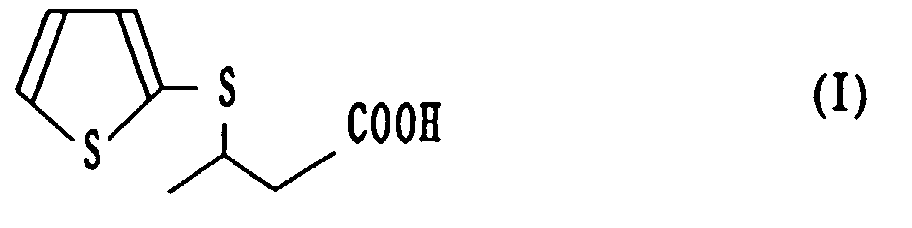
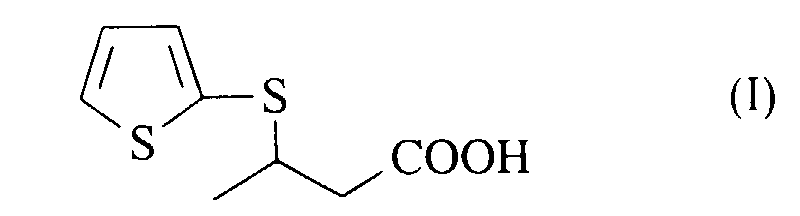
[0001] The present invention relates to a process for preparing 3-(2-thienylthio)butyric acid having the structural formula (I):
[0002] The present compound is an important key intermediate in the preparation of a medicament having the structural formula (V):
which is used in the treatment of glaucoma, MK-507 (see Fortschritte der Ophthalmologie, 88, 513 (1991)).
BACKGROUND ART
[0003] As a process for preparing 3-(2-thienylthio)butyric acid, there is known a process wherein 3-(2-thienylthio)butyric acid methyl ester is hydrolyzed with an about 6N aqueous solution of hydrochloric acid under refluxing conditions (see Journal of Organic Chemistry, 58 [7], 1672 (1993), USP 4,968,814 and Japanese Unexamined Patent Publication No. 224576/1992).
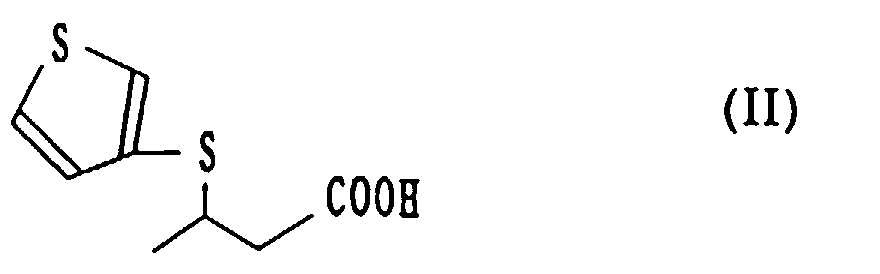
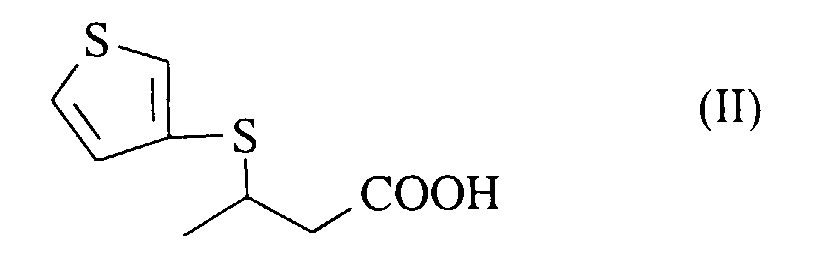
[0004] However, in the above-mentioned process, the production of 3-(3-thienylthio)butyric acid having the structural formula (II):
as a by-product is unavoidable. Furthermore, the removal of this by-product is extremely difficult because in the subsequent process for the synthesis of the medicament used in the treatment of glaucoma having the structural formula (V), this by-product is subjected to the chemical conversion in the same way as in 3-(2-thienylthio)butyric acid.
[0005] Therefore, in order to use the obtained 3-(2-thienylthio)butyric acid as an intermediate for a medicament, it has been desired to develop a process for preparing 3-(2-thienylthio)butyric acid wherein the content of 3-(3-thienylthio)butyric acid is controlled to at most 0.1 mol %.
DISCLOSURE OF THE INVENTION
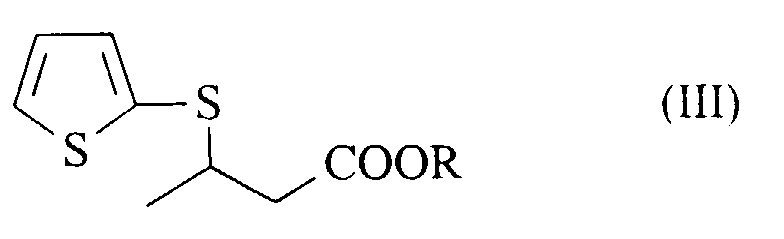
[0006] As the result of the detailed investigation of the present inventors to control the production of 3-(3-thienylthio)butyric acid as a by-product, they have found that in a contact reaction of a compound having the formula (III):
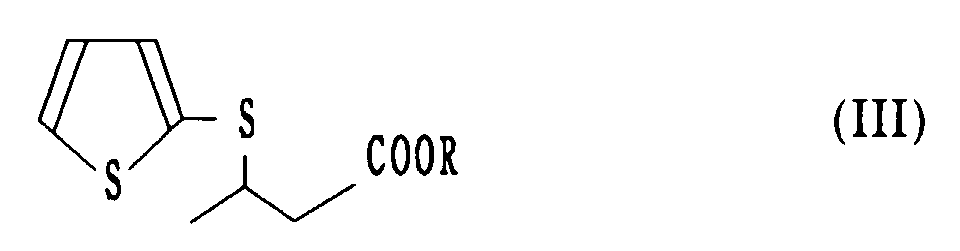
wherein R is a straight chain or branched C1 to C4 alkyl group, with an aqueous solution of acid, the production of 3-(3-thienylthio)butyric acid as a by-product can be dramatically controlled to at most 0.1 mol % by adding an organic solvent or an organic acid. Consequently, the present invention has been accomplished.
[0007] Namely, the present invention relates to a process for preparing a compound having the structural formula (I):
characterized by, in a reaction of a compound having the formula (III):
wherein R is a straight chain or branched C1 to C4 alkyl group, with an aqueous solution of acid, adding an organic solvent or an organic acid whereby the production of a by-product compound having the structural formula (II):
is controlled to at most 0.1 mol %.
BEST MODE FOR CARRYING OUT THE INVENTION
[0008] The compound having the formula (III) as a starting compound can be prepared according to the process described in USP 4,968,814.
[0009] To be concrete, the compound (III) can be prepared by reacting an alkaline metal salt of 2-thiophenethiol with a 3-tosyloxybutyric acid ester.
[0010] Examples of the group represented by R in the formula (III) are, for instance, methyl group, ethyl group, n-propyl group, i-propyl group, n-butyl group, i-butyl group, sec-butyl group, tert-butyl group and the like. Among these, methyl group is preferable from the viewpoint that an alcohol or alcohol derivative produced during the reaction is easily removed by distillation.
[0011] Examples of the acid in the aqueous solution of acid to be used are, for instance, an inorganic acid such as hydrochloric acid, sulfuric acid or phosphoric acid; an organic acid such as trifluoroacetic acid, toluenesulfonic acid or methanesulfonic acid; and a Lewis acid such as boron trifluoride-diethyl ether complex or a boron fluoride. It is desirable to use hydrochloric acid or sulfuric acid because it is easy to industrially handle them in the waste disposal etc.
[0013] Examples of the organic solvent or the organic acid to be added are, for instance, an organic solvent such as dioxane, toluene, dichloromethane, chloroform, acetone or dimethoxyethane, and an organic acid such as acetic acid, formic acid, malonic acid, benzoic acid or tartaric acid which are a carboxylic acid. Particularly, when acetic acid or formic acid is used, good results are obtained.
[0014] The amount of the organic solvent or the organic acid, for example, carboxylic acid, to be added can be determined in a desired ratio to the amount of the compound (III). Particularly, when the amount is from 4 to 10 molar equivalents based on the compound (III), good results are obtained.
[0015] The compound having the formula (III) can be used for the reaction in a desired reaction concentration. When the reaction concentration thereof is from 5 to 30 % by weight based on the total amount of the reaction mixture, good results are obtained.
[0016] A temperature during the reaction can be determined at a desired temperature of not more than the boiling point of the reaction mixture, and may be decided taking account of the acceptable reaction time.
[0017] In the case of carrying out the reaction as it is, the reaction reaches equilibrium in a conversion ratio which depends on the charging amount of the compound having the formula (III), the kind and amount of the acid in the aqueous solution of acid to be used, the amount of water used, and the kind and amount of the organic solvent or the organic acid to be added. However, it is possible to raise the conversion ratio up to any desired conversion ratio by removing a produced alcohol or alcohol derivative by distillation which has the formula (IV):
R-OX (IV)
wherein R is a straight chain or branched C1 to C4 alkyl group and X is hydrogen atom or COR' wherein R' is hydrogen atom, a straight chain or branched C1 to C3 alkyl group or a phenyl group which may be substituted. Additionally, in the case that at this time, water is also removed by distillation together with the alcohol or alcohol derivative, water may be added to the reaction system in an amount of the removed water.
[0018] Examples of a group represented by R' in the formula (IV) are, for instance, hydrogen atom, methyl group, ethyl group, n-propyl group, i-propyl group, phenyl group, a toluyl group and the like.
[0019] The obtained 3-(2-thienylthio)butyric acid may be isolated and purified by a usual treating process such as solvent extraction, concentration or distillation, or may be used as it is.
[0020] The present invention is more specifically explained below by means of the Examples. However, it is to be understood that the present invention is not limited to those Examples.
Reference Example 1
[0021] There were mixed 180 g of a concentrated hydrochloric acid having a concentration of 35 % and 146 g of water to prepare an aqueous solution of hydrochloric acid having a concentration of 5.8 N.
[0022] The resulting aqueous solution of hydrochloric acid was mixed with 56 g of 3-(2-thienylthio)butyric acid methyl ester (net content 54 g), with stirring at room temperature. The mixture was warmed till the contents started to be refluxed and then was allowed to react under refluxing conditions for 23 hours. The progress of the reaction was monitored by means of a high-pressure liquid chromatography. The conversion ratio was 99 mol % and the amount of 3-(3-thienylthio)butyric acid produced was 0.82 mol % (mol % based on 3-(2-thienylthio)butyric acid).
[0023] The high-pressure liquid chromatography was carried out under the following conditions:
- Column:
- Finepak SIL C18-5 (4.6 mm × 25 cm, made by JASCO CORP. )
- Eluent:
- acetonitrile : water : phosphoric acid = 4 : 6 : 0.006 (V/V)
- Flow rate:
- 1.0 mℓ/min
- Temperature:
- 40°C
- Detection condition:
- U.V. detector, wavelength: 230 nm
[0024] 3-(2-Thienylthio)butyric acid
1H NMR (CDCl3) 7.41 (M, 1H), 7.17 (M, 1H), 7.02 (M, 1H), 3.37 (M, 1H), 2.71 (dd, 1H, J=16.0, J=6.4Hz), 2.47 (dd, 1H, J=16.0, J=8.0Hz), 1.34 (d, 3H, J=6.8Hz) 13C NMR (CDCl3) 177.5 (s), 136.4 (s), 130.9 (s), 130.5 (s), 127.7 (s), 41.4 (s), 41.3 (s), 20.6 (s)
[0025] 3-(3-Thienylthio)butyric acid
1H NMR (CDCl3) 7.35 (M, 2H), 7.08 (M, 1H), 3.45 (M, 1H), 2.65 (dd, 1H, J=15.6, J=6.4Hz), 2.47 (dd, 1H, J=15.6, J=8.4Hz), 1.33 (d, 3H, J=7.6Hz) 13C NMR (CDCl3) 177.6 (s), 132.2 (s), 129.1 (s), 128.3 (s), 126.2 (s), 41.6 (s), 39.6 (s), 20.9 (s)
Example 1
[0026] There were mixed 13 g of a concentrated sulfuric acid having a concentration of 97 % and 108 g of water to prepare an aqueous solution of sulfuric acid. To the resulting aqueous solution of sulfuric acid were added 90 g of acetic acid (6 molar equivalents based on 3-(2-thienylthio)butyric acid methyl ester) and 56 g of 3-(2-thienylthio)butyric acid methyl ester (net content 54 g), successively, and they were mixed. The mixture was allowed to react under refluxing for 24 hours. The progress of the reaction was monitored by means of a high-pressure liquid chromatography. The conversion ratio was 95 mol % and the amount of 3-(3-thienylthio)butyric acid produced was 0.01 mol % (mol % based on 3-(2-thienylthio)butyric acid).
[0027] The high-pressure liquid chromatography was carried out under the following conditions:
- Column:
- Finepak SIL C18-5 (4.6 mm × 25 cm, made by JASCO CORP.)
- Eluent: acetonitrile :
- water : phosphoric acid = 4 : 6 : 0.006 (V/V)
- Flow rate:
- 1.0 mℓ/min
- Temperature:
- 40°C
- Detection condition:
- U.V. detector, wavelength: 230 nm
[0028] In order to further proceed the reaction, 11 g of the mixture of methyl acetate, methanol, acetic acid and water was removed by distillation and the remaining reaction mixture was allowed to react under refluxing for 7 hours. The conversion ratio was 99 mol % and the amount of 3-(3-thienylthio)butyric acid produced was 0.01 mol % (mol % based on 3-(2-thienylthio)butyric acid).
[0029] Each NMR data obtained as to 3-(2-thienylthio)butyric acid and 3-(3-thienylthio)butyric acid was consistent with that obtained in Reference Example 1.
Examples 2 to 19
[0030] 3-(2-Thienylthio)butyric acid was prepared in the same procedure as in Example 1 wherein the kind and amount of the acid in the aqueous solution of acid, the amount of water used, the kind and amount of the organic solvent or the organic acid to be added and the reaction time were changed. Whether the removal by distillation of the produced alcohol or alcohol derivative was done or not done is as shown in Table 1.
INDUSTRIAL APPLICABILITY
[0032] According to the present invention, 3-(2-thienylthio)butyric acid which is an important intermediate for a medicament used in the treatment of glaucoma MK-507, can be prepared with controlling the content of contamination by 3-(3-thienylthio)butyric acid, which is the position isomer, to at most 0.1 mol %.
1. A process for preparing a compound having the structural formula (I):
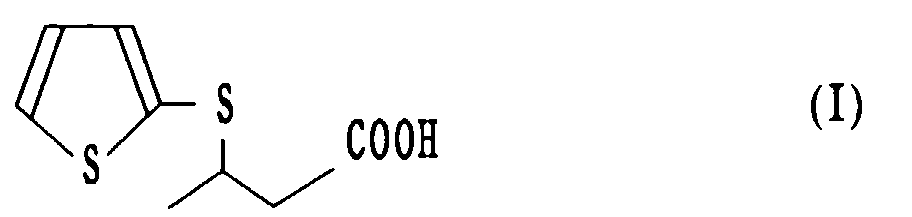
characterized by, in a reaction of a compound having the formula (III):
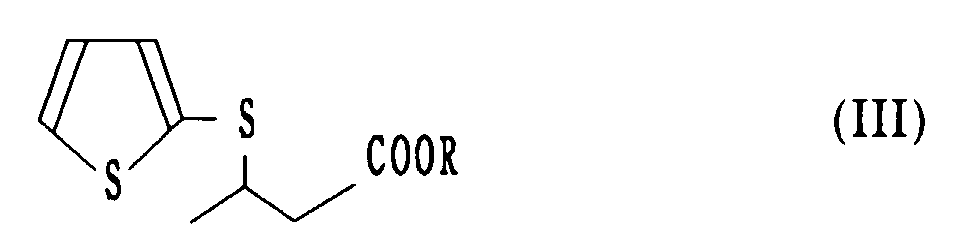
wherein R is a straight chain or branched C1 to C4 alkyl group, with an aqueous solution of acid, adding an organic solvent or an organic acid whereby the production of a by-product compound having the structural formula (II):
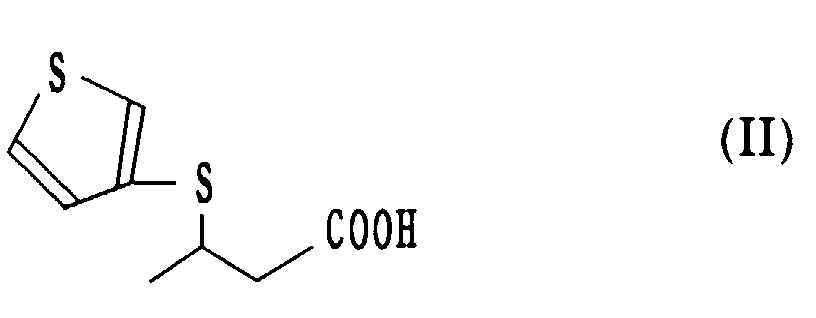
is controlled to at most 0.1 mol %.
characterized by, in a reaction of a compound having the formula (III):
wherein R is a straight chain or branched C1 to C4 alkyl group, with an aqueous solution of acid, adding an organic solvent or an organic acid whereby the production of a by-product compound having the structural formula (II):
is controlled to at most 0.1 mol %.
2. The process of Claim 1 wherein R in the formula (III) is methyl group.
3. The process of Claim 1 or 2, characterized by removing an alcohol or alcohol derivative
by distillation, which is produced during the reaction and has the formula (IV):
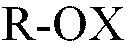
wherein R is a straight chain or branched C1 to C4 alkyl group and X is hydrogen atom or COR' wherein R' is hydrogen atom, a straight chain or branched C1 to C3 alkyl group or a phenyl group which may be substituted.
wherein R is a straight chain or branched C1 to C4 alkyl group and X is hydrogen atom or COR' wherein R' is hydrogen atom, a straight chain or branched C1 to C3 alkyl group or a phenyl group which may be substituted.
4. The process of Claim 1, 2 or 3 wherein the organic solvent or the organic acid is
a carboxylic acid.
5. The process of Claim 4 wherein the carboxylic acid is acetic acid.
6. The process of Claim 4 wherein the carboxylic acid is formic acid.
7. The process of Claim 1, 2, 3, 4, 5 or 6 wherein the acid in the aqueous solution of
acid is hydrochloric acid, sulfuric acid, phosphoric acid, toluenesulfonic acid, methanesulfonic
acid, trifluoroacetic acid or boron trifluoride-diethyl ether complex.
8. The process of Claim 7 wherein the acid in the aqueous solution of acid is hydrochloric
acid.
9. The process of Claim 7 wherein the acid in the aqueous solution of acid is sulfuric
acid.
10. The process of Claim 4 wherein an amount of the carboxylic acid to be added is from
4 to 10 molar equivalents based on the compound having the formula (III).
1. Verfahren zur Herstellung einer Verbindung mit der Strukturformel (I):
dadurch gekennzeichnet, dass in einer Umsetzung einer Verbindung mit der Formel (III):
wobei R eine geradkettige oder verzweigte C1 bis C4-Alkylgruppe ist, mit einer wässrigen Säurelösung, ein organisches Lösungsmittel oder eine organische Säure hinzugefügt wird, wodurch die Herstellung einer Nebenproduktverbindung mit der Strukturformel (II):
auf höchstens 0,1 mol % begrenzt wird.
dadurch gekennzeichnet, dass in einer Umsetzung einer Verbindung mit der Formel (III):
wobei R eine geradkettige oder verzweigte C1 bis C4-Alkylgruppe ist, mit einer wässrigen Säurelösung, ein organisches Lösungsmittel oder eine organische Säure hinzugefügt wird, wodurch die Herstellung einer Nebenproduktverbindung mit der Strukturformel (II):
auf höchstens 0,1 mol % begrenzt wird.
2. Verfahren nach Anspruch 1, wobei R in der Formel (III) eine Methylgruppe ist.
3. Verfahren nach Anspruch 1 oder 2, dadurch gekennzeichnet, dass ein Alkohol oder ein
Alkoholderivat durch Destillation entfernt wird, welcher während der Reaktion hergestellt
wird und die Formel (IV) aufweist:
R-OX (IV)
wobei R eine geradkettige oder verzweigte C1 bis C4 Alkylgruppe ist und X ein Wasserstoffatom oder COR' ist, wobei R' ein Wasserstoffatom, eine geradkettige oder verzweigte C1 bis C3 Alkylgruppe oder eine Phenylgruppe, welche substituiert sein kann, ist.
R-OX (IV)
wobei R eine geradkettige oder verzweigte C1 bis C4 Alkylgruppe ist und X ein Wasserstoffatom oder COR' ist, wobei R' ein Wasserstoffatom, eine geradkettige oder verzweigte C1 bis C3 Alkylgruppe oder eine Phenylgruppe, welche substituiert sein kann, ist.
4. Verfahren nach Anspruch 1, 2 oder 3, wobei das organische Lösungsmittel oder die organische
Säure eine Carbonsäure ist.
5. Verfahren nach Anspruch 4, wobei die Carbonsäure Essigsäure ist.
6. Verfahren nach Anspruch 4, wobei die Carbonsäure Ameisensäure ist.
7. Verfahren nach Anspruch 1, 2, 3, 4, 5 oder 6, wobei die Säure in der wässrigen Säurelösung
Salzsäure, Schwefelsäure, Phosphorsäure, Toluolsulfonsäure, Methansulfonsäure, Trifluoressigsäure
oder Bortrifluoriddiethyletherkomplex ist.
8. Verfahren nach Anspruch 7, wobei die Säure in der wässrigen Säurelösung Salzsäure
ist.
9. Verfahren nach Anspruch 7, wobei die Säure in der wässrigen Säurelösung Schwefelsäure
ist.
10. Verfahren nach Anspruch 4, wobei die Menge der Carhonsäure, die hinzugefügt werden
soll, 4 bis 10 molare Äquivalente beträgt, basierend auf der Verbindung mit der Formel
(III).
1. Procédé pour la préparation d'un composé présentant la formule structurale (I):
caractérisé en ce que, lors de la réaction d'un composé présentant la formule (III):
dans laquelle R est un groupe alkyle en C1 à C4 à chaîne droite ou ramifiée, avec une solution aqueuse d'un acide, on ajoute un solvant organique ou un acide organique, grâce à quoi la production du sous-produit présentant la formule structurale (II):
est contrôlée à une valeur au plus égale à 0,1 % en moles.
caractérisé en ce que, lors de la réaction d'un composé présentant la formule (III):
dans laquelle R est un groupe alkyle en C1 à C4 à chaîne droite ou ramifiée, avec une solution aqueuse d'un acide, on ajoute un solvant organique ou un acide organique, grâce à quoi la production du sous-produit présentant la formule structurale (II):
est contrôlée à une valeur au plus égale à 0,1 % en moles.
2. Procédé selon la revendication 1, dans lequel R dans la formule (III) est un groupe
méthyle.
3. Procédé selon la revendication 1 ou 2, caractérisé par l'élimination par distillation
d'un alcool ou d'un dérivé d'alcool, qui est produit au cours de la réaction et qui
possède la formule (IV):
R-OX (IV)
dans laquelle R est un groupe alkyle en C1 à C4 à chaîne droite ou ramifiée et X est un atome d'hydrogène ou un groupe COR', dans lequel R' est un atome d'hydrogène, un groupe alkyle en C1 à C3 à chaîne droite ou ramifiée ou un groupe phényle qui peut être substitué.
R-OX (IV)
dans laquelle R est un groupe alkyle en C1 à C4 à chaîne droite ou ramifiée et X est un atome d'hydrogène ou un groupe COR', dans lequel R' est un atome d'hydrogène, un groupe alkyle en C1 à C3 à chaîne droite ou ramifiée ou un groupe phényle qui peut être substitué.
4. Procédé selon la revendication 1, 2 ou 3, dans lequel le solvant organique ou l'acide
organique est un acide carboxylique.
5. Procédé selon la revendication 4, dans lequel l'acide carboxylique est l'acide acétique.
6. Procédé selon la revendication 4, dans lequel l'acide carboxylique est l'acide formique.
7. Procédé selon la revendication 1, 2, 3, 4, 5 ou 6, dans lequel l'acide dans la solution
aqueuse d'acide est l'acide chlorhydrique, l'acide sulfurique, l'acide phosphorique,
l'acide toluènesulfonique, l'acide méthanesulfonique, l'acide trifluoroacétique ou
le complexe trifluorure de bore - éther diéthylique.
8. Procédé selon la revendication 7, dans lequel l'acide dans la solution aqueuse d'acide
est l'acide chlorhydrique.
9. Procédé selon la revendication 7, dans lequel l'acide dans la solution aqueuse d'acide
est l'acide sulfurique.
10. Procédé selon la revendication 4, dans lequel la quantité d'acide carboxylique que
l'on doit ajouter est comprise entre 4 et 10 équivalents molaires sur la base du composé
présentant la formule (III).