|
(11) | EP 0 753 167 B1 |

| (12) | EUROPEAN PATENT SPECIFICATION |
|
|
| (54) |
LIQUID CRYSTAL DISPLAY DEVICE FLUESSIGKRISTALL-ANZEIGEVORRICHTUNG DISPOSITIF D'AFFICHAGE A CRISTAUX LIQUIDES |
|
|
|||||||||||||||||||||||||||||||
| Note: Within nine months from the publication of the mention of the grant of the European patent, any person may give notice to the European Patent Office of opposition to the European patent granted. Notice of opposition shall be filed in a written reasoned statement. It shall not be deemed to have been filed until the opposition fee has been paid. (Art. 99(1) European Patent Convention). |
[0001] The invention relates to a liquid crystal display device comprising a matrix of pixels arranged in rows and columns, a group of row electrodes and a group of column electrodes for driving the pixels, each pixel comprising a display element defined by picture electrodes, which element comprises a layer of twistedd nematic liquid crystal material between the picture electrodes and is connected to a row or column electrode via a switching element.
In this application, a switching element is understood to mean both a two-pole and a three-pole switching element. Examples of two-pole switching elements are non-linear switching elements such MIMs, diodes or varistors, but linear switching elements are not excluded. Examples of three-pole switching elements are TFTs.
A twisted nematic liquid crystal material in the display device usually has a twist angle between two supporting substrates of 90 degrees, but this twist angle may vary between 60 degrees and 100 degrees.
Said display devices are used, for example in television applications and datagraphic display devices.
[0002] Display devices of the type described in the opening paragraph are generally known. A display device using two-pole switching elements (MIMs) is known, for example from USP 5,159,325. This Patent describes such a device with drive means which are adapted in such a way that a uniform image is obtained.
Notably if a twisted-nematic liquid crystalline material is used and a MIM (metal-isolator-metal) is chosen for the switching element, the burn-in phenomenon occurs (image retention). Dark characters against a light background, e.g. in datagraphic applications, then remain visible after selection of the characters.
[0003] The features of the preamble of amended Claim 1 are, in combination, known from US 5,159,325 and EP-A-261 614 describes nine examples of twisted-nematic liquid crystalline mixtures. Three examples include all the features of the characterising portion of Claim 1. EP-A-261 614 further suggests the use of values for the quotient (Δε/ε┴) of the dielectric anisotropy (Δε) of the liquid crystal material and the dielectric constant (ε┴) in the direction perpendicular to the directors of the liquid material which are in between 0.8 and 2.0. US-A-4,534,627 suggests that characteristics of a MIM element can be chosen to correspond to the liquid crystal material chosen.
[0004] It is, inter alia an object of the invention to provide a display device in which the burn-in phenomenon is suppressed.
[0005] To this end, a liquid crystal display device according to the invention is characterized in that the quotient of the dielectric anisotropy (Δε) of the liquid crystal material and the dielectric constant in the direction perpendicular to the directors of the liquid crystal material (ε┴) has a value (
) of between 0.8 and 1.8, the dielectric anisotropy (Δε) of the liquid crystal material being smaller than 7.
[0007] The invention is based on the recognition that, for a slight dielectric anisotropy, the difference in capacitance to be charged for dark and light pixels is smaller, so that the charge current in the switching elements varies to a smaller extent as a function of the information to be displayed. A smaller difference in charge current leads to less burn-in of the image to be displayed and to less differential drift.
[0008] By choosing the quotient (
) between said values, it is also achieved that image retention and flicker are reduced. Also, (vertical) crosstalk is reduced notably if higher values are chosen for ε┴. The value of ε┴ is chosen to be, for example larger than 3.2 and preferably larger than 3.4.
[0009] The measures are particularly suitable for use in active-matrix display devices using non-linear two-pole switching elements such as MIMs, but also in active-matrix display devices using non-linear three-pole switching elements such as TFTs. In the latter case, notably when using auxiliary capacitances, smaller auxiliary capacitances can be used due to the usually higher values of (ε┴). The latter aspect may then in turn be utilized for realising a larger aperture.
[0010] These and other aspects of the invention will be apparent from and elucidated with reference to the embodiments described hereinafter.
In the drawings:
Fig. 1 diagrammatically shows a display device according to the invention,
Fig. 2 shows transmission/voltage curves for a display device according to the invention and for a known display device, while
Fig. 3 shows diagrammatically a part of another display device according to the invention.
[0011] Fig. 1 shows a display device for displaying information, for example video images, which device comprises an active-matrix liquid crystal display panel 10 comprising m rows (1 to m) with n pixels (1 to n) in each row. In this example, each pixel 12 consists of a twisted-nematic liquid crystal display element 14 which is electrically connected in series with a non-linear two-pole switching element 15 (in this example, a metal-isolator-metal element or MIM) operating as a switching element, the liquid crystal display element and the switching element being arranged between a row or selection conductor 16 and a column or data conductor 17. The pixels 12 are driven via the row and column conductors which are arranged on facing sides located opposite each other of two substrates (not shown) of, for example glass, on which the facing electrodes of the pixels are also provided. The switching elements 15 are present on the same substrate as the group of row electrodes or row conductors 16.
The row conductors 16 are successively selected by means of a row drive circuit 20, while data signals are simultaneously presented to the column conductors or column electrodes via a column drive circuit 22. These drive circuits are in turn controlled by a control circuit 25 in which also the timing is controlled. Timing signals and signals defining the voltages of the selection signals are applied from the control circuit 25 to the row drive circuit 20 via lines 26 and 27, respectively. Signals which define the voltages of the data signals (video signals) are applied from the control circuit 25 to the column drive circuit 22 via one or more lines 28, while timing signals are applied in synchronization with those for the row selection via one or more lines 29.
The effective dielectric constant of the liquid crystal material and consequently the pixel capacitance may vary between a minimum capacitance Cmin = ε0.ε┴.A/d at the threshold voltage Vth and Cmax = ε0.ε∥. A/d at the saturation voltage Vsat, in which A and d are the surface of the pixel and the thickness of the liquid crystal layer, respectively, while ε┴ and ε∥ represent the "perpendicular" and "parallel" dielectric constant of the liquid crystal (mixture). The maximum difference in pixel capacitance between two pixels (display elements) then is ΔC = C(Vsat)-C(Vth) = Δε.A/d. A decrease of Δε thus leads to a decrease of the difference in charge current and hence to a smaller variation of the properties of the switching elements due to current passage through these elements (reduction of the differential drift).
On the other hand, this decrease leads to an increase of the threshold voltage because Vth is proportional to (Δε)1/2 and hence disproportionally high drive voltages. It has been surprisingly found that this can be prevented by choosing the composition of the mixtures in a suitable manner (in accordance with the above-mentioned criteria with respect to (
).
[0012] Fig. 2 shows the transmission/voltage characteristics for two mixtures . having the following values of Δn, Δε and ε┴. For curve 3 (reference) it holds that Δn = 0.101, Δε = 5.0 and ε┴ = 3.1, while for curve 4 (according to the invention) it holds that Δn = 0.101, Δε = 3.8 and ε┴ = 3.6. The Figure shows that there is no or hardly any noticeable difference in threshold voltage. Moreover, approximately 20% less differential drift was found in a display device in which the second mixture was used, as compared with a display device in which the first mixture was used.
Fig. 3 shows another display device in which TFT transistors 30 are now used as switching elements. The row and column electrodes 16, 17 are now realised on the same substrate as the transistors, while the other substrate is provided with a counter electrode which is usually connected to a fixed voltage (for example to earth (31)). The other reference numerals in Fig. 3 have the same meaning as those in Fig. 1.
Since the liquid crystal (mixture) has a higher value of ε┴ than the known mixtures, possible auxiliary capacitances (parallel to the display element) may be dispensed with or may be very small.
The value of (
) is 1.05. In the active-matrix display devices shown, this value, which may vary between 0.8 and 1.8, leads to an improved behaviour as regards differential drift, image retention and flicker.
In summary, the invention provides active-matrix display devices with non-linear two-pole switching elements such as MIMs or three-pole switching elements such as TFTs with a smaller difference in charge current at a different picture content by using a suitable (
). This leads to less burn-in of the picture to be displayed. Moreover, a satisfactory transmission characteristic is obtained at a higher value of ε┴. For TFTs it is then possible to use smaller auxiliary capacitances due to the higher values of (ε┴). The latter aspect may in turn be utilized to realise a larger aperture.
1. A liquid crystal display device (10) comprising a matrix of pixels (12) arranged in
rows and columns, a group of row electrodes (16) and a group of column electrodes
(17) for driving the pixels, each pixel comprising a display element (14) defined
by picture electrodes, which element comprises a layer of twisted nematic liquid crystal
material between the picture electrodes and is connected to a row or column electrode
via a switching element (15), characterized in that the quotient of the dielectric anisotropy (Δε) of the liquid crystal material and
the dielectric constant in the direction perpendicular to the directors of the liquid
crystal material (ε┴) has a value (

) of between 0.8 and 1.8, the dielectric anisotropy (Δε) of the liquid crystal material being smaller than 7.
) of between 0.8 and 1.8, the dielectric anisotropy (Δε) of the liquid crystal material being smaller than 7.
2. A liquid crystal display device as claimed in Claim 1, characterized in that (

) is larger than 1.
) is larger than 1.
3. A liquid crystal display device as claimed in Claim 1 or 2, characterized in that (

) is smaller than 1.5.
) is smaller than 1.5.
4. A liquid crystal display device as claimed in Claim 1, 2 or 3, characterized in that the dielectric anisotropy (Δε) of the liquid crystal material is smaller than 5.
5. A liquid crystal display device as claimed in any one of the preceding Claims, characterized in that the dielectric constant in the direction perpendicular to the directors of the liquid
crystal material (ε┴) is larger than 3.2.
6. A liquid crystal display device as claimed in Claim 5, characterized in that the dielectric constant in the direction perpendicular to the directors of the liquid
crystal material (ε┴) is larger than 3.4.
7. A liquid crystal display device as claimed in any one of the preceding Claims, characterized in that the device comprises drive means (20) for presenting row selection signals to the
row electrodes and drive means (22) for presenting data signals to the column electrodes.
8. A liquid crystal display device as claimed in any one of the preceding Claims, characterized in that the switching elements are non-linear two-pole switching elements.
1. Flüssigkristall-Wiedergabeanordnung (10) mit einer Matrix von Pixeln (12), die in
Reihen und Spalten gegliedert sind, mit einer Gruppe von Reihenelektroden (16) und
einer Gruppe von Spaltenelektroden (17) zum Betreiben der Pixel, wobei jedes Pixel
ein Wiedergabeelement (14) aufweist, definiert durch Bildelektroden, wobei dieses
Element eine Schicht aus verdrillt nematischem Flüssigkristallmaterial zwischen den
Bildelektroden aufweist und über ein Schaltelement (15) mit einer Reihen- oder einer
Spaltenelektrode verbunden ist, dadurch gekennzeichnet, dass der Quotient aus der dielektrischen Anisotropie (Δε) des Flüssigkristallmaterials
und der Dielektrizitätskonstante in der Richtung senkrecht zu den Direktoren des Flüssigkristallmaterials
(ε ┴) einen Wert
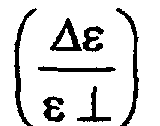
hat zwischen 0,8 und 1.8, wobei die dielektrische Anisotropie (Δε) des Flüssigkristallmaterials kleiner als 7 ist.
hat zwischen 0,8 und 1.8, wobei die dielektrische Anisotropie (Δε) des Flüssigkristallmaterials kleiner als 7 ist.
2. Flüssigkristall-Wiedergabeanordnung nach Anspruch 1, dadurch gekennzeichnet, dass
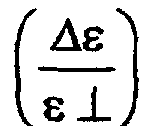
kleiner ist 1.
kleiner ist 1.
3. Flüssigkristall-Wiedergabeanordnung nach Anspruch 1 oder 2, dadurch gekennzeichnet, dass
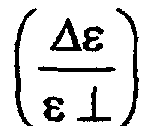
kleiner ist als 1,5.
kleiner ist als 1,5.
4. Flüssigkristall-Wiedergabeanordnung nach Anspruch 1, 2 oder 3, dadurch gekennzeichnet, dass die dielektrische Anisotropie (Δε) des Flüssigkristallmaterials kleiner ist als 5.
5. Flüssigkristall-Wiedergabeanordnung nach einem der vorstehenden Ansprüche, dadurch gekennzeichnet, dass die Dielektrizitätskonstante in der Richtung senkrecht zu den Direktoren des Flüssigkristallmaterials
(ε┴) gröber ist als 3,2.
6. Flüssigkristall-Wiedergabeanordnung nach Anspruch 5, dadurch gekennzeichnet, dass die Dielektrizitätskonstante in der Richtung senkrecht zu den Direktoren des Flüssigkristallmaterials
(ε┴) größer ist als 3,4.
7. Flüssigkristall-Wiedergabeanordnung nach einem der vorstehenden Ansprüche, dadurch gekennzeichnet, dass die Anordnung Treibermittel (20) aufweist um den Reihenelektroden Reihenselektionssignale
zuzuführen und Treibermittel (22) um den Spaltenelektroden Datensignale zuzuführen.
8. Flüssigkristall-Wiedergabeanordnung nach einem der vorstehenden Ansprüche, dadurch gekennzeichnet, dass die Schaltelemente nicht lineare Zweipolschaltelemente sind.
1. Dispositif d'affichage à cristaux liquides (10) comprenant une matrice de pixels (12)
qui sont agencés dans des rangées et dans des colonnes, un groupe d'électrodes de
rangée (16) et un groupe d'électrodes de colonne (17) pour entraîner les pixels, chaque
pixel comprenant un élément d'affichage (14) qui est défini par des électrodes d'image,
lequel élément comprend une couche constituée de matériau à cristaux liquides nématique
en hélice entre les électrodes d'image et est connecté à une électrode de rangée ou
de colonne par l'intermédiaire d'un élément commutateur (15), caractérisé en ce que le quotient de l'anisotropie diélectrique (Δε) du matériau à cristaux liquides et
de la constante diélectrique dans la direction perpendiculaire aux directeurs du matériau
à cristaux liquides (ε┴) présente une valeur (

) dans la gamme comprise entre 0,8 et 1,8, l'anisotropie diélectrique (Δε) du matériau à cristaux liquides étant inférieure à 7.
) dans la gamme comprise entre 0,8 et 1,8, l'anisotropie diélectrique (Δε) du matériau à cristaux liquides étant inférieure à 7.
2. Dispositif d'affichage à cristaux liquides selon la revendication 1, caractérisé en ce que la valeur (

) est supérieure à 1.
) est supérieure à 1.
3. Dispositif d'affichage à cristaux liquides selon la revendication 1 ou 2, caractérisé en ce que la valeur (

) est inférieure à 1,5.
) est inférieure à 1,5.
4. Dispositif d'affichage à cristaux liquides selon la revendication 1, 2 ou 3, caractérisé en ce que l'anisotropie diélectrique (Δε) du matériau à cristaux liquides est inférieure à
5.
5. Dispositif d'affichage à cristaux liquides selon l'une quelconque des revendications
précédentes 1 à 4, caractérisé en ce que la constante diélectrique dans la direction perpendiculaire aux directeurs du matériau
à cristaux liquides (ε┴) est supérieure à 3,2.
6. Dispositif d'affichage à cristaux liquides selon la revendication 5, caractérisé en ce que la constante diélectrique dans la direction perpendiculaire aux directeurs du matériau
à cristaux liquides (ε┴) est supérieure à 3,4.
7. Dispositif d'affichage à cristaux liquides selon l'une quelconque des revendications
précédentes 1 à 6, caractérisé en ce que le dispositif comprend des moyens d'entraînement (20) pour présenter des signaux
de sélection de rangée aux électrodes de rangée et des moyens d'entraînement (22)
pour présenter des signaux de données aux électrodes de colonne.
8. Dispositif d'affichage à cristaux liquides selon l'une quelconque des revendications
précédentes 1 à 7, caractérisé en ce que les éléments commutateurs sont des éléments commutateurs à deux pôles non linéaires.