|
(11) | EP 0 754 306 B1 |

| (12) | EUROPEAN PATENT SPECIFICATION |
|
|
| (54) |
SYSTEM FOR DETERMINING THE COMPOSITION OF A MINERAL-CONTAINING MATERIAL SYSTEM ZUR BESTIMMUNG DER ZUSAMMENSETZUNG EINES MINERALHALTIGEN MATERIALS SYSTEME DE DETERMINATION DE LA COMPOSITION D'UN MATERIAU CONTENANT DES MINERAUX |
|
|
|||||||||||||||||||||||||||||||
| Note: Within nine months from the publication of the mention of the grant of the European patent, any person may give notice to the European Patent Office of opposition to the European patent granted. Notice of opposition shall be filed in a written reasoned statement. It shall not be deemed to have been filed until the opposition fee has been paid. (Art. 99(1) European Patent Convention). |
[0001] The invention relates to a system for determining a composition of radionuclides in a mineral-containing material by detecting gamma and/or x-ray radiation emitted by the radionuclides, comprising a detector unit which supplies an electrical signal containing information about the intensity and energy of the emitted radiation and a signal processing system by which these electrical signals are further processed for determining said composition of radionuclides, wherein the signal processing system comprises an A/D converter to which said electrical signals are applied and a first computer unit which further processes signals supplied by the A/D converter for the purpose of determining said composition of radionuclides; the first computer unit composes an energy spectrum of the detected radiation from the signals supplied by the A/D converter; and wherein the first computer unit determines the concentration of the radionuclides on the basis of the spectrum according to a predetermined first algorithm
[0002] Such systems are known per se and are employed inter alia for the exploration and exploitation of oil and gas. For example GB-A-2,172,103 discloses such a known method. The known methods are based on the presence of radionuclides in mineral containing materials. These nuclides emit radiation which is characteristic of the nuclide in question. By detecting this radiation, information can be obtained about the composition of the material in radionuclides.
[0003] The nuclides of interest to be detected are nuclides having a long life (half-time in excess of 109 years), such as e.g. 40K, 232Th, 235U and 238U and their decay products. During the period in which minerals were formed, these nuclides were incorporated into them.
[0004] The radionuclides mentioned typically decay by way of a long sequence of intermediate products to a stable lead isotope. During this decay, inter alia alpha, beta, gamma and x-ray radiation are released. The present invention, however, only relates to the detection and interpretation of emitted gamma and x-ray radiation.
[0005] Although the gamma radiation is not emitted by the nuclides 232Th, 235U and 238U but by nuclides further down the decay sequence, for convenience the terms Th and U activity are used in this specification.
[0006] In the known systems, the radiation to be detected is for instance allowed to fall on a crystal, whereby a light flash can be generated. In case of gamma and x-ray radiation, such a photon causes such a light flash. These light flashes are applied to a photomultiplier which converts the light flashes into electrical pulses. The magnitude of the electrical pulse is a measure for the energy of the photon incident on the crystal.
[0007] By counting the number of pulses for a period of, for instance, twenty seconds, and sorting them according to pulse magnitude, an energy spectrum can be composed, i.e. the number of photons recorded per unit time as a function of their energy.
[0008] Such a spectrum will contain peaks or lines which are respectively caused at least substantially by the radionuclides mentioned. A peak or a set of peaks can then be ascribed to a nuclide. In addition, however, contributions from other physical phenomena are present in the spectrum, such as for instance the Compton effect.
[0009] In the known systems the spectrum is analyzed per window. Within a window a peak a present. That is to say that the content of generally three windows is determined. On the basis of the content of these windows, it can be determined which nuclides have been detected. The information about the content of the windows is then processed in combination in order to determine the concentrations of the nuclides in the material in question, since the concentrations of the nuclides appear to comprise a practically linear relation with the intensity of the radiation, i.e. with the number of photons emitted.
[0010] These systems often utilize NaI(Tl) crystals; such a crystal has a moderate energy resolution and further is fairly insensitive to highly energetic radiation, so that a long integration time, for instance more than 20 seconds, is required to obtain a useful spectrum.
[0011] The above-referred to known systems all determine concentrations of predetermined radionuclides in the material. However, these concentrations very often do not provide sufficient information to analyse the material.
[0012] The system according to the invention provides a solution to these problems and is characterised in that the first computer unit determines according to a second algorithm what amounts of predetermined groups of minerals are present in the material on the basis of the determined concentrations of the radionuclides in the material wherein a group of minerals consist of a predefined group of minerals whose spectra are very much alike or only one kind of mineral. Hence, according to the invention the amounts of predetermined groups of minerals which are present in the material are determined. These amounts of groups of minerals provide new information about the material.
[0013] According to a preferred embodiment, the detector unit comprises a scintillation detector and a photomultiplier which converts the light pulses supplied by the scintillation detector into an electrical pulse of an amplitude which is a measure for the energy of the radiation received by the scintillation detector. The detector preferably comprises a pulse height analyzer for obtaining the electrical signals mentioned from the electrical pulses.
[0014] However, according to the invention it is also possible to use other detector units. Such an alternative detector unit can comprise a semiconductor crystal to which a bias voltage is applied and means for detecting a variation in the bias voltage for obtaining the electrical signals.
[0015] According to a highly advantageous embodiment, the first computer unit determines the concentrations on the basis of the complete determined spectrum. Because according to this method all available information, i.e. the complete spectrum, is utilized, a very high accuracy is obtained. According to the known method discussed earlier, in which the content of mostly only three windows is analyzed, only about 10 percent of the available information is processed.
[0016] In accordance with the invention, the detector unit is preferably provided with a BGO crystal. The sensitivity of such a crystal to highly energetic radiation is much better (by an order of magnitude) than the sensitivity of a conventional NaI(Tl) crystal. The energy resolution, however, is slightly less good than in the case of the NaI(Tl) crystal, so that the energy spectrum will comprise somewhat broader peaks. The peaks will therefore overlap to a larger extent. 3y virtue of the fact that the spectrum is analyzed with the predetermined algorithm mentioned, reliable information can yet be obtained from the spectrum.
[0017] According to yet another aspect of the invention, the first computer unit comprises a memory in which energy spectra of radiation emitted by radionuclides are stored. These spectra stored in the memory can be used in the predetermined first algorithm. Similarly, the memory of the computer may store data of minerals which are known as such and the corresponding concentrations of radionuclides. Such information stored in the memory can be used in the second algorithm.
[0018] According to a highly advanced embodiment of the invention, the detector unit comprises sensors by which sound, temperature, magnetism and/or other physical phenomena in the environment of the nuclides to be detected can be detected and converted into an electrical sensor signal. The sensor signal can be applied via the A/D converter to a computer unit, such as, for instance, the first computer unit for performing corrections in determining the composition referred to.
[0019] It is moreover possible for the sensor signal to be applied to a second computer unit for the purpose of correcting and/or stabilizing the detector unit.
[0020] Thus the detector unit and the first computer unit can be separated from each other, allowing the corrections mentioned to be performed directly, locally at the detector unit.
[0021] Thus, it is for instance possible that the system further comprises a transmitter unit to which output signals of the A/D converter are applied and a receiver unit which applies received signals to the first computer unit, while the detector unit and the A/D converter are accommodated, for instance, in a probe-forming housing. Such a probe can be deployed in many places.
[0022] In this connection it is noted that the system according to the invention finds application in many areas. The system can for instance be used for measuring and/or analyzing sludge, separating minerals in, for instance, waste processing, and tracing waste streams in rivers and oceans. In addition, the detector unit of the system can also be mounted under a plane for performing radiometric tracings. Yet another example is the performance of horizontal and/or vertical soil research, the performance of soil analyses and the above-mentioned exploration and exploitation or minerals.
[0023] EP-A-0,473,467 also discloses a system wherein concentrations of radionuclides in a material are determined. However, it is not known from EP-A-0,473,467 to determine the amounts of groups of minerals in the material based on the measured concentrations of radionuclides in the material.
[0024] The invention will be further explained below with reference to the drawing. In the drawing:
Fig. 1 shows an embodiment of a system according to the invention;
Fig. 2 shows an example of an energy spectrum of a mineral; and
Fig. 3 shows the process steps which are carried out by the system according to Fig. 1.
[0025] In Fig. 1 reference numeral 1 designates a system according to the invention for detecting and interpreting gamma and x-ray radiation emitted by radionuclides. The system comprises a scintillation detector 2, known per se: in this example a BGO(Bismuth Germanium Oxide) crystal. This crystal can generate a light flash when a photon of the radiation falls on the crystal. These light flashes are applied to a known type of photomultiplier 6, as diagrammatically designated by reference numeral 4. The photomultiplier 6 converts the light pulses supplied by the scintillation detector into an electrical pulse of an amplitude which is a measure for the energy of the radiation received by the scintillation detector. These electrical pulses are applied via line 8 to a known type of pulse height analyzer 10.
[0026] The pulse height analyzer generates on line 12 electrical signals containing information about the height of a pulse and hence the energy emitted by the photons. This analyzer 10 consists, for instance, of a detection device, not shown here, which produces a signal if a pulse is present and a "sample and hold" device, also not shown, to which the output signal of the last-mentioned detection device is applied. The number of photons detected per unit time (cps) is a measure for the intensity of the radiation, so that this information is also present in the electrical signal on line 12.
[0027] The electrical signal referred to is subsequently applied to an A/D converter 14 which digitizes the signal.
[0028] In this example, the digitized signal is then applied via line 16 to a transmitter/receiver unit 18, which radiates the digitized signal. The carrier modulated with the electrical signal is diagrammatically indicated by reference numeral 20.
[0029] The system in this example further comprises a transmitter/receiver unit 22 for receiving and demodulating the signal transmitted by the transmitter/receiver unit 18. The transmitter/receiver unit 22 provides on line 24 a digital signal which corresponds with the digital signal supplied by the A/D converter.
[0030] The digital signal is then applied to a first computer unit 26 for further processing. In a manner which is known per se, the computer unit 26 composes from the digital information an energy spectrum as is shown, by way of example, in Fig. 2.
[0031] In this example the first computer unit 26 counts for a period of about one second the number of pulses having a magnitude between Ei+1 and Ei for i=l,l,...n with n=(En-E0)/(Ei+1-Ei). If n is large, an at least substantially continuous spectrum can be constructed, as is shown in Fig. 2. In Fig. 2 three peaks are visible which stem from K, U and Th.
[0032] On the basis of spectra coming from, respectively, pure K, U, and Th and which are stored in a memory 28 of the first computer unit 26, the spectrum of Fig. 1 is de-convolved according to a first algorithm for obtaining the concentrations of the detected isotopes in question, for instance in a material comprising various minerals. For this purpose the algorithm preferably utilizes the entire spectrum, i.e. all information that is available.
[0033] Also stored in the memory 28 are data about known minerals and the concentrations of the isotopes contained therein. The computer 26 then determines, on the basis of these data and the measured concentrations, according to a second algorithm, in what ratio the groups of minerals have been detected. These data are then relayed to a data output system 30 for further processing. According to this method, therefore, a new spectrum can be determined and analyzed per second or so much longer as is desired.
[0034] On the basis of spectra determined by the first computer unit 26 it is then possible to adjust particular parameters in respect of which for instance the photomultiplier 6, the pulse height analyzer and the A/D converter have been set. This creates a feedback to the photomultiplier 6, the pulse height analyzer and/or the A/D converter 14. The feedback signals generated by the computer unit 26 can be fed to the A/D converter via line 24, transmitter/receiver units 22, 18 and line 16. The system further comprises a D/A converter to feed these feedback signals via lines 12 and 8 to the photomultiplier 6 and the pulse height analyzer 10. If, for instance, the amplification factor of the signal is not optimal, for instance the gain of one of these components 6,10 and/or 14 can be adjusted in this way.
[0035] According to a particular embodiment of the system, the system further comprises additional sensors. In this example, two of such sensors 32,34 are shown. It is also possible, however, to expand the system with three or more sensors. The sensor 32 in this example is a temperature sensor. The temperature-representing signals supplied by this sensor 32 are fed to the A/D converter via line 36. The A/D converter digitizes this signal and dispatches it via line 16 to the transmitter/receiver unit. In this connection, it can be ensured, for instance through multiplex techniques or coding techniques, that these signals on line 16 are distinguishable from signals coming from the pulse height analyzer 10. The first computer unit 26 can then utilize the received digitized temperature-representing signals for carrying out the first and/or second algorithm, if these algorithms contain temperature-dependent parameters. Similarly, the system comprises a motion detector 34 whose signals are applied to the first computer unit 26 for further processing, via the same route as described for the temperature sensor. In general, it holds that the information obtained with the additional sensors can be used for carrying out corrections through software. However, it is also possible for the first computer unit to generate feedback signals on the basis of information obtained with the additional sensors, which feedback signals, as described hereinbefore, can be applied to various components of the system for adjusting, for instance, the parameters referred to.
[0036] According to a highly advanced embodiment of the invention, the system 1 further comprises a second computer unit 38 to which also output signals from the sensors 32, 34 are applied. The second computer unit 38 processes these signals according to a third algorithm which determines in what way setting parameters of, for instance, the photomultiplier 6, pulse height analyzer 10 and/or A/D converter 14 can be adjusted via line 40. Thus, for instance, the gain of the units 6, 10, 14 can be adjusted depending on the temperature.
[0037] According to a highly advantageous embodiment, the units 2, 6, 10, 14 and 18 are assembled in a housing 42 and constitute a probe. If the units 32, 34 and 38 are present, they can also be accommodated in the housing 42. The provides the advantage that the probe can be set directly and be adjusted on the basis of physical conditions of the direct environment of the probe as measured by the sensors 32, 34.
[0038] The invention is not limited to the embodiments of the system 1 shown in Fig. 1. Thus, on the one hand, the transmitter/receiver units 18, 22 can be replaced by a direct connection by means of line 44. On the other hand, the other lines of Fig. 1 can be replaced by pairs of transmitter/receiver units. The A/D converter 14 could form part of the second computer unit 38. The system can also form part of a larger system, such as for instance a mineral separation system. In such a separation system, a basic stream of material is typically split up into a first stream which comprises minerals of a first type and a first residual group. The first residual group can then be split up into a second stream which comprises minerals of a second type and a second residual group, etc. By means of the system 1 it can for instance be determined how many minerals of the first type are present in the basic stream. On the basis of this information, process parameters (such as for instance the speed of the basic stream) of the separation system can be set. In addition, with the system 1 it can be determined in respect of the first residual group how many minerals of the second type are present in it. On the basis of this information, process parameters of the separation system can also be set, etc. Also, it can be checked if, for instance, the stream with minerals of the first type is not "contaminated" with other minerals.
[0039] The software of the first and second computer units preferably comprises a protection against unauthorized copying.
[0040] In illustration, it will now be indicated with reference to Fig. 3 which process steps the first and second algorithms can be made up of.
[0042] From the input data 61, the data of the other sensors are continuously selected and processed 63. The processed data 65 can be outputted. From the input data 61, the data of the detector are also continuously selected and sorted 67 and collected in a spectrum 69. Once per second or so much longer as is desired, this spectrum is converted 71 to another spectrum 73, in which the measured photons have been sorted according to energy. This takes place with a number of conversion factors 75. From this spectrum 73 concentrations 77 of potassium, uranium and thorium are calculated 79 using previously recorded spectra of K, U and Th separately and a background spectrum 81. Energy stabilization 83 is obtained by composing a spectrum from concentrations 77 and spectra 81 and comparing this with spectrum 73 and adjusting conversion factors 75 on the basis thereof. This stabilization takes place entirely through software. From the K, U and Th concentrations 77, mineral or mineral group proportions 85 are calculated 87 using previously determined radiometric data of these minerals 89.
[0043] The calculation 79 of the concentrations 77 can be performed as follows.
Hereinafter the following applies:
- S(i) =
- number of photons detected per second with energy Ei in material to be analyzed;
- Cx =
- concentration of nuclide x in material to be analyzed;
- X(i) =
- K(i), U(i), Th(i): number of photons detected per second with energy Ei coming from pure K, U or Th spectra;
- B(i) =
- number of photons detected per second with energy Ei coming from background radiation;
- i =
- 1, 2 .... n; and
- x =
- K, U or Th.
The value of CK, CU and CTh can be determined according to the least-squares method.
This means that:
wherein
represents the uncertainty in the number of detected photons with energy Ei in the time interval T.
From formula (1), Ck, CU and CTh can be determined. It is noted that formula (1) can also be applied by using only a part of the spectrum. Accordingly, in that case not all values of i are used. Then preferably those values of 1 are used for which it holds that Ei lies in or adjacent a peak.
[0044] The calculation of 87 can be performed as follows.
The assumption is that the material to be analyzed comprises four groups of minerals which are designated a, b, c and d. Every mineral group is characterized by its relative mass mj in the material and three concentrations Cj(U), Cj(Th) and Cj(K) with j = a, b, c or d.
The relative masses are characteristic of the material to be analyzed, while the concentrations (Cj(U), Cj(Th) and Cj(K)) are characteristic of the mineral group. These last-mentioned concentrations are therefore known. A mineral group is a predefined group of minerals whose spectra are very much alike. However, a mineral group may also consist of only one kind of mineral. The mineral groups are further defined in such a manner that the spectra of different mineral groups are not very much alike.
For the material, it holds that C(U), C(Th) and C(K) represent the total (activity) concentrations of U, Th and K. These values can have been determined according to formula (1).
It further holds that:
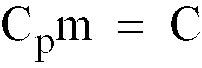
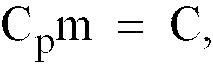
[0045] From the equation (2), using the known values of Cj(U), Cj(Th) and Cj(K) and the measured values of C(U), C(Th) and C(K), the values of ma, mb, mc and md can be determined.
[0046] Comparisons (2) can be written in matrix form as
wherein
The uncertainties in mi, σ(mi) follow from
1. A system (1) for determining the composition of a mineral-containing material by detecting
gamma and/or x-ray radiation emitted by radionuclides contained in said minerals,
comprising a detector unit (2) which supplies an electrical signal containing information
about the intensity and energy of the emitted radiation and a signal processing system
by which these electrical signals are further processed for determining the composition
of said radionuclides, wherein the signal processing system (1) comprises an A/D converter
(14) to which said electrical signals are applied and a first computer unit (26) which
further processes signals supplied by the A/D converter (14) for the purpose of determining
said composition of radionuclides; the first computer unit (26) composes an energy
spectrum of the detected radiation from the signals supplied by the A/D converter
(14); and wherein the first computer unit (26) determines the concentration of the
radionuclides on the basis of the spectrum according to a predetermined first algorithm,
characterized in that, the first computer unit (26) determines according to a second
algorithm what amounts of predetermined groups of minerals are present in the material
on the basis of the determined concentrations of the radionuclides in the material
wherein each predetermined group of minerals consist of a group of minerals whose
spectra are very much alike or only one kind of mineral.
2. A system according to claim 1, characterized in that, the first computer unit 26 determines
the concentrations C(U), C(Th) and C(K) of the radionuclides uranium, thorium and
potassium respectively according to the first algorithm and that the first computer
unit 26 determines the relative masses mj (j = a, b, c or d) of respective mineral
groups which are designated a, b, c and d according to the second algorithm.
3. A system according to claim 2, characterized in that, according to the second algorithm
mj(j = a, b, c or d) is determined from the equation:
wherein
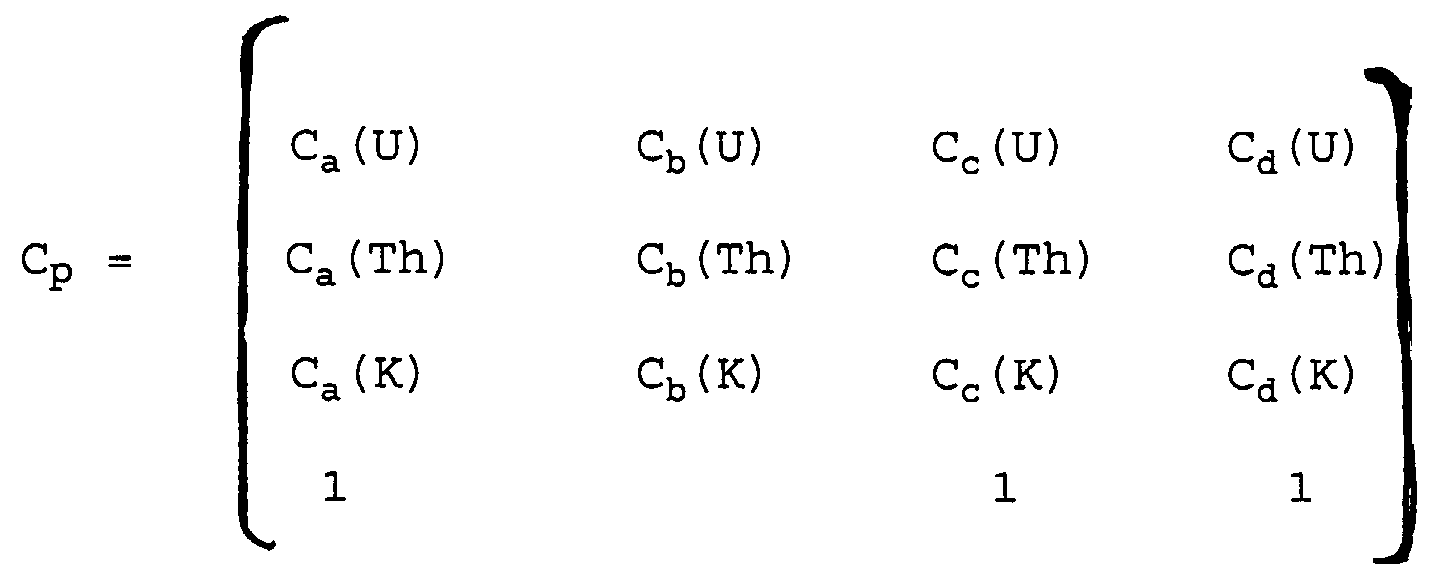
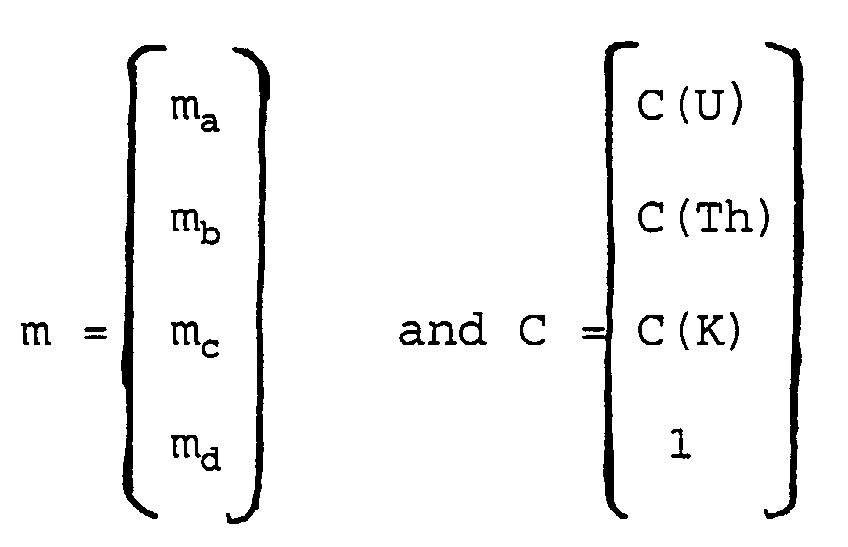
and wherein every mineral group a, b, c or d is characterized by its three known concentrations Cj(U), Cj(Th) and Cj(K) with j = a, b, c or d.
wherein
and wherein every mineral group a, b, c or d is characterized by its three known concentrations Cj(U), Cj(Th) and Cj(K) with j = a, b, c or d.
4. A system according to claim 1, characterized in that the detector unit comprises a
scintillation detector 2 and a photomultiplier 6 which converts the light pulses supplied
by the scintillation detector 2 into an electrical pulse of an amplitude which is
a measure for the energy of the radiation received by the scintillation detector 2.
5. A system according to claim 4, characterized in that the detector unit further comprises
a pulse height analyzer 10 for obtaining said electrical signals.
6. A system according to claim 1, characterized in that the detector unit comprises a
semiconductor crystal 2 to which a bias voltage is applied and means for detecting
a variation in the bias voltage for obtaining said electrical signals.
7. A system according to any of the preceding claims, characterized in that the first
computer unit 26 determines said concentrations on the basis of the complete determined
spectrum.
8. A system according to any of the preceding claims, c characterized in that the first
computer unit 26 determines said concentrations on the basis of predetermined energy
ranges of the spectrum which correspond to spectra of individual radionuclides whose
concentration is being determined.
9. A system according to any one of the preceding claims, characterized in that the first
computer unit 26 comprises a memory 28 in which energy spectra of radiation emitted
by radionuclides are stored.
10. A system according to claim 9, characterized in that the spectra stored in the memory
28 are used in the predetermined first algorithm.
11. A system according to claim 9 or 10, characterized in that data of minerals which
are known per se and the corresponding concentrations of radionuclides in said minerals
are stored in the memory 28 of the first computer unit 26.
12. A system according to claim 11, characterized in that the second algorithm utilizes
the information about said minerals which is stored in the memory 28.
13. A system according to any one of the preceding claims, characterized in that the detector
unit comprises sensors 32, 34 by which sound, temperature, magnetism and/or other
physical phenomena in the environment of the radionuclides to be detected can be detected
and converted into an electrical sensor signal.
14. A system according to claim 13, characterized in that the sensor signal is applied
via the A/D converter 14 to the first computer unit 26 for the purpose of performing
corrections in determining said compositions.
15. A system according to claim 14, characterized in that said corrections are performed
through software.
16. A system according to any one of claims 13-15, characterized in that the sensor signal
is applied to a second computer unit 38 for correcting and/or stabilizing the detector
unit.
17. A system according to any one of the preceding claims, characterized in that the system
further comprises a transmitter unit 18 to which output signals of the A/D converter
14 are applied and a receiver unit 18 which feeds received signals to the first computer
unit 26.
18. A system according to any one of the preceding claims 1-16, characterized in that
the output signals of the A/D converter 14 are fed to the first computer unit 26 via
a cable 44.
19. A system according to any one of the preceding claims, characterized in that the detector
unit and the A/D converter 14 are accommodated in a probe-forming housing 42.
20. A system according to claims 16 and 19, characterized in that the second computer
unit 38 is also accommodated in said housing 42.
21. A system according to claim 4, characterized in that the scintillation detector comprises
a BGO crystal.
1. System (1) zum Bestimmen der Zusammensetzung eines mineralhaltigen Materials durch
Detektieren von Gamma- und/oder Röntgenstrahlung, die von in diesen Mineralien enthaltenen
Radionukliden ausgesandt wird, mit einer Detektoreinheit (2), die ein elektrisches
Signal, das Informationen über die Stärke und Energie der ausgesandten Strahlung enthält,
liefert, und einem Signalverarbeitungssystem, mit dem diese elektrischen Signale zum
Bestimmen der Zusammensetzung der Radionuklide weiterverarbeitet werden, wobei das
Signalverarbeitungssystem (1) einen A/D-Wandler (14), dem die elektrischen Signale
zugeführt werden, und eine erste Computereinheit (26), die vom A/D-Wandler (14) übermittelte
Signale zum Bestimmen der Zusammensetzung von Radionukliden weiterverarbeitet, aufweist;
die erste Computereinheit (26) ein Energiespektrum der detektierten Strahlung aus
den vom A/D-Wandler (14) übermittelten Signalen erstellt; und wobei die erste Computereinheit
(26) die Konzentration der Radionuklide anhand des Spektrums gemäß einem vorbestimmten
ersten Algorithmus bestimmt,
dadurch gekennzeichnet, dass
die erste Computereinheit (26) anhand eines zweiten Algorithmus auf der Basis der bestimmten Radionuklidkonzentrationen im Material bestimmt, welche Menge an vorbestimmten Mineralgruppen im Material vorhanden sind, wobei jede vorbestimmte Mineralgruppe aus einer Mineralgruppe besteht, deren Spektra sehr ähnlich sind, oder nur aus einer Art von Mineral.
dadurch gekennzeichnet, dass
die erste Computereinheit (26) anhand eines zweiten Algorithmus auf der Basis der bestimmten Radionuklidkonzentrationen im Material bestimmt, welche Menge an vorbestimmten Mineralgruppen im Material vorhanden sind, wobei jede vorbestimmte Mineralgruppe aus einer Mineralgruppe besteht, deren Spektra sehr ähnlich sind, oder nur aus einer Art von Mineral.
2. System nach Anspruch 1, dadurch gekennzeichnet, dass die erste Computereinheit (26)
die Konzentrationen C(U), C(Th) und C(K) der Radionuklide Uran, Thorium bzw. Kalium
gemäß dem ersten Algorithmus bestimmt und dass die erste Computereinheit (26) die
relativen Massen mj (j = a, b, c oder d) der jeweiligen Mineralgruppen, die als a, b, c und d bezeichnet
werden, gemäß dem zweiten Algorithmus bestimmt.
3. System nach Anspruch 2, dadurch gekennzeichnet, dass gemäß dem zweiten Algorithmus
mj(j = a, b, c, oder d) durch folgende Gleichung bestimmt wird:
wobei
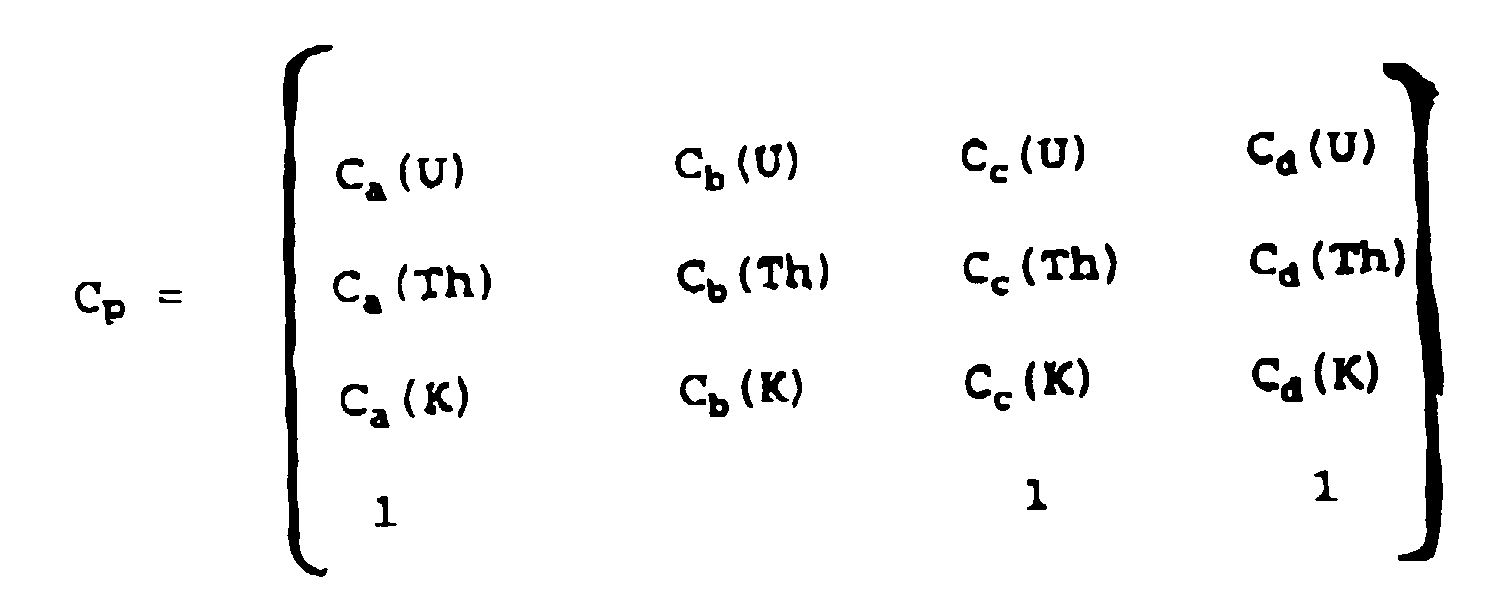
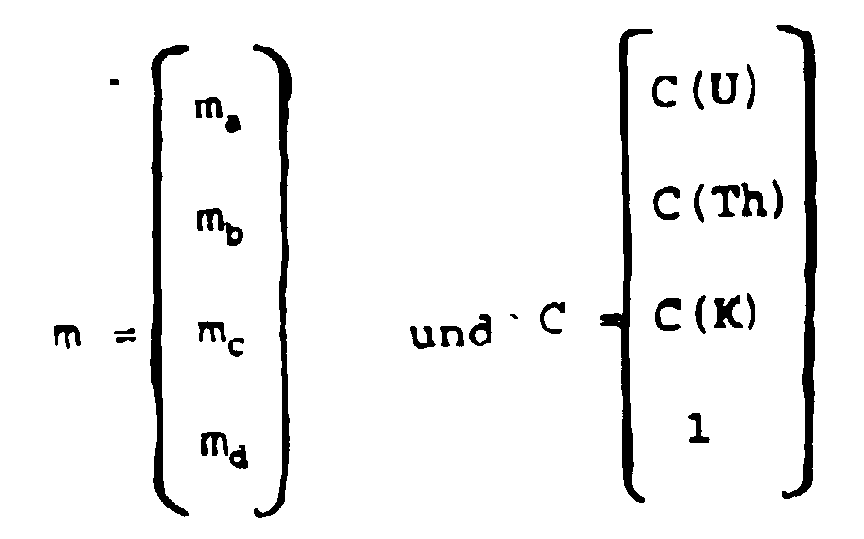
und wobei jede Mineralgruppe a, b, c oder d durch Ihre drei bekannten Konzentrationen Cj(U), Cj(Th) und Cj(K) gekennzeichnet ist, wobei = a, b, c oder d ist.
wobei
und wobei jede Mineralgruppe a, b, c oder d durch Ihre drei bekannten Konzentrationen Cj(U), Cj(Th) und Cj(K) gekennzeichnet ist, wobei = a, b, c oder d ist.
4. System nach Anspruch 1, dadurch gekennzeichnet, dass die Detektoreinheit einen Szintlllatlonsdetektor
(2) und einen Photomultiplier (6) aufweist, der die von dem Szintillationsdetektor
(2) gelieferten Lichtimpulse in einen elektrischen Impuls mit einer Amplitude, die
ein Maß für die Energie der von dem Szintillationsdetektor (2) empfangenen Strahlung
Ist, umwandelt.
5. System nach Anspruch 4, dadurch gekennzeichnet, dass die Detektoreinheit ferner einen
Impulshöhenanalysator (10) zum Erhalten der elektrischen Signale aufweist.
6. System nach Anspruch 1, dadurch gekennzeichnet, dass die Detektoreinheit zum Erhalten
der elektrischen Signale einen Halbleiterkristall (2), an den eine Vorspannung angelegt
wird, und eine Einrichtung zum Detektieren einer Schwankung In der Vorspannung aufweist.
7. System nach einem der vorhergehenden Ansprüche, dadurch gekennzeichnet, dass die erste
Computereinheit (26) die Konzentrationen anhand des kompletten bestimmten Spektrums
bestimmt.
8. System nach einem der vorhergehenden Ansprüche, dadurch gekennzeichnet, dass die erste
Computereinheit (26) die Konzentrationen anhand vorbestimmter Energlebereiche des
Spektrums bestimmt, welche den Spektren einzelner Radionuklide, deren Konzentration
bestimmt wird, entsprechen.
9. System nach einem der vorhergehenden Ansprüche, dadurch gekennzeichnet, dass die erste
Computereinheit (26) einen Speicher (28) aufweist, in dem Energiespektren von von
den Radionukliden ausgesandter Strahlung gespeichert sind.
10. System nach Anspruch 9, dadurch gekennzeichnet, dass die Im Speicher (28) gespeicherten
Spektren in dem vorbestimmten ersten Algorithmus verwendet werden.
11. System nach Anspruch 9 oder 10, dadurch gekennzeichnet, dass die an sich bekannten
Daten von Mineralien und die entsprechenden Radionuklidkonzentrationen in diesen Mineralien
im Speicher (28) der ersten Computereinheit (26) gespeichert sind.
12. System nach Anspruch 11, dadurch gekennzeichnet, dass in dem zweiten Algorithmus die
In dem Speicher (28) gespeicherten Informationen über die Mineralien verwendet werden.
13. System nach einem der vorhergehenden Ansprüche, dadurch gekennzeichnet, dass die Detektoreinheit
Sensoren (32,34) aufweist, mit denen Schall, Temperatur, Magnetismus und/oder andere
physikalische Faktoren in der Umgebung der zu detektierenden Radionuklide detektiert
und In ein elektrisches Sensorsignal umgewandelt werden können.
14. System nach Anspruch 13, dadurch gekennzeichnet, dass zur Durchführung von Korrekturen
bei der Bestimmung der Zusammensetzung das Sensorsignal über den A/D-Wandler (14)
an die erste Computereinheit (26) angelegt wird.
15. System nach Anspruch 14, dadurch gekennzeichnet, dass die Korrekturen von der Software
durchgeführt werden.
16. System nach einem der Ansprüche 13-15, dadurch gekennzeichnet, dass das Sensorsignal
zum Korrigieren und/oder Stabilisieren der Detektoreinheit an eine zweite Computereinheit
(38) angelegt wird.
17. System nach einem der vorhergehenden Ansprüche, dadurch gekennzeichnet, dass das System
ferner eine Sendeeinheit (18), an die Ausgangssignale des A/D-Wandlers (14) angelegt
werden, und eine Empfangseinheit (18), die empfangene Signale der ersten Computereinheit
(26) zuführt, aufweist.
18. System nach einem der Ansprüche 1-16, dadurch gekennzeichnet, dass die Ausgangssignale
des A/D-Wandlers (14) der ersten Computereinheit (26) über ein Kabel (44) zugeführt
werden.
19. System nach einem der vorhergehenden Ansprüche, dadurch gekennzeichnet, dass die Detektoreinheit
und der A/D-Wandler (14) In einem eine Sonde bildenden Gehäuse (42) untergebracht
sind.
20. System nach Anspruch 16 und 19, dadurch gekennzeichnet, dass die zweite Computereinheit
(38) ebenfalls In dem Gehäuse (42) untergebracht ist.
21. System nach Anspruch 4, dadurch gekennzeichnet, dass der Szintillationsdetektor einen
BGO-Kristall aufweist.
1. Système (1) permettant de déterminer la composition d'une matière contenant des minéraux
par détection du rayonnement gamme et, ou bien, du rayonnement X émis par les radionucléides
contenus dans lesdits minéraux, le système comprenant une unité détectrice (2) qui
fournit un signal électrique contenant des informations concernant l'intensité et
l'énergie du rayonnement émis et un système de traitement de signaux par lequel ces
signaux électriques sont traités plus complètement pour que soit déterminée la composition
desdits radionucléides, où le système de traitement de signaux (1) comprend un convertisseur
analogique-numérique, noté convertisseur A/D, (14) auquel lesdits signaux électriques
sont appliqués et une première unité d'ordinateur (26) qui traite plus complètement
les signaux fournis par le convertisseur A/D (14) dans le but de déterminer ladite
composition des radionucléides ; la première unité d'ordinateur (26) compose un spectre
d'énergie pour le rayonnement détecté à partir des signaux fournis par le convertisseur
A/D (14); et où la première unité d'ordinateur (26) détermine la concentration en
radionucléides sur la base du spectre en fonction d'un premier algorithme prédéterminé,
caractérisé en ce que la première unité d'ordinateur (26) détermine selon un deuxième
algorithme quelles quantités de groupes prédéterminés de minéraux sont présents dans
la matière sur la base des concentrations déterminées en les radionucléides de la
matière, où chaque groupe prédéterminé de minéraux consiste en un groupe de minéraux
dont les spectres sont très semblables ou en une seule sorte de minéral.
2. Système selon la revendication 1, caractérisé en ce que la première unité d'ordinateur
(26) détermine les concentrations C(U), C(Th) et C(K) des radionucléides respectifs
uranium, thorium et potassium en fonction du premier algorithme et en ce que la première
unité d'ordinateur (26) détermine les masses relatives mj (j = a, b, c ou d) de groupes de minéraux respectifs qui sont désignés par a, b,
c et d selon le deuxième algorithme.
3. Système selon la revendication 2, caractérisé en ce que, selon le deuxième algorithme,
mj (j = a, b, c ou d) est déterminé à partir de l'équation :
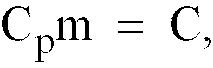
où
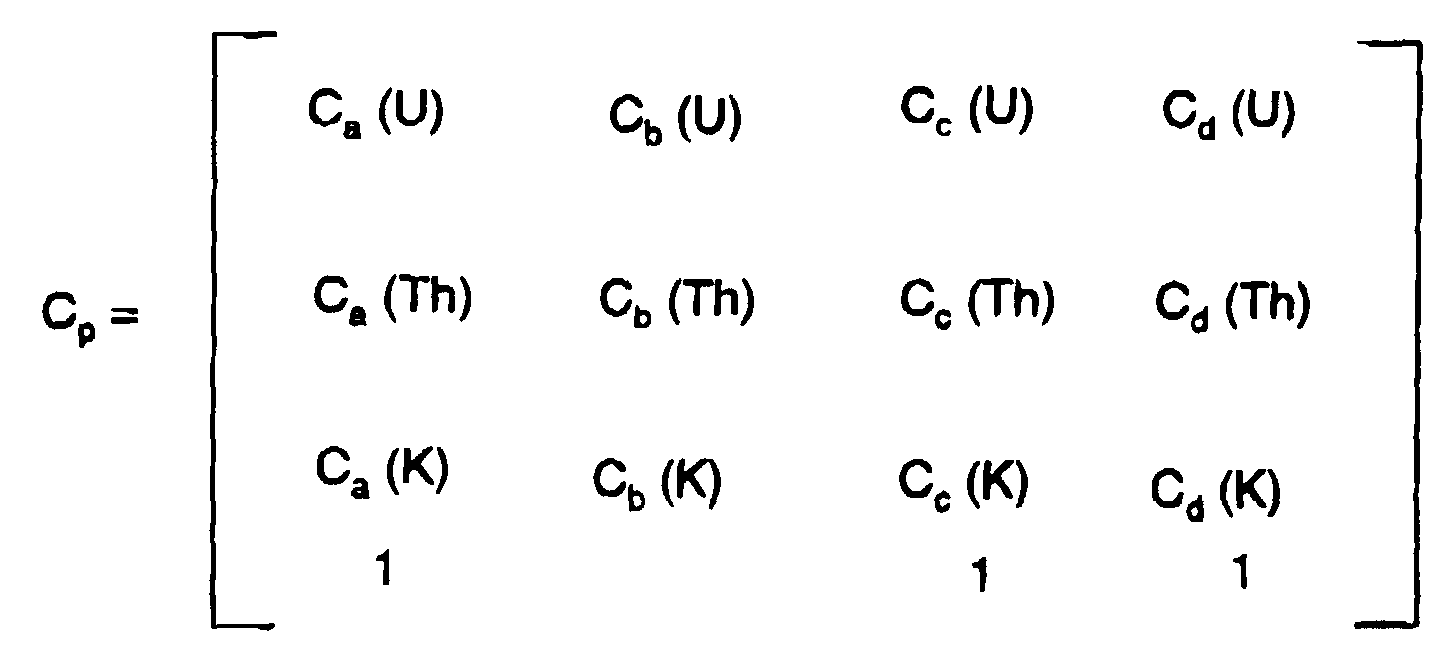
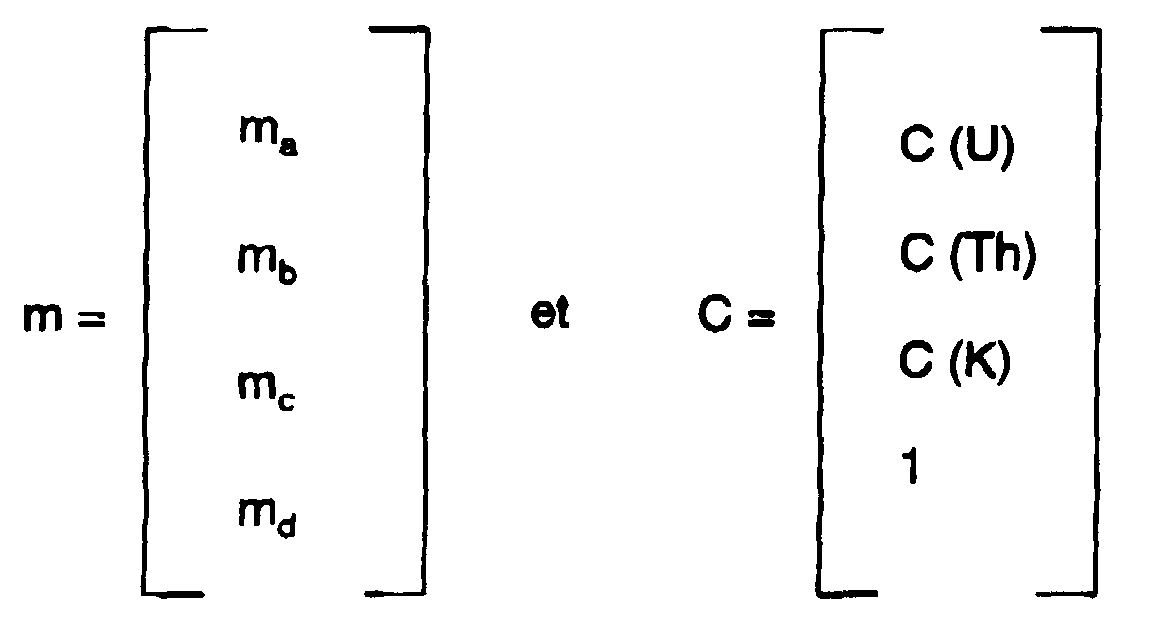
et où chaque groupe a, b, c ou d de minéraux est caractérisé par ses trois concentrations connues Cj (U), Cj (Th) et Cj (K), avec j = a, b, c ou d.
où
et où chaque groupe a, b, c ou d de minéraux est caractérisé par ses trois concentrations connues Cj (U), Cj (Th) et Cj (K), avec j = a, b, c ou d.
4. Système selon la revendication 1, caractérisé en ce que l'unité détectrice comprend
un détecteur de scintillations (2) et un photomultiplicateur (6) qui convertit les
impulsions de lumière fournies par le détecteur de scintillations (2) en une impulsion
électrique d'une amplitude qui est une mesure de l'énergie du rayonnement reçu par
le détecteur de scintillations (2).
5. Système selon la revendication 4, caractérisé en ce que l'unité détectrice comprend
en outre un analyseur de hauteur d'impulsion (10) servant à obtenir lesdits signaux
électriques.
6. Système selon la revendication 1, caractérisé en ce que l'unité détectrice comprend
un cristal semiconducteur (2) auquel une tension de polarisation est appliquée et
un moyen servant à détecter une variation de la tension de polarisation afin d'obtenir
lesdits signaux électriques.
7. Système selon l'une quelconque des revendications précédentes, caractérisé en ce que
la première unité d'ordinateur (26) détermine lesdites concentrations sur la base
du spectre déterminé complet.
8. Système selon l'une quelconque des revendications précédentes, caractérisé en ce que
la première unité d'ordinateur (26) détermine lesdites concentrations sur la base
d'intervalles d'énergie prédéterminés du spectre qui correspondent à des spectres
de radionucléides distincts dont la concentration est en train d'être déterminée.
9. Système selon l'une quelconque des revendications précédentes, caractérisé en ce que
la première unité d'ordinateur (26) comprend une mémoire (28) dans laquelle sont stockées
des spectres d'énergie du rayonnement émis par des radionucléides.
10. Système selon la revendication 9, caractérisé en ce que les spectres stockés dans
la mémoire (28) sont utilisés dans le premier algorithme prédéterminé.
11. Système selon la revendication 9 ou 10, caractérisé en ce que des données relatives
à des minéraux, qui sont connues en elles-mêmes, et les concentrations correspondantes
en radionucléides desdits minéraux sont stockées dans la mémoire (28) de la première
unité d'ordinateur (26).
12. Système selon la revendication 11, caractérisé en ce que le deuxième algorithme utilise
l'information se rapportant auxdits minéraux qui est stockée dans la mémoire (28).
13. Système selon l'une quelconque des revendications précédentes, caractérisé en ce que
l'unité détectrice comprend des capteurs (32, 34) par lesquels le son, la température,
le magnétisme et, ou bien, d'autres phénomènes physiques de l'environnement des radionucléides
à déterminer peuvent être détectés et convertis en un signal de capteur électrique.
14. Système selon la revendication 13, caractérisé en ce que le signal de capteur est
appliqué via le convertisseur A/D (14) à la première unité d'ordinateur (26) dans
le but d'effectuer des corrections dans la détermination desdites compositions.
15. Système selon la revendication 14, caractérisé en ce que lesdites corrections sont
effectuées via un logiciel.
16. Système selon l'une quelconque des revendications 13 à 15, caractérisé en ce que le
signal de capteur est appliqué à une deuxième unité d'ordinateur (38) servant à corriger
et, ou bien, stabiliser l'unité détectrice.
17. Système selon l'une quelconque des revendications précédentes, caractérisé en ce qu'il
comprend en outre une unité émettrice (18) à laquelle des signaux de sortie du convertisseur
A/D (14) sont appliqués et une unité réceptrice (18) qui fournit des signaux reçus
à la première unité d'ordinateur (26).
18. Système selon l'une quelconque des revendications 1 à 16, caractérisé en ce que les
signaux de sortie du convertisseur A/D (14) sont fournis à la première unité d'ordinateur
(26) via un câble (44).
19. Système selon l'une quelconque des revendications précédentes, caractérisé en ce que
l'unité détectrice et le convertisseur A/D (14) sont logés dans un boîtier formant
une sonde (42).
20. Système selon les revendications 16 et 19, caractérisé en ce que la deuxième unité
d'ordinateur (38) est également logée dans ledit boîtier (42).
21. Système selon la revendication 4, caractérisé en ce que le détecteur de scintillations
comprend un cristal dit BGO, c'est-à-dire à base d'oxyde de germanium et de bismuth.