| (19) |
 |
|
(11) |
EP 0 758 220 B1 |
| (12) |
EUROPEAN PATENT SPECIFICATION |
| (45) |
Mention of the grant of the patent: |
|
30.12.1998 Bulletin 1998/53 |
| (22) |
Date of filing: 10.04.1995 |
|
| (51) |
International Patent Classification (IPC)6: A61F 13/48 |
| (86) |
International application number: |
|
PCT/SE9500/383 |
| (87) |
International publication number: |
|
WO 9530/396 (16.11.1995 Gazette 1995/49) |
|
| (54) |
A METHOD FOR PRODUCING AN ABSORBENT STRUCTURE WHICH INCLUDES A LAYER OF SUPERABSORBENT
MATERIAL
METHODE ZUR HERSTELLUNG EINER ABSORBIERENDEN STRUKTUR WELCHE EINE SCHICHT SUPERABSORBIERENDES
MATERIAL ENTHÄLT
PROCEDE DE PRODUCTION D'UNE STRUCTURE ABSORBANTE COMPRENANT UNE COUCHE DE MATERIAU
SUPERABSORBANT
|
| (84) |
Designated Contracting States: |
|
AT BE CH DE DK ES FR GB GR IE IT LI NL PT SE |
| (30) |
Priority: |
04.05.1994 SE 9401541
|
| (43) |
Date of publication of application: |
|
19.02.1997 Bulletin 1997/08 |
| (73) |
Proprietor: SCA Hygiene Products AB |
|
405 03 Göteborg (SE) |
|
| (72) |
Inventor: |
|
- WIDLUND, Urban
S-435 43 Mölnlycke (SE)
|
| (74) |
Representative: Larsson, Karin et al |
|
Albihns Patentbyra Stockholm AB
P.O.Box 3137
103 62 Stockholm
103 62 Stockholm (SE) |
| (56) |
References cited: :
DK-B- 153 066
US-A- 4 537 590
|
US-A- 4 186 165
|
|
| |
|
|
|
|
| |
|
| Note: Within nine months from the publication of the mention of the grant of the European
patent, any person may give notice to the European Patent Office of opposition to
the European patent
granted. Notice of opposition shall be filed in a written reasoned statement. It shall
not be deemed to
have been filed until the opposition fee has been paid. (Art. 99(1) European Patent
Convention).
|
Background
[0001] The present invention relates to a method for producing an absorbent structure for
use in an absorbent article, such as a sanitary napkin, incontinence guard, diaper
and like articles.
[0002] Many different types of absorbent articles of this kind are known to the art. The
absorbent body of such articles is produced conventionally by dry-defibering cellulose
pulp contained, for instance, in reels, bales or sheets, and converting the cellulose
pulp in a fluff state to a pulp mat, sometimes while mixing so-called superabsorbents
in the pulp mat, these superabsorbents being polymers which are capable of absorbing
many times their own weight in liquid or body fluid.
[0003] EP 0,122,042 describes a method of manufacturing an absorbent structure which includes
superabsorbent material. The cellulose pulp is first defibered to form cellulose fibres,
so-called fluff pulp, whereafter a mixture of these fibres and water-insoluble hydrogel
particles are air-laid to form a web from which the absorbent structure is formed
and subsequently compressed to a density of 0.15-1.0 g/cm
3.
[0004] The pulp body is compressed with the intention of reducing its bulk and also with
the intention of enhancing its liquid wicking properties. With the majority of sanitary
products a thin article is desired so that the article can be worn as discretely as
possible.
[0005] Superabsorbent material is normally used in the form of granules or small particles.
It may be found difficult to bind these small particles satisfactorily in the absorbent
structure, which is one problem associated with the use of superabsorbent material.
The method described, for instance, in EP 0,122,042 involves the risk of superabsorbent
material being spread in and around the manufacturing plant, and also involves the
risk of particles of superabsorbent material escaping from the finished pulp core
when packaging, transporting or using the core. When manufacturing products which
include superabsorbent material, the aforesaid problems become greater with thinner
products.
[0006] Superabsorbent particles often have sharp edges and are therefore at times able to
perforate the liquid-impermeable sheets of absorbent articles, unless preventative
measures are taken. It is also important to obtain intimate contact between fibres
and superabsorbent material, in order to achieve effective transference of liquid
between the two materials.
[0007] Furthermore, the absorbent body may include other ingredients that are intended,
for instance, to improve its ability to take-up or disperse liquid, or to increase
its coherency and its ability to resist deformation while in use.
[0008] A very large part of the production plant used by the manufacturers of the aforesaid
sanitary articles is comprised of defibrating equipment, pneumatic conveyor systems
and mat-forming equipment. This production plant is often followed by equipment for
compressing the finished pulp mat or the finished sanitary product.
[0009] It is known from US-A 3,017,304 that a surface sheet containing paper bonds and having
a higher density and greater strength than the original cellulose pulp mat can be
obtained, by spraying water onto a cellulose pulp mat and then compressing the mat.
Such a layer is sometimes called a "Burgeni layer". It is also known from US-A 4,186,165
to compress a cellulose pulp mat that contains superabsorbent material with the aid
of heated rolls and without adding water, and therewith obtain in the cellulose pulp
mat an inner layer which has a higher density and greater strength than in the original
pulp mat. The particles of superabsorbent material are bound to the structure in this
layer, and the layer can also be obtained at a desired level in the structure by varying
the temperature difference between the rolls. However, when practicing this method,
the particles of superabsorbent material that are present in remaining parts of the
pulp mat remain only loosely bound in the structure. Neither is it possible with this
method to obtain a structure in which only one layer contains superabsorbent material
and where this layer is surrounded by one or more layers which are free from such
material, which is desired in some product applications.
Summary of the Invention
[0010] An object of the present invention is to provide a thin absorbent structure which
includes a layer which contains bound superabsorbent material and which can be included
in an absorbent article of the kind defined in the introduction. The absorbent structure
shall exhibit very good absorption properties and it shall be possible to produce
the structure without spreading superabsorbent material around the manufacturing plant
during the production process, or without the superabsorbent material escaping from
the finished absorbent article when packaging, transporting or using the article.
[0011] This object is achieved by means of the present invention, in that the absorbent
structure is produced by placing a layer that contains essentially superabsorbent
material between two layers of defibered and moistened cellulose pulp or tissue, and
then calendaring the composite structure between one or more heated pairs of rolls,
wherein the moisture in the immediate proximity of the heated rolls is vapourized
by the heat emitted therefrom and then condensed in the colder layer of superabsorbent
material located further down in the material, and wherein said layer is self-binding
and able to form a stable layer; and in that said layer is bound to the surrounding
cellulose pulp layers or tissue layers.
Brief Description of the Drawing
[0012]
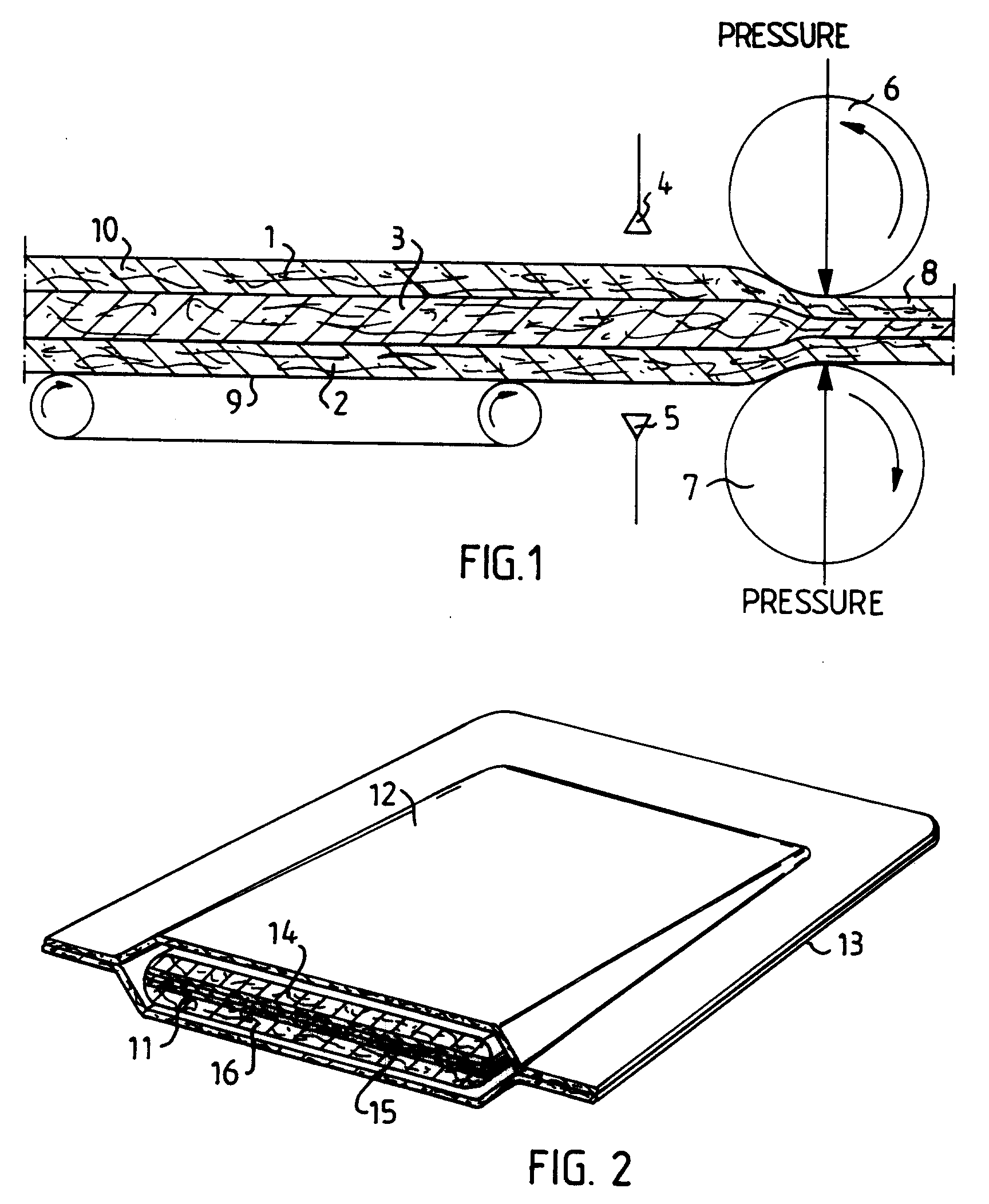
Figure 1 illustrates schematically equipment for manufacturing an absorbent structure
in accordance with the inventive method; and
Figure 2 illustrates schematically an exemplifying embodiment of an absorbent article
produced in accordance with the invention.
Description of the Invention
[0013] The object of the present invention is to provide an absorbent structure which includes
superabsorbent material and which can be included in an absorbent article, such as
a sanitary napkin, panty guard, incontinence guard, diaper and like articles. The
liquids concerned are primarily urine and blood. The absorbent structure shall exhibit
very good absorption properties, both with regard to its ability to quickly take-up
liquid and its ability to disperse the liquid throughout the material. Certain layers
of the absorbent structure will preferably contain no superabsorbent material, and
it shall be possible to produce a very thin structure. It shall also be possible to
produce the structure without spreading superabsorbent material in and around the
manufacturing machine during the manufacturing process and without articles of superabsorbent
material escaping from the finished pulp core or from the absorbent article when packaging,
transporting or using the article.
[0014] This object has been achieved in accordance with the invention by producing the absorbent
structure in accordance with a method in which a layer that contains essentially superabsorbent
material is placed between two layers of defibered and moistened cellulose pulp or
moistened tissue, and then calendaring the composite structure by compressing the
structure between one or more heated pairs of rolls. The moisture in the immediate
proximity of the heated rolls is vapourized by the heat emitted therefrom and is then
condensed in the colder layer of superabsorbent material located deeper in the material.
This layer is herewith bound in its self and formed into a stable layer, and the layer
is bound to the surrounding cellulose pulp layers or tissue layers. The cellulose
pulp or the tissue used may be moist from the outset or may be moistened at an early
stage of the manufacturing process, although the outer surfaces of the cellulose pulp
or the tissue may advantageously be sprayed with moisture immediately prior to calendaring
the pulp, which simplifies the manufacturing process while still enabling moisture
to be transported in- to the layer of superabsorbent material in the compression and
heating stage. When an upper or lower layer is constituted of cellulose pulp, the
moisture content of this layer shall be 10-40 %, preferably 15-30 % and more preferably
20-25 %, calculated on the dry weight of the cellulose pulp. When an upper or lower
layer is constituted of tissue, the moisture content of this layer shall be 20-70%,
preferably 40-60% and more preferably 45-55%, calculated on the dry weight of the
tissue layer.
[0015] The properties of the different layers in the structure can be controlled to suit
different product applications, by using as the starting materials for the absorbent
structure, two separate fluff pulp layers or tissue layers between which the layer
of superabsorbent material is placed. One or both of the fluff pulp layers may, for
instance, be free from superabsorbent material. The various fluff pulp layers may
be comprised of different cellulose pulps or may be the same type of cellulose pulp,
for instance fibres of chemithermomechanically produced pulp (CTMP) or a corresponding
product produced from sulphite or sulphate pulp, so-called chemical cellulose pulp.
Cellulose fibres that have been stiffened chemically or in some other way may also
be used in one or in both layers. When fibres of chemithermomechanically produced
pulp are used, these fibres may be flash-dried fibres for instance.
Description of Exemplifying Embodiments
[0016] Figure 1 schematically illustrates equipment for manufacturing an absorbent structure
in accordance with the invention. There is formed on a wire 9 a web 10 that has a
surface weight of 100-1,000 gm/m
2 and a density of 0.05-0.2 g/cm
3. The web comprises an upper layer in the form of an upper pulp web 1 having a surface
weight of 100-1,000 g/m
2 and a density of 0.05-0.2 g/cm
3, and a lower pulp web 2 having a surface weight of 50-1,000 g/m
2 and a density of 0.05-0.2 g/cm
3, and a layer of essentially superabsorbent material 3 lying between said upper and
lower layers and having a surface weight of 50-500 g/m
2 and a density of 0.4-0.7 g/cm
3. Water is sprayed onto the web 10 with the aid of spray nozzles 4 and 5, to obtain
a moisture content of 15-40 percent, calculated on the total weight of the web in
a dry state. The web 10 is compressed to a density of 0.1-0.5 g/cm
3 with the aid of the heated rolls 6 and 7, causing the superabsorbent layer 3 to bind
to the two layers 1 and 2. The rolls 6 and 7 have a line pressure of 100-200 kg/cm
and a temperature of 120-250°C. The compressed pulp mat 8 has a thickness of 1-4 mm.
[0017] Figure 2 illustrates a diaper manufactured by the method according to one embodiment
of the invention. The diaper typically comprises an absorbent body 11 enclosed between
a liquid-permeable top sheet 12, which is suitably comprised of a soft non-woven material,
a perforated plastic film or the like, and which lies proximal to the wearer in use,
and a liquid-impermeable bottom or backing sheet 13. The sheets 12 and 13 have parts
which extend beyond the absorbent body 11 and are joined together at these parts.
The bottom sheet 13 is comprised of a suitable plastic material, for instance polyethylene.
It will be understood that the top and the bottom sheets may be comprised of other
known materials, within the scope of the invention. The absorbent body 11 may be manufactured
totally of the inventive material, or with a combination of inventive material and
other material.
[0018] If the absorbent structure is manufactured totally from an inventive material, it
may have the following construction comprising the various layers of different properties
obtained in accordance with the invention. The absorbent structure will then have
an upper liquid or fluid entry layer 14, an intermediate layer 15 and a bottom layer
16.
[0019] The purpose of the entry layer 14 is to take-up and disperse a given quantity of
liquid quickly. The liquid shall be held loosely in the fibre structure and drained
rapidly therefrom. The entry layer 14 is preferably comprised of an upper layer of
inventive material and is composed of relatively stiff or rigid fibres which provide
a relatively open fibre structure, even after compression and wetting. For instance,
the entry layer 14 may be comprised of chemically stiffened cellulose fibres and will
preferably contain less than 10 percent superabsorbent material, calculated on the
weight of the structure in a dry state.
[0020] The purpose of the intermediate layer 15 is to bind absorbed liquid in the interior
of the absorbent structure, so as to prevent liquid returning and wetting the wearer's
skin. The intermediate layer 15 contains a high percentage of superabsorbent material,
a suitable percentage in this respect being 60-90 percent by weight calculated on
the weight of the structure in a dry state.
[0021] The purpose of the bottom layer 16 is to disperse the liquid that penetrates through
the intermediate layer 15 to parts of the absorbent body 1 that have not yet been
utilized. Another purpose of the bottom layer 16 is to protect the liquid-impermeable
bottom sheet 13 against perforation by particles of superabsorbent material. The bottom
layer 16 is preferably comprised of the bottom layer of a material that has been constructed
in accordance with the invention, and may be comprised of chemical fluff pulp and
contain 5-20 percent superabsorbent material calculated on the weight of the structure
in a dry state.
[0022] The various layers may have different shapes and sizes. The absorbent structure is
normally combined with some type of elastication, among other things in the crotch
region, so as to improve the fit and the function of the product.
[0023] It will be understood that the invention is not restricted to the illustrated exemplifying
embodiment thereof and that other embodiments are conceivable within the scope of
the following Claims.
1. A method for producing an absorbent structure in an absorbent article such as a diaper,
sanitary napkin, panty guard, incontinence guard and like article, characterized in that the absorbent structure is produced by laying an intermediate layer (10)
containing essentially superabsorbent material between an upper absorbing layer (1)
and a bottom absorbing layer (2) of defibered cellulose pulp moisturized to at least
10 %, or tissue moisturized to at least 20 %, calculated on the weight of the cellulose
pulp or the tissue in a dry state, and thereafter compressing the composite structure
(8) between one or more heated pairs of rolls (6,7), wherewith the moisture in the
immediate proximity of the heated rolls (6,7) is vapourized by the heat and condensed
in the colder intermediate layer (10) of superabsorbent material located further down
in the material, and wherein this intermediate layer (10) is bound in itself to form
a stable layer and also binds to the surrounding cellulose pulp layers (1,2) or tissue
layers (1,2).
2. A method for producing an absorbent structure according to Claim 1, characterized in that at least one upper or one bottom layer (1,2) is constituted of defibered
cellulose pulp, and by moisturizing this defibered cellulose pulp to a moisture content
of 10-40 %, preferably 15-30 % and more preferably 20-25 %, calculated on the weight
of the cellulose pulp or the tissue in a dry state.
3. A method for producing an absorbent structure according to Claim 1, characterized in that at least one upper or one bottom layer (1,2) is constituted of tissue, and
by moisturizing this tissue to a moisture content of 20-70 %, preferably 40-60 % and
more preferably 45-55 %, calculated on the weight of the cellulose pulp or the tissue
in a dry state.
4. A method for producing an absorbent structure according to any one of Claims 1 - 3,
characterized in that the intermediate layer (10) that contains superabsorbent material originally
contains at least 60 percent by weight, preferably at least 80 percent by weight and
more preferably at least 90 percent by weight superabsorbent material, calculated
on the weight of the cellulose pulp or the tissue in a dry state.
5. An absorbent structure (11), characterized in that the structure has been produced in accordance with the method according to
any one of Claims 1-4, the density of the intermediate layer (15) that contains superabsorbent
material is 0.2-1.0 g/cm3, preferably 0.3-0.7 g/cm3, the uppermost absorbing layer (14) has a density of 0.05-0.4 g/cm3, preferably 0.1-0.3 g/cm3 and more preferably 0.15-0.25 g/cm3, and in that the bottom absorbing layer (16) has a density between 0.1-0.5 g/cm3, preferably 0.15-0.4 g/cm3 and more preferably 0.2-0.3 g/cm3.
6. An absorbent structure (11) according to Claim 5, characterized in that the surface weight is 50-1,500 g/m2, preferably 100-1,000 g/m2 and more preferably 200-600 g/m2.
7. An absorbent structure (11) according to any one of Claims 5-6, characterized in that the cellulose fibres in the upper absorbing layer (14) and/or the bottom
absorbing layer are com-prised essentially of fibres of chemithermomechanically produced
pulp.
8. An absorbent structure (11) according to Claim 7, characterized in that the chemithermomechanical pulp fibres have a curl value of 0.20-0.40.
9. An absorbent structure (11) according to Claim 7 or 8, characterized in that the cellulose fibres are comprised essentially of flash-dried cellulose fibres.
10. An absorbent structure (11) according to any one of Claims 5-6, characterized in that the cellulose fibres in the upper absorbing layer (14) and/or the bottom
absorbing layer (16) are comprised essentially of fibres of chemically produced pulp.
11. An absorbent structure (11) according to any one of the preceding Claims, characterized in that at least some of the fibres are stiffened cellulose fibres.
12. An absorbent structure (11) according to any one of the preceding Claims, characterized in that the percentage of superabsorbent material in the intermediate layer (15)
is at least 60 percent by weight, preferably at least 80 percent by weight and more
preferably at least 90 percent by weight, calculated on the total weight of the structure
in a dry state.
13. An absorbent structure (11) according to any one of the preceding Claims, characterized in that the percentage of superabsorbent material in the upper absorbing layer (14)
is lower than 10 percent by weight, calculated on the total weight of the structure
in a dry state.
14. An absorbent structure (11) according to any one of the preceding Claims, characterized in that the percentage of superabsorbent material in the bottom absorbing layer (16)
is at most 20 percent by weight, preferably at most 10 percent by weight, calculated
on the total weight of the structure in a dry state.
15. An absorbent structure (11) according to any one of the preceding Claims, characterized in that the finished structure has a moisture content of 3-20 percent by weight,
preferably 4-18 percent by weight and more preferably 8-12 percent by weight, calculated
on the total weight of the structure.
16. An absorbent article, such as a diaper, sanitary napkin, panty guard, incontinence
guard and like article comprising a liquid-permeable top sheet (12), a generally liquid-impermeable
bottom sheet or backing sheet (13) and an absorbent body placed therebetween, characterized in that the absorbent body includes an absorbent structure (11) according to anyone
of Claims 5-15.
1. Verfahren zum Herstellen einer absorbierenden Struktur in einem absorbierenden Artikel,
wie beispielsweise eine Windel, eine Hygienebinde, ein Höschenschutz, ein Inkontinenzschutz
und ähnliches, dadurch gekennzeichnet, daß die absorbierende Struktur hergestellt wird durch Einlegen einer im wesentlichen
superabsorbierendes Material enthaltenden Zwischenschicht (10) zwischen eine obere
Absorptionsschicht (1) und eine untere Absorptionsschicht (2) aus zumindest 10%ig
angefeuchtetem, zerfasertem Zellstoff oder aus zumindest 20 %ig angefeuchtetem Tissue,
bezogen auf das Trockengewicht des Zellstoffs oder des Tissues, und hiernach Zusammendrücken
der Verbundstruktur (8) zwischen einem oder mehreren beheizten Rollenpaaren (6, 7),
womit die Feuchtigkeit in der unmittelbaren Nähe der beheizten Rollen (6, 7) durch
die Wärme verdampft wird und in der im Material weiter unten liegenden kälteren Zwischenschicht
(10) aus superabsorbierendem Material kondensiert, und wobei diese Zwischenschicht
(10) in sich selbst, eine stabile Schicht bildend und auch mit den umgebenden Zellstoff-
(1, 2) oder Tissueschichten (1, 2) bindet.
2. Verfahren zum Herstellen einer absorbierenden Struktur nach Anspruch 1, dadurch gekennzeichnet, daß zumindest die obere oder untere Schicht (1, 2) aus zerfasertem Zellstoff besteht,
und gekennzeichnet durch Anfeuchten dieses zerfaserten Zellstoffs auf einen Feuchtigkeitsgehalt
von 10-40 %, vorzugsweise 15-30 % und insbesondere 20-25 %, bezogen auf das Trockengewicht
des Zellstoffs.
3. Verfahren zum Herstellen einer absorbierenden Struktur nach Anspruch 1, dadurch gekennzeichnet, daß zumindest eine obere oder untere Schicht (1, 2) aus Tissue besteht und gekennzeichnet
durch Anfeuchten dieses Tissues auf einen Feuchtigkeitsgehalt von 20-70 %, vorzugsweise
40-60 % und insbesondere 45-55 %, bezogen auf das Trockengewicht des Tissues.
4. Verfahren zum Herstellen einer absorbierenden Struktur nach einem der Ansprüche 1-3,
dadurch gekennzeichnet, daß die superabsorbierendes Material enthaltende Zwischenschicht (10) ursprünglich zumindest
60 Gew.%, vorzugsweise zumindest 80 Gew.% und insbesondere zumindest 90 Gew.% superabsorbierendes
Material enthält, bezogen auf das Trockengewicht des Zellstoffs oder des Tissues.
5. Absorbierende Struktur (11), dadurch gekennzeichnet, daß die Struktur gemäß dem Verfahren nach einem der Ansprüche 1-4 hergestellt wurde,
die Dichte der superabsorbierendes Material enthaltenden Zwischenschicht (15) 0,2-1,0
g/cm3, vorzugsweise 0,3-0,7 g/cm3, ist, die oberste Absorptionsschicht (14) eine Dichte von 0,05-0,4 g/cm3, vorzugsweise 0,1-0,3 g/cm3 und insbesondere 0,15-0,25 g/cm3 hat, und daß die untere Absorptionsschicht (16) eine Dichte zwischen 0,1-0,5 g/cm3, vorzugsweise 0,15-0,4 g/cm3 und insbesondere 0,2-0,3 g/cm3 hat.
6. Absorbierende Struktur (11) nach Anspruch 5, dadurch gekennzeichnet, daß das Flächengewicht 50-1500 g/m2, vorzugsweise 100-1000 g/m2 und insbesondere 200-600 g/cm2 ist.
7. Absorbierende Struktur (11) nach Anspruch 5 oder 6, dadurch gekennzeichnet, daß die Zellstofffasern in der oberen Absorptionsschicht (14) und/oder der unteren Absorptionsschicht
im wesentlichen aus chemithermomechanisch hergestelltem Zellstoff bestehen.
8. Absorbierende Struktur (11) nach Anspruch 7, dadurch gekennzeichnet, daß die chemithermomechanisch hergestellten Zellstofffasern einen Curl-Wert (curl-value)
von 0,20-0,40 haben.
9. Absorbierende Struktur (11) nach Anspruch 7 oder 8, dadurch gekennzeichnet, daß die Zellstofffasern im wesentlichen aus schnellgetrockneten Zellstofffasern bestehen.
10. Absorbierende Struktur (11) nach Anspruch 5 oder 6, dadurch gekennzeichnet, daß die Zellstofffasern in der oberen Absorptionsschicht (14) und/oder der unteren Absorptionsschicht
(16) im wesentlichen aus Fasern aus chemisch hergestelltem Zellstoff bestehen.
11. Absorbierende Struktur (11) nach einem der vorhergehenden Ansprüche, dadurch gekennzeichnet, daß zumindest einige der Fasern versteifte Zellstofffasern sind.
12. Absorbierende Struktur (11) nach einem der vorhergehenden Ansprüche, dadurch gekennzeichnet, daß der Prozentanteil an superabsorbierendem Material in der Zwischenschicht (15) mindestens
60 Gew.%, vorzugsweise mindestens 80 Gew.% und insbesondere mindestens 90 Gew.% beträgt,
bezogen auf das Gesamtgewicht der Struktur in trockenem Zustand.
13. Absorbierende Struktur (11) nach einem der vorhergehenden Ansprüche, dadurch gekennzeichnet, daß der Prozentanteil an superabsorbierendem Material in der oberen Absorptionsschicht
(14) niedriger als 10 Gew.% ist, bezogen auf das Gesamtgewicht der Struktur in trockenem
Zustand.
14. Absorbierende Struktur (11) nach einem der vorhergehenden Ansprüche, dadurch gekennzeichnet, daß der Prozentanteil an superabsorbierendem Material in der unteren Absorptiosschicht
(16) höchstens 20 Gew.%, vorzugsweise höchstens 10 Gew.% beträgt, bezogen auf das
Gesamtgewicht der Struktur in trockenem Zustand.
15. Absorbierende Struktur (11) nach einem der vorhergehenden Ansprüche, dadurch gekennzeichnet, daß die fertige Struktur einen Feuchtigkeitsgehalt von 3-20 Gew.%, vorzugsweise 4-18
Gew.% und insbesondere 8-12 Gew.% hat, bezogen auf das Gesamtgewicht der Struktur.
16. Absorbierender Artikel, wie beispielsweise eine Windel, eine Hygienebinde, ein Höschenschutz,
ein Inkontinenzschutz und ähnliches, umfassend eine flüssigkeitsdurchlässige Oberlage
(12), eine im wesentlichen flüssigkeitsundurchlässige untere Lage oder rückseitige
Lage (13) und einen absorbierenden Körper, der hierzwischen eingelegt ist, dadurch gekennzeichnet, daß der absorbierende Körper eine absorbierende Struktur (11) nach einem der Ansprüche
5-15 enthält.
1. Procédé de fabrication d'une structure absorbante pour un article absorbant comme
une couche-culotte, une serviette hygiénique, un protège-slip, une protection anti-incontinence
ou autre article similaire, caractérisé en ce que l'on produit la structure absorbante
en déposant une couche intermédiaire (10), qui contient essentiellement un matériau
superabsorbant, entre une couche absorbante supérieure (1) et une couche absorbante
inférieure (2) en pâte de cellulose défibrée, humidifiée à au moins 10%, ou en tissu
papier humidifié à au moins 20%, valeurs rapportées au poids de la pâte de cellulose
ou du tissu papier à l'état sec, et en comprimant ensuite la structure composite (8)
entre une ou plusieurs paires de rouleaux chauffés (6, 7), de sorte que l'humidité
se trouvant au voisinage immédiat des rouleaux chauffés (6, 7) est vaporisée par la
chaleur et se condense dans la couche intermédiaire plus froide (10) de matériau superabsorbant,
située plus en profondeur dans le matériau, et dans lequel cette couche intermédiaire
(10) est liée à elle-même pour former une couche stable et est également liée aux
couches environnantes (1, 2) de pâte de cellulose ou de tissu papier.
2. Procédé de fabrication d'une structure absorbante selon la revendication 1, caractérisé
en ce que l'une au moins des couches supérieure et inférieure (1, 2) est constituée
de pâte de cellulose défibrée, et par une humidification de cette pâte de cellulose
défibrée jusqu'à une valeur comprise entre 10 et 40%, de préférence entre 15 et 30%
et mieux encore entre 20 et 25%, rapportés au poids de la pâte de cellulose ou du
tissu papier à l'état sec.
3. Procédé de fabrication d'une structure absorbante selon la revendication 1, caractérisé
en ce que l'une au moins des couches supérieure et inférieure (1, 2) est constituée
de tissu papier, et par une humidification de ce tissu papier jusqu'à une valeur comprise
entre 20 et 70%, de préférence entre 40 et 60% et mieux encore entre 45 et 55%, rapportés
au poids de la pâte de cellulose ou du tissu papier à l'état sec.
4. Procédé de fabrication d'une structure absorbante selon l'une quelconque des revendications
1 à 3, caractérisé en ce que la couche intermédiaire (10) qui contient le matériau
superabsorbant contient au départ au moins 60% en poids, de préférence au moins 80%
en poids et mieux encore au moins 90% en poids, de matériau superabsorbant, rapportés
au poids de la pâte de cellulose ou du tissu papier à l'état sec.
5. Structure absorbante (11), caractérisée en ce qu'elle a été produite selon le procédé
de l'une quelconque des revendications 1 à 4, en ce que la masse volumique de la couche
intermédiaire (15) qui contient le matériau superabsorbant est comprise entre 0,2
et 1,0 g/cm3 et de préférence entre 0,3 et 0,7 g/cm3, en ce que la couche absorbante supérieure (14) a une masse volumique comprise entre
0,05 et 0,4 g/cm3, de préférence entre 0,1 et 0,3 g/cm3 et mieux encore entre 0,15 et 0,25 g/cm3, et en ce que la couche absorbante inférieure (16) a une masse volumique comprise
entre 0,1 et 0,5 g/cm3, de préférence entre 0,15 et 0,4 g/cm3 et mieux encore entre 0,2 et 0,3 g/cm3.
6. Structure absorbante (11) selon la revendication 5, caractérisée en ce que la masse
surfacique est de préférence comprise entre 50 et 1500 g/m2, de préférence entre 100 et 1000 g/m2 et mieux encore entre 200 et 600 g/m2.
7. Structure absorbante (11) selon l'une quelconque des revendications 5 et 6, caractérisée
en ce que les fibres de cellulose de la couche absorbante supérieure (14) et/ou de
la couche absorbante inférieure sont faites essentiellement de fibres de pâte produite
par voie chimio-thermo-mécanique.
8. Structure absorbante (11) selon la revendication 7, caractérisée en ce que les fibres
de pâte chimio-thermo-mécanique ont une valeur de frisure comprise entre 0,20 et 0,40.
9. Structure absorbante (11) selon la revendication 7 ou 8, caractérisée en ce que les
fibres de cellulose sont faites essentiellement de fibres de cellulose à séchage instantané.
10. Structure absorbante (11) selon l'une quelconque des revendications 5 et 6, caractérisée
en ce que les fibres de cellulose de la couche absorbante supérieure (14) et/ou de
la couche absorbante inférieure (16) sont faites essentiellement de fibres de pâte
produite chimiquement.
11. Structure absorbante (11) selon l'une quelconque des revendications précédentes, caractérisée
en ce que certaines au moins des fibres sont des fibres de cellulose rigidifiées.
12. Structure absorbante (11) selon l'une quelconque des revendications précédentes, caractérisée
en ce que la proportion de matériau superabsorbant dans la couche intermédiaire (15)
est d'au moins 60% en poids, de préférence d'au moins 80% en poids et mieux encore
d'au moins 90% en poids, rapportés au poids total de la structure à l'état sec.
13. Structure absorbante (11) selon l'une quelconque des revendications précédentes, caractérisée
en ce que la proportion de matériau superabsorbant dans la couche absorbante supérieure
(14) est inférieure à 10% en poids, rapportés au poids total de la structure à l'état
sec.
14. Structure absorbante (11) selon l'une quelconque des revendications précédentes, caractérisée
en ce que la proportion de matériau superabsorbant dans la couche absorbante inférieure
(16) est de 20% en poids au plus, et de préférence de 10% en poids au plus, rapportés
au poids total de la structure à l'état sec.
15. Structure absorbante (11) selon l'une quelconque des revendications précédentes, caractérisée
en ce que la structure terminée a une teneur en humidité comprise entre 3 et 20% en
poids, de préférence entre 4 et 18% en poids et mieux encore entre 8 et 12% en poids,
rapportés au poids total de la structure.
16. Article absorbant comme une couche-culotte, une serviette hygiénique, un protège-slip,
une protection anti-incontinence ou autre article similaire, comprenant une feuille
supérieure (12) perméable au liquide, une feuille inférieure ou feuille de support
(13) globalement imperméable au liquide, et un corps absorbant placé entre elles,
caractérisé en ce que le corps absorbant contient une structure absorbante (11) selon
l'une quelconque des revendications 5 à 15.